Vol. 24, No. 2 57~64 (2018)
https://doi.org/10.20909/kopast.2018.24.2.57
Shelf-life Extension of Fresh and Processed Meat Products by Various Packaging Applications
Keun Taik Lee*
Department of Food Science and Distribution, Gangneung-Wonju National University, Gangneung 25457, Korea
Abstract This article delves into the current status of various packaging technologies, which are currently being applied or are under development for the shelf-life extension and quality improvement of fresh and processed meat products. Tra- ditional packaging methods include vacuum packaging, modified atmosphere packaging, and air-permeable packaging.
Recently, innovative packaging methods have been introduced that utilize technologies such as barrier-films, active pack- aging, nanotechnology, microperforated films, far-infrared radiations, and plasma treatment. All of these packaging meth- ods have their own merits and drawbacks in terms of shelf-life and quality maintenance. A right choice of packaging system for fresh and processed meat products must be made in accordance with the conditions of the raw material, stor- age, and distribution in the market and household, and while considering the environmental sustainability and consumer’s expectations.
Keywords Packaging, Shelf-life, Fresh and processed meat products, Quality of meat
Introduction
It is estimated that about one-third of food is lost or wasted from the time of its agricultural production down to the stage of human consumption. In developed countries, the losses and wastes of fresh and processed meat products are most dom- inant at the end of the food supply chain (FSC), while in developing countries, they occur evenly throughout the FSC, accompanied by high losses at the livestock rearing stage because of diseases (e.g. pneumonia, digestive diseases, and parasite infections)1). Significant losses can occur at the stages of processing and consumption in the FSC, which can be red- uced or avoided by the application of appropriate packaging technologies2).
Fresh and processed meat products are susceptible to spoil- age and poisoning. Shelf-life extension can be achieved by suppressing the growth of microorganisms and enzyme activ- ity during storage after meat preparation. To achieve this goal, various intrinsic, extrinsic, and implicit preservation counter- measures should be adopted, such as chilling, heating, drying, salting, fermenting, addition of chemical preservatives, and packaging.
Apart from traditional packaging technologies, including air-permeable packaging (APP), modified atmosphere pack- aging (MAP), and vacuum packaging (VP), various inno- vative packaging technologies have been tested and partly applied in the field to extend the shelf-life and preserve the quality of fresh and processed meat products3). It would be valuable to review the status of traditional packaging tech- nologies, while considering their advantages and drawbacks, where the latter would be highlighted in order to be solved by innovative technologies in the future. The future packaging systems of fresh and processed meat products should be developed to meet the need for high convenience and quality of packaged products and to achieve better functional efficacy of these systems without damaging the environment and health safety.
1. The Significance of Packaging in the Global Value Chain
Agriculture is an important sector in the economy of the world’s developing countries, contributing nearly 15~40% of national GDP in 20174). In the case of the meat industry in developing countries, the marketing and processing sector has its challenges; as most producers are small and have mediocre mechanization, their products are often distributed without proper processing. Consequently, improved management and processing/packaging of raw meat materials after slaughtering would considerably reduce financial losses, and thus contrib- ute to enhancement of the quality of products.
*Corresponding Author : Keun Taik Lee
Department of Food Processing and Distribution, Gangneung- Wonju National University, Gangneung 25457, Korea
Tel : +82-33-640-2333, Fax : +82-33-647-4559 E-mail : [email protected]
Linkage effects refer to the degree to which certain factors can induce the demand of manufactured goods and influence the economic prospects of other related industries. Forward linkage promotes more advanced industries to flourish and function as a base on which other industries can be established.
Contrarily, backward linkage has a somewhat beneficial feed- back effect on agriculture itself, where linking factors, such as market expansion, act as stimuli to increase agricultural pro- duction5).
For animal rearing, backward linkage industries include feeds, equipment, breeding stocks, veterinary services, and construction. On the other hand, packaging industries, together with slaughter, processing, storage, and distribution industries, constitute forward linkage industries. In order to convert live- stock to fresh and processed meat products and bring them into distribution chains and supermarkets, they require to be packaged and labeled after undergoing processing procedures, such as slaughtering, deboning, dressing, grinding, cutting, heating, or smoking etc. Besides, the manufacturing date of product states, when the product was packaged. Therefore, packaging is a prerequisite for processed meat products to be converted into commercial commodities in the modern global value chain system.
2. Requirements of Packaging
Eilert6) reviewed the current status and major influences on the evolution of meat packaging and elucidated the three major demands in this sector in the 21st century: 1) the grow- ing demand for convenient products, 2) the demand for bio- based packaging materials, and 3) the demand for pre-pack- aged meat with longer shelf-life. However, the traditional role of meat packaging has been restricted to preservation and pro- tection of meat quality from chemical, physical, and biological deterioration till consumption. According to this concept, spoilage retardation, shelf-life extension, and quality preser- vation of packaged foods are a priority7). However, meat pack- aging in modern times should play a role not only in quality preservation, but also in an increase of commodity values and promotion of sales and information delivery8). Moreover, fac- tors, including convenience of use, eco-friendliness, logistics, high-functionality, and safety of packaging materials, are more emphasized than before.
Presently, various packaging films are available to satisfy consumer's particular needs for various applications. The sel- ection of an appropriate film for packaging of fresh and pro- cessed meat products would be an initial step in the storage of distributed products. Before selecting a packaging material and method, it is essential to understand their properties and the effect they might have on product quality and shelf-life. For instance, physical properties of storage film, including its thick- ness, tensile and impact strength, transparency, and perme- ability, are the important factors, which affect the stability and
quality of packaged fresh and processed meat products.
3. Packaging Options
The most common and typical formats for packaging and distribution of fresh meat currently applied in the markets include the APP, MAP, and VP systems. Among them, VP is primarily used for wholesale meat, while APP is the most popular packaging method for retail meat. For processed meat products, VP, including skin and shrink packaging, is the most prevalent packaging system. Moving on, MAP is also used for the purpose - albeit less frequently - where O2 is often substi- tuted by N2. These three different packaging systems are typ- ically characterized by the concentration and composition of gas inside of the package and the packaging materials used.
In case of APP system, wrapping films are typically made up of plasticized polyvinyl chloride (PVC). The trays are made of polystyrene paper (PSP), pulp mold, and rigid or foamed polyethylene (PE) or polypropylene (PP). The packages can also be produced, using trays made up of relatively thick gau- ges of PP or/and PE sheet that are hermetically sealed with a top film made of PP or/and high-density polyethylene (HDPE).
For the wrapping film, PVC films are still the most prev- alent in the retail meat markets. It might be because of their superior mechanical properties, such as sheet flatness and less wrinkling, and cheap price as compared to other alternative films, such as linear low-density polyethylene (LLDPE), poly- olefin (PO), or ethylene vinyl acetate (EVA) films, although these substitutes can also provide equivalent O2 and water vapor permeability just like the PVC film6). Commercial wrap- ping films often have O2 permeability higher than 15,000 cm3/ m2/d/atm. The average water vapor transmission rate (WVTR) of PVC and LLDPE wrapping films obtained from a Korean local market was reported to be 786 g/m2/d/ and 99 g/m2/d, respectively9). Wrapping films must possess an O2 perme- ability higher than 5,000 cm3/m2/d/atm to guarantee bright red oxymyoglobin color and to prevent browning of the surface of fresh meat10). However, the ingress of O2 through an air-per- meable film can promote the growth of aerobes and oxidative enzyme activity, which in turn, induces short shelf-life of meat products. The WVTR of such air-permeable films should lie in a range that enables them to maintain the required level of relative humidity (RH), balance the prevention of drying and accumulation of dewed moisture on the meat surface.
The packaging films used for VP systems should possess low gas permeability; therefore, they are usually multilayered, with a layer of polyamide (PA) as a gas barrier and that of PE as a heat sealer. Less frequently, polyethylene terephthalate (PET) or PVC are used as barrier layers, while PP is used as the sealing layer. Ethylene vinyl acetate (EVA) and ionomer films can be used for better sealability than PE films, even when the sealing layer is contaminated with food components, such as fat or powder. Ethylene vinylalcohol (EVOH) and
polyvinylidene chloride (PVDC) layers are also often incor- porated to enhance the gas barrier property. They are com- bined by extrusion, lamination, or coating to create the desired properties. Recently, composite films incorporated with inor- ganic fillers (clay, glass flakes, and nanoparticles) are becom- ing popular in the market of fresh and processed meat prod- ucts owing to their advantages of microwaveability, the ability to work as gas barrier in low gauges, and/or transparency11). Among the various inorganic fillers, silica oxide is most widely used to achieve low oxygen permeability, typically down to 1 cm3/m2/d/atm, along with superior transparency, microwave- ability, and eco-friendliness11,12).
The principal purpose of introducing vacuum inside the packaging is to shift the internal gas composition to that of O2- depletion, which makes the environment favorable for the growth of lactic acid bacteria, but suppresses the growth of aerobic and putrefactive microorganisms, such as Pseudomo- nas13,14). An advantage of applying vacuum in fresh meat pac- kaging would be a longer shelf-life and, additionally, impro- ved tenderness. However, a principal drawback of vacuum- packaged meat in the retail market is a purplish red color, which is not preferred by consumers, although it blooms after exposure to air. Recently, the retail market for vacuum-pack- aged fresh meat is increasing due to its extended shelf-life, especially for pork and poultry meat in which the deoxygena- ted myoglobin color is not as prominent as in beef.
Another problem with vacuum-packaged meat is increased purge loss during storage, which makes the meat visually unattractive and causes a loss of nutrients and color pigment.
Purge loss from meat is increased owing to cutting it in smaller portions, temperature fluctuations, and pressure on the prod- ucts15). It can be reduced by minimizing the surface area and by cutting the meat longitudinally rather than in transverse dir- ection16). Thus, careful handling and less damage to the mus- cle fiber and fascia during preparation of meat for packaging are required to lessen purge loss. The extent of purging is inc- reased with an increase in storage temperature. This increase is noticeable, when the temperature increases from 0 to 5oC, but it increases significantly, when the temperature rises from 5 to 10oC17). In this regard, in the last few decades, a variation of vacuum packaging, the skin pack, has gained popularity in the retail meat market by virtue of its smart shape, attractive- ness for display and POP (Point of Purchase), and also with its increasing market volume as case-ready packaging.
Considering the drawbacks of APP and VP systems, such as short shelf-life and purplish-red color, respectively, the MAP system could be a packaging technology that provides a com- promise between these disadvantages in the form of a bright red color and an intermediate shelf-life. In most MAPs of pro- cessed meat products, three major gases are used, either indi- vidually or in combination. Carbon dioxide is used to provide an antimicrobial effect, especially to suppress aerobic putre-
factive spoilage bacteria18). On the other hand, N2 is an inert gas, which is used in MAP as a filler gas, either to substitute other gases or to prevent the package from deformation19). The major role of O2 in MAP is to convert purplish red myo- globin to bright red oxymyoglobin. The use of CO at 1~5%
concentration in MAP was first introduced in 197620); it is known to be effective in inhibiting browning of meat by con- verting meat color to carboxymyoglobin, which is more stable against oxidation to metmyoglobin than reduced myoglo- bin20). Argon was recently recommended because of its better effectiveness in retarding enzymatic activities, microbial growth, and chemical spoilage as compared to N221).
Gas compositions used in MAP are different depending on the meat species. For instance, the common concentration mixture of gases for fresh beef is 60-80% O2 and 20-40%
CO222), and occasionally, an additional 10% N223). On the other hand, for cooked meats, the gas is composed of 70% N2 and 30% CO224). As compared to VP, MAP is less efficient bec- ause it needs more time to package the product as well as more investment in its operation. However, the application of MAP is expanding due to its value-added retail format, particularly, with regard to shelf-life, which satisfies the requirements of both the consumer and the retailer. Therefore, the MAP sys- tem might be recognized as a best way to find a compromise between the advantages and drawbacks of APP and VP for retail fresh meat. Currently, trays used for MAP are formed by thermoforming web film made of various sheets, such as PET/
PE (PP), PS/EVOH/PE, PS foam/EVOH/PE, PET/EVOH/PE, PP/EVOH/PP, PVC/PE (PP, EVA), and EPP (expanded poly- propylene)/EVOH/PE etc., with thickness of 300-800 µm.
Thermoforming of the tray preferentially requires a rigid poly- mer, such as PP, PA, PET, and PVC, which can be molded via heating to form a cavity of the desired size and shape of the product.
There are some drawbacks of the MAP system, which are as follows: 1) oxidation of lipid, protein, and cholesterol in the presence of high O2 concentrations, 2) premature browning on cooking, 3) discoloration of the bone marrow to a brown color due to oxidation, and 4) growth of psychrotrophic pathogens, such as L. monocytogenes, Aeromonas hydrophila, and Yersinia enterocolitica, especially the growth of C. botulinum and pot- ential toxin production by it in anaerobic conditions25-28).
In order to select the optimal packaging system for preserv- ation of meat quality, it is essential to understand the functions of packaging in terms of deterioration processes, hygienic condition of the product before packaging, and the storage temperature10). At present, many different kinds of commer- cial packaging materials and equipment have been developed over the last several decades, which further propelled the adv- ancement of packaging systems and the quality of packaged processed meat products. However, the key factor to consider, when selecting a packaging system for fresh meat, is how it
will meet the requirements of specific commercial applications of maintaining quality, while minimizing packaging costs10,29).
4. Packaging and Shelf-life of Products
The shelf-life of meat packaged in a plastic film is depen- dent upon the micro-climate established within the package30). Quality-related characteristics of meat products, such as growth of aerobes, fat oxidation, discoloration, and purge loss, are aff- ected by the packaging method (Table 1). Film composition, temperature, and RH affect O2 permeability of VP films31). The positive effect of reduced permeability on storage life of chilled meat was established by Newton and Rigg (1979)32). Various quality attributes, such as color, odor, flavor, and water holding and binding capacity, of meat deteriorate with extended storage time after animal carcasses are subjected to wholesale and then further to retail meat. Therefore, preserv- ative packaging for raw meat must fulfill the responsibilities of delaying physicochemical deterioration of the product as well as retarding the onset of bacterial spoilage. The principal factors that must be taken into consideration, when applying any packaging technology on raw retail meats, are the reten- tion of an attractive and fresh appearance, delay in microbial spoilage, and minimization of purge losses15).
Quality and shelf-life of fresh and processed meat products are affected by various intrinsic factors (food composition, components, structure, initial microbial load, pH, water activ- ity, redox-potential), processing factors (degree of heat treat- ment, level of salting, types and amounts of additives, smok- ing etc.), and extrinsic factors (storage temperature and RH, packaging methods, lighting, pressure etc.). Moreover, some implicit factors, such as growth conditions and rate of growth of microorganisms, are also involved.
The shelf-life of vacuum-packaged meat is preferentially influenced by the factors, including the storage temperature, the size of meat cut, initial levels of contaminating micro- organisms, and the O2 permeability of packaging materi- al13,14,33). Longer shelf-life of fresh meat can be achieved with a lower O2 permeability of packaging film, storage tempera- ture approaching freezing point of meat, i.e., around -1.5oC, and a lower initial bacterial load of raw meat before pack- aging14).
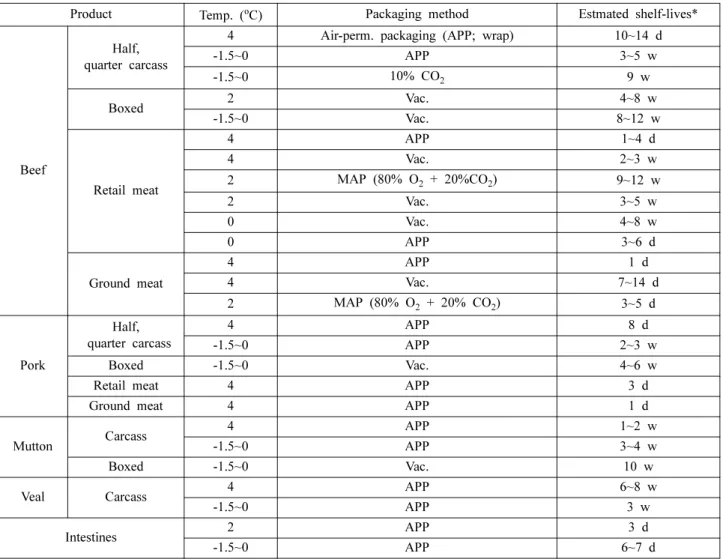
The average shelf-lives of various types of meat and meat products packaged by different methods are summarized in Tables 2-3. Lee and Yoon34) reported that boxed beef chucks imported from the US, which were vacuum-packaged in heat- contractile gas barrier films and kept at -1.5oC during ship- ment until inbounding custom clearance for a total of 37 days, could maintain a marketable quality for an additional 29 days at 0oC in the Korean market.
By virtue of modern packaging technologies, the shelf-life of chilled meats has been considerably extended. However, excessively extended preservation of meat is sometimes not preferred in local markets because it could cause an undesir- able soft texture and excessive exudate. The deterioration in quality of vacuum-packaged chilled meat during storage is attributed to some physicochemical changes, such as discolo- ration, sour odor, off-flavor, and increased purge loss35,36). Additionally, under evacuated state, growth of C. botulinum in the package poses a potential threat, when the storage tem- perature exceeds 3oC36,37). After evacuation for VP, 0.3-3% air may remain in the package38). In the VP, residual O2 is con- sumed to release CO2 as a result of active metabolism in mus- cle tissues and the growth of microorganisms15,39). The O2 proportion inside the vacuumed package can decrease to less than 1%, when CO2 level rises40). Seideman et al.41) reported that CO2 ratio increased to more than 61% or 78% for vac- uum-packaged pork and beef, respectively, during storage.
The blooming capability of meat decreases with extended storage. Discoloration and inferior blooming was reported in 1-day old beef after opening the vacuum pack39). Nevertheless, this transient discoloration is a possible problem only when the vacuum-packaged meat has to be displayed as a retail-ready product within a short time after packaging because, otherwise, it can be resolved within 2-4 days, if the amount of residual O2 inside the package is not excessive15). When the vacuum pack- aging film can not pose sufficient barrier to prevent further ingress of O2 (<30 cm3/m2/d/atm) or the vacuum applied is not sufficient to lower residual O2 concentration to the critical range, formation of metmyoglobin on the surface of vacuum- packaged meat is prone to occur. Furthermore, this phenome- non is also observed when the meat is exposed to air for too long before packaging as it allows excessive O2 to absorb in Table 1. Various quality parameters of meat products as affected by different packaging methods
Packaging method Quality parameter
Growth of aerobes Fat oxidation Discoloration Purge loss
No packaging +++ +++ +++ ++++
Air-permeable (Wrap) ++++ +++ +++ ++
MAP ++ +++ ++ ++
Vacuum + + + ++++
++++: Extremely high, +++: high, ++: moderate, +: low.
the meat and later be released into the package42). Therefore, it has been recommended that the earlier application of vac- uum packaging after preparation of cut meat is favorable to
prevent the meat surface from discoloration.
The shelf-life of processed meat products is largely depen- dent on various factors, including the heat treatment conditions, Table 2. Estimated shelf-lives of different processed meat products depending on packaging methods
Product Temp. (oC) Packaging method Estmated shelf-lives*
Beef
Half, quarter carcass
4 Air-perm. packaging (APP; wrap) 10~14 d
-1.5~0 APP 3~5 w
-1.5~0 10% CO2 9 w
Boxed 2 Vac. 4~8 w
-1.5~0 Vac. 8~12 w
Retail meat
4 APP 1~4 d
4 Vac. 2~3 w
2 MAP (80% O2 + 20%CO2) 9~12 w
2 Vac. 3~5 w
0 Vac. 4~8 w
0 APP 3~6 d
Ground meat
4 APP 1 d
4 Vac. 7~14 d
2 MAP (80% O2 + 20% CO2) 3~5 d
Pork
Half, quarter carcass
4 APP 8 d
-1.5~0 APP 2~3 w
Boxed -1.5~0 Vac. 4~6 w
Retail meat 4 APP 3 d
Ground meat 4 APP 1 d
Mutton Carcass 4 APP 1~2 w
-1.5~0 APP 3~4 w
Boxed -1.5~0 Vac. 10 w
Veal Carcass 4 APP 6~8 w
-1.5~0 APP 3 w
Intestines 2 APP 3 d
-1.5~0 APP 6~7 d
* Dependent on the initial bacterial load.
Table 3. Estimated shelf-lives of different processed meat products depending on packaging methods
Product Temp. (oC) Packaging method Estmated shelf-lives*
Boiled, smoked domestic sausages & hams
5 Normal vac. 5~6 w
5 Vac. with low gas permeable film 6~8 w
10 Normal vac. 3~4 w
Fermented sausages & hams RT None-vac. 1 m~1 y**
Dried products (e.g. jerkies) RT None-vac. 3~12 m
Vac. 1~2 y
Canned product RT TFS, Tin, Al can 2~3 y***
Retorted product in Al-pouch
Frozen PET/PA/CPP (F0= 0.1) 1 y***
Chilled PET/Al/PA/CPP (F0=1-3) 1 y***
RT PET/Al/PA/CPP (F0=8-10) 1.5~ 2 y***
* Dependent on the initial bacterial load, ** dependent on the fermentation time, *** dependent on the F0-value.
the addition of chemical additives (sodium nitrite, sodium sor- bate, antioxidants etc.), storage temperature, and O2 perme- ability of the film used. Generally, the shelf-lives of processed meat products treated under commercial pasteurization tem- perature conditions, i.e. ca. 70-80oC/30-120 min, are in a range between 3 and 6 weeks at chilling storage temperature. To achieve extended shelf-life beyond this range, more severe heat treatment, including post-pasteurization after packaging or retorting along with the use of gas barrier films, is essential.
For instance, retorted ready-to-eat chicken porridge packaged in a multilayer film containing an EVOH layer can be stored for at least 24 weeks at 25oC43).
The dominant microflora in MA packaged meat was reported to be lactic acid bacteria44,45) with a concomitant growth of B.
thermosphacta23). It has also been reported that the aerobic plate counts were higher than those for lactic acid bacteria in Spanish beef packaged with MAP (60% O2, 30% CO2, and 10% N2). In the presence of O2 in the MAP, the Gram-negative bacteria, such as Pseudomonas, Enterobacteriaceae, Acine- tobacter, and Moraxella, are more sensitive to CO2 than the Gram-positive bacteria such as lactic acid bacteria.
In an atmosphere of 20% CO2, the growth of aerobic bac- teria, including Pseudomonas, is effectively inhibited. How- ever, above this concentration, the inhibitory effect does not increase notably with an increase in the CO2 concentration46). In MAP, headspace to meat volume ratio is the most influenc- ing factor to dictate CO2 volume change in the package, fol- lowed by surface area and meat volume47). The higher the ini- tial CO2 concentration, the greater is the change in its concen- tration during storage47). The gas ratio of 80:20:0 for O2:CO2: N2 was found to be the most effective packaging combination for maintenance of the color of MA-packaged lamb and hog- get meat. Besides, the ratio of 2:1 for headspace to meat vol- ume was the most effective for a decrease in Pseudomonas growth and an increase in growth of lactic acid bacteria in both lamb and hogget meat48). High O2 concentration accel- erates the lipid oxidation rate to cause rancidity49). It was rep- orted that an atmosphere with high O2 causes protein oxidation, which leads to decreased palatability, such as reduced tender- ness and juiciness, flavor deterioration, and discoloration49,50). To avoid the negative effect of O2 in MAP, the use of 100%
CO2 or N2 packaging is proposed, especially for pork and poultry meats. When sealed, the packaging atmosphere should have a residual O2 concentration of no more than 0.1% - pref- erably no more than 0.05% - to prevent the irreversible dis- coloration of meat15). Longer shelf-life was observed with an increase in the CO2 proportion in the MA-packaged meat51). Other researchers found the optimum CO2 concentration in MA-packaged meat to be generally below 40%52,53). Gill15) reported that increasing the CO2 concentration above 20%
produced little additional inhibition.
Moving on, APP is the most prevalent packaging for dis-
tribution of retail meat. When APP system is applied with air- permeable wrap film and trays, O2 is abundant, and thus, the bright red color is preserved after packaging, which is attrac- tive to the consumer. However, this advantage is diminished with prolonged storage time, resulting in a short shelf-life. For instance, shelf-life is typically 3-4 days for beef and 2-3 days for pork at refrigeration temperatures. Furthermore, high O2 permeability of wrap film favors the growth of aerobic micro- organisms, such as Pseudomonas. Therefore, spoilage pheno- mena typical of the APP system are putrefactive odor, slime formation on the surface, and discoloration in the form of browning, etc. In households, left-over meat is usually kept in a refrigerator after either packing in a PE bag or placing in an air-tight PP container, oroccasionally, it is vacuum-packaged with a household vacuum-packaging machine. Quality changes of pork loins in terms of off-odor and discoloration were det- ectable earlier in the meat packed in PE bag as compared to those packaged with vacuum films or in PP container 54).
5. Innovative Packaging Technologies
Traditional packaging technologies have been successfully devised in the fresh and processed meat products sector, but these packaging technologies are continuously developed to improve equipment, packaging material, and methodology, in order to be commercialized in the meat science field. The pos- itive effects of various innovative packaging technologies that use barrier-films, active packaging, nanotechnology, microper- forated films, far-infrared (FIR) radiation, and plasma treat- ment for quality improvement and shelf-life extension of fresh and processed meat products have been verified11). The con- cepts of these technologies can be characterized by the way they regulate gas permeability or WVTR (passive packaging) and also by the way they incorporate bioactive ingredients into or onto the packaging materials (active packaging). Some inno- vative approaches have been developed by improving the con- trol of gas permeability or WVTR (microperforation of film, high gas-barrier film, and nanotechnology etc.), by the func- tional improvement in the packaging material itself (nano- technology, FIR radiations, plasma treatment, and irradiation), and by application of active packaging systems55).
The active packaging system can be classified in terms of the mode of application, which includes a direct incorporation of active agents into the packaging materials; an incorporation of active agents into a sachet, patch, or tablet; and the use of edible films and coatings with active agents11). However, up until now, not many active packaging systems, except the O2 scavenger and moisture absorber systems, have found exten- sive use in the meat industry. Presumably, this is owing to var- ious problems, such as cost, effectiveness, consumer accept- ance, or applicability in the production line etc. Nonetheless, active packaging system has significant potential to help the meat industry and consumers by establishing a new platform
for preservation and packaging of meat products56). These advances have contributed effectively to meet the consumer demands for better quality and longer shelf-life of meat prod- ucts.
Conclusion
Currently, diverse packaging materials and systems for fresh and processed meat products are available. The choice of app- ropriate packaging system should be based on the product’s characteristics and requirements for commercial applications;
the main aim is that quality and extended shelf-life are main- tained and packaging costs are minimized. The increment of costs induced by the application of innovative packaging sys- tems can be compensated for with quality improvement and the shelf-life extension of products, which will ultimately result in the reduction in waste loss and enhanced consumer satisfaction.
References
1. FAO. 2011. Global food losses and food waste. http://www.
fao.org/fileadmin/user_upload/suistainability/pdf/Global_Food_
Losses_and_Food_Waste.pdf. Accessed 1. Aug. 2017.
2. Lipinski, B., Hanson, C., Lomax, J., Kitinoja, L., Waite, R., and Searchinger, T. 2013. Reducingfood loss and waste. World Resources Institute working paper.
3. McMillin, K. W. 2017. Advancements in meat packaging.
Meat Sci. 132: 153-162.
4. OECD-FAO. 2016. OECD-FAO Agricultural outlook 2016- 2015. Part 1, Chapter 2. Agriculture in sub-saharan Africa:
Prospects and challenges for the next decade. pp. 59-95.
5. Granis, J., Hine, S., and Thilmary, D. 2001. Marketing prem- ium food products in emerging economies: The case of mac- edonian cheese. J. of International Food and Agribusiness Marketing 13: 59-76.
6. Eilert, S. J. 2005. New packaging technologies for the 21st century. Meat Sci. 71: 122-127.
7. Brody, A. L., Bugusu, B., Han, J. H., Koelsch, C., and Mc- Hugh, T. H. 2008. Innovative food packaging solutions. J. of Food Sci. 73: 107-116.
8. Han, J. H. 2005. New technologies in food packaging: Over- view. In: Innovations in food packaging. Elsevier Academic Press, Amsterdam, pp. 3-11.
9. Lee, K. T. and Yoon, C. S. 2001a. Investigation on various physical properties of vacuum and wrap packaging materi- als for chilled meat. Food Sci. Biotechnol. 10: 282-285.
10. Jeremiah, L. E. 2001. Packaging alternatives to deliver fresh meats using short- or long-term distribution. Food Res. 34:
749-772.
11. Lee, K. T. 2010. Quality and safety aspects of meat prod- ucts as affected by various physical manipulations of pack- aging materials. Meat Sci. 86: 138-150.
12. Lange, J. and Wyser, Y. 2003. Recent innovations in barrier technologies for plastic packaging. Packaging Technology and
Science 16: 146-158.
13. Labadie, J. 1999. Consequences of packaging on bacterial growth. Meat is an ecological niche. Meat Sci. 52: 299-305.
14. Lee, K. T. 1985. Einfluss von Verpackung und Lagerung auf frisches oder aufgetautes portioniertes Rindfleisch. Ph.D. The- sis, T.U. München Univ., Germany.
15. Gill, C. O. 1996. Extending the storage life of raw chilled meats. Meat Sci. 43: 99-109.
16. McMillin, K. W. 2008. Where is MAP going? A review and future potential of modified atmosphere packaging for meat.
Meat Sci. 80: 43-65.
17. O'Keefe, M. and Hood, D. E. 1980. Anoxic storage of fresh beef. 1: Nitrogen and carbon dioxide storage atmospheres.
Meat Sci. 5: 27-39.
18. Ooraikul, B. 2003. Modified atmosphere packaging (MAP).
CRC, New York.
19. Bell, R. G. and Bourke, B. J. 1996. Recent developments in packaging of meat and meat products. In: Proceedings of the international developments in process efficiency and quality in the meat industry. Dublin Castle, Ireland, pp. 99-119.
20. Wolfe, S. K., Brown, W. D., and Silliker, J. H. 1976. Trans- fresh shipping of meat. In: Proceedings of Meat Ind. Res.
Conf., Chicago, pp. 137-148.
21. Spencer, K. C. 2002. Method of preservation foods using noble gases. US patent number 6,342,261, American Air Liq- uide, assignee.
22. Hood, D. E. and Mead, G. C. 1993. Modified atmosphere storage of fresh meat and poultry. In: Principles and applica- tions of modified atmosphere packaging of foods. Parry, R.T.
(ed.), Blackie Academic & Professional, London, pp. 269- 295.
23. Lee, K. T., Lee, K. J., and Yoon, C. S. 1999. Quality changes of Hanwoo beef packaged in modified Atmosphere. Korean J. Food Sci. An. 19: 27-35.
24. Smiddy, M., Papkovsky, D., and Kerry, J. 2002. Evaluation of oxygen content in commercial modified atmosphere packs (MAP) of processed cooked meats. Food Research Interna- tional 35: 571-575.
25. Clausen, I., Jakobsen, M., Ertbjerg, P., and Madsen, N. 2008.
Modified atmosphere packaging affects lipid oxidation, myo- fibrillar fragmentation index and eating quality of beef. Pac- kag. Technol. Sci. 22: 85-96.
26. Farber, J. M. 1991. Microbiological aspects of modified- atmosphere packaging technology- A Riview. J. of Food Prot.
54: 58-70.
27. King, N. J. and Whyte, R. 2006. Does it look cooked? A review of factors that influence cooked meat color. J. of Food Sci. 71: 31-40.
28. Mancini, R. A. 2009. Meat color. In: Improving the sensory and nutritional quality of meat. Kerry, J. P. and Ledward, D.
(eds.), Woodhead Publishing, Cambridge, pp. 89-104.
29. Gill, C. O. 1992. Application of preservative packagings to chilled raw meats. Canadian Meat Science Association Sym- posium, 7: 1-8.
30. Lee, K. T. and Yoon, C. S. 2001b. Storage and quality char-
acteristics of vacuum-packaged fresh meat with oxygen bar- rier second-heat-seal film or shrink film. Korean J. Food Sci.
An. 21: 235-245.
31. Eustace, I. J. 1981. Some factors affecting oxygen transmis- sion rates of plastic films for vacuum packaging of meat. J.
Food Tech. 16: 73-80.
32. Newton, K. G. and Rigg, W. J. 1979. The effect of film per- meability on the storage life and microbiology of vacuum- packed meat. J. of Applied Bacteriology 47: 433-441.
33. Koch, A. G., Christensen, H., Sorensen, P. E., and Meinert, L.
2009. Requirement to shelf life of fresh meat and meat prod- ucts. In: Proceeding of 55th Int. Cong. Meat Sci. Technol., Copenhagen, PS8.01.
34. Lee, K. T. and Yoon, C. S. 2001c. Quality changes and shelf- life of imported vacuum-packaged beef chuck during storage at 0oC. Meat Sci. 59: 71-77.
35. Hotchkiss, J. H. 1995. Safety considerations in active packag- ing. In: Active food packaging. Rooney, M. L. (ed.), Blackie Academic & Professional, London, pp. 238−253.
36. Husband, P. M. 1982. The history of vacuum packaged meat.
Food Technology in Australia 34: 272-275.
37. Gill, A. O. and Gill, C. O. 2005. Preservative packaging for fresh meats, poultry, and fin fish. In: Innovations in food pac- kaging. Han, J. H. (ed.), Elsevier Academic Press, California, USA, pp. 204-226.
38. Sanjeev. K. and Ramesh, M. N. 2006. Low oxygen and inert gas processing of foods. Critical Reviews in Food Science and Nutrition 46: 423-451.
39. Lee, K. T. and Lee, K. J. 1998. Quality changes of vacuum packaged Hanwoo beef during cold storage. Korean J. Anim.
Sci. 40: 651-660.
40. Ledward, D. 1979. Using modified atmospheres to package fresh meat. Meat 52: 35-54.
41. Seideman, S. C., Carpenter, Z. L., Smith, G. C., Dill, C. W., and Vanderzant, C. 1979. Physical and sensory characteris- tics of pork packaged in various gas atmospheres. J. of Food Prot. 42: 317-322.
42. Kropf, D. H. 2004. Packaging/modified and controlled atmo- spheres. In: Encyclopedia of meat sciences, Jensen, W. et al.
(eds.), Elsevier, Oxford, UK, pp. 962-969.
43. Jang, D. H. and Lee, K. T. 2012. Quality changes of ready- to-eat ginseng chicken porridge during storage at 25oC. Meat Sci. 92: 469-473.
44. Christopher, F. M., Seidemann, S. C., Carpenter, Z. L., Smith,
G. C., and Vanderzant, C. 1979a. Microbiology of beef pack- aged in various gas atmospheres. J. of Food Prot. 42: 240- 244.
45. Christopher, F. M., Vanderzant, C., Carpenter, Z. L., and Smith, G. C. 1979b. Microbiology of pork packaged in vari- ous gas atmospheres. J. of Food Prot. 42: 323-327.
46. Clark, D. S. and Lentz, C. P. 1969. The effect of carbon dio- xide on the growth of slime producing bacteria on fresh beef.
Can. Inst. Food Technol. J. 2: 72-75.
47. Zhao, Y. and Wells, J. H. 1995. Method for measuring CO2 absorption in CO2 and N2 packaged fresh meat. J. of Food Process Engineering 18: 383-395.
48. Kennedy, C., Buckley, D. J., and Kerry, J. P. 2004. Display life of sheep meats retail packaged under atmospheres of vari- ous volumes and compositions. Meat Sci. 68: 649-658.
49. Lund, M. N., Hviid, M. S., and Skibsted, L. H. 2007. The combined effect of antioxidants and modified atmosphere packaging on protein and lipid oxidation in beef patties during chill storage. Meat Sci. 76: 226-233.
50. Xiong, Y. L. 2000. Protein oxidation and implications for muscle food quality. Antioxidants in muscle foods. Decker, E.
and Faustman, C. (eds.), John Wiley and Sons, Chichester, pp. 5-111.
51. Skandamis, P. N. and Nychas, G. J. E. 2002. Preservation of fresh meat with active and modified atmosphere packaging conditions. International J. of Food Microbiology 79: 35-45.
52. Satomi, K. 1990. Gas-exchange packaging. In: Food packag- ing. Kadoya, T. (ed.), Academic Press, London, pp. 269-277.
53. Selman, J. D. 1987. On-line detection of food container faults.
Packaging 58: 23-7.
54. Lee, K. T. and Jang, D. H. 2013. Quality changes in pork in relation to packaging conditions during chilled storage in households. Korean J. Food Sci. An. 33: 448-455.
55. Kerry, J. P., O'Grady, M. N., and Hogan, S. A. 2006. Past, current and potential utilization of active and intelligent pack- aging systems for meat and muscle-based products. Meat Sci.
74: 113-130.
56. Han, J. H. and Floros, J. D. 2007. Active packaging: A non- thermal process. In: Advances in thermal and non-thermal food preservation. Tewari, G. and Juneja, V. K. (eds.), Black- well Publishing, Carlton, pp. 167-185.
투고: 2018.07.19 / 심사완료: 2018.08.20 / 게재확정: 2018.08.22