- 123 - J. Exp. Biomed. Sci. 2010, 16(2): 123~126
The Effects of Volatile Organic Compounds on Apoptosis of Human Neutrophils and Eosinophils
Eun Ju Yang and In Sik Kim†
Department of Biomedical Laboratory Science, School of Medicine, Eulji University and Eulji University Medical Sciences Research Center, Daejeon 301-746, Korea
Volatile organic compounds are commonly off gassed from various building materials and can induce sick building syndrome. Volatile organic compounds such as formaldehyde, xylene and toluene are known as toxic agents in immune cells. Human leukocytes, particularly, neutrophils and eosinophils play important roles in the regulation of immune responses. In this study, we investigated the toxic effects of formaldehyde, ortho-xylene (o-xylene), para-xylene (p-xylene) and toluene on the apoptosis of neutrophils and eosinophils isolated from the blood of healthy donors. Formaldehyde increased the constitutive apoptosis of neutrophils and eosinophils. o-xylene, p-xylene and toluene increased the spontaneous apoptosis of eosinophils, but not that of neutrophils. Formaldehyde increased the protein level of IL-8 in neutrophils and eosinophils, and suppressed the MCP-1 expression in neutrophils. The release of IL-6 from neutrophils was diminished by volatile organic compounds used in this study. In conclusion, formaldehyde, xylene and toluene elevate the apoptosis of neutrophils and eosinophils, and regulate the release of cytokine and chemokine in neutrophils and eosinophils. These results indicate that formaldehyde, xylene and toluene have a cytotoxicity in human neutrophils and eosinophils and may damage the modulation of immune responses.
Key Words: Formaldehyde, Xylene, Toluene, Apoptosis, Neutrophils, Eosinophils
휘발성 유기화합물 (volatile organic compound, VOC)은 대기 중에 가스형태로 존재하는 유기화합물로서 신축 건 물의 다양한 마감재와 건축자재 등에서 많이 배출된다.
대부분의 휘발성 유기화합물은 발암물질과 신경독성물질 로 작용해서 실내 공기를 오염시키고, 새집증후군 (sick building syndrome)과 같은 질환을 일으킨다 (Bernstein et al., 2008). 새집증후군은 새로 지은 건물에 입주한 후 눈 이 따갑거나, 발진, 가려움, 두통, 구역질, 기관지염 및 호흡곤란 등의 증상을 유발하여 건강의 위험요소로서 지 속적으로 제기되고 있다 (Bernstein et al., 2008). 새집증후 군을 유발하는 대표적인 휘발성 유기화합물로 포름알데 하이드 (formaldehyde), 톨루엔 (toluene), 자일렌 (xylene) 등이 알려져 있다. 포름알데하이드는 발암성 물질로서
세포 내 다양한 유전자 발현 변화 및 아토피 피부염, 천 식과 같은 알레르기 질환을 유도한다 (Casset et al., 2006; Sul et al., 2007). 신경독성물질로 알려져 있는 톨루 엔과 이것의 대사산물인 자일렌은 간세포에 독성을 보 이고 호르몬 생산 및 분비에 작용하여 호르몬 불균형을 유도한다 (Guzelian et al., 1988; Rosenberg et al., 1988;
Lindbohm et al., 1990). 최근에도 다양한 세포에서 휘발성 유기화합물의 작용기전을 연구하고 있지만 백혈구 중 에서도 주요 면역세포인 호중구 및 호산구에서의 연구 가 미비한 실정이다. 호중구는 백혈구 중 가장 많이 존 재하는 세포로 다양한 면역 매개물질 및 케모카인에 의해 초기 면역반응에 작용한다 (Fitzharris et al., 1987).
호산구는 알레르기 면역반응에 주요하게 작용하는 세 포로서 손상 및 감염부위로 이동하여 특이 과립단백질 (specific granule protein)과 활성산소종 (reactive oxygen species)을 분비한다 (Rothenberg and Hogan, 2006). 그러나, 이 세포들은 짧은 생존기간을 가지고 있어서 일정 시간 이 지나면 혈액 순환 중에 세포고사가 일어나 제거되고, 이 과정을 통해 혈액 내 일정한 세포 수를 유지한다.
*접수일: 2010년 4월 21일 / 수정일: 2010년 5월 11일 채택일: 2010년 5월 30일
†Corresponding author: In Sik Kim, Department of Biomedical Laboratory Science School of Medicine, Eulji University 143-5, Yeuongdu-dong, Jung-gu Daejeon, 301-746, Korea.
Tel: +82-42-259-1753, Fax: +82-42-259-1759 e-mail: [email protected]
Brief Communication
- 124 - 이 과정은 체내에서 면역반응을 조절하는데 중요한 기 전으로 작용한다 (Savill et al., 1989; Rothenberg and Hogan, 2006).
이에 본 연구에서는 호중구 및 호산구에서 휘발성 유 기화합물의 작용효과를 알아보기 위해 세포독성을 확인 하고, 그로 인해 각 세포에서 분비되는 염증 매개물질을 측정하여 면역반응에 미치는 영향을 알아보고자 하였 다. 먼저 정상인의 혈액을 채취한 다음 Ficoll-Hypaque (Amersham phamacia biotechnology, Buckinghamshire, UK) 를 이용하여 과립구층을 분리하였다. 분리된 과립구층에 서 적혈구를 저장성 용액으로 용해시키고 CD16 magnetic microbead (Miltenyi Biotechnology, Bergisch Gladbach, Germany)를 이용하여 호중구와 호산구 분리를 실시하였 다. CD16은 호중구에 존재하는 세포표면 단백질로 과립 구 중에 CD16 microbead가 부착된 호중구에서 부착되지 않은 호산구를 분리하였다. 분리된 세포는 각각 10% FBS, penicillin (100 U/ml), streptomycin (100 μg/ml)을 함유한 RPMI 1640 배지에 3×10⁶ cells/ml의 농도로 부유하였다.
각 세포는 trypan blue 염색을 통해 생존율이 90% 이상인 것을 확인하였고, cytospin 후 Wright 염색을 하여 호중구 및 호산구의 순도가 97% 이상임을 관찰하였다. 휘발성 유기화합물의 세포독성을 확인하기 위해 각 세포에 포 름알데하이드, 톨루엔, 자일렌 이성질체 중 ortho-자일렌 (o-자일렌), para-자일렌 (p-자일렌)을 각각 50 μM 처리한 다음 annexin V-FITC와 propidium iodide (PI) (BD bioscience, San Diego, CA)를 첨가하여 실온에서 15분간 방치하였다.
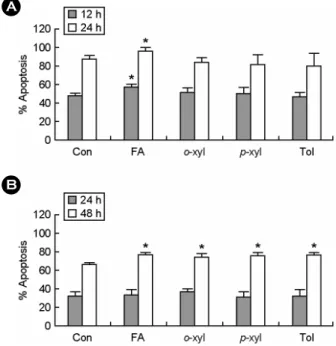
그 후 염색된 세포는 유세포 분석기를 통해 세포고사가 진행된 세포를 측정하였다. Annexin V가 염색된 모든 세 포를 세포고사가 일어난 세포로 정의하고 각 샘플당 총 10,000개의 세포를 분석하였다. 모든 실험 결과는 통계적 인 유의성을 측정하기 위해 대조군과 휘발성 유기화합 물 처리군의 결과를 Student's t-test로 분석하였고, 각 통 계 처리의 P 값이 0.05 미만인 경우 통계적으로 유의한 차이가 있다고 해석하였다. 본 연구 결과, 호중구에서 포 름알데하이드를 12시간, 24시간 처리한 세포에서 대조군 에 비해 세포고사가 증가하였다 (Fig. 1A). 호산구에서는 포름알데하이드, o-자일렌, p-자일렌, 톨루엔을 48시간 동 안 처리한 그룹에서 세포고사가 증가하였다 (Fig. 1B). 특 히 포름알데하이드는 호중구와 호산구에서 모두 세포독 성을 나타냈다. 이전 연구에서도 포름알데하이드는 세포 에서 DNA 손상을 증가할 뿐만 아니라 DNA 손상에 대 한 회복기전을 억제하여 세포 죽음을 유도한다고 보고된
바가 있다 (Schmid and Speit, 2007). 자일렌, 톨루엔도 역 시 DNA 분절의 형성을 증가시키고 세포생존을 감소시킨 다고 알려져 있다 (Al-Ghamdi et al., 2004; Sandikci et al., 2009). 그러나 Fig. 1에 나타난 바와 같이, 휘발성 유기화 합물에 대한 세포독성이 작용하는 세포에 따라 다르게 나타남을 확인할 수 있었다.
또한 휘발성 유기화합물과 같은 세포독성물질의 처리 는 염증성 사이토카인 및 케모카인 등을 포함한 관련 매 개물질의 분비를 유발한다. 본 연구에서도 휘발성 유기화 합물에 자극을 받은 각각의 세포에서 분비된 단백질을 측정하고자, 먼저 각 세포에 포름알데하이드, o-자일렌, p-자일렌, 톨루엔 50 μM을 처리한 다음 세포배양액을 분리하고 OptEIATM Set IL-6, IL-8, MCP-1 (BD bioscience)을 이용하여 효소면역법 (ELISA)으로 측정하였다. 호중구에 서 포름알데하이드에 의해 IL-8의 발현이 일시적으로 증 가함을 보였고 반대로 MCP-1의 발현은 감소하였다 (Fig.
2A). 호중구의 IL-6 발현은 포름알데하이드, o-자일렌, A
B
Fig. 1. The effects of volatile organic compounds on apoptosis of human neutrophils and eosinophils. Neutrophils (n=5) (A) and eosinophils (n=3) (B) were isolated from human peripheral blood and incubated in the absence (Con) and presence of 50 μM of formaldehyde (FA), ortho-xylene (o-xyl), para-xylene (p-xyl) and toluene (Tol) for the indicated time. The apoptosis of these cells were analyzed by measuring the binding of annexin V-FITC and PI using flow cytometry. The percentage of apoptotic cells in total cell population was included all annexin V-binding cells. Data are expressed as the means ± S.E.M. in five individual experiments (A) or in three individual experiments (B). *p<0.05 and **p<0.01 indicate a significant difference between the untreated group and the chemical-treated group at the same incubation time.
- 125 - p-자일렌, 톨루엔에 의해 3시간 후부터 감소하였다 (Fig.
2A). 반면, 호산구의 IL-8의 발현은 포름알데하이드를 처 리한 후 48시간에서 증가되고, IL-6와 MCP-1은 전혀 발 현양의 변화를 보이지 않았다 (Fig. 2B). IL-6, IL-8, MCP-1 과 같은 염증성 매개물질의 분비는 다양한 염증 질환에 서 호중구 뿐만 아니라 호산구에서 세포의 증식 및 생존 을 조절한다 (Kimura et al., 2003; Shakoory et al., 2004). 그 러나 호중구에서 IL-6는 세포고사를 유도하는 포름알데 하이드 이외에도 다른 휘발성 유기화합물들에 의해 감 소되었고, 반대로 호산구에서는 세포고사를 유도하는 휘 발성 유기화합물 중에서 포름알데하이드만 IL-8 발현을 증가시켰다. 이 결과는 휘발성 유기화합물 자극에 의한 염증성 매개물질의 발현이 세포마다 다르게 조절하는 것 을 나타내고, 본 연구에서 측정된 사이토카인 이외의 단 백질에 의한 복합적인 기전이 작용하리라 생각된다.
본 연구에서 확인한 바와 같이, 휘발성 유기화합물에
의한 세포고사의 증가는 정상적인 면역기전의 조절을 방해하고, 이로 인해 체내 면역반응의 위험요소로 작용 할 것으로 생각된다. 앞으로 휘발성 유기화합물에 의한 세포 내 신호전달단백질의 변화 및 작용물질의 발현 여 부를 확인하여 좀더 명확하게 세포고사를 일으키는 기 전을 밝혀내야 할 필요가 있다. 앞으로 복합적인 유기화 합물의 작용연구 및 다양한 휘발성 유기화합물의 세포독 성효과를 관찰해서 새집증후군과 같은 면역질환의 원인 및 발병과정을 규명해야 할 것이다.
감사의 글
이 논문은 2009년도 정부(교육과학기술부)의 재원으 로 한국연구재단의 지원을 받아 수행된 연구의 일부임 (과제번호: R01-2008-0020166-0).
Fig. 2. The effects of volatile organic compounds on the release of cytokine and chemokine in human neutrophils and eosinophils.
Human neutrophils (n=3) (A) and eosinophils (n=3) (B) were incubated with or without 50 μM of formaldehyde (FA), ortho-xylene (o-xyl), para-xylene (p-xyl) and toluene (Tol) for the indicated time. After the indicated period, the supernatant was collected and then the release of IL-6, IL-8 and MCP-1 in the supernatant was measured by ELISA. All results were expressed as the means ± S.E.M. in three individual experiments. *p<0.05 and **p<0.01 indicate a significant difference among the untreated groups, which includes the different incubation time groups, and further indicate between the untreated group and the chemical-treated group at the same incubation time.
A B
- 126 - REFERENCES
Al-Ghamdi SS, Raftery MJ, Yaqoob MM. Toluene and p-xylene induced LLC-PK1 apoptosis. Drug Chem Toxicol. 2004. 27:
425-432.
Bernstein JA, Alexis N, Bacchus H, Bernstein IL, Fritz P, Horner E, Li N, Mason S, Nel A, Oullette J, Reijula K, Reponen T, Seltzer J, Smith A, Tarlo SM. The health effects of nonindustrial indoor air pollution. J Allergy Clin Immunol.
2008. 121: 585-591.
Casset A, Marchand C, Purohit A, le Calve S, Uring-Lambert B, Donnay C, Meyer P, de Blay F. Inhaled formaldehyde exposure: effect on bronchial response to mite allergen in sensitized asthma patients. Allergy 2006. 61: 1344-1350.
Fitzharris P, Cromwell O, Moqbel R, Hartnell A, Walsh GM, Harvey C, Kay AB. Leukotriene B4 generation by human neutrophils following IgG-dependent stimulation. Immunology 1987. 61: 449-455.
Guzelian P, Mills S, Fallon HJ. Liver structure and function in print workers exposed to toluene. J Occup Med. 1988. 30:
791-796.
Kimura T, Iwase M, Kondo G, Watanabe H, Ohashi M, Ito D, Naqumo M. Suppressive effect of selective cyclooxygenase- 2 inhibitor on cytokine release in human neutrophils. Int Immunopharmacol. 2003. 3: 1519-1528.
Lindbohm ML, Taskinen H, Sallmen M, Hemminki K.
Spontaneous abortions among women exposed to organic solvents. Am J Ind Med. 1990. 17: 449-463.
Rosenberg NL, Spitz MC, Filley CM, Kavis KA, Schaumburg HH. Central nervous system effects of chronic toluene abuse- clinical, brainstem evoked response and magnetic resonance imaging studies. Neurotoxicol Teratol. 1988. 10: 489-495.
Rothenberg ME, Hogan SP. The eosinophil. Annu Rev Immunol.
2006. 24: 147-174.
Sandikci M, Seyrek K, Aksit H, Kose H. Inhalation of formaldehyde and xylene induces apoptotic cell death in the lung tissue. Toxicol Ind Health 2009. 25: 455-461.
Savill JS, Wyllie AH, Henson JE, Walport MJ, Henson PM, Haslett C. Macrophage phagocytosis of aging neutrophils in inflammation. Programmed cell death in the neutrophil leads to its recognition by macrophages. J Clin Invest. 1989. 83:
865-875.
Schmid O, Speit G. Genotoxic effects induced by formaldehyde in human blood and implications for the interpretation of biomonitoring studies. Mutagenesis 2007. 22: 69-74.
Shakoory B, Fitzgerald SM, Lee SA, Chi DS, Krishnaswamy G.
The role of human mast cell-derived cytokines in eosinophil biology. Interferon Cytokine Res. 2004. 24: 271-281.
Sul DG, Kim HS, Oh EH, Phark SH, Cho EK, Choi SY, Kang HS, Kim EM, Hwang KW, Jung WW. Gene expression profiling in lung tissues from rats exposed to formaldehyde. Arch Toxicol. 2007. 81: 589-597.