Graphene/BaCrO 4 Nanocomposites Catalyzed Photodegradation and Kinetics Study of Organic Dyes
Keun Hyung Kim and Weon Bae Ko †
Department of Chemisty, Sahmyook University, Seoul 139-742, Korea
(Received December 2, 2014, Revised December 30, 2014, Accepted January 7, 2015)
Abstract: The BaCrO
4nanoparticles were synthesized from a 0.1 M K
2CrO
4and 0.1 M BaCO
3solution with stirring for 10 h. The product was washed several times with acetone and heated to 700°C for 6 h. At that time, the color of mixture was a greenish yellow. The graphene/BaCrO
4nanocomposites were prepared with graphene and BaCrO
4nanoparticles by stirring in tetrahydrofuran and heated in an electric furnace at 700°C for 2 h. The BaCrO
4nanoparticles, graphene/BaCrO
4and heated graphene/BaCrO
4nanocomposites were characterized by X-ray diffraction, scanning electron microscopy and transmission electron microscopy. The graphene/BaCrO
4nanocomposites and heated graphene/BaCrO
4nanocomposites were evaluated as a photocatalyst and discussed about kinetics study for the degradation of organic dyes, such as methylene blue and rhodamine B under ultraviolet light irradiation at 254 nm.
Keywords: BaCrO
4nanoparticles, Graphene, Methylene blue, Rhodamine B, Photodegradation
Introduction
Organic wastewater causes serious worldwide environmen- tal problems.
1Semiconductor photocatalysis has attracted increasing attention over the past two decades as an effective technique for reduction of pollutants in organic dyes, air and wastewater.
2-4Semiconductor oxides and other inorganic compounds can exhibit high photocatalytic activity for the synthesis, reforming, degradation, and other reactions of organic compounds.
5,6Photocatalytic reactions using semi- conductors for purification, such as water splitting and the decomposition of waste materials, have attracted particular attention because of their possible applications to the con- version of solar energy to chemical energy as well as to pol- lution remediation using solar energy.
7-10The band gap of BaCrO
4nanoparticles is 2.63 eV, making them an attractive candidate for photocatalysis, such as an oxidizing agent in organic reactions and an efficient photocatalyst with a response to visible light irradiation.
9,11,12Two dimensional graphene is one atom thick sheet of carbon atoms bound together in an aromatic structure (sp
2bond) and is the basic building block of zero dimensional fullerenes, one dimen- sional carbon nanotubes and three dimensional graphite.
13,14This one atom thick pseudo-infinite nanocrystal is charac- terized by its large theoretical conductivity, and excellent optical transmittance,
15-19such as nanoelectronic devices, energy storage materials and polymer composites, owing to the high mobility of charge carriers, specific surface area and Young’s modulus.
14,20-22Experiment Details
1. Chemicals
Organic dyes, such as methylene blue (MB), rhodamine B (RhB) were purchased from Sigma-Aldrich. K
2CrO
4, BaCO
3, acetone and tetrahydrofuran (THF) were obtained from Sam- chun Chemicals. Graphene was supplied by ENano Tec.
2. Instruments
An electric furnace (Ajeon Heating Industry Co., Ltd.) was used to heat the sample. A UV lamp (8 W, 254 nm, 77202 Marne La Valee-Cedex1 France) was used as an ultraviolet light irradiation source.
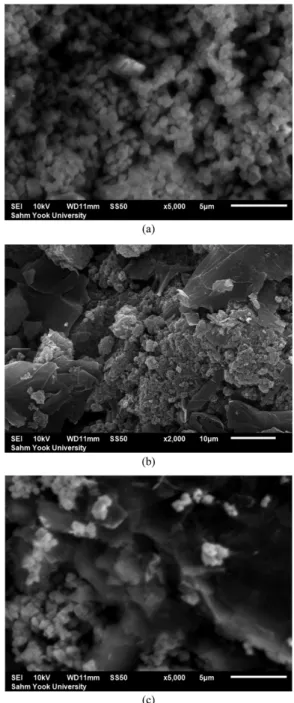
The surfaces of the BaCrO
4nanoparticles, graphene/
BaCrO
4nanocomposites and heated graphene/BaCrO
4nano- composites were observed by scanning electron microscopy
†