한국 청소년의 지질 농도와 이상지질혈증의 유병률
김신혜·안병철1·정효지2·박미정
인제대학교 상계백병원 소아청소년과, 영남대학교 경제금융학부1, 서울대학교 보건대학원 보건영양학교실2
Received: 6 April 2012, Accepted: 25 May 2012 Corresponding authors: Mi Jung Park
Department of Pediatrics, Inje University Sanggye Paik Hospital, Inje University College of Medicine, 1342 Dongil-ro, Nowon-gu, Seoul 139-707, Korea Tel: +82-2-950-1130, Fax: +82-2-951-1246, E-mail: [email protected] Hyojee Joung
Department of Public Health Nutrition, Seoul National University School of Public Health, 599 Gwanak-ro, Gwanak-gu, Seoul 151-742, Korea Tel: +82-2-740-8865, Fax: +82-2-883-2832, E-mail: [email protected]
※ 본 연구는 2010년도 대한비만학회 문석연구비 지원으로 진행되었음.
Lipid Profiles and Prevalence of Dyslipidemia in Korean Adolescents
Shin Hye Kim, Byung Chul Ahn1, Hyojee Joung2, Mi Jung Park
Department of Pediatrics, Inje University Sanggye Paik Hospital, Inje University College of Medicine, Seoul; Yeungnam University School of Economics and Finance1, Gyeongsan; Department of Public Health Nutrition2, Seoul National University School of Public Health, Seoul, Korea
Background: The aim of this study is to investigate the distribution of plasma cholesterol and triglyceride levels as well as the preva- lence of dyslipidemia among Korean adolescents.
Methods: We analyzed data for 3,045 adolescents aged 10-18 years (1,622 boys and 1,423 girls) who participated in the Korea Na- tional Health and Nutrition Examination Surveys from 2007 to 2010.
Results: The mean values of total cholesterol, triglycerides, low-density lipoprotein cholesterol (LDL-C), and high-density lipopro- tein cholesterol (HDL-C) were 159, 89, 89, and 52 mg/dL, respectively. Plasma cholesterol levels were significantly higher in girls than those in boys (162.1 mg/dL vs. 155.6 mg/dL, P < 0.0001). The 90th percentile values of total cholesterol, triglycerides, and LDL- C were 192, 149, 117 mg/dL for boys, and 195, 147, 119 mg/dL for girls. The 10th percentile value of HDL-C was 38 mg/dL for boys and 40 mg/dL for girls. Triglyceride, LDL-C cholesterol levels increased, whereas plasma HDL-C levels decreased with increasing the body mass index (P < 0.0001) in both genders. Total cholesterol levels significantly increased with increasing the body mass in- dex, especially in boys (P < 0.0001). The prevalence of dyslipidemia was 25.2% for boys and 21.7% for girls; this value significantly increased with overweight (37-40%) and obesity (53-56%). Independent predictors (odds ratio) of dyslipidemia were age (1.49), overweight (2.06), and obesity (5.11) for boys; overweight (1.95) and obesity (3.22) for girls.
Conclusion: Adolescent dyslipidemia is strongly associated with obesity. Lipid screening for overweight or obese youths should be emphasized. Further, longitudinal studies examining the impact of childhood obesity and dyslipidemia on subsequent cardiovas- cular diseases are needed. (Endocrinol Metab 27:208-216, 2012)
Key Words: Adolescence, Dyslipidemia, Lipids, Obesity, Prevalence
서 론
사회경제적발달과함께소아및청소년비만은급격하게증가하 여지난 20여년동안비만율이거의 10배가까이증가하였다[1-3].
에너지섭취의증가와에너지소모의감소에의해기인된비만은[4]
성장호르몬분비장애[5], 사춘기조숙증[6], 다낭성난소증후군[7], 체
력저하[8] 등의신체적문제와자아존중감저하및우울, 불안등으 로인한사회정서적인측면의문제점을초래한다[9]. 비만은이상지 질혈증, 고혈압등의대사증후군위험요소의동반도가높으며[10,11], 관상동맥경화증등을포함한심혈관계질환의발현으로연결된다 [12,13].
전세계적으로성인의주요사망원인중하나인심혈관계질환은
This is an Open Access article distributed under the terms of the Creative Commons Attribution Non-Commercial License (http://creativecommons.org/licenses/by-nc/3.0/) which permits unrestricted non-commercial use, distribution, and reproduction in any medium, provided the original work is properly cited.
Copyright © 2012 Korean Endocrine Society
임상증상이주로성인기에발현되지만, 부검연구에따르면소아기 또는청소년기부터초기죽상경화증의 조직학적소견인 지방선조 (fatty streak) 또는보다진행된단계인섬유성판(fibrous plaque)이 출현하며[14,15], 비만, 고혈압, 이상지질혈증, 흡연등의위험요인이 증가할수록죽상경화증성혈관병변의면적또한증가하는것으로 밝혀졌다[16]. 또한 12-18세청소년기의고LDL (low-density lipopro-
tein)-콜레스테롤혈증, 고혈압, 비만및흡연이 30대성인기경동맥
내중막두께증가의독립적인위험인자임이보고되었다[17,18]. 뿐만 아니라 90백분위수이상의고콜레스테롤혈증이발견된학동기청소 년의약 75%는 20대까지고콜레스테롤혈증이유지되고[19], 고콜레 스테롤혈증, 고LDL-콜레스테롤혈증, 저HDL (high-density lipopro-
tein)-콜레스테롤혈증의소견이 있는소아청소년의약 50%는 12년
후에도여전히지속된다고보고되므로[20], 성인기의이상지질혈증 이청소년기에서부터시작하고지속되어성인기심혈관계질환의주 요위험인자로작용하므로이를조기진단하고관리하는것이매우 중요하다.
소아청소년의비만율이급증함에따라이상지질혈증의유병률도 매우높을것으로추정되고있으나현재까지국내소아청소년의지 질농도에관한체계적인대규모연구는없는실정이다. 본연구는 전국민을대표하는국민건강영양조사(2007-2010년) 원시자료를토
대로 10-18세한국청소년의성별및연령에따른혈청지질농도의
분포를분석하고비만도별이상지질혈증의 유병률및연관인자를 조사하고자하였다.
대상 및 방법
1. 대상
본연구는보건복지부산하질병관리본부에서시행한 2007-2010 년국민건강영양조사의 원시자료를이용하여 분석하였다. 조사에 참여한 10세 0개월-18세 11개월연령의소아청소년총 4,244명중혈 액검사를시행하지않은 659명, 공복시간 8시간미만인 367명, 신체 계측을시행하지않은 173명을제외한총 3,045명(남아 1,622명, 여
아 1,423명)을최종대상자로선정하여분석을시행하였다.
2. 방법
검진조사는사전에교육을받은검진조사팀에의해수행되었으 며, 검진조사원이신체계측을, 보건소간호사가혈압측정을, 보건소 임상병리사가혈액채취를수행하였다. 신장과체중은 Seca 225 (Seca Deutchland, Hamburg, Germany) 신장측정기와 GL-6000-20 (CAS-
KOREA, Seoul, Korea) 체중측정기로측정하였다. 허리둘레는줄자
가수평면을이루게하여, 가볍게숨을내쉰상태에서마지막늑골 의하단부와장골능선상단부의중간부위를맨살위에서측정하 였다. 비만하여가장좁은부분을가려내기힘든경우에는늑골과
장골능선사이에서가장작은둘레를측정하였다. 체질량지수는체 중(kg)/[신장(m)]2으로구하였다.
채혈은최소 8시간이상금식후아침공복상태에서이루어졌고 혈액은검체처리후냉장보관하였으며, 검체는당일중앙검사기관 으로우송하여 24시간이내에 검사를진행하였다. 총콜레스테롤, 중성지방, LDL-콜레스테롤, HDL-콜레스테롤농도는 Hitachi Auto- matic Analyzer 7600 (Hitachi, Tokyo, Japan)을사용하여각각 Pure- auto SCHO-N, Pureauto S TG-N, CHOLESTEST LDL, CHOLESTEST N HDL을이용한 enzymatic colorimeter method 방법으로분석하 였다.
3. 진단 기준
2007년소아청소년표준성장도표를참조값으로이용하여, 성별, 연령별체질량지수 5백분위수미만을저체중, 5백분위수이상에서
85백분위수미만을정상체중, 85백분위수이상에서 95백분위수미
만을과체중, 95백분위수이상을비만으로정의하였다[21].
미국심장협회[22]와미국콜레스테롤교육프로그램의성인치료 패널[23]에서제시한소아청소년에서제시한진단기준에근거하여고 콜레스테롤혈증은 > 200 mg/dL [22,24], 고중성지방혈증은 > 150 mg/
dL [22,24], 고LDL-콜레스테롤혈증은 > 130 mg/dL [22,24], 저HDL- 콜레스테롤혈증은 < 40 mg/dL [23,24]로정의하였다. 이상지질혈증 은고콜레스테롤혈증, 고중성지방혈증, 고LDL-콜레스테롤혈증, 또 는저HDL-콜레스테롤혈증중하나이상이존재할때로정의하였다.
4. 통계 분석
통계분석은 SAS package version 9.1 (SAS Institute Inc., Cary,
NC, USA) 프로그램을이용하였고 P값이 0.05 미만일때통계적으
로유의하다고판정하였다. 변수의값들은평균±표준편차(mean ± SD) 또는백분율(%)로나타내었다. 성별에따른일반적특성과평균 지질농도의차이는χ2검정과 t 검정을이용하여분석하였고, 비만 도에따른네군에서의평균지질농도와이상지질혈증의유병률의
차이는각각분산분석(ANOVA)과χ2검정을사용하여분석하였다.
이상지질혈증의위험인자를분석하기위해다변량로지스틱회귀분 석을사용하였다. 본연구의결과는가중치를적용한가중표본평균 또는분율이며가중치는표본추출률, 응답률을반영하였다.
결 과
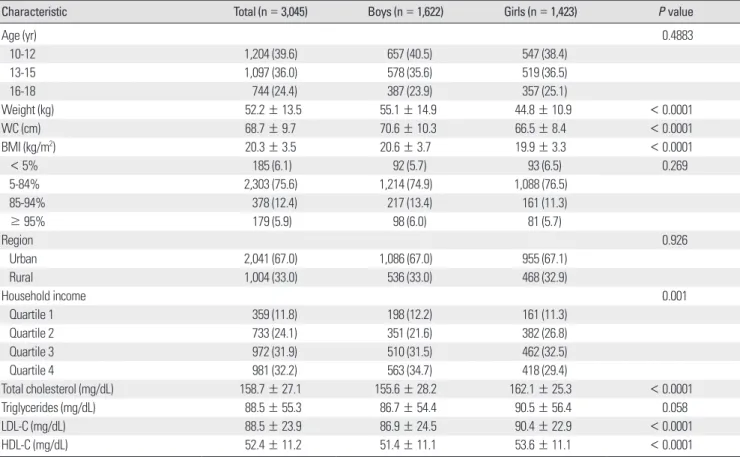
1. 성별에 따른 일반적 특징 및 평균 지질 농도
과체중의유병률은남아 13.4%, 여아 11.3%였으며, 비만의유병률
은남아 6.0%, 여아 5.6%로남녀간유의한차이는없었다(P = 0.269).
연령(P = 0.4883) 및거주지역(P = 0.926)도성별에따른차이를보 이지않았다. 청소년의평균콜레스테롤농도(여아, 162.1 mg/dL; 남
아, 158.7 mg/dL), LDL-콜레스테롤농도(여아, 90.4 mg/dL; 남아, 86.9 mg/dL) 및 HDL-콜레스테롤농도(여아, 53.6 mg/dL; 남아, 51.4 mg/
dL)는여아에서남아보다유의하게높았으나(P < 0.0001), 평균중성 지방농도(여아, 90.5 mg/dL; 남아, 86.7 mg/dL)는성별에따른유의 한차이를보이지않았다(P = 0.058) (Table 1).
2. 혈청 지질 농도의 분포
남아에서총콜레스테롤, LDL-콜레스테롤및 HDL-콜레스테롤농
도는연령이증가함에따라유의한감소를보였고(P < 0.0001), 중성
지질농도는연령이증가함에따라증가하는경향을보였으나통계
적유의성은없었다(P = 0.08). 여아에서는중성지방농도가연령이
증가함에따라유의하게감소하였으나(P < 0.0001), 총콜레스테롤, LDL-콜레스테롤및 HDL-콜레스테롤농도는연령에따른변화를보
이지않았다(P > 0.05). 총콜레스테롤농도의 90백분위수는남아
192 mg/dL, 여아 195 mg/dL, 중성지질농도의 90백분위수는남아 149 mg/dL, 여아 147 mg/dL, LDL-콜레스테롤농도의 90백분위수는 남아 117 mg/dL, 여아 119 mg/dL였으며, HDL-콜레스테롤 농도의 10백분위수는남아 38 mg/dL, 여아 40 mg/dL였다(Table 2).
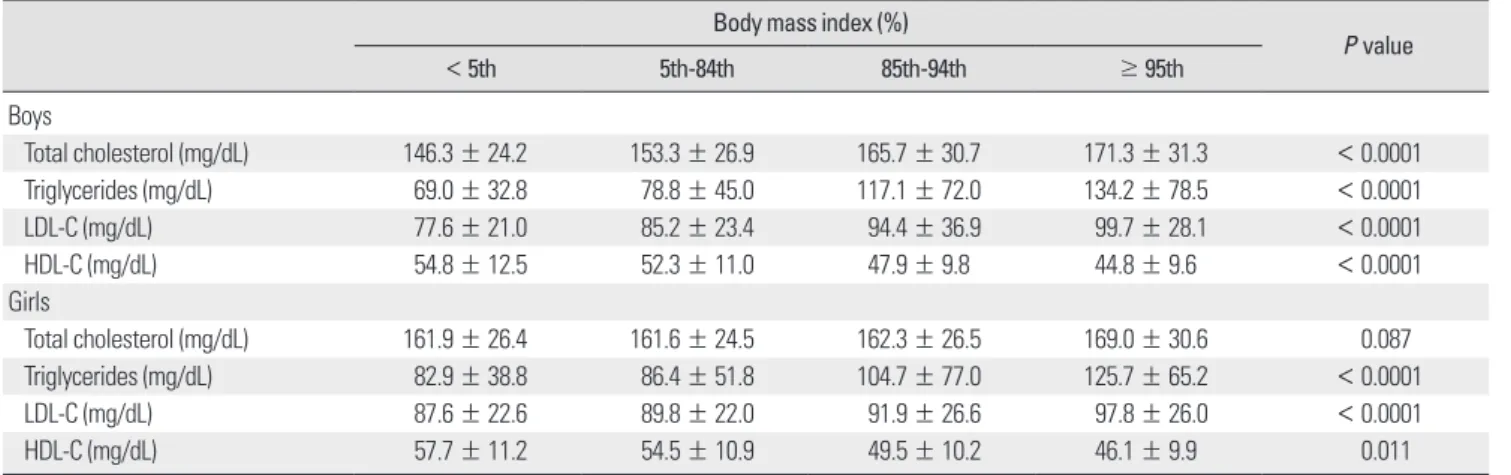
3. 체질량지수에 따른 혈청 지질 농도
체질량지수 백분위수가증가함에따라 중성지방, LDL-콜레스테 롤농도가유의하게증가하였고(P < 0.0001), HDL-콜레스테롤농도 는유의하게감소하였다(P < 0.0001). 총콜레스테롤농도는체질량 지수백분위수가증가함에따라증가하는경향을보였으며, 특히남 아에서통계적으로유의하였다(P < 0.0001) (Table 3).
4. 체질량지수에 따른 이상지질혈증의 유병률
저HDL-콜레스테롤혈증의유병률이남아 14.5% (235/1,622명), 여 아 9.5% (235/1,423명)로가장 높았고, 고콜레스테롤혈증의 유병률 은남아 6.0% (97/1,622명), 여아 7.2% (103/1,423명), 고중성지방혈증 의유병률은남아 9.9% (161/1,622명), 여아 9.5% (135/1,423명)이었으 며, 고LDL-콜레스테롤혈증의유병률이남아 4.6% (75/1,622명), 여 아 5.5% (78/1,423명)로가장낮았다. 이상지질혈증의유병률은남아 의 25.2% (408/1,622명), 여아의 21.7% (394/1,423명)이었으며, 체질 량지수백분위수가증가함에따라유의하게증가하여(P < 0.0001), 비만남아및여아에서는각각 56.1% (55/98명), 53.1% (43/81명)였 다(Table 4).
남아에서는연령이증가함에따라이상지질혈증의유병률이증가
Table 1. General characteristics of the participants
Characteristic Total (n = 3,045) Boys (n = 1,622) Girls (n = 1,423) P value
Age (yr) 0.4883
10-12 1,204 (39.6) 657 (40.5) 547 (38.4)
13-15 1,097 (36.0) 578 (35.6) 519 (36.5)
16-18 744 (24.4) 387 (23.9) 357 (25.1)
Weight (kg) 52.2 ± 13.5 55.1 ± 14.9 44.8 ± 10.9 < 0.0001
WC (cm) 68.7 ± 9.7 70.6 ± 10.3 66.5 ± 8.4 < 0.0001
BMI (kg/m2) 20.3 ± 3.5 20.6 ± 3.7 19.9 ± 3.3 < 0.0001
< 5% 185 (6.1) 92 (5.7) 93 (6.5) 0.269
5-84% 2,303 (75.6) 1,214 (74.9) 1,088 (76.5)
85-94% 378 (12.4) 217 (13.4) 161 (11.3)
≥ 95% 179 (5.9) 98 (6.0) 81 (5.7)
Region 0.926
Urban 2,041 (67.0) 1,086 (67.0) 955 (67.1)
Rural 1,004 (33.0) 536 (33.0) 468 (32.9)
Household income 0.001
Quartile 1 359 (11.8) 198 (12.2) 161 (11.3)
Quartile 2 733 (24.1) 351 (21.6) 382 (26.8)
Quartile 3 972 (31.9) 510 (31.5) 462 (32.5)
Quartile 4 981 (32.2) 563 (34.7) 418 (29.4)
Total cholesterol (mg/dL) 158.7 ± 27.1 155.6 ± 28.2 162.1 ± 25.3 < 0.0001
Triglycerides (mg/dL) 88.5 ± 55.3 86.7 ± 54.4 90.5 ± 56.4 0.058
LDL-C (mg/dL) 88.5 ± 23.9 86.9 ± 24.5 90.4 ± 22.9 < 0.0001
HDL-C (mg/dL) 52.4 ± 11.2 51.4 ± 11.1 53.6 ± 11.1 < 0.0001
Values are expressed as mean ± SD or number (%).
BMI, body mass index; HDL-C, high-density lipoprotein cholesterol; LDL-C, low-density lipoprotein cholesterol; WC, waist circumference.
하였고, 여아에서는연령에따른유병률의차이는뚜렷하지않았다.
10-12세연령에서는이상지질혈증의유병률이성별에따른차이를
보이지않았으나, 13세이후과체중및비만아동에서남아에서여 아보다이상지질혈증의유병률이높아져, 16-18세비만남아에서의 이상지질혈증유병률은 69.2%, 동일연령인비만여아에서의유병 률은 48.1%였다(Fig. 1).
5. 이상지질혈증의 위험요인
이상지질혈증의위험도(odds ratio)는남아(1.21)가여아보다유의 하게높았다(P = 0.043). 과체중(2.30) 및비만(4.04)은남녀모두에 서이상지질혈증의독립적인위험인자였다(P < 0.0001). 연령의경우 남아에서는 독립적인위험인자(1.49)였으나, 여아에서는 유의하지 않았다(P = 0.883) (Table 5).
Table 2. Distributions of cholesterol and triglyceride levels by gender and age
Boys (%) Girls (%)
5th 10th 50th 75th 90th 95th 5th 10th 50th 75th 90th 95th
Total cholesterol (mg/dL)
10-12 yr 123 132 161 179 199 211 128 133 162 179 192 202
13-15 yr 112 119 148 166 181 197 121 128 160 176 195 207
16-18 yr 108 117 147 167 185 198 124 132 161 180 199 209
Total 115 123 153 171 192 204 124 132 161 178 195 207
Triglycerides (mg/dL)
10-12 yr 32 38 70 101 143 185 38 46 84 119 155 186
13-15 yr 34 41 73 103 151 189 39 47 79 107 148 195
16-18 yr 38 42 79 108 154 190 38 44 71 95 127 158
Total 35 40 73 104 149 186 38 45 79 107 147 179
LDL-C (mg/dL)
10-12 yr 58 65 90 106 123 134 57 65 89 103 117 127
13-15 yr 50 57 81 96 111 120 57 64 87 102 120 133
16-18 yr 44 55 81 97 115 124 59 66 90 107 124 135
Total 52 59 85 101 117 129 58 65 89 104 119 131
HDL-C (mg/dL)
10-12 yr 37 40 53 61 53 74 36 40 53 61 53 74
13-15 yr 34 37 49 57 49 68 35 40 53 60 53 72
16-18 yr 34 36 48 55 48 67 36 40 54 62 54 74
Total 35 38 51 58 51 71 36 40 53 61 53 73
HDL-C, high-density lipoprotein cholesterol; LDL-C, low-density lipoprotein cholesterol.
Table 3. Mean values of cholesterol and triglycerides by body mass index
Body mass index (%)
P value
< 5th 5th-84th 85th-94th ≥ 95th
Boys
Total cholesterol (mg/dL) 146.3 ± 24.2 153.3 ± 26.9 165.7 ± 30.7 171.3 ± 31.3 < 0.0001
Triglycerides (mg/dL) 69.0 ± 32.8 78.8 ± 45.0 117.1 ± 72.0 134.2 ± 78.5 < 0.0001
LDL-C (mg/dL) 77.6 ± 21.0 85.2 ± 23.4 94.4 ± 36.9 99.7 ± 28.1 < 0.0001
HDL-C (mg/dL) 54.8 ± 12.5 52.3 ± 11.0 47.9 ± 9.8 44.8 ± 9.6 < 0.0001
Girls
Total cholesterol (mg/dL) 161.9 ± 26.4 161.6 ± 24.5 162.3 ± 26.5 169.0 ± 30.6 0.087
Triglycerides (mg/dL) 82.9 ± 38.8 86.4 ± 51.8 104.7 ± 77.0 125.7 ± 65.2 < 0.0001
LDL-C (mg/dL) 87.6 ± 22.6 89.8 ± 22.0 91.9 ± 26.6 97.8 ± 26.0 < 0.0001
HDL-C (mg/dL) 57.7 ± 11.2 54.5 ± 10.9 49.5 ± 10.2 46.1 ± 9.9 0.011
HDL-C, high-density lipoprotein cholesterol; LDL-C, low-density lipoprotein cholesterol.
고 찰
소아청소년기의혈중지질농도는인종, 성별, 연령, 사춘기단계,
체격에영향을받는것으로알려졌다. 한국 10-18세의남녀청소년
의평균지질농도는총콜레스테롤 159 mg/dL, 중성지방 89 mg/dL, LDL-콜레스테롤 89 mg/dL, HDL-콜레스테롤 52 mg/dL이었다. 건강 한한국소아청소년의혈청지질농도에대한대규모연구는매우
드물며[25,26], 1990년대이후한국소아청소년의평균총콜레스테
롤농도를보고한연구중, 한연구에서는 164 mg/dL로[25], 다른연
구에서는 155 mg/dL로보고하는등[26] 보고자에따라차이를보였
다. 한국청소년의총콜레스테롤농도는스페인(175 mg/dL) [27], 폴 란드(165 mg/dL) [28], 이란(166 mg/dL) [29] 및일본(165 mg/dL) [30]
의청소년에비해낮았고, 미국(162 mg) [31]의청소년과비슷한수
준이며, 멕시코(150 mg/dL) [32] 청소년에비해높았다.
본연구결과, 총콜레스테롤, LDL-콜레스테롤, HDL-콜레스테롤 농도는여아에서남아보다높았고, 이와같은성별차는여러국가 의소아청소년에서도동일하게관찰되었다[27,33,34]. 혈청지질농도 는출생이후부터사춘기전연령까지는성별에따른차이없이유 지되다가, 사춘기가시작되면서남아에서총콜레스테롤, LDL-콜레
스테롤, HDL-콜레스테롤농도가급격히감소하는반면, 여아에서는
큰차이를보이지않는데, 이는사춘기진행에따른성호르몬의변
화로인한현상으로추정된다[33,35]. 사춘기단계가진행함에따라
남아의혈청테스토스테론농도는급격히증가하며, 여아의테스토 스테론농도는일정하게유지되는데, 증가된테스토스테론농도는 Table 4. Prevalence of dyslipidemia by body mass index
Body mass index (%)
P value
Total < 5th 5th-84th 85th-94th ≥ 95th
Boys
Hypercholesterolemia* 6.0 2.2 4.9 10.6 12.2 0.0002
Hypertriglyceridemia† 9.9 4.3 6.5 21.2 32.7 < 0.0001
Hyper-LDL-cholesterolemia‡ 4.6 2.2 3.5 7.8 13.3 < 0.0001
Hypo-HDL-cholesterolemia§ 14.5 12.0 12.5 19.8 29.6 < 0.0001
Dyslipidemiall 25.2 16.3 20.7 39.6 56.1 < 0.0001
Girls
Hypercholesterolemia 7.2 8.6 6.6 8.7 11.1 0.312
Hypertriglyceridemia 9.5 7.5 7.9 13.7 24.7 < 0.0001
Hyper-LDL-cholesterolemia 5.5 6.5 4.8 6.8 11.1 0.081
Hypo-HDL-cholesterolemia 9.5 5.4 4.8 16.1 22.2 < 0.0001
Dyslipidemia 21.7 26.9 24.5 36.6 53.1 < 0.0001
Values are expressed as percentage.
*Total cholesterol > 200 mg/dL; †Triglycerides > 150 mg/dL; ‡LDL-cholesterol > 130 mg/dL; §HDL-cholesterol < 40 mg/dL; llHaving at least one of the lipid profiles among hypercholesterolemia, hypertriglyceridemia, hyper-LDL cholesterol and hypo-HDL-cholesterol.
HDL, high-density lipoprotein; LDL, low-density lipoprotein.
Prevalence of dyslipidemia (%) Prevalence of dyslipidemia (%)70
60 50 40 30 20 10 0
70 60 50 40 30 20 10 0
< 85p 85-94p ≥ 95p < 85p 85-94p ≥ 95p
16-18 yr 16-18 yr
13-15 yr 13-15 yr
10-12 yr 10-12 yr
BMI (%) BMI (%)
Boys Girls
Fig. 1. Prevalence of dyslipidemia stratified by body mass index (BMI) and age.
총콜레스테롤, LDL-콜레스테롤및 HDL-콜레스테롤농도와음의 상관관계가있으며[34], 혈청테스토스테론대에스트라디올농도의 비가증가할수록 LDL-콜레스테롤및 HDL-콜레스테롤농도가유의
하게감소함이보고된바있다[35].
소아청소년기이상지질혈증의중요성에도불구하고현재까지전 세계적으로청소년기이상지질혈증의통일된진단기준은정립되지 않았다. 1981년 Lipid Research Clinics Program Prevalence Study에
서발표한 6-19세백인소아청소년의혈청지질농도의분포를바탕
으로 1992년미국콜레스테롤 교육프로그램(National Cholesterol Education Program, NCEP)과미국소아과학회(American Academy
of Pediatrics)에서 90-95백분위수에해당하는값을고콜레스테롤혈
증(≥ 200 mg/dL) 및고LDL-콜레스테롤혈증(≥ 130 mg/dL)의기준치 로제시하였다[36]. 이후대사증후군의요소로서심혈관계질환및 당뇨병발생의위험인자로밝혀진고중성지방혈증및저HDL-콜레 스테롤혈증의중요성이대두되면서, 미국심장협회(American Heart Association)에서는고콜레스테롤혈증(> 200 mg/dL), 고LDL-콜레스 테롤혈증(> 130 mg/dL)과함께고중성지방혈증(> 150 mg/dL) 및저 HDL-콜레스테롤혈증(< 35 mg/dL)의기준치를제시하였다[22]. 한편, 미국콜레스테롤교육프로그램의성인치료패널(National Choles- terol Education Program Adult Treatment Pannel III)을소아의실정 에맞게변형하여사용한기준에서는고중성지방혈증 ≥ 110 mg/dL,
저HDL-콜레스테롤혈증 < 40 mg/dL으로정의하고있으나[23], 최근 국제당뇨병연맹(International Diabetes Federal)은고중성지방혈증
은 ≥ 150 mg/dL, 저HDL-콜레스테롤혈증의경우성별과연령에따
라구분하여 10-15세소아청소년에서는 HDL-콜레스테롤 < 40 mg/
dL을, 만 16세이상소아청소년에서는 HDL-콜레스테롤 < 40 mg/dL (남아), < 50 mg/dL (여아)을기준치로제시하여[37], 다양한기준치 가혼재되어사용되고있다.
본연구결과, 총콜레스테롤, 중성지질, LDL-콜레스테롤농도의 90백분위수는각각 193, 148, 118 mg/dL이었고, HDL-콜레스테롤농 도의 10백분위수는 39 mg/dL였다. 이는미국청소년[33]의총콜레 스테롤, 중성지질, LDL-콜레스테롤의 90백분위수(200, 160, 132 mg/
dL)보다낮고, HDL-콜레스테롤농도의 10백분위수(35 mg/dL)보다 높은수치였다. 대상수가많지않아본연구로서이상지질혈증의기 준치를제시하기는어려우나현재널리사용되고있는총콜레스테 롤 > 200 mg/dL 및 LDL-콜레스테롤 > 130 mg/dL의기준치는한국
청소년의 90-95백분위수에해당하므로적절하다고판단된다. 소아
청소년의고중성지방혈증기준으로미국콜레스테롤교육프로그램 에서는 ≥ 110 mg/dL을[23], 미국심장협회에서는 > 150 mg/dL을제안
하였는데[22], 본연구결과에서 110 mg/dL는한국청소년중성지방
농도의 75-80백분위수에해당하므로이보다는 90-95백분위수에해
당하는 > 150 mg/dL가적절하다고생각된다. HDL-콜레스테롤농도 Table 5. Independent risk factors for dyslipidemia
Total Boys Girls
OR* 95%-CI P value OR 95%-CI P value OR 95%-CI P value
Gender 0.043
Boys 1.210 1.012-1.449
Girls Ref
Age 0.065 0.007 0.883
10-12 yr Ref Ref Ref
13-15 yr 1.154 0.945-1.410 1.175 0.895-1.543 1.135 0.844-1.527
16-18 yr 1.222 0.978-1.527 1.492 1.103-2.018 1.015 0.724-1.423
BMI percentile < 0.0001 < 0.0001 < 0.0001
< 5 percentile 0.830 0.560-1.232 0.657 0.367-1.174 1.002 0.583-1.722
5-84 percentile Ref Ref Ref
85-94 percentile 2.300 1.817-2.911 2.606 1.913-3.549 1.954 1.349-2.828
≥ 95 percentile 4.044 2.957-5.529 5.108 3.328-7.841 3.219 2.004-5.170
Region 0.573 0.920 0.442
Urban Ref Ref Ref
Rural 1.065 0.887-1.279 1.306 0.808-1.328 1.114 0.849-1.463
Household income 0.547 0.447 0.791
Quartile 1 Ref Ref Ref
Quartile 2 1.195 0.876-1.630 1.321 0.866-2.014 1.093 0.687-1.737
Quartile 3 1.345 1.000-1.808 1.328 0.892-1.977 1.315 0.841-2.056
Quartile 4 0.989 0.732-1.336 0.996 0.668-1.483 0.954 0.599-1.520
*Energy intake-adjusted odds ratios for dyslipidemia by multivariate logistic regression analyses.
BMI, body mass index; CI, confidence intervals; OR, odds ratio.
는여아에서남아보다높으므로국제당뇨병연맹에서는저HDL-콜레 스테롤혈증의기준을성별에따라차별화하였으나[37], 한국청소년
의 10백분위수값은성별에따른차이가없으므로동일한기준(< 40
mg/dL)을적용하는것이적절하다고사료된다.
한국청소년에서고콜레스테롤혈증의유병률은남아 6.0%, 여아 7.2%, 고LDL-콜레스테롤혈증의 유병률은남아 4.6%, 여아 5.5%이 었다. 이상지질혈증의유병률은조사대상자의연령과진단기준에따 라달라지므로 타연구결과와의비교에제한점이있지만, 1992년 보고된한국소아청소년의고콜레스테롤혈증(8.0%) 및고LDL-콜레 스테롤혈증(7.4%)의유병률에비해낮았고[26], 미국청소년의고콜
레스테롤(9.6%) 및고LDL-콜레스테롤혈증(6.6%)의유병률 보다도
낮았다[38].
체질량지수백분위수가증가함에따라이상지질혈증의유병률도 증가하여, 과체중청소년의 37-40%, 비만청소년의 53-56%에서이상 지질혈증이동반되었다. 중등도및고도비만초등학생에서고콜레 스테롤혈증의유병률이각각 38.8%, 61.5%에이르는것으로보고된
바있으나[39], 본연구에서는비만청소년의고콜레스테롤혈증유병
률은 12%에불과했고고중성지방혈증및저HDL-콜레스테롤혈증의 유병률이 30%에이르는것으로나타나, 과체중및비만청소년의지 질농도평가에총콜레스테롤농도뿐아니라중성지방및 HDL-콜 레스테롤농도를측정하는것이바람직하겠다.
이상지질혈증의위험도는비만도가상승함에따라증가하여정상 체중에비해과체중은 2.3배, 비만은 4배높았다. 따라서비만뿐아 니라과체중단계에서도이상지질혈증에대한교육과추적관찰이
필요할것으로생각된다. 2008년미국소아과학회의가이드라인에서
도과체중아동에대해이상지질혈증의선별검사를실시하도록권
고하고있다[40]. 남아에서여아보다이상지질혈증의위험도가 1.2배
높으며, 초등학생에비해고등학생에서위험도가 1.5배증가하므로 고등학교남학생에서이상지질혈증에대한주의가더필요함을알 수있었다.
본연구의제한점은첫째, 4년간의국민건강영양조사자료를바탕 으로분석한단면적연구로서, 본연구에서설정된이상지질혈증의 기준치와심혈관계질환발생과의인과관계를단언할수는없으며, 둘째, 이상지질혈증의위험인자인고혈압, 흡연, 신체활동량, 가족력 등의인자를분석하지않아, 향후이러한요소를보완하여우리나 라청소년기이상지질혈증의유병률의추이에대한지속적인연구 가필요할것으로보인다. 그럼에도불구하고본연구는소아청소년 비만의유병률이급증하고소아지질농도의분포와기준치설정의 필요성이증대되는현시점에서대표성이있는대규모최근자료를 바탕으로성별및연령에따른지질농도의분포를확인하고이상지 질혈증의기준치를정립하는기초자료를제공했다는점에서의의 가있다. 향후종단적연구를통하여한국성인의심혈관계질환의 위험요인으로서의미있는소아청소년기이상지질혈증의기준치를
설정하기위한추가적연구가필요할것으로생각된다.
결론적으로 한국청소년의 이상지질혈증의 유병률은 비만뿐만 아니라과체중에서도매우높으므로, 이상지질혈증의위험요인으로 서과체중을간과해서는안되며, 특히남아에서는연령이증가할수 록위험도가증가하므로지속적인관리와추적관찰이필요하다. 향 후우리나라청소년의비만및이상지질혈증의유병률추이에대한 지속적인연구와청소년기이상지질혈증과성인기심혈관계질환의 위험도에대한종단적연구가필요하다.
요 약
배경:본연구는한국청소년의성별및연령에따른혈청지질농 도의분포를분석하고비만도별이상지질혈증의유병률및연관인 자를조사하고자하였다.
방법: 2007-2010년에국민건강영양조사에참여한 10-18세청소년, 총 3,045명(남아 1,622명, 여아 1,423명)을대상으로하였다.
결과:청소년의평균지질농도는총콜레스테롤 159 mg/dL, 중성 지방 89 mg/dL, LDL-콜레스테롤(low-density lipoprotein choles- terol), 89 mg/dL, HDL-콜레스테롤 (high-density lipoprotein cho- lesterol), 52 mg/dL이었으며, 총콜레스테롤및 HDL/LDL-콜레스테
롤농도는여아에서남아보다유의하게높았다(P < 0.0001). 총콜레
스테롤, 중성지질, LDL-콜레스테롤농도의 90백분위수는, 남아에서
각각 192, 149, 117 mg/dL이었고, 여아에서는각각 195, 147, 119 mg/
dL이었으며, HDL-콜레스테롤농도의 10백분위수는남아 38 mg/dL,
여아 40 mg/dL였다. 남녀모두체질량지수백분위수가증가함에따
라중성지방, LDL-콜레스테롤농도는증가하고(P < 0.0001), HDL-콜 레스테롤농도는감소하였다(P < 0.0001). 남아에서는총콜레스테 롤농도가체질량지수백분위수증가에따라유의하게증가하였으 나(P < 0.0001), 여아에서는유의하지않았다. 이상지질혈증의유병 률은남아 25.2%, 여아 21.7%였으며, 과체중(37-40%) 및비만(55-
56%) 청소년에서유의하게증가하였다. 이상지질혈증의독립적인위
험인자(odds ratio)는남아에서는연령(1.49), 과체중(2.06) 및비만 (5.11)이었으며, 여아에서는과체중(1.95) 및비만(3.22)이었다.
결론:한국청소년의이상지질혈증은과체중및비만과매우높은 연관성을가진다. 따라서, 과체중및비만청소년에대한이상지질혈 증의선별검사가강조되어야하며향후소아청소년비만과이상지질 혈증이심혈관계질환발생에미치는영향에대한종단적연구가필 요하다.
참고문헌
1. Park YS, Lee DH, Choi JM, Kang YJ, Kim CH: Trend of obesity in school age children in Seoul over the past 23 years. Korean J Pediatr 47:247-257,
2004
2. Kim YS, Park MJ: Time trend in height, weight, BMI and waist circum- ference of Korean adolescents: from the Korean National Health and Nu- trition Examination Survey (KNHNES), 1998, 2001 and 2005. J Korean Soc Pediatr Endocrinol 12:142-149, 2007
3. Khang YH, Park MJ: Trends in obesity among Korean children using four different criteria. Int J Pediatr Obes 6:206-214, 2011
4. Park MJ: Recent advances in regulating energy homeostasis and obesity.
Korean J Pediatr 48:126-137, 2005
5. Park MS, Park MJ, Kim HS, Kim DH: Mechanism of impaired growth hormone response in children with simple obesity. J Korean Pediatr Soc 37:457-463, 1994
6. Yoon JR, Ahn JH, Huh K, Park MJ: Body composition in girls with pre- cocious puberty. Korean J Obes 19:95-100, 2010
7. Huh K, Ko JK, Park MJ: Two cases of polycystic ovary syndrome with metabolic syndrome presenting with hirsutism in adolescence. Korean J Obes 18:167-172, 2009
8. Park MJ, Suh SH: Evaluation of physical fitness in terms of levels of obesi- ty among middle and high school students in Seoul. Korean J Obes 18:65- 71, 2009
9. Kim B, Park MJ: The influence of weight and height status on psycholog- ical problems of elementary schoolchildren through child behavior check- list analysis. Yonsei Med J 50:340-344, 2009
10. Park MJ, Boston BA, Oh M, Jee SH: Prevalence and trends of metabolic syndrome among Korean adolescents: from the Korean NHANES survey, 1998-2005. J Pediatr 155:529-534, 2009
11. Park MJ: Epidemiology of the metabolic syndrome among Korean chil- dren and adolescents. Korean J Pediatr 51:564-568, 2008
12. McGill HC Jr, McMahan CA, Zieske AW, Tracy RE, Malcom GT, Herd- erick EE, Strong JP: Association of coronary heart disease risk factors with microscopic qualities of coronary atherosclerosis in youth. Circulation 102:
374-379, 2000
13. Grundy SM: Obesity, metabolic syndrome, and cardiovascular disease. J Clin Endocrinol Metab 89:2595-2600, 2004
14. McGill HC Jr, McMahan CA, Zieske AW, Malcom GT, Tracy RE, Strong JP: Effects of nonlipid risk factors on atherosclerosis in youth with a favor- able lipoprotein profile. Circulation 103:1546-1550, 2001
15. McGill HC Jr, McMahan CA, Malcom GT, Oalmann MC, Strong JP:
Effects of serum lipoproteins and smoking on atherosclerosis in young men and women. The PDAY Research Group. Pathobiological Determinants of Atherosclerosis in Youth. Arterioscler Thromb Vasc Biol 17:95-106, 1997
16. Berenson GS, Srinivasan SR, Bao W, Newman WP 3rd, Tracy RE, Wat- tigney WA: Association between multiple cardiovascular risk factors and atherosclerosis in children and young adults. The Bogalusa Heart Study. N Engl J Med 338:1650-1656, 1998
17. Davis PH, Dawson JD, Riley WA, Lauer RM: Carotid intimal-medial thickness is related to cardiovascular risk factors measured from childhood through middle age: The Muscatine Study. Circulation 104:2815-2819, 2001
18. Raitakari OT, Juonala M, Kähönen M, Taittonen L, Laitinen T, Mäki- Torkko N, Järvisalo MJ, Uhari M, Jokinen E, Rönnemaa T, Akerblom HK, Viikari JS: Cardiovascular risk factors in childhood and carotid artery intima-media thickness in adulthood: the Cardiovascular Risk in Young
Finns Study. JAMA 290:2277-2283, 2003
19. Lauer RM, Lee J, Clarke WR: Factors affecting the relationship between childhood and adult cholesterol levels: the Muscatine Study. Pediatrics 82:309-318, 1988
20. Webber LS, Srinivasan SR, Wattigney WA, Berenson GS: Tracking of se- rum lipids and lipoproteins from childhood to adulthood. The Bogalusa Heart Study. Am J Epidemiol 133:884-899, 1991
21. Moon JS, Lee SY, Nam CM, Choi JM, Choe BK, Seo JW, Oh K, Jang MJ, Hwang SS, Yoo MH, Kim YT, Lee CG: 2007 Korean national growth charts: review of developmental process and an outlook. Korean J Pediatr 51:1-25, 2008
22. Kavey RE, Daniels SR, Lauer RM, Atkins DL, Hayman LL, Taubert K;
American Heart Association. American Heart Association guidelines for primary prevention of atherosclerotic cardiovascular disease beginning in childhood. Circulation 107:1562-1566, 2003
23. Cook S, Weitzman M, Auinger P, Nguyen M, Dietz WH: Prevalence of a metabolic syndrome phenotype in adolescents: findings from the third National Health and Nutrition Examination Survey, 1988-1994. Arch Pediatr Adolesc Med 157:821-827, 2003
24. Williams AN: Disorders of lipoprotein metabolism and transport. In:
Robert MK, Bonita FS, Joseph WS, Nina FS, Richard EB. Nelson Text- book of Pediatrics. 19th ed. pp470-482, Philadelphia, Elsevier, 2011 25. Whoang GE, Rhee KS, Chung YH: The normal serum total cholesterol
level in children. J Korean Pediatr Soc 35:1559-1565, 1992
26. Kim JQ, Song JH, Kim SI: Prevalence of hyperlipidemia and other risk factors of coronary artery disease in Korean children. Korean J Lipidol 2:72-80, 1992
27. Leis R, Pavón P, Queiro T, Recarey D, Tojo R: Atherogenic diet and blood lipid profile in children and adolescents from Galicia, NW Spain. The Ga- linut Study. Acta Paediatr 88:19-23, 1999
28. Malecka-Tendera E, Lewin-Kowalik J, Wazowski R, Piskorska D, Klimek K: Lipid profiles in Polish adolescents from high- and low-risk families:
tracking unfavourable lipid levels over a one-year period. Acta Paediatr 89:908-914, 2000
29. Azizi F, Rahmani M, Madjid M, Allahverdian S, Ghanbili J, Ghanbarian A, Hajipour R: Serum lipid levels in an Iranian population of children and adolescents: Tehran lipid and glucose study. Eur J Epidemiol 17:281-288, 2001
30. Okada T, Murata M, Yamauchi K, Harada K: New criteria of normal serum lipid levels in Japanese children: the nationwide study. Pediatr Int 44:596-601, 2002
31. Hickman TB, Briefel RR, Carroll MD, Rifkind BM, Cleeman JI, Maurer KR, Johnson CL: Distributions and trends of serum lipid levels among United States children and adolescents ages 4-19 years: data from the Third National Health and Nutrition Examination Survey. Prev Med 27:879- 890, 1998
32. Posadas-Sánchez R, Posadas-Romero C, Zamora-González J, Mendoza- Pérez E, Cardoso-Saldaña G, Yamamoto-Kimura L: Lipid and lipoprotein profiles and prevalence of dyslipidemia in Mexican adolescents. Metabo- lism 56:1666-1672, 2007
33. Ford ES, Li C, Zhao G, Mokdad AH: Concentrations of low-density lipo- protein cholesterol and total cholesterol among children and adolescents in the United States. Circulation 119:1108-1115, 2009
34. Garcés C, Oya I, Lasunción MA, López-Simón L, Cano B, de Oya M: Sex
hormone-binding globulin and lipid profile in pubertal children. Metabo- lism 59:166-171, 2010
35. Laskarzewski PM, Morrison JA, Gutai J, Khoury PR, Glueck CJ: Longi- tudinal relationships among endogenous testosterone, estradiol, and Que- telet index with high and low density lipoprotein cholesterols in adoles- cent boys. Pediatr Res 17:689-698, 1983
36. American Academy of Pediatrics. National cholesterol education program:
report of the expert panel on blood cholesterol levels in children and ado- lescents. Pediatrics 89(3 Pt 2):525-584, 1992
37. Zimmet P, Alberti KG, Kaufman F, Tajima N, Silink M, Arslanian S, Wong G, Bennett P, Shaw J, Caprio S; IDF Consensus Group. The meta-
bolic syndrome in children and adolescents: an IDF consensus report. Pe- diatr Diabetes 8:299-306, 2007
38. Centers for Disease Control and Prevention (CDC): Prevalence of abnormal lipid levels among youths: United States, 1999-2006. MMWR Morb Mor- tal Wkly Rep 59:29-33, 2010
39. Park JB, Choi TI, Kim JS, Jung DS, Kim KN, Lee SY, Kang JH: The prevalence of childhood obesity, risk factors, and obesity related disease in elementary students. J Korean Acad Fam Med 27:104-112, 2006 40. Daniels SR, Greer FR; Committee on Nutrition. Lipid screening and car-
diovascular health in childhood. Pediatrics 122:198-208, 2008