Although acute traumatic dislocation of the knee is unco- mmon, rapid and accurate diagnosis is required to determine the extent of injury to soft tissue, ligaments, the popliteal artery and the tibial and peroneal nerves3,7,8).
Surgical treatment has been recommended for multiple ligament injuries following knee dislocation. The simulta- neous reconstruction of anterior cruciate ligament (ACL) and posterior cruciate ligament (PCL) tears and the repair of col- lateral ligaments or posterior cruciate ligament reconstruc- tion and the repair of collateral ligaments are usually perfor- med19).
Despite various methods of treating knee dislocation, com- plications such as instability, joint stiffness, and infection are common due to the severity of the initial soft tissue damage, additional operation and immobilization1,5).
To overcome the complications associated with knee dislo- cation surgery, we devised a two stage surgical approach. In the first stage, the collateral ligament complexes including the posterolateral and posteromedial structures were repaired or reconstructed. After the patient recovered full range of motion, the second surgical stage involving ACL and/or PCL reconstruction was performed, if necessary.
MATERIALS AND METHODS
This study involved 15 knees in 14 patients with acute knee dislocations treated between October 1997 and Novem- ber 2001. With a minimum follow-up period 20 months
555 555
Two Stage Surgical Treatment of Acute Traumatic Knee Dislocation
Jong-Min Kim, M.D.*, Dong-Man Joo, M.D., Tae-Seok Nam, M.D., Hyung-Sun Ahn, M.D.�, Ji-Hyun Ahn, M.D.�, Dong-Wook Kim, M.D., and Seong-Il Bin, M.D.
Department of Orthopedic Surgery, University of Ulsan, College of Medicine, Asan Medical Center, Seoul;
Department of Orthopedic Surgery, KEPCO Medical Foundation, Hanil General Hospital*, Seoul; Department of Orthopedic Surgery, Gangneung Asan Hospital�, Gangneung; Department of Orthopedic Surgery, University of
Dong-guk, College of Medicine�, Ilsan, Korea
555 555 Address reprint requests to
Seong-Il Bin, M.D.
Department of Orthopedic Surgery, University of Ulsan, College of Medicine, Asan Medical Center, 388-1 Pungnapdong, Songpagu, Seoul 138-736, Korea Tel: +82.2-3010-3528, Fax: +82.2-488-7877
E-mail: [email protected]
Purpose: The purpose of this study was to determine the effectiveness of a new two stage surgical treat- ment for acute traumatic knee dislocation.
Materials and Methods: The study involved 15 knees in 14 patients treated between October 1997 and November 2001. The mean follow-up period was 24 months. In the first surgical stage, medial and/or lateral ligament complexes were repaired or reconstructed within two weeks of the injury. In the second surgical stage, once full range of motion was obtained 3-6 months later, anterior or posterior cruciate ligaments (ACL or PCL) were reconstructed if significant laxity was present. The final outcomes were assessed using stress X-rays, range of motion and Lysholm score.
Results: There were ten cases of MCL tear and eight cases of LCL tear. All MCL and LCL injuries were either repaired or reconstructed. All cases had both ACL and PCL tears. Following the first stage of MCL/LCL surgery, the second stage surgery of ACL or PCL reconstructions was deemed to be neces- sary in three and seven cases, respectively. Five cases did not require ACL or PCL reconstruction. In stress X-rays at the last follow up examination, MCL, LCL, ACL and PCL instability was graded as 0 or 1 in 15, 14, 15 and 11 cases, respectively. PCL instability was graded as 2 in four cases. The mean postop- erative Lysholm score was 87.6 points.
Conclusion: The two stage surgical approach described here resulted in good outcomes for patients suffering from acute knee dislocation patients in terms of range of motion and stability.
Key Words: Knee dislocation, Two stage surgical treatment
(mean 24 months), all cases were diagnosed by physical exam- ination and radiographic imaging. Seven cases had ACL, PCL and MCL complex (MCL and posteromedial structures) rup- tures; five cases had ACL, PCL and LCL complex (LCL and posterolateral structures) ruptures; and three cases had ACL, PCL, MCL and LCL complex ruptures. Patients with associ- ated supracondylar femoral fractures and tibial plateau frac- tures were excluded from this study. Of the 14 patients, 12 were males and two were female. The mean age of the pa- tients at the time of surgery was 30.4 years (range 20-51 years). In addition to knee dislocation, accompanied injuries included contralateral knee trauma (2 cases), head and cervi- cal spine trauma (2 cases), ankle fractures (2 cases), ipsilateral and contralateral femoral fractures (1 case of each), fibula frac- tures (2 cases), hemothorax (1 case), pelvic bone fracture (1 case), and meniscal injuries (5 cases) (Table 1).
In the first surgical stage, repair or reconstruction of collat- eral ligaments was performed after swelling had subsided.
With regards to the medial collateral complex, injuries to the deep medial collateral ligament (MCL), the superficial MCL and the posterior oblique ligament of the posterome- dial structures were repaired. With regards to the lateral col- lateral complex, injuries to the lateral collateral ligament (LCL), lateral capsule, popliteal tendon, and popliteofibular ligament were repaired if possible, otherwise reconstruction was performed. Treatment for these posteromedial and pos- terolateral structures is very important for stability of dislo- cated knees. Rehabilitation after this first stage of surgery included splint immobilization at 40 degrees flexion in a position blocked to prevent posterior subluxation for 3 to 4 weeks followed by progressive knee exercises. Partial weight bearing crutch walking was allowed 6 weeks postoperatively and full ROM was obtained at approximately 3 months. In case of persistent limitation of motion, arthroscopic adhesi- olysis or manipulation under anesthesia was performed.
Once full ROM was obtained (3-6 months after the first
surgery), the patient’s symptoms and stability cruciate liga- ment were reevaluated. Second stage surgery involving arth- roscopic ACL or PCL reconstruction was performed only in cases with persistent instability.
Anteroposterior instability was evaluated by physical exam- ination, and for objectivity, stress x-rays were also performed.
Translation of less than 5 mm was classified as grade 1 insta- bility, 5 to 10 mm as grade 2, and more than 10 mm was classified as grade 3. Also, ROM and Lysholm score were eval- uated at the last follow up examination12).
RESULTS
1. Types of ligament injuries
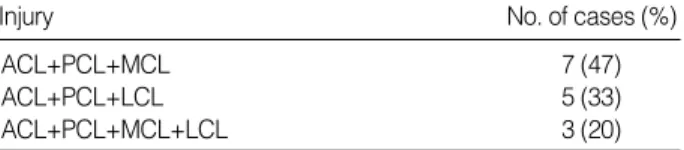
According to anatomical classifications, there were seven cases of ACL/PCL/MCL rupture, five cases of ACL/PCL/LCL rupture, and three cases of ACL/PCL/MCL/LCL rupture (Table 2).
2. Surgical treatment
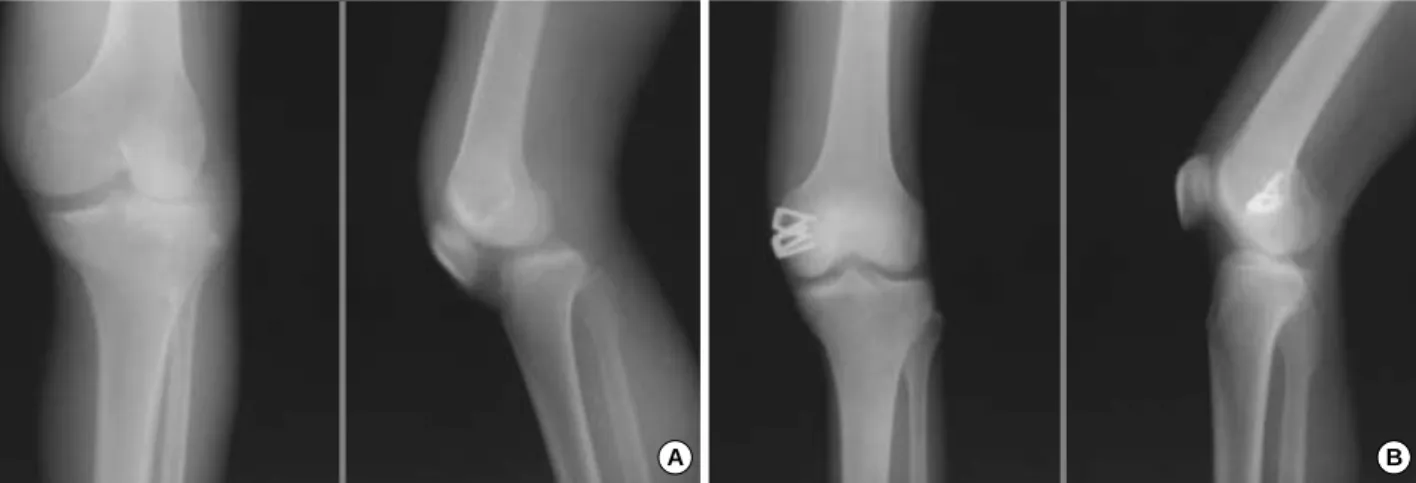
All cases were reduced after standard reduction measures, with the exception of one case in which an open reduction was performed (Fig. 1). In the first surgical stage, all cases underwent collateral ligament repair (14 cases) or reconstruc- tion (1 case) within 2 weeks of the injury. Of the 15 cases, seven underwent medial collateral complex repair, five under- went lateral collateral complex repair (4 cases) or reconstruc- tion (1 cases), and three underwent both medial and lateral repair. In the second surgical stage, there were three cases of ACL reconstruction and seven cases of PCL reconstruction.
No cases required both ACL and PCL surgery, and five cases did not require second stage surgery on either the ACL or PCL.
3. Functional evaluation
Lysholm scores ranged from 65 to 100 points with an aver- age score of 87.6 points. One patient with severe quadriceps atrophy scored 65; when excluding this score, the average
Injury No.
Ankle fracture 2
Femur fracture 2
Fibular fracture 2
Hemothrorax 1
Head & C-spine injury 2
Meniscal tear 5
Pelvic fracture 1
Table 1.Injuries in addition to knee dislocation
ACL, anterior cruciate ligament; PCL, posterior cruciate ligament;
MCL, medial collateral ligament; LCL, lateral collateral ligament.
Injury No. of cases (%)
ACL+PCL+MCL 7 (47)
ACL+PCL+LCL 5 (33)
ACL+PCL+MCL+LCL 3 (20)
Table 2.Anatomical classification of knee dislocations
Lysholm score for the remaining patients was 89.2 points.
One patient complained of intermittent discomfort during daily activity. Every patient experienced mild pain and swel- ling during vigorous exercise.
4. Range of motion
All patients recovered full ROM, but three patients who had limited motion of 0-120°, 5-120°and 5-110°required arthroscopic adhesiolysis or manipulation under general anes- thesia to recover full ROM.
5. Instability evaluation using stress radiography In ten cases with initial medial instability, seven cases were classified as grade 0 and three cases were classified as grade 1 on stress x-rays at the last follow up. In eight cases with ini- tial lateral instability, five cases were classified as grade 0, two cases were classified as grade 1 and one case was classified as grade 2 at the last follow-up examination. In 15 cases with initial anterior instability, 12 cases were classified as grade 0 and three cases were classified as grade 1. In 15 cases with initial posterior instability, three cases were classified as grade 0, eight cases were classified as grade 1 and four cases were classified as grade 2 at the last follow-up examination.
In cases where ACL and PCL instability was not severe and reconstruction was not performed, the results were as follows:
In 12 cases with ACL tears, nine cases were classified as grade 0 and three cases were classified as grade 1 instability; In eight cases of PCL tears, two cases were classified as grade 0, three cases were classified as grade 1 and three cases were classified
as grade 2 instability on stress radiography at last follow up examination.
6. Complications
All cases showed no limitation of motion at the last follow- up examination and there were no cases of infection.
DISCUSSIONS
The treatment of acute knee dislocation in the initial stage must include immediate reduction and neurovascular repair
3,6-8). However, there is controversy concerning the classifica-
tion and treatment of multiple ligament injuries.
Recently, reconstruction of isolated cruciate injuries was standardized, resulting in improved outcomes2,9,10,14). This standard treatment has also resulted in better outcomes after applying these principles to cases of dislocation and multiple ligament injuries11,13).
Even though aggressive ligament repair or reconstruction is needed to treat multiple ligament injuries after dislocation, early surgical treatment can lead to limited ROM of the knee joint due to extensive soft tissue damage18). Based on these reports and concepts, we devised a two stage surgical approach in which cruciate ligament reconstruction was performed in the second stage only if necessary. Using this two stage proce- dure, we were able to obtain superior results in terms of liga- ment stability and ROM recovery. In 2002, Ohkoshi et al.
reported similar results using a different two stage procedure.
In the first stage, PCL reconstruction was performed at an average of 2 weeks after the injury, and in the second stage,
A B
Fig. 1.A 21-year-old man with posterolateral dislocation of the left knee. We performed an open reduction and MCL repair in the first stage because there were reduction problems due to buttonholing of the medial femoral condyle through a torn capsule and MCL. (A) Preoperative radiographs showing posterolateral dislocation. (B) Postoperative radiographs.
ACL and collateral ligament reconstruction were performed 3 months later in cases not treated by conservative methods12).
It is generally agreed that the PCL shows a better natural healing ability than the ACL. Shelbourne et al. reported that in 40 cases of acute PCL rupture, all mild and moderate in- juries underwent natural healing and 19 of 22 severe cases also underwent natural healing of the PCL15). In contrast, the ACL has been reported to have no natural healing abilities4), which may be due to the findings that the PCL and ACL have different types of fibroblasts. However, ACL ruptures near the femoral attachment have been reported to heal after con- servative treatment in some cases15-17). It has also been reported that in some cases (less than 10%) of ACL ruptures, treatment with conservative methods in order to prevent ankylosis re- sulted in sufficient ligament stability and reconstruction was not necessary.
In this study, using the two stage surgical approach, we successfully treated severe knee instability due to multiple ligament injuries after dislocation. In the first stage, injuries of posteromedial and posterolateral structures along with the collateral ligaments were treated. A posterior block was used to prevent posterior subluxation in order to aid the natural healing of cruciate ligaments and to keep the knee in a proper position. If necessary, in the second surgical stage, reconstruc- tion of the ACL or PCL was performed. The results of this study also suggest natural healing of the cruciate ligaments.
CONCLUSIONS
In treatment of acute knee dislocations, superior results were obtained in ROM and ligament stability recovery using our two stage surgical approach. Following the first stage of repair or reconstruction of the collateral ligament complex, natural healing of the ACL and PCL was allowed to occur.
The second stage operation of ACL/PCL reconstruction was only performed in cases where it was deemed necessary. We propose this two stage procedure be considered as an effective approach for treatment of acute traumatic knee dislocation.
REFERENCES
1. Almekinders LC and Logan TC: Results following treatment of traumatic knee dislocations of the knee joint. Orthop Clin North Am, 284: 203-207, 1992.
2. Clancy WG Jr, Ray JM and Zoltan DJ: Acute tears of the anteri-
or cruciate ligament. Surgical versus conservative treatment. J Bone Joint Surg, 70-A: 1483-1488, 1988.
3. Eger M, Huler T and Hirsh M: Popliteal artery occlusion asso- ciated with dislocation of the knee joint. Br J Surg, 57: 315-325, 1970.
4. Hefti FL, Kress A, Fasel J, et al: Healing of transected anterior cruciate ligament in the rabbit. J Bone Joint Surg, 73-A: 373-383, 1991.
5. Hegyes MS, Richardson MW and Miller MD: Knee disloca- tion. Complications of nonoperative and operative management. Clin Sports Med, 19: 519-543, 2000.
6. Kennedy JC: Complete dislocation of the knee joint. J Bone Joint Surg, 45-A: 889-904, 1963.
7. Lysholm J and Gillquist J: Evaluation of knee ligament surgery results with special emphasis on use of a scoring scale. Am J Sports Med, 10: 150-154, 1982.
8. Meyers MH, Moore TM and Harvey JP Jr: Follow-up notes on articles previously published in the journal: traumatic disloca- tion of the knee joint. J Bone Joint Surg, 57-A: 430-433, 1975.
9. Moore TM: Fracture-dislocation of the knee. Clin Orthop, 156:
128-140, 1981.
10. Noyes FR and Barber SD: Allograft reconstruction of the ante- rior and posterior cruciate ligaments: report of ten-year experience and results. Instruct Course Lectures, 42: 381-396, 1993.
11. Noyes FR and Barber-Westin SD: Reconstruction of the ante- rior and posterior cruciate ligaments after knee dislocation: use of early postoperative motion to decrease arthrofibrosis. Am J Sports Med 25: 769-778, 1997.
12. Ohkoshi Y, Nagasaki S, Shibata N, Yamamoto K, Hashimo- to T and Yamane S:Two-stage reconstruction with autografts for knee dislocations. Clin Orthop, 398: 169-175, 2002.
13. Schenck RC Jr, Hunter RE, Osturm RF, et al: Knee dislocations.
Instruct Course Lectures, 48: 515-522, 1999.
14. Shapiro MS and Freedman EL: Allograft reconstruction of the anterior and posterior cruciate ligaments after traumatic knee dis- location. Am J Sports Med, 23: 580-587, 1995.
15. Shelbourne KD, Jennings RW and Vahey TN: Magnetic re- sonance imaging of posterior cruciate ligament injuries: assessment of healing. Am J Knee Surg, 12: 209-213, 1999.
16. Shelbourne KD and Klootwyk TE: Low-velocity knee disloca- tion with sports injuries. Treatment principles. Clin Sports Med, 19: 443-456, 2000.
17. Shelbourne KD, Porter DA, Clingman JA, et al: Low-velocity knee dislocation. Orthop Rev, 20: 995-1004, 1991.
18. Taylor AR, Arden GP and Rainey HA: Traumatic disloca-
tion of the knee: a report of 43 cases with special reference to conser- vative treatment. J Bone Joint Surg, 54-B: 96-102, 1972.
19. Wascher DC, Becker JR, Dexter JG, et al: Reconstruction of
the anterior and posterior cruciate ligaments after knee dislocation:
Results using fresh-frozen nonirradiated allografts. Am J Sports Med, 27: 189-196, 1999.
목 적: 외상성 슬관절 탈구의 치료에서 2단계로 나누어진 새로운 수술원칙의 유용성을 보고하고자 한다.
대상 및 방법: 1997년 10월부터 2001년 11월까지 슬관절 탈구로 내원한 14명, 15예를 대상으로 하였다. 평균 추시 기간은 24개월이었다. 측부인대 복합체는 수상 2주 내에 수술하였고, 이후 불안정성을 보이는 십자인대에 대하여 재건술을 시행 하였다. 결과는 스트레스 방사선 사진, 관절 운동 범위, Lysholm 점수를 이용하여 평가하였다.
결 과: 모든 예에서 전방, 후방십자인대가 파열되었으며, 내측측부인대는 10예, 외측측부인대는 8예에서 파열되었다. 모든 측부인대 복합체 손상에 대하여 수술 시행하였다. 3예에서 전방십자인대, 7예에서 후방십자인대 재건술을 시행하였으며, 5예에서는 재건술이 필요하지 않았다. 최종 스트레스 방사선 검사에서 내측측부인대는 모든 예에서 0-1도, 외측측부인대 는 14예에서 0-1도, 전방십자인대는 모든 예에서 0-1도였으며, 후방십자인대는 11예에서 0-1도, 4예에서 2도였다. Lysholm 점수는 평균 87.6점이었다.
결 론: 외상성 슬관절 탈구의 치료시, 첫 단계로 측부인대의 수술을 시행하고, 이후 선택적으로 십자인대 재건술을 시행하 는 2단계 치료로 좋은 결과를 얻을 수 있었다.
색인 단어: 슬관절 탈구, 2단계 수술적 치료
급성 외상성 슬관절 탈구의 2단계 수술적 치료방법
김종민*ㆍ주동만ㆍ남태석ㆍ안형선�ㆍ안지현�ㆍ김동욱ㆍ빈성일
울산대학교 의과대학 서울아산병원 정형외과학교실, 한일병원 정형외과학교실*, 강릉아산병원 정형외과학교실�, 동국대학교 의과대학 일산병원 정형외과학교실�