INTRODUCTION
The prognosis of children with acute myeloid leukemia (AML) has improved over the past 30 yr (1). Reported sur- vival figures range from 40 to 60%, and the proportion of patients achieving complete remission (CR) range from 70 to 90% (2-6). This success reflects the use of increasingly inten- sive induction chemotherapy followed by post-remission che- motherapy or allogeneic hematopoietic stem cell transplan- tation (HSCT). However, debate continues regarding the best chemotherapeutic regimen in induction and post-remission therapy. The most widely used combination of chemothera-
py for AML is anthracycline and cytarabine (ara-C), often in combination with etoposide or 6-thioguanine (6-TG) (2-6).
Cytarabine is a major antimetabolic drug used in the treat- ment of AML. However, the drug is rapidly inactivated by cytidine deaminase, and has a very short plasma half-life (7).
Many studies have been done on the administration sched- ule and dose of cytarabine in order to achieve optimum ther- apeutic effect with minimal adverse events. Other trials for overcoming the limitation of cytarabines include the devel- opment of cytarabine derivatives resistant to deamination (7).
N4-behenoyl-1-b-D-arabinofuranosylcytosine (BHAC) is lipophilic, resistant to cytidine deaminase, and has strong
9
Dae Hyoung Lee1, Nak Gyun Chung2, Bin Cho2, Hack Ki Kim2,
Hyoung Jin Kang3, Hee Young Shin3, Hyo Seop Ahn3, Keon Hee Yoo4, Ki Woong Sung4, Hong Hoe Koo4, Hoon Kook5, Tai Ju Hwang5, Ho Joon Im6, Jong Jin Seo6, and Hyeon Jin Park7
Department of Pediatrics1, College of Medicine, Hallym University, Seoul; Department of Pediatrics2, College of Medicine, The Catholic University of Korea, Seoul; Department of Pediatrics3, Cancer Research Institute, Seoul National University College of Medicine, Seoul; Department of Pediatrics4, Samsung Medical Center, Sungkyunkwan University School of Medicine, Seoul; Department of Pediatrics5, Chonnam National University Hwasun Hospital, Chonnam National University Medical School, Gwangju; Department of Pediatrics6, Asan Medical Center, University of Ulsan College of Medicine, Seoul; Pediatric Oncology Clinic7, Specific Organs Cancer Center, National Cancer Center, Goyang, Korea
Address for Correspondence Bin Cho, M.D.
Department of Pediatrics, Seoul St. Mary’s Hospital, 641 Banpo-ro, Seocho-gu, Seoul 137-701, Korea Tel : +82.2-2258-6187, Fax : +82.2-537-4544 E-mail : [email protected]
This study was supported by a grant from the Korea Childhood Leukemia Foundation.
Idarubicin Plus Behenoyl Cytarabine and 6-thioguanine Compares Favorably with Idarubicin Plus Cytarabine-based Regimen for Children with Previously Untreated Acute Myeloid Leukemia: 10-Year
Retrospective, Multicenter Study in Korea
We investigated the outcome of idarubicin plus N4-behenoyl-1-b-D-arabinofuranosyl cytosine (BHAC)-based chemotherapy (BHAC group, n=149) compared to idaru- bicin plus cytarabine-based chemotherapy (cytarabine group, n=191) for childhood acute myeloid leukemia (AML). Between January 1996 and December 2005, 340 children with AML from 5 university hospitals in Korea received the BHAC-based or cytarabine-based chemotherapy, with or without hematopoietic stem cell trans- plantation. After induction therapy, 264 (77.6%) of 340 children achieved a complete remission (CR) and 43 (12%) achieved a partial remission (PR). The CR rate in the BHAC group was higher than in the cytarabine group (85.2% vs. 71.7%, P=0.004).
However, the overall response rate (CR+PR) was not different between the two groups (93.3% vs. 87.9%, P=0.139). The 5-yr estimates of overall survival (OS) of children in the two groups were similar (54.9% for the BHAC group vs. 52.4% for the cytarabine group, P=0.281). Although the results were analyzed according to the treatment type and cytogenetic risk, the OS showed no significant difference between the BHAC group and the cytarabine group. In the present study, the clini- cal outcomes of the BHAC-based chemotherapy, consisting of BHAC, idarubicin, and 6-TG, are comparable to that of the cytarabine-based chemotherapy for child- hood AML.
Key Words : Leukemia, Myeloid, Acute; Enocitabine; Childhood
ⓒ 2010 The Korean Academy of Medical Sciences.
This is an Open Access article distributed under the terms of the Creative Commons Attribution Non-Commercial License (http://creativecommons.org/licenses/by-nc/3.0) which permits unrestricted non-commercial use, distribution, and reproduction in any medium, provided the original work is properly cited.
Received : 2 July 2009 Accepted : 10 September 2009
antitumor activity against a wide variety of tumors regard- less of administration schedules (8-10).
In clinical studies, BHAC combined with anthracycline showed a 60-80% CR rate, which was comparable to cytara- bine-based chemotherapy for adult AML (11-14). Idarubicin (IDA)-BHAC combination regimen, which consists of IDA plus BHAC and 6-TG, has been widely used for induction or post-remission therapy for childhood AML in Korea. How- ever, few reports have been made on IDA-BHAC chemother- apy for childhood AML (13, 15). In this retrospective, mul- ticenter study, we report the results of IDA plus BHAC-based chemotherapy for childhood AML between 1996 and 2005.
It is well established that multi-drug combination chemother- apy including cytarabine combined with anthracycline has shown a high CR rate and has been widely used in consolida- tion therapy as well as induction therapy for childhood AML (2-6). Therefore, we investigated the outcomes of BHAC- based chemotherapy compared to the cytarabine-based che- motherapy for childhood AML.
MATERIALS AND METHODS Patients
Between January 1996 and December 2005, 464 children from 5 university hospitals in Korea were diagnosed with AML. Patients included were younger than 20 yr at the time of diagnosis and had no prior treatment. Patients with Down syndrome, secondary AML, extramedullary leukemia with- out bone marrow involvement, or acute promyelocytic leu- kemia were excluded. Patients who underwent HLA-mis- matched HSCT or cord blood transplantation after remission were also excluded. If the number of patients treated with each chemotherapy protocol was below 30, the data from the corresponding institution were not included. A total of 340 children were included in this study.
Diagnosis
Initial diagnosis of AML was done at each hospital. Leu- kemia subtypes were recorded using the French-American- British (FAB) classification system (16). Bone marrow was analyzed for cytogenetic abnormalities and immunopheno- type at diagnosis.
Treatment
The IDA plus BHAC-based induction regimen consisted of BHAC daily 200-250 mg/m2intravenously (IV) for 7 con- secutive days, IDA daily 12 mg/m2IV 3 consecutive days (day 1 to 3), and 6-TG daily 100 mg/m2orally for 7 days. The IDA plus cytarabine-based induction regimen consisted of cytara- bine daily 100 mg/m2continuously IV for 7 days or 100 mg/
m2/12-hr b.i.d IV infusion for 7 days and IDA daily 12 mg/
m2IV 3 consecutive days (day 1 to 3). According to the each institutional principle, etoposide daily 150 mg/m2IV for 3 days (day 4 to 6) and 6-TG daily 160 mg/m2orally for 7 days were added in the IDA plus cytarabine-based induction che- motherapy.
Patients who had achieved a CR received consolidation therapy. Allogeneic HSCT was recommended to all patients in first remission with HLA-matched familial or unrelated donors. HLA typing for class I and class II antigens was per- formed using standard serologic techniques. Familial donor- patient pairs were considered fully matched by compatibili- ty for HLA-A, -B, -C, and -DRB1. Unrelated donor-patient pairs were considered matched for HLA-A, -B, and -DRB1.
The patients without an available donor received autologous HSCT or further intensive chemotherapy in accordance with the institutional principle. Patients who had not achieved remission received another course of chemotherapy. For con- venience, treatment was subdivided into two groups as fol- lows: the patients who underwent HSCT after induction ther- apy (Transplantation group) and the patients who did not receive HSCT (Chemotherapy group), including patients who died during induction chemotherapy or patients lacking an available donor.
In post-remission chemotherapy, each institution adopted a different chemotherapy protocol. Therefore, patients were classified into the ‘‘BHAC group’’ or the ‘‘cytarabine group’’
in accordance with the regimen administered for remission induction.
Definitions and statistics
CR was defined as less than 5% leukemic blasts in the bone marrow with evidence of normal hematopoiesis, no leukemia cells in peripheral blood or anywhere else. Induction death was defined as a fatal event occurring within the first 6 weeks of treatment. Induction death occurring before starting treat- ment was not included in this study. Partial remission (PR) was defined as a bone marrow with 5-15% blast cells and evi- dence of regeneration of normal hematopoietic cells. Patients who did not achieve CR or PR and who survived after the first 6 weeks of treatment were defined as nonresponders (NR).
Cytogenetic abnormalities were classified into 3 risk groups:
low risk, t(8;21), inv(16); high risk, 11q23 rearrangement, -5, del(5q), -7, del(7q), inv(3)/t(3;3)/ins(3;3); intermediate risk, normal karyotype or other numerical or structural abnor- malities.
Event-free survival (EFS) was calculated from the date of diagnosis to last follow-up or first event (failure to achieve remission, demonstration of resistant leukemia, relapse, sec- ond malignancy or death due to any cause, whichever occurr- ed first). Patients who did not attain CR were considered fail- ures at time zero. Overall survival (OS) was defined as the time between diagnosis and death from any cause or time of
last contact.
The characteristics of two chemotherapy groups were com- pared using chi-square test or Fischer’s exact test for categori- cal data and Mann-Whitney U test for continuous variables.
Probabilities of survival were estimated using the Kaplan- Meier method and were compared using the log-rank test.
Data for all surviving patients were censored as of April 2007.
RESULTS Patients characteristics
Patient characteristics of the two groups are given in Table 1. A total of 340 patients were included in the BHAC group and the cytarabine group. There was no significant difference in the patient characteristics between the two groups. The median age at presentation was 7.7 yr, 7% were infants less than 1 yr of age, 34% were 10-yr old or more at diagnosis.
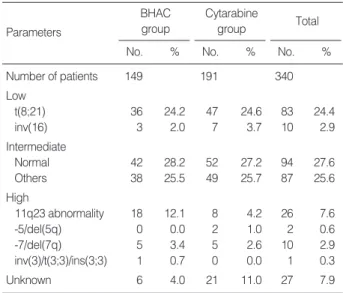
The median white blood cell count (WBC) at diagnosis was 15.8×10⁹/L, and 25% of the children showed a WBC count of at least 50×109/L. Karyotypes were available for 92% of patients. The cytogenetics of patients in the two groups are presented in Table 2. A significant difference was noted with regards to the frequency of cytogenetic aberrations (P=0.03), with patients with the 11q23 rearrangement more frequently observed in the BHAC group than in the cytarabine group.
In the cytarabine group, the different induction regimens were administered equally. HSCT was performed in 211 patients (62%) treated in both groups.
Characteristics
Parameters BHAC
group
Cytarabine
group P value*
Number of patients 149 191
Median age, yr (range) 7.7 (0-17.2) 7.7 (0-18.9) NS
Male/female, n 86/63 105/86 NS
FAB type, n (%) 0.009
M0/M1 18 (12.1) 48 (25.1)
M2 60 (40.3) 74 (38.7)
M4/M5 52 (34.9) 44 (23.0)
M6/M7/others 19 (12.8) 25 (13.1)
WBC at diagnosis (×109/L)
Median 15.9 15.8 NS
Cytogenetic group, n (%) 0.03
Low 39 (26.2) 54 (28.3)
Intermediate 80 (53.7) 101 (52.9)
High 24 (16.1) 15 (7.9)
Unknown 6 (4.0) 21 (11.0)
Induction regimen, n (%)
IDA+BHAC+TG 149 (100)
IDA+Cytarabine 65 (34.0)
IDA+Cytarabine+VP 64 (33.5)
IDA+Cytarabine+VP+TG 62 (32.5)
Treatment, n (%) NS
Chemotherapy 57 (38.7) 72 (37.7)
Transplantation 92 (61.7) 119 (62.3)
Type of transplantation, n (%) <0.001
Familial donor HSCT 22 (14.8) 53 (27.8) Unrelated donor HSCT 28 (18.7) 54 (28.2) Autologous HSCT 42 (28.2) 14 (7.3) Table 1. Patient characteristics
BHAC group
No. %
Cytarabine group
No. %
Total
No. %
Number of patients 149 191 340
Low
t(8;21) 36 24.2 47 24.6 83 24.4
inv(16) 3 2.0 7 3.7 10 2.9
Intermediate
Normal 42 28.2 52 27.2 94 27.6
Others 38 25.5 49 25.7 87 25.6
High
11q23 abnormality 18 12.1 8 4.2 26 7.6
-5/del(5q) 0 0.0 2 1.0 2 0.6
-7/del(7q) 5 3.4 5 2.6 10 2.9
inv(3)/t(3;3)/ins(3;3) 1 0.7 0 0.0 1 0.3
Unknown 6 4.0 21 11.0 27 7.9
Table 2. Details of cytogenetics
*Comparison between the BHAC group and Cytarabine group.
CR, complete remission; PR, partial remission; NR, nonresponder; BHAC, N4-behenoyl-1-b-D-arabinofuranosyl cytosine; NS, not significant.
BHAC group
No. %
Cytarabine group
No. %
Total
P value*
No. %
Number of patients 149 191 340
CR 127 85.2 137 71.7 264 77.6 0.004
PR 12 8.1 31 16.2 43 12.6 0.03
NR 6 4.0 9 4.7 15 4.4 NS
Induction death 4 2.7 14 7.3 18 5.3 NS
Response (CR+PR) 139 93.3 168 87.9 307 90.3 NS
Table 3. Results of induction therapy in the BHAC and the Cytarabine group
BHAC, N4-behenoyl-1-b-D-arabinofuranosyl cytosine.
*Comparison between the BHAC group and Cytarabine group.
M, male; F, female; FAB, French-American-British; WBC, white blood cell count; IDA, idarubicin; BHAC, N4-behenoyl-1-b-D-arabinofuranosyl cytosine; TG, 6-thioguanine; VP, etoposide; HSCT, hematopoietic stem cell transplantation; NS, not significant.
Parameters
Response to induction treatment and survival
After induction chemotherapy, 264 (77.6%) of 340 chil- dren achieved a CR. The results of the BHAC group and the cytarabine group are compared in Table 3. The CR rate in the BHAC group was higher than in the cytarabine group (85.2% vs. 71.7%, P=0.004). However, the overall response (CR+PR) rates between the 2 groups were not significantly different (93.3% vs. 87.9%, P=0.139). The percentage of
induction death and nonresponders showed no significant difference between the two groups. Five (33%) of 15 nonre- sponders after the first induction therapy in the two groups were alive at time of last follow-up. In the cytarabine group, the overall response rates of the three types of induction reg- imen (IDA+cytarabine, IDA+cytarabine+etoposide, and IDA+cytarabine+etoposide+6-TG) were 78.5%, 93.8%, and 91.9%, respectively (P=0.022).
A total of 200 patients survived with a median follow-up of 4.1 yr. The 5-yr estimate of OS of 340 children was 53.3%.
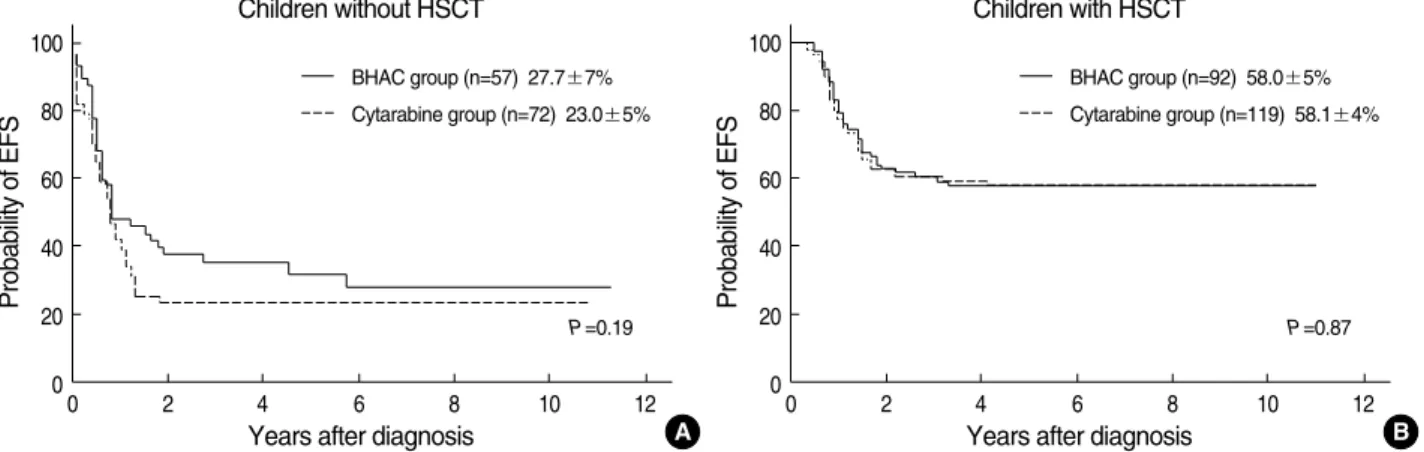
The 5-yr estimates of OS of children were not significantly different between the BHAC group and the cytarabine group (54.9% vs. 52.4%, P=0.281) (Fig. 1). Although the children were divided into the two groups (chemotherapy group and transplantation group), the OS and EFS showed no signifi- cant difference between the BHAC group and the cytarabine group (Fig. 2, 3). When the patients who died during induc- tion chemotherapy were excluded in the chemotherapy group, a total of 111 patients received the further intensive chemo- therapy. The 5-yr estimates of OS of the 111 children in the BHAC group and cytarabine group were 44.6% and 38.6%, respectively (P=0.591) and the EFS were 29.8% and 28.6%, respectively (P=0.679). For patients who received HSCT, the
Probability of OS
100
80
60
40
20
00 2 4 6 8 10 12
Years after diagnosis
BHAC group (n=149) 54.9±4%
Cytarabine group (n=191) 52.4±4%
P=0.28
Fig. 1. Kaplan-Meier estimates of OS at 5 yr for the 340 children.
Probability of OS
100
80
60
40
20
00 2 4 6 8 10 12
Years after diagnosis Children without HSCT
BHAC group (n=57) 41.5±7%
Cytarabine group (n=72) 31.0±6%
P=0.14
Fig. 2. Kaplan-Meier estimates of OS of children without HSCT (A) and with HSCT (B) at 5 yr.
A
Probability of OS
100
80
60
40
20
00 2 4 6 8 10 12
Years after diagnosis Children with HSCT
BHAC group (n=92) 62.5±5%
Cytarabine group (n=119) 64.1±4%
P=0.77
B
Probability of EFS
100
80
60
40
20
00 2 4 6 8 10 12
Years after diagnosis Children without HSCT
BHAC group (n=57) 27.7±7%
Cytarabine group (n=72) 23.0±5%
P=0.19
Fig. 3. Kaplan-Meier estimates of EFS of children without HSCT (A) and with HSCT (B) at 5 yr.
A
Probability of EFS
100
80
60
40
20
00 2 4 6 8 10 12
Years after diagnosis Children with HSCT
BHAC group (n=92) 58.0±5%
Cytarabine group (n=119) 58.1±4%
P=0.87
B
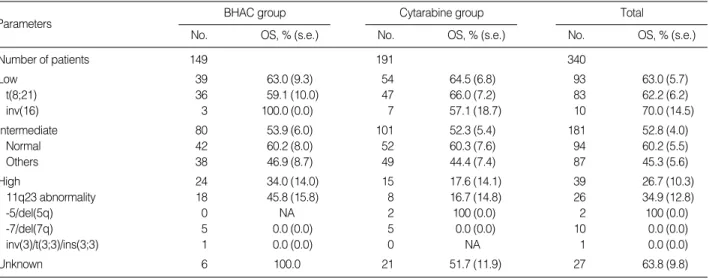
OS and EFS of children in the two groups were similar with regard to the type of HSCT (Table 4). The OS of patients in the two groups was also not significantly different in terms of the cytogenetic risk (Table 5).
The 5-yr estimates of OS and EFS of patients achieving a first CR were higher in the transplantation group (64.4%
and 58.0%, respectively) than in the chemotherapy group (41.0% and 28.6%, respectively) (P<0.001).
DISCUSSION
In the present study, the clinical outcome of the BHAC- based regimen, consisting of BHAC, idarubicin, and 6-TG, are comparable to that of the cytarabine-based regimen for childhood AML. In a phase II study, BHAC monotherapy for
adult AML produced a 36% CR rate and adverse events such as nausea and vomiting were less than for cytarabine (17). In a comparative study between BHAC and cytarabine in com- bination induction and consolidation therapy for adults with de novo AML, the efficacy of BHAC given with daunorubicin was found to be inferior to that of cytarabine in combination with daunorubicin (14). However, the dose of BHAC was not equivalent to that of cytarabine in terms of the mean leuko- cyte nadir of both groups (18). In Korea, the combination regimen consisting of IDA and BHAC has been widely used for induction or post-remission therapy for adult and child- hood AML since 1996. Park et al. (13) reported that IDA- BHAC combination regimen for previously untreated adult and childhood AML showed a high CR rate (75%), which was similar or superior to results obtained with cytarabine and other anthracyclines. However, a small number of chil- dren (22%) were included in their study and follow-up dura- tion was too short to draw a complete conclusion.
The anti-leukemic efficacy of IDA-BHAC regimen in remis- sion induction appears to be effective, with a high CR rate (85.2%) compared to the CR rate (71.7%) of cytarabine-based regimen in our study. The proportion of NR is comparable between the 2 groups after remission induction chemother- apy (4% in the BHAC group; 4.7% in the cytarabine group).
In the present study, children in the two groups have a sim- ilar 5-yr estimate of OS (55% in the BHAC group; 53% in the cytarabine group). These results are comparable to pre- viously summarized results of the AML-BFM93, UK-MRC AML10, CCG-2891, and NOPHO-AML93, which enroll- ed patients between 1988 and 2001 (2-4, 6). Children with de novo AML in these studies showed CR rates of 78-93%, induction death rates of 2-7%, proportion of NR of 3-18%, and 5-yr estimates of OS of 47-66%. The addition of other agents to the standard ‘‘7+3’’ induction regimen did not im-
*Comparison between the BHAC group and Cytarabine group.
EFS, event-free survival; OS, overall survival; BHAC, N4-behenoyl-1-b- D-arabinofuranosyl cytosine; HSCT, hematopoietic stem cell transplan- tation; s.e., standard error; NS, not significant.
BHAC group
Cytarabine
group P value*
Number of patients 149 191
EFS at 5 yr, % (s.e.) NS
Familial donor HSCT 77.3 (8.9) 54.4 (7.2) Unrelated donor HSCT 59.1 (9.6) 60.3 (6.8) Autologous HSCT 48.5 (7.8) 57.1 (13.2)
OS at 5 yr, % (s.e.) NS
Familial donor HSCT 74.7 (10.0) 62.6 (7.6) Unrelated donor HSCT 61.6 (9.8) 69.8 (6.3) Autologous HSCT 59.2 (8.8) 64.3 (12.8)
Table 4. Results of HSCT in the BHAC and the Cytarabine group
BHAC group
No. OS, % (s.e.)
Total
No. OS, % (s.e.)
Cytarabine group
No. OS, % (s.e.)
Number of patients 149 191 340
Low 39 63.0 (9.3) 54 64.5 (6.8) 93 63.0 (5.7)
t(8;21) 36 59.1 (10.0) 47 66.0 (7.2) 83 62.2 (6.2)
inv(16) 3 100.0 (0.0) 7 57.1 (18.7) 10 70.0 (14.5)
Intermediate 80 53.9 (6.0) 101 52.3 (5.4) 181 52.8 (4.0)
Normal 42 60.2 (8.0) 52 60.3 (7.6) 94 60.2 (5.5)
Others 38 46.9 (8.7) 49 44.4 (7.4) 87 45.3 (5.6)
High 24 34.0 (14.0) 15 17.6 (14.1) 39 26.7 (10.3)
11q23 abnormality 18 45.8 (15.8) 8 16.7 (14.8) 26 34.9 (12.8)
-5/del(5q) 0 NA 2 100 (0.0) 2 100 (0.0)
-7/del(7q) 5 0.0 (0.0) 5 0.0 (0.0) 10 0.0 (0.0)
inv(3)/t(3;3)/ins(3;3) 1 0.0 (0.0) 0 NA 1 0.0 (0.0)
Unknown 6 100.0 21 51.7 (11.9) 27 63.8 (9.8)
Table 5. Probability of 5-yr OS by cytogenetic prognostic group at diagnosis
The OS of children in the two groups were not significantly different in regard to the cytogenetic risk.
OS, overall survival; NA, not applicable; s.e., standard error; BHAC, N4-behenoyl-1-b-D-arabinofuranosyl cytosine.
Parameters
Parameters
prove the remission rate, OS or EFS in children and adoles- cents with AML in UK-MRC AML10 trial and CCG-213 study (2, 3). In our results, the addition of etoposide improves the remission rate. However, children who received the three types of induction regimen have shown similar long-term outcome in terms of OS and EFS.
Since the cytotoxic effect of cytarabine is time-dependent and S-phase specific, the standard dose of cytarabine is thought to have better therapeutic effects when administered by con- tinuous IV infusions rather than by short-time IV infusion (7). Because BHAC, a new cytarabine analogue, has a long plasma half-life after IV administration and releases cytara- bine slowly, it may give the same effect as continuous cytara- bine infusion (19). Studies of Nara et al. (10) have demon- strated that BHAC is rapidly taken into leukemic blasts and converted to cytarabine, and has a suppressive activity on self-renewal of leukemic blast progenitors in vitro. There- fore, BHAC may contribute to these results which are com- parable to those of cytarabine-based chemotherapy.
In our study, the 5-yr estimates of EFS and OS for children appear to be much lower in the chemotherapy group than in the transplantation group. In this retrospective survey, the chemotherapy group includes induction deaths and has more nonresponders than the transplantation group. Although autologous and allogeneic HSCT represent approaches to dose intensification, several randomized studies in pediatrics have shown no advantage of autologous HSCT compared to chemotherapy alone and the majority of clinical trials have demonstrated a consistent advantage for allogeneic HSCT in terms of disease-free survival, but not always for OS (3, 6, 20-22). In our study period, allogeneic HSCT was recom- mended to all patients in first remission with HLA-matched familial or unrelated donors and autologous HSCT was per- formed for patients without an available donor. The patients who were not candidates for HSCT received intensive chemo- therapy according to the institutional principle. Therefore, our study is not a prospective randomized trial comparing chemotherapy with HSCT and our results may have a selec- tion bias in survival analysis. For this reason, our results do not suggest the superiority of transplantation over intensive chemotherapy but the comparable outcomes of IDA plus BHAC and 6-TG versus idarubicin plus cytarabine-based regimen in childhood de novo AML regardless of post-induc- tion therapy.
The cytogenetic aberrations in our study show a high pro- portion of children with t(8;21) compared to other studies (2-6). In our pediatric population, the children with favorable karyotypes such as t(8;21) or inv(16) appear to show a bet- ter outcome than those with an unfavorable kayrotype in both the BHAC and cytarabine group. However, recent reports suggest that t(8;21) and inv(16) AMLs seem to be distinct clinical entities and should be stratified and reported sepa- rately when considering race, secondary cytogenetic abnor- malities (23, 24). Karyotype markers with unfavorable impli-
cations also have been identified, such as -5/del(5q) and -7/
del(7q) (3). In our data, the patients with -7/del(7q) show a very poor prognosis compared to the reported figure (21).
Only two patients had -5/del(5q), a rare cytogenetic abnor- mality in children, so it appears difficult to draw any conclu- sion. This issue needs to be elucidated further in the future, as well as the other prognostic implications such as FLT3 inter- nal tandem duplications (FLT3-ITDs) (25).
This study is limited by its retrospective nature. Patients are not equally randomized into the BHAC group and cytara- bine group in induction or post-remission therapy at each institution. There is a little heterogeneity in the induction regimen and post-remission therapy in terms of administra- tion schedule of cytarabine, addition of etoposide, and dif- ferent consolidation schedule. However, the main point of our investigation is that BHAC shows a similar efficacy com- pared to cytarabine in combination chemotherapy in view of induction response and long term survival. Another limi- tation is that the information for adverse events during induc- tion therapy is not enough to compare the two groups in terms of regimen-related toxicity. Since childhood AML is a rare disease, further studies with a prospective, randomized, mul- tiinstitutional cohort are required to validate the results of our study and additional studies about risk-directed therapy including post-remission intensive chemotherapy and HSCT are warranted.
ACKNOWLEDGMENT
The authors are grateful to all members of the Korean Soci- ety of Pediatric Hematology-Oncology for data collection.
REFERENCES
1. Kaspers GJ, Creutzig U. Pediatric acute myeloid leukemia: interna- tional progress and future directions. Leukemia 2005; 19: 2025-9.
2. Smith FO, Alonzo TA, Gerbing RB, Woods WG; Arceci RJ for the Children’s Cancer Group. Long-term results of children with acute myeloid leukemia: a report of three consecutive Phase III trials by the Children’s Cancer Group: CCG 251, CCG 213 and CCG 2891.
Leukemia 2005; 19: 2054-62.
3. Gibson BE, Wheatley K, Hann IM, Stevens RF, Webb D, Hills RK, De Graaf SS, Harrison CJ. Treatment strategy and long-term results in paediatric patients treated in consecutive UK AML trials. Leu- kemia 2005; 19: 2130-8.
4. Lie SO, Abrahamsson J, Clausen N, Forestier E, Hasle H, Hovi L, Jonmundsson G, Mellander L, Siimes MA, Yssing M, Zeller B, Gus- tafsson G; Nordic Society of Pediatric Hematology and Oncology (NOPHO); AML Study Group. Long-term results in children with AML: NOPHO-AML Study Group--report of three consecutive tri- als. Leukemia 2005; 19: 2090-100.
5. Ravindranath Y, Chang M, Steuber CP, Becton D, Dahl G, Civin C,
Camitta B, Carroll A, Raimondi SC, Weinstein HJ; Pediatric Oncol- ogy Group. Pediatric Oncology Group (POG) studies of acute mye- loid leukemia (AML): a review of four consecutive childhood AML trials conducted between 1981 and 2000. Leukemia 2005; 19: 2101-16.
6. Creutzig U, Zimmermann M, Ritter J, Reinhardt D, Hermann J, Henze G, Ju_rgens H, Kabisch H, Reiter A, Riehm H, Gadner H, Schellong G. Treatment strategies and long-term results in paediatric patients treated in four consecutive AML-BFM trials. Leukemia 2005; 19:
2030-42.
7. Hamada A, Kawaguchi T, Nakano M. Clinical pharmacokinetics of cytarabine formulations. Clin Pharmacokinet 2002; 41: 705-18.
8. Aoshima M, Tsukagoshi S, Sakurai Y, Oh-ishi JI, Ishida T, Kobayashi H. N4-Behenoyl-1-beta-D-arabinofuranosylcytosine as a potential new antitumor agent. Cancer Res 1977; 37: 2481-6.
9. Aoshima M, Tsukagoshi S, Sakurai Y, Oh-ishi J, Ishida T, Kobayashi H. Antitumor activities of newly synthesized N4-acyl-1-beta-D-ara- binofuranosylcytosine. Cancer Res 1976; 36: 2726-32.
10. Nara N, Tohda S, Suzuki T, Nagata K, Yamashita Y, Imai Y, Maruya- ma Y, Tomiyama J. Effects of N4-behenoyl-1-beta-D-arabinofura- nosylcytosine on blast progenitors of acute myeloblastic leukemia.
Cancer Res 1990; 50: 7587-92.
11. Ohno R, Kato Y, Nagura E, Murase T, Okumura M, Yamada H, Ogura M, Minami S, Suzuki H, Morishima Y, Yokomaku S, Ezaki K, Kodera Y, Kawashima K, Saito H, Yamada K. Behenoyl cytosine arabinoside, daunorubicin, 6-mercaptopurine, and prednisolone com- bination therapy for acute myelogenous leukemia in adults and prog- nostic factors related to remission duration and survival length. J Clin Oncol 1986; 4: 1740-7.
12. Nagura E, Kimura K, Yamada K, Ohta K, Maekawa T, Takaku F, Uchino H, Masaoka T, Amaki I, Kawashima K, Kariyone S, Toya- ma K, Ichimaru M, Nomura T, Sakai Y, Takatsuki K, Hamajima N.
Nationwide randomized comparative study of daunorubicin and aclarubicin in combination with behenoyl cytosine arabinoside, 6- mercaptopurine, and prednisolone for previously untreated acute myeloid leukemia. Cancer Chemother Pharmacol 1994; 34: 23-9.
13. Park HS, Kim DW, Kim CC, Kim HK, Kim JS, Hwang TJ, Kim HJ, Kim HS, Song HS, Park JW, Ahn HS, Chung TJ, Cho KS, Lee KS, Choi YM. Induction chemotherapy with idarubicin plus N4-behenoyl- 1-beta-D-arabinofuranosylcytosine in acute myelogenous leukemia:
a newly designed induction regimen--a prospective, cooperative multi- center study. Semin Hematol 1996; 33 (4 Suppl 3): 24-9.
14. Kobayashi T, Miyawaki S, Tanimoto M, Kuriyama K, Murakami H, Yoshida M, Minami S, Minato K, Tsubaki K, Ohmoto E, Oh H, Jinnai I, Sakamaki H, Hiraoka A, Kanamaru A, Takahashi I, Saito K, Naoe T, Yamada O, Asou N, Kageyama S, Emi N, Matsuoka A, Tomon- aga M, Ohno R. Randomized trials between behenoyl cytarabine and cytarabine in combination induction and consolidation therapy, and with or without ubenimex after maintenance/intensification therapy in adult acute myeloid leukemia. The Japan Leukemia Study Group.
J Clin Oncol 1996; 14: 204-13.
15. Takashima Y. Clinical use of intermediate to high dose of N4-behe- noyl-1-beta-D-arabinofuranosylcytosine in children with acute leu-
kemia. J Clin Pharmacol 1988; 28: 356-62.
16. Bennett JM, Catovsky D, Daniel MT, Flandrin G, Galton DA, Gral- nick HR, Sultan C. Proposals for the classification of the acute leu- kaemias. French-American-British (FAB) co-operative group. Br J Haematol 1976; 33: 451-8.
17. Kimura K, Ohno R, Amaki I, Hattori K, Hirota Y, Hoshino A, Ichi- maru M, Ito M, Kimura I, Maekawa T, Masaoka T, Nakamura T, Ogawa M, Oguro M, Ohta K, Osamura S, Shimoyama M, Takaku F, Uzuka Y, Yamada K. Treatment of acute myelogenous leukemia in adults with N4-behenoyl-1-beta-D-arabinofuranosylcytosine. Can- cer 1985; 56: 1913-7.
18. Miyawaki S, Kobayashi T, Tanimoto M, Kuriyama K, Murakami H, Yoshida M, Minami S, Minato K, Tsubaki K, Omoto E, Oh H, Jin- nai I, Sakamaki H, Hiraoka A, Kanamaru A, Takahashi I, Saito K, Naoe T, Yamada O, Asou N, Kageyama S, Emi N, Ueda T, Tomon- aga M, Ohno R. Comparison of leukopenia between cytarabine and behenoyl cytarabine in JALSG AML-89 consolidation therapy. The Japan Adult Leukemia Study Group. Int J Hematol 1999; 70: 56-7.
19. Ueda T, Nakamura T, Ando S, Kagawa D, Sasada M, Uchino H, Johno I, Akiyama Y. Pharmacokinetics of N4-behenoyl-1-beta-D- arabinofuranosylcytosine in patients with acute leukemia. Cancer Res 1983; 43: 3412-6.
20. Ravindranath Y, Yeager AM, Chang MN, Steuber CP, Krischer J, Graham-Pole J, Carroll A, Inoue S, Camitta B, Weinstein HJ. Autol- ogous bone marrow transplantation versus intensive consolidation chemotherapy for acute myeloid leukemia in childhood. Pediatric Oncology Group. N Engl J Med 1996; 334: 1428-34.
21. Alonzo TA, Wells RJ, Woods WG, Lange B, Gerbing RB, Buxton AB, Neudorf S, Sanders J, Smith FO, Feig SA. Postremission ther- apy for children with acute myeloid leukemia: the children’s cancer group experience in the transplant era. Leukemia 2005; 19: 965-70.
22. Oliansky DM, Rizzo JD, Aplan PD, Arceci RJ, Leone L, Ravindra- nath Y, Sanders JE, Smith FO 3rd, Wilmot F, McCarthy PL Jr, Hahn T. The role of cytotoxic therapy with hematopoietic stem cell transplan- tation in the therapy of acute myeloid leukemia in children: an evidence- based review. Biol Blood Marrow Transplant 2007; 13: 1-25.
23. Marcucci G, Mro@zek K, Ruppert AS, Maharry K, Kolitz JE, Moore JO, Mayer RJ, Pettenati MJ, Powell BL, Edwards CG, Sterling LJ, Vardiman JW, Schiffer CA, Carroll AJ, Larson RA, Bloomfield CD.
Prognostic factors and outcome of core binding factor acute mye- loid leukemia patients with t(8;21) differ from those of patients with inv(16): a Cancer and Leukemia Group B study. J Clin Oncol 2005;
23: 5705-17.
24. Narimatsu H, Yokozawa T, Iida H, Tsuzuki M, Hayakawa M, Takeo T, Iino M, Ichihashi T, Kato C, Sawamoto A, Sao H, Yanada M, Emi N, Kiyoi H, Yamaguchi T, Naoe T, Suzuki R, Sugiura I. Clinical characteristics and outcomes in patients with t(8;21) acute myeloid leukemia in Japan. Leukemia 2008; 22: 428-32.
25. Meshinchi S, Alonzo TA, Stirewalt DL, Zwaan M, Zimmerman M, Reinhardt D, Kaspers GJ, Heerema NA, Gerbing R, Lange BJ, Radich JP. Clinical implications of FLT3 mutations in pediatric AML. Blood 2006; 108: 3654-61.