서 론
소아의 폐쇄성수면무호흡증후군(obstructive sleep apnea syn- drome, OSAS)은 폐쇄성수면호흡장애(sleep disordered breathing) 의 가장 심한 형태로서, 심혈관계와 성장에 영향을 주며 인지장애 나 주의력결핍/과잉행동과 같은 신경행동학적 이상을 초래할 수 있 다.1 천식과의 연관성도 많이 연구되고 있는데, 야간 호흡곤란(noc- turnal dyspnea)을 동반한 잘 조절되지 않는 심한 천식의 경우 폐쇄 성수면무호흡증후군 동반 여부를 살펴보는 것이 필요하겠다.2
폐쇄성수면무호흡증후군의 확진 검사로서 표준수면다원검사 는 비용과 시간이 많이 들며, 훈련받은 인력과 장비 및 시설이 있는 전문화된 센터에서만 시행할 수 있다. 이에, 수면다원검사를 해야 하는 환자들을 선별하기 위한 도구로서 폐쇄성수면호흡장애를 예 측할 수 있는 다양한 수면설문지들이 개발되어 왔는데,3-5 빠르고 쉽게 적용할 수 있으며 비용이 거의 들지 않는다는 장점이 있다.
최근 국내에서는 수면다원검사에 보험이 적용되어 일부 환자군 에서 비용 절감 효과가 있으나, 이에 부합하지 않는 환자군에서는
여전히 비용 부담이 될 수밖에 없다. 이에 소아를 대상으로 한 수면 설문지 일부를 소개함으로써(Table 1), 폐쇄성수면무호흡증후군의 진단이 필요한 환자들을 선별하는 데에 도움이 되고자 한다.
소아용 수면설문지
1. Pediatric Sleep Questionnaires
이는 Chervin 등4이 개발한 22개 항목의 ‘예’ 또는 ‘아니오’로 답 하는 설문지로 코골이, 낮시간의 과다졸림과 행동 문제에 중점을 두고 있다. 작성하는 데 15분 정도 걸리며, 8개 항목 이상에서 ‘예’라 고 대답하면 양성(비정상, 폐쇄성수면무호흡증후군의 가능성)으 로 간주된다. 소아 수면설문지 중 가장 유용한 것으로 평가되며, 유 럽호흡기학회에서도 이를 추천하였다.6 특별히, 편도/아데노이드 절제술 이후 폐쇄성수면무호흡증후군과 관련된 신경행동학적 문 제 개선을 예측하는 데 탁월하였다.7
천식이 있는 소아에서 폐쇄성수면무호흡 동반 여부를 선별하는 데 Pediatric Sleep Questionnaires (PSQ)가 유용한 것으로 보고한
Allergy Asthma Respir Dis 7(3):122-128, July 2019 https://doi.org/10.4168/aard.2019.7.3.122 REVIEW
Correspondence to: Eun Kyeong Kang https://orcid.org/0000-0003-4226-0700 Department of Pediatrics, Dongguk University Ilsan Hospital, 27 Dongguk-ro, Ilsandong-gu, Goyang 10326, Korea
Tel: +82-31-961-7170, Fax: +82-31-961-7188, E-mail: [email protected] Received: March 16, 2019 Revised: May 31, 2019 Accepted: May 31, 2019
© 2019 The Korean Academy of Pediatric Allergy and Respiratory Disease The Korean Academy of Asthma, Allergy and Clinical Immunology This is an Open Access article distributed under the terms of the Creative Commons Attribution Non-Commercial License
폐쇄성수면무호흡증후군 선별을 위한 소아용 수면설문지
강은경
동국대학교 일산병원 소아청소년과
Pediatric sleep questionnaires for screening of obstructive sleep apnea syndrome
Eun Kyeong Kang
Department of Pediatrics, Dongguk University Ilsan Hospital, Goyang, Korea
Obstructive sleep apnea syndrome (OSAS) is the most severe form of obstructive sleep-disordered breathing. It can produce cardio- vascular problems, growth retardation, cognitive deficits, and behavioral problems such as attention deficit/hyperactivity symp- toms in children. The diagnostic gold standard for OSAS is overnight polysomnography, but it is expensive, time-consuming, and la- bor intensive, and is conducted by specialized centers which have trained personnel. Therefore, sleep questionnaires as screening tools for OSAS was developed. The benefits of sleep questionnaires are easy/quick application and low cost. The objective of this re- view is to describe several available pediatric sleep questionnaires which are helpful in screening OSAS. (Allergy Asthma Respir Dis 2019;7:122-128)
Keywords: Obstructive sleep apnea syndrome, Sleep questionnaire, Child
2017-03-16 https://crossmark-cdn.crossref.org/widget/v2.0/logos/CROSSMARK_Color_square.svg
최근 연구도 있다.8 PSQ는 한국어로 ‘소아 수면 무호흡에 관한 설문’
으로 번역이 되어 있어 진료실에서 활용 가능하다(Fig. 1).
2. Sleep clinical record
기존의 설문지들은 수면호흡장애(sleep disordered breathing)의 증상을 기반으로 하여 이를 선별하기에는 유용하나 수면다원검사 를 대체할 수는 없었다.6 이를 보완하기 위해 Villa 등9은 신체 진찰
에 대한 항목을 추가하여 sleep clinical record (SCR)를 개발하였 다. 30–60분 정도 걸리는 복합적인 설문지로 PSQ와는 달리 의사나 훈련된 전문 인력이 작성할 수 있다. 첫 부분은 코, 구강, 교합, 얼굴 표현형에 대한 신체 진찰의 세부항목으로 이루어져 있고, 두 번째 와 세 번째 부분은 폐쇄성수면호흡장애의 야간 증상과 중추신경 증상, 주의력결핍/과잉행동 평가척도에 대한 설문으로 구성되어 있 다. 코골이가 있는 소아에서 SCR 6.5점 이상이면 비정상이며 수면 Fig. 1. Korean version of Pediatric Sleep Questionnaire.
Table 1. Comparison of pediatric sleep questionnaires for obstructive sleep disordered breathing
Questionnaire Age No. of questions Completion time (min) Respondent Sensitivity (%) Specificity (%)
PSQ 2–18 yr 22 10–15 Parent 78 72
SCR All Complex 30–60 Physician/parent 96 67
OSA-18 6 mo–12 yr 18 10–15 Parent 59 48
I’M SLEEPY All 8 5 Parent child version (≥ 7 yr) 82 50
Teen STOP-Bang 9–18 yr 8 5 Parent/self-report 56 84
CSHQ 4–12 yr 45 20 Parent - -
PSQ, Pediatric Sleep Questionnaires; SCR, sleep clinical record; OSA-18, obstructive sleep apnea-18; CSHQ, Children’s Sleep Health Questionnaire.
Fig. 2. Korean version of obstructive sleep apnea-18 (KOSA-18).
다원검사상 폐쇄성수면무호흡증후군(무호흡/저호흡지수[apnea hypopnea index, AHI]>1 episode/hr)을 진단하는 데 민감도 96%, 특이도는 67%였다. 유럽호흡기학회는 Task force 가이드라인에서 PSQ와 함께 SCR도 진단적 도구로 제안하였다.
3. Obstructive sleep apnea-18
이 설문지는 폐쇄성수면호흡장애의 주간 및 야간 증상이 보호 자와 아이의 삶의 질에 미치는 영향을 평가하는 18개 항목으로 되 어 있으며 10–15분 정도 소요된다.5 이후 연구에서 수면다원검사의 결과를 예측하는 데 민감도와 특이도가 낮다고 보고되어10 유럽호 흡기학회에서는 진단적 도구로 추천하고 있지 않다.6
국내에서는 Korean version of obstructive sleep apnea-18 (Fig. 2) 이라는 한국어 버전으로 연구에 사용되고 있다.11,12 이비인후과를 방문한 3세 이상, 편도 크기가 3단계 이상인 소아에서 수면다원검 사 결과 중 AHI와는 상관관계가 없었지만 호흡장애지수(respira- tory disturbance index)와 각성지수(arousal index)와 상관관계를 보였다.11
4. I’M SLEEPY
I’M SLEEPY 설문지는 8개 질문으로 구성되었고 3개 이상의 질 문에 ‘예’이면 비정상으로 간주된다.13 작성에 5분 정도 걸리며 시간
이 짧다는 것이 가장 큰 장점이다. 설문지의 단순성에 비해서는 상 대적으로 높은 민감도(민감도 82%, 특이도 50%)로 보고되었으나, 2014년도에 개발되어 2016년 유럽호흡기학회 가이드라인에서는 다뤄지지 않았다.14 이 설문지를 더 짧게 3개의 질문으로 변형한 것 이 OSAsq3 설문지인데, 폐쇄성수면호흡장애의 야간 증상만 다루 고 있다.14
설문지 중 부모 버전을 풀어 설명하면 I (Is your child often Irri- tated or angry during the night?), M (Body Mass Index>85%?), S (does your child usually Snore?), L (Does your child sometimes have Labored breathing at night?), E (Ever noticed a stop in your child’s breathing at night?), E (Does your child have Enlarged ton- sils and/or adenoids?), P (Does your child have Problems with concentration?), Y (Does your child often Yawn or is often tired/
sleepy during the day?)이다. 체질량지수나 편도/아데노이드 비대 등의 신체 진찰 소견도 간접적으로 다루고 있는 것이 특징이다.
5. Teen STOP-Bang
성인에서 폐쇄성수면무호흡증후군의 위험도를 층화하는 데 흔 히 쓰이고 있는 STOP-Bang 설문지를 소아 연령, 특히 십대를 위해 서 변형한 최근 설문지이다.15 혈압과 인체계측 지표(체질량지수, 목 둘레)가 들어간 것이 특징이며, 8개의 항목으로 이루어져 있다
(Table 2). Teen STOP-Bang 점수가 3점 이상일 때 폐쇄성수면무호 흡증후군 진단에 대한 민감도 56%, 특이도 84%였다.
6. Children’s Sleep Health Questionnaire
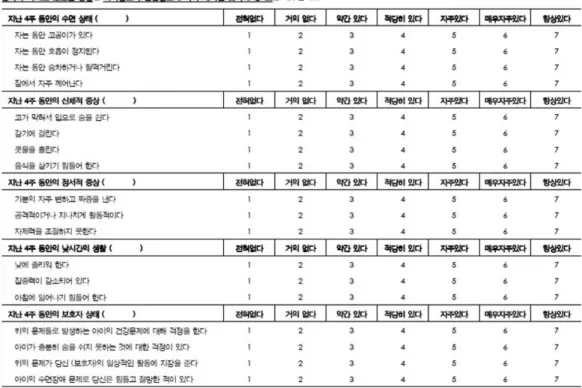
이 설문지는 45개 항목으로 구성되어 있으며 학동기 소아를 대 상으로 만들어졌으나 학동전기 연령에서도 사용되고 있다. 35개 항목으로 줄여 8개 소제목으로 구분한—(1) 잠자리 저항(bedtime resistance), (2) 수면 개시 지연(sleep onset delay), (3) 수면시간 (sleep duration), (4) 수면 불안(sleep anxiety), (5) 야간에 깨는 것 (night wakings), (6) 사건수면(parasomnias), (7) 수면호흡장애 (sleep-disordered breathing), (8) 주간졸림(daytime sleepiness)—
설문지를 주로 사용한다.16
이 Children’s Sleep Health Questionnaire (CSHQ)를 바탕으로 하여 수면 스케줄에 대한 질문을 더 추가하고 수정하여 한글판으 로 만든 것이 ‘소아청소년 수면 평가 설문’인데(Appendix 1), 원래의 CSHQ 설문지와는 다소 차이가 있어 보인다. 이 CSHQ의 한글판 에서 항목을 더 줄이고 선별하여 만든 것으로 보이는 32개 항목의 설문지를 사용하여 알레르기질환을 가진 소아 환자의 수면장애를 조사한 연구가 있었다.17 최근 일본에서는 CSHQ 중에서 19개 항목 을 발췌하여 원래 CSHQ와의 일치성을 보는 연구18가 보고되었고, 그리스에서는 알레르기비염 환자를 대상으로 Pediatric Allergic Rhinitis Quality of Life 설문지와 CSHQ 설문지와의 일치도를 본 연구도 있었다.19 수면호흡장애뿐 아니라 전반적인 수면 문제를 다 루고 있어 유럽호흡기학회 가이드라인에서는 OSAS 진단도구로 언 급하지 않았다.
수면설문지와 그 외 임상 자료를 융합한 OSAS 예측 모델
임상적 지표들, 즉 인구학적 특성, 진찰소견, 수면설문지(Ep- worth 졸림척도, PSQ, OSA-18)가 OSAS의 심한 정도를 예측할 수 있는지에 대한 다기관 전향적 연구인 CHAT (ChildHood Adeno- Tonsillectomy) study에서는 이런 임상 정보들이 OSAS 중증도의
단계를 신뢰성 있게 구별하지 못한다고 보고하였다.20 하지만 이 연 구에서는 여러 지표들을 조합해서 OSAS의 예측에 대한 상관관계 는 조사하지 않았다. 비슷한 시기에 진행된 두 번째의 전향적 연구 는 진찰 소견인 편도비대와 PSQ 설문지와 산소 불포화 지수(oxy- gen desaturation index)를 조합하여 통계모델을 만들어 OSAS 예 측에 민감도 88%, 특이도 86%를 가진다고 발표하였다.21 SCR 설문 지도 비슷한 연구가 있었는데, 이 설문지와 야간 산소측정법(noc- turnal oximetry)을 함께 사용했을 때는 중등-심한 정도의 폐쇄성 수면무호흡증후군(AHI>5 episode/hr)을 예측하는 데 높은 특이 도를 보였다.22
결론 및 고찰
앞에서 살펴본 몇몇(PSQ, SCR, I’M SLEEPY, teen STOP-Bang) 수면설문지는 소아에서 폐쇄성수면호흡장애를 선별하는 데 유용 한 도구로 사용될 수 있다. 국내에서도 소아 수면설문지를 활용한 연구가 일부 있었지만, 향후 통일된 형식의 소아 수면설문지를 활용 하여 수면다원검사와 연계하여 OSAS의 중증도를 예측하는 다기 관 연구가 필요하다. 그러기 위해서는 한국 실정을 고려하여 다학 제(소아 호흡기/소아 신경분과, 소아 치과, 이비인후과, 신경과, 정신 건강의학과 등 소아 수면 환자를 보는 모든 파트) 간 협업으로 적절 한 변수들로 구성된 단일화된 설문지를 개발하는 것이 우선이다.
또한 야간 산소측정법이나 최근 개발되어 연구 중인 WatchPAT (Watch Peripheral Arterial Tonometry) 등과 같은 휴대용 모니터링 기구와 진찰 소견, 설문지를 종합하여 OSAS 예측 모델을 만드는 것 도 의미 있을 것으로 생각한다. 특히, 신경학적 문제가 있거나 어린 소아 등 수면다원검사를 하기가 어려운 환자군에서 이런 간편한 검사들의 조합이 수면다원검사를 대체할 수 있기를 기대해 본다.
REFERENCES
1. Marcus CL, Brooks LJ, Draper KA, Gozal D, Halbower AC, Jones J, et al.
Diagnosis and management of childhood obstructive sleep apnea syn- drome. Pediatrics 2012;130:576-84.
2. Min YZ, Subbarao P, Narang I. The bidirectional relationship between asthma and obstructive sleep apnea: which came first? J Pediatr 2016;176:
10-6.
3. Joosten KF, Larramona H, Miano S, Van Waardenburg D, Kaditis AG, Vandenbussche N, et al. How do we recognize the child with OSAS? Pe- diatr Pulmonol 2017;52:260-71.
4. Chervin RD, Hedger K, Dillon JE, Pituch KJ. Pediatric sleep questionnaire (PSQ): validity and reliability of scales for sleep-disordered breathing, snoring, sleepiness, and behavioral problems. Sleep Med 2000;1:21-32.
5. Franco RA Jr, Rosenfeld RM, Rao M. First place--resident clinical science award 1999. Quality of life for children with obstructive sleep apnea. Oto- laryngol Head Neck Surg 2000;123(1 Pt 1):9-16.
6. Kaditis AG, Alonso Alvarez ML, Boudewyns A, Alexopoulos EI, Ersu R, Table 2. Variables of teen STOP-Bang questionnaire
Variable Questionnaire
Snoring How often does your child snore loudly?
Tired Is your child sleepy during the daytime?
Observed apnea Does your child stop breathing during sleep?
BP (systolic or diastolic) ≥ 95th percentile for height and age?
BMI ≥ 95th percentile for age?
Academic problems Does your child have learning problems?
Neck circumference ≥ 95th percentile for age?
Male Gender
Joosten K, et al. Obstructive sleep disordered breathing in 2- to 18-year- old children: diagnosis and management. Eur Respir J 2016;47:69-94.
7. Rosen CL, Wang R, Taylor HG, Marcus CL, Katz ES, Paruthi S, et al. Util- ity of symptoms to predict treatment outcomes in obstructive sleep apnea syndrome. Pediatrics 2015;135:e662-71.
8. Ehsan Z, Kercsmar CM, Collins J, Simakajornboon N. Validation of the pediatric sleep questionnaire in children with asthma. Pediatr Pulmonol 2017;52:382-9.
9. Villa MP, Paolino MC, Castaldo R, Vanacore N, Rizzoli A, Miano S, et al.
Sleep clinical record: an aid to rapid and accurate diagnosis of paediatric sleep disordered breathing. Eur Respir J 2013;41:1355-61.
10. Borgström A, Nerfeldt P, Friberg D. Questionnaire OSA-18 has poor va- lidity compared to polysomnography in pediatric obstructive sleep apnea.
Int J Pediatr Otorhinolaryngol 2013;77:1864-8.
11. Lim HW, Lee SH, Lee HM, Choi JH, Kwon SY, Shin C, et al. Correlation between quality of life and indices of polysomnography in children with obstructive sleep apnea syndrome. Korean J Otolaryngol-Head Neck Surg 2006;49:35-40.
12. Seon SW, Jung JH, Lee SK, Lee SA, Lee E, Lee S, et al. Changes of sleep disordered breathing and quality of life after adenotonsillectomy in pedi- atric obstructive sleep apnea. Korean J Otorhinolaryngol-Head Neck Surg 2017;60:174-8.
13. Kadmon G, Chung SA, Shapiro CM. I'M SLEEPY: a short pediatric sleep apnea questionnaire. Int J Pediatr Otorhinolaryngol 2014;78:2116-20.
14. Burghard M, Brożek-Mądry E, Krzeski A. Sleep disordered breathing in children - Diagnostic questionnaires, comparative analysis. Int J Pediatr Otorhinolaryngol 2019;120:108-11.
15. Combs D, Goodwin JL, Quan SF, Morgan WJ, Parthasarathy S. Modified STOP-Bang tool for stratifying obstructive sleep apnea risk in adolescent children. PLoS One 2015;10:e0142242.
16. Owens JA, Spirito A, McGuinn M. The Children’s Sleep Habits Question- naire (CSHQ): psychometric properties of a survey instrument for school- aged children. Sleep 2000;23:1043-51.
17. Oh EM, Eun SH, Park SH, Seo YS, Kim J, Seo WH, et al. Sleep disturbance in children with allergic disease. Allergy Asthma Respir Dis 2015;3:70-6.
18. Okada M, Kitamura S, Iwadare Y, Tachimori H, Kamei Y, Higuchi S, et al.
Reliability and validity of a brief sleep questionnaire for children in Japan.
J Physiol Anthropol 2017;36:35.
19. Mavroudi A, Chrysochoou EA, Boyle RJ, Trypsianis G, Xinias I, Cassimos D, et al. Validation of the Children’s Sleep Habits Questionnaire in a sam- ple of Greek children with allergic rhinitis. Allergol Immunopathol (Madr) 2018;46:389-93.
20. Mitchell RB, Garetz S, Moore RH, Rosen CL, Marcus CL, Katz ES, et al.
The use of clinical parameters to predict obstructive sleep apnea syndrome severity in children: the Childhood Adenotonsillectomy (CHAT) study randomized clinical trial. JAMA Otolaryngol Head Neck Surg 2015;141:
130-6.
21. Certal V, Silva H, Carvalho C, Costa-Pereira A, Azevedo I, Winck J, et al.
Model for prediction of pediatric OSA: proposal for a clinical decision rule. Laryngoscope 2015;125:2823-7.
22. Villa MP, Pietropaoli N, Supino MC, Vitelli O, Rabasco J, Evangelisti M, et al. Diagnosis of pediatric obstructive sleep apnea syndrome in settings with limited resources. JAMA Otolaryngol Head Neck Surg 2015;141:
990-6.
Appendix 1. Children’s Sleep Health Questionnaire (CSHQ)
(Continued to the next page)
Appendix 1. Continued