• 검색 결과가 없습니다.

Surgical Repair of a Traumatic Tracheobronchial Injury in a Pediatric Patient Assisted with Venoarterial Extracorporeal Membrane Oxygenation

N/A
N/A
Protected

Academic year: 2021

Share "Surgical Repair of a Traumatic Tracheobronchial Injury in a Pediatric Patient Assisted with Venoarterial Extracorporeal Membrane Oxygenation"

Copied!
4
0
0

로드 중.... (전체 텍스트 보기)

전체 글

(1)

ISSN: 2233-601X (Print) ISSN: 2093-6516 (Online)

− 403 −

Received: November 10, 2016, Revised: April 2, 2017, Accepted: April 19, 2017, Published online: October 5, 2017

Corresponding author: Jin Gu Lee, Division of Thoracic Surgery, Department of Thoracic and Cardiovascular Surgery, Severance Hospital, Yonsei University College of Medicine, 50-1 Yonsei-ro, Seodaemun-gu, Seoul 03722, Korea

(Tel) 82-2-2228-2140 (Fax) 82-2-393-6012 (E-mail) [email protected]

© The Korean Society for Thoracic and Cardiovascular Surgery. 2017. All right reserved.

This is an open access article distributed under the terms of the Creative Commons Attribution Non-Commercial License (http://creativecommons.org/

licenses/by-nc/4.0) which permits unrestricted non-commercial use, distribution, and reproduction in any medium, provided the original work is properly cited.

Surgical Repair of a Traumatic Tracheobronchial Injury in a Pediatric Patient Assisted with Venoarterial

Extracorporeal Membrane Oxygenation

Jee Won Suh, M.D. 1 , Hong Ju Shin, M.D. 2 , Chang Young Lee, M.D. 1 , Seung Hwan Song, M.D. 1 , Kyoung Sik Narm, M.D. 1 , Jin Gu Lee, M.D., Ph.D. 1

1
Division of Thoracic Surgery, Department of Thoracic and Cardiovascular Surgery, Severance Hospital, Yonsei University College of Medicine,

2

Department of Thoracic and Cardiovascular Surgery,

Chungbuk National University College of Medicine

Tracheobronchial rupture due to blunt chest trauma is a rare but life-threatening injury in the pediatric population. Computed tomography (CT) is not always reliable in the management of these patients. An addi- tional concern is that ventilation may be disrupted during surgical repair of these injuries. This report pres- ents the case of a 4 -year-old boy with an injury to the lower trachea and carina due to blunt force trauma that was missed on the initial CT scan. During surgery, he was administered venoarterial extracorporeal membrane oxygenation (ECMO). Although ECMO is not generally used in children, this case demonstrated that the short-term use of ECMO during pediatric surgery is safe and can prevent intraoperative desaturation.

Key words: 1. Tracheobronchial injury 2. Pediatric

3. Blunt trauma

4. Extracorporeal membrane oxygenation

Case report

Tracheobronchial rupture due to blunt chest trau- ma is a rare but life-threatening injury in the pedia- tric population [1]. However, milder cases are not life-threatening and are very often missed at the ini- tial presentation [2]. The role of computed tomog- raphy (CT) in the management of pediatric blunt tra- cheobronchial trauma is unclear [1]. This report presents the case of a child with an injury to the lower trachea and carina due to blunt trauma that was missed on the initial CT scan. During surgical re- pair, the patient was administered venoarterial ex-

tracorporeal membrane oxygenation (ECMO).

A 4-year-old boy was admitted to the emergency medical center with cervical discomfort. He had been squeezed under a table leg at his home. H e pre- sented with neck pain and discomfort, subcutaneous emphysema at the neck level, and bloody sputum.

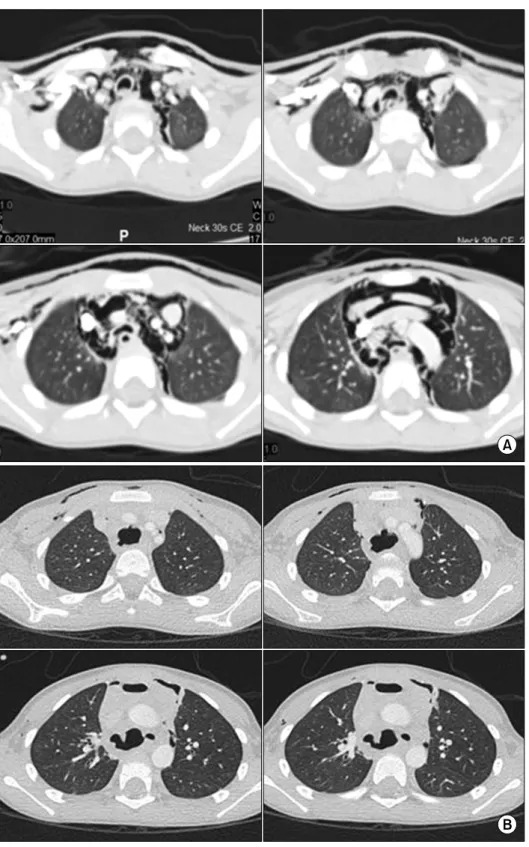
Initial oxygen saturation on pulse oximetry was 100% with room air. CT was performed, but there were no significant findings in the tracheobronchial tree, lung, or esophagus (Fig. 1A). He was initially di- agnosed with uncomplicated pneumomediastinum with subcutaneous emphysema, for which he was prescribed antibiotic support and restriction of oral

Korean J Thorac Cardiovasc Surg 2017;50:403-406 □ CASE REPORT □

https://doi.org/10.5090/kjtcs.2017.50.5.403

(2)

Jee Won Suh, et al

− 404 −

Fig. 1. (A) The initial CT scan shows no significant findings in the tra- cheobronchial tree, lung, or eso- phagus. (B) A CT scan performed on hospital day 2 shows a large com- mon cavity from the proximal to the middle esophagus at the level of the T3 –T5 vertebrae. CT, com- puted tomography.

foods and fluids. By day 2 of his hospitalization, a physical examination showed that his symptoms had improved. However, on chest radiography, a quad- rate-shaped trapping of air in the mid-sternal area

was seen (Fig. 2B) and a blood test showed leuko-

cytosis. On a follow-up chest CT, the presence of a

large common cavity, extending from the proximal to

the middle esophagus at the level of the T3–T5 ver-

(3)

The Utility of ECMO in Preventing Desaturation during Tracheobronchial Surgery in Children

− 405 −

Fig. 2. (A) Plain chest radiography initially found no abnormalities, ex- cept a pneumomediastinum and subcutaneous emphysema. (B) A quadrate-shaped region of air trap- ping in the mid-sternal area was later detected (arrow).

Fig. 3. (A) Venoarterial extracor- poreal membrane oxygenation was established via the right jugular vein with a 14-Fr catheter and via the right common carotid artery with a 10-Fr catheter. (B) A bi- lateral linear disconnection of ap- proximately 3 cm at the mem- branous and cartilage portions of the trachea and main bronchus.

The white arrow shows the mem- branous portion detached from the tracheobronchial tree. The black arrow is the cartilage portion of the main bronchus.

tebrae, suggested a traumatic tracheobronchoeso- phageal fistula (Fig. 1B). The decision to surgically treat the tracheobronchial injury (TBI) was compli- cated by the difficulty in differentiating between the TBI and an esophageal fistula. Moreover, if the TBI was proximally located, ventilation would be dis- rupted during surgical repair. In the operating room, both a bronchoscopy and an esophagogastroduodeno- scopy were performed, with the patient under gen- eral anesthesia. An extensive tracheal injury was identified, extending from the main carina to the main bronchus, as well as luminal disruption, which caused the membranous trachea to be detached with a quadriangular shape. Therefore, the bronchoscope could not enter the distal part of the injury, thorugh

out to the mediastinum. There was no esophageal in-

jury (perforation or laceration). Venoarterial ECMO

via the right jugular vein was established with a

14-Fr catheter, and via the right common carotid ar-

tery with a 10-Fr catheter (Fig. 3A). The ECMO flow

was 1,300 L/min, the gas flow was 0.8 L/min, and

the fraction of inspired oxygen was 1.0. The TBI was

explored surgically using a posterolateral thor-

acotomy approach at the fifth intercostal space, with

the patient in the left lateral decubitus position. A

small hematoma in the lower trachea and carina was

removed and the lower trachea and carina were

found to be covered with parietal pleura. Its removal

revealed a bilateral linear disconnection of about 3

cm at the membranous tracheobronchial and carti-

(4)

Jee Won Suh, et al

− 406 − lage portions (Fig. 3B). This tear was continuously sutured using polydioxanone 5-0 sutures. A hemovac drain and a chest tube drain were placed. After the repair operation, the venoarterial ECMO was decannulated. The total operation time was 317 mi- nutes, including a tracheal operation time of 102 mi- nutes; the total ECMO support time was 200 minutes.

On postoperative day 1, the patient was transferred from intensive care to the general ward. On post- operative day 6, a chest CT scan was performed and the drainage tubes were removed. He was discharged in good condition and without other complications on postoperative day 8. H e was found to be doing well, without any respiratory symptoms, 9 months postoperatively.

Discussion

TBIs in children are rare, occurring in <0.05% of chest traumas [3]. Moreover, the diagnosis of trau- matic TBIs is often delayed, due to occult clinical findings [4]. Our patient had mild symptoms that re- solved quickly, after 2 days. In addition, diagnosis of the TBI was difficult because the parietal pleura cov- ered the injury, masking the symptoms and signs.

Hwang et al. [4] reported that only 47.8% of patients with a TBI were diagnosed within 48 hours.

Although plain chest radiography is the initial imag- ing modality, it can be misleading in cases of TBI due to blunt trauma, as it shows normal results in 1 in 5 cases [5]. Most authors agree that TBI is best diagnosed by a bronchoscopic examination [3].

Hwang et al. [4] reported that among TBI patients undergoing bronchoscopy, 100% of the cases were detected, compared to just 50% with CT. An initial suspicion of TBI greatly increases the likelihood of its diagnosis. The bronchoscopic criteria for surgery include tears involving the full thickness of the tra- cheal wall, tears >2 cm, and transluminal ruptures involving the parenchyma [1]. Our patient was first treated with conservative management for a mis- diagnosed pneumomediastinum, but the follow-up CT scan showed an extended TBI. Compared with the in- itial CT scan, the TBI was clearer, so we thought that it had progressed despite the conservative treatment.

The injury extended from the main trachea to main bronchus, about 3–4 cm longitudinally, and a trans- verse injury may induce interruption of airway con-

tinuity or stenosis after spontaneous healing.

However, a bronchoscopic exam is often difficult to perform in children due to their small airways.

Selective 1-lung intubation and double-lumen in- tubation are options for managing ventilation issues during tracheobronchial surgery. Furthermore, during surgical repair of a carinal injury or an injury to both sides of the main bronchus, ventilation may be disrupted. In these situations, ECMO should be con- sidered, as its use can prevent catastrophic results.

However, because children are cannulated in the car- otid artery, ECMO is not generally preferred because it impedes surgery and increases the risk of neuro- logical complications. ECMO support has been used in TBI patients with respiratory failure, but in our pediatric patient, ECMO support was implemented for 200 minutes during the surgical repair of the injury.

Our case demonstrates the utility of ECMO in pre- venting desaturation during surgery and shows that its short-term use in children is associated with a minimal risk of complications.

In conclusion, this case highlights the importance of suspecting TBI in order to diagnose it correctly.

During tracheal repair in pediatric TBI patients, the short-term use of venoarterial ECMO can prevent in- traoperative respiratory problems.

Conflict of interest

No potential conflicts of interest relevant to this article are reported.

References

1. Ballouhey Q, Fesseau R, Benouaich V, et al. Management of blunt tracheobronchial trauma in the pediatric age group. Eur J Trauma Emerg Surg 2013;39:167-71.

2. Ballouhey Q, Fesseau R, Benouaich V, Leobon B. Benefits of extracorporeal membrane oxygenation for major blunt tracheobronchial trauma in the paediatric age group. Eur J Cardiothorac Surg 2013;43:864-5.

3. Dominguez E, De La Torre C, Sanchez AV, et al. Severe tra- cheobronchial injuries: our experience. Eur J Pediatr Surg 2015;25:71-6.

4. Hwang JJ, Kim YJ, Cho HM, Lee TY. Traumatic tracheo- bronchial injury: delayed diagnosis and treatment outcome.

Korean J Thorac Cardiovasc Surg 2013;46:197-201.

5. Juvekar NM, Deshpande SS, Nadkarni A, Kanitkar S.

Perioperative management of tracheobronchial injury fol-

lowing blunt trauma. Ann Card Anaesth 2013;16:140-3.

수치

Fig. 1. (A) The initial CT scan shows  no significant findings in the  tra-cheobronchial tree, lung, or  eso-phagus
Fig. 3. (A) Venoarterial extracor- extracor-poreal membrane oxygenation was  established via the right jugular  vein with a 14-Fr catheter and via  the right common carotid artery  with a 10-Fr catheter

참조

관련 문서

In addition, Wallace and Froum 20) reported that the bone formation rate was superior in the cases using a barrier membrane in comparison with the

(4)the spiral ganglion (5)the auditory nerve fibres.. The Basilar Membrane is a Mechanical Analyzer of Sound Frequency The Basilar Membrane is a Mechanical Analyzer of

• To compare this neural activity with MI of a human with spinal cord injury, MN performed a step tracking, ‘center-out’ task using the neural

The feed is commonly a solution in a solvent like ethanol or t-butanol, and the nonsolvent is water..

<Figure 5-6> Transport in an asymmetric Membrane as a result of various mechanisms.. • transport through a

3) A comparison of the stoichiometric equation with the experimental kinetic expression can suggest whether or not we are dealing with an elementary reaction. 4) If one

This book contains hundreds of complete, working examples illustrating many common Java programming tasks using the core, enterprise, and foun- dation classes APIs.. Java Examples

Post-surgical use of radioiodine (131I) in patients with papillary and follicular thyroid cancer and the issue of remnant ablation: a consensus