| Abstract |
1)PURPOSE: The objective of this study was to provide a basis for the need to apply psychological factors-based rehabilitation programs to osteoarthritis patients by understanding how the limitations on the activities of osteoarthritis patients relate to the health-related quality of life and depression.
METHODS: This study assessed 1,994 osteoarthritis patients from the 7th Korea National Health and Nutrition Examination Survey (KNHANES, 2016-2018). The subjects were divided into two categories: with activity limitation and without activity limitation. A Chi-square test and logistic regression analysis were conducted.
RESULTS: The EQ-5D index of subjects with activity limitation was .84 ± .16, it was .94 ± .12 in those with no activity limitation (p < .05). The diagnosis of depression was 16.8% and; 8.3% in those with and without activity limitation, respectively (p < .05). There was a significant difference in the
†Corresponding Author : Seung-Min Nam
[email protected], http://orcid.org/0000-0002-9215-0545 This is an Open Access article distributed under the terms of the Creative Commons Attribution Non-Commercial License (http://creativecommons.org/licenses/by-nc/3.0) which permits unrestricted non-commercial use, distribution, and reproduction in any medium, provided the original work is properly cited.
odds ratio for each item in the EQ-5D. Moreover, the odds ratio for depression with an activity limitation was 2.171 (1.512 - 3.118) compared with no activity limitation.
CONCLUSION: The activity limitation of osteoarthritis patients reduces the health-related quality of life significantly and increases the probability of depression. Therefore, the treatment of osteoarthritis patients should be approached considering the psychological conditions. Moreover, early diagnosis of depressive symptoms is needed to prevent symptom deterioration and increase the compliance with rehabilitation therapy.
Key Words: Activity limitation, Depression, Quality of life, Osteoarthritis
Ⅰ. 서 론
관절염은 환자에게 신체적 활동의 제한과 정서적 우울감을 유발할 수 있는 질병이다[1]. 골관절염은 가 장 흔한 형태의 관절염 중 하나로서 대표적인 만성퇴행 성 질환으로서, 우리나라 만성질환 진료비 지출 중 가 장 큰 항목에 해당하며, 1인당 연간 644만원의 진료비 가 지출된다 [2,3]. 또한, 통증과 신체장애가 동반되는
Research Article Open Access
골관절염 환자의 활동제한이 건강관련 삶의 질과 우울증에 미치는 영향
이도연⋅남승민
†대구대학교 물리치료학과
Effects of Activity Limitations on the Health-Related Quality of Life and Depression in Osteoarthritis Patients
Do-Youn Lee, PT, PhD⋅Seung-Min Nam, PT, PhD
†Department of Physical Therapy, Daegu University Received: June 8, 2020 / Revised: June 9, 2020 / Accepted: June 24, 2020
ⓒ 2020 J Korean Soc Phys Med
질환으로 노령화 인구구조에 따라 골관절염의 유병률 이 점차 증가하는 추세이며, 이와 함께 의료비 지출도 상승할 것으로 보인다[4]. 뿐만 아니라, 무릎 골관절염 은 노인의 장기적인 보행운동 및 신체의 기능적 부분에 장애를 일으키는 주요한 요인으로 알려져 왔다[5].
골관절염은 생명에 영향을 주는 질환이 아니라는 인식과 함께 노화의 정상적인 과정으로 인식되므로 초 기 관리와 함께 적절한 의학적 치료를 받지 않는 경향이 있다[6]. 이로 인해 관절연골의 손상과 같은 병리적 변 화와 함께 관절마찰음, 관절통증, 강직과 같은 증상이 나타날 뿐만 아니라 기능적 활동의 제한을 경험하게 된다[7,8].
삶의 질이란 한 개인의 환경적, 사회문화적 배경을 중심으로 삶의 가치를 다루는 평가로서, 관절염, 당뇨 병 등 다양한 만성질환을 가진 환자들에게 활용되는 장기적 예후 평가 지표이다[9]. 대부분의 골관절염 환 자들이 질환으로 인해 정신적, 신체적 건강문제, 그리 고 낮은 건강 관련 삶의 질을 경험하게 된다[10]. 선행연 구에 따르면 골관절염이 없는 노인에 비해 골관절염이 있는 노인은 본인의 건강상태를 나쁘게 인식하게 된다 [11]. 또한 골관절염 환자들은 통증, 강직 등의 증상으로 인해 보행장애와 일상생활 활동제한, 낙상 등을 경험하 면서 관절염 질환을 앓지 않는 노인이나 건강한 노인에 비해 우울을 더 경험하는 경향이 있다[12].
우울은 역할상실 감정에 빠지게 하므로 기능장애의 회복에 부정적인 영향을 미치고, 고통이 심한 경우에는 재활의 동기를 감소시켜 치료를 어렵게 하며, 삶의 질 저하와 신체적인 기능상태에 직접적인 영향을 미친다 [13]. 또한, 골관절염 환자에게 우울은 수술 이후의 예후 나 통증관리의 중재에 부정적 영향을 미치고[14], 통증 을 악화시키킬 수 있는 요인 중 하나이며, 자살위험을 높이기도 한다[15].
선행연구에 따르면 골관절염 환자의 삶의 질 및 우울 증의 정도에 대한 연구는 많았지만, 골관절염 환자의 활동제한이 삶의 질과 우울에 대한 직접적인 영향력과 관련된 연구는 활발하지 않았다. 따라서 본 연구에서는 골관절염 환자를 대상으로 활동제한의 여부가 건강관
련 삶의 질에 미치는 영향과 우울증 발생 정도에 대한 구체적인 영향력을 알아보고자 시행하였다. 또한 이러 한 영향력을 파악함으로써 보건의료인들에게 골관절 염 환자의 재활프로그램에 있어 심리적인 요소를 고려 한 접근법에 대한 기초적인 근거 자료를 제시하자 하였 다. 뿐만 아니라, 우울증의 완화와 삶의 질을 향상시킬 임상적인 개입방향에 도움을 주고자 한다.
Ⅱ. 연구방법
1. 대상자 선정
본 연구의 자료는 질병관리본부에서 시행한 국민건 강영양조사 제7기 자료(2016-2018년도)를 이용하였다.
본 연구의 대상자는 총 24,269명 중 50세 미만인 자 13,892명, 골관절염 진단 비응답자 832명 및 골관절염 진단을 받지 않은 자 7,394명, 건강관련 삶의 질 및 우울 증 진단 비응답자 157명을 제외하여 최종 1,994명을 선정하였다.
2. 연구변수 측정
본 연구는 건강설문조사 항목 중 성별, 연령, 개인소 득수준, 결혼상태, 체질량지수, 흡연 및 음주여부, 주관 적 건강상태, 활동제한, 건강관련 삶의 질 설문조사, 우울증 의사진단 자료를 이용하여 분석하였다.
1) 일반적 특성
골관절염 환자의 일반적 특성 변수로 성별, 연령, 개인소득수준, 결혼상태를 사용하였다. 개인소득수준 은 ‘하’, ‘중하’, ‘중상’, ‘상’으로 구분하여 사분위수에 따른 소득으로 분류하였다. 결혼상태의 경우 ‘유배우 자, 동거’는 ‘동거’로, ‘별거, 사별, 이혼, 미혼’은 ‘비동 거’로 재분류하였다.
2) 건강 관련 특성
건강 관련 특성 변수로는 체질량지수(Body mass
index, BMI), 흡연 및 음주여부, 주관적 건강상태, 우울
증 의사진단 여부 자료를 사용하였다. [체중(kg)/신장
(㎡)]으로 계산된 체질량지수 변수는 ‘저체중’, ‘정상’,
‘과체중’ 세 단계로 재분류하였다. 흡연상태는 건강설 문조사의 현재 흡연 여부에서 ‘매일 피움, 가끔 피움’은
‘현재흡연’, ‘과거에는 피웠으나 현재 피우지 않음’은
‘과거흡연’, 그리고 ‘비흡연’으로 분류하였다. 음주상 태 변수는 최근 1년 간의 음주빈도에서 ‘월 1회미만과 전혀 마시지 않았다’로 응답한 경우 ‘비음주군’, ‘월1회 정도, 월 2-4회, 주 2-3회 이상’으로 응답한 경우 ‘음주 군’으로 분류하였다. ‘좋음’, ‘보통’, ‘나쁨’ 세 가지 단계 로 주관적 건강상태를 구분하였고, 우울증 의사진단 여부는 ‘예’ 또는 ‘아니오’로 응답한 것을 사용하였다.
3) 건강 관련 삶의 질
골관절염 환자의 건강 관련 삶의 질은 EQ-5D (EuroQol-5 dimension) 평가도구를 통해 측정된 결과값 을 분석하였다. EQ-5D는 건강과 관련된 삶의 질을 측정 하는 평가도구로서, 총 5개 영역인 운동능력, 자기관리, 일상활동, 통증/불편, 불안/우울로 구분된다. 또한, 만성 질환자의 건강 관련 삶의 질을 평가하기 위해 사용되기 도 하며, 측정하기가 간단하고 비교적 신뢰도가 높은 평가도구로 사용되며, 신뢰도는 Cronbach's α = .70 이다 [16]. 이러한 평가도구는 ‘전혀 문제없음’, ‘다소 문제 있음’, ‘많이 문제 있음’ 세 단계로 구분되며, 각 문항에 대하여 객관식으로 응답할 수 있도록 구성된다. 5개 영역 문항의 측정값 각각에 대하여 가중치를 적용한 건강관련 삶의 질 점수인 EQ-5D index 지표가 있다.
완전한 건강상태를 의미하는 1점에서부터 죽음보다 못 한 건강상태를 나타내는 -1점 사이로 값이 분포된다.
본 연구에서는 ‘다소 문제있음’ 및 ‘많이 문제있음’을
‘문제있음’ 그룹으로, ‘전혀 문제없음’을 ‘문제없음’그 룹으로 구분하였다.
3. 통계분석
국민건강영양조사의 표본은 우리나라 국민을 대표 할 수 있도록 추출률과 응답률을 고려하여 가중치를 부여하였다. 본 연구에서는 자료분석 시, 국민건강영양 조사에서 제시한 건강설문과 검진의 연관성 분석에 사
용되는 itvex 가중치를 반영하였다. 대상자의 일반적인 특성과 건강 관련 특성은 기술통계로 분석하였고, 일원 배치분산분석과 카이제곱검정을 통하여 대상자들의 우울증과 건강관련 삶의 질을 활동제한 여부에 따라 비교하였다. 로지스틱 회귀분석을 활용하여 성별, 나 이, 개인소득수준, 결혼여부, BMI, 흡연 및 음주여부, 주관적 건강상태와 같은 변수들을 보정하여 연구대상 자의 활동제한과 우울증 및 건강관련 삶의 질의 연관성 에 대해 분석하였다. SPSS 22.0 프로그램을 사용하여 자료분석을 하였고, 통계적 유의수준 α = .05로 정의하 였다.
Ⅲ. 연구결과
1. 연구대상자의 일반적 특성
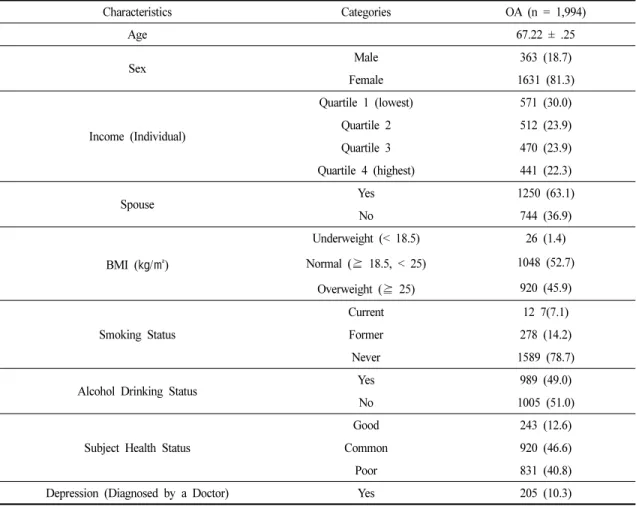
총 1,994명 중 남성은 363명, 여성은 1,631명이었고, 평균연령은 67.22세였다. 체질량지수는 정상이 52.7%, 과체중이 45.9%였다. 현재 흡연을 하고 있는 대상자는 7.1%이며, 과거흡연자는 14.2%, 비흡연자가 78.7%로 가 장 많이 나타났다. 음주군은 49.0%, 비음주군은 51.0%로 나타났고, 총 대상자의 40.8%가 주관적 건강상태가 나 쁨이라고 답하였다. 또한, 우울증 진단을 받은 대상자 는 10.3%로 나타났다(Table 1).
2. 골관절염 환자의 활동제한에 따른 건강관련 삶의 질 및 우울증의 차이
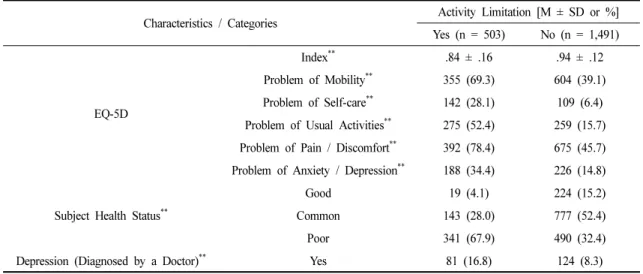
골관절염 환자의 삶의 질의 기준은 최대값인 1로 하였고, 활동제한이 있다고 응답한 대상자에서 0.84점 으로 활동제한이 없다고 응답한 대상자의 0.94점에 비 해 통계적으로 유의하게 낮게 나타났다. 삶의 질의 각 요소는 운동능력, 자기관리, 일상활동, 통증/불편, 불안/
우울로 구분되고, 활동제한 여부에 따른 각 항목에서
모두 통계적으로 유의한 차이를 보였다. 또한, 주관적
건강상태 변수는 활동제한이 있는 집단에서 ‘나쁨’으
로 대답한 비율이 67.9%로 가장 높았던 반면, 활동제한
이 없는 집단에서는 ‘보통’으로 응답한 비율이 52.4%로
가장 높았다. 우울증 진단에서는 활동제한이 있는 집단
에서 16.8%, 활동제한이 없는 집단에서는 8.3%로 통계 적으로 유의한 차이가 나타났다(Table 2).
3. 골관절염 환자의 활동제한에 따른 건강관련 삶의 질 및 우울증 교차비
성별, 나이, 개인소득수준, 결혼여부, BMI, 흡연 및 음주여부, 주관적 건강상태를 보정한 후 삶의 질 교차 비에서 운동능력에 활동제한이 없는 대상자를 기준으 로 활동제한이 있는 대상자가 운동능력은 3.14배, 자기 관리는 4.93배, 일상활동은 5.43배, 통증/불편은 4.03배, 불안/우울은 2.67배 문제가 있는 것으로 나타났다 (Table 3).
또한, 활동제한이 있다고 응답한 대상자의 우울증 진단이 활동제한이 없는 대상자에 비해 2.17배 높았다 (Table 4).
Ⅳ. 고 찰
골관절염과 같이 발병률과 의료비 지출이 높고, 지 속적인 의료서비스를 필요로 하는 질병은 환자의 건강 관련 삶의 질을 확인할 필요가 있다. 이에 본 연구는 제7기 국민건강영양조사 자료를 활용하여 골관절염 환 자의 삶의 질과 우울에 활동제한이 어떠한 영향을 미치
Characteristics Categories OA (n = 1,994)
Age 67.22 ± .25
Sex Male 363 (18.7)
Female 1631 (81.3)
Income (Individual)
Quartile 1 (lowest) 571 (30.0)
Quartile 2 512 (23.9)
Quartile 3 470 (23.9)
Quartile 4 (highest) 441 (22.3)
Spouse Yes 1250 (63.1)
No 744 (36.9)
BMI ( ㎏/㎡)
Underweight (< 18.5) 26 (1.4) Normal ( ⪴ 18.5, < 25) 1048 (52.7)
Overweight ( ⪴ 25) 920 (45.9) Smoking Status
Current 12 7(7.1)
Former 278 (14.2)
Never 1589 (78.7)
Alcohol Drinking Status Yes 989 (49.0)
No 1005 (51.0)
Subject Health Status
Good 243 (12.6)
Common 920 (46.6)
Poor 831 (40.8)
Depression (Diagnosed by a Doctor) Yes 205 (10.3)
M ± SD : Mean ± standard Deviation BMI : Nody Mass Index
Table 1. General Characteristics of the Study Population
는지 살펴보았다. 골관절염 환자 1,994명을 대상으로 활동제한 여부에 따라 층화하였고, 건강 관련 삶의 질
과 우울증의 관계를 비교한 결과에서 유의한 차이가 있었다.
Characteristics / Categories Activity Limitation [M ± SD or %]
Yes (n = 503) No (n = 1,491)
EQ-5D
Index
**.84 ± .16 .94 ± .12
Problem of Mobility
**355 (69.3) 604 (39.1) Problem of Self-care
**142 (28.1) 109 (6.4) Problem of Usual Activities
**275 (52.4) 259 (15.7) Problem of Pain / Discomfort
**392 (78.4) 675 (45.7) Problem of Anxiety / Depression
**188 (34.4) 226 (14.8)
Subject Health Status
**Good 19 (4.1) 224 (15.2)
Common 143 (28.0) 777 (52.4)
Poor 341 (67.9) 490 (32.4)
Depression (Diagnosed by a Doctor)
**Yes 81 (16.8) 124 (8.3)
*
p < .05,
**p < .001 by ANOVA or Chi-square Test M ± SD: Mean ± Standard Deviation
Table 2. Response of Depression and Health-related Quality of Life According to the Activity Limitation of OA Patients
Individual Components Activity Limitation
Yes No B
EQ-5D
Problem of Mobility* 3.14 (2.440 - 4.041) 1 (ref) 1.214
Problem of Self-care* 4.92 (3.578 - 6.781) 1 (ref) 1.617
Problem of Usual Activities* 5.42 (4.192 - 7.021) 1 (ref) 1.762 Problem of Pain / Discomfort* 4.02 (3.063 - 5.291) 1 (ref) 1.434 Problem of Anxiety / Depression* 2.67 (2.073 - 3.438) 1 (ref) 1.015
*
p < .05
p Values were Obtained by Logistic Regression Analysis Adjusted for Sex, Age, Income (Individual), Spouse, BMI, Smoking Status, Alcohol Drinking Status, Subject Health Status.
Table 3. Association between Each Item of EQ-5D and Activity Limitation in Stroke Patients
Depression Activity Limitation
Yes No B
Diagnosed by a Doctor* 2.17 (1.512 - 3.118) 1 (ref) .836
*