INTRODUCTION
The methods of immunoassay are constantly improving.
Moreover, the methods of antibody production have improved since the introduction of the first, relatively hazardous radioimmunoassay [1]. Immunoanalysers have evolved from stand-alone units to integrated, automated modular systems that we have today. These modern systems have better reproducibility, sensitivity, and shorter reaction times than those of previous technologies [1,2]. However, despite such improvements, further innovations are needed to provide rapid, cost-effective, and high quality analysis of larger volumes of data [3].
Optimal operational efficiency requires an open, flexible,
and adaptable space. The laboratory instrumentation must combine excellent analytical performance with flexibility, large test panels, and high throughput [4].
The cobas 8000 modular analyzer series is a random- access, multichannel, and modular-design system, with a flexible potential for consolidation, designed for laboratories with a high workload. The cobas 8000 e602 analyzer (Roche Diagnostics, Mannheim, Germany) is an automated system for immunoassays within the cobas 8000 modular analyzer series. It is capable of detecting heterogeneous immunoassays based on electrochemiluminescence tech- nology. It has a throughput of up to 170 tests/hr. A recent study evaluated the analytical performance of the cobas 8000 c702 chemistry analyzer (Roche Diagnostics System,
Evaluation of Analytical Performance of the Cobas 8000 Analyzer Series Module e602
Kiwoong Ko, Min-Jung Kwon, Hee-Yeon Woo, and Hyosoon Park
Department of Laboratory Medicine, Kangbuk Samsung Hospital, Sungkyunkwan University School of Medicine, Seoul, Korea
Background: The e602, a module of the recently released cobas 8000 modular analyzer series, is an automated system for immunoassays. In this study, we evaluated its analytical performance using 17 immunoassay analytes.
Methods: The Clinical Laboratory Standards Institute guidelines were used to determine the efficiency of the cobas 8000 e602 based on its precision, linearity, assay comparison, and reference range validation. Performance analyses were completed using two levels of quality control materials and pooled sera from our institution. The performance of the cobas 8000 e602 was compared to that of the modular analytics E170. Statistical analyses were performed using Excel 2010 (Microsoft Co., USA) and EP Evaluator Release 10 (Data Inno- vations, USA).
Results: For all analytes, except level 1 total vitamin D, the coefficients of variation were
<5%. The linearity results were within the allowable systemic error limits. The performance comparison revealed that the two systems are comparable, with correlation coefficients (r)
>0.975 for all analytes. The reference range validation was also within the allowable criteria.
Conclusions: Taken together, these findings demonstrate that the cobas 8000 e602 analyzer has good precision, linearity, performance comparison, and reference range validation. Thus, e602 is a useful module of the cobas 8000 modular analyzer series.
(J Lab Med Qual Assur 2015;37:101-109)
Key Words: Immunoassay, Performance, Evaluation
Corresponding author:
Min-Jung Kwon
Department of Laboratory Medicine, Kangbuk Samsung Hospital, Sungkyunkwan University School of Medicine, 29 Saemunan-ro, Jongno-gu, Seoul 110-746, Korea Tel: +82-2-2001-5211 Fax: +82-2-757-0711 E-mail: [email protected] pISSN: 2384-2458
eISSN: 2288-7261 Received January 26, 2015, Revision received March 27, 2015, Accepted April 16, 2015
Switzerland) [5]. However, to the best of our knowledge, the cobas 8000 e602 immunoassay has not yet been evaluated. Therefore, in this study, using 17 immunoassay analytes, we evaluated the overall analytical performance of the cobas 8000 e602.
MATERIALS AND METHODS
1. Materials
This study was performed in June 2014. The cobas 8000 e602 was evaluated for its precision, linearity, comparison, and reference range validation using 17 immunoassay analytes. These analytes included alpha fetoprotein, cancer antigen 15-3, cancer antigen 19-9, cancer antigen 125, carcinoembryonic antigen, cytokeratin 19 fragment, ferritin, neuron specific enolase, prostate specific antigen (PSA), total vitamin D, estradiol (E2), follicle stimulating hormone (FSH), insulin, osteocalcin, free triiodothyronine, free thyroxine, and thyroid stimulating hormone. The performance of the cobas 8000 e602 was compared to that of the Modular Analytics E170 (Roche Diagnostics, Tokyo, Japan). Quality control materials of levels 1 and 2 (PreciControl, Roche Diagnostics, Indianapolis, IN, USA) and pooled sera from subjects who visited our institution were used for analyses. The comparison study was performed using sera from at least 40 subjects with normal, high, and low values of the 17 analytes.
2. Methods
1) Repeatability and within-laboratory precision
Quality control materials of levels 1 and 2 were used for analyses. The repeatability and within-laboratory pre- cision of the cobas 8000 e602 was evaluated using the 17 analytes. Quality control materials of each level were an- alysed twice on the same day (once in the morning and once in the afternoon) for 20 consecutive days. The results were evaluated according to the Clinical Laboratory Standards Institute (CLSI) guideline EP5-A3 [6].
2) Linearity
The linearity of the assays was validated according to the CLSI guideline EP6-A [7]. Pooled serum samples with
the highest and lowest concentrations of the analytes were mixed. Five levels of equally spaced samples were ma- de for each test item. Three intermediate concentration pools were prepared by mixing low (L) and high (H) concentrations as follows: 1 L+3 H, 2 L+2 H, and 3 L+1 H. Each sample was measured twice and the mean values were calculated. Linear regression analysis was applied to determine linearity. The data was considered acceptable if the percentage error was within the allowable range of systemic error (established by the manufacturer).
3) Comparison
Sera from at least 40 subjects with clinically significant values (distributed over the analytical measurement range) were used for analyses in accordance with the CLSI guideline EP9-A3 [8]. A comparison study was performed between the cobas 8000 e602 and modular analytics E170. The concentration of each analyte was measured using the two instruments, within a two- hour period. The mean values were used for regression analyses and for calculating the correlation coefficient (r).
The results were considered acceptable if the correlation coefficient was ≥0.975.
4) Reference range validation
The proposed reference ranges were established using the sera from 88 healthy subjects (44 males and 44 females) between the ages of 20 and 60 years. All the subjects underwent a comprehensive health examination at our institution (in accordance with the CLSI guideline C28-A3c [9]). All of these subjects had normal laboratory findings. In addition, the sera from 22 healthy men aged between 60 and 80 years were used to determine the PSA reference range for men older than 60 years of age.
The verification study tested if >10% of (at least) 20 results were outside of the proposed reference range. The reference range was acceptable if <10% of the total results were outside of the proposed range.
5) Statistics
Excel 2010 (Microsoft Co., Redmond, WA, USA) was used to calculate the mean, standard deviation, and coeffi-
cient of variation (CV) at each level of quality control material. Linear regression analysis was used to calculate the slope and intercept of the regressed line. Validation of linearity was performed using the EP Evaluator Release 10 (Data Innovations, South Burlington, VT, USA).
RESULTS
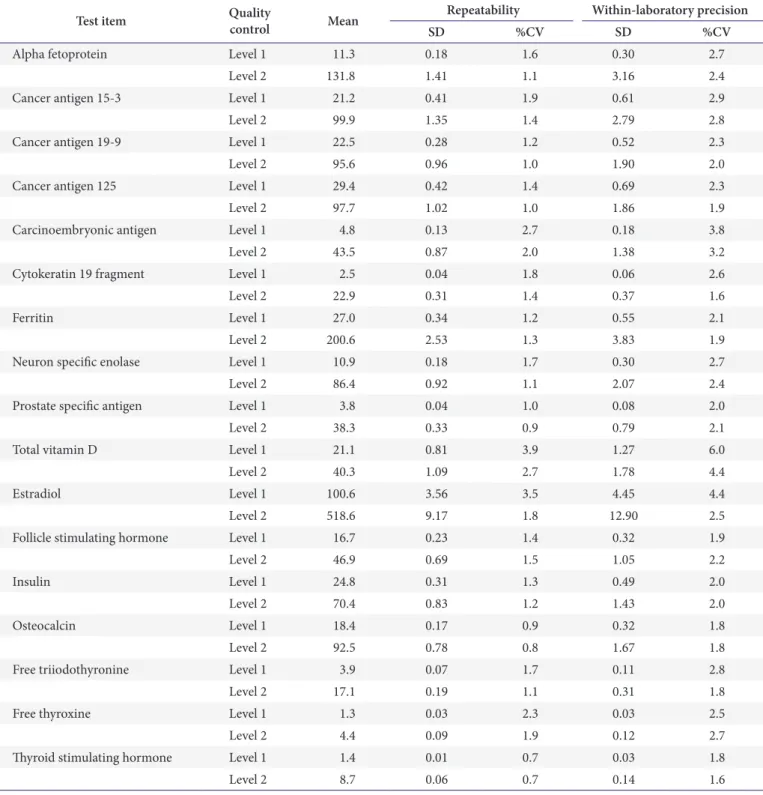
1. Repeatability and Within-Laboratory Precision
The data for all the analytes, excluding level 1 total vitamin D, was reproducible and precise with CV between
Table 1. Repeatability and within-laboratory precision of the Roche cobas 8000 e602
Test item Quality
control Mean Repeatability Within-laboratory precision
SD %CV SD %CV
Alpha fetoprotein Level 1 11.3 0.18 1.6 0.30 2.7
Level 2 131.8 1.41 1.1 3.16 2.4
Cancer antigen 15-3 Level 1 21.2 0.41 1.9 0.61 2.9
Level 2 99.9 1.35 1.4 2.79 2.8
Cancer antigen 19-9 Level 1 22.5 0.28 1.2 0.52 2.3
Level 2 95.6 0.96 1.0 1.90 2.0
Cancer antigen 125 Level 1 29.4 0.42 1.4 0.69 2.3
Level 2 97.7 1.02 1.0 1.86 1.9
Carcinoembryonic antigen Level 1 4.8 0.13 2.7 0.18 3.8
Level 2 43.5 0.87 2.0 1.38 3.2
Cytokeratin 19 fragment Level 1 2.5 0.04 1.8 0.06 2.6
Level 2 22.9 0.31 1.4 0.37 1.6
Ferritin Level 1 27.0 0.34 1.2 0.55 2.1
Level 2 200.6 2.53 1.3 3.83 1.9
Neuron specific enolase Level 1 10.9 0.18 1.7 0.30 2.7
Level 2 86.4 0.92 1.1 2.07 2.4
Prostate specific antigen Level 1 3.8 0.04 1.0 0.08 2.0
Level 2 38.3 0.33 0.9 0.79 2.1
Total vitamin D Level 1 21.1 0.81 3.9 1.27 6.0
Level 2 40.3 1.09 2.7 1.78 4.4
Estradiol Level 1 100.6 3.56 3.5 4.45 4.4
Level 2 518.6 9.17 1.8 12.90 2.5
Follicle stimulating hormone Level 1 16.7 0.23 1.4 0.32 1.9
Level 2 46.9 0.69 1.5 1.05 2.2
Insulin Level 1 24.8 0.31 1.3 0.49 2.0
Level 2 70.4 0.83 1.2 1.43 2.0
Osteocalcin Level 1 18.4 0.17 0.9 0.32 1.8
Level 2 92.5 0.78 0.8 1.67 1.8
Free triiodothyronine Level 1 3.9 0.07 1.7 0.11 2.8
Level 2 17.1 0.19 1.1 0.31 1.8
Free thyroxine Level 1 1.3 0.03 2.3 0.03 2.5
Level 2 4.4 0.09 1.9 0.12 2.7
Thyroid stimulating hormone Level 1 1.4 0.01 0.7 0.03 1.8
Level 2 8.7 0.06 0.7 0.14 1.6
0.7% and 4.4%. The within-laboratory precision for level 1 total vitamin D was 6.0% (Table 1).
2. Linearity
The linearity of assays was evaluated using five levels of serum samples prepared by mixing sera of high and low concentrations (Table 2). The percentage error for all the 17 analytes was within the allowable limits of systemic error. Therefore, the linearity was acceptable.
3. Comparison of Performance of Cobas e602 and Modular Analytics E170
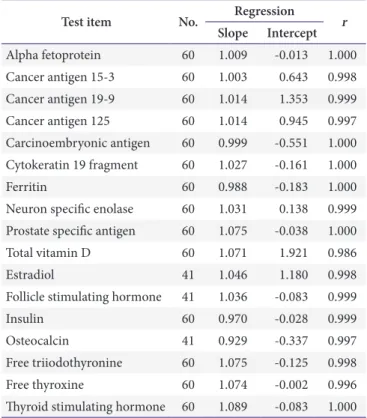
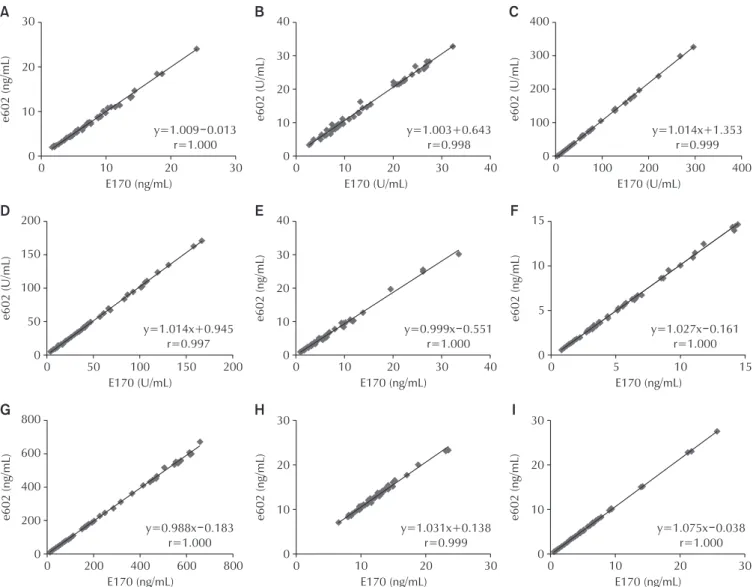
We compared the performances of the cobas e602 and modular analytics E170. The slopes ranged between 0.929 and 1.089, intercepts between -0.337 and 1.921, and correlation coefficients (r) between 0.986 and 1.000 (Table 3, Fig. 1). The correlation coefficients for all 17 analytes were >0.975, suggesting that the two instruments produce comparably acceptable results.
Table 2. Linearity of the Roche cobas 8000 e602
Test item Range Unit Linear regression analysis
% error Allowable systemic error (%) Slope Intercept
Alpha fetoprotein 0.91–144.45 ng/mL 1.031 -0.0001 3.1 10.0
Cancer antigen 15-3 1.77–94.57 U/mL 1.003 0.0666 4.1 7.8
Cancer antigen 19-9 0.77–620.65 U/mL 1.026 0.0005 2.6 22.1
Cancer antigen 125 2.66–506.40 U/mL 0.983 0 1.7 15.0
Carcinoembryonic antigen 0.49–48.46 ng/mL 1.037 0.1409 4.0 15.0
Cytokeratin 19 fragment 0.12–133.35 ng/mL 0.994 0.0076 5.6 13.9
Ferritin 4.04–860.55 ng/mL 1.022 0.251 2.3 15.0
Neuron specific enolase 0.38–73.96 ng/mL 1.004 -0.0086 1.8 5.0
Prostate specific antigen 0.004–92.512 ng/mL 0.977 -0.0727 2.4 15.0
Total vitamin D 4.17–58.42 ng/mL 0.984 0 1.6 7.5
Estradiol 17.52–3326.00 pg/mL 0.985 0.880 1.4 12.5
Follicle stimulating hormone 0.73–152.35 mIU/mL 0.988 0.2905 3.5 12.5
Insulin 1.89–678.85 mU/mL 1.027 0.279 2.8 12.5
Osteocalcin 1.00–260.70 ng/mL 0.983 0 1.7 5.6
Free triiodothyronine 1.60–25.36 pg/mL 1.011 -0.0976 1.6 15.0
Free thyroxine 0.561–6.790 ng/dL 1.019 0 1.9 7.5
Thyroid stimulating hormone 0.008–13.445 mIU/mL 1.050 0 5.0 12.3
Table 3. Comparisons of performance of the cobas 8000 e602 and modular analytics E170
Test item No. Regression
Slope Intercept r Alpha fetoprotein 60 1.009 -0.013 1.000 Cancer antigen 15-3 60 1.003 0.643 0.998 Cancer antigen 19-9 60 1.014 1.353 0.999 Cancer antigen 125 60 1.014 0.945 0.997 Carcinoembryonic antigen 60 0.999 -0.551 1.000 Cytokeratin 19 fragment 60 1.027 -0.161 1.000
Ferritin 60 0.988 -0.183 1.000
Neuron specific enolase 60 1.031 0.138 0.999 Prostate specific antigen 60 1.075 -0.038 1.000
Total vitamin D 60 1.071 1.921 0.986
Estradiol 41 1.046 1.180 0.998
Follicle stimulating hormone 41 1.036 -0.083 0.999
Insulin 60 0.970 -0.028 0.999
Osteocalcin 41 0.929 -0.337 0.997
Free triiodothyronine 60 1.075 -0.125 0.998
Free thyroxine 60 1.074 -0.002 0.996
Thyroid stimulating hormone 60 1.089 -0.083 1.000
4. Reference Range Validation
Less than 10% of the values were outside the proposed reference range. Therefore, the reference range was acceptable (Table 4).
DISCUSSION
In this study, we used the CLSI guidelines to assess the accuracy of the cobas 8000 e602 based on parameters, such as precision, linearity, comparison, and reference range validation. The CLSI guideline EP5-A3 states
that precision evaluation should include measurements of repeatability and within-laboratory precision for each analyte [6]. The within-laboratory precision estimate is computed as a combination of three components: vari- ability attributable to within-run sources, variability attributable to within-day run-to-run sources, and variability attributable to day-to-day sources. The term ‘total precision’ is potentially misleading. Within- laboratory precision does not include inter-laboratory sources of variation. In practice, this type of precision measurement takes little to no account of lot-to-lot diffe- H
E170 (U/mL)
0 10 20
30
20
10
30
e602(ng/mL)
0
A
E170 (ng/mL)
y=1.009 0.013 r=1.000
0 10 20
40
20
10
40
e602()U/mL
0
B
y=1.003+0.643 r=0.998 30
30 0 100 200
400
300
200
100
400
e602()U/mL
0
C
E170 (U/mL)
y=1.014x+1.353 r=0.999
300
0 10 20
40
20
10
40
e602(ng/mL)
0
E
E170 (ng/mL)
y=0.999x 0.551 r=1.000 30
30 0 10
15
10
5
15
e602(ng/mL)
0
F
E170 (ng/mL)
y=1.027x 0.161 r=1.000 5
0 50 100
200
150
100
50
200
e602()U/mL
0
D
E170 (U/mL)
y=1.014x+0.945 r=0.997
150
0 200 400
800
600
400
200
800
e602(ng/mL)
0
G
E170 (ng/mL)
y=0.988x 0.183 r=1.000
600 0 10
10
30
e602(ng/mL)
0
E170 (ng/mL)
y=1.031x+0.138 r=0.999 30
20 20
0 10
10
30
e602(ng/mL)
0
I
E170 (ng/mL)
y=1.075x 0.038 r=1.000 30
20 20
Fig. 1. Comparisons between the cobas e602 and modular analytics E170. (A) Alpha fetoprotein. (B) Cancer antigen 15-3. (C) Cancer antigen 19-9. (D) Cancer antigen 125. (E) Carcinoembryonic antigen. (F) Cytokeratin 19 fragment. (G) Ferritin. (H) Neuron specific enolase. (I) Prostate specific antigen. (J) Total vitamin D. (K) Estradiol. (L) Follicle stimulating hormone. (M) Insulin. (N) Osteocalcin. (O) Free triiodothyronine. (P) Free thyroxine. (Q) Thyroid stimulating hormone.
rences in the reagents- and/or calibrators, or other potential sources of variation [6].
Overall, the CV values for repeatability and within- laboratory precision were within an acceptable range, except for those of level 1 total vitamin D. Although the within-laboratory precision for level 1 total vitamin D was 6.0%, its repeatability was 3.9%. The within-laboratory precision and repeatability for level 2 total vitamin D were 4.4% and 2.7%, respectively. A previous study has evaluated the performance of the Roche MODULAR Analytics E170 and the Siemens ADVIA Centaur using total vitamin D assays. The ADVIA Centaur assay demonstrated within-run and total precision values of 6.4%
and 14.1% with 52.6 nmol/L total vitamin D, respectively, and 4.2% and 7.4% with 225 nmol/L, respectively. The
Roche E170 demonstrated within-run and total precision values of 2.6% and 5.9% with 41.3 nmol/L, 1.7% and 1.9% with 129.5 nmol/L, and 1.5% and 2.8% with 204.6 nmol/L, respectively [10]. Both instruments demonstrate acceptable precision with regard to total vitamin D measurement. Another study observed that the DiaSorin LIAISON has a within-run precision range of 2.9% to 5.5% and a total precision range of 6.3% to 12.9% for total vitamin D assay [11]. These results were also acceptable because the CV were within the ranges that were observed with the 25-hydroxyvitamin D methods in the Vitamin D External Quality Assessment Scheme survey [11]. Considering these two previous studies, we believe that our within-laboratory precision value i.e. 6.0%
for level 1 total vitamin D is acceptable.
0 200 400
800
600
400
200
800
e602(pg/mL)
0
K
E170 (pg/mL)
y=1.046x+1.180 r=0.998
600
0 20 40
60
40
20
60
e602() U/mL
0
M
E170 ( U/mL)
y=0.970x 0.028 r=0.999
0 10
30
20
10
30
e602() IU/ML
0
Q
E170 ( IU/ML)
y=1.089x 0.083 r=1.000 20
0 50 100
150
50 100
150
e602()mIU/mL
0
L
E170 (mIU/mL)
y=1.036x 0.083 r=0.999
0 20 40
80
60
40
20
80
e602(ng/mL)
0
J
E170 (ng/mL)
y=1.071x+1.921 r=0.986
60
0 10 20
30
20
10
30
e602(pg/mL)
0
O
E170 (pg/mL)
y=1.075x 0.125 r=0.998
0 20
50
20 10
60
e602(ng/mL)
0
N
E170 (ng/mL)
y=0.929x 0.337 r=0.997 30
40
40
0 1 2 3
4
3
2
1
4
e602(ng/dL)
0
P
E170 (ng/dL)
y=1.074x 0.002 r=0.996
Fig. 1. Contineud.
The linearity evaluation was performed according to the CLSI guideline EP6-A [7]. The data was first visually analysed on the XY graph to identify extreme nonlinearity or outliers. Polynomial regression analysis was also performed for first-, second-, and third-order polynomials to determine whether any nonlinear coefficient was significantly different. None of the nonlinear coefficients was observed to be significantly different. The CLSI guideline EP6-A states that the goals for linearity should be less than or equal to the goals for bias [7]. Thus, the goals for bias should be less than or equal to goals for measurement error [7]. Further, the CLSI guideline EP21-A states that while obtaining total analytic error goals, manufacturers may provide claims for their assays [12]. However, if the goals are not provided by the manufacturers, then the laboratory must define its own for the measurement error for each analyte [7]. Many national and international proficiency testing and external quality assessment programs offer recommendations
regarding the allowable total error that laboratory professionals may employ [13]. In our study, the manu- facturer has provided the goals for acceptable limits of systemic error. The overall linearity was acceptable for every analyte because the percentage errors were within the allowable ranges.
In this study, the cobas 8000 e602 and modular analy- tics E170 produced comparable data (r>0.975) for all the analytes. The reference range validation for all the analytes also produced acceptable results. Less than 10%
of the total results were outside of the proposed reference range. The manufacturer describes that the reference ranges for E2 and FSH vary throughout the menstruation cycle. However, we did not consider the menstruation cycle when performing reference range validation for E2 and FSH.
In conclusion, the cobas 8000 e602 analyzer performs well with regard to its precision, linearity, comparison, and reference range validation for the 17 analytes tested Table 4. Reference Range Validation of the Roche cobas 8000 e602
Test item Proposed reference interval Unit Total count Outside count % Outside
Alpha fetoprotein 0 to 7.5 ng/mL 44 0 0
Cancer antigen 15-3 0 to 20 U/mL 22 1 4.5
Cancer antigen 19-9 0 to 26.6 U/mL 22 0 0
Cancer antigen 125 0 to 39 U/mL 22 0 0
CEA (male) 0 to 4.6 ng/mL 44 0 0
CEA (female) 0 to 3.2 ng/mL 44 3 6.8
Cytokeratin 19 fragment 0 to 3.3 ng/mL 44 0 0
Ferritin (male) 59 to 507 ng/mL 22 0 0
Ferritin (female) 6 to 174 ng/mL 22 1 4.5
Neuron specific enolase 0 to 16.3 ng/mL 44 0 0
PSA (age, 0–59) 0 to 3 ng/mL 22 0 0
PSA (age, ≥60) 0 to 4 ng/mL 22 0 0
Total vitamin D 9.8 to 34.6 ng/mL 44 3 6.8
Estradiol 5.0 to 451.3 pg/mL 22 1 4.5
Follicle stimulating hormone 2.5 to 127.5 mIU/mL 21 2 9.5
Insulin 1.5 to 14.5 mU/mL 44 0 0
Osteocalcin 7.0 to 41.8 ng/mL 22 0 0
Free triiodothyronine 2.5 to 4.2 pg/mL 43 0 0
Free thyroxine 0.97 to 1.68 ng/dL 43 1 2.3
Thyroid stimulating hormone 0.27 to 4.2 mIU/mL 44 0 0
Abbreviations: CEA, carcinoembryonic antigen; PSA, prostate specific antigen.
here. Therefore, e602 is a reliable module of the cobas 8000 modular analyzer series.
REFERENCES
1. Hendriks HA, Kortlandt W, Verweij WM. Analytical per- formance comparison of five new generation immuno- assay analyzers. Ned Tijdschr Klin Chem 2000;25:170-7.
2. Wan B, Augustin R, Chan MK, Leblond J, Verjee Z, Adeli K. Analytical performance and workflow evaluation of the Roche E170 modular immunoassay analyzer in a pediatric setting. Clin Biochem 2005;38:262-71.
3. Hubl W, Zogbaum M, Boyd JC, Savory J, Schubert M, Meyer D, et al. Evaluation of analytical methods and workflow performance of the Architect ci8200 integrated serum/plasma analyzer system. Clin Chim Acta 2005;
357:43-54.
4. Lippi G, Dipalo M, Musa R, Avanzini P, Ferrarini C, Pa- ttini A, et al. Evaluation of the analytical performances of the novel Beckman Coulter AU5800. Clin Biochem 2012;
45:502-4.
5. Kim SY, Jeong TD, Lee W, Chun S, Min WK. Performance Evaluation of the Roche-Hitachi cobas 8000 c702 Che- mistry Autoanalyzer. Lab Med Online 2014;4:132-9.
6. McEnroe RJ, Durham AP, Goldford MD, Kondratovich MV, Lababidi S, Magari R, et al. Evaluation of precision of quantitative measurement procedures: approved gui- deline. 3rd ed. CLSI document EP5-A3. Wayne (PA):
Clinical and Laboratory Standards Institute, 2014.
7. Tholen DW, Kroll M, Astles JR, Caffo AL, Happe TM, Krouwer J, et al. Evaluation of the linearity of quantitative mea surement procedures: a statistical approach: app- roved guideline. Wayne (PA): Clinical and Laboratory Standards Institute, 2003.
8. Budd JR, Durham AP, Gwise TE, Iriarte B, Kallner A, Linnet K, et al. Measurement procedure comparison and bias estimation using patient samples: approved guide- line. 3rd ed. CLSI document EP09-A3. Wayne (PA):
Clinical and Laboratory Standards Institute, 2013.
9. Clinical and Laboratory Standards Institute. Defining, establishing, and verifying reference intervals in the clinical laboratory: approved guideline. 3rd ed. CLSI do- cument C28-A3. Wayne (PA): Clinical and Laboratory Standards Institute, 2010.
10. Chen Y, Kinney L, Bozovic A, Smith H, Tarr H, Diaman- dis EP, et al. Performance evaluation of Siemens ADVIA Centaur and Roche MODULAR Analytics E170 Total 25- OH Vitamin D assays. Clin Biochem 2012;45:1485-90.
11. Wagner D, Hanwell HE, Vieth R. An evaluation of automated methods for measurement of serum 25- hydroxyvitamin D. Clin Biochem 2009;42:1549-56.
12. Krouwer JS, Astles JR, Cooper WG, Gutman SI, Koch DD, Levine JB, et al. Estimation of total analytic error for clinical laboratory methods: approved guideline. CLSI document EP 21-A. Wayne (PA): Clinical and Laboratory Standards Institute, 2003.
13. Westgard JO, Westgard SA. Total analytic error: from concept to application. Clin Chem News 2013;39:8-10.
Cobas 8000 Analyzer Series Module e602 장비의 성능 평가
고기웅 • 권민정 • 우희연 • 박효순
성균관대학교 의과대학 강북삼성병원 진단검사의학과
배경: Cobas 8000 e602는 자동화 면역장비로 최근에 출시된 cobas 8000 모듈 시리즈 중 하나이 다. 본 연구에서는 cobas 8000 e602의 17가지 면역검사항목에 대한 분석적 검사수행능을 평가하 였다.
방법: Clinical Laboratory Standards Institute 지침에 근거하여 cobas 8000 e602의 재현성, 정 밀도, 직선성, 상관성 분석, 그리고 참고치 검증을 평가하였다. 평가는 두 레벨의 정도관리물질 및 본 원의 환자 혈청을 이용하였다. Cobas 8000 e602는 modular analytics E170과 상관성 비교평가 를 시행하였다. 통계분석은 Excel 2010 (Microsoft Co., USA) 및 EP Evaluator Release 10 (Data Innovations, USA)을 사용하였다.
결과: 레벨 1 vitamin D를 제외한 모든 항목의 변이계수는 <5%였다. 직선성 평가결과는 모두 허 용오차 이내에 해당하였다. 두 장비 간 비교평가 시 모든 항목에 대하여 correlation coefficient (r)>0.975로 유의한 상관관계를 보였다. 참고치 검증결과, 모두 허용기준 이내인 것으로 확인되었다.
결론: Cobas 8000 e602의 17가지 항목에 대하여 정밀도, 직선성, 상관성 분석, 그리고 참고치 검증 에서 모두 우수한 결과를 보였다. 이 장비는 cobas 8000 모듈 시리즈의 일환으로 유용하게 사용될 수 있을 것이다.
(J Lab Med Qual Assur 2015;37:101-109)
교신저자: 권민정
우)110-746 서울시 종로구 새문안로 29, 성균관대학교 의과대학 강북삼성병원 진단검사의학과 Tel: 02)2001-5211, Fax: 02)757-0711, E-mail: [email protected]