Agric. Chem. Biotechnol.49(4), 131-134 (2006) Article
In vitro Anti-fungal Activity of Various Hydroxylated Fatty Acids Bioconverted by Pseudomonas aeruginosa PR3
Vivek K. Bajpai
1, Hak Ryul Kim
2and Sun Chul Kang
1,*
1Department of Biotechnology, Daegu University, Kyoungsan 712-714, Korea
2Department of Animal Science and Biotechnology, Kyoungpook National University, Daegu 702-701, Korea Received October 16, 2006; Accepted November 28, 2006
The in vitro anti-fungal activity of hydroxylated fatty acids obtained from microbial conversion by Psuedomonasaeruginosa PR3 using ricinoleic acid (RA), eicosadienoic acid (EDA) and conjugated linoleic acid (CLA) as substrates, was investigated. Bioconverted hydroxylated fatty acids showed different anti-fungal activities potentials against the range of phytopathogenic fungi such as Botrytis cinerea, Rhizoctonia solani, Fusarium oxysporum, Sclerotonia sclerotiorum, Colletotricum capsici, Fusarium solani and Phytophthora capsici. RA and EDA showed up to 50% fungal mycelial inhibition at the concentration of 5µl ml−1. RA, EDA and CLA also exhibited anti-fungal activities with minimum inhibitory concentration (MIC), ranging from 500 to 1000 µg ml−1. Screening was also carried out using varied concentrations of bioconverted RA and EDA for determining the anti-fungal effect on the spore germination of different fungi. Bioconverted RA and EDA showed a considerable degree of spore germination inhibition.
Key words: Anti-fungal activity, bioconversion, conjugated linoleic acid, eicosadienoic acid, Pseudomonas aeruginosa PR3, ricinoleic acid
Hydroxy fatty acids are known to be produced in nature mainly from plant systems. The hydroxyl group on fatty acid is well known to give some kinds of special properties, such as higher viscosity and reactivity compared with other normal fatty acids; hence, the hydroxy fatty acids are used in a wide range of industrial products.1) These products include resins, waxes, nylons, plastics, lubricants, cosmetics, and additives in coatings and paintings.2) Among those, unsaturated fatty acids used for the microbial production of hydroxy fatty acids such as oleic, linoleic and linolenic acids were well studied as substrates to produce mono-, di-, and tri-hydrorxy fatty acids.
The bioconversion reactions by Pseudomonas aeruginosa PR3 have been cited extensively among the microbial systems that produce mono-, di- and tri-hydroxy fatty acid derivatives from unsaturated fatty acids.3-8) Strain PR3, isolated from a wastewater stream on a pig farm in Morton, Illinois, was found to convert oleic acid to a novel compound, 7,10- dihydroxy-8(E)-octadecenoic acidand to convert ricinoleic acid to a novel compound, 7,10,12-trihydroxy-8(E)-octadecenoic acid. Conjugated linoleic acid is a group of polyunsaturated fatty acids found in ruminant fats and is said to be composed of at least of eight kinds of isomers.9,10) Eicosadienoic acid is a newly invented group of polyunsaturated fatty acids. Ricinoleic acid is readily available from castor oil and would be a practical substrate for microbial conjugated linoleic acid production.11)
In this paper, we report the anti-fungal activity and industrial potential of hydroxylated ricinoleic acid, eicosadienoic acid and conjugated linoleic acid produced by P. aeruginosa PR3 strain by determining mycelia inhibition, minimum inhibitory concentration values and the effect of spore germination against the range of plant pathogenic fungi.
Materials and Methods
Chemicals. Ricinoleic acid, conjugated linoleic acid and eicosadienoic acid were purchased from Cayman Chemical Co. (Denver, CO, USA). The purity of substrate fatty acids was over 95%.
Microorganisms. Pseudomonas aeruginosa PR3, kindly provided by Dr. Hou from USDA/ARS/NCAUR, was grown at 28oC aerobically at 200 rpm on screening medium (SM) containing per liter 4 g dextrose, 2 g K2HPO4, 2 g (NH4)2HPO4, 1 g NH4NO3, 0.5 g yeast extract, 0.014 g ZnSO4, 0.01 g FeSO4
·7H2O and 0.01 g MnSO4 · 7H2O.
The fungi tested were obtained from the Korean Agricultural Culture Collection (KACC) (Suwon, Korea). Cultures of each fungal species were maintained on potato-dextrose-agar (PDA) slants and stored at 4. The fungal species used in the experiment were Botrytis cinerea (KACC40573), Rhizoctonia solani (KACC40111), Fusarium oxysporum (KACC41083), Sclerotonia sclerotiorum (KACC41065), Colletotricum capsici (KACC410978), Fusarium solani (KACC41092) and Phytophthora capsici (KACC40157).
Bioconversion. Bioconversion reactions were carried out in 50 ml of standard medium containing (per l) 4 g dextrose, 2 g
*Corresponding author
Phone: +82-53-850-6553; Fax: +82-53-850-6559 E-mail: [email protected]
132 Vivek K. Bajpai et al.
K2HPO4, 2 g (NH4)2HPO4, 1 g NH4NO3, 0.5 g yeast extract, 0.014 g ZnSO4, 0.01 g FeSO4 · 7H2O and 0.01 g MnSO4 · 7H2O.12) Ricinoleic acid, conjugated linoleic acid and eicosadienoic acid (0.5 g) as substrates were each added to a 24 h old cultures, followed by continued incubation for an additional 72 h, and subsequently shaken continuously at 200 rpm in a Psycro Therm controlled environment shaker (New Brunswick Scientific, Edison, NJ) for specified temperature and duration. Bioconversion was allowed to occur. The culture broths were acidified with 6 N HCl to pH 2.0 followed by immediate extraction twice with an equal volume of ethyl acetate and diethyl ether (1 : 1, v/v). The solvents were evaporated from the combined extract with a rotary evaporator and the oil extracts of RA, EDA and CLA were obtained with the yield of 95%.
Preparation of spore suspension and test samples. The spore suspension of B. cinerea,F. oxysporum, S. sclerotiorum, C. capsici,F. solani, and P. capsici were obtained from their respective 10 days old cultures and mixed with sterile distilled water to obtain a homogenous spore suspension of 1×10⁸ spore ml−1.
Bioconverted RA, EDA and CLA were dissolved in 5%
DMSO separately to prepare the stock solution, which was further diluted to prepare test samples where the final concentration of DMSO was 0.5% (v/v).
Anti-fungal activity. Petri dishes of 9 cm in diameter containing 20 ml of PDA medium were used for anti-fungal activity assay, which was performed in solid media by disc diffusion method.13) Sterile Whatman paper discs of 6 mm diameter were pierced in the agar plates, equidistant and near the border, where 5µl ml−1 oil extracts of RA, EDA and CLA were used respectively. A disc of fungal inoculum 6 mm in diameter was removed from a previous culture of B. cinerea, R. solani,F. oxysporum, S. scleritiorum, F. solani, P. capsici, and C. capsici and placed upside down in the center of the petri dishes. The plates were incubated at 25 for 5-7 days, the time period by which the growth of control would have reached the edges of the plates. Growth of inhibition was calculated as the percentage of inhibition of radial growth relative to the control along with anti-fungal effect on fungal mycelium.The plates were used in three replicates for each
treatment.
Anti-fungal susceptibility test. The minimum inhibitory concentration (MIC) of bioconverted oil extracts of RA, EDA and CLA was determined by twofold dilution method against B. cinerea, F. oxysporum, S. scleritiorum, F. solani, P. capsici and C. capsici.14) Oil samples were dissolved in 5%
dimethylsulfoxide (DMSO). These solutions were serially diluted with 5% DMSO and were added to PDA to final concentrations of 0, 62.5, 125, 250, 500, and 1,000µg ml−1, respectively. The spore suspensions of test strains were inoculated in the test tubes in PDA medium and incubated for 2-7 days at 25oC. The minimum concentration at which no visible growth was observed was defined as the MIC, which was expressed in µg ml−1.
Spore germination assay. Five concentrations of each bioconverted RA and EDA (100, 200, 300, 400 and 500 µg ml−1) and one control 0.5% DMSO with sterile distilled water were separately tested for spore germination of different fungi. Aliquots of 10µl fixed with lactophenol-cotton blue, from each mixed with fungal spore obtained from 10 days old cultures of test fungi, were placed on both chambers of hemocytometer by carefully touching the edges of cover slip with the pipette tip, allowed capillary action to fill the counting chambers in triplicate and observed under the microscope for spore germination. About 200 spores were counted and percent spore germination was calculated.
Results and Discussion
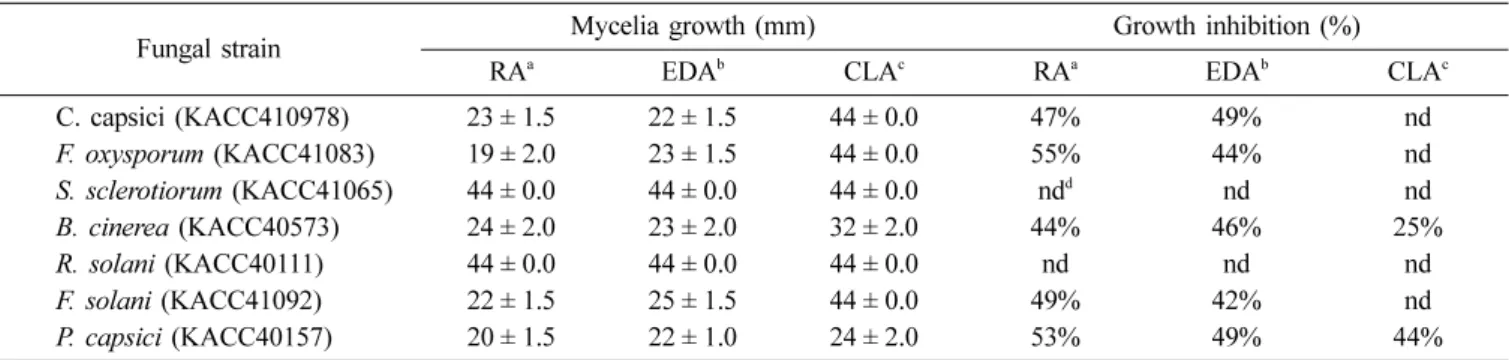
The anti-fungal activity of the bioconverted ricinoleic acid, eicosadienoic acid and conjugated linoleic acid against the tested plant pathogenic fungi was investigated by disc diffusion method, minimum inhibitory concentration and spore germination assay. The crude extracts of bioconverted ricinoleic, eicosadienoic and conjugated linoleic acids showed different anti-fungal activity potentials against the tested fungal strains as shown in Table 1. In solid media, bioconverted ricinoleic acid exhibited strong anti-fungal effect against F. oxysporum (55%), P. capsici (53%) and F. solani (49%) whereas, bioconverted eicosadienoic acid showed inhibition against P. capsici (49%), B. cinerea (46%) and C.
Table 1. Mycelia growth inhibition of various hydroxylated fatty acids against phytopathogenic fungi
Fungal strain Mycelia growth (mm) Growth inhibition (%)
RAa EDAb CLAc RAa EDAb CLAc
C. capsici (KACC410978) 23 ± 1.5 22 ± 1.5 44 ± 0.0 47% 49% nd
F. oxysporum (KACC41083) 19 ± 2.0 23 ± 1.5 44 ± 0.0 55% 44% nd
S. sclerotiorum (KACC41065) 44 ± 0.0 44 ± 0.0 44 ± 0.0 ndd nd nd
B. cinerea (KACC40573) 24 ± 2.0 23 ± 2.0 32 ± 2.0 44% 46% 25%
R. solani (KACC40111) 44 ± 0.0 44 ± 0.0 44 ± 0.0 nd nd nd
F. solani (KACC41092) 22 ± 1.5 25 ± 1.5 44 ± 0.0 49% 42% nd
P. capsici (KACC40157) 20 ± 1.5 22 ± 1.0 24 ± 2.0 53% 49% 44%
aRA, Ricinoleic acid; bEDA, Eicosadienoic acid; cCLA, Conjugated linoleic acid
dnd means no detection of anti-fungal activity
In vitro Anti-fungal Activity of Various Hydroxylated Fatty Acids Bioconverted by Pseudomonas aeruginosa PR3 133
capsici (49%) at the concentration of 5 µl ml−1. Bioconverted conjugated linoleic acid was found to be slightly susceptible against two plant pathogenic fungi B. cinerea (25%) and P.
capsici (44%) at 5 µl ml−1(Table 1).
Minimum inhibitory concentration values against the tested fungal strains were found to be between the range of 500~
1,000 µg ml−1 for bioconverted ricinoleic, eicosadienoic and conjugated linoleic acids. In liquid medium, bioconverted ricinoleic acid exhibited strong anti-fungal activity against C.
capsici, P. capsici, S. sclerotiorum and F. solani as compared to B. cinerea and F. oxysporum. Bioconverted eicosadienoic acid showed potent inhibitory effect as a minimum inhibitory concentration (MIC) against S. sclerotiorum (500µg ml−1) whereas conjugated linoleic acid was found to be less effective against all the fungal strains tested. These results are broadly similar to those reported by others for essential oils against plant pathogenic fungi as Mishra and Dubey reported that the essential oil of bael leaves exhibited wide range of anti-fungal activity against certain plant pathogenic fungi at concentrations ranging from 1000~3000 ppm.15-21) Essential oils from different
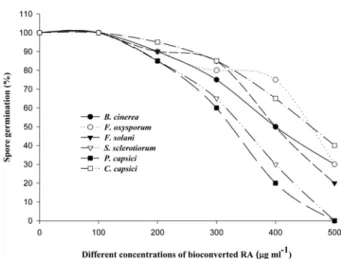
sources have been found to exhibit narrow as well as wide ranges of activities. The results obtained for bioconverted RA and EDA from the spore germination assay of the test fungi are shown in Fig. 1 and 2, respectively. A separate control run simultaneously in the presence of DMSO (0.5% v/v) as it used in the present study showed that it did not inhibit spore germination. There was a significant inhibition of fungal spore germination by different concentrations of bioconverted RA and EDA. A 100% fungal spore inhibition was observed against S. sclerotiorum and P. capsici for bioconverted RA and against the B. cinerea and P. capsici for bioconverted EDA at the concentration of 500 µg ml−1, whereas the rest of the fungi showed a considerable degree of inhibition in the range of 45% to 90%.
In this study, we found that there was a potential for anti- fungal effects of different hydroxylated fatty acids against different fungal strains in solid media. However, in liquid media, bioconverted ricinoleic and eicosadienoic acids were found to be more effective against the tested fungal strains as compared to bioconverted conjugated linoleic acid (Table 2).
Thus, these are results on the in vitro anti-fungal properties of bioconverted crude extracts using various hydroxylated fatty acids such as ricinoleic, eicosadienoic and conjugated linoleic acid produced by a bacterial strain P. aeruginosa PR3 against the tested phytopathogens.
In conclusion, especially, the bioconverted ricinoleic and eicosadienoic acids can be considered as leading factors in a wide range of activities against many phytopathogenic fungi, causing severe destruction to the agriculture industry in pre- and post-harvest such as B. cinerea (grey mold rot), F.
oxysporum (vascular wilt), S. sclerotiorum (water soaked spot), F. solani (fruit rot) and P. capsici (fruit rot). As a result, work on alternative approaches to controlling such pathogens is important. In view of the continuing need for new, environmentally benign approaches to disease control, this research will be valuable. Bioconverted ricinoleic and eicosadienoic acids may be the alternatives to the currently used fungicides in controlling plant pathogenic fungi.
Possessing rich sources of bioactive substances, they could lead to the development of new classes of possibly safer disease control agents as microbial conversions of fatty acids Fig. 1. Effect of various concentrations of bioconverted RA
on spore germination of different fungi.
Fig. 2. Effect of various concentrations of bioconverted EDA on spore germination of different fungi.
Table 2. Minimum inhibitory concentrations (MICs) of RA, EDA and CLA
Fungal strain MIC (µg ml−1) RAa EDAb CLAc C. capsici (KACC410978) 500 1000 1000 F. oxysporum (KACC41083) 1000 1000 1000 S. sclerotiorum (KACC41065) 500 500 1000 B. cinerea (KACC40573) 1000 1000 1000
F. solani (KACC41092) 500 1000 1000
P. capsici (KACC40157) 500 1000 1000
aRA, Ricinoleic acid; bEDA, Eicosadienoic acid; cCLA, Conjugated linoleic acid.
134 Vivek K. Bajpai et al.
have yielded diverse range of products that are useful potentially as value added products.3) In order to produce the bioconverted oil extracts of ricinoleic and eicosadienoic acids in large quantity and to render the bioprocess feasible and practical, further improvement in the production yield and process cost is needed. Attempts are being made to isolate the bioactive novel compounds from these bioconverted hydroxylated fatty acids responsible for this anti-fungal effect.
Acknowledgment
This work was supported by a grant (No. 20050301034472), from Bio Green 21 Program, Rural Development Administration, Republic of Korea.
References
1. Bagby, M. O. and Calson, K. D. (1989) Chemical and bio- logical conversion of soybean oil for industrial products. In Fats for the Future, Chichester, Ellis Horwood Limited Press, pp. 301-307.
2. Naughton, F. C. (1974) Production, chemistry, and commer- cial applications of various chemicals from castor oil. J.
Am. Oil. Chem. Soc.51, 65-71.
3. Hou, C. T. and Bagby, M. O. (1991) Production of a new compound, 7,10-dihydroxy-8(E)-octadecenoic acid from oleic acid by Pseudomonas sp. PR3. J. Ind. Microbiol. 7, 123-130.
4. Kato, T., Yamaguchi, Y., Abe, N., Uyehara, T., Nakai, T., Yamanaka, S. and Harada, N. (1984) Unsaturated hydroxy fatty acids, the self-defensive substances in rice plant against rice blast disease. Chem. Lett. 25, 409-412.
5. Kuo, T. M., Manthey, L. K. and Hou, C. T. (1998) Fatty acid bioconversions by Pseudomonas aeruginosa PR3. J.
Am. Oil. Chem. Soc.75, 875-879.
6. Kim, H., Kuo, T. M. and Hou, C. T. (1999) Production of 10,12-dihydroxy-8(E)-octadecenoic acid, an intermediate in the conversion of ricinoleic acid to 7,10,12-trihydroxy-8(E)- octadecenoic acid by Pseudomonas aeruginosa PR3. J. Ind.
Microbiol. Biotechnol. 24, 167-172.
7. Kim, H., Gardner, H. W. and Hou, C. T. (2000) Production of isomeric 9,10,13(9,12,13)-trihydroxy-11E(10E)-octade- cenoic acid from linoleic acid by Pseudomonas aeruginosa PR3. J. Ind. Microbiol. Biotechnol. 25, 109-115.
8. Kuo, T. M., Kim, H. and Hou, C. T. (2001) Production of a novel compound, 7,10,12-trihydroxy-8(E)-octadecenoic acid from ricinoleic acid by Pseudomonas aeruginosa PR3.
Curr. Microbiol.43, 198-203.
9. Pariza, M. W., Park, Y. and Cook, M. E. (2001) The bio- logically active isomers of conjugated linoleic acid. Prog.
Lipid Res.40, 283-298.
10. Belury, M. A. (2002) Dietary conjugated linoleic acid in health: physiological effects and mechanisms of action.
Annu. Rev. Nutr.22, 505-531.
11. Kishino, S., Ogawa, J., Ando, A., Omura, Y. and Shimizu, S. (2002) Ricinoleic acid and castor oil as substrates for conjugated linoleic acid production by washed cells of Lac- tobacillus plantarum. Biosci. Biotechnol. Biochem. 66, 2283-2286.
12. Hou, C. T., Gardner, H. W. and Brown, W. (2001) 12,13,16- Trihydroxy-9(Z)-octadecenoic acid, a possible intermediate in the bioconversion of linoleic acid to tetrahydrofuranyl fatty acids by Clvibacter sp. ALA2. J. Am. Oil Chem. Soc.
78, 1167-1169.
13. Rana, B. K., Singh, U. P. and Taneja, V. (1997) Antifungal activity and kinetics of inihibition by essential oil isolated from leaves of Aegle marmelos. J. Ethnopharmacol. 57, 29- 14. Murray, P. R., Baron, E. J., Pfaller, M. A., Tenover, F. C.34.
and Yolke, R. H. (1995) In Manual of Clinical Microbiol- ogy, (6th ed.) ASM, Washington, DC.
15. Begum, J., Yusuf, M., Chowdhury, J. U. and Wahab, M. A.
(1993) Studies on essential oils for their anti-bacterial and anti-fungal properties. Part 1. Preliminary screening of 35 essential oils. Bangl. J. Sci. Indu. Res.28, 25-34.
16. Anthonov, A., Stewart, A. and Walter, M. (1997) Inhibition of conidium germination and mycelial growth of Botrytis cinerea by natural products. New Zealand Plant Prot. Soc.
1-7.
17. Jain, N. K. (1997) Anti-fungal activity of essential oil of Aegle marmelos Correa (Rutaceae). Indian Drugs Pharma.
Indu.12, 55-59.
18. Mishra, A. K. and Dubey, N. K. (1990) Fungitoxicity of essential oil of Amomum subulatum against Aspergillus fla- vus. Econ. Bot. 44, 530-533.
19. Shimoni, M. (1993) Growth inhibition of plant pathogenic fungi. J. Essen. Oil Res.74, 306-308.
20. Rao, B. G. V. N. and Joseph, P. L. (1971) Activity of some essential oils towards phytopathogenic fungi. Riech. Arom.
Koerperpfl.21, 405-410.
21. Singh, A. K., Dikshit, A., Sharma, M. L. and Dixit, S. N.
(1980) Fungitoxic activity of some essential oils. Econ. Bot.
34, 186-190.