한국의 건강한 소아청소년을 대상으로 한 인플루엔자 사백신의 면역원성과 안전성 연구
이수현1ᆞ김미정2ᆞ김윤경1
고려대학교 의과대학 안산병원 소아과학교실1, 경기도의료원 이천병원 소아청소년과2
Immunogenicity and Safety of Inactivated Influenza Vaccine in Healthy Korean Children and Adolescent
Soohyun Ri1, Mi Jeong Kim2, Yun-Kyung Kim1
1Department of Pediatrics, Korea University Ansan Hospital, Korea University College of Medicine, Ansan; 2Department of Pediatrics, Gyeonggi Provincial Medical Center Icheon Hospital, Icheon, the Republic of Korea
Purpose: This study aimed to evaluate the immunogenicity and safety of a trivalent inactivated influenza vaccine (TIV) among healthy Korean children and adolescents.
Methods: From October to December 2008, 65 healthy patients aged 6 months to 18 years who visited Korea University Ansan Hospital for influenza vaccination were enrolled in this study. We measured the hemagglutinin inhibition antibody titers at baseline and 30 days after vaccinating enrollees with split influenza vaccine and calculated the seroprotection rates, geometric mean titers, and seroconversion rates.
Local and systemic adverse events were assessed after vaccination.
Results: The seroprotection rates against all three viral strains (A/H1N1, A/H3N2, B) were 87.7%, 89.2%, and 89.2% (≥70%), respectively;
seroconversion rates were 44.6%, 73.8%, and 63.1% (≥40%), respectively; and seroconversion factors were 4.5, 8.4, and 10.5 (>2.5), re
spectively. The TIV immunogenicity was acceptable according to the CPMP (Committee for Proprietary Medicinal Products) criteria. Although 48 patients (73.8%) reported one or more adverse events, no severe adverse events such as anaphylaxis and convulsion were observed.
Fortytwo patients (64.6%) reported a local skin reaction, including redness (29.2%), pain (43.1%), or swelling (41.5%) of the injected site, and 26 (40.0%) reported a systemic reaction: fatigue (23.1%), myalgia (20.0%), headache (10.8%), arthralgia (10.8%), chills (9.2%), or fever (7.7%).
Conclusions: This study shows that the immunogenicity of the TIV vaccine is acceptable. As there were no serious adverse events aside from local reactions and mild systemic reactions, this vaccine can be safely used among healthy Korean children and adolescents.
Key Words: Influenza vaccines; Immunogenicity, vaccine; Safety
Received: 15 September 2017 Revised: 16 October 2017 Accepted: 18 October 2017
책임저자: Yun-Kyung Kim
Department of Pediatrics, Korea University Ansan Hospital, Korea University College of Medicine, Ansan, Korea
Tel: +82-31-412-4844, Fax: +82-31-405-8591 E-mail: [email protected]
ARTICLE
Introduction
Influenza infection causes an acute febrile illness mainly of the respiratory type. It can also increase hos
pitalization and mortality rates in highrisk groups13). The prevalence of influenza is the highest among children and adolescents, and these groups play an
important role as a mediator by shedding more viruses longer than adults and by making close contact with each other in the family or at school. Therefore, pre
vention of influenza in childhood is important socioe
conomically4,5).
According to the Organization for Economic Coopera
tion and Development (OECD) Health Data, in 20156), the influenza vaccination rate among people aged 65 and older was 81.7% in Korea, which is the highest among OECD countries. According to data from the Commissioner of Statistics Korea and the Centers for Disease Control and Prevention, in 20157), the rate of influenza vaccination among children and adolescents aged 1 to 18 years was 49.3%, indicating that about half of all children and adolescents get the influenza vaccine every year.
However, there are limited immunogenicity and safety data on Korean children and adolescents. This study was aimed at evaluating the immunogenicity and safety of an inactivated split influenza vaccine, which is widely used in Korea, among healthy Korean children and ado
lescents811).
Materials and Methods
1. Study population
From October to December 2008, healthy children and adolescents, aged 6 months to 18 years, who vi
sited the Department of Pediatrics, Korea University Ansan Hospital, for influenza vaccination were included in the study. Of the 68 patients who agreed to partici
pate in the study with informed consents, three with
drew and 65 completed the study. We collected demo
graphic information and data on the medical history and immunization history from the subjects. Height, weight, and body temperature were measured, and physical examination was con ducted. This study was reviewed and approved by the Institutional Review Board of Korea University Ansan Hospital (IRB number: AS0857).
2. Vaccination and blood sampling
The split vaccine used in this study was VaxigripⓇ (SPL
influenza vaccine; Aventis Pasteur MSD, Lyon, France).
Vaxigrip contained three inactivated viral strains: (1) A/
Brisbane/59/2007 (H1N1) strain (IVR148), (2) A/Uru
guay/716/2007 (H3N2) strain (NYMCX175C), and (3) B/Florida/4/2006 strain. After the baseline blood samp
ling (5 mL), the vaccine was injected, and the adverse effects were monitored at the hospital for 30 minutes.
The second blood sampling was performed 30 days after the first shot in each primed subject and 30 days after the second shot in the unprimed group. The vaccine was injected intramuscularly (deltoid or upper lateral thigh) in 0.25mL volume. Usually, one dose was given, and in the case of no influenza vaccination history, two doses were injected at a 1month interval.
3. Antibody assays
Antihemagglutinin antibody titers were determined by the hemagglutinin inhibition (HI) test. Antihemag
glutinin titers toward H1N1 were measured by means of A/Brisbane/59/2007 (H1N1) strain (IVR148), titers to H3N2 were measured by means of A/Uruguay/716/
2007 (H3N2) strain (NYMCX175C), and titers to influ
enza B were measured using B/Florida/4/2006 strain.
4. Immunogenicity
The seroprotection rate, seroconversion rate, geo
metric mean titer (GMT), and seroconversion factor were calculated from the antibody titers for the three viruses (A/H1N1, A/H3N2, and B) whose antigens were contained in the vaccine. Afterwards, immunogenicity was assessed based on the CPMP (Committee for Pro
prietary Medicinal Products) standards12,13). According to these standards, in case of healthy adults aged 18 to 60, if at least one of the following three conditions is met, then the vaccine is immunogenic: (1) the seropro
tection rate of 70% or higher; (2) the serocon version rate is 40% or higher; (3) the seroconversion factor (GMT ratio, which is the ratio of GMT values of HI pre
and postvaccination) is greater than 2.5fold.
The seroprotection rate was defined as the percen
tage of people with the HI antibody titer of 1:40 or better. The seroconversion rate was defined as: the percentage of participants whose postvaccination HI
antibody titer reached 1:40 or better among those with the baseline titer 1:10 or weaker; or increased fourfold or more among those with the baseline titer 1:10 or stronger. The seroconversion factor is the GMT fold increase after vaccination relative to GMT before vacci
nation.
5. Adverse events
Immediately after the vaccination, the examiner moni
tored possible emergence of immediate and serious ad
verse events such as anaphylaxis, allergic asthma, and angioedema for 30 minutes at the hospital. A diary was kept by each guardian until the 7th day, and adverse events were subdivided into systemic reactions and local reactions. Redness, pain, swelling, and ecchymosis were recorded as four types of local reaction, whereas fever, chills, fatigue, headache, myalgia, and arthralgia were recorded as six types of systemic reaction. The participants were instructed to report convulsions and serious adverse events immediately to the examiners.
The recorded adverseevent diaries were collected 30 days after the injection. In case of the second injection, the adverse events were monitored in the same manner as after the first injection, and the diaries were collected 30 days after the second injection.
6. Statistical analysis
These analyses were performed in the SPSS version 20.0 (IBM Co., Armonk, NY, USA). The statis tical me
thods for agespecific comparisons of immunogenicity, seroconversion rates, and serum protection rates were as follows: the chisquare test, oneway analysis of variance for discontinuous variables, and the ttest for continuous variables. Differences with P<0.05 were considered statistically significant.
Results
1. Characteristics of subjects
Of the 68 patients who agreed to participate in the clinical trial, three withdrew, and 65 completed the study. The 65 subjects were subdivided into two groups
by age: (1) 6 to 59montholds, 31 subjects (47.7%);
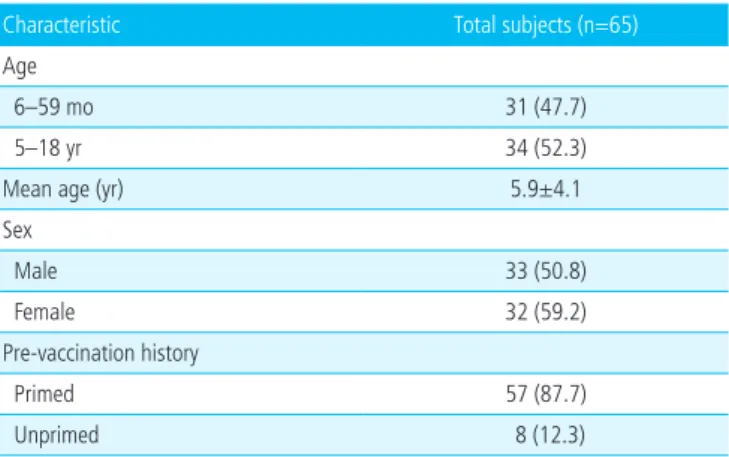
and (2) 5 to 18yearolds, 34 subjects (52.3%). The mean age±standard deviation was 5.9±4.1 and the sex ratio was 33 (50.8%) to 32 (59.2%). Fiftyseven subjects were influenza vaccine primed, and eight sub
jects were influenza vaccine unprimed (Table 1).
2. Immunogenicity of influenza vaccine
Trivalent inactivated influenza vaccine (TIV) was suc cessfully induced immunogenicity in most subjects.
Sero protection rate for H1N1, H3N2, B were 87.8%, 89.2%, and 89.2%, respectively. Seroconversion rate were 44.6%, 73.8%, and 63.1%. GMT ratio were 4.5, 8.4, and 10.5 (Table 2).
1) Immunogenicity comparison by age
We compared immunogenicity of TIV by age (Table 3). The seroprotection rate toward the inactivated H1N1 virus was 80.6% in the 6 to 59monthold group and 94.1% in the 5 to 18yearold group (P=0.021). The seroprotection rates toward the H3N2 virus were 83.9%
and 94.1%, respectively (P=0.042). The seroprotection rates for influenza B virus were 83.9% and 94.1%
Table 1. Demographic Characteristics
Characteristic Total subjects (n=65)
Age
6–59 mo 31 (47.7)
5–18 yr 34 (52.3)
Mean age (yr) 5.9±4.1
Sex
Male 33 (50.8)
Female 32 (59.2)
Prevaccination history
Primed 57 (87.7)
Unprimed 8 (12.3)
Values are presented as number (%) or mean±standard deviation.
Table 2. Immunogenicity of Subjects
A/H1N1 A/H3N2 B CPMP standards
Seroprotection rate (%) 87.7 89.2 89.2 ≥70%
Seroconversion rate (%) 44.6 73.8 63.1 ≥40%
GMT ratio 4.5 8.4 10.5 >2.5fold
Abbreviation: CPMP, committee for proprietary medicinal products; GMT, geometric mean titer.
(P=0.042).
The seroconversion rate toward the H1N1 virus was 51.6% in the 6 to 59monthold group and 38.2% in the 5 to 18yearold group (P=0.398). The serocon
version rate for the H3N2 virus was 80.6% and 67.6%, respectively (P=0.620). The seroconversion rates for the influenza B virus were 74.2% and 52.9% (P=0.152).
The GMT ratio for H1N1 virus was 6.7 in the 6 to 59monthold group and 3.0 in the 5 to 18yearold group (P=0.026). The GMT ratios for H3N2 virus were 8.5 and 8.7, respec tively (P=0.284). The GMT ratios for influenza B were 6.4 and 7.5, respectively (P=0.024).
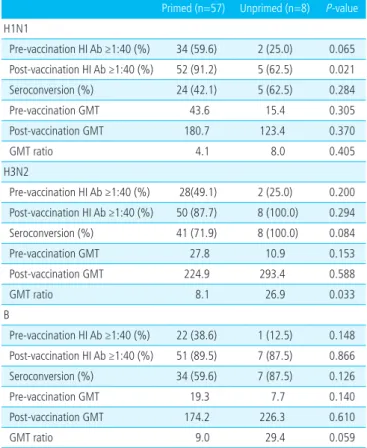
2) Immunogenicity comparison by vaccination history We compared the immunogenicity of TIV by vacci
nation history (Table 4). The seroprotection rate toward the H1N1 virus was 91.2% in the primed group and
62.5% in the unprimed group (P=0.021). The seropro
tection rates for the H3N2 virus were 87.7% and 100%
(P=0.294), whereas the seroprotection rates for influ
enza B were 89.5% and 87.2%, respectively (P=0.866).
The seroconversion rate for the H1N1 virus was 42.1% in the primed group and 62.5% in the unprimed group (P=0.284). The seroconversion rates for the H3N2 virus were 71.9% and 100% (P=0.084), whereas the seroconversion rates for influenza B were 59.6%
and 87.5%, respectively (P=0.126).
The GMT ratio for the H1N1 virus was 4.1 in the primed group and 8.0 in the unprimed group (P=0.405).
The GMT ratios for the H3N2 virus were 8.1 and 26.9 (P=0.033), and for influ enza B virus 9.0 and 29.4, re
spectively (P=0.059).
3. Adverse drug events for influenza vaccine
There were no severe adverse events, and the most Table 3. Comparison of Immunogenicity of Influenza Vaccine
According to Age Groups
6–59 mo (n=31)
5–18 yr (n=34)
Total (n=65)
P
value H1N1
Prevaccination HI Ab ≥1:40 (%) 11 (35.5) 25 (73.5) 36 (55.4) <0.001 Postvaccination HI Ab ≥1:40 (%) 25 (80.6) 32 (94.1) 57 (87.7) 0.021 Seroconversion (%) 16 (51.6) 13 (38.2) 29 (44.6) 0.398
Prevaccination GMT 20.0 72.0 38.3 0.015
Postvaccination GMT 134.5 219.3 172.4 0.329
GMT ratio 6.7 3.0 4.5 0.026
H3N2
Prevaccination HI Ab ≥1:40 (%) 10 (32.3) 20 (58.8) 30 (46.1) 0.017 Postvaccination HI Ab ≥1:40 (%) 26 (83.9) 32 (94.1) 58 (89.2) 0.042 Seroconversion (%) 25 (80.6) 23 (67.6) 48 (73.8) 0.620
Prevaccination GMT 16.8 36.0 27.8 0.194
Postvaccination GMT 170.7 313.3 232.4 0.107
GMT ratio 8.5 8.7 8.4 0.284
B
Prevaccination HI Ab ≥1:40 (%) 5 (16.1) 18 (52.9) 23 (35.4) <0.001 Postvaccination HI Ab ≥1:40 (%) 26 (83.9) 32 (94.1) 58 (89.2) 0.042 Seroconversion (%) 23 (74.2) 18 (52.9) 41 (63.1) 0.152
Prevaccination GMT 8.8 33.1 17.2 0.004
Postvaccination GMT 128.8 248.7 179.9 0.126
GMT ratio 6.4 7.5 10.5 0.024
Values are presented as number (%).
GMT ratio is defined as division of postGMT by preGMT.
Abbreviations: HI, hemagglutinin inhibition; GMT, geometric mean titer.
Table 4. Comparison of Immunogenicity of Influenza Vaccine between Primed and Unprimed Group
Primed (n=57) Unprimed (n=8) Pvalue H1N1
Prevaccination HI Ab ≥1:40 (%) 34 (59.6) 2 (25.0) 0.065 Postvaccination HI Ab ≥1:40 (%) 52 (91.2) 5 (62.5) 0.021
Seroconversion (%) 24 (42.1) 5 (62.5) 0.284
Prevaccination GMT 43.6 15.4 0.305
Postvaccination GMT 180.7 123.4 0.370
GMT ratio 4.1 8.0 0.405
H3N2
Prevaccination HI Ab ≥1:40 (%) 28(49.1) 2 (25.0) 0.200 Postvaccination HI Ab ≥1:40 (%) 50 (87.7) 8 (100.0) 0.294
Seroconversion (%) 41 (71.9) 8 (100.0) 0.084
Prevaccination GMT 27.8 10.9 0.153
Postvaccination GMT 224.9 293.4 0.588
GMT ratio 8.1 26.9 0.033
B
Prevaccination HI Ab ≥1:40 (%) 22 (38.6) 1 (12.5) 0.148 Postvaccination HI Ab ≥1:40 (%) 51 (89.5) 7 (87.5) 0.866
Seroconversion (%) 34 (59.6) 7 (87.5) 0.126
Prevaccination GMT 19.3 7.7 0.140
Postvaccination GMT 174.2 226.3 0.610
GMT ratio 9.0 29.4 0.059
Values are presented as number (%).
GMT ratio is defined as division of postGMT by preGMT.
Abbreviations: HI, hemagglutinin inhibition; GMT, geometric mean titer.
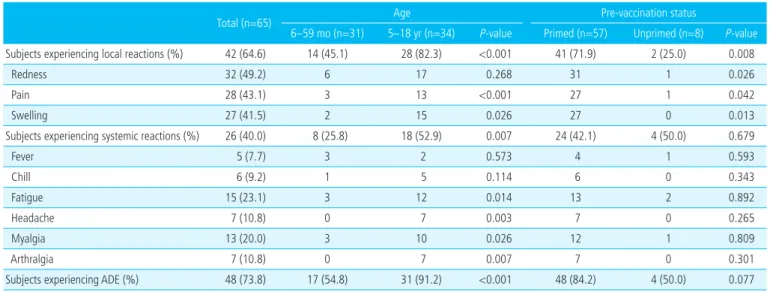
frequent one was a local skin reaction. The total number of subjects who reported one or more local and/or systemic reaction was 48 (73.8%). Fortytwo subjects (64.6%) reported a local skin reaction such as redness (29.2%), pain (43.1%), and/or swelling (41.5%) of the injected site, and 26 subjects (40.0%) reported a sys
temic reaction: fatigue (23.1%), myalgia (20.0%), head
ache (10.8%), arthralgia (10.8%), chills (9.2%), and/or fever (6.2%) (Table 5).
In the comparison by age groups, 17 out of 31 sub
jects (54.8%) in the 6 to 59monthold group and 31 out of 34 subjects (91.2%) in the 5 to 18yearold group reported one or more adverse events (P<0.001).
A local reaction was reported by 14 subjects (45.1%) and 28 subjects (82.3%), respectively (P<0.001). Eight subjects (25.8%) and 18 subjects (52.9%) reported a systemic reaction, respectively (P=0.007).
In the comparison by vaccination history, 48 out of 57 subjects (84.2%) in the primed group and four out of eight subjects (50.0%) in the unprimed group re
ported one or more adverse events. A local reaction was reported by 41 subjects (71.9%) and two subjects (25.0%), whereas 24 subjects (42.1%) and four subjects (50.0%) reported a systemic reaction, respectively.
Discussion
This study was conducted to investigate the immu
nogenicity and safety of an inactivated split influenza vaccine that is widely used in Korea, among healthy children and adolescents.
The European Medicines Evaluation Agency decides that an influenza vaccine (that is administered every year) is immunogenic when it meets at least one of the three criteria for adults aged 18 to 60 years. These CPMP criteria were applied to our subjects who were aged 6 months to 18 years in this study12,13). Among all the subjects, seroprotection rates toward viruses H1N1, H3N2, and B were >70%; seroconversion rates for the three inactivated viruses in the vaccine were >40%; and the serum conversion factor for the three viral strains were >2.5. Based on these results, it was confirmed that the immunogenicity was acceptable according to the CPMP standards (Table 2).
In Korea, nationwide free inactivated split influenza vaccination of 6 to 59monthold children was started in September 2017. Therefore, in this study, we tried to compare immunogenicity by subdividing the subjects into two age groups: the 6 to 59monthold group and 5 to 18yearold group (Table 3). There are not many studies on the efficacy and effectiveness of
Table 5. Local and Systemic Adverse Events
Total (n=65) Age Prevaccination status
6–59 mo (n=31) 5–18 yr (n=34) Pvalue Primed (n=57) Unprimed (n=8) Pvalue Subjects experiencing local reactions (%) 42 (64.6) 14 (45.1) 28 (82.3) <0.001 41 (71.9) 2 (25.0) 0.008
Redness 32 (49.2) 6 17 0.268 31 1 0.026
Pain 28 (43.1) 3 13 <0.001 27 1 0.042
Swelling 27 (41.5) 2 15 0.026 27 0 0.013
Subjects experiencing systemic reactions (%) 26 (40.0) 8 (25.8) 18 (52.9) 0.007 24 (42.1) 4 (50.0) 0.679
Fever 5 (7.7) 3 2 0.573 4 1 0.593
Chill 6 (9.2) 1 5 0.114 6 0 0.343
Fatigue 15 (23.1) 3 12 0.014 13 2 0.892
Headache 7 (10.8) 0 7 0.003 7 0 0.265
Myalgia 13 (20.0) 3 10 0.026 12 1 0.809
Arthralgia 7 (10.8) 0 7 0.007 7 0 0.301
Subjects experiencing ADE (%) 48 (73.8) 17 (54.8) 31 (91.2) <0.001 48 (84.2) 4 (50.0) 0.077
Values are presented as number (%).
Abbreviation: ADE, adverse drug event.
the inactivated influenza vaccine in children, and some studies have shown that immunogenicity of the vaccine is lower in infants than in adolescents and adults1417). According to one study, the rate of conversion of the antibody to a titer of 1:40 or better after vaccination is approximately 40% to 80% among children younger than 6 years, and 70% to 100% among children older than 6 years18). There are some studies presenting dif ferences in immunogenicity by age as described above. However, recent studies showed that influenza vaccines are effective enough for children under 2 or 3 years of age1921). Therefore, we wanted to evaluate the age differences in immunogenicity of an influenza vaccine.
In this study, the seroprotection rates toward viruses H1N1, H3N2, and B in the two age groups were in compliance with the CPMP standards (≥70%). This study shows statistically significantly higher seroprotec
tion rates in the 5 to 18yearold group than in the 6 to 59monthold group, and this finding is consis
tent with other studies, indicating that the immunoge
nicity of the inactivated vaccine increases with age22). These results can be discussed in terms of HI antibody levels prior to influenza vaccination. In this study, the proportion of subjects with HI antibody of 1:40 or better before the vaccination was determined in each age group, 6 to 59montholds versus 5 to 18
yearolds (Table 3): 35.5% versus 73.5% (P=0.001) for the H1N1 virus; 32.3% versus 58.8% (P=0.017) for the H3N2 virus; and 16.1% versus 52.9% (P<0.001) for influenza B. These data suggest that there is a contri
bution to the preexisting immunity by the current vac
cination. This finding is similar to the results of a study on hospital workers between the ages of 18 and 60, namely, that they already have high levels of the HI antibody before influenza vaccination20).
Although the difference was not statistically signifi
cant, the seroconversion rate tended to be higher in the younger age group. The reason for the low sero
conversion rate in the 5 to 18yearold group may be that the HI antibody was already upregulated prior to vaccination, and accordingly, the number of subjects whose antibody level increased 4fold or more after
the vaccination was relatively low. The seroconversion rate toward the H1N1 virus in the 5 to 18yearold group was less than 40%, which is insufficient accor
ding to the CPMP standards. Because the seroprotection rate was 94.1%, overall immunogenicity was good.
The GMT ratios (i.e., the seroconversion factor) for viruses H1N1, H3N2, and B met the CPMP standards (>2.5) in both age groups. In the analysis of pre and postvaccination GMT of each viral strain by age of the participants, the H1N1 virus’ prevaccination GMTs were 20.0 and 72.0 (P=0.015), and postvaccination GMTs were 134.5 and 219.3 (P=0.329), respectively.
The H3N2 virus’s prevaccination GMTs were 16.8 and 36.0 (P=0.194), and postvaccination GMTs were 170.7 and 313.3 (P=0.107). Influenza B virus’ prevaccination GMTs were 8.8 and 33.1 (P=0.004), and postvaccina
tion GMTs were 128.8 and 248.7 (P=0.126). Viruses H1N1 and B showed a statistically significant difference in prevaccination GMT between the two age groups, but postvaccination GMT showed no statistically signi
ficant difference between the two age groups.
According to the comprehensive analysis of the results by age, this study shows statistically significantly higher seroprotection rates in the 5 to 18yearold group than in the 6 to 59monthold group for all three viral strains, and the seroconversion rate tended to be higher in the younger age group albeit statistically not significantly. These age differences may be closely re
lated to differences in the immunity already obtained before vaccination.
Eight of the 65 subjects (12.3%) were firsttime vac
cine recipients, all under 5 years of age. In this study, two vaccinations were administered to unprimed sub
jects with a 1month interval (Table 4).
The seroprotection rate toward the H1N1 virus showed a statistically significant difference between the primed and unprimed group. The numbers of subjects with the HI antibody titer 1:40 or better before vacci nation against influenza viruses H1N1, H3N2, and B were two (25.0%), two (25.0%), and one (12.5%) among the eight unprimed subjects, and 34 (59.5%), 28 (49.1%), and 22 (38.6%) among the 57 primed sub jects. These results suggest that there is a difference in immunogeni
city between unprimed and primed groups before in
fluenza vaccination. This is because the per centages of subjects with the HI antibody titer 1:40 or better before vaccination were 35.5%, 32.3%, and 16.1% in the 6 to 59monthold group, and 73.5%, 58.8%, and 52.9% in the 5 to 18yearold group. The percentage of primed subjects is higher in the older group, meaning the pre
existing immunity against influenza was stronger in older group.
As for the seroconversion rate, there was no statisti
cally significant difference between the unprimed group and primed group. However, when the Pvalue for the seroconversion rate comparison for the H3N2 virus is 0.084, it is likely that there will be a significant diffe
rence between the two groups when the number of subjects is increased. The seroconversion rates toward viruses H3N2 and B were high, at 100% and 87.5%, re spectively, whereas this rate for the H1N1 virus was low, 62.5%. In the case of the primed group, the re
sults are similar. Thus, the seroconversion rate toward the H1N1 virus was relatively low regardless of the vaccination history. In the case of the H3N2 virus, the seroconversion rate was relatively high: 100% in the unprimed group and 71.9% in the primed group, indi
cating excellent immunogenicity because of its age
independent pattern.
The GMT ratio (i.e., the seroconversion factor) for the H1N1 virus was 4.1 in the primed group and 8.0 in the unprimed group (P=0.405). The GMT ratios for the H3N2 virus were 8.1 and 26.9 (P=0.033), and for in flu enza B virus 9.0 and 29.4, respectively (P=0.059).
Among the subjects whose antibody titers increased more than 4fold after the influenza vaccination, the proportion of subjects with a final antibody titer of 1:40 or better tended to be lower among the primed subjects than among the unprimed subjects. The GMT ratios for viruses H3N2 and B were significantly higher in the unprimed group than in the primed group; this result may be related to the higher preexisting HI anti
body titer.
In general, the most commonly reported adverse events after influenza vaccination are local reactions and fever23). Neuzil and Edwards24) reported no serious
adverse events in trials of an inactivated TIV among children between 1 and 16 years of age and stated that local reactions occurred in 6% to 14% of the subjects.
And other studies have documented local reactions such as vaccinated site pain, redness, and swelling in 25% of the subjects25,26). The local reaction rates varied widely because in most of the studies, adverse events were selfreported by participants. However, in this study, local adverse event rate was particularly high as 64.6%. This may be due to that adolescents have a high level of awareness of adverse events and they constituted a relatively large portion of the total pop
ulation27). In our study, the local adverse event repor
ting rate was significantly higher in the 5 to 18year
old group than 6 to 59monthold group (82.3% vs.
45.1%, P<0.001). As evidence to support this, in other two studies on healthy adults28,29), local adverse events were reported at high rates as 56.3% and 78.0%, re
spectively. However, the objective index, fever, was 9.0% and <5%, respectively, similar to 7.7% of this study. Although the rates of objective adverse events are similar, rates of subjective adverse events can vary depending on the age and the degree of awareness of the target groups. According to a nonrandomized co horts study in 106 pediatric participants under 36 months, there was no significant difference between the subunit vaccine and the split vaccine, suggesting that local adverse reaction rates do not differ depending on the vaccine formulation30).
Masurel et al.31) reported that adverse reactions are more frequent in the unprimed group. However, in the present study, the older group, which had a higher vac
cination rate, reported a greater number of systemic adverse reactions. This is probably because the sys
temic reactions almost all consisted of subjective symp toms selfreported by the subjects, e.g., fatigue, myalgia, headache, and arthralgia. Therefore, when comparing only the fever, which is an objective indi
cator, there was no significant difference in two groups (P=0.593).
Starting from September 2017, KCDC has begun free nationwide influenza vaccination for children in 6 to 59 months age group. Thus, our study can be meaningful
in that we have added basic data on immunogenicity and safety in the target age group of the policy. This study also included data comparing the unprimed and primed group.
The limitation of this study is that the study was per
formed in a single center; thus, the number of subject was small. Sixtyfive subjects are difficult to generalize, and especially the unprimed subjects were only eight. In addition, studies on the comparison with the placebo group will be necessary to verify the safety of influenza vaccine itself. Therefore, multicenter randomized trial is needed in future studies. Also, it is necessary to develop objective indicators that can evaluate the ad
verse events. In addition, multiyear data should be constructed because influenza vaccine strains change every year.
In conclusion, this study shows that the seroprotection rate, seroconversion rate, and GMT—of the vaccine under study toward influenza viruses H1N1, H3N2, and B—meet the CPMP criteria. There were no serious adverse events aside from local reac tions and mild sys
temic reactions such as fatigue and myalgia. Therefore, this vaccine can be considered relatively safe.
References
1. Thompson WW, Shay DK, Weintraub E, Brammer L, Cox N, Anderson LJ, et al. Mortality associated with influenza and respiratory syncytial virus in the United States. JAMA 2003;289:179-86.
2. Thompson WW, Shay DK, Weintraub E, Brammer L, Bridges CB, Cox NJ, et al. Influenza-associated hospitali- zations in the United States. JAMA 2004;292:1333-40.
3. Fiore AE, Shay DK, Broder K, Iskander JK, Uyeki TM, Mootrey G, et al. Prevention and control of seasonal in- fluenza with vaccines: recommendations of the Advisory Committee on Immunization Practices (ACIP), 2009.
MMWR Recomm Rep 2009;58(RR-8):1-52.
4. Cheong HJ, Song JY, Park JW, Yeon JE, Byun KS, Lee CH, et al. Humoral and cellular immune responses to influenza vaccine in patients with advanced cirrhosis. Vaccine 2006;
24:2417-22.
5. Fiore AE, Shay DK, Broder K, Iskander JK, Uyeki TM, Mootrey G, et al. Prevention and control of influenza:
recommendations of the Advisory Committee on Immu- nization Practices (ACIP), 2008. MMWR Recomm Rep 2008;57(RR-7):1-60.
6. Organization for Economic Cooperation and Develop- ment (OECD). 2015 Influenza vaccination rates [Internet].
Paris: OECD; c2018 [cited 2018 Mar 17]. Available from:
https://data.oecd.org.
7. Korean Statistical Information Service. 2015 Influenza vaccination rate for children and adolescents [Internet].
Daejeon: Statistics Korea; 2015 [cited 2018 Mar 17]. Avail- able from: http://kosis.kr.
8. Kim YK, Eun BW, Lee TJ, Lee J, Kim KH, Kim DH, et al.
Immunogenicity and safety of a cell culture-derived in- activated quadrivalent influenza vaccine (NBP607-QIV) in South Korean children and adolescents: a randomized, double-blind, multi-center, phase 3 clinical trial. Open Forum Infect Dis 2016;3 Suppl 1:S201.
9. Cintra OA, Rey LC. Safety, immunogenicity and efficacy of influenza vaccine in children. J Pediatr (Rio J) 2006;82 (3 Suppl):S83-90.
10. Wright PF. The use of inactivated influenza vaccine in children. Semin Pediatr Infect Dis 2006;17:200-5.
11. Han SB, Rhim JW, Shin HJ, Lee SY, Kim HH, Kim JH, et al. Immunogenicity and safety assessment of a trivalent, inactivated split influenza vaccine in Korean children:
Double-blind, randomized, active-controlled multicenter phase III clinical trial. Hum Vaccin Immunother 2015;11:
1094-102.
12. Committee for Medicinal Products for Human Use. Gui- deline on dossier structure and content for pandemic influenza vaccine marketing authorisation application [Internet]. London: European Medicines Agency; 2008 [cited 2018 Mar 17]. Available from: http://www.ema.
europa.eu.
13. Committee for Proprietary Medicinal Products. Note for guidance on harmonisation of requirements for influenza vaccines [Internet]. London: European Agency for the Evaluation of Medicinal Products; 1997 [cited 2018 Mar 17]. Available from: http://www.ema.europa.eu.
14. Walter EB, Rajagopal S, Zhu Y, Neuzil KM, Fairchok MP, Englund JA. Trivalent inactivated influenza vaccine (TIV)
immunogenicity in children 6 through 23 months of age:
do children of all ages respond equally? Vaccine 2010;28:
4376-83.
15. Seidman JC, Richard SA, Viboud C, Miller MA. Quanti- tative review of antibody response to inactivated seasonal influenza vaccines. Influenza Other Respir Viruses 2012;
6:52-62.
16. Langley JM, Vanderkooi OG, Garfield HA, Hebert J, Chandrasekaran V, Jain VK, et al. Immunogenicity and safety of 2 dose levels of a thimerosal-free trivalent sea- sonal influenza vaccine in children aged 6-35 months: a randomized, controlled trial. J Pediatric Infect Dis Soc 2012;1:55-63.
17. Yang P, Thompson MG, Ma C, Shi W, Wu S, Zhang D, et al. Influenza vaccine effectiveness against medically-at- tended influenza illness during the 2012-2013 season in Beijing, China. Vaccine 2014;32:5285-9.
18. Song JY, Ha SH, Kee SY, Jeong HW, Cheong HJ, Kim WJ.
Debate on annual influenza vaccination in healthcare workers for the same subtype under the vaccine shortage.
J Clin Virol 2007;38:149-52.
19. Ahout I, Ferwerda G, de Groot R. Influenza vaccination in kids, are you kidding me? J Infect 2014;68 Suppl 1:S100- 7.
20. Heinonen S, Silvennoinen H, Lehtinen P, Vainionpaa R, Ziegler T, Heikkinen T. Effectiveness of inactivated in- fluenza vaccine in children aged 9 months to 3 years: an observational cohort study. Lancet Infect Dis 2011;11:23- 9.
21. Blyth CC, Jacoby P, Effler PV, Kelly H, Smith DW, Robins C, et al. Effectiveness of trivalent flu vaccine in healthy young children. Pediatrics 2014;133:e1218-25.
22. Kee SY, Lee JS, Cheong HJ, Chun BC, Song JY, Choi WS, et al. Influenza vaccine coverage rates and perceptions on vaccination in South Korea. J Infect 2007;55:273-81.
23. Jefferson T, Rivetti A, Harnden A, Di Pietrantonj C, Demi cheli V. Vaccines for preventing influenza in healthy children. Cochrane Database Syst Rev 2008;(2):CD004879.
24. Neuzil KM, Edwards KM. Influenza vaccines in children.
Semin Pediatr Infect Dis 2002;13:174-81.
25. McMahon AW, Iskander J, Haber P, Chang S, Woo EJ, Braun MM, et al. Adverse events after inactivated influ- enza vaccination among children less than 2 years of age:
analysis of reports from the vaccine adverse event re- porting system, 1990-2003. Pediatrics 2005;115:453-60.
26. Kanra G, Marchisio P, Feiterna-Sperling C, Gaedicke G, Lazar H, Durrer P, et al. Comparison of immunogenicity and tolerability of a virosome-adjuvanted and a split in- fluenza vaccine in children. Pediatr Infect Dis J 2004;23:
300-6.
27. Jo YM, Ki SY, Song JY, Choi WS, Kim JY, Seo YB, et al.
Immunogenicity and safety of half dose intradermal injection compared to full dose intramuscular injection of influenza vaccine in healthy adults. Infect Chemother 2006;38:259-65.
28. Greenberg ME, Lai MH, Hartel GF, Wichems CH, Gitt- leson C, Bennet J, et al. Response to a monovalent 2009 in fluenza A (H1N1) vaccine. N Engl J Med 2009;361:2405- 13.
29. al-Mazrou A, Scheifele DW, Soong T, Bjornson G. Com- parison of adverse reactions to whole-virion and split- virion influenza vaccines in hospital personnel. CMAJ 1991;145:213-8.
30. Kim YK, Eun BW, Kim NH, Kang EK, Lee BS, Kim DH, et al. Comparison of immunogenicity and reactogenicity of split versus subunit influenza vaccine in Korean children aged 6-35 months. Scand J Infect Dis 2013;45:460-8.
31. Masurel N, Ophof P, de Jong P. Antibody response to immunization with influenza A/USSR/77 (H1N1) virus in young individuals primed or unprimed for A/New Jersey/76 (H1N1) virus. J Hyg (Lond) 1981;87:201-9.
요약
목적: 인플루엔자 유행 예방에 대한 가장 효과적인 방법은 인플루엔자 백신이나 한국의 소아청소년을 대상으로 한 면역원성 및 안전성에 대한 자료가 많지 않다. 이에 본 연구는 국내에서 많이 사용되는 불 활성화 3가 백신의 면역원성과 안전성을 확인하고자 하였다.
방법: 2008년 10월부터 12월까지 고려대학교 의료원 안산병원 소아청소년과에 인플루엔자 예방접종 을 위해 내원한 건강한 소아청소년 중 임상시험 지원자 65명을 대상으로 하여 접종 전과 접종 후 30일 째 혈구응집억제(hemagglutinin inhibition) 항체검사를 시행하고 접종 직후부터 접종 후 7일까지 국 소반응과 전신반응을 포함한 이상반응을 관찰하여 기록하도록 하였다.
결과: 분할 인플루엔자 백신의 세 항원(H1N1, H3N2, B) 각각에 대한 접종 후 혈청보호율은 87.7%, 89.2%, 89.2% (≥70%)였으며 혈청전환율은 44.6%, 73.8%, 63.1% (≥40%), 혈청전환인자는 3.35, 7.18, 5.13 (>2.5)으로 Committee for Proprietary Medicinal Products (CPMP) 기준을 만족하였다.
전체 피험자 65명 중 48명(73.8%)이 백신 접종 후 이상반응을 보고하였으나 아나필락시스나 경련과 같은 심각한 이상반응은 없었다. 발적(29.2%), 동통(43.1%), 종창(41.5%)과 같은 국소반응을 보고한 피 험자는 42명(64.6%)이었고, 권태(23.1%), 근육통(20.0%), 두통(10.8%), 관절통(10.8%), 오한(9.2%), 발열(7.7%) 등과 같은 전신반응을 보고한 피험자는 26명(40.0%)이었다.
결론: 6개월에서 18세까지의 소아청소년을 대상으로 한 불활성화 3가 백신의 면역원성과 안전성에 대 한 연구 결과 H1N1, H3N2, B 항원 모두 CPMP 기준에 부합하여 적합한 면역원성이 있는 것으로 나 타났으며, 국소반응 및 경미한 전신반응 이외에 심각한 이상반응은 보이지 않아 비교적 안전하다고 판 단된다.