140 PISSN 0304-128X, EISSN 2233-9558
반응표면분석법을 통한 Arthrobacter sp.의 amylase 생산 최적화
김현도 · 임영금 · 최종일† · 한세종*
전남대학교 생물공학과 바이오에너지 및 바이오소재 협동과정 61186 광주광역시 북구 용봉로 77
*극지연구소 극지생명과학연구부 21990 인천광역시 연수구 송도미래로 26
(2015년 6월 17일 접수, 2015년 9월 8일 수정본 접수, 2015년 9월 17일 채택)
Optimization of Physical Factor for amylase Production by Arthrobacter sp.
by Response Surface Methodology
Hyun-do Kim, Young-kum Im, Jong-il Choi† and Se Jong Han*
Department of Biotechnology and Bioengineering, Interdisciplinary Program of Graduate School for Bioenergy and Biomaterials, Chonnam National University, 77, Yongbong-ro, Buk-gu, Gwangju, 61186, Korea
*Division of Life Sciences, Korea Polar Research Institute, 26, Songdomirae-ro, Yeonsu-gu, Incheon, 21990, Korea (Received 17 June 2015; Received in revised form 8 September 2015; accepted 17 September 2015)
요 약
본 연구에서는 극지 연구소로부터 분양 받은 Arthrobacter sp. PAMC 27388 균주에서 생산되는 아밀라아제(amylase)를 물리적 요인(physical factor)들의 변화를 통하여 생산배지 최적화를 수행하였다. 한천 배지 상에서 lugol solution을 이 용한 클린환의 확인을 통하여 아밀라아제가 생산됨을 확인하였으며, 16S rDNA를 이용하여 동정한 결과 Arthrobacter sp. 임을 확인할 수 있었다. 최적화 이전의 아밀라아제 생산량은 1.66 mU/L로 확인되었다. 최적화 결과, 2.49 mL의 접 종부피, pH 6.85, 42.87 mL의 배지 부피의 조건에서 가장 많은 양의 아밀라아제가 생산될 것으로 예상되었으며, 생산 량은 2.84 mU/L로 예상되었다. 확인 실험을 통하여 최적화 이전과 비교하여 생산량이 약 150% 증가한 2.50 mU/L의 아밀라아제가 생산됨을 확인할 수 있었다.
Abstract − In this study, the physical factors for amylase production by Arthrobacter sp. were optimized using response surface methodology(RSM). Antarctic microorganism Arthrobacter sp. PAMC 27388 was obtained from the Polar and Alpine Microbial Collection(PAMC) at the Korea Polar Research Institute. This microorganism was con- firmed for the excretion of amylase with Lugol`s solution. The amylase activity was after flask culture was as low as 1.66 mU/L before optimization. The physical factors including the inoculum volume, the initial culture pH, and the medium volume were chosen to be optimized for the enhanced amylase production. The calculated results using RSM indicate that the optimal physical factors were 2.49 mL inoculum volume, 6.85 pH and 42.87 mL medium volume with a predicted amylase production of 2.84 mU/L. The experimentally obtained amylase activity was 2.50 mU/L, which was a 150% increase compared to the level before optimization.
Key words: Antarctic microorganism, Amylase, Response surface methodology
1. 서 론
산업적인 효소의 생산은 새로운 효소들과 활성이 좋은 효소들의 발견에 의하여 급격하게 증가하였다[1].
극한기능효소(extremozyme)는 높고 낮은 수소이온농도(pH), 고 압, 높은 염분 농도 등의 극한 환경에서 성장하는 미생물들이 생산
하는 효소들을 의미한다. 미생물들은 극한의 상황에서도 이용 가능 한 여러 효소를 생산하며, 이러한 효소들은 미생물들이 극한의 환경을 견딜 수 있는 중요한 역할을 수행한다. 다양한 산업 및 학문적으로 큰 잠재력을 가지고 있는 아밀라아제, 프로테아제(protease), 셀룰라 아제(cellulase)등의 극한기능효소는 다양한 미생물들에 의해 생산되 고 있으나, 오직 1~2%만 산업적으로 적용되고 있다[2,3].
낮은 온도의 극지 환경에서 성장하는 많은 미생물들 역시 다양한 효소들을 생산하는 것으로 알려져 있다. 이러한 미생물들은 종종 17oC 이하의 저온 또는 20~37oC 사이의 중온에서 최적의 활성을 갖는 효소들을 생산한다. 이러한 효소들은 저온에서도 사용될 수 있
†To whom correspondence should be addressed.
E-mail: [email protected]
This is an Open-Access article distributed under the terms of the Creative Com-
mons Attribution Non-Commercial License (http://creativecommons.org/licenses/by-
nc/3.0) which permits unrestricted non-commercial use, distribution, and reproduc-
tion in any medium, provided the original work is properly cited.
기 때문에 산업적으로 많이 이용되고 있다. 그 예로 저온 활성 프로 테아제는 세제첨가물에 사용하여 세탁수의 온도를 감소시킴으로써 효과는 동일하지만 이전보다 에너지 소비에 따른 비용의 절감을 유 도할 수 있으며, 유제품 가공 및 치즈 숙성과 같은 식품 산업에서 맛의 개선 및 비용의 절감을 가져올 수 있다[4-7]. 또한 식품 산업에서 녹 말 등의 가수분해에 이용되고 있는 아밀라아제 역시 이전보다 낮은 온도에서 이용이 가능하다.
이러한 효소들 중 아밀라아제는 전분에 있는 O-glycosidic 결합을 특이적으로 분해할 수 있는 가수분해 효소이다. 아밀라아제에서 중 요한 두 집단은 글루코아밀라아제(glucoamylase)와 알파-아밀라아 제(α-amylase)이다.
글루코아밀라아제(exo-1,4- α-D-glucan glucanohydrolase, E. C.
3.2.1.3)는 아밀라아제와 아밀로펙틴(amylopectin)의 비환원 말단으 로부터 글루코스(glucose) 단위체로 단계적으로 가수분해한다[8]. 반 면에 알파-아밀라아제(endo-1, 4-α-D-glucan glucohydrolase, E. C.
3.2.1.1)는 linear amylose chain 내부의 인접한 글루코스 단위체 사 이에 존재하는 1,4- α-D-glucosidic 결합을 무작위로 분해하는 세포외 효소(extracellular enzyme)이다[9].
그들은 동물과 식물 등에서 발견되며 많은 미생물들에 의해 생산 된다. 그러나, 미생물 유래의 알파-아밀라아제가 동·식물 유래의 알 파-아밀라아제보다 더욱 안정적이고 싼 가격으로 여러 범위의 산업에 사용되고 있다[10,11]. 이 효소는 전분을 사용하는 전분 액화, 제빵, 양조, 세제 및 섬유 산업 등의 넓은 범위에서 사용된다. 또한, 식품 가공, 제약 및 생물학적 정화 등의 산업에도 이용되고 있다[10,12-14].
이러한 중요 효소들은 유전자 조작, 또는 최적화 방법을 통하여 생산량을 증가시킬 수 있다. 생산량 증가를 위한 재조합 기술은 최 적화 방법보다 안정적이지 못하다는 이유로 최적화 방법이 더욱 전 략적인 것으로 간주되고 있다.
과거부터 요인 배치법, 분할법, 교락법 등의 다양한 최적화 방법들이 존재하였으며, 현재는 반응표면분석법(Response Surface Methodology, RSM)이 최적화 연구의 주된 실험방법으로 사용되고 있다.
RSM은 여러 개의 인자가 복합적인 작용을 함으로써 어떤 반응변 수에 영향을 미치고 있을 때 반응의 변화가 이루는 반응표면에 대한 통계학적 분석방법으로 독립변수들의 어떠한 값에서 반응량이 최적 화인가를 예측하는데 사용된다[15-17].
본 연구에서는 극지에서 유래한 아밀라아제 생산 미생물인 Arthrobacter sp. PAMC 27388의 최대 아밀라아제 생산을 확인하기 위해 변수로써 자주 적용되지 않는 물리적 요인들을 독립변수로 적용하여, 물리적 요인들과 아밀라아제의 생산에 관한 상관관계를 RSM을 통하여 알아보고 가장 최적화된 조건을 확인해보고자 한다.
2. 실험재료 및 방법 2-1. 미생물 및 배양 배지
실험에서 사용된 극지 미생물인 PAMC 27388은 극지연구소(Korea Polar Research Institute, Incheon, South Korea)로부터 분양 받았다.
전배양 한천 배지에 2%의 soluble starch (Becton, Dickinson and Company, Franklin Lakes, NJ, USA)를 첨가하여 콜로니가 생긴 이후 Lugol’s solution (2.4 g KI, 1 g I2 and 0.5 g phenol per 100 mL solution)을 이용하여 아밀라아제 생산을 확인하였다.
2-2. 미생물 동정
연구에 사용된 미생물의 크로모좀 DNA를 주형(template)으로 16S rDNA유전자를 중합효소연쇄반응(Polymerase Chain Reaction, PCR)방법을 사용하여 증폭하였으며, 실험에 사용된 primer는 universal primer인 1492R (5'-CGG TTA CCT TGT TAC GAC TT-3')과 27F (5'-AGA GTT TGA TCM TGG CTC AG-3')를 이용하였다[18]. PCR 결과물은 QIAquick® PCR Purification Kit (Qiagen, Venlo, Netherlands) 를 이용하여 정제하였으며, 약 1.5 kb의 크기를 갖는 것을 확인하였 다. 이후 (주)마크로젠(Seoul, South Korea)에 의뢰하여 16S rDNA 염기서열을 확인한 후 NCBI blast를 통하여 동정하였다.
2-3. 배양 조건
전배양 한천 배지는 Marine agar (Becton, Dickinson and Company) 를 사용하였으며, 미생물을 접종하여 15oC에서 7일간 배양하여 사용 하였다. 액체 배양은 Marine broth (Becton, Dickinson and Company) 를 이용하였으며, 50 ml씩 250 ml 삼각 플라스크(triangular flask)에 넣고 121oC, 20분간 멸균한 후 pre-culture 단계에서 OD값이 0.4에 도달하였을 때 2%의 미생물(v/v)을 접종하여 15oC에서 150 rpm으로 교반하여 3일간 배양하였다.
2-4. 미생물의 세포농도 측정
미생물의 세포농도는 ELISA Reader (Molecular Devices, VersaMax™
and SpectraMax® 340PC384, Menlo Park, CA)를 이용하여 600 nm에서 흡광도를 측정하였다. 배양액을 200 μL 취하여 멸균된 MB 800 μL에 넣어 5배 희석하여 흡광도를 측정하였고, 멸균된 MB을 blank로 사 용하였다.
2-5. 아밀라아제 활성 측정
아밀라아제 활성 측정은 배양액을 4oC에서 원심분리(14,000 rpm, 10 min)한 후 상등액을 회수하여 1% soluble starch가 첨가된 50 mM Tris-Hcl (pH 7.0)완충액 250 μl에 배양 상등액 250 μl를 혼합하여 25oC에서 60분간 반응시킨 후, DNS solution 500 μl를 혼합하여 100oC에서 5분간 incubation하였다[19]. 이후 4oC에서 냉각하여 ELISA Reader 를 이용하여 575 nm에서 흡광도를 측정하였고, 멸균된 MB를 첨가한 혼합액을 blank로 사용하였다. 또한, 사전에 측정된 0.2% 말토오스(maltose)를 이용한 표준곡선(standard curve)을 바탕 으로 확인된 광학밀도(optical density, OD)를 대입하여 환원당의 양을 계산하였다(data not show).
배양 및 활성 실험은 3차례 반복하여 평균값으로 표시하였다.
2-6. 실험 설계 및 반응표면분석
본 연구에서는 아밀라아제의 생산에 영향을 미칠 수 있는 요소들 중 자주 적용되고 있지 않는 물리적 요인 3가지를 이용하여 Minitab 16 (Minitab Inc, State College, PA)을 통한 중심합성계획법을 설계 한 후, 조건이 각기 다른 20개의 실험군을 각각 3번 반복실험을 거 쳐 평균적인 아밀라아제 활성을 확인하였으며 이에 따른 모델식은 다음과 같다(식 1).
Y = α0+ α1X1 + α2X2 + α3X3 + α12X1X2 + α13X1X3 + α23X2X3 + α11X12+ α22X22+ α33X32 (1) 종속 변수 Y는 아밀라아제 생산량이며, 아밀라아제 생산에 영향을
미치는 물리적 요인들을 각각 X1, X2와 X3의 독립변수로 설정하였다.
3. 결과 및 고찰 3-1. 미생물 동정 결과
PAMC 27388의 16S rDNA 유전자 정보의 염기서열을 확인한 후, NCBI blast를 통하여 동정해본 결과 Arthrobacter sp. B-5 (GenBank:
DQ513408.1)와 97%의 유사성을 보였다.
3-2. 아밀라아제 생산량 확인
본 연구에서 사용된 미생물의 아밀라아제 생산량을 확인하기 위 하여 미생물을 15oC에서 MB에서 96h 동안 배양하여 아밀라아제 생산량을 확인하였다. 그 결과, 72 h 배양하였을 때 가장 높은 아밀 라아제 생산이 이루어짐을 확인하였으며(data not show), 1.665 mU/L 의 활성을 나타내는 것을 확인할 수 있었다.
3-3. 반응표면분석
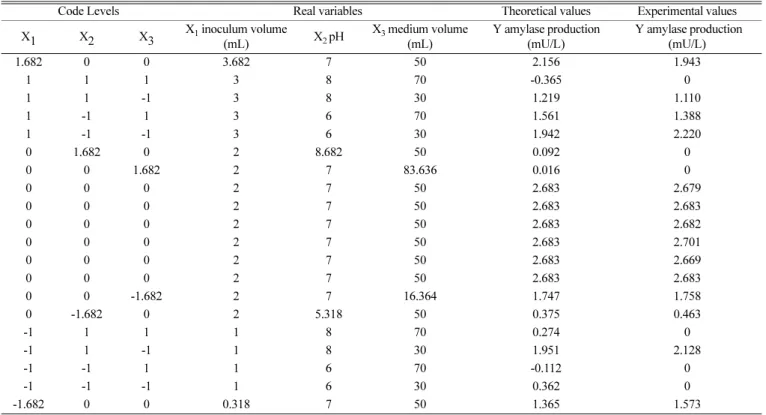
MB에서 확인된 아밀라아제 생산량을 증가시키기 위하여 물리적 요인에 변화를 주어 RSM을 진행하였다. 물리적 요인들과 아밀라아 제 생산의 상관관계를 확인하기 위하여 물리적 요인으로는 접종원의 부피(inoculum volume), 수소이온농도, 배지의 부피(medium volume) 를 선정하였으며, 선정된 3가지 물리적 요인들을 독립변수로 하여 Minitab 16을 통한 중심합성계획법을 설계한 후, 조건이 각기 다른 20개의 실험군을 각각 3번의 반복실험을 거쳐 평균적인 아밀라아제 생산량을 확인하였다(Table 1).
실험 결과 접종원의 부피가 3 mL 이며, 7.0 pH, 배지의 부피가 50 mL의 조건에서 아밀라아제가 가장 많이 생산하는 것으로 확인 되었다.
이 실험 결과를 토대로 하여 다음과 같은 모델식을 얻을 수 있었다.
Y =−56.9 + 5.53 X1 + 13.9 X2 + 0.236 X3 – 0.578 X1X2 + 0.00116 X1X3− 0.015 X2 X3 – 0.326 X12 – 0.866 X22 – 0.00159 X32
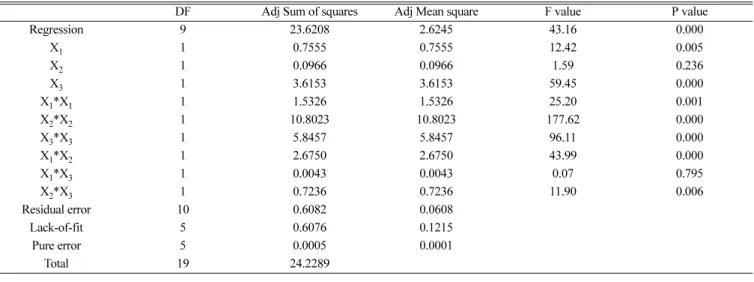
Y는 아밀라아제의 생산량을 나타내며, X1, X2, X3는 각각 접종원의 부피, 수소이온농도, 배지의 부피를 나타낸다. 분석결과 결정계수 (R2)는 0.975로 계산되었다. R2값은 항상 0과 1사이에 존재하며, R2 값이 0.975라는 것은 실험설계 한 아밀라아제 생산성 설계와 97.5%의 적합성을 보였음을 의미한다.
P value는 각 계수의 중요성을 확인하는 도구로 유의 확률을 확인 하는 지표가 된다. 또한, F value는 모형의 적합성을 판단하는 지표로 사용되며, 모델의 noise가 생길 확률을 확인할 수 있다. 결정계수와 결정계수조정은 위 모델의 유효성과 정확성을 암시하는 것으로 적 합성을 판단할 수 있다(Table 2).
3-4. 변수들 간의 상관관계
물리적 요인들간의 정확한 상관관계는 확인되지 않았다. 하지만 아밀라아제의 최적화된 생산에 각각의 물리적 요인들 간의 유기적 인 관계가 존재하는 것을 확인할 수 있었다(Fig. 1).
3-5. RSM 결과에 따른 아밀라아제 최대 생산량 확인 최근 여러 효소들의 최적화에 대한 관심이 증가됨에 따라 여러 연 구가 진행되고 있다. 아밀라아제 역시 최적화가 진행되고 있는 주된 효소들 중 하나이다. 이전의 아밀라아제 최적화에 대한 연구들을 보 면 대부분이 배양배지의 성분만을 변화 시키거나 물리적 요인과 배 지의 성분을 변수로 하여 진행되었다. 그 예로 Bacillus sp.에서 유래 된 아밀라아제를 배지 성분의 변화를 통한 최적화를 진행하여 134%의 생산량 증가를 확인한 연구가 존재하며, 물리적 요인과 배 지의 성분을 변수로 하여 487%의 생산량 증가를 확인한 연구도 존
Table 1. Central Composite Design (CCD) for screening of physical factors for amylase production
Code Levels Real variables Theoretical values Experimental values
X1 X2 X3 X1 inoculum volume
(mL) X2 pH X3 medium volume (mL)
Y amylase production (mU/L)
Y amylase production (mU/L)
1.682 0 0 3.682 7 50 2.156 1.943
1 1 1 3 8 70 -0.365 0
1 1 -1 3 8 30 1.219 1.110
1 -1 1 3 6 70 1.561 1.388
1 -1 -1 3 6 30 1.942 2.220
0 1.682 0 2 8.682 50 0.092 0
0 0 1.682 2 7 83.636 0.016 0
0 0 0 2 7 50 2.683 2.679
0 0 0 2 7 50 2.683 2.683
0 0 0 2 7 50 2.683 2.682
0 0 0 2 7 50 2.683 2.701
0 0 0 2 7 50 2.683 2.669
0 0 0 2 7 50 2.683 2.683
0 0 -1.682 2 7 16.364 1.747 1.758
0 -1.682 0 2 5.318 50 0.375 0.463
-1 1 1 1 8 70 0.274 0
-1 1 -1 1 8 30 1.951 2.128
-1 -1 1 1 6 70 -0.112 0
-1 -1 -1 1 6 30 0.362 0
-1.682 0 0 0.318 7 50 1.365 1.573
재한다[20,21]. 또한, Kluyeromyces marxianus, Serratia marcescens, Streptomyces sp. 등을 이용하여 최적화를 진행한 연구도 존재한다 [22-24].
본 연구에서는 오직 물리적 요인만을 변수로 사용하여 연구를 진 행하였다. 반응표면분석을 통하여 최대 아밀라아제 생산량은 2.84 mU/L 로 예상되었다. 이때의 물리적 요인들은 각각 접종원의 부피는 2.49 mL 이며, pH 6.85, 배지의 부피가 42.87 mL의 조건에서 최대 아밀라아 제 생산량을 갖는 것으로 예상되었다. 이에 따른 확인 실험을 수행한 결과 2.50 mU/L의 아밀라아제 생산량을 보였다. 이와 같은 결과는 최적화되지 않은 조건에서의 생산량과 비교하였을 때 약 150%의 증가된 아밀라아제 생산량을 보였다. RSM을 이용한 배지최적화는 극지미생물을 이용한 프로티아제와 카로티노이드의 생산에도 보고 되었다[25,26].
4. 결 론
아밀라아제를 생산하는 극지 미생물인 Arthrobacter sp. 의 아밀 라아제 생산량을 증가시키기 위하여 반응표면분석법을 이용하여 최 적화 조건을 설계하였다. MB에 접종원의 부피가 1 mL이며, pH 7.6, 배지의 부피가 50 mL의 조건에서 PAMC 27388을 성장시켰을 경우 아밀라아제의 생산량은 1.665 mU/L으로 확인되었다. 물리적 요인 3가지를 변수로 하여 RSM을 진행한 결과 회귀식의 R2값은 0.975로 확인되었고, 최대 생산량은 접종원의 부피가 2.49 mL이며, pH 6.85, 배지의 부피가 42.87 mL의 조건에서 미생물을 배양하였을 때, 2.84 mU/L의 아밀라아제가 생산될 것으로 예측되었다. 이에 따 른 확인 실험 결과 2.50 mU/L의 아밀라아제 생산량을 확인하였고, 최적화전의 조건보다 약 150%의 생산량 증가를 확인하였다. 본 연 구를 통해 아밀라아제 생산량의 증가에 반응표면분석법의 적용이 매우 유용하다는 것을 확인할 수 있었다. 이러한 결과로부터 RSM 을 이용한 미생물 유래의 아밀라아제 생산량의 증가가 산업적으로 여러 분야에 유용하게 이용될 수 있을 것이라 생각된다.
감 사
본 연구는 농림축산식품부·해양수산부·농촌진흥청·산림청 Golden Table 2. Analysis of variance of the experimental results of the ANOVA
DF Adj Sum of squares Adj Mean square F value P value
Regression 9 23.6208 2.6245 43.16 0.000
X1 1 0.7555 0.7555 12.42 0.005
X2 1 0.0966 0.0966 1.59 0.236
X3 1 3.6153 3.6153 59.45 0.000
X1*X1 1 1.5326 1.5326 25.20 0.001
X2*X2 1 10.8023 10.8023 177.62 0.000
X3*X3 1 5.8457 5.8457 96.11 0.000
X1*X2 1 2.6750 2.6750 43.99 0.000
X1*X3 1 0.0043 0.0043 0.07 0.795
X2*X3 1 0.7236 0.7236 11.90 0.006
Residual error 10 0.6082 0.0608
Lack-of-fit 5 0.6076 0.1215
Pure error 5 0.0005 0.0001
Total 19 24.2289
Fig. 1. Three-dimensional response surface plot of amylase production.
A; inoculum (mL), B; pH, C; medium volume (mL), D; amylase (mU/L). And, (a) Showing the effect of inoculum volume and pH, (b) inoculum volume and medium volume, (c) pH and medium volume.
Seed 프로젝트 사업(213004-04-3-SBA30)에 지원과 극지연구소 과제(PE14070)지원, 그리고 2015년도 정부(미래창조과학부)의 재원 으로 한국연구재단의 지원(No. NRF-2015R1A2A2A01004733)으로 수행되었습니다.
References
1. Dastager, S. G., Dayanand, A., Li, W. J., Kim, C. J., Lee, J. C., Park, D. J., Tian, X. P. and Raziuddin, Q. S., “Proteolytic Activity from An Alkali-thermotolerant Streptomyces gulbargensis sp. nov,”
Current Microbiology, 57, 638-642(2008).
2. Gomes, J. and Steiner, W., “The Biocatalytic Potential of Extremo- philes and Extremozymes,” Food technology and Biotechnology, 42, 223-235(2004).
3. Feller, G. and Gerday, C., “Psychrophilic Enzymes: Hot Topics In Cold Adaptation,” Nature Reviews Microbiology, 1, 200-208(2003).
4. Cavicchioli, R., Siddiqui, K. S., Andrews, D. and Sowers, K. R.,
“Low-temperature Extremophiles and Their Application,” Current Opinion in Biotechnology, 13, 253-261(2002).
5. Gerday, C, Aittaleb, M., Bentahir, M., Chessa, J. P., Claverie P., Collins, T., D'Amico, S., Dumont, J., Garsoux, G., Georlette, D., Hoy- oux, A., Lonhienne, T., Meuwis, M. A. and Feller, G., “Cold-adapted Enzymes: from Fundamentals to Biotechnology,” Trends in Bio- technology, 18, 103-107(2000).
6. Huston, A. L., “Biotechnological Aspects of Cold-adapted Enzymes,”
In Psychrophiles: from Biodiversity to Biotechnology, Springer.
Berlin. Heidelberg, pp. 347-363(2008).
7. Peng, Y., Yang, X. and Zhang, Y., “Microbial Fibrinolytic Enzymes:
An Overview of Source, Production, Properties, and Thrombo- lytic Activity in vivo,” Appled Microbiology and Biotechnology, 69, 126-132(2005).
8. Anto, H., Trivedi, U. and Patel, K., “α-Amylase Production by Bacil- lus cereus MTCC 1305 Using Solid-state Fermentation,” Food Technology and Biotechnology, 44, 241-245(2006).
9. Irfan, M., Nadeem M. and Syed, Q., “Media Optimization for Amylase Production in Solid State Fermentation of Wheat Bran by Fungal Strains,” Journal of Cell & Molecular Biology, 10, 55- 64(2012).
10. Pandey, A., Nigam, P., Soccol, C. R. V. T., Soccol, V., Singh, D.
and Mohan, R., “Advances in Microbial Amylases,” Biotechnol- ogy and Applied Biochemistry, 31, 135-152(2000).
11. Gupta, R., Gigras, P., Mohapatra, H., Goswami, V. K. and Chauhan, B., “Microbial α-amylases: a Biotechnological Perspective,” Pro- cess Biochemistry, 38, 1599-1616(2003).
12. Burhan, A., Nisa, U., Gökhan, C., Ömer, C., Ashabil, A. and Osman, G., “Enzymatic Properties of a Novel Thermostable, Thermo- philic, Alkaline and Chelator Resistant Amylase from An Alka- liphilic Bacillus sp. isolate ANT-6,” Process Biochemistry, 38, 1397-1403(2003).
13. Haki, G. D. and Rakshit, S. K., “Developments in Industrially
Important Thermostable Enzymes: a Review,” Bioresource Tech- nology, 89, 17-34(2003).
14. Tonkova, A., “Microbial Starch Converting Enzymes of the α- Amylase Family,” Microbial Biotechnology in Horticulture, 1, 421-472(2006).
15. Puri, S., Beg, Q. K. and Gupta, R., “Optimization of Alkaline Prote- ase Production from Bacillus sp. by Response Surface Method- ology,” Current Microbiology, 44, 286-290(2002).
16. Adinarayana, K. and Ellaiah, P., “Response Surface Optimiza- tion of the Critical Medium Components for the Production of Alkaline Protease by a Newly Isolated Bacillus sp.,” Journal of Pharmacy & Pharmaceutical Sciences,5, 272-278(2002).
17. Hanlon, G. W., Hodges, N. A. and Russell, A. D., “The Influence of Glucose, Ammonium and Magnesium Availability on the Produc- tion of Protease and Bacitracin by Bacillus licheniformis,” Jour- nal of General Microbiology, 128, 845-851(1982).
18. Lane, D. J., “16S-23S rRNA Sequencing,” In Stackebrandt E, Goodfellow M (eds.), Nucleic Acid Techniques in Bacterial Sys- tematics, Wiley, New York, pp. 115-175(1991).
19. Sumner, J. B. and Howell, S. F., “A Method for the Determina- tion of Saccharase Activity,” Journal of Biological Chemistry, 108, 51-54(1935).
20. Zhong, G., Wang, Y., Xu, C., Wei, D. and Yang, X., “Application of Response Surface Methodology for the Optimization of Acid α- Amylase Production by Bacillus subtilis Y-am6,” China Brewing, 9, 019(2011).
21. Tanyildizi, M. S., Elibol, M. and Özer, D., “Optimization of Growth Medium for the Production of α-amylase from Bacillus amylo- liquefaciens Using Response Surface Methodology,” Journal of Chemical Technology and Biotechnology, 81, 618-622(2006).
22. Stergiou, P. Y., Foukis, A., Theodorou, L., Papagianni, M. and Papamichael, E., “Optimization of the Production of Extracellular α-amylase by Kluyveromyces marxianus IF0 0288 by Response Surface Methodology,” Brazilian Archives of Biology and Tech- nology, 57, 421-426(2014).
23. Sivakumar, K., Karuppiah, V., Sethubathi, G. V., Thangaradjou, T.
and Kannan, L., “Response Surface Methodology for the Optimi- zation of α-amylase Production by Streptomyces sp. ML12 Using Agricultural Byproducts,” Biologia, 67, 32-40(2012).
24. Venil, C. K. and Lakshmanaperumalsamy, P., “Response Sur- face Methodology for the Optimization of Alpha Amylase Pro- duction by Serratia marcescens SB08,” Pakistan Journal of Scientific and Industrial Research, 51, 333-339(2008).
25. Kim, H., Yun, C. W., Choi, J. and Han, S. J., “Optimization of Medium for Protease Production by Enterobacteriaceae sp. PAMC 25617 by Response Surface Methodology,” Korean Chemical Engi- neering Research, 53, 524-529(2015).
26. Kim, H., Choi, J. and Han, S. J., “Optimization of Medium for Carotenoids Production by Arthrobacter sp. PAMC 25486 Using Response Surface Methodology,” Korean Chemical Engineering Research, 52, 834-839(2014).