524 PISSN 0304-128X, EISSN 2233-9558
단 신
반응표면분석법을 통한 Enterobacteriaceae sp. PAMC 25617의 protease 생산배지 최적화
김현도 · 윤철원 · 최종일† · 한세종*
전남대학교 생물공학과 광주광역시 북구 용봉로 77
*극지연구소 극지생명과학연구부 인천광역시 연수구 송도미래로 26
(2014년 9월 29일 접수, 2014년 11월 24일 수정본 접수, 2014년 11월 24일 채택)
Optimization of Medium for Protease Production by Enterobacteriaceae sp. PAMC 25617 by Response Surface Methodology
Hyun-do Kim, Chul-Won Yun, Jong-il Choi† and Se Jong Han*
Department of Biotechnology and Bioengineering, Chonnam National University, 77, Yongbong-ro, Buk-gn, Gwangju 500-757, South Korea
*Division of Life Sciences, Korea Polar Research Institute, 26 Songdomirae-ro, Yeonsu-gu, Incheon 406-840, South Korea (Received 29 September 2014; Received in revised form 24 November 2014; accepted 24 November 2014)
요 약
본 논문에서는 저온활성 protease의 생산을 최적화하기 위하여 극지 미생물인 Enterobacteriaceae sp. PAMC 25617의 반응표면분석법을 이용한 배지의 최적화를 수행하였다. One-factor-at-a-time 방법을 이용하여 yeast extract, TritonX- 100이 protease의 생산에 영향을 미치는 주요인자인 것을 확인하였다. 물리적인 환경 요인으로 pH를 추가하여 반응표 면분석 방법을 이용한 최대 protease 생산 농도를 갖는 각 인자들의 농도를 확인한 결과 5 g/L peptone, 3 g/L malt extract, 10 g/L C6H12O6, 6.690 g/L yeast extract, 0.018 g/L TritonX-100의 농도에 pH 6.777의 조건에서 미생물을 배양하였을 경우, 최대 10.049 U/L의 protease가 생산될 수 있는 것으로 예측되었다. 실제 배양 결과 8.03 U/L의 protease가 얻어졌으며, 최적화 이전의 생산농도와 비교하여 150% 이상의 증가를 이루었다. 결과적으로 배지최적화를 통한 protease 생산량의 증가에 반응표면분석법의 적용이 유용하다는 것을 확인할 수 있는다. 이러한 결과로부터, 배지 최적화를 이용한 극지 미생물 유래 cold-adapted protease 생산량의 증가가 여러 산업 분야에서 유용하게 이용될 수 있을 것으로 생각된다.
Abstract − This study was conducted to optimize the medium composition for cold-adaptive protease production of Enterobacteriaceae sp. by response surface methodology (RSM). Yeast extract, and TritonX-100 were identified as the significant factors affecting protease from one-factor-at-a-time method. RSM studies for optimizing protease production of Enterobacteriaceae sp. have been carried out for three parameters including yeast extract concentration, TritonX-100 concentration, and culture pH. These significant factors were optimized as 6.690 g/L yeast extract, 0.018 g/L Triton™ X-10, and pH 6.677. The experimentally obtained protease activity was 8.03 U /L, and it became 1.5-fold increase before optimization.
Key words: Antarctic Microorganism, Protease, Response Surface Methodology
1. 서 론
척박한 환경에 의해 고립된 일반적인 극지방은 종종 생물공학적인 탐구의 의문을 해결하는데 유용한 역할을 한다. 최근 보고된 저온 생장 균주의 생물공학적 적용의 잠재성이 그러한 것이다[1-4].
Psychrophiles 및 psychrotolerants를 포함한 저온 생장 균주들은 낮은 온도에서 높은 활성을 갖는 효소들을 생산한다. 최근, 이러한 저온 활성 효소들에 대한 관심이 높아짐에 따라 저온 활성 효소들의 여러 산업적인 적용 및 활용에 대한 관심도 증가하고 있다[4-8]. 이 러한 산업 효소의 생산은 현대 생물공학의 급격한 발전과 더불어 지 난 수십 년간 급속도로 증가하였다[9,10]. 특히, 환경에 대한 관심이 증가하면서 그에 대한 수요의 증가로 인해 산업 효소 시장이 꾸준히 성장하게 될 것이라 예측된다[9,11].
전체 산업 효소 중 protease가 차지하는 효소 시장의 비율은 약 60%에 달하는 방대한 양이다. 실크, 가죽 세공, 음식 산업, 의약 산
†To whom correspondence should be addressed.
E-mail: [email protected]
This is an Open-Access article distributed under the terms of the Creative Com-
mons Attribution Non-Commercial License (http://creativecommons.org/licenses/by-
nc/3.0) which permits unrestricted non-commercial use, distribution, and reproduc-
tion in any medium, provided the original work is properly cited.
업뿐만 아니라 생물학적 환경 정화 분야에 이르기 까지 널리 사용되 고 있다[4,7,12-17]. Protease를 비롯한 대부분 효소는 온도가 낮아질 수록 화학반응 속도가 감소하게 된다. 그렇지만 저온 생장 균주들 유래의 저온 활성 효소들은 일반적으로 0oC~30oC의 낮은 온도에서 최적 활성을 가진다[18]. 이러한 낮은 온도에서의 최적 활성을 갖는 특성은 다양한 분야에 유용하게 적용될 수 있을 것이라 예상된다[19].
과거부터 요인 배치법, 분할법, 교락법, 불완비 블록계획법, 혼합 물에 관한 실험계획법 등의 다양한 최적화 방법들이 존재하였으며, 현재는 반응표면분석법, 다구찌 기법이 최적화 연구의 주된 실험방 법으로 적용되고 있다. 다구찌 기법은 직교배열표에 잡음인자라는 개념을 도입한 실험계획법으로 다양한 환경에서도 최적의 성능을 유지할 수 있는 제어인자들의 조합을 확인하는데 주로 이용된다[20- 22]. 반응표면분석법은 여러 개의 인자가 복합적인 작용을 함으로써 어떤 반응변수에 영향을 주고 있을 때 반응의 변화가 이루는 반응표 면에 대한 통계적 분석방법으로 독립변수들의 어떠한 값에서 반응 량이 최적화인가를 예측하는데 이용되고 있다[23-30].
본 연구에서는 극지에서 유래한 protease 생산 미생물인 Entero- bacteriaceae sp. PAMC 25617의 최대 protease 생산을 확인하기 위 해 one-factor-at-a-time을 이용하여 protease 생산에 주요한 영향을 미치는 인자들을 확인하였으며[31,32], 확인된 주요인자와 protease를 생산하는데 있어서 영향을 미칠 수 있는 physical factor를 추가하여 protease를 생산하는데 가장 최적화된 배지를 RSM을 통하여 알아보 고자 한다.
2. 실 험 2-1. 균주와 시약
실험에 사용한 protease 생산 미생물은 Enterobacteriaceae sp.
PAMC 25617을 사용하였으며, 극지연구소(Korea Polar Research Institute, Incheon, South Korea)로부터 분양 받았다. Yeast extract, peptone, malt extract, agar, soluble starch(Becton, Dickinson and Company, Franklin Lakes, NJ, USA), C6H12O6(Junsei Chemical Co., LTD, Tokyo, Japan), urea(Bio Basic INC., Ontario, Canada), lactose, AAPF[N-Succinyl-Ala-Ala-Pro-Phe-p-nitroanilide], protease(Sigma- Aldrich Co., St. Louis, Mo, USA), TritonX-100(Duksan Pure Chemical co., LTD, Ansan, South Korea), SDS(GE Healthcare Bio-Science AB, Uppsala, Sweden), Tween #80(Yakuri Pure Chemicals Co., LTD, Osaka, Japan), Sodium Phosphate(Daejung Chemicals & Metals Co., LTD, Inchon, South Korea)를 이용하여 실험을 진행하였다.
2-2. 배양 배지 및 배양 조건
전배양 한천 배지는 3 g/L yeast extract, 5 g/L peptone, 3 g/L malt extract, 10 g/L C6H12O6, 20 g/L agar 조성에 pH 6.2의 배지에 미생물 을 접종하여 15oC에서 14일간 배양하여 사용하였고, 액체 배양은 3 g/L yeast extract, 5 g/L protease peptone NO.3, 3 g/L malt extract, 10 g/L C6H12O6조성에 pH 6.2의 YM 배지를 50 mL씩 250 mL triangular flask에 넣어 121oC, 20분간 멸균한 후 미생물을 접종해 15oC에서 150 rpm으로 교반하여 17시간 배양하였다.
주요인자를 찾기 위한 배지 조성은 YM 배지를 사용하여 질소원, 탄소원을 변형시키고, 계면활성제를 첨가하여 실험을 하였다. 모든 실험군은 3회 반복하여 진행하였다.
2-3. 성장률 측정
PAMC 25617의 성장률은 ELISA Reader(Molecular Devices, VersaMaxTM and SpectraMax® 340PC384, California, USA)를 이용하여 600 nm에서 흡광도를 측정하였다. 배양액을 50 μL 취하여 멸균된 YM medium 950 μL에 넣어 20배 희석하여 흡광도를 측정하였고, 멸균된 YM medium을 blank로 사용했다.
2-4. Protease 생산량 측정
Protease 생산량 측정은 배양액을 4oC에서 원심분리(14,000 rpm, 10 min)한 후 상등액을 회수하여 50 mM Na-phosphate(pH 7.6) 200 μL, 배양 상등액 100 μL, 10 mM AAPF 10 μL, 증류수 690 μL를 혼합하여 20oC에서 10분간 반응시켰고, 60oC에서 20분간 불활성화 시킨 후 410 nm에서 흡광도를 측정하였고, 기질 대신 증류수를 첨가한 혼합 액을 blank로 사용하였다.
Protease의 unit은 extinction coefficient(e)을 8800으로 하여 다음 식에 의해 계산하였다[33,34].
Unit (μmole/min)/L =
배양 및 활성 실험은 3차례 반복하여 평균값으로 표시하였다.
2-5. 실험 설계 및 반응표면분석
이 연구에서는 One-factor-at-a-time 방법을 이용하여 protease 생산 에 영향을 미치는 주요인자를 분석하기 위하여 한가지 인자를 변화 시키고 다른 인자들은 고정시켜서 protease 생산량을 확인하였다. 확 인된 주요인자는 Minitab 16(Minitab Inc, State College, Pennsylvania, USA)을 통한 중심합성계획법을 설계한 후, 배지조성이 각기 다른 16개의 실험군을 각각 3번의 반복실험을 거쳐 평균적인 protease 생 산량을 확인하였으며 이에 따른 모델식은 다음과 같다(식 1).
Y = α0 + α1X1 + α2X2 + α3X3 + α12X1X2 + α13X1X3 + α23X2X3 + α11X12+ α22X22+ α33X32 (1) 종속 변수 Y는 protease의 생산량이고 protease 생산에 중요한 독 립 변수는 각각 X1, X2와 X3이다.
중심합성계획법을 통한 실험 이후, 최대의 protease를 생산하는 배지 성분을 산출하여 확인실험을 진행하였다.
3. 결과 및 고찰 3-1. 주요인자분석
One-factor-at-a-time방법을 통한 주요인자분석을 진행하여 각각의 인자들이 미생물의 성장 및 protease생산에 어떠한 영향을 미치는지 확인하였다. 먼저, 질소원을 변화하여 미생물의 성장 및 protease생 산량을 확인한 결과 Fig. 1과 같이 yeast extract가 protease생산에 있 어서 더 많은 영향을 주는 질소원으로 작용한다는 것을 확인하였다.
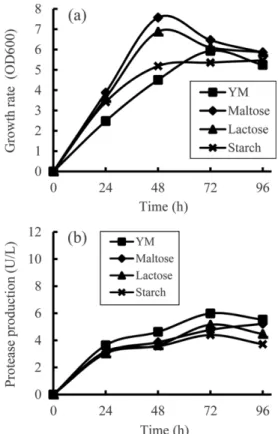
탄소원를 변화시켰을 경우에는 YM 배지의 기본조성인 glucose가 protease 생산에 가장 영향력 있는 탄소원으로 작용하는 것을 확인하 였다(Fig. 2). Protease생산에 관한 계면활성제의 영향은 TritonX-100 을 첨가하였을 때가 다른 계면활성제를 첨가하였을 때보다 더 높은 protease 생산량을 보였다(Fig. 3). 본 연구에서는 접종 후 72시간을
(net OD410) × (반응액 부피, L) × 106 ε × (반응시간, min) × (반응에 사용된 배양액, L)
배양기준으로 잡고 배지의 최적화를 진행하였다.
3-2. 반응표면분석법
확인된 주요인자인 yeast extract, Triton X-100과 물리적인 환경
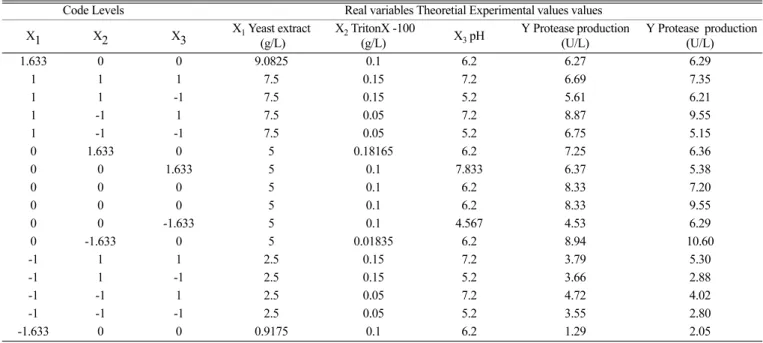
요인으로 pH를 변수로 하여 Minitab 16을 통한 중심합성계획법을 설계한 후, 배지조성이 각기 다른 16개의 실험군을 각각 3번의 반복 실험을 거쳐 평균적인 protease 생산량을 확인하였다(Table 1).
실험 결과 5 g/L peptone, 3 g/L malt extract, 10 g/L C6H12O6, 5 g/L yeast extract, 0.1 g/L Triton X-100의 농도에 pH6.8의 조건에서 미 생물을 배양하였을 경우, protease를 가장 많이 생산하는 것을 확인 하였으며(10.61 U/L), 5 g/L peptone, 3 g/L malt extract, 10 g/L C6H12O6, 0.9175 g/L yeast extract, 0.1 g/L Triton X-100의 농도에 pH6.8의 조 건에서 미생물을 배양하였을 경우, protease의 생산량이 가장 낮은 것을 확인하였다(2.05 U/L).
이 실험 결과를 토대로 다음과 같은 모델식을 얻을 수 있었다.
Y = -47.4 + 3X1 + 41.6 X2 + 14X3 – 2.5X1X2 + 0.095X1X3 - 5.2X2 X3 - 0.273X12 - 36X22 - 1.08X32
Y는 protease의 생산량을 나타내며, X1, X2, X3은 각각 yeast extract, TritonX–100과 pH를 나타낸다. 분석결과 결정계수(R2)는 0.797으로 계산되었다. R2값은 항상 0과 1사이에 존재하며, R2값이 0.797이라 함은 실험설계 한 protease 생산성 설계와 79.7%의 적합 성을 보였음을 의미한다.
P value는 각 계수의 중요성을 확인하는 도구로 유의 확률을 확인 하는 지표가 된다. F value는 모형의 적합성을 판단하는 지표로 사 용되며, 모델의 noise가 생길 확률을 확인할 수 있다. 결정계수와 결 정계수조정은 위 모델의 유효성과 정확성을 암시하는 것으로 적합 성을 판단할 수 있다(Table 2).
Fig. 1. Effect of nitrogen source on (a) growth and (b) protease pro- duction of PAMC 25617.
Fig. 2. Effect of carbon sources on (a) growth and (b) protease pro- duction of PAMC 25617.
Fig. 3. Effect of surfactant on (a) growth and (b) protease produc- tion of PAMC 25617.
3-3. 주요 인자들 간의 상관관계
각 주요 인자들간의 정확한 상관관계는 확인되지 않았으나, TritonX-100과 pH는 yeast extract의 함량이 증가할수록 더 많은 protease 생산성을 나타내는 것으로 확인되었다. 반면에 pH와 TritonX-100의 관계는 비교적 각자에게 영향을 받지 않는 것으로 확인되었다(Fig. 4).
3-4. RSM 결과에 따른 protease 최대 생산량 확인
반응표면분석을 통하여 예측된 protease를 최대로 생산하는 배지의 조성은 5 g/L peptone, 3 g/L malt extract, 10 g/L C6H12O6, 6.690 g/L yeast extract, 0.018 g/L TritonX-100의 농도에 pH 6.677의 조건이었 으며, 이때 예상되는 protease의 생산량은 10.049 U/L으로 확인되었다.
이에 따른 확인 실험을 수행한 결과 8.03 U/L의 protease 생산량을 보였다. 이와 같은 결과는 최적화되지 않은 YM 배지에서의 생산량과 비교했을 때 158%의 증가된 protease 생산량을 보였다. 이전의연구 중 극지 미생물인 Microbacterium sp.을 이용한 3.6배의 protease 생
Table 1. Central Composite Design (CCD) for screening of important variables for protease production
Code Levels Real variables Theoretial Experimental values values
X1 X2 X3 X1 Yeast extract
(g/L)
X2 TritonX -100
(g/L) X3 pH Y Protease production (U/L)
Y Protease production (U/L)
1.633 0 0 9.0825 0.1 6.2 6.27 6.29
1 1 1 7.5 0.15 7.2 6.69 7.35
1 1 -1 7.5 0.15 5.2 5.61 6.21
1 -1 1 7.5 0.05 7.2 8.87 9.55
1 -1 -1 7.5 0.05 5.2 6.75 5.15
0 1.633 0 5 0.18165 6.2 7.25 6.36
0 0 1.633 5 0.1 7.833 6.37 5.38
0 0 0 5 0.1 6.2 8.33 7.20
0 0 0 5 0.1 6.2 8.33 9.55
0 0 -1.633 5 0.1 4.567 4.53 6.29
0 -1.633 0 5 0.01835 6.2 8.94 10.60
-1 1 1 2.5 0.15 7.2 3.79 5.30
-1 1 -1 2.5 0.15 5.2 3.66 2.88
-1 -1 1 2.5 0.05 7.2 4.72 4.02
-1 -1 -1 2.5 0.05 5.2 3.55 2.80
-1.633 0 0 0.9175 0.1 6.2 1.29 2.05
Table 2. Analysis of variance of the experimental results of the ANOVA DF Adj Sum of
squares
Adj Mean
square F value P value
Regression 9 70.1531 7.7948 2.35 0.180
X1 1 7.1515 7.1515 2.15 0.202
X2 1 0.4438 0.4438 0.13 0.730
X3 1 9.0167 9.0167 2.72 0.160
X1*X1 1 22.7016 22.7016 6.84 0.047
X2*X2 1 0.0031 0.0031 0.00 0.977
X3*X3 1 8.6766 8.6766 2.61 0.167
X1*X? 1 0.7813 0.7813 0.24 0.648
X?*X? 1 0.4513 0.4513 0.14 0.727
X?*X3 1 0.5304 0.5304 0.16 0.706
Residual error 6 18.457 3.076
Lack-of-fit 5 16.5994 3.3199 1.14 0.609
Pure error 1 2.761 2.761
Total 15 91.004
Fig. 4. Three-dimensional response surface plot of cold-production protease production. (a) Showing the effect of yeast extract and TritonX-100 concentration, (b) pH and yeast extract concentration, (c) pH and TritonX-100 concentration.
산량증가 또는, Bacillus sp.을 이용한 2.6배의 protease 생산량의 증 가 연구와 비교하였을 때 150% 이상의 protease 생산량 증가는 결코 낮은 수치가 아님을 확인할 수 있다[23,27].
4. 결 론
Protease를 생산하는 극지 미생물인 Enterobacteriaceae sp.의 protease 생산량을 증가시키기 위해 반응표면분석법을 이용하여 최 적 배지조성을 설계하였다. Enterobacteriaceae sp.의 성장 배지인 YM 배지를 이용하여 protease 생산량을 측정한 결과 5.07 U/L의 생 산량을 보였다. 기본 배지의 조성 중 탄소원과 질소원을 각각 변형 하고 계면활성제를 첨가하여 protease 생산에 가장 많은 영향을 주는 성분을 확인한 결과 yeast extract, Triton X-100이 가장 큰 영향을 주는 요인으로 확인하였다. 물리적인 환경 요인으로 pH를 추가하여, protease 생산성에 회귀식의 R2은 0.797로 확인되었고, 최대 생산량을 보이는 배지의 각 인자들의 농도는 5 g/L peptone, 3 g/L malt extract, 10 g/L C6H12O6, 6.690 g/L yeast extract, 0.018 g/L TritonX-100의 농도에 pH 6.677의 조건에서 미생물을 배양하였을 때, 10.049 U/L의 protease가 생산될 것으로 예측되었다. 이에 대한 확인실험 결과 8.03 U/L의 protease 생산량을 보였고, 예상된 생산량보다는 낮은 생 산량을 보였으나 기본 배지보다 158%의 생산량 증가가 확인되었다.
본 연구에 의해 PAMC 25617의 변형된 조성의 YM 배지 최적화를 통한 protease 생산이 향상하는 것을 확인했다. 결과적으로 배지최적 화를 통한 protease 생산량의 증가에 반응표면분석법의 적용이 유용 하다는 것을 확인할 수 있는다. 이러한 결과로부터, 배지 최적화를 이용한 극지 미생물 유래 cold-adapted protease 생산량의 증가가 여 러 산업 분야에서 유용하게 이용될 수 있을 것으로 생각된다.
감 사
본 연구는 농림축산식품부·해양수산부·농촌진흥청·산림청 Golden Seed 프로젝트 사업에 지원, 2015년도 정부(미래창조과학부)의 재원 으로 한국연구재단의 지원(No. NRF-2015R1A2A01004733), 그리고 극지연구소 과제(PE14070) 지원으로 수행되었습니다.
Reference
1. Nichols, D., Bowman, J., Sanderson, K., Nichols, C. M., Lewis, T., McMeekin, T. and Nichols, P. D., “Developments with Ant- arctic Microorganisms: Culture Collections, Bioactivity Screen- ing, Taxonomy, PUFA Production and Cold-adapted Enzymes,”
Curr. Opin. Biotechnol.” 10, 240-246(1999).
2. Antranikian, G. and Egorova, K., “Extremophiles, a Unique Resource of Biocatalysts for Industrial Biotechnology,” Physiology and Biochemistry of Extremophiles. ASM Press. Washington, 361- 406(2007).
3. Huston, A. L., “Biotechnological Aspects of Cold-adapted Enzymes,”
In Psychrophiles: From Biodiversity to Biotechnology. Springer.
Berlin. Heidelberg, 347-363(2008).
4. Kim, D. K., Park, H. J., Lee, Y. M., Hong, S. G., Lee, H. K. and Yim, J. H., “Screening for Cold-Active Protease-Producing Bac- teria from the Culture Collection of Polar Microorganisms and Characterization of Proteolytic Activities,” Korean J. Microbiol.,
46, 73-79(2010).
5. Zhu, H. Y., Tian, Y., Hou, Y. H. and Wang, T. H., “Purification and Characterization of the Cold-active Alkaline Protease from Marine Cold-adaptive Penicillium Chrysogenum FS010,” Mol. Boil. rep., 36, 2169-2174(2009).
6. Georlette, D., Blaise, V., Collins, T., D`Amico, S., Gratia, E., Hoyoux, A., Marx, J., Sonan, G., Feller, G. and Gerday, C., “Some Like it Cold: Biocatalysis at Low Temperatures,” FEMS microbial. Rev., 28, 25-42(2004).
7. Yang, J., Li, J., Mai, Z., Tian, X. and Zhang, S., “Purification, Char- acterization, and Gene Cloning of a Cold-adapted Thermolysin- Like Protease from Halobacillus sp. SCSIO 20089,” J. Biosci.
Bioeng., 115, 628-632(2013).
8. Gerday, C., Aittaleb, M., Bentahir, M., Chessa, J. P., Claverie, P., Collins, T., D`Amico, S., Dumont, J., Garsoux, G., Georlette, D., Hoyoux, A., Lonhienne, T., Meuwis, M. A. and Feller G., “Cold- adapted Enzymes: from Fundamentals to Biotechnology,” Trends.
Biotechnol., 18, 103-107(2000).
9. Dastager, S. G., Dayanand, A., Li, W. J., Kim, C. J., Lee, J. C., Park, D. J., Tian, X. P. and Raziuddin, Q.S., “Proteolytic Activity from An Alkali-thermotolerant Streptomyces gulbargensis sp.
nov,” Curr. Microbiol., 57, 638-642(2008).
10. Kirk, O., Borchert, T. V. and Fuglsang, C. C., “Industrial Enzyme Applications,” Curr. Opin. Biotechnol., 13, 345-351(2002).
11. Cherry, J. R. and Fidantsef, A. L., “Directed Evolution of Indus- trial Enzymes: An Update,” Curr. Opin. Biotechnol., 14, 438-443 (2003).
12. Daniel R. M., Toogood, H. S. and Bergquist, P. L., “Thermo- stable Proteases,” Biotech. Genet. Eng. Rev., 13, 51-100(1996).
13. Gupta, R., Beg, Q. and Lorenz, P., “Bacterial Alkaline Proteases:
Molecular Approaches and Industrial Applications,” Appl. Micro- bial. Biotechnol., 59, 15-32(2002).
14. Anisworth, S. J., “Soap & Detergents,” Chem. Eng. News., 70, 27-37(1992).
15. Marx, J. C., Collins, T., D’Amico, S., Feller, G. and Gerday, C.,
“Cold-adapted Enzymes from Marine Antarctic Microorganisms,”
Marine Biotechnol., 9, 293-304(2007).
16. Cavicchioli, R., Siddiqui, K. S., Andrews, D. and Sowers, K. R.,
“Low-temperature Extremophiles and Their Applications,” Curr.
Opin. Biotechnol., 13, 253-261(2002).
17. Wang, Q., Hou, Y., Xu, Z., Miao, J. and Li, G., “Optimization of Cold-active Protease Production by the Psychrophilic Bacterium Colwellia sp. NJ341 with Response Surface Methodology,” Biores.
Technol., 99, 1926-1931(2008).
18. Irwin, J. A., Alfredsson, G. A., Lanzetti, A. J., Gudmundsson, H.
M. and Engel, P. C., “Purification and Characterisation of a Serine Peptidase from the Marine Psychrophile Strain PA-43,” FEMS Microbiol. Let., 201, 285-290(2001).
19. Siddiqui, K. S. and Cavicchioli, R., “Cold-adapted Enzymes,”
Annual Rev. Biochem., 75, 403-433(2006).
20. Kackar, R. N., “Off-line Quality Control, Parameter Design, and the Taguchi Method,” J. Quality Technol., 17, 176-188(1985).
21. Ghani, J. A., Choudhury, I. A. and Hassan, H. H. “Application of Taguchi Method in the Optimization of End Milling Parame- ters,” J. Mater. Process. Technol., 145, 84-92(2004).
22. Tsai, J. T., Liu, T. K. and Chou, J. H. “Hybrid Taguchi-genetic Algorithm for Global Numerical Optimization,” Evolutionary Com-
putation, IEEE Transactions on, 8, 365-377(2004).
23. Puri, S., Beg, Q. K. and Gupta, R., “Optimization of Alkaline Prote- ase Production from Bacillus sp. By Response Surface Method- ology,” Curr, Microbiol., 44, 286-290(2002).
24. Adinarayana, K. and Ellaiah, P., “Response Surface Optimization of the Critical Medium Components for the Production of Alka- Line Protease by a Newly Isolated Bacillus sp.,” J. Pharmacy.
Pharmaceutical Sci., 5, 272-278(2002).
25. Dutta, J. R., Dutta, P. K. and Banerjee, R., “Optimization of Culture Parameters for Extracellular Protease Production from a Newly Isolated Pseudomonas sp. Using Response Surface and Artificial Neural Network Models,” Proc. Biochem., 39, 2193-2198(2004).
26. Hanlon, G. W., Hodges, N. A. and Russel, A. D., “The Influence of Glucose, Ammonium and Magnesium Availability on the Pro- duction of Protease and Bacitracin by Bacillus Licheniformis,” J.
General Microbiol., 128, 845-851(1982).
27. Tabaraki, R. and Rastgoo, S., “Comparison Between Conven- tional and Ultrasound-assisted Extractions of Natural Antioxidants from Walnut Green Husk,” Korean J. Chem. Eng., 31, 676-683 (2014)
28. İlbay, Z., Şahin, S. and Büyükkabasakal, K., “A Novel Approach for Olive Leaf Extraction Through Ultrasound Technology:
Response Surface Methodology Versus Artificial Neural Net- works,” Korean J. Chem. Eng., 31, 1661-1667(2014).
29. Toon, C. H., Bok, H. S., Choi, D. K. and Row, K. H., “Optimization Condition of Astaxanthin Extract from Shrimp Waste Using Response Surface Methodology,” Korean Chem. Eng. Res., 50, 545-550(2012).
30. Kin, J. W., “Response Surface Optimization of Fermentation Parameters for Citric Acid Production in Solid Substrate Fermenta- tion,” Korean Chem. Eng. Res., 50, 879-884(2012).
31. Thys, R., Guzzon, S. O., Cladera-Olivera, F. and Brandelli, A., “Opti- mization of Protease Production by Microbacterium sp. in Feather Meal Using Response Surface Methodology,” Proc. Biochem., 41, 67-73(2006).
32. De Coninck, J., Bouquelet, S., Dumortier, V., Duyme, F. and Verdier-Denantes, I., “Industrial Media and Fermentation Process for Improved Growth and Protease Production by Tetrahymena thermophila BIII,” J. Ind. Microbiol. Biotechnol., 24, 285-290 (2000).
33. Plotnick, M. I., Rubin, H. and Schechter, N. M., “The Effects of Reactive Site Location on the Inhibitory Properties of the Serpin α1- Antichymotrypsin,” J. Biol. Chem., 277, 29927-29935(2002).
34. McKeller, R. C. and Cholette, H., “Synthesis of Extracellular Protein- ase by Pseudomonas fluorescens Under Conditions of Limiting Carbon, Nitrogen and Phosphate,” Appl. Biochem. Microbiol., 47, 1224-1227(1984).