
2014, Vol. 58, No. 2
Printed in the Republic of Korea
http://dx.doi.org/10.5012/jkcs.2014.58.2.169
Synthesis, Spectral, Characterization, DFT and Biological Studies of New 3-[(3-Chlorophenyl)-hydrazono]-pentane-2,4-dione Metal Complexes
Sadeek. A. Sadeek*, Wael. A. Zordok, Ahmed. F. El-Farargy, and Sameh. I. El-Desoky† Department of Chemistry, Faculty of Science, Zagazig University, Zagazig, Egypt.
*E-mail: [email protected]
†Department of Quality Control, Ceramica Royal, Egypt (Received November 6, 2013; Accepted January 24, 2014)
ABSTRACT. A new series of metal complexes of V(IV), Pd(II), Pt(IV), Ce(IV) and U(VI) with 3-[(3-chlorophenyl)-hydra- zono]-pentane-2,4-dione (Cphpd) were synthesized and characterized by elemental analysis, molar conductivity, magnetic moment measurements, UV-vis, FT-IR and 1H NMR as well as TG-DTG techniques. The data indicated that the Cphpd acts as a bidentate ligand through the hydrazono nitrogen and one keto oxygen. The kinetic parameters have been evaluated by using Coats Redfern (CR) and Horowitz-Metzeger (HM) methods. The thermodynamic data reflected the thermal stability for all complexes. The calculated bond length and the bond stretching force constant, F(U=O), values for UO2 bond are 0.775 Å and 286.95 Nm−1. The bond lengths, bond angles, dipole moment and the lowest energy model structure of the complexes have been determined with DFT calculations. The antimicrobial activity of the synthesized ligand and its complexes were screened.
Key words: Cphpd, Transition metal complexes, FT-IR, Mass spectra
INTRODUCTION
Recently, chlorinated organic compounds have attracted attention due to the ability of chlorine to act as polar hydrogen or hydroxyl mimic. Therefore, substitution of hydrogen by chlorine has been a strategy in designing molecules for biological activity studies.1 Benzenediazonium chloride is excellent starting material for the synthesis of 3-[(3- chlorophenyl)-hydrazono]-pentane-2,4-dione (Cphpd) (Scheme 1) via the reaction of 3-chlorobenzenediazonium chloride with acetyl acetone.1
In recent years the chemistry of heterocyclic compounds are well known for their diverse therapeutic properties and exhibited antibacterial, anticancer, antiulcer, diuretics, anticonvulsant, antihypertensive, antitumor, antifungal, anti- AIDS and antiviral properties.2 Metal chelates play an important role in various fields of chemical, biological and technological sciences on coordination, ligands might improve their bioactivity profiles, while some inactive ligand may acquire pharmacological properties. Activity of various anti-inflammatory drugs existing in market has enhanced after complexation with transition metal ion.3
A detailed literature research has shown that no work is reported on the 3-[(3-chlorophenyl)-hydrazono]-pentane- 2,4-dione (Cphpd). Thus, our aim was to synthesize and characterize the complexes of V(IV), Pd(II), Pt(IV), Ce(IV) and U(VI) with Cphpd in order to investigate their mag-
netic, spectroscopic and thermal techniques in an attempt to examine the mode of binding. Density functional theory (DFT) was used to compute the cation type influence on theoretical parameters of V(IV), Pd(II), Pt(IV)and Ce(IV) complexes and detect the exact structure of these com- plexes. Indeed, the biological activity of the ligand and its complexes were screened against selected kinds of bac- teria and fungi.
EXPERIMENTAL
Materials
All chemicals used for the preparation of the complexes were of analytical reagent grade, commercially available Scheme 1.
from different sources and used without further purifica- tion.
Synthesis
Synthesis of metal complexes
The black solid complex [VO(Cphpd)2(H2O)]SO4 was prepared by adding 1 mmol (0.18 g) of VOSO4.H2O in 20 ml acetone drop-wisely to a stirred clear solution of Cphpd (2 mmol, 0.48 g) at room temperature for one day. The solu- tion was left for slow evaporation, the black precipitate formed was filtered off, washed with doubly distilled water sev- eral times and dried in vacuum over CaCl2 in a desiccator.
The deep-brown, deep-brown, olive-green and brown solid complexes of [Pd(Cphpd)2(H2O)2]Cl2.2H2O, [Pt(Cphpd)2Cl2]Cl2, [Ce(Cphpd)2(H2O)2](SO4)2 and [UO2(Cphpd)2](NO3)2.3H2O were prepared in a similar manner described above by using acetone as a solvent and using PdCl2, PtCl4, Ce(SO4)2 and UO2(NO3)2.6H2O respectively, in 1:2 molar ratio (M: Cphpd).
All compounds were characterized by their elemental anal- ysis, molar conductance, magnetic moment, IR, 1H NMR, electronic, mass spectra as well as thermal analysis.
Instrumentation-Physical Measurements
C, H and N analyses was carried out on a Perkin Elmer CHN 2400. The percentage of the metal ions were deter- mined gravimetrically by transforming the solid products into metal oxide or sulphate and also determined by using atomic absorption method. Spectrometer model PYE-UNI- CAM SP 1900 fitted with the corresponding lamp was used for this purpose. IR spectra were recorded on FT-IR 460 PLUS (KBr discs) in the range from 4000−400 cm−1,1H NMR spectra were recorded on Varian Mercury VX-300 NMR Spectrometer using DMSO-d6 as solvent. TGA-DTG mea- surements were carried out with heating rate being controlled at 10oC min−1 under N2 atmosphere from room temperature to 800oC using TGA-50H Shimadzu. The mass of sample was accurately weighted out in an aluminum crucible.
Electronic spectra were obtained using UV-3101PC Shi- madzu. The solid reflection spectra were recorded with KBr pellets. Magnetic measurements were carried out on a Sherwood scientific magnetic balance using Gouy method using Hg[Co(SCN)4] as calibrant. Melting points were determined on an Electrothermal-9100 apparatus. Molar conductivities of the solution of the ligand and metal com- plexes in DMSO at 1×10⁻³ M were measured on CONSORT K410.
Biological Activity
Antibacterial activity of the ligands and their metal
complexes was investigated by a modied method of Beecher and Wong,4 against different bacterial species, such as S. aureus K1, B. subtilis K22, E. Coli K32 and P. aerug- inosa SW1. And antifungal screening was studied against two species, aspergillus flarus (A. flarus) and aspergillus fumigates (A. fumigates), the tested microorganisms isolates were isolated from Egyptian soil and identified according to the standard mycological and bacteriological keys for identification of fungi and bacteria as stock cultures in the microbiology laboratory, Faculty of Science, Zagazig Univer- sity. The nutrient agar medium for antibacterial was Müller–
Hington agar (30.0% beef extract, 1.75% Casein hydroly- sate, 0.15% starch and 1.7% agar) and for antifungal (3%
Sucrose, 0.3% NaNO3, 0.1% K2HPO4, 0.05% KCl, 0.001%
FeSO4, 2% Agar-Agar) was prepared and then cooled to 47oC and seeded with tested microorganisms. After solid- ication 5 mm diameter holes were punched by a sterile cork- borer. The investigated compounds, i.e., ligands and their complexes were introduced in holes (only 100 μL) after being dissolved in DMSO at 10−3M. These culture plates were then incubated at 37oC for 20 h for bacteria and seven days at 30oC for fungi. The activity was determined by measuring the diameter of the inhibition zones (in mm). Growth inhi- bition was calculated with reference to the positive con- trol, i.e., ligands.
RESULTS AND DISCUSSION
The complexes of 3-[(3-chlorophenyl)-hydrazono]-pen- tane-2,4-dione (Cphpd) with V(IV), Pd(II), Pt(IV), Ce(IV) and U(VI) were synthesized and studied. Single x-ray dif- fraction measurements could not be done due to the for- mation of non suitable crystals. The stoichiometry of the complexes was established on the basis of their elemental analysis (Table 1). The formulas pattern and the geometry of the complexes were assigned on the basis of physico- chemical parameters such as conductance measurements, magnetic susceptibilities and spectral measurements. The magnetic susceptibility measurments for all the five com- plexes indicated that the complexes were found as diamagne- tism except V(IV) and Pd(II) complexes have magnetic moments of 1.73 and 3.00 B.M. at room temperature, res- pectively. The molar conductance values of Cphpd and their metal complexes measured in DMSO at room temper- ature were found from 2.14 to 234.59 S cm2 mol−1 (Table 1).
The molar conductance values showed that all the com- plexes were electrolytes.5 Qualitative reactions for the iso- lated complexes indicated the presence of sulphate, chloride and nitrate ions as counter ions which agreed well with the
results of molar conductance and infrared data.
Spectroscopic Studies IR absorption spectra
Before discussing the assignments of the infrared spec- tra of the free ligand (Cphpd) and its metal complexes, the proposed structures of the complexes must be considered.
Here, metal ions reacted with Cphpd forming complexes of monomeric structure where the metal ions are six coor- dinated.
The proposed structure of [M(Cphpd)2(H2O)2]+n (M=
Pd(II) and Ce(IV)), [Pt(Cphpd)2Cl2]+2 and [UO2(Cphpd)2]+2 complexes, (Scheme 2), contain only a plane of symmetry
and hence the four complexes may belong to CS symmetry but V(IV) complex may belong to C1.6−14 The Cs complexes are expected to display 177 for Pd(II) and Ce(IV) and 165 for Pt(IV) and U(VI) vibrational fundamentals and all vibra- tions are distributed between motions of the types A\ and A\\, all are monodegenrate, infrared and Raman active.
The data showed that the νas(U=O) and νs(U=O) absorp- tion bands occur at 941 and 822 cm−1 as a very strong singlet and strong bands, respectively. These assignments for the stretching vibrations of the uranyl group, agreed quite well with those known for many dioxouranium (VI) complexes.7,9,15,16 The ν(U=O) of the uranyl unit in the [UO2(Cphpd)2]+2 com- plex occurred at lower frequency values compared with those for the same unit, UO2, in simple salts and this was consistent with the formation of the complex.7 The νs(U=O) value was used to calculate both the bond length and the bond stretching force constant, F(U=O), for UO2 bond in our complex according to known methods.7,9 The calcu- lated bond length and force constant values are 0.775 Å and 286.95 Nm−1, respectively.
The infrared spectrum of free ligand shows two bands at 1490 and 1670 cm−1 which attributed to the stretching vibra- tion of ν(C=N) for hydrazono group and ν(C=O) for two equivalent keto groups.9,10 Upon comparison of the IR spectra of the complexes with those of free ligand the shift of ν(C=N) to higher frequency values (1508 and 1512 cm−1) confirming that the ligand molecule coordinated to metal ion through the nitrogen atom of hydrazono group. The shift of ν(C=N) to higher frequency values may indicate an increase of C=N bond strength upon coordination.7−11 The possi- bility that the electron density on the nitrogen atom was decreased upon coordination to metal ions means a decrease in the electron repulsion between the nitrogen lone pair and the double bond electrons leading to a stronger C=N Table 1. Elemental analysis and physico-analytical data for Cphpd and its metal complexes
Compounds
M.Wt. (M.F.) Yield% Mp/ οC Color Found (Calcd.) (%)
μeff (B.M) Λ (S cm2 mol−1)
C H N Cl M
Cphpd
238.50, C11H11N2O2Cl − 110 Buff 55.27 (55.34)
4.59 (4.61)
11.71 (11.74)
14.80
(14.88) − Diamagnetic 2.14 [VO(C11H11N2O2Cl)2(H2O)]SO4
658, VC22H24N4O10Cl2S 73 119 Black 39.99 (40.12)
3.53 (3.64)
8.39 (8.51)
10.66 (10.79)
7.64
(7.74) 1.73 109.69 [Pd(C11H11N2O2Cl)2(H2O)2]Cl2.2H2O
726.42, PdC22H30N4O8Cl4 90 120 Deep-brown 36.29 (36.34)
4.03 (4.12)
7.63 (7.70)
19.49 (19.54)
14.55
(14.64) 3.00 163.71 [Pt(C11H11N2O2Cl)2Cl2]Cl2
814.08, PtC22H22N4O4Cl6 78.6 140 Deep-brown 32.31 (32.42)
2.59 (2.70)
6.77 (6.87)
26.06 (26.16)
23.77
(23.96) Diamagnetic 160.33 [Ce(C11H11N2O2Cl)2(H2O)2](SO4)2
845.12, CeC22H26N4O14Cl2S2 64 120 Olive-green 31.12 (31.23)
3.03 (3.07)
6.51 (6.62)
8.35 (8.40)
16.38
(16.57) Diamagnetic 227.50 [UO2(C11H11N2O2Cl)2](NO3)2.3H2O
925.03, UC22H28N6O15Cl2 81.4 198 Brown 28.58 (28.60)
3.00 (3.03)
9.07 (9.10)
7.55 (7.69)
25.67
(25.78) Diamagnetic 234.59
Scheme 2. The proposed coordination mode of V(IV), Pt(IV), U(VI) and M=Pd(II) and Ce(IV) with Cphpd.
bond then, a higher frequency bond. Also, the shift of ν(C=O) to lower frequency value (1632 and 1639 cm−1) in the spectra of the complexes may indicate a decrease of the C=O bond strength upon coordination.9 The bands in the range 3489−3400 cm−1 in the spectra of the complexes can be attributed to the ν(O−H) vibration of the water mol- ecules.11 The ν(N−H) vibration appears in the region of 3310−3222 cm−1 and the stretching vibrations ν(C−H) of phenyl and methyl groups are assigned as a number of bands in the region 3178−2920 cm−1.12
The spectra of the isolated solid complexes showed a group of new bands with different intensities which char- acteristics for ν(M−O) and ν(M−N). The ν(M−O) and ν(M−
N) bands observed at 632, 590 and 522 cm−1 for V(IV), at 683, 625 and 590 cm−1 for Pd(II), at 679, 575 and 448 cm−1 for Pt(II), at 667, 533 and 489 for Ce(IV) and at 683, 625 and 590 cm−1 for U(VI) (Table S3) which are absent in the spectrum of Cphpd.6−12
Electronic spectra
The UV-visible spectral data of the free ligand (Cphpd) and its metal complexes were recorded (Table 2). The electronic absorption spectrum of the Cphpd was reflected by three absorption bands at 262, 281 and 374. The first band at 262 nm may be attributed to π−π* (phenyl ring) transition and the second two bands are assigned to n−π* (−NH, −C=O and −C=N) transition, these transitions occur in case of unsaturated hydrocarbons which contain ketone and cyanide group.17 The intraligand bands were slightly shifted to longer wavelength (bathochromic shift) and to lower values (hypsochromic shift) upon complexation and the presence of new bands in the reflection spectra of all complexes indicated the formation of their metal complexes.
The new bands in the range from 419 to 499 nm may be
assigned to the ligand to metal charge-transfer.18,19 The electronic spectra of V(IV), Pd(II) and Pt(IV) complexes showed bands from 515 to 579 nm. These bands were assigned to d−d transitions.
Nuclear magnetic resonance (1H NMR)
The 1H NMR spectra of Cphpd and its metal complexes confirms the suggested structures. The proton of −NH sig- nal for the Pt(IV), Ce(IV) and U(VI) complexes observed at δ: 14.53 ppm (s, 2H, −NH, exchange with D2O) showed no big differences as compared to that of the free ligand at δ: 13.24 ppm (s, 1H, −NH, exchange with D2O). This enhan- ces the hypothesis that −NH is not the coordinating group.
The new signals are observed in the range δ: 3.24−3.51 ppm due to presence of H2O molecules in all complexes. On the other hand, the values of protons of −CH aliphatic obser- ved in the range of 2.07−2.58 ppm (s, 12H, −CH3) and those of aromatic ring in the range of 6.81−7.88 ppm (m, 8H, Ar−H) increased and the intensity of signals is increased, as shown in Table 3.20 From 1H NMR and FT-IR results, it was proposed that the Cphpd coordinated to the central metal ion as bidentate ligand through the nitrogen atom of hydrazono group and oxygen atom of one keto group.21
Thermal studies
Thermogravimetric (TGA) and differential thermogra- vimetric (DTG) analyses for Cphpd and its metal complexes were carried out. Table 4 gives the maximum temperature values for decomposition along with the corresponding weight loss values for each step of the decomposition reac- tion. The Cphpd is thermally stable up to135oC and the decomposition started at 135oC and finished at 550oC with one stage at one maximum 205oC and is accompa- nied by a weight loss of 59.54% (Fig. S4(A)).
Table 2. UV-vis spectral data of the free ligand Cphpd and its metal complexes
Assignments (nm) Cphpd Metal complexes with
V(IV) Pd(II) Pt(IV) Ce(IV) U(VI)
π−π* transitions 262 272 252 259 210, 233 248
n−π* transitions 281, 374 291, 394 364 292, 370 314 381, 386
Ligand-metal charge transfer − 439, 493 459, 499 419, 438 495 475, 483
d−d transitions − 524, 566 577 515, 522, 579 − −
Table 3. Selected 1H NMR data (in ppm) of Cphpd and its diamagnetic metal complexes
Compounds δH; −CHaliphatic (methyl) δH; H2O δH; −CH aromatic δH; −NH hydrazid
Cphpd 2.42 − 6.81−7.23 13.24
Pt(IV) / Cphpd 2.08−2.58 3.51 7.19−7.86 14.53
Ce(IV) / Cphpd 2.44−2.51 3.46 7.20−7.88 14.53
U(VI) / Cphpd 2.07−2.57 3.24−3.37 7.20−7.87 14.54
The thermal decompostion of [VO(Cphpd)2(H2O)]SO4 complex proceeds with one degradation step. The decom- position stage occurs at one maximum temperature at 228oC with intermediate formation of very unstable products which were not identified and the weight loss found at this stage equals to 75.57% corresponds to loss 10C2H2+2HCl+4NO +CO+H2O.
For Pd(II) complex, the thermal decomposition exhibits two main degradation steps. The first step involves decom- position in which the complex losses water molecules of crystalization. The second step of decompostion occurs at two maxima 205 and 466oC with a weight loss of 61.54%
associated with the loss of Cphpd and two coordinated water molecules, leaving palladium oxide as residue.
The thermal degradation exhibits one step with maximum temperature at 215oC for [Pt(Cphpd)2Cl2]Cl2 and two maxima at 211 and 498oC for [Ce(Cphpd)2(H2O)2](SO4)2 with a wei- ght loss of 8C2H2+2CO+6HCl+2N2 (66.37%) and 9C2H2 +CO2+2NO2+3NH4Cl (56.69%), giving PtO2 and Ce(SO4)2
as a final product.
For U(VI) complex, the thermal decomposition exhibits two main degradation steps. The first step occurring from 35 to 85oC is accompanied by a weight loss of 5.62% in agreement with the theoretical values 5.83% for the loss of three uncoordinated water molecules. The second stage occurs at two maxima temperatures 198 and 490oC cor- responding to the loss of Cphpd forming uranium oxide as a final product (Table 4).
Biological Activities
The susceptibility of certain strains of bacterium, such as S. aureus K1, B. subtilis K22, E. Coli K32 and P. aerug-
inosa SW1 and antifungal screening was studied against two species, aspergillus flarus (A. flarus) and aspergillus fumigates (A. fumigates) towards Cphpd and its complexes, and judged by measuring size of the inhibitions diameter (Table 5). The results of the antibacterial study of Cphpd and the five metal complexes have inhibitory action against all four types of bacteria and no antifungal activity observed for ligand and their metal complexes. The complex of V(IV) showed a significant difference against all four types of bacteria than free ligand. The Pd(II) complex showed sig- nificant for Gram-negative and highly significant for Gram- positive bacteria. Pt(IV) showed highly significant dif- ference against E. Coli K32, significant difference against S. aureus K1 and not significant against B. subtilis K22 and P. aeruginosa SW1. The Ce(IV) showed highly sig- nificant against Gram-positive and not significant against Gram-negative bacteria. U(VI) showed highly significant difference against S. aureus K1, significant difference against E. Coli K32 and B. subtilis (Table 5). The results are prom- ising compared with the previous studies.21,22 Such increased activity of metal chelate can be explained on the basis of the oxidation state of the metal ion, overtone concept and chelation theory. According to the overtone concept of cell permeability, the lipid membrane that surrounds the cell favors the passage of only lipid-soluble materials in which liposolubility is an important factor that controls the anti- microbial activity. On chelation the polarity of the metal ion will be reduced to a greater extent due to overlap of ligand orbital and partial sharing of the positive charge of the metal ion with donor groups. Further it increases the delo- calization of π-electrons over the whole chelate ring and enhances the lipophilicity of the complexes.23 This increased Table 4. Thermogravimetric data of Cphpd and its metal complexes
Compounds Decomposition DTG max (oC) % Estimated (calculated) Assignment Mass loss Total mass loss Lost species Cphpd
238.50, C11H11N2O2Cl
First step
Residue 205 59.54 (59.75)
40.46 (40.25) 59.54 (59.75) CH4+2CO+NH4Cl+NH3 8C
[VO(C11H11N2O2Cl)2(H2O)]SO4 658, VC22H24N4O10Cl2S
First step
Residue 228 75.57 (75.83)
24.43 (24.15) 75.57 (75.83) 10C2H2+2HCl+4NO+CO+H2O VSO4+C
[Pd(C11H11N2O2Cl)2(H2O)2]Cl2.2H2O 726.42, PdC22H30N4O8Cl4
First step Second step Residue
56 205, 466
4.83 (4.96) 61.54 (61.67) 33.63 (33.37)
66.37 (66.63) 2H2O
6C2H2+4HCl+2NH3+NO2+NO+2H2O PdO+10C
[Pt(C11H11N2O2Cl)2Cl2]Cl2 814.08, PtC22H22N4O4Cl6
First step
Residue 215 66.37 (66.21)
33.63 (33.79) 66.37 (66.21) 8C2H2+2CO+6HCl+2N2 PtO2+4C
[Ce(C11H11N2O2Cl)2(H2O)2](SO4)2
845.12, CeC22H26N4O14Cl2S2
First step
Residue 211, 498 56.69 (56.44)
43.31(43.55) 56.69 (56.44) 9C2H2+CO2+2NO2+ 3NH4Cl Ce(SO4)2+3C
[UO2(C11H11N2O2Cl)2](NO3)2.3H2O 925.03, UC22H28N6O15Cl2
First step Second step Residue
81 198, 490
5.62 (5.83) 56.03 (55.89) 38.35 (38.27)
61.65 (61.72) 3H2O
7C2H2+CO2+4NO2+2NH4Cl UO2+7C
lipophilicity enhances the penetration of complexes into the lipid membranes and blocks the metal binding sites in enzymes of microorganisms. These complexes also disturb the respiration process of the cell and thus block the synthe- sis of proteins, which restricts further growth of the micro- organisms.
COMPUTATIONAL DETAILS
Computational Method
The geometric parameters and energies were computed by density functional theory at the B3LYP/CEP-31G level of theory, using the GAUSSIAN 98W package of the pro- grams, on geometries that were optimized at CEP-31G basis set. The high basis set was chosen to detect the ener- gies at a highly accurate level. The atomic charges were computed using the natural atomic orbital populations.
The B3LYP is the keyword for the hybrid functional,24 which is a linear combination of the gradient functionals proposed by Becke25 and Lee, Yang and Parr,26 together with the Hartree-Fock local exchange function.27
Structural Parameters and Model of Ligand Cphpd
The biological activity of Cphpd is mainly determined by its fine structure, the Cphpd has many characteristic structural features. The antimicrobial activity of the synthesized Cphpd might be attributed to interferance with nutrient transporter
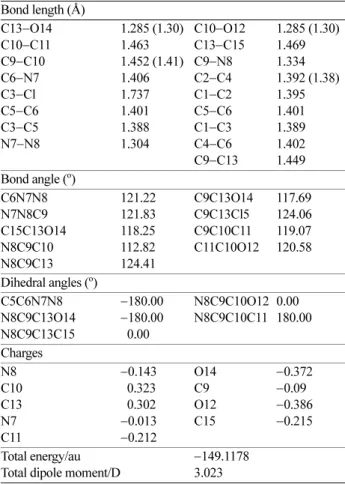
on plasma membrane as ABC transporter, or changing the ionic state by free chlorine/metal interaction with membrane poreins/interference with membrane lipids. As well as, the reliable cytotoxic effect reasons, might be due to the inte- raction with various metallo-enzymes especially with mito- chondrial enzymes.28 Table 6 gives the optimized geometry of Cphpd as obtained from B3LYP/CEP-31G calculations.
The values of bond distances are compared nicely with that obtained from X-ray data.29 The molecule is not highly sterically-hindered, the two benzene ring in the same plane of the all fragments. This observation is supported by the values of calculated dihedral angles. Scheme 3, showed the opti- Table 5. The inhibitation diameter zone values (mm) for Cphpd and their complexes
Compounds
Microbial species
Bacteria fungi
E. coli P. aeruginosa B. subtilis S. aureus A. flarus A. Fumigates
Cphpd 10±0.33 15±0.11 20±0.22 23±0.90 0 0
Cphpd / V(IV) 20+1±0.22 24+1±0.02 26+1±0.44 28+1±0.06 0 0
Cphpd / Pd(II) 21+1±0.11 25+1±0.03 35+2±0.30 38+2±0.88 0 0
Cphpd / Pt(IV) 25+2±0.22 18NS±0.04 22NS±0.20 28+1±0.33 0 0
Cphpd / Ce(IV) 14NS±0.15 16NS±0.05 30+2±0.13 40+2±0.11 0 0
Cphpd / U(VI) 18+1±0.12 0 25+1±0.60 39+2±0.14 0 0
VO(SO4)2.2H2O 0 0 0 0 0 0
PdCl2 9±0.73 0 5±0.53 0 0 0
PtCl4 0 0 0 0 0 0
Ce(SO4)2 0 0 0 0 0 0
UO2(NO3)2.6H2O 0 0 0 0 0 0
Control (DMSO) 0 0 0 0 0 0
Standard
Ampicilin 0 13 28 18 0 0
Amoxycillin 0 23 22 16 0 0
Cefaloxin 24 0 27 0 0 0
Statistical significance PNS–P not significant, P>0.05; P+1–P significant, P<0.05; P+2–P highly significant, P<0.01; P+3–P very highly signifi- cant, P>0.001; Student’s t-test (Paired).
Scheme 3. Optimized geometrical structure of Cphpd by using B3LYP/CEP-31G.
mized geometrical structure of Cphpd molecule. The dihe- dral angles confirm C10O12 group is lying in cis form with respect to C9N8 group and C13O14 group in trans form with respect to C9N8 group. The chelation of this ligand can be occurred through the nitrogen atom of hydra- zono group N8 and the oxygen atom of keto group O12 as bi-dentate ligand.
Charge distribution on the optimized geometry of Cphpd is given in Table 6. There is a significant built up of charge density on the oxygen atoms of the two keto groups and nitrogen atom of hydrazono group so we expect that Cphpd ligand behave as bi-dentate (Oketo and Nhyd atoms) and the molecule is not highly dipole µ=3.023 because the planarity of the Cphpd molecule, the charges accumulated on O12 and O14 are −0.386 and −0.372, respectively, also, the charges on N8 and N7 are −0.143 and 0.013, respec- tively. These values of charges enhance the chelation through the O12 of keto group and the N8 of the hydra- zono group. The value of energy of the optimized geom- etry is −149.117 au.
Proposal Structure of the Complexes with Molecular Modeling
Description of the structure of [VO(Cphpd)2(H2O)]2+
The V(IV) may be chelated with two molecules of Cphpd through four coordinate bonds (Oketo and Nhyd
atoms) from each molecule. The experimental data set that the result complex is six-coordinate so, the complex consists of four coordinate bonds with two Cphpd mol- ecules and coordinated bond with water molecule beside oxygen atom of V(IV) ion. In this part we study theo- retically the structure parameters of [VO(Cphpd)2(H2O)]2+
complex. The energy of the isomers is almost equal as expected,30 it is difficult to distinguish between trans and cis isomers. Nevertheless, the trans Oc-isomer exhibit the lowest energy.
The structure of complex with atomic numbering scheme is shown in Scheme 4. The complex consists of two units of Cphpd molecule and one water molecule with VO ion.
The complex is six-coordinate with distorted octahedral environment around the metal ion. The bond lengths and angles were calculated and found in Table 7. These values agree with these expected for a distorted octahedron.31−36 The two Cphpd molecules are perpendicular to each other and they are not lying in the same plane.
The energy of this complex is −338.096 au and the dipole moment is high (17.865D) and the charges accumulated on Oketo are −0.274 and −0.255 and on Nhyd are 0.04 and 0.019, in octahedral complex. There is a strong interaction between central metal ion V(IV) which has charge equal +0.578 and Cphpd molecule which more negative oxygen and nitrogen atoms in octahedral complex. For this reason the octahedral complex is more stable.
Table 6. Equilibrium geometric parameters bond lengths (Å), bond angles (o), dihedral angles (o) and charge density of Cphpd ligand by using DFT/B3LYP/CEP-31G.
Bond length (Å) C13−O14 C10−C11 C9−C10 C6−N7 C3−Cl C5−C6 C3−C5 N7−N8
1.285 (1.30) 1.463 1.452 (1.41) 1.406 1.737 1.401 1.388 1.304
C10−O12 C13−C15 C9−N8 C2−C4 C1−C2 C5−C6 C1−C3 C4−C6 C9−C13
1.285 (1.30) 1.469 1.334 1.392 (1.38) 1.395 1.401 1.389 1.402 1.449 Bond angle (o)
C6N7N8 N7N8C9 C15C13O14 N8C9C10 N8C9C13
121.22 121.83 118.25 112.82 124.41
C9C13O14 C9C13Cl5 C9C10C11 C11C10O12
117.69 124.06 119.07 120.58
Dihedral angles (o) C5C6N7N8 N8C9C13O14 N8C9C13C15
−180.00
−180.00 0.00
N8C9C10O12 N8C9C10C11
0.00 180.00
Charges N8 C10 C13 N7 C11
−0.143 0.323 0.302
−0.013
−0.212
O14 C9 O12 C15
−0.372
−0.09
−0.386
−0.215 Total energy/au
Total dipole moment/D
−149.1178 3.023
Scheme 4. Optimized geometrical structure of trans Oc-isomer of [VO(Cphpd)2(H2O)]2+ complex by using B3LYP/CEP-31G.
Description of the structure of [Pd(Cphpd)2(H2O)2]2+
Scheme 5 shows the optimized geometrical structure of [Pd(Cphpd)2(H2O)2]2+ with the atomic numbering scheme.
The selected bond distances and angles are given in Table 8.
The Pd(II) ion, at a crystallographic inversion center, is in a distorted octahedral environment. The metal ion may be coordinated by two oxygen atoms (Oketo) and two nitro- gen atoms (Nhyd) of two Cphpd ligand beside two oxygen atoms of two water molecules to complete the octahedral structure.37−46
In the equatorial plane the Pd(II) bonded with one oxy- gen atom and one nitrogen atom (O18 and N15) of Cphpd molecule beside two oxygen atoms, one oxygen atom (O25) of other ligand molecule and one oxygen atom (O4) of water molecule. These four atoms are lying in the same plane which perpendicular to the other plane occupied by other atoms (N27) of other ligand molecule and O1 of other water molecule. The bond angles O18PdO25 and O18PdN27 are 93.48 and 96.75. The bond angles N15PdO25 and O18PdO4 are 166.32and 170.52, also, the bond angle O1PdN27 is 159.51. These values confirm that the two ligand mol- ecules not occupy the same plane but they are perpendicular to
each other. The energy of this complex is −363.135 au and the dipole moment is high 8.097D, so this complex is more stable.
The bond distances between Pd(II) and surrounded oxy- gen atoms and nitrogen atoms of Cphpd in complex are shown in Table 8. Also, the charges accumulated on Oketo
are −0.568 and −0.660 and on Nhyd are 0.689 and 0.559. There is a strong interaction between central metal ion Pd(II) Table 7. Equilibrium geometric parameters bond lengths (Å), bond
angles (o) and charge density of [VO(Cphpd)2(H2O)]2+ complex by using B3LYP/CEP-31G
Bond length (Å) V−O15 V–O22 V–N12 V–N24 V–O37 V–OH2O
1.869 1.868 1.914 1.912 1.789 1.899
C13−N12 C44−O15 C23−N24 C21−O22 C13−C14 C21−C23
1.349 1.215 1.348 1.215 1.364 1.364 Bond angle (o)
O37 V O15 O37 V N12 O37 V N24 O37 V O22 O37 V O1 O15 V N12 O15 V N24 O15 V O22
92.72 88.13 166.19 88.92 86.53 80.39 97.81 178.29
O15 V O1 O15 V O37 N12 V N24 N12 V O22 N12 V O1 N24 V O22 N24 V O1 O22 V O1 O22 V O37
88.37 92.72 102.39 100.18 167.31 80.49 84.86 91.23 88.92 Charges
V O15 N12 C13 N24
0.578
−0.274 0.040 0.019 0.006
C21 C23 O37 O1 C14 O22
0.381 0.012
−0.281
−0.322 0.419
−0.255 Total energy/au
Total dipole moment/D
−338.096 17.856
Scheme 5. Optimized geometrical structure of trans O-isomer of [Pd(Cphpd)2(H2O)2]2+complex by using B3LYP/CEP-31G.
Table 8. Equilibrium geometric parameters bond lengths (Å), bond angles (o) and charge density of [Pd(Cphpd)2(H2O)2]2+by using DFT/B3LYP/CEP-31G
Bond length (Å) Pd−O18 Pd−O25 Pd−N15 Pd−N27 Pd−O1 C26−N27
1.923 1.924 1.967 1.971 1.953 1.349
Pd−O4 C17−O18 C16−C17 C16−N15 C24−O25 C24−C26
1.951 1.216 1.363 1.348 1.214 1.364 Bond angle (o)
O1 Pd N15 O1 Pd O25 N15 Pd N27 N15 Pd O25 O18 Pd O25 N15 Pd O4 O18 Pd O4 O25 Pd O4
86.49 82.49 112.95 166.32 93.48 91.56 170.52 95.96
O18 Pd N27 N27 Pd O25 O1 Pd O18
O1 Pd O4 N27 Pd O4 O1 Pd N27 N15 Pd O18
96.75 79.08 93.21 87.26 85.85 159.51 79.03
Charges Pd C16 N27 O1 N15
0.688 0.131 0.559
−0.399 0.689
C17 C24 O4 O18 O25 C26
0.401 0.402
−0.395
−0.568
−0.660 0.137 Total energy/au
Total dipole moment/D
−363.135 8.097
which has charge equal +0.688 and more negative oxygen and nitrogen atoms in octahedral complex. For this reason the octahedral complex is more stable and Pd(II) favor coordinated with two molecules of Cphpd with four coor- dinated bonds and completes the octahedron structure by bonding with two water molecules.
CONCLUSION
The reaction of some transition metal ions V(IV), Pd(II), Pt(IV), Ce(IV) and U(VI) with Cphpd has been studied.
The results of the elemental analysis and thermogravi- metric analysis deduced the formation of 2:1 Cphpd/metal ions complexes in all cases. The structure of the formed complexes were further supported by infrared, UV-vis and
1H NMR spectra. The Cphpd has two donating centers Oketo and Nhyd when chelated with metal ions and the metal ions completed the octahedral structures with water mol- ecules or chloride ions, there are six-coordinated bonds are formed four with two Cphpd molecules and other two with two water molecules or chloride ions. The produced complexes are treated as distorted octahedral complex.
For all studied complexes the two Cphpd molecules are perpendicular to each other and they are not lying in the same plane. In case of V(IV) in VO ion the energy difference between two enantiomers cis and trans is very low, it is difficult to distinguish between trans or cis isomers. Nev- ertheless, the trans-isomer exhibits the lowest energy value.
Antimicrobial studies were carried out against S. aureus K1, B. subtilis K22, E. coli K32 and P. aeruginosa SW1 and antifungal screening was studied. The results showed significant increase in antibacterial activity of metal com- plexes as compared with uncomplexed ligand and no anti- fungal activity observed for ligand and their complexes.
Acknowledgments. The author would like to thank the colleagues at University of Zagazig, Faculty of Science, Microbiology and Chemistry Department for performing the antimicrobial measurements (Prof. Dr. Ashraf sabry and Dr.Walaa H. El-Shwiniy). And the publication cost of this paper was supported by the Korean Chemical Society.
REFERENCES
1. Odabasoglu, M.; Büyükgüngör, O.; Sarojini, B. K.; Naray- ana, B. Acta Cryst. 2007, E63, o4135.
2. Rashad, A. E.; Shamroukh, A. H.; El-Hashash, M. A.;
El-Farargy, A. F.; Yousif, N. M.; Salama, M. A.; Mostafa, A.; El-Shahat, M. J. Heterocyclic. Chem. 2012, 49, 1130.
3. Zordok, W. A.; Sadeek, S. A.; EL-Shwiniy, W. H. J. Coord.
Chem. 2012, 65, 353.
4. Beecher, D. J.; Wong, A. C. Appl. Environ. Microbial.
1994, 60, 1646.
5. Geary, W. J. Coord. Chem. Rev. 1971, 7, 81.
6. Nour, E. M.; Alnami, I. S.; Alem, N. A. J. Phys. Chem.
Solids 1992, 53, 197.
7. Mcglynnm, S. P.; Smith, J. K.; Neely, W. C. J. Chem. Phys.
1961, 35, 105.
8. Syamal, A.; Singhal, P. O.; Banerjee, S. Synth. React.
Inorg. Met.-Org. Chem. 1980, 243, 10.
9. Jones, L. H. Spectrochim. Acta 1958, 10, 395; Jones, L.
H. Spectrochim. Acta 1959, 11, 409.
10. Nakamoto, K. Infrared and Raman Spectra of Inorganic and Coordination Compounds, 4th ed.; Wiley: New York, 1986, pp 230−233.
11. Sultana, N.; Arayne, M. S.; Gul, S.; Shamim, S. J. Mol.
Struct. 2010, 975, 285.
12. Zordok, W. A.; El-Shwiniy, W. H.; El-Attar, M. S.; Sadeek, S. A. J. Mol. Struct. 2013, 1047, 267.
13. King, D. E.; Malone, R.; Lilley, S. H. Am. Fam. Phys. 2000, 61, 2741.
14. Patai, S. Chemistry of the Carbon-nitrogen Double Bond;
Willey: New York, 1970; pp 238−247.
15. Jones, L. H. Spectrochim. Acta 1959, 15, 409.
16. Sadeek, S. A.; Teleb, S. M.; AL-Kority, A. M. J. Indian Chem. Soc. 1993, 70, 63.
17. Refat, M. S. Spectrochim. Acta., Part A 2007, 68, 1393.
18. Nakamoto, K.; McCarthy, P. J.; Spectroscopy and Structure of Metal Chelate Compounds; John Wiley & Sons: New York, London, Sydney, 1968; chapter 2.
19. Saif, M.; Mashaly, M. M.; Eid, M. F.; Fouad, R. Spectro- chim. Acta.; Part A 2012, 92, 347.
20. Skauge, T.; Turel, I.; Sletten, E. Inorg. Chem. Acta. 2002, 339, 239.
21. Rossmore, H. W. Disinfection, Sterilization and Preservation, 4th ed.; Block, S. S., Ed., Lea and Febiger: Philadelphia, 1991; pp 290−321.
22. Russell, A. D. Disinfection, Sterilization and Preservation, 4th ed.; Block, S. S., Ed., Lea and Febinger: Philadelphia, 1991, pp. 27−59.
23. Beltagi, A. M. J. Pharm. Biomed. Anal. 2003, 31, 1079.
24. Kohn, W.; Sham, L. J. Phys. Rev. A 1965, 140, 1133.
25. Becke, A. D. Phys. Rev. A 1988, 38, 3098.
26. Lee, C.; Yang, W.; Parr, R. G. Phys. Rev. B 1988, 37.
27. Flurry, R. L. Jr. Molecular Orbital Theory of Bonding in Organic Molecules; Marcel Dekker: New York, 1968.
28. Warrilow, A. G. S.; Martel, C. M.; Parker, J. E.; Melo, N.;
Lamb, D. C.; Nes, W. D.; Kelly, D. E.; Kelly, S. L. Ant- microb. Agents Chemother. 2010, 54, 4235.
29. Turel, I.; Golic, L.; Bukovec, P.; Gubina, M. J. Inorg. Bio- chem. 1998, 71, 53.
30. Ahmed, M.; Schwendt, P.; Marek, J.; Sivak, M. Polyhe- dron 2004, 23, 655.
31. Grivani, G.; Khalaji, A. D.; Tahmasebi, V.; Gotoh, K.; Ishida,
H. Polyhedron 2012, 31, 265.
32. Gonzalez-Baro, A. C.; Castellano, E. E.; Piro, O. E.; Para- jon-Costa, B. S. Polyhedron 2005, 24, 49.
33. Kuriakose, M.; Prathapachandra Kurup, M. R.; Suresh, E.
Polyhedron 2007, 26, 2713.
34. Vannan, M.; Lloffman, J. T.; Dimayuga, V. L.; Dwight, T.; Carrano, C. J. Inorg. Chem. Acta 2007, 360, 529.
35. Rochon, F. D.; Massarweh, G. Inorg. Chim. Acta 2006, 359, 4095.
36. Quintal, S. M. O.; Felix, V.; Drew, M. G. B.; Nogueira, H.
I. S. Polyhedron 2006, 25, 753.
37. Hao, Y. Z.; Li, Z. X.; Tian, J. L. J. Mol. Catal. A.: Chem.
2007, 265, 258.
38. Kaplum, M.; Sandstrom, M.; Bostrom, D.; Shchukarev, A.; Persson, P. Inorg. Chem. Acta 2005, 358, 527.
39. Lo´pez, C.; Caubet, A.; Perez, S.; Solans, X.; Font-Bardla,
M. J. Organ. Chem. 2003, 681, 82.
40. Kumar, P. R.; Upreti, S.; Singh, A. K. Polyhedron 2008, 27, 1610–1622.
41. Al-Jibori, S. A.; Habeeb, A. T.; Al-Jibori, G. H. H.; Dayaaf, N. A.; Merzweiler, K.; Wagner, C.; Schmidt, H.; Hogarth, G. Polyhedron 2014, 67, 338.
42. Sanchez, G.; Garcla, J.; Meseguer, D.; Serrano, J. L.; Gar- cla, L.; Perez, J.; Lopez, G. Inorg. Chim. Acta 2004, 357, 4568.
43. Griffith, D. M.; Bíró, L.; Platts, J. A.; Müller-Bunz, H.;
Farkas, E.; Buglyó, P. Inorg. Chim. Acta 2012, 380, 291.
44. Oltean, D.; Pöllnitz, A.; Silvestru, A. Polyhedron 2013, 53, 67.
45. Gao, H. L.; Yi, L.; Zhao, B.; Zhao, X. Q.; Cheng, P.; Liao, D. Z.; Yan, S. P. Inorg. Chem. 2006, 45, 5980.
46. Aghabozorg, H.; et al. Polyhedron 2010, 29, 1453.

![Table 8. Equilibrium geometric parameters bond lengths (Å), bond angles ( o ) and charge density of [Pd(Cphpd) 2 (H 2 O) 2 ] 2+ by using DFT/B3LYP/CEP-31G Bond length (Å) Pd −O18 Pd −O25 Pd −N15 Pd −N27 Pd −O1 C26 −N27 1.9231.9241.9671.9711.9531.349 Pd −O4](https://thumb-ap.123doks.com/thumbv2/123dokinfo/5298855.154214/8.892.465.803.149.389/table-equilibrium-geometric-parameters-lengths-angles-density-length.webp)
