• 검색 결과가 없습니다.

Seasonal Effects on Shoot Regeneration from Petal Explants of Chrysanthemum (Chrysanthemum morifolium) cv. 'Baeksun'

N/A
N/A
Protected

Academic year: 2021

Share "Seasonal Effects on Shoot Regeneration from Petal Explants of Chrysanthemum (Chrysanthemum morifolium) cv. 'Baeksun'"

Copied!
3
0
0

로드 중.... (전체 텍스트 보기)

전체 글

(1)

Current Research on Agriculture and Life Science (2014) 32(4): 175−177 http://dx.doi.org/10.14518/crals.2014.32.4.031

Online ISSN 2288-0356 Print ISSN 2287-271X

Original Article

Seasonal Effects on Shoot Regeneration from Petal Explants of Chrysanthemum (Chrysanthemum morifolium) cv. ‘Baeksun’

Aung Htay Naing and Chang Kil Kim *

Department of Horticultural Science, Kyungpook National University, Daegu 702-701, Korea

Received: August 27 2014 / Revised: November 4 2014 / Accepted: November 17 2014

Abstract This is the first report describing the seasonal conditions affecting shoot regeneration by the chrysanthemum cv.

Baeksun. The shoot regeneration from petal explants was found to be more favorable from September to December, reaching the highest values in December. In addition, the quality of the shoots was also influenced according to the season of the explant collection, where healthy and uniform plants were derived from the explants collected in December. Choosing the proper season for explant collection affected the successive plant growth parameters (i.e., plant height and fresh weight). Thus, the current results strongly suggest that season plays an important role in plant tissue culturing, which is an essential tool for micropropagation and Agro-bacterium-mediated genetic transformation studies.

Keywords: Chrysanthemum, micropropagation, plant growth, seasonal effect

Introduction

Chrysanthemum is one of the most important cut flowers in Korea, and is also widely used as a herbaceous landscape plant.

The cv. ‘Baeksun’, a newly released standard Chrysanthemum cultivar blooming from May to December, was produced by conventional breeding and is commonly used as a cut flower. Due to its various beneficial traits, such as a high tolerance to white

rust disease and long vase life after harvesting, Chrysanthemum breeders have become interested in introducing foreign genes to the cultivar using an Agrobacterium-mediated transformation method. Yet, this approach requires efficient in vitro regeneration procedures.

Shoot regeneration from petal explants has already been developed for chrysanthemums (Nahid et al., 2007; Barakat et al., 2010; Song et al., 2011; Song et al., 2012), and the application of petal explants for successful Agrobacterium-mediated transformation has also been reported (Song et al., 2012). However, the seasonal influence on shoot regeneration from petals has not yet been investigated, except for the study by Nahid et al (2007).

The season seems to be an important factor determining the shoot regeneration efficiency in tissue cultures (Prasad and Chaturvedi, 1988; Sharma et al., 2005; Nahid et al., 2007; Zalewska et al., 2011; Nongalleima et al., 2014). For chrysanthemums, Prasad and Chaturvedi (1988) reported that efficient shoot regeneration from leaf explants of field-grown plants was totally dependent on the collection season. In 2007, similar results for shoot regeneration from petal explants were observed by Nahid et al.

(2007). More recently, Zalewska et al. (2011) also found that the induction of adventitious shoot regeneration in chrysanthemums was affected by the season. Accordingly, the present study used explants collected monthly from field-grown donor plants to investigate whether the season plays an important role in shoot regeneration by chrysanthemums.

Materials and Methods

Plant material

The Chrysanthemum (Chrysanthemum morifolium) cv. ‘Baeksun’

was grown in an environmentally controlled greenhouse at Gumi Research Station (South Korea) and flowers of the same size were harvested monthly from May to December. The flowers were thoroughly washed under running tap water with 5% liquid detergent (Sando, Korea). Thereafter, the surfaces were sterilized using a 70% (v/v) ethanol solution for 30 seconds and 1% NaOCl

*Corresponding author: Chang-Kil Kim Tel: 82-53-950-5728; Fax: 82-53-950-5722 E-mail: [email protected]

This is an Open Access article distributed under the terms of the Creative Commons Attribution Non-Commercial License (http://creativecommons.

org/licenses/by-nc/3.0/) which permits unrestricted non-commercial use, distribution, and reproduction in any medium, provided the original work is properly cited.

© 2014 Institute of Agricultural Science and Technology, Kyungpook

National University

(2)

176 Naing and Kim

Curr Res Agric Life Sci (2014) 32(4): 175 −177

plus Tween 20 for 5 min, followed by five rinses with sterilized distilled water.

Effect of season on shoot regeneration

The petals were transversely cut into two halves and only the basal parts used as explants. For shoot regeneration, all the explants were cultured on a Murashige and Skoog (MS) medium supplemented with a combination of 1 mg/L 6-benzyladenine (BA) and 0.5 mg/L 3-indole acetic acid (IAA), which was already shown to be an optimal PGR combination for this cultivar in our previous study. To investigate the effects of the season on the capacity of shoot regeneration, the experiments were conducted monthly from May to December, 2013. Each treatment consisted of 10 explants and three replicates. The number of shoots induced per explant was recorded after 4 weeks of culture.

Evaluation of plant growth parameters

The regenerated shoots collected from the explants each month (September to December) were placed separately onto a hormone- free MS basal medium containing 1 g/L activated charcoal (AC).

Each treatment consisted of ten shoots with three replicates. The growth parameters (i.e, plant height and fresh weight) were recorded after 4 weeks of culture.

Experimental design and statistical analysis

For all the cultures, the percentage of sucrose and agar was 0.8 and 3.0, respectively. All the cultures were incubated under fluorescent light at an intensity of 40 µmol m

−2

s

−1

with a 16 h photoperiod. All the data were analyzed using ANOVA, and the means compared using DMRT (p<0.05)

Results and Discussion

The seasonal effect of explant collection on shoot regeneration is presented in figures 1A and B. The results showed significant differences according to the season of explant collection. In general, the percentage of shoot regeneration and number of shoots formed per explant were greatly influenced by the month of the year during which the explants were collected. Similar results were also reported by Rani and Rana (2010). For the period May-August, the explants were found to be brown in color and no in vitro response was observed, while the period September-December was the most favorable season, where the explants collected in September exhibited the lower percentage of in vitro response. The seasonal effect of explant collection on the in vitro adventitious shoot regeneration of chrysanthemums was already reported (Prasad and Chaturvedi, 1988; Nahid et al., 2007;

Zalewska et al., 2011). In these studies, a distinct increase in the number of shoots was noticed from the explants collected in October, followed by a slightly continuous increase into

December. Plus, the number of days to shoot regeneration for the explants collected in December was lower than that for the explants collected in other months. Similar to the present study, Nahid et al. (2007) observed that the highest shoot regeneration rate was from petal explants collected during December to January, followed by a strong decrease from May to September.

Prasad and Chaturvedi (1988) also reported that shoot tip explants only proliferated and survived in vitro during March and April. In addition, Zalewska et al. (2011) reported a more intensive regeneration from chrysanthemum internode and leaf explants in summer and autumn than in winter and spring. When comparing the findings of other studies, the favorable season for in vitro shoot regeneration would seem to differ according to the explant used, regardless of the genotype. The most favorable season for organogenesis from peat explants would appear to be December when comparing the current findings with those of Nahid et al.

(2007). Thus, the physiological effect or indogenous hormone

level of the explant that can stimulate the induction of shoots

would seem to be optimum in December. Meanwhile, Morrish

and Vasil (1987) reported that the physical effects of the donor

plant, which depend on the growth environment, affect the in vitro

responses of explants. Thus, it would be interesting to study the

variation of the indogenous hormone level in petal explants after

Figure 1. Seasonal influence on shoot regeneration responses from petal

explants of Chrysanthemum morifolium cv. ‘Baeksun’: A) percentage of

shoot regeneration in different seasonal periods and B) number of shoots

per explant in different seasonal periods.

(3)

Shoot Regeneration from Petal Explants of Chrysanthemum 177

Curr Res Agric Life Sci (2014) 32(4): 175 −177 being collected monthly. The seasonal variation observed in vitro

would seem to suggest the existence of an inner biological clock in plants (Salomé and McClung, 2005). El- Morsy and Millet (1996) also claimed that shoots produced in vitro demonstrated the same infradian rhythmic growth as the parent plant. Plus, Zalewska et al (2011) mentioned that one cannot disregard the fact that plants receive signals from the environment outside the laboratory.

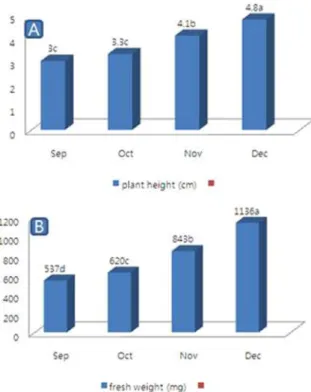
When the shoots collected each month were cultured on the plant growth medium, a different effect on plant growth was observed according to the season (Figures 2A and B). Most of the shoots obtained from the explants collected in September were found to be weak and grew slowly, while the shoots from the explants collected during the other three months grew well, and the shoots from the explants collected in December were the best.

Thus, a strong relation was found between the season of the explant collection and the successive plant growth. For the explants collected during the less favorable season, the shoots were weaker physiologically and lacked a sufficient endogenous hormone level for good growth. Yadav and Singh (2011) also reported on the effect of the seed harvesting season on the germination of Albizia lebbeck (L.) BENTH. However, there have been no other reports on the effect of the explant collection season on successive plant growth for other crops.

The best condition for shoot regeneration of the commercial Chrysanthemum cv. Baeksun was determined by examining the

effect of the season on explant collection. The choice of the proper season for explant collection affected the successive plant growth.

The present findings also support the fact that plants receive signals from the environment outside the laboratory conditions.

Thus, plant neurobiology is a new emerging area of plant biotechnology that includes the study of signal transfer mechanisms between biotic and abiotic environments.

Acknowledgments

This work was supported by the Bio-industry Technology Development Program, Ministry for Food, Agriculture, Forestry and Fisheries, Republic of Korea.

References

Barakat MN, Fattah RSA, Badr M, EI-Torky MG (2010) In vitro culture and plant regeneration derived from ray florets of Chrysanthemum morifolium. Afr J Biotechnol 9: 1151-1158.

El- Morsy AA, Millet B (1996) Rhythmic growth and optimization of micropropagation: the effect of excision time and position of axillary buds on in vitro culture of Citrus aurantium L. Ann Bot 78: 197-202.

Morrish F, Vasil V, Vasil IK (1987) Developmental morphogenesis and genetic manipulation in tissue and cell cultures of the Gramineae. Adv Genet 24: 431-499.

Nahid JS, Shyamali S, Kazumi H (2007) High frequency shoot regeneration from petal explants of Chrysanthemum morifolium Ramat. in vitro. Pak J Biol Sci 10: 3356-3361.

Nongalleima K, Singh TD, Amitabha D, Deb L, Devi S (2014) Optimization of surface sterilization protocol, induction of axillary shoots regeneration in Zingiber zerumbet (L.) Sm. as affected by season. Biol Rhythm Res 45: 317-324.

Prasad RN, Chaturvedi HC (1988) Effect of season on collection of explants on micropropagation of Chrysanthemum morifolium. Biol Planttarum 30: 20-24.

Rani S, Rana JS (2010) In vitro propagation of Tylophora indica- influence of explanting season, growth regulators synergy, culture passage and planting substrate. J Am Sci 6: 385-392.

Salome PA, McClung CR (2005) What makes the Arabidopsis clock tick on time? A review on entrainment. Plant Cell Environ 28: 21-38.

Sharma VK, Hansch R,. Mendel RR, Schulze J (2005) Seasonal effect on tissue culture response and plant regeneration frequency from non- bombarded and bombarded immature scutella of barley (Hordeum vulgare) harvested from controlled environment. Plant Cell Tiss Organ Cult 81: 19-26.

Song JY, Mattson NS, Jeong BR (2011) Efficiency of shoot regeneration from leaf, stem, petiole and petal explants of six cultivars of Chrysanthemum morifolium. Plant Cell Tiss Organ Cult 107: 295-304.

Song JY, Sivanesan I, Jeong BR (2012) Use of petal explants for successful transformation of Dendrathema × grandiflorum Kitamura ‘Orlando’

mediated by Agrobacterium tumefaciens. Afr J Biotechnol 11: 9141-9148.

Yadav K, Singh N (2011) Effect of seed harvesting season and sterilization treatments on germination and in vitro propagation of Albizia lebbeck (L.) Benth. An U O Fasc Biol 2: 151-156.

Zalewska M, Lema-Ruminska J, Miler N, Gruszka M, Dabal W (2011) Induction of adventitious shoot regeneration in chrysanthemum as affected by the season. In vitro Cell Dev Biol-Plant 47: 375-378.

Figure 2. Plant growth parameters for shoots derived from petal explants

collected during September to December and grown in hormone-free

media with 1 gl-1 AC: A) mean plant height and B) mean fresh weight.

수치

Figure 2. Plant growth parameters for shoots derived from petal explants collected during September to December and grown in hormone-free media with 1 gl-1 AC: A) mean plant height and B) mean fresh weight.

참조

관련 문서

웹 표준을 지원하는 플랫폼에서 큰 수정없이 실행 가능함 패키징을 통해 다양한 기기를 위한 앱을 작성할 수 있음 네이티브 앱과

- 노뼈머리는 위팔뼈 작은머리(capitulum of the humerus)와 자뼈의 노패임(ulnar radial notch)과 관절을 이룬다...

_____ culture appears to be attractive (도시의) to the

머리 가속 또는 감속 움직임시 TM joint 손상 탈구 시 연부조직 손상..

A frame size error in a frame that could alter the state of the entire connection MUST be treated as a connection error (Section 5.4.1); this includes any frame carrying a

1 John Owen, Justification by Faith Alone, in The Works of John Owen, ed. John Bolt, trans. Scott Clark, &#34;Do This and Live: Christ's Active Obedience as the

The Effects of the Utilization of External Resources on the Technological Innovation Performance Along the Stages of Growth in Korean Ventures,

The main effects of rooting medium composition, growth regulators and node parts of shoot on rooting and growth of plug plantlets using stem cuttings of