• 검색 결과가 없습니다.

Selective NO<sub>2</sub> Sensors Using MoS<sub>2</sub>-MoO<sub>2</sub> Composite Yolk-shell Spheres

N/A
N/A
Protected

Academic year: 2021

Share "Selective NO<sub>2</sub> Sensors Using MoS<sub>2</sub>-MoO<sub>2</sub> Composite Yolk-shell Spheres"

Copied!
4
0
0

로드 중.... (전체 텍스트 보기)

전체 글

(1)

151 J. Sensor Sci. & Tech. Vol. 24, No. 3, 2015 Journal of Sensor Science and Technology

Vol. 24, No. 3 (2015) pp. 151-154 http://dx.doi.org/10.5369/JSST.2015.24.3.151 pISSN 1225-5475/eISSN 2093-7563

Selective NO 2 Sensors Using MoS 2 -MoO 2 Composite Yolk-shell Spheres

Seong Yong Jeong

1

, Seung Ho Choi

1

, Ji-Wook Yoon

1

, Jong Min Won

1

, Yun Chan Kang

1

, Joon-Shik Park

2

, and Jong-Heun Lee

1,+

Abstract

The gas sensing characteristic of MoS

2

-MoO

2

composite yolk-shell spheres were investigated. MoO

3

-carbon composite spheres were prepared by ultrasonic spray pyrolysis of aqueous droplets containing Mo-source and sucrose in nitrogen, which were converted into MoO

3

yolk-shell spheres by heat treatment at 400

o

C in air. Subsequently, MoS

2

-MoO

2

composite yolk-shell spheres were prepared by the partial sulfidation of MoO

3

. The MoS

2

-MoO

2

composite yolk-shell spheres showed relatively low and irreversible gas sensing characteristics at < 200

o

C. In contrast, the sensor showed high and reversible response (S=resistance ratio) to 5 ppm NO

2

(S = 14.8) at 250

o

C with low cross-responses (S = 1.17-2.13) to other interference gases such as ethanol, CO, xylene, toluene, trimethylamine, NH

3

, H

2

, and HCHO. The MoS

2

-MoO

2

composite yolk-shell spheres can be used as reliable sensors to detect NO

2

in a selective manner.

Keywords: Gas sensors, MoS

2

Yolk-shell Spheres, NO

2

Sensor, Selectivity

1. INTRODUCTION

Molybdenum disulfides (MoS

2

) with 2-dimensional (2-D) layered nanostructures show distinctive electrical and electrochemical properties, which can be used for various applications such as Li-ion battery [1], field effect transistor [2], and gas sensors [3]. In particular, the MoS

2

nanostructures with high surface area to volume ratio and thinness are regarded as promising platform to design chemiresistors that can be operated at relatively low sensing temperature [3].

Various form of MoS

2

nanostructures were investigated as chemiresistive materials, which include chemically or mechanically exfoliated flakes [3,4], thick oriented film [5], and atomic layer prepared by chemical vapor deposition [6]. However, the researches of high performance gas sensors using MoS

2

nanostructures are still in the nascent stage.

Yolk-shell nanostructures, thin hollow spheres containing movable single or multiple yolks, are superior electrode materials for Li ion batteries on account of their high surface area, nanoarchitectures to buffer the structural strain, and short diffusion length of Li ion [7]. Moreover, the reforming of specific analyte gas within yolk-shell micro reactors can provide a new strategy to design selective and sensitive gas sensors [8-10].

In this contribution, MoS

2

-MoO

2

composite yolk-shell spheres are prepared by the partial sulfidation of MoO

3

yolk- shell spheres and their gas sensing characteristics are investigated. Main focus of the study is directed at the selective and reversible detection of specific gas using MoS

2

- MoO

2

composite yolk-shell spheres.

2. EXPERIMENTAL

2.1 Preparation of MoS

2

-MoO

2

yolk-shell spheres The MoO

3

-carbon composite spheres were prepared by the ultrasonic spray pyrolysis of aqueous droplets containing 0.1 M of MoO

3

(Kanto Chemical Co., Inc., 99.5%), 0.1 M of sucrose (Sigma-Aldrich, 99.5%), and H

2

O

2

(Sigma-Aldrich, 29.0-32.0%) at 900

o

C (carrier gas: nitrogen, flow rate: 10 L/min). The MoO

3

- carbon composite spheres were converted into multiple-shelled MoO

3

yolk-shell spheres by heat treatment at 400

o

C. The oxidation of Mo-source and the partial combustion of carbon at

1

Department of Materials Science and Engineering, Korea University, Seoul 136-713, Republic of Korea

2

Smart Convergence Sensor Research Center, Korea Electronic Technology Institute (KETI),

Gyeonggi 463-816, Republic of Korea

+
Corresponding author: [email protected] (Received : May. 5, 2015, Accepted : May. 26, 2015)

This is an Open Access article distributed under the terms of the Creative Commons Attribution Non-Commercial License(http://creativecommons.org/

licenses/bync/3.0) which permits unrestricted non-commercial use, distribution,

and reproduction in any medium, provided the original work is properly cited.

(2)

Seong Yong Jeong, Seung Ho Choi, Ji-Wook Yoon, Jong Min Won, Yun Chan Kang, Joon-Shik Park, and Jong-Heun Lee

J. Sensor Sci. & Tech. Vol. 24, No. 3, 2015 152 the outer part, the contraction of inner MoO

3

-carbon composite spheres, and repetition of these procedures leaded to the formation of MoO

3

yolk-shell spheres. The MoO

3

yolk-shell spheres were placed in crucible and converted into MoS

2

-MoO

2

composite yolk-shell spheres by flowing H

2

S (generated by flowing H

2

/Ar to Thiourea) at 400

o

C for 6 h.

2.2 Gas sensing characteristics

The MoS

2

-MoO

2

composite yolk-shell spheres were dispersed in ethanol and small amount of slurry was coated on the alumina substrate (1.5 mm ×15 mm×0.25 mm) with two Au electrodes.

The sensor was dried at room temperature for 2 h and heat treated at 250

o

C for 6 h to remove the residual water solvent in the sensing materials. A flow-through technique with a constant flow rate of 500 cm

3

min

-1

was used and a 4-way valve was used to switch the gas atmospheres. The responses of the sensors (R

g

/R

a

for NO

2

and R

a

/R

g

for other reducing gases: R

g

: resistance in gas, R

a

: resistance in air) were measured with varying sensor temperature using electrometer interfaced with a computer.

3. RESULTS AND DISCUSSIONS

3.1 Materials characterization

The X-ray diffraction pattern of powders by sulfidation of MoO

3

yolk-shell spheres through flowing H

2

S at 400

o

C for 6 h

was shown in Fig. 1. The powders were identified as the composite between MoS

2

(JCPDS #37-1492) and MoO

2

(JCPDS

#32-0671). The reduction of Mo

6+

into Mo

4+

and the formation of MoS

2

phase were attributed to the partial sulfidation reaction. The MoS

2

-MoO

2

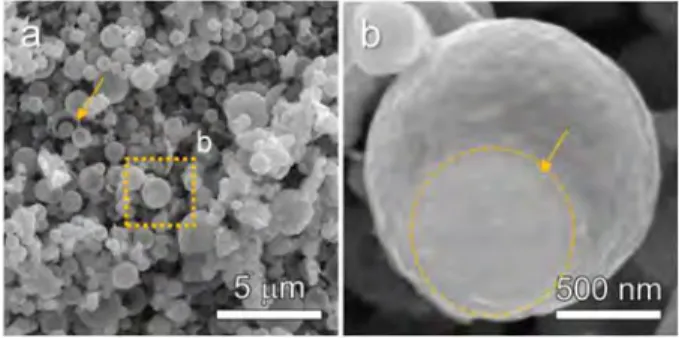
composite powders showed the spherical morphology (Fig. 2a). The diameters of spheres ranged from 0.2 to 2.0 mm.

The yolk-shell morphology was frequently observed in broken spheres (arrow in Fig. 2a), which was confirmed again by the different contour within a sphere in high magnification SEM image (Fig. 2b). It is known to convert MoO

3

phase into phase pure MoS

2

phase by heat treatment under H

2

S atmosphere [11].

Thus, the co-existence of MoO

2

and MoS

2

in the present study can be attributed to the lower heat-treatment temperature and insufficient heat treatment time [12].

3.2 Gas sensing characteristics

The sensor using MoS

2

-MoO

2

composite yolk-shell spheres showed the low response to analyte gases at < 200

o

C.

Moreover, the sensor resistance did not completely recover to original resistance in air after gas sensing reaction (not shown).

Thus, it was difficult to measure the reliable gas sensing characteristics at <200

o

C. Accordingly, the gas sensing characteristics were measured at 200 and 250

o

C. Fig. 3 shows the sensing transients to 5 ppm NO

2

, C

2

H

5

OH, CO, xylene, toluene, trimethylamine (TMA), NH

3

, H

2

, and HCHO at 250

o

C. The R

a

value at 250

o

C was ~ 0.2 MΩ. It increased upon exposure to oxidizing gas such as NO

2

, while it decreased upon exposure to all other reducing gases. This indicates that the MoS

2

-MoO

2

composite yolk-shell spheres in the present study show n-type gas sensing behaviors. It is natural considering that MoS

2

and MoO

3

show the n-type gas sensing behaviors in the literature [3,13]. It should be noted that the sensor resistance was recovered completely upon exposure to air. The Fig. 1. X-ray diffraction pattern (XRD) of MoS

2

-MoO

2

composite

yolk-shell spheres.

Fig. 2. Scanning electron microscopy (SEM) images of MoS

2

-MoO

2

composite yolk-shell spheres.

I 8 I

(3)

Selective NO

2

Sensors Using MoS

2

-MoO

2

Composite Yolk-shell Spheres

153 J. Sensor Sci. & Tech. Vol. 24, No. 3, 2015 sensing transients at 200

o

C were also reversible. This says that

the sensing temperature higher than 200

o

C is necessary to achieve reliable and reversible gas sensing characteristics in the sensor using MoS

2

-MoO

2

composite yolk-shell spheres.

The gas responses at 200 and 250

o

C were summarized in Fig.

4. At both sensing temperatures, the variation of sensor resistance upon exposure to NO

2

is opposite to those upon exposure to reducing gases. Accordingly, in principle, NO

2

can be detected in a selective manner. However, when both NO

2

and reducing gases co-exist, the increase of sensor resistance by NO

2

can be nullified by the decrease of sensor resistance induced by other reducing gases. In particular, this problem becomes more significant when the cross-responses (R

a

/R

g

) to other interfering reducing gases are comparably high. In this perspective, the R

a

/R

g

values to reducing gases should be negligibly low to achieve selective NO

2

sensing.

The response to 5 ppm NO

2

(R

g

/R

a

) at 200

o

C is 4.9, while those (R

a

/R

g

) to other 8 different analyte gases ranged from 1.04 to 2.66 (left in Fig. 4). In particular, high cross responses to CO (S=2.36), TMA (S=2.66), NH

3

(S=2.10), and H

2

(S=1.71) increase the possibility of sensor malfunction. In contrast, the response to 5 ppm NO

2

at 250

o

C (S=14.8) is significantly higher than those toward other 8 different reducing gases (S=1.17 – 2.13).

Accordingly, the operation of sensor using MoS

2

-MoO

2

composite yolk-shell spheres at 250

o

C is advantageous for selective, sensitive and reliable detection of NO

2

.

3.3 Discussion

The sensor using MoS

2

-MoO

2

composite yolk-shell spheres showed the reversible sensing behavior at 200 and 250

o

C, while it showed incomplete recovery at low sensing temperature.

Donarelli et al. [3] measured NO

2

sensing characteristics of chemically exfoliated MoS

2

flakes annealed at 150 or 250

o

C. They observed n-type NO

2

sensing behavior (i.e. increase of sensor resistance) from the specimen annealed at 250

o

C and p-type sensing behavior from the specimen annealed at 150

o

C. They observed the incomplete recovery from sensing reaction at the sensor temperature of 25, 100 and 150

o

C. These results are consistent with those in the present study.

The increase of sensor resistance upon exposure to NO

2

can be explained by the adsorption of NO

2

with negative charge (NO

2-

(ads)) and consequent decrease of charge carrier concentration near the surface. Thus, the incomplete recovery from NO

2

sensing reaction means the sluggish kinetics of NO

2

desorption reaction.

Thus, the rapid and complete recovery from NO

2

sensing at 200 and 250

o

C can be attributed to the thermal promotion of NO

2

desorption.

The selective detection of NO

2

is a key result in the present study. Yue et al. [14] reported the calculation that NO

2

and NH

3

weakly adsorbed on the monolayer MoS

2

played roles of acceptor and donor, respectively. This is consistent with Cho’s report [6]

and explains the decrease of sensor resistance upon exposure to NH

3

in the present study. However, the sensing mechanisms of other gases such as C

2

H

5

OH, CO, xylene, toluene, trimethylamine (TMA), H

2

, and HCHO remain unclear and should be studied further. The sensor resistance was decreased upon exposure to reducing gases. Thus, the adsorption of oxygen with negative Fig. 3. Gas sensing transients to 5 ppm (a) NO

2

, (b) C

2

H

5

OH, (c) CO,

(d) p-xylene, (e) Toluene, (f) Trimethylamine, (g) NH

3

, (h) H

2

, and (i) HCHO of MoS

2

-MoO

2

composite yolk-shell spheres at 250

o

C.

Fig. 4. Gas responses (S=R

a

/ R

g

or S=R

g

/ R

a

) to 5 ppm NO

2

(N), C

2

H

5

OH (E), CO (C), p-xylene (X), Toluene (T), Trime- thylamine (TMA), NH

3

(A), H

2

(H), and HCHO (F) of MoS

2

- MoO

2

composite yolk-shell spheres and at (a) 200

o

C and (b) 250

o

C.

I 9 I

(4)

Seong Yong Jeong, Seung Ho Choi, Ji-Wook Yoon, Jong Min Won, Yun Chan Kang, Joon-Shik Park, and Jong-Heun Lee

J. Sensor Sci. & Tech. Vol. 24, No. 3, 2015 154 charge and their reaction with reducing gases to produce electrons can be considered as a plausible explanation.

4. CONCLUSIONS

The MoS

2

-MoO

2

composite yolk-shell spheres were prepared by the partial sulfidation of MoO

3

yolk-shell spheres and their gas sensing characteristics were investigated. The sensor showed low and incomplete gas responses at < 200

o

C, while it showed high and reversible gas sensing characteristics at 200 and 250

o

C. The response to 5 ppm NO

2

was 14.8 at 250

o

C, which is significantly higher than those towards other 8 different interference gases. The sensors MoS

2

-MoO

2

composite yolk-shell spheres can be used to detect trace concentration of NO

2

in a highly selective, sensitive, and reversible manner.

ACKNOWLEDGMENT

This work was supported by the Industrial Strategic Technology Development Program (semiconductor gas sensor array and complex sensor module for detection of driver alcohol within 3 seconds, No.10047868) and by project (No.R1105552) of the Technology Development Program of S/W convergence Component (No.10043800) by Korea Evaluation Institute of Industrial Technology (KEIT) funded by the Ministry of trade, industry & energy.

REFERENCES

[1] H. Hwang, H. Kim, and J. Cho, “MoS

2

nanoplates con- sisting of disordered graphene-like layers for high rate lith- ium battery anode materials”, Nano Lett., Vol. 11, pp. 4826- 4830, 2011.

[2] H. Li, M. Si, S. Najmaei, A. T. Neal, Y. Du, P. M. Ajayan, J. Lou, and P. D. Ye, “Statistical study of deep submicron dual-gated field-effect transistors on monolayer chemical vapor deposition molybdenum disulfide films”, Nano Lett., Vol. 13, pp. 2640-2646, 2013.

[3] M. Donarelli, S. Prezioso, F. Perrozzi, F. Busti, M. Nardone,

L. Giancaterini, C. Cantalini, and L Ottaviano, “Response to NO

2

and other gases of resistive chemically exfoliated MoS

2

-based gas sensors”, .Sens. Actuators B, Vol. 207, pp.

602-613, 2015.

[4] H. Li, J. Wu, Z. Yin, and H. Zhang, “Preparation and appli- cations of mechanically exfoliated single-layer and mul- tilayer MoS

2

and WSe

2

nanosheets”, Acc. Chem. Res., Vol.

47, pp. 1067-1075, 2014.

[5] J. K. Miremadi, R. C. Singh, S. R. Morrison, and J. Colbow,

“A highly sensitive and selective hydrogen sensor from thick oriented films of MoS

2

”, Appl. Phys. A, Vol. 63, pp.

271-275, 1996.

[6] B. Cho, M. G. Han, M. Choi, J. Yoon, A. R. Kim, Y.-J. Lee, S.-G. Park, J.-D. Kwon, C. S. Kim, M. Song, Y. Jeong, K.- S. Nam, S. Lee, T. J. Yoo, C. G. Kang, B. H. Lee, P. M.

Ajayan, and D.-H. Kim, “Charge-transfer-based gas sensing using atomic-layer MoS

2

”, Sci. Rep., Vol. 5, pp. 8052, 2015.

[7] Y. N, Ko, Y. C. Kang, and S. B. Park, “Superior elec- trochemical properties of MoS

2

powders with a MoS

2

@void@MoS

2

configuration”, Nanoscale, Vol. 6, pp.

4508-4512, 2014.

[8] Y. N. Ko, S. B. Park, J.-H. Lee, and Y. C. Kang, “Com- parison of the electrochemical properties of yolk-shell and dense structured CoFe

2

O

4

powders prepared by a spray pyrolysis process”, RSC Adv., Vol. 4, pp. 40188-40192, 2014.

[9] Y. J. Hong, J.-W. Yoon, J.-H. Lee, and Y. C. Kang, “One- pot synthesis of Pd-loaded SnO

2

yolk-shell nanostructures for ultraselective methyl benzene sensors,” Chem. -Eur. J., Vol. 20, pp. 2737-2741, 2014.

[10] J.-W. Yoon, Y. J. Hong, Y. C. Kang, and J.-H. Lee, “High performance chemiresistive H

2

S sensors using Ag-loaded SnO

2

yolk-shell nanostructures,” RSC Adv., Vol. 4, pp.

16067-16074, 2014.

[11] Y.-C. Lin, W. Zhang, J.-K. Huang, K.-K. Liu, Y.-H. Lee, C.- T. Liang, C.-W. Chu, and L.-J. Li, “Wafer-scale MoS

2

thin layers prepared by MoO

3

sulfurization,” Nanoscale, Vol. 4, pp. 6637-6641, 2012.

[12] I. H. Cho, Y. C. Kang, and S. B Park, “Thiophene hydrodes- ulfurization of unsupported Co-Mo catalysts prepared by spray pyrolysis method”, Korean J. Chem. Eng., Vol. 35, pp. 814-818, 1997.

[13] Y. H. Cho, Y. N. Ko, Y. C. Kang, I.-D Kim, and J. H. Lee,

“Ultraselective and ultrasensitive detection of trimethy- lamine using MoO

3

nanoplates prepared by ultrasonic spray pyrolysis”, Sens. Actuators B, Vol. 195, pp. 189-196, 2014.

[14] Q. Yue, Z. Shao, S. Chang, and J. Li, “Adsorption of gas molecules on monolayer MoS

2

and effect of applied electric field” Nano Res. Lett., Vol. 8, pp. 425-431, 2013.

I 10 I

수치

Fig. 2. Scanning electron microscopy (SEM) images of MoS 2 -MoO 2 composite yolk-shell spheres.
Fig. 4. Gas responses (S=R a / R g  or  S=R g / R a ) to 5 ppm NO 2  (N), C 2 H 5 OH (E), CO (C),  p-xylene (X), Toluene (T),  Trime-thylamine (TMA), NH 3  (A), H 2  (H), and HCHO (F) of MoS 2  -MoO 2  composite yolk-shell spheres and at (a) 200 o C and (b

참조

관련 문서

그러므로 ㉥ ‘김 선생님’은 현재의 담화 상황에 참여하지 않는 인물을 지칭하는 표현이라는 설명은 적절하다.. 그러므로 ㉤이 아버지가 지금까지 은주와 나눈 대화의 화제

상기 신입생 장학금 외에도 본교는 신입생장학금-재학생장학금-해외연수장학금-대학원진학장학금에 이르는 전주기 장학제도를 운영하고 있으며, 다양한 교외장학금

Sang - pil Yoon, Hyeok - jung Kwon, Han - sung Kim, Yong - sub Cho, Bo - hyun Chung, Kyung - tae Seol, Young - gi Song, Dae - il Kim, and Yi - sub Min(KAERI). Current Design

ƒ CNC lathe can achieve multi-functional machining using attached milling turret, sub-spindle, etc.

Third, looking at the sub-factors in terms of textbooks and software by priority, they were in the order of development of textbooks and learning tools

for a future of work that does not yet exist, careers that have not yet been invented, an economy that prizes things not yet created, and that puts STEAM into the

&#34;Relationship between variations of 7Be, 210Pb and 212Pb concentrations and sub-regional atmospheric transport: simultane- ous observation at distant

This research was supported by Korea Atomic Energy Research Institute (NTIS-1711139325) and National Research Foundation of Korea (NRF) Grant funded by the Korean