INTRODUCTION
The prevalence of colorectal cancer is the second highest after stomach cancer in Korea [1]. Advanced diagnostic and medical technologies have raised the rate of early detection of colorectal cancer, and its five-year relative survival rate increased from 54.8% in 1993~1995 to 76.3% in 2010~2014 [2]. These increases suggest that there are many patients who are in need of manag- ing their disease process continuously, resulting in demands for various nursing interventions for psychosocial adjustment in their communities. However, clinical outcome measures are mostly confined to laboratory results, complication rates, and death, which often overlook those aspects of functioning and fall short of providing a complete picture of how patients’ lives have been
affected by the disease and its sequelae [3].
As a traumatic event, cancer causes patients to face a variety of stressful situations from the moment of diagnosis such as fear and anxiety of death, high-risk recurrence and metastasis, and uncertainty about the future [4]. Moreover, colorectal cancer survivors mostly suffer from frequent bowel movements, fecal incontinence, and difficulty in activities of daily living, and some are obliged to have a stoma [5]. These changes in appearance and physical functions result in psychological atrophy and social isolation [6].
Although cancer causes traumatic impacts on lifestyle [4,6], during the process of overcoming, some survivors experience positive growth with respect to their life values and report affir- mative changes in relationships with others, indicating posttrau-
* This article is a revision of the first author’s master’s thesis from Kyung Hee University.
* This research was partially supported by Basic Science Research Program through the National Research Foundation of Korea (NRF) funded by the Ministry of Edu- cation (No. 2016R1A2B2016339).
Address reprint requests to : Lee, Jia
College of Nursing Science, Kyung Hee University, 26 Kyungheedae-ro, Dongdaemun-gu, Seoul 02447, Korea Tel: +82-2-961-0894 Fax: +82-2-961-9398 E-mail: [email protected]
Received: March 14, 2018 Revised: August 31, 2018 Accepted: September 3, 2018
This is an Open Access article distributed under the terms of the Creative Commons Attribution NoDerivs License. (http://creativecommons.org/licenses/by-nd/4.0) If the original work is properly cited and retained without any modification or reproduction, it can be used and re-distributed in any format and medium.
J Korean Acad Nurs Vol.48 No.5, 545 https://doi.org/10.4040/jkan.2018.48.5.545
Psychosocial Adjustment in Korean Colorectal Cancer Survivors
Sun, Hyejin · Lee, Jia
College of Nursing Science, Kyung Hee University, Seoul, Korea
Purpose: The increasing survival rate of colorectal cancer demands various nursing interventions and continuous care for patients to adapt to their psychosocial daily lives. The purpose of this study was to identify factors associated with psychosocial adjustment in colorectal cancer sur- vivors. Methods: A cross-sectional descriptive study with face-to-face interviews was conducted of 156 colorectal cancer survivors after surgery visiting an outpatient cancer clinic at a tertiary hospital in S city, Korea. Posttraumatic growth, health-promoting behavior, length of treatment, difficulty in activities of daily living, and having a stoma were entered into the linear regression model. Results: The strongest factor influencing the level of psychosocial adjustment was health-promoting behavior (β=.33, p<.001), followed by difficulty in activities of daily living (β=-.24, p=.001), posttraumatic growth (β=.20, p=.004), and having a stoma (β=-.19, p=.004). Conclusion: Nursing interventions for psychosocial adjust- ment in colorectal cancer survivors need to include the contents for posttraumatic growth, as well as health-promoting behavior, and activities of daily living.
Key words: Social Adjustment; Colorectal Neoplasms; Health Promotion; Growth
matic growth [7]. Posttraumatic growth has been reported in a certain portion of individuals undergoing traumatic episodes of natural disaster, sexual assault, or military attacks [7]. Recently, these positive changes are notable in individuals enduring treat- ment of life-threatening illness. The posttraumatic growth in cancer survivors contributes to an improved lifestyle [8]. How- ever, there are few studies of posttraumatic growth among col- orectal cancer survivors in Korea. On the one hand, although cancer survivors should maintain health-promoting behaviors continuously to minimize the after-effects of treatment and to prevent recurrence and metastasis [9,10], little is known about the relationship between their healthy behaviors and psychosocial adjustment to daily life. It is important to understand the psycho- social adjustment of colorectal cancer survivors through multidi- mensional approaches [3]. However, there is a lack of studies of psychosocial adjustment in Korean colorectal cancer survivors [11].
The purpose of this study was to identify the factors associated with psychosocial adjustment in Korean colorectal cancer survi- vors after surgery. The study addressed the following research objectives:
· To identify general characteristics contributing to levels of psychosocial adjustment in Korean colorectal cancer survi- vors.
· To identify factors associated with psychosocial adjustment in Korean colorectal cancer survivors.
METHODS
1. Study designA cross-sectional descriptive design with face-to-face inter- views was used to identify the factors associated with psychoso- cial adjustment in colorectal cancer survivors after surgery.
2. Setting and sample
The participants were 156 colorectal cancer survivors visiting an outpatient cancer clinic after surgery in a tertiary hospital in S city, Korea. The inclusion criteria were: 1) individuals over 18 years old who were receiving continuous colorectal cancer treat- ments after surgery; 2) individuals who were experiencing no recurrence of cancer; and 3) individuals who were not taking any
antipsychotic agents.
The sample size was calculated as 138 using the G*Power 3.1.9 program for statistical power analysis, with a significance level of .05, a power of .95, a medium effect size of .15 for multiple re- gression, and five independent variables (posttraumatic growth, health-promoting behavior, difficulty in activities of daily living, length of treatment, and having a stoma). Considering an ex- pected attrition rate of 30%, 183 individuals were recruited. The final sample was 156 participants with the exclusion of 27 indi- viduals who wanted to stop participating during interview ar- rangements due to a scheduling conflict (n=19) or who were re- ported to pall on the survey queries during the interview (n=8).
3. Ethical consideration
The ethical approval of this study was obtained from the insti- tutional review board (IRB) of the hospital (approval no. AM- CIRB2016-0146). The individuals were contacted voluntarily through the study flyers, and the researcher explained the study procedure, including the participants’ rights, before obtaining the informed consents. Individuals were also informed that they were free to withdraw from the study at any time. After receiving the written informed consents voluntarily, the researcher explained the survey queries one-on-one. All data were treated anony- mously with study identification numbers.
4. Instruments
The modified Posttraumatic Growth Inventory for cancer sur- vivors was used to measure posttraumatic growth [6,12]. The scale consists of 21 questions with five subdomains, including ap- preciation of life (three questions), new possibilities (five ques- tions), personal strength (four questions), spiritual change (two questions), and relating to others (seven questions). Each item was scored on a 6-point Likert scale from 0 to 5. A higher aver- age score indicates greater posttraumatic positive growth. The internal consistency of the tool was Cronbach’s α=.97 at the time of development [12] and .96 in this study.
The revised Health-Promoting Behavior Scale [13,14] is com- posed of a total of 38 questions with six subdomains, including nutrition (10 questions), physical activity (five questions), stress management (five questions), interpersonal relations (five ques- tions), health responsibility (five questions), and spiritual growth
(eight questions). Each item was scored on a 4-point Likert scale from 1 to 4. A higher average score indicates a higher degree of health-promoting behavior. The reliability was Cronbach’s α=.92 at the time of development [14] and .92 in this study.
The Psychosocial Adjustment to Illness Scale for cancer survi- vors [15] is composed of a total of 46 questions with seven sub- domains, including health management (eight questions), social environment (six questions), home environment (eight questions), sexual relationships (six questions), extended family relationships (five questions), job environment (six questions), and psychologi- cal distress (seven questions). Each item was scored on a 5-point Likert scale from 1 to 5. Higher average scores indicate a higher level of psychosocial adjustment. The reliability was Cronbach’s α=.56~.86 at the time of the development [15] and .86 in this study.
General characteristics were collected, including: gender, age, marital status, educational level, religion, attitude toward religion, monthly income, unemployment due to treatment, length of treatment, difficulty in activities of daily living, cancer stage, treatment method, having a stoma, person caring for stoma, and attending the stoma support group.
5. Study procedures
After the IRB approval, the data were collected at the outpa- tient cancer clinic of the colorectal surgery department from March 14th, 2016 to May 21th, 2016. The colorectal cancer sur- vivors voluntarily contacted us via the study flyers attached on the clinic bulletin board. The researcher explained to the individ- uals the purpose and contents of the study, confidentiality, and the participants’ rights. The data collection place was the outpa- tient counseling room at the colorectal surgery department to maintain comfort and confidentiality, which might reduce attrition bias. The interview time was around 30 minutes on average.
6. Data analysis
Data were analyzed using SPSS/PC version 22.0 (IBM SPSS Statistics-Korea, Seoul, Korea). Descriptive statistics were used to describe the general characteristics and study variables. Tests for normality were conducted using the Shapiro-Wilk test and Kolmogorov-Smirnov before the parametric statistics and re- vealed normal distributions of continuous variables. Differences in
the level of psychosocial adjustment by the general characteristics were analyzed using t-test and ANOVA. The post-hoc test was conducted with the Scheffe test. The correlations between post- traumatic growth, health-promoting behavior, general character- istics (having a stoma and difficulty in activities of daily living), and psychosocial adjustment were analyzed using the Pearson Correlation Coefficient. A multiple linear regression analysis was carried out to determine the influencing factors on psychosocial adjustment in colorectal cancer survivors.
RESULTS
1. General characteristics and study variables
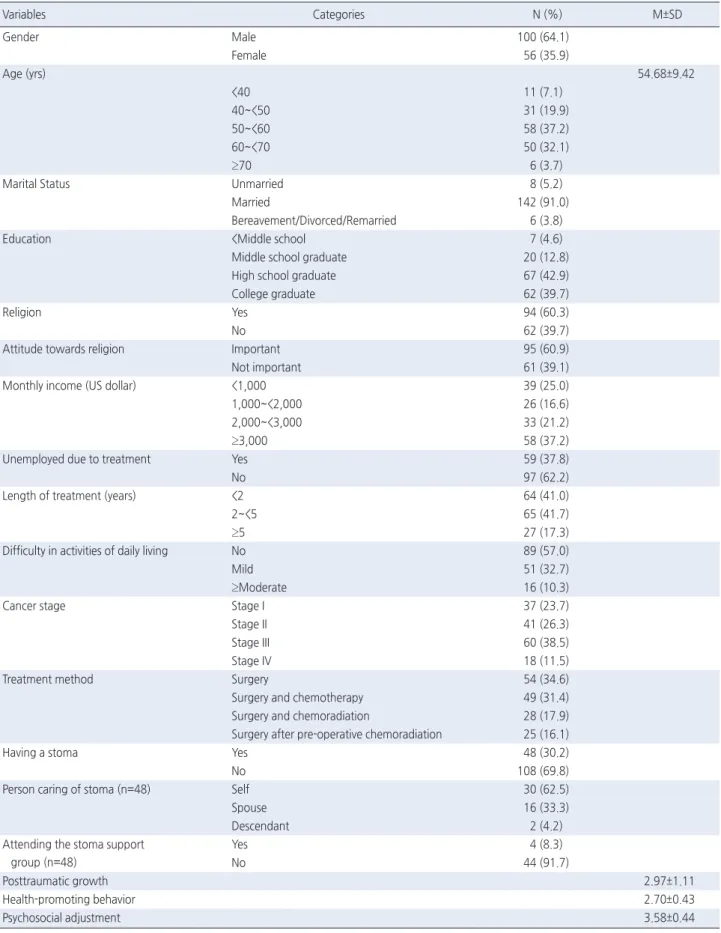
The average age of the colorectal cancer survivors was 54.68 years old, and 17.3% had survived for five years or more. Partic- ipants who had religion were 60.3%, and 60.9% responded that their religious life was important. Fifty-nine participants (37.8%) could not hold a job due to cancer treatment. For the level of ac- tivities of daily living, 10.3% reported moderate or severe diffi- culty in activities of daily living. Participants at cancer stage III or IV were 50.0%, and 30.2% had a stoma after surgery. Among those with a stoma, 62.5% were managing it themselves, and 91.7% were not attending the stoma support group. The average scores of posttraumatic growth, health-promoting behavior, and psychosocial adjustment were 2.97±1.11, 2.70±0.43, and 3.58±
0.44, respectively (Table 1).
2. Differences in the level of psychosocial adjust- ment by general characteristics
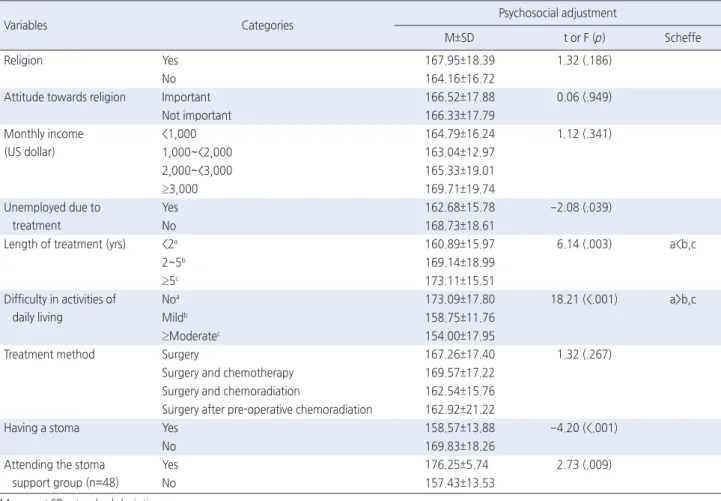
The level of the psychosocial adjustment was significantly lower in participants who could not hold a job due to cancer treatment (t=-2.08, p=.039). Individuals having difficulty in ac- tivities of daily living (F=18.21 p<.001), having a stoma (t=-4.20, p<.001), and not attending the stoma support group (t=2.73, p=.009) had lower levels of psychosocial adjustment, while it was higher in those under a longer period of treatment care after surgery (F=6.14, p=.003). Post-hoc analysis revealed that length of treatment less than two years and no difficulty in activities of daily living contributed to the significant differences in psychoso- cial adjustment among subgroups (Table 2).
Table 1. General Characteristics and Study Variables (N=156)
Variables Categories N (%) M±SD
Gender Male 100 (64.1)
Female 56 (35.9)
Age (yrs) 54.68±9.42
<40 11 (7.1)
40~<50 31 (19.9)
50~<60 58 (37.2)
60~<70 50 (32.1)
≥70 6 (3.7)
Marital Status Unmarried 8 (5.2)
Married 142 (91.0)
Bereavement/Divorced/Remarried 6 (3.8)
Education <Middle school 7 (4.6)
Middle school graduate 20 (12.8)
High school graduate 67 (42.9)
College graduate 62 (39.7)
Religion Yes 94 (60.3)
No 62 (39.7)
Attitude towards religion Important 95 (60.9)
Not important 61 (39.1)
Monthly income (US dollar) <1,000 39 (25.0)
1,000~<2,000 26 (16.6)
2,000~<3,000 33 (21.2)
≥3,000 58 (37.2)
Unemployed due to treatment Yes 59 (37.8)
No 97 (62.2)
Length of treatment (years) <2 64 (41.0)
2~<5 65 (41.7)
≥5 27 (17.3)
Difficulty in activities of daily living No 89 (57.0)
Mild 51 (32.7)
≥Moderate 16 (10.3)
Cancer stage Stage I 37 (23.7)
Stage II 41 (26.3)
Stage III 60 (38.5)
Stage IV 18 (11.5)
Treatment method Surgery 54 (34.6)
Surgery and chemotherapy 49 (31.4)
Surgery and chemoradiation 28 (17.9)
Surgery after pre-operative chemoradiation 25 (16.1)
Having a stoma Yes 48 (30.2)
No 108 (69.8)
Person caring of stoma (n=48) Self 30 (62.5)
Spouse 16 (33.3)
Descendant 2 (4.2)
Attending the stoma support group (n=48)
Yes 4 (8.3)
No 44 (91.7)
Posttraumatic growth 2.97±1.11
Health-promoting behavior 2.70±0.43
Psychosocial adjustment 3.58±0.44
3. Factors associated with psychosocial adjustment
The correlation coefficient r between independent variables ranged from -.35 to .46. Psychosocial adjustment had significant positive correlations with health-promoting behavior (r=.49, p<.001), posttraumatic growth (r=.39, p<.001), and length of treatment (r=.27, p=.001), and negative correlations with diffi- culty in activities of daily living (r=-.42, p<.001) and having a stoma (r=-.29, p<.001) (Table 3).
Before conducting a multiple linear regression analysis, the re- sult of the Durbin-Watson statistic was 1.88, indicating that there was no autocorrelation in the residuals. The tolerance limits were all above .10 and the variance inflation factors (VIFs) were all below 10 at 1.125~1.279. Thus, there was no multicollinearity is- sue between the independent variables.
The results of the multiple regression analysis showed that the regression model of psychosocial adjustment was significant (F=22.00, p<.001). The strongest factor associated with psycho- Table 2. Differences in the Level of Psychosocial Adjustment by General Characteristics (N=156)
Variables Categories Psychosocial adjustment
M±SD t or F (p) Scheffe
Religion Yes 167.95±18.39 1.32 (.186)
No 164.16±16.72
Attitude towards religion Important 166.52±17.88 0.06 (.949)
Not important 166.33±17.79
Monthly income (US dollar)
<1,000 164.79±16.24 1.12 (.341)
1,000~<2,000 163.04±12.97
2,000~<3,000 165.33±19.01
≥3,000 169.71±19.74
Unemployed due to treatment
Yes 162.68±15.78 -2.08 (.039)
No 168.73±18.61
Length of treatment (yrs) <2a 160.89±15.97 6.14 (.003) a<b,c
2~5b 169.14±18.99
≥5c 173.11±15.51
Difficulty in activities of daily living
Noa 173.09±17.80 18.21 (<.001) a>b,c
Mildb 158.75±11.76
≥Moderatec 154.00±17.95
Treatment method Surgery 167.26±17.40 1.32 (.267)
Surgery and chemotherapy 169.57±17.22
Surgery and chemoradiation 162.54±15.76
Surgery after pre-operative chemoradiation 162.92±21.22
Having a stoma Yes 158.57±13.88 -4.20 (<.001)
No 169.83±18.26
Attending the stoma support group (n=48)
Yes 176.25±5.74 2.73 (.009)
No 157.43±13.53
Table 3. Correlations between Study Variables (N=156)
Variables Length of
treatment r (p)
Difficulty in activities of daily living r (p)
Having a stoma r (p)
Posttraumatic growth r (p)
Health promoting behavior r (p) Difficulty in activities of daily living -.35 (<.001)
Having a stoma -.23 (.004) .29 (<001)
Posttraumatic growth .05 (.526) -.15 (.064) .04 (.611)
Health-promoting behavior .13 (.105) -.21 (.010) -.06 (.496) .46 (<.001)
Psychosocial adjustment .27 (.001) -.42 (<.001) -.29 (<.001) .39 (<.001) .49 (<.001) M=mean; SD=standard deviation.
social adjustment was health-promoting behavior (β=.33, p<.001), followed by difficulty in activities of daily living (β=-.24, p=.001), posttraumatic growth (β=.20, p=.004), and having a stoma (β=
-.19, p=.004). The adjusted R square exhibited an explanatory power of 40.4% regarding psychosocial adjustment in colorectal cancer survivors (Table 4).
DISCUSSION
The present study attempted to investigate the factors associ- ated with psychosocial adjustment in Korean colorectal cancer survivors among posttraumatic growth, health-promoting behav- ior, and general characteristics. The score of posttraumatic growth in this study was relatively low as 2.97 compared to 3.18 in individuals with gynecologic cancer [16] and 3.38 in those with general cancer [9]. This might result from the burden of caring for fecal incontinence or stoma following colorectal cancer sur- gery, along with a lack of support group activities in this study.
The level of health-promoting behavior in colorectal cancer survivors was relatively higher as 2.70 than the 2.61 of individu- als with breast cancer [17], 2.65 of those with uterine cancer [16], and 2.34 of healthy adults [18]. These results may indicate that colorectal cancer survivors actively engage in health-promoting behaviors to overcome their illness and to prevent aftereffects more than other cancer survivors or healthy persons.
The level of psychosocial adjustment in this study was rela- tively higher as 3.58 compared to 3.05 of those with permanent colostomy [19]. This may indicate that colorectal cancer survi- vors after surgery more proactively try to cope, compared to those living with stoma. Nurses need to actively provide effective
solutions for patients during the adjustment period after surgery, because patients receiving authoritative information from a medi- cal team rather than outside sources actively participated in the required management [20]. The level of psychosocial adjustment was lower in individuals within two years of treatments compared to those with a longer period of treatment. This result also indi- cates that patients in the early period of treatment may require more nursing interventions, whereas those in the long-term fol- low-up period need support for adjusting to society and regaining their careers.
Health-promoting behavior was the strongest factor facilitating psychosocial adjustment, followed by level of activities of daily living, posttraumatic growth, and not having a stoma. Nurses need to develop an intervention program that promotes health-promoting behaviors such as physical exercise and healthy lifestyles, because colorectal cancer survivors experience hard- ships during the treatment process. To reduce the health risks and challenges facing cancer survivors, interventions to encour- age physical exercise and screening for cancer recurrence and secondary disease should be implemented [21]. Adopting a health-promoting approach based on empowerment is important, not just for improving care, but also for increasing perceptions of control that may reduce negative cancer beliefs [22].
In this study, the difficulty in activities of daily living decreased the level of psychosocial adjustment. Although there is a lack of studies examining psychosocial adjustment based on the level of activities of daily living in Korean colorectal cancer survivors, higher levels of physical, mental, and social discomfort related to cancer may decrease quality of life and psychosocial adjustment.
A study of breast cancer survivors found that physical disability Table 4. Factors Associated with Psychosocial Adjustment in Colorectal Cancer Survivors (N=156)
Unstandardized coefficients
Standardized
coefficients t p
B SE β
Length of treatment 2.11 1.63 .09 1.29 .198
Difficulty in activities of daily living -6.32 1.82 -.24 -3.47 .001
Having a stoma -7.43 2.54 -.19 -2.92 .004
Posttraumatic growth 0.16 0.06 .20 2.91 .004
Health-promoting behavior 0.37 0.08 .33 4.67 <.001
F=22.00, p<.001, Adj R2=.404 SE=standard error.
was significantly associated with psychosocial well-being [23].
Posttraumatic growth was reported by colorectal cancer survi- vors and promoted their psychosocial adjustment in this study.
Previous studies of breast cancer survivors also highlighted the importance of psychological intervention focusing on depressive symptoms, distress, and spirituality, which are associated with posttraumatic growth [24,25]. A study of patients with colorectal cancer identified resilience, coping, and importance of religion as influencing factors on posttraumatic growth [26]. The current methodological study of posttraumatic growth inventory for gen- eral cancer patients found that the new possibilities for cancer treatments and an active life were the strongest factors account- ing for posttraumatic growth [27]. The development of medical technology will provide more opportunities. Hence, nursing inter- ventions should include strategies for posttraumatic growth, to facilitate psychosocial adjustment.
Having a stoma is an important task in adapting to a changed appearance and lifestyle. For some colorectal cancer patients, the change of location of the excretory orifice to the surface of the abdomen and the sight of this excretion and stoma may be the biggest shock to them. The psychological stress from changes in the passageway of bowel movements, uncontrollable smells, and the noise of passing gas is a serious challenge for cancer survi- vors. Previous studies found that colorectal cancer survivors with colostomy had a lower quality of life and experienced depression and anxiety due to a diminished body image [28,29]. Because survivors with stomas experience hardships in adjusting to phys- ical changes, psychosocial adjustment often takes a significant amount of time for them. Therefore, the comprehensive stoma programs are necessary for these survivors to obtain a positive body image and to restore themselves psychologically, as well as to reintegrate social relationships.
Nurses have responsibilities for encouraging colorectal cancer survivors to use positive life transformations to maintain an opti- mal level of health and to increase their level of psychosocial ad- justment. Thus, nurses should have a comprehensive under- standing of the possibilities for physical, psychological, and spiri- tual improvements, which one can accomplish through cancer management. In addition, nurses should develop intervention pro- grams to explore efficient strategies that can increase continuous and systematic psychosocial adjustment. The study findings sug-
gest that more research is needed to identify and facilitate post- traumatic growth for colorectal cancer survivors, to increase the level of psychosocial adjustment.
CONCLUSION
Among Korean colorectal cancer survivors after surgery, the level of psychosocial adjustment increased through health-pro- moting behavior and posttraumatic growth; and decreased due to difficulty in activities of daily living and having a stoma. The psychosocial adjustment program for colorectal cancer survivors after surgery should include various nursing strategies to promote health-promoting behaviors and level of activities of daily living.
As patients also experience posttraumatic growth, which was important for their survival and quality of life, nurses need to understand the nature of posttraumatic growth and develop in- tervention strategies for facilitating affirmative growth during colorectal cancer management. Medical technology also needs to develop new approaches related to stoma management, consider- ing malodor control and appearance improvement for psychoso- cial adjustment.
Several limitations existed in this study. The study used a cross-sectional design, and the causal relationship between inde- pendent and dependent variables should be carefully inferred.
However, the significant factors such as health-promoting be- havior, difficulty in activities of daily living, posttraumatic growth, and having a stoma are theoretically ahead of psychosocial ad- justment, and those factors may be useful for nursing interven- tions, to facilitate the psychosocial adjustment of colorectal cancer survivors. As we included participants with colorectal cancer without discriminating between colon cancer and rectal cancer, a further comparative study may be able to identify the character- istics of the relationships among variables between patients with colon cancer and those with rectal cancer.
CONFLICTS OF INTEREST
The authors declared no conflict of interest.
REFERENCES
1. Statistics Korea. The incidence of cancer by type [Internet].
Daejeon: Statistics Korea; c2017 [cited 2018 Jan 20]. Available from: http://www.index.go.kr/potal/main/EachDtlPageDetail.
do?idx_cd=2770.
2. National Cancer Information Center. The 5-year relative sur- vival rate of cancer by type [Internet]. Goyang: National Can- cer Information Center; c2016 [cited 2017 Jan 10]. Available from: https://www.cancer.go.kr/lay1/S1T648C650/contents.
do.
3. Gautam S, Poudel A. Effect of gender on psychosocial adjust- ment of colorectal cancer survivors with ostomy. Journal of Gastrointestinal Oncology. 2016;7(6):938-945.
https://doi.org/10.21037/jgo.2016.09.02
4. Weiss T. Correlates of posttraumatic growth in married breast cancer survivors. Journal of Social and Clinical Psychology.
2004;23(5):733-746.
https://doi.org/10.1521/jscp.23.5.733.50750
5. Cercek A, Holt PR. The care of the colorectal cancer survivor.
Current Opinion in Gastroenterology. 2017;33(1):26-33.
https://doi.org/10.1097/MOG.0000000000000321
6. Laskowska AE. Non-adaptive reaction to disease - coping, demographic variables and trauma symptoms in cancer pa- tients. Psychiatria Polska. 2015;49(4):811-819.
https://doi.org/10.12740/PP/27107
7. Tedeschi RG, Calhoun LG. Target article: “Posttraumatic growth: Conceptual foundations and empirical evidence”. Psy- chological Inquiry. 2004;15(1):1-18.
https://doi.org/10.1207/s15327965pli1501_01
8. Jim HSL, Jacobsen PB. Posttraumatic stress and posttraumatic growth in cancer survivorship: A review. The Cancer Journal.
2008;14(6):414-419.
https://doi.org/10.1097/PPO.0b013e31818d8963
9. Jang SH, Lee HR, Yeu HN, Choi SO. The effects of posttrau- matic growth and meaning in life on health promotion behavior in cancer patients. Asian Oncology Nursing. 2014;14(2):100- 108. https://doi.org/10.5388/aon.2014.14.2.100
10. Suh SR, Kim HJ. The resourcefulness and the health-promot- ing behaviors of cancer patients. Journal of Korean Academy of Adult Nursing. 2000;12(1):112-121.
11. Baek Y, Yi M. Factors influencing quality of life during chemo- therapy for colorectal cancer patients in South Korea. Journal of Korean Academy of Nursing. 2015;45(4):604-612.
https://doi.org/10.4040/jkan.2015.45.4.604
12. Yun YH, Sim JA, Jung JY, Noh DY, Lee ES, Kim YW, et al.
The association of self-leadership, health behaviors, and post- traumatic growth with health-related quality of life in patients with cancer. Psycho-oncology. 2014;23(12):1423-1430.
https://doi.org/10.1002/pon.3582
13. Walker SN, Sechrist KR, Pender NJ. The health-promoting lifestyle profile: Development and psychometric characteristics.
Nursing Research. 1987;36(2):76-81.
https://doi.org/10.1097/00006199-198703000-00002
14. Oh PJ. A structural model for health promotion and quality of life in people with cancer. The Journal of Academy of Nursing.
1996;26(3):632-652.
https://doi.org/10.4040/jnas.1996.26.3.632
15. Derogatis LR. The Psychosocial adjustment to illness scale (PAIS). Journal of Psychosomatic Research. 1986;30(1):77- 91. https://doi.org/10.1016/0022-3999(86)90069-3
16. Lee ES, Park JS. The comparison of health promotion be- havior, post traumatic growth and quality of life according to stages of survivorship in patients with female genital neoplasm.
Korean Journal of Adult Nursing. 2013;25(3):312-321.
https://doi.org/10.7475/kjan.2013.25.3.312
17. Jeong KS, Park GJ. Relationships among body image, self-es- teem and health promotion behavior in mastectomy patients.
Asian Oncology Nursing. 2007;7(1):36-46.
18. Bae H, Kim A, Nam S, Youn J, Youn H, Kim G, et al. The influence of expectations regarding aging on health-promoting behaviors. Journal of the Korean Data and Information Science Society. 2014;25(1):77-85.
https://doi.org/10.7465/jkdi.2014.25.1.77
19. Cha BK, Beak ES. Psychosocial adaptation and related factors in patients with a permanent colostomy. Journal of Korean Academy of Fundamental Nursing. 2009;16(4):506-514.
20. Lee MS, Kim JH, Park EY, Kim JN, Yoo ES. Focus group study on psychosocial distress of cancer patients. Korean Jour- nal of Adult Nursing. 2010;22(1):19-30.
21. Chun SY, Park H, Lee TH, Park EC. Do long term cancer sur- vivors have better health-promoting behavior than non-cancer populations?: Case-control study in Korea. Asian Pacific Jour- nal of Cancer Prevention. 2015;16(4):1415-1420.
22. Baker N, Armour K, Meystre C, Redwood S, Dawson A. PA14 the legacy of cancer: Why a health promoting approach is so important in palliative care. BMJ Supportive & Palliative Care.
2015;5(Suppl 1):A23-24.
https://doi.org/10.1136/bmjspcare-2015-000906.74
23. Phillips SM, McAuley E. Associations between self-reported post-diagnosis physical activity changes, body weight changes, and psychosocial well-being in breast cancer survivors. Sup- portive Care in Cancer. 2015;23(1):159-167.
https://doi.org/10.1007/s00520-014-2346-5
24. Gesselman AN, Bigatti SM, Garcia JR, Coe K, Cella D, Champion VL. Spirituality, emotional distress, and post-trau- matic growth in breast cancer survivors and their partners: An actor-partner interdependence modeling approach. Psycho-on- cology. 2017;26(10):1691-1699.
https://doi.org/10.1002/pon.4192
25. Romeo A, Ghiggia A, Tesio V, Di Tella M, Torta R, Castelli L.
Post-traumatic growth, distress and attachment style among women with breast cancer. Journal of Psychosocial Oncology.
2017;35(3):309-322.
https://doi.org/10.1080/07347332.2017.1289291
26. Lee HJ, Jun SS. Factors related to posttraumatic growth in pa- tients with colorectal cancer. Korean Journal of Adult Nursing.
2016;28(3):247-255.
https://doi.org/10.7475/kjan.2016.28.3.247
27. Jung YM, Park JH. Development and validation of the can-
cer-specific posttraumatic growth inventory. Journal of Korean Academy of Nursing. 2017;47(3):319-331.
https://doi.org/10.4040/jkan.2017.47.3.319
28. Cotrim H, Pereira G. Impact of colorectal cancer on patient and family: Implications for care. European Journal of Oncology Nursing. 2008;12(3):217-226.
https://doi.org/10.1016/j.ejon.2007.11.005
29. Karadağ A, Menteş BB, Ayaz S. Colostomy irrigation: Result of 25 cases with particular reference to quality of life. Journal of Clinical Nursing. 2005;14(4):479-485.
https://doi.org/10.1111/j.1365-2702.2004.01083.x