ISSN 2234-3806 • eISSN 2234-3814
http://dx.doi.org/10.3343/alm.2014.34.5.395
Large Deletion in KCNQ1 Identified in a Family with Jervell and Lange-Nielsen Syndrome
Ji Yeon Sung, M.D.1, Eun Jung Bae, M.D.2, Seungman Park, M.D.3, So Yeon Kim, M.D.4, Ye Jin Hyun, M.T.1, Sung Sup Park, M.D.1, and Moon-Woo Seong, M.D.1
Departments of Laboratory Medicine1 and Pediatrics2, Seoul National University Hospital; Green Cross Laboratories3; Department of Laboratory Medicine4, National Medical Center, Seoul, Korea
Long QT syndrome (LQTS) is a genetically heterogeneous disorder associated with se- quence variations in more than 10 genes; in some cases, it is caused by large deletions or duplications among the main, known LQTS-associated genes. Here, we describe a 14-month-old Korean boy with congenital hearing loss and prolonged QT interval whose condition was clinically diagnosed as Jervell and Lange-Nielsen syndrome (JLNS), a re- cessive form of LQTS. Genetic analyses using sequence analysis and multiplex ligation- dependent probe amplification (MLPA) assay revealed a large deletion spanning exons 7-10 as well as a frameshift mutation (c.1893dup; p.Arg632Glnfs*20). To our knowledge, this is the first report of a large deletion in KCNQ1 identified in JLNS patients. This case indicates that a method such as MLPA, which can identify large deletions or duplications needs to be considered in addition to sequence analysis to diagnose JLNS.
Key Words: Jervell and Lange-Nielsen syndrome, KCNQ1 mutation, Multiplex ligation-de- pendent probe amplification, Exon deletion
Received: November 20, 2013 Revision received: January 23, 2014 Accepted: June 24, 2014
Corresponding author: Moon-Woo Seong Department of Laboratory Medicine, Seoul National University Hospital,
101 Daehak-ro, Jongno-gu, Seoul 110-744, Korea Tel: +82-2-2072-4180 Fax: +82-2-747-0359 E-mail: [email protected]
© The Korean Society for Laboratory Medicine This is an Open Access article distributed under the terms of the Creative Commons Attribution Non-Commercial License (http://creativecom- mons.org/licenses/by-nc/3.0) which permits unrestricted non-commercial use, distribution, and reproduction in any medium, provided the original work is properly cited.
INTRODUCTION
Jervell and Lange-Nielsen syndrome (JLNS) is an autosomal re- cessive disorder associated with sensorineural hearing loss and long QTc, usually greater than 500 msec. Long QT syndrome (LQTS) manifests with episodes of syncope and is characterized by susceptibility to sudden death due to a specific type of poly- morphic ventricular tachycardia, torsade de pointes [1]. Patients with JLNS have a more severe cardiac phenotype than those with Romano-Ward syndrome (RWS), an autosomal dominant inherited form of LQTS [2]. The prevalence of LQTS is estimated to be about 1 in 2,500 live births [3, 4]. Although it varies de- pending on the population studied, JLNS has been reported to affect about 3-5 in 1 million individuals, which represents less than 1% of all LQTS patients [5-7].
Among more than 10 genes responsible for LQTS, only 2 genes, KCNQ1 (LQTS1) and KCNE1 (LQTS5), are known to be
associated with JLNS. About 90% cases of JLNS can be attrib- uted to mutations in KCNQ1 [8, 9]. KCNQ1 contains 19 exons and spans more than 400 kb on chromosome 11p15.5 [10]. In addition to sequence variants, both deletions and duplications of KCNQ1 exon(s) are known to cause LQTS [11, 12]. However, their frequency is unknown. Because these deletions and dupli- cations cannot be detected by sequence analysis, various other methods are used, e.g., quantitative PCR, long-range PCR, mul- tiplex ligation-dependent probe amplification (MLPA), and chro- mosomal microarray analysis.
Here, we report compound heterozygous mutations in KCNQ1 in a child with JLNS who inherited a large gene deletion from his father and a frameshift mutation from his mother.
CASE REPORT
A 14-month-old boy with hearing loss visited the otolaryngology
unit of the department of surgery; the electrocardiogram showed a prolonged QT interval with a QTc of 530 msec. He never ex- perienced syncopal episodes, but his brother had a history of syncope while running in play. Otherwise, no other specific fam- ily history of LQTS was found. A Holter study showed neither T wave interruption nor Torsade de points. Treatment was imme- diately started with atenolol (β-adrenergic blocker), and genetic studies were performed on the patient and his family members (father, mother, and brother). The patient’s father and mother showed normal echocardiograms with QTc values of 425 msec and 418 msec, respectively. However, the QT interval of the pa- tient’s brother was prolonged (QTc of 547 msec), but hearing loss was not observed.
After obtaining informed consent, we collected peripheral blood samples from the patient and his family. Whole blood was collected in standard EDTA tubes, and DNA was extracted by us- ing the GentraPureGene blood kit (Gentra Systems, Minneapolis, MN, USA) according to the manufacturer’s instructions. PCR was performed by using primers specific for 16 coding exons of KCNQ1. The amplified products were sequenced on an ABI 3730 analyzer (Applied Biosystems, Foster City, CA, USA) by us- ing BigDye Terminator v3.1 Cycle sequencing kits (Applied Bio- systems). Gross deletions and duplications in KCNQ1 were screened by the MLPA method, using the SALSA MLPA P114 Long-QT probe mix kit (MRC-Holland, Amsterdam, Netherlands).
The study was performed in accordance with the Declaration of Helsinki and approved by the institutional ethics review board of the Seoul National University Hospital.
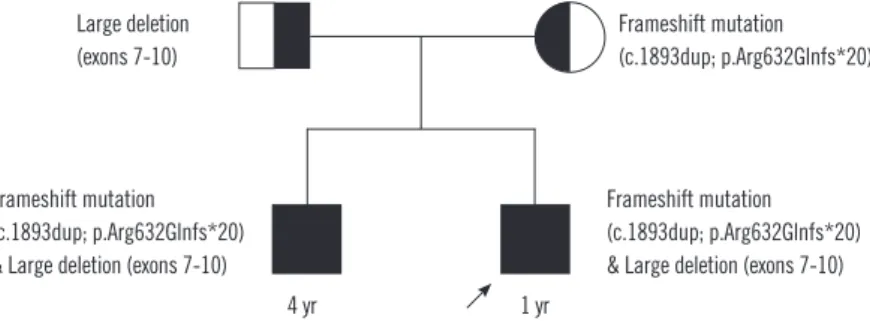
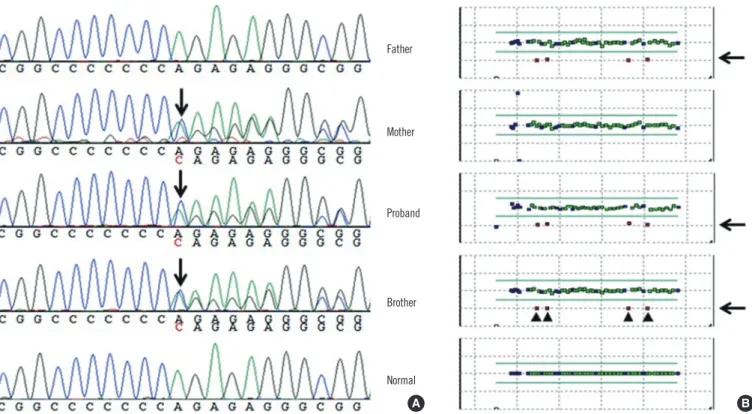
Genetic analysis revealed compound heterozygous mutations in KCNQ1 consisting of a large deletion (exons 7-10, c.922-?_
c.1393+?del, reference sequence: NM_000218.2) and a frame- shift mutation (c.1893dup; p.Arg632Glnfs*20) in the proband and his brother. The proband’s father was heterozygous for the large deletion (exons 7-10) but did not carry the frameshift mu-
tation, whereas the proband’s mother was heterozygous for the frameshift mutation (c.1893dup; p.Arg632Glnfs*20) but neither exon deletions nor duplications were detected (Fig. 1 and 2).
DISCUSSION
Most of the symptomatic JLNS patients carry mutations in KCNQ1 and most of the asymptomatic patients carry KCNE1 mutations [9]. Among the mutations associated with JLNS, only a few cases with compound heterozygous mutations have been reported, all consisting of sequence mutations [5, 10, 13, 14]. Any large dele- tion or duplication in LQTS has been reported in RWS patients with mutation-negative cohorts by sequence analysis [12, 15, 16]. In our laboratory, this is the third case with a large deletion in KCNQ1 among patients whose conditions were clinically diag- nosed as LQTS to date; however, the two previous cases were di- agnosed as RWS (See supplemental data Table S1).
In general, although they are heterozygous for the same gene, patients with LQTS1 are significantly more symptomatic, whereas the parents of the JLNS patients are asymptomatic or mildly symptomatic. The most obvious explanation would be that JLNS mutations result in a less severe phenotype and, therefore, have a less pronounced effect in heterozygous carriers [9]. Most LQTS1 genetic variants are missense mutations that can co-as- semble with normal subunits and interfere with channel func- tions, thereby exerting a negative effect [17, 18]. In contrast, frameshift/truncating mutations are responsible for the majority of JLNS cases [8]; these mutations cannot co-assemble with normal subunits and are unable to cause dominant-negative suppression under normal circumstances [2]. The frameshift mutation (c.1893dup; p.Arg632Glnfs*20) leads to a premature stop codon and is predicted to produce a truncated protein [10].
When this mutation was first identified as a novel mutation in a RWS family, the proband experienced several stress-induced
Large deletion (exons 7-10)
Frameshift mutation (c.1893dup; p.Arg632Glnfs*20)
Frameshift mutation (c.1893dup; p.Arg632Glnfs*20)
& Large deletion (exons 7-10)
Frameshift mutation (c.1893dup; p.Arg632Glnfs*20)
& Large deletion (exons 7-10)
4 yr 1 yr
Fig. 1. Family pedigree. The older brother with a history of syncope and long QTc carries the same mutations as the proband (marked with arrow), i.e., large exon deletion and frameshift sequence mutation. Each mutation was inherited from one of the parents; the exon deletion from the father and the frameshift mutation from the mother.
syncopes since the age of 3 yr, but her affected father was as- ymptomatic [10]. However, homozygous/compound heterozy- gous JLNS is the most severe form among the major variants of LQTS [9], and the efficacy of β-blockers is very limited [19].
Of the 249 KCNQ1-positive patients included in a study that was performed at the Mayo Clinic, 15 patients (6.0%) carried mutations on both KCNQ1 alleles; furthermore,11 of these dou- ble-KCNQ1-positive individuals (73%) presented without senso- rineural deafness/hearing loss typically associated with JLNS and, thus, are best defined as autosomal recessive form of LQT1 [20]. Moreover, this result implies that the incidence of the autosomal recessive form of LQT1 in the absence of an au- ditory phenotype may be higher than previously anticipated and that these cases should be treated as a higher-risk LQTS subset similar to their JLNS counterparts [20]. Therefore, appropriate molecular diagnostic methods are needed to differentiate the autosomal recessive form of LQT1 from autosomal dominant RWS. In addition, it is important to perform molecular screening to identify carriers and counsel on the possibility of transmitting the mutation to children who are at possible risk of being homo- zygous and, consequently, developing a severe phenotype that may be lethal [21]. Molecular testing of LQTS is based mostly
on sequence analysis and regardless of whether sequence mu- tations are detected or not, additional deletion and duplication analysis should be considered.
To our knowledge, this is the first report of a large deletion in KCNQ1 identified in JLNS patients. The present case suggests that a testing method such as MLPA, which can identify large deletions or duplications needs to be considered in addition to sequence analysis to diagnose JLNS.
Acknowledgment
This study was supported by the Basic Science Research Pro- gram through the National Research Foundation of Korea funded by the Ministry of Education, Science, and Technology (NRF-2013R1A1A2011551).
Authors’ Disclosures of Potential Conflicts of Interest
No potential conflict of interest relevant to this article was re- ported.
Fig. 2. (A) Sequencing analysis revealed a frameshift mutation (c.1893dup; p.Arg632Glnfs*20) in the proband, his mother, and his broth- er. (B) On the basis of the result of multiplex ligation-dependent probe amplification, 4 exons (exons 9, 10, 7, and 8 in this order) with half the copy number were identified, indicating a large deletion in the proband, his father, and his brother.
B A
Father
Mother
Proband
Brother
Normal
REFERENCES
1. Kannankeril P, Fish F. Disorders of cardiac rhythm and conduction. In:
Allen HD, Driscoll DJ, Shaddy RE, Feltes TF, eds. Moss and Adams’
heart disease in infants, children, and adolescents including the fetus and youngadult. 7th ed. Philadelphia: Lippincott Williams & Wilkins, 2008:293-341.
2. Baek JS, Bae EJ, Lee SY, Park SS, Kim SY, Jung KN, et al. Jervell and Lange-Nielsen syndrome: novel compound heterozygous mutations in the KCNQ1 in a Korean family. J Korean Med Sci 2010;25:1522-5.
3. Kanovsky J, Novotny T, Kadlecova J, Gaillyova R. A new homozygous mutation of the KCNQ1 gene associated with both Romano-Ward and incomplete Jervell Lange-Nielsen syndromes in two sisters. Heart Rhythm 2010;7:531-3.
4. Kaltenbach S, Capri Y, Rossignol S, Denjoy I, Soudée S, Aboura A, et al.
Beckwith-Wiedemann syndrome and long QT syndrome due to familial- balanced translocation t(11;17)(p15.5;q21.3) involving the KCNQ1 gene. Clin Genet 2013;84:78-81.
5. Tranebjaerg L, Bathen J, Tyson J, Bitner-Glindzicz M. Jervell and Lange- Nielsen syndrome: a Norwegian perspective. Am J Med Genet 1999;
89:137-46.
6. Goldenberg I, Moss AJ, Zareba W, McNitt S, Robinson JL, Qi M, et al.
Clinical course and risk stratification of patients affected with the Jervell and Lange-Nielsen syndrome. J Cardiovasc Electrophysiol 2006;17:
1161-8.
7. Winbo A, Stattin EL, Diamant UB, Persson J, Jensen SM, Rydberg A.
Prevalence, mutation spectrum, and cardiac phenotype of the Jervell and Lange-Nielsen syndrome in Sweden. Europace 2012;14:1799- 806.
8. Tyson J, Tranebjaerg L, McEntagart M, Larsen LA, Christiansen M, Whiteford ML, et al. Mutational spectrum in the cardioauditory syn- drome of Jervell and Lange-Nielsen. Hum Genet 2000;107:499-503.
9. Schwartz PJ, Spazzolini C, Crotti L, Bathen J, Amlie JP, Timothy K, et al.
The Jervell and Lange-Nielsen syndrome: natural history, molecular ba- sis, and clinical outcome. Circulation 2006;113:783-90.
10. Neyroud N, Richard P, Vignier N, Donger C, Denjoy I, Demay L, et al.
Genomic organization of the KCNQ1 K+ channel gene and identifica- tion of C-terminal mutations in the long-QT syndrome. Circ Res 1999;
84:290-7.
11. Zehelein J, Kathoefer S, Khalil M, Alter M, Thomas D, Brockmeier K, et al. Skipping of Exon 1 in the KCNQ1 gene causes Jervell and Lange- Nielsen syndrome. J Biol Chem 2006;281:35397-403.
12. Eddy CA, MacCormick JM, Chung SK, Crawford JR, Love DR, Rees MI, et al. Identification of large gene deletions and duplications in KCNQ1 and KCNH2 in patients with long QT syndrome. Heart Rhythm 2008;5:
1275-81.
13. Wang Z, Li H, Moss AJ, Robinson J, Zareba W, Knilans T, et al. Com- pound heterozygous mutations in KvLQT1 cause Jervell and Lange- Nielsen syndrome. Mol Genet Metab 2002;75:308-16.
14. Ning L, Moss AJ, Zareba W, Robinson J, Rosero S, Ryan D, et al. Novel compound heterozygous mutations in the KCNQ1 gene associated with autosomal recessive long QT syndrome (Jervell and Lange-Nielsen syn- drome). Ann Noninvasive Electrocardiol 2003;8:246-50.
15. Tester DJ, Benton AJ, Train L, Deal B, Baudhuin LM, Ackerman MJ.
Prevalence and spectrum of large deletions or duplications in the major long QT syndrome-susceptibility genes and implications for long QT syndrome genetic testing. Am J Cardiol 2010;106:1124-8.
16. Barc J, Briec F, Schmitt S, Kyndt F, Le Cunff M, Baron E, et al. Screen- ing for copy number variation in genes associated with the long QT syn- drome: clinical relevance. J Am Coll Cardiol 2011;57:40-7.
17. Splawski I, Shen J, Timothy KW, Lehmann MH, Priori S, Robinson JL, et al. Spectrum of mutations in long-QT syndrome genes. KVLQT1, HERG, SCN5A, KCNE1, and KCNE2. Circulation 2000;102:1178-85.
18. Tester DJ, Will ML, Haglund CM, Ackerman MJ. Compendium of cardi- ac channel mutations in 541 consecutive unrelated patients referred for long QT syndrome genetic testing. Heart Rhythm 2005;2:507-17.
19. Richter S and Brugada P. Risk-stratifying Jervell and Lange-Nielsen syndrome from clinical data. J Cardiovasc Electrophysiol 2006;17:
1169-71.
20. Giudicessi JR and Ackerman MJ. Prevalence and potential genetic de- terminants of sensorineural deafness in KCNQ1 homozygosity and compound heterozygosity. Circ Cardiovasc Genet 2013;6:193-200.
21. Shinwari Z, Al-Hazzani A, Dzimiri N, Tulbah S, Mallawi Y, Al-Fayyadh M, et al. Identification of a novel KCNQ1 mutation in a large Saudi family with long QT syndrome: clinical consequences and preventive implica- tions. Clin Genet 2013;83:370-4.
Table S1. LQTS patients with large exon(s) deletion discovered in our laboratory
Age Gender Diagnosis Symptom Family Hx QTc (ms) Schwartz score Sequence mutation Deletion
10 yr M Romano-Ward syndrome - - 460 2 - Exon 11
19 yr M Romano-Ward syndrome syncope + 516 5 - Exon 8
14 mo M Jervell and Lange-Nielsen syndrome Hearing loss + 546 3.5 + Exon 7-10