Original Articles Korean Circulation J 2000;;;;30((((9))))::::1107-1116
한국인에서 관상동맥 질환에 대한 만성 감염 및 염증의 역할
전남대학교병원 심장센터,
1전남대학교 의과학연구소
2김계훈
1
·정명호2
·신종희2
·주신배1
·김 원1
·이승욱1
·김건형1
·김남호1
조장현1
·박종철1
·안영근1
·나국주1
·조정관2
·안병희2
·박종춘2
·강정채1
The Role of Chronic Infection and Inflammation in Korean Patients with Coronary Artery Disease
Kye Hun Kim, MD
1, Myung Ho Jeong, MD
2, Jong Hee Shin, MD
2, Shin Bae Joo, MD
1, Weon Kim, MD
1, Seung Uk Lee, MD
1, Kun Hyung Kim, MD
1, Nam Ho Kim, MD
1, Jang Hyun Cho, MD
1, Jong Choel Park, MD
1, Kook Joo Na, MD
1, Young Keun Ahn, MD
1, Jeong Gwan Cho, MD
1, Byoung Hee Ahn, MD
2,
Jong Chun Park, MD
2and Jung Chaee Kang, MD
21
Department of Internal Medicine, The Heart Center, Chonnam National University Hospital, Seoul,
2The Research Institute of Medical Sciences, Kwangju, Korea
ABSTRACT
Background: : : :Chronic infections, including Chlamydia pneumoniae, cytomegalovirus and Helicobacter pylori may be one of the risk factors for coronary artery disease (CAD). To document whether chronic infection may be associated with coronary artery disease, various inflammatory markers were analyzed in Korean patients with CAD. Methods: : : :The patients who underwent diagnostic coronary angiography (CAG) were divided into two groups according to the results of CAG;the patients with significant coronary lesions (Group Ⅰ;n=126, M:F=99:27, 58.7±9.7 years) or the patients without coronary lesions (Group Ⅱ;
n=58, M:F=30:28, 55.5±8.9 years). Serologic assays for the immunoglobulin G (IgG) titers to C.
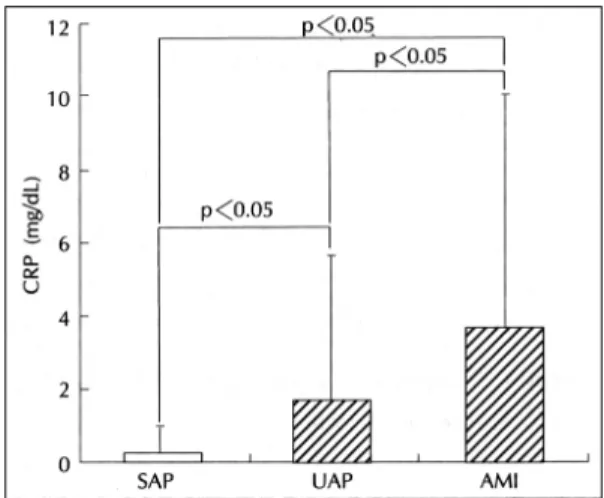
pneumoniae, CMV, H. pylori, and for inflammatory markers, including erythrocyte sedimentation rate (ESR) and C-reactive protein (CRP) were performed. Results: : : :There were no significant differences in the sero- positivity of three infections between two groups, but titer of IgG antibody against H. pylori was significantly higher in Group Ⅰ than that in Group Ⅱ (859.3±342.2 vs. 474.2±113.2 U/mL, p=0.02). After adjust- ment for age, sex and other cardiovascular risk factors, high titer of IgG antibody aganist H. pylori was independently associated with coronary artery disease (p=0.05). CRP and ESR were significantly elevated in group Ⅰ (2.7±5.1 vs. 0.6±0.9 mg/dL, p=0.003, 23.2±26.7 vs. 12.7±15 mm/hr, p=0.006). Angiographic parameters were not related with the titer of infectious agents or inflammatory markers. The value of CRP was significantly different according to clinical severity (3.8±6.0 in acute myocardial infarction, 1.5±3.6 in unstable angina pectoris, and 0.4±0.3 mg/dL in stable angina pectoris, p<0.01). The value of ESR was also significantly different according to clinical severity (29.0±30.2 in acute myocardial infarction, 17.1±19.0 in unstable angina pectoris, and 12.1±17.6 mm/hr in stable angina pectoris, p<0.01). Conclusions: : : :Our results
논문접수일:2000년 1월 10일 심사완료일:2000년 9월 25일
교신저자:정명호, 501-757, 광주광역시 동구 학 1동 8 전남대학교병원 심장센타 전화:(062) 220-6243・전송:(062) 228-7174 E-mail:[email protected]