Veterinary Science
J. Vet. Sci. (2013), 14(3), 299-305 http://dx.doi.org/10.4142/jvs.2013.14.3.299
Received: 20 Jul. 2012, Revised: 5 Oct. 2012, Accepted: 10 Nov. 2012
Original Article
*Corresponding authors: Tel: +82-2-880-1257; Fax: +82-2-871-7524; E-mail: [email protected], [email protected]
†The first two authors contributed equally to this work.
ⓒ 2013 The Korean Society of Veterinary Science.
This is an Open Access article distributed under the terms of the Creative Commons Attribution Non-Commercial License (http://creativecommons.org/licenses/by-nc/3.0) which permits unrestricted non-commercial use, distribution, and reproduction in any medium, provided the original work is properly cited.
Dissimilarity of ccrAB gene sequences between methicillin-resistant Staphylococcus epidermidis and methicillin-resistant Staphylococcus aureus among bovine isolates in Korea
Young Kyung Park
1,†, Young Hwan Paik
1,†, Jang Won Yoon
1, Lawrence K. Fox
2, Sun Young Hwang
1,*, Yong Ho Park
1,3,*
1
Department of Microbiology, College of Veterinary Medicine and BK21 Program for Veterinary Science, Seoul National University, Seoul 151-742, Korea
2
Departments of Veterinary Clinical Science and Animal Sciences, Washington State University, Pullman, WA 99164, USA
3
Animal and Plant Quarantine Agency, Anyang 430-757, Korea
The sequences of the ccrAB genes from bovine-, canine- and chicken-originating methicillin-resistant Staphylococcus (S.)
epidermidis (MRSE) and bovine methicillin-resistant Staphylococcus (S.) aureus (MRSA) were compared toinvestigate the frequency of intra-species horizontal transfer of the staphylococcal cassette chromosome mec (SCCmec) complex. Nineteen MRSE strains were isolated from bovine milk, chickens, and dogs, and their genetic characteristics were investigated by multilocus sequence typing and SCCmec typing.
Among the animal MRSE strains, the most frequent SCCmec type was type IV, which consisted of the type B mec complex and
ccrAB type 2. The ccrA2 and ccrB2 genes were sequenced fromthe bovine, chicken and canine MRSE strains and compared with those of the bovine MRSA strains. The sequences generally clustered as MRSA and MRSE groups, regardless of the animal source. Additionally, no bovine MRSE sequence was associated with the bovine MRSA groups. Although most of the bovine MRSE and MRSA isolates possessed SCCmec type IV sequences, our results suggest that the intra-species gene transfer of the SCCmec complex between bovine S. aureus and bovine S. epidermidis strains is not a frequent event.
Keywords: ccrAB, methicillin-resistant Staphylococcus aureus, methicillin-resistant Staphylococcus epidermidis, SCCmec
Introduction
Methicillin-resistant staphylococci, including Staphylococcus
(S.) epidermidis (MRSE), have emerged as important pathogens that can cause serious infections in humans and animals [5,30]. Most MRSE strains have also been shown to be resistant to other antimicrobial agents [20], causing concern from a clinical veterinary perspective by threatening to narrow the spectrum of antimicrobial therapeutic choices.
Moreover, from a zoonotic point of view, animal reservoirs of MRSE can be considered a great threat to human healthcare. Therefore, effective detection and control of MRSE associated with mastitis in dairy cows is essential.
The methicillin resistance of staphylococci is mediated by the mecA gene, which is carried by a mobile genetic element known as the staphylococcal cassette chromosome mec (SCCmec) [15]. SCCmec is composed of the mec complex containing the mecA gene and its regulator genes, as well as the cassette chromosome recombinase (ccr) complex, which encodes site-specific recombinase genes such as ccrA and ccrB [14,17]. These recombinase genes are responsible for the mobility of SCCmec, as they mediate its site-specific insertion and excision [14,17].
Several studies have shown that methicillin-susceptible
Staphylococcus (S.) aureus can be converted to the
pathogen, methicillin-resistant S. aureus (MRSA), through
the transfer of SCCmec from another methicillin-resistant
Staphylococcus species such as MRSE [2,11,12,33]. To
reduce the spread of methicillin-resistant staphylococcal
infections among dairy herds, the distribution of MRSE
and transfer of SCCmec should be monitored. However,
only a few veterinary investigations of MRSE infections
have been published to date [4,25,27]. Here, we identified the prevalence of MRSE among various animal sources, including bovine milk, and compared their ccrAB gene sequences to those of bovine MRSA strains to assess the frequency of intra-species horizontal gene transfer of the SCCmec complex.
Materials and Methods Bacterial strains
All utilized S. epidermidis strains were isolated from April 2006 to February 2007. Bovine strains were isolated from quarter milk samples with over 500,000 somatic cells/mL collected from 61 dairy farms in South Korea.
Milk somatic cell counts were analyzed with a Somacount 150 (Bentley Instruments, USA) within 24 h of sampling.
Chicken strains were isolated from fecal swabs collected from three broiler farms in Gyeonggi and Chungnam.
Canine strains were isolated from patients in two veterinary medical teaching hospitals (Chungbuk, Seoul) and one private referral animal clinic (Gyeonggi).
S. epidermidis isolates were identified using the schemes developed by Koneman et al. [19] and confirmed using a Vitek II (BioMérieux, France) and PCR with species- specific Serp0107 primers. These primers targeted the gene for a putative transcriptional regulator that is uniquely present in S. epidermidis [24]. Among 857 milk samples showing over 500,000 somatic cell/mL, 21 S. epidermidis strains were isolated. Additionally, 190 fecal swab samples were collected from chickens, from which ten S.
epidermidis strains were isolated. Moreover, 175 swab samples from horizontal ear canals (n = 49), nasal mucosa (n
= 45), anuses (n = 33), skin (n = 28), urine (n = 12), wound regions (n = 6), and eyes (n = 2) were collected from 35 canine outpatients, and 11 S. epidermidis strains were isolated.
For ccrAB comparison, 25 bovine MRSA strains were used in this study. These strains were previously isolated from bovine milk by the above-described method, and had been characterized as SCCmec type IV in our laboratory from 1999 to 2006 [22,23,28].
Antimicrobial susceptibility tests
The minimum inhibitory concentration (MIC) to oxacillin (Sigma-Aldrich, USA) was detected using a microdilution test according to the guidelines of the Clinical and Laboratory Standards Institute (CLSI) [8].
Isolates with a MIC ≥ 0.5 μg/mL were classified as oxacillin-resistant strains. A disc diffusion test was also performed according to the guidelines of the CLSI and used to test the susceptibility of these oxacillin-resistant isolates to ten other antimicrobials [8]: amikacin, amoxicillin, ampicillin, cephalothin, erythromycin, gentamicin, kanamycin, penicillin, tetracycline, and
vancomycin (BD BBL, USA). For quality control, S.
aureus ATCC 25923, Escherichia coli ATCC 25922 and Enterococcus faecalis ATCC 29212 were used as reference strains.
DNA preparation and polymerase chain reaction (PCR)
S. epidermidis isolates were grown overnight on 5% sheep blood agar plates (Promed, Korea) at 37
oC. Chromosomal DNA was extracted using the DNeasy tissue kit (Qiagen, Germany) according to the manufacturer’s instructions with one modification: the cell-lysis step was performed with 50 U/mL lysostaphin (Sigma-Aldrich).
MRSEs from the oxacillin-resistant S. epidermidis strainswere confirmed by detection of the mecA gene, and PCR-based SCCmec typing was carried out with multiplex PCR designed by Kondo et al. [18]. Briefly, two multiplex PCR strategies were used. The mec class (A, B, or C) was identified by the M-PCR1reaction, and the type of ccr complex (ccrAB1, ccrAB2, ccrAB3, ccrAB4, or ccrC) was determined by the M-PCR2 reaction. DNA amplification was carried out in a Mastercycler gradient (Eppendorf, Germany) using Ex Taq DNA polymerase (Takara Bio, Japan).
Sequencing and analysis
The ccrA2 and ccrB2 genes of SCCmec type IV MRSE and MRSA strains were amplified with the specific primer sets described by Hanssen et al. [11], and the PCR products were sequenced by Bionics (Korea). Sequence data were compared by the ClustalV method using the DNAstar software (USA). A phylogenetic tree of the ccr genes was constructed by the neighbor-joining method using the Mega 3.1 software [21]. The topologies of the phylogenetic trees were evaluated by bootstrap analyses with 1,000 replicates, which yielded confidence intervals for each node on the phylogenetic trees. The following reference sequences were used in the phylogenetic analyses: ccrA2 and ccrB2 from S. aureus N315 (GenBank accession no. D86934), and ccrA3 and ccrB3 from S.
aureus 85/2082 (GenBank accession no.AB037671) [6].
Multilocus sequence typing (MLST) analysis
MLST analysis of the MRSE isolates was performed as
described by Thomas et al. [32]. Alleles at seven loci
(arcC, aroE, gtr, mutS, pyrR, tpi, and yqiL) were assigned
by comparing the sequences with those of the known
alleles in the S. epidermidis MLST database [16]. The
allele numbers at each of the seven loci were used to define
the allelic profile of each isolate, and each allelic profile
was taken as a different sequence type (ST). To group the
STs and identify the patterns of evolutionary descent, data
from the isolates were analyzed using the eBURST
program available on the MLST website [16]. Grouping
was carried out using the most stringent definition, which defined a group as having members that all shared identical alleles at more than six loci with at least one other member of the group.
Results
Identification of MRSE from animal sources
A total of 42 S. epidermidis strains were isolated and the isolation rates of S. epidermidis were 2.5%, 5.3% and 6.2%
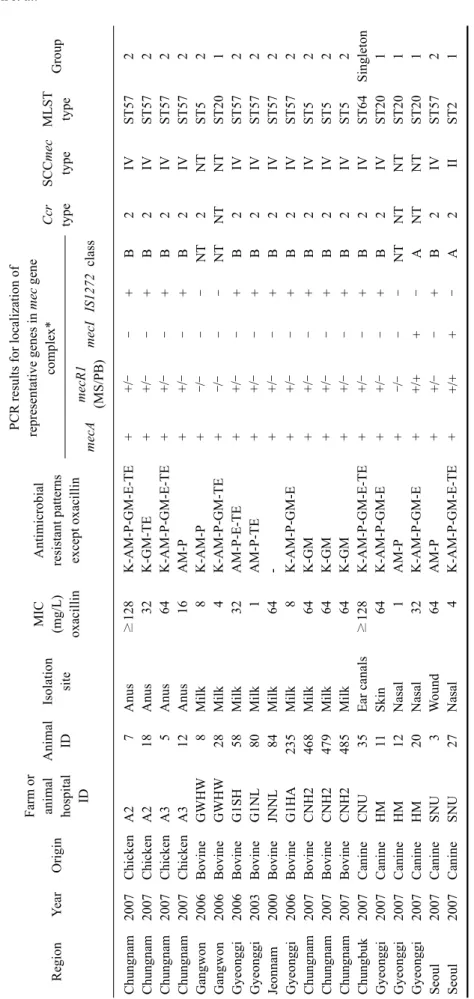
among samples collected from bovine milk, chicken and dogs, respectively. Among the 42 S. epidermidis, 19 strains (45.2%) were identified as MRSE based on their resistance to oxacillin and their possession of the mecA gene (Table 1). According to the origin, the MRSE detection rates were 42.9% (9 out of 21 bovine strains), 40% (4 out of 10 chicken strains) and 54.5% (6 out of 11 canine strains), respectively.
Antimicrobial resistance of MRSE
The oxacillin MICs for the 19 MRSE isolates were1 μg/mL or more. The animal MRSE isolates were highly resistant to ampicillin (73.7%) and penicillin (73.7%).
Resistance to kanamycin (68.4%), erythromycin (42.1%), gentamicin (63.2%), and tetracycline (42.1%) was also observed (Table 1). All MRSE isolates were susceptible to amikacin, amoxicillin, cephalothin, and vancomycin. Nine of the MRSE isolates (47.4%) showed multidrug resistance patterns (2 bovine strains, 22.2%; 3 chicken strains, 75.0%;
4 canine strains, 66.7%) of resistance to three or more antimicrobials other than β-lactams (Table 1).
Identification of ccrAB genes and mec gene complexes The SCCmec types of the MRSE strains were defined by determining the ccrAB types and mec gene complex classes. Sequence analysis confirmed that 16MRSE isolates were ccrAB type 2, and the majority (14/19, 73.7%) of these harbored class B mec gene complexes (Table 1). One canine MRSE strain possessed SCCmec type II, and four MRSE strains (10.5%, 2 bovine and 2 canine strains) could not be typed.
MLST analysis
The MRSE strains isolated from different animal origins (bovine milk, chickens, and dogs) showed different MLST patterns, although some belonged to the common MLST type, ST57. While all four of the MRSE isolates from chickens were type ST57, three MLST types (ST5, 20, and 57) and four MLST types (ST2, 20, 57, and 64) were identified in MRSE isolates from bovine milk and dogs, respectively.
Four of the five MLST types identified in the animal MRSE isolates could be divided into two groups using the eBURST: group 1 included ST2 and ST20; group 2
contained ST5 and ST57; and ST64 existed as a singleton.
Most of the MRSE strains isolated from bovine milk and chickens belonged to group 2, while those isolated from dogs were part of group 1.
ccrA2 and ccrB2 sequence alignment
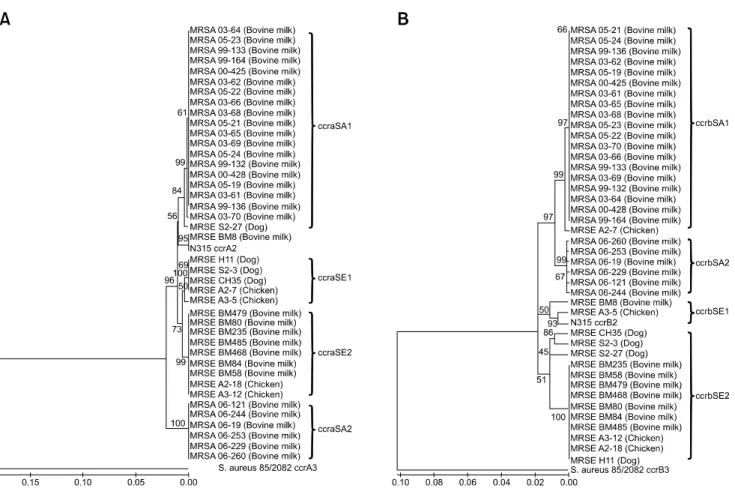
As the most prevalent type of SCCmec was type IV, the ccrAB sequences of those strains were selected for comparison to the bovine MRSA sequences. The ccrA2 and ccrB2 sequences of 16 SCCmec type IV-MRSE and 25 SCCmec type IV-bovine MRSA strains were aligned and phylogenetic trees were constructed (Fig. 1). The sequence homology of ccrA2 and ccrB2 genes between the MRSE and MRSA was found to be 95∼100% and 95.4∼100%, respectively.
The tree for ccrA2 showed that MRSA and MRSE belong to separate groups, except for MRSE S2∼27 (belongs to ccraSA1) and MRSE BM8 (does not belong to any group) (Fig. 1A). Similarly, the tree for ccrB2 showed that MRSA and MRSE belong to separate groups except for MRSE A2
∼7 (belongs to ccrbSA1) and N315 (belongs to ccrbSE1) (Fig. 1B).
Discussion
Although the prevalence of S. epidermidis was not high (2.5%) in bovine milk samples, we found high methicillin- resistance rates (40%, 42.9% and 54.5%) among the isolates, regardless of origin. Moreover, almost half of the MRSE isolates (47.4%) showed multidrug resistance patterns. The high detection rates of MR-CNS were also reported in previous studies. In Norway, 70 ~ 80% of CNS isolated from hospitals was methicillin-resistant, while the rate of MRSA was low [11]. Among animals, a 65.2%
mecA detection rate was observed in isolates from sheep, goats, pigs, and chicken samples [35]. In Japan, MR-CNS was isolated from healthy horses with a 27% detection rate [34]. The high prevalence of mecA among CNS strains suggests that they may serve as a reservoir for antibiotic-resistant genes that can be transferred to other Gram-positive organisms, including S. aureus [26]. In addition, the multidrug resistant MRSEs pose a public health threat because they make treatment of infections difficult [36].
The most frequent SCCmec type detected in MRSE
isolates was type IV, which is characterized by ccrAB type
2 and the class B mec gene complex. SCCmec type IV is
often found in community-acquired MRSA among
humans [3,10], as well as in animal MRSA [23]. SCCmec
type IV is much smaller than that of other SCCmec
elements, perhaps increasing its mobility and propensity
for horizontal transfer to the diverse genetic backgrounds
of Staphylococcus strains [1]. SCCmec type IV has been
associated with a comparatively large number of STs,
Table 1. Genetic and phenotypic characteristics of MRSE isolates from animal sources RegionYearOrigin
Farm or animal hospital ID
Animal IDIsolation site
MIC (mg/L) oxacillin
Antimicrobial resistant patterns except oxacillin
PCR results for localization of representative genes in mec gene complex*Ccr typeSCCmec typeMLST typeGroup mecAmecR1 (MS/PB)mecIIS1272class Chungnam Chungnam Chungnam Chungnam Gangwon Gangwon Gyeonggi Gyeonggi Jeonnam Gyeonggi Chungnam Chungnam Chungnam Chungbuk Gyeonggi Gyeonggi Gyeonggi Seoul Seoul
2007 2007 2007 2007 2006 2006 2006 2003 2000 2006 2007 2007 2007 2007 2007 2007 2007 2007 2007
Chicken Chicken Chicken Chicken Bovine Bovine Bovine Bovine Bovine Bovine Bovine Bovine Bovine Canine Canine Canine Canine Canine Canine
A2 A2 A3 A3 GWHW GWHW G1SH G1NL JNNL G1HA CNH2 CNH2 CNH2 CNU HM HM HM SNU SNU
7 18 5 12 8 28 58 80 84 235 468 479 485 35 11 12 20 3 27
Anus Anus Anus Anus Milk Milk Milk Milk Milk Milk Milk Milk Milk Ear canals Skin Nasal Nasal Wound Nasal
≥128 32 64 16 8 4 32 1 64 8 64 64 64 ≥128 64 1 32 64 4
K-AM-P-GM-E-TE K-GM-TE K-AM-P-GM-E-TE AM-P K-AM-P K-AM-P-GM-TE AM-P-E-TE AM-P-TE - K-AM-P-GM-E K-GM K-GM K-GM K-AM-P-GM-E-TE K-AM-P-GM-E AM-P K-AM-P-GM-E AM-P K-AM-P-GM-E-TE
+ + + + + + + + + + + + + + + + + + +
+/– +/– +/– +/– –/– –/– +/– +/– +/– +/– +/– +/– +/– +/– +/– –/– +/+ +/– +/+
– – – – – – – – – – – – – – – – + – +
+ + + + – – + + + + + + + + + – – + –
B B B B NT NT B B B B B B B B B NT A B A
2 2 2 2 2 NT 2 2 2 2 2 2 2 2 2 NT NT 2 2
IV IV IV IV NT NT IV IV IV IV IV IV IV IV IV NT NT IV II
ST57 ST57 ST57 ST57 ST5 ST20 ST57 ST57 ST57 ST57 ST5 ST5 ST5 ST64 ST20 ST20 ST20 ST57 ST2
2 2 2 2 2 1 2 2 2 2 2 2 2 Singleton 1 1 1 2 1 *Localization of the essential genes in the mec gene complex was estimated by PCR and sequencing. The mecA gene and its regulator genes, mecR1 [both the membrane spanning region (MS) and the penicillin-binding region (PB)] and mecI were identified. K: kanamycin, AM: ampicillin, P: penicillin, GM: gentamicin, E: erythromycin, TE: tetracycline, NT: not typable.