• 검색 결과가 없습니다.

Adenophorae Radix Attenuates Mast Cell-mediated Allergic Inflammation through Down-regulation of NF-κB/ Caspase-1 Activation

N/A
N/A
Protected

Academic year: 2021

Share "Adenophorae Radix Attenuates Mast Cell-mediated Allergic Inflammation through Down-regulation of NF-κB/ Caspase-1 Activation"

Copied!
7
0
0

로드 중.... (전체 텍스트 보기)

전체 글

(1)

Introduction

Allergic inflammatory diseases including asthma, atopic dermatitis and allergic rhinitis, have become global health problems (Hawiger, 2001). Allergic inflammation plays an important role in allergic diseases. Mast cells are crucial effector cells and are associated with allergic disorders (Modena et al., 2016). Specifically, activated mast cells release preformed and synthesized inflammatory cytokines including interleukin (IL)-6, IL-8 and tumor necrosis factor (TNF)-a which contribute to the development of allergic inflammation (Furue and Kadono, 2017). It has been shown that mast cells are present in larger numbers in AD lesional skin and mast cell depletion could interfere with allergic rhinitis (Lim et al., 2018). Thus, these findings suggest that the prevention of mast cell activation and cytokine production could be a potent treatment strategy for allergic inflammation- related diseases.

Nuclear factor-kappa B (NF-kB) is a transcription factor that regulates numerous genes involved in immune and

allergic inflammation (Lee et al., 2020). An increase in NF- kB activity associated with the secretion of high levels of inflammatory cytokines was shown to be involved in allergic inflammatory responses (Gilmore and Garbati, 2011). Emerging evidence has shown that NF-kB represents a potential target for treating allergic diseases. It was reported that the inhibition of NF-kB activation diminished the influx of inflammatory cells and reduced allergic inflammation (Birrell et al., 2005). Caspase-1 is a member of the family of caspases and is associated with apoptosis and inflammation.

The activation of caspase-1 induced an allergic inflammatory response by increasing inflammatory cytokines and the recruitment of inflammatory cells (Kim et al., 2016). Caspase-1 deficiency was reported to reduce inflammation in an allergic rhinitis mice model (Martin et al., 2013). These results suggest caspase-1 activation as an attractive target for the treatment of inflammatory diseases.

Traditional medicines are commonly used as a comple- mentary and alternative therapy for various allergic diseases (Song et al., 2016). Although herbal medicines have long been effectively employed, their precise mechanism is not completely understood. Adenophorae Radix (AR) has been

Adenophorae Radix Attenuates Mast Cell-mediated Allergic Inflammation through Down-regulation of NF-κB/ Caspase-1 Activation

Noh-Yil Myung*

Professor, Department of Oriental Medicine and Healthcare, Wonkwang Digital University, Iksan 54538, Korea

Abstract - Adenophorae Radix (AR) has been used as a traditional medicine for various diseases. However, the regulatory mechanisms of AR in allergic inflammation are not yet understood. The present study was conducted to investigate the effect and mechanisms of AR on the mast cell-mediated allergic response. To determine the pharmacological mechanisms of AR in allergic inflammation, we evaluated the effects of AR on the production of tumor necrosis factor (TNF)-α, interleukin (IL)-6, IL-1β and IL-8 as well as the activation of nuclear factor-κB (NF-κB) and caspase-1 in phorbol 12-myristate 13-acetate plus calcium ionophore A23187 (PMACI)-stimulated human mast cells (HMC-1). Our results demonstrated that AR effectively attenuated the PMACI-induced production of TNF-α, IL-6, IL-1β and IL-8 in stimulated HMC-1. Additionally, we showed that the inhibitory effect of AR on inflammatory cytokines in PMACI-stimulated HMC-1 cells involved the suppression of the activation NF-kB/caspase-1 in PMACI-stimulated HMC-1. Collectively, these findings provide experimental evidence that AR may be a useful candidate for the treatment of allergic inflammation.

Key words – Adenophorae Radix, Allergic inflammation, Caspase-1, Inflammatory cytokines, Mast cells, Nuclear factor-κB

*Corresponding author. E-mail : [email protected] Tel. +82-70-5227-3492

Original Research Article

(2)

widely used as natural food as well as traditional medicine.

AR has been used for the prevention of cough, sputum, asthma and cancer (Kim and Kang, 2017; Kim et al., 2008; Li et al., 2016). Despite previous studies demonstrating the pharma- cological activity of AR, information on the precise mechanism of AR on mast cell-mediated allergic inflammation remains limited. To find a possible explanation for the anti-allergic inflammation mechanism of AR, we investigated the effect of AR on the expression of inflammatory cytokines as well as the activation of NF-kB/caspase-1 in phorbol 12-myristate 13-acetate plus calcium ionophore A23187 (PMACI)- stimulated human mast cells (HMC-1).

Materials and Methods

Reagents

We purchased phorbol 12-myristate 13-acetate (PMA), calcium Ionophore A23187, avidin peroxidase (AP), dimethyl sulfoxide (DMSO), 3-(4,5-dimethylthiazol-2-yl)-2,5-dipheny- ltetrazolium bromide (MTT) and phosphate buffered saline (PBS) from the Sigma Chemical Co. (St. Louis, MO, USA).

Iscove’s Modified Dulbecco’s Medium (IMDM) was procured from Gibco BRL (Grand Island, NY, USA). Fetal bovine serum (FBS), the bicinchoninic acid (BCA) assay kit (Cat:23227) and enhanced chemiluminescence (ECL) kit (Cat:32106) were obtained from Thermo Fisher Scientific Inc. (Somerset, NJ, USA). Anti-human TNF-α (Cat:555212)/

IL-6 (Cat:550799)/ IL-1β(Cat:557966) /IL-8(Cat:550999) antibodies (Abs) assay were procured from BD Biosciences (San Diego, CA, USA). NF-κB (sc-515045), IκB-α (sc-71291) and histone Abs were purchased from Santa Cruz Bio- technology, Inc. (Santa Cruz, CA, USA).

Preparation of AR

We purchased the dried root of AR from the Human herb (Gyeongbuk, Korea). A voucher specimen (no. WD2019-10) was authenticated by Dr. Jong-Hyun Lee, the Botanical Garden of Dongduk Women’s University and deposited at Wonkwang Digital University. The AR dried root (200 g) was pulverized into a fine powder and extracted in 2 L of a 70% aqueous ethanol solution at room temperature for 24 h, then concentrated under vacuum. The ethanol extract was

filtered (Whatman, GD/X, USA), lyophilized (Sunileyela, EYELA-FDU-1200, Japan), and kept at 4℃ (yield, 13.7%).

The samples were dissolved in PBS and filtered through a 0.22 ㎛ syringe filter.

Cell culture

Human mast cell line, HMC-1, cells were grown in IMDM medium supplemented with 100 IU/mL penicillin, 100 ㎍ /mL streptomycin, and 10% heat-inactivated FBS at 37℃ in a humidified incubator under 5% CO

2

. The HMC-1 cells were stimulated with PMA (50 nM) plus A23187 (1 ㎍/mL).

MTT assay

To test the cell viability at each concentration of AR, the MTT colorimetric assay was performed. Briefly, the cells were incubated with AR (0.01, 0.1 and 1 ㎎/mL) for 12 h and 50 µL of MTT (5 ㎎/mL) solution was subsequently added and incubated for 4 h. Next, the crystallized formazan was dissolved in 1 mL of DMSO and the absorbance of the wells was read at 540 ㎚ (Molecular Devices, Sunnyvale, CA, USA).

Cytokine assay

The production of TNF-α, IL-6, IL-1β and IL-8 was evaluated by modified enzyme-linked immunosorbent assays (ELISA) as previously described (Kim et al., 2010). Briefly, 96-well plates were coated with anti-human TNF-α, IL-6, IL-1β and IL-8 monoclonal Abs and incubated overnight at 4℃. After additional washes, the samples or TNF-α, IL-6, IL-1β and IL-8 standard solution was added and incubated for 2 h. The plates were exposed to biotinylated Abs and incubated for 2 h. After washing the plates, AP and ABTS substrates containing H

2

O

2

were sequentially added. Color development was evaluated at 405 ㎚ by a microplate reader.

Western blot analysis

Nuclear extracts were prepared using NE-PER Nuclear and

Cytoplasmic Extraction Reagents. After protein quantification

using the BCA protein assay kit, the supernatant was mixed

with sample buffer, separated by gel electrophoresis, and

transferred to membranes. The membranes were then blocked

with 5% skimmed milk and subsequently reacted with the

(3)

primary Abs. After washing, the membranes were incubated with secondary Abs for 1 h. After washing with 0.1% PBST, the protein bands were visualized using an ECL detection system.

Luciferase reporter gene assay

NF-κB transcriptional activity was measured using NF-κB promoter luciferase assay, as previously described (Sakamoto et al., 2018). The cells were transfected with NF-κB-luc DNA and refreshed with complete IMDM media. The transfected cells were seeded in 6-well plates and treated with AR before PMACI stimulation for another 2 h. Luciferase activity was determined using the Dual-Glo Luciferase Assay System following the manufacturer’s instructions (Promega, Madison, WI, USA).

Caspase-1 activity assay

Caspase-1 activity was assayed using a caspase colorimetric assay kit (R&D System Inc., Minneapolis, MN, USA, Cat:

K111-100) according to the manufacturer’s protocols. After protein quantification using the BCA protein assay kit, the protein supernatant was incubated with 50 µL of reaction buffer and 5 µL of caspase substrate at 37℃ for 2 h. The absorbance was measured using a plate reader at a wavelength of 405 ㎚.

Statistical analysis

The results are shown as the mean ± S.D and each experiment was performed at least three times. The statistical analyses were performed using an independent t- test and ANOVA with a Tukey post hoc test. P < 0.05 was considered significant.

Results

Effect of AR on cell viability in PMACI- stimulated HMC-1 cells

To investigate the anti-allergic inflammatory effect of AR, the human mast cell line, HMC-1, was employed in this study. First, The cells were pretreated with or without AR (0.01, 0.1 and 1 ㎎/mL) for 1 h prior to stimulation with PMACI for 8 h and the cytotoxic effects of AR was evaluated

using an MTT assay. The result showed that no cell cytotoxicity of AR was observed (Fig. 1A).

Effect of AR on inflammatory cytokine secretion in PMACI- stimulated HMC-1 cells

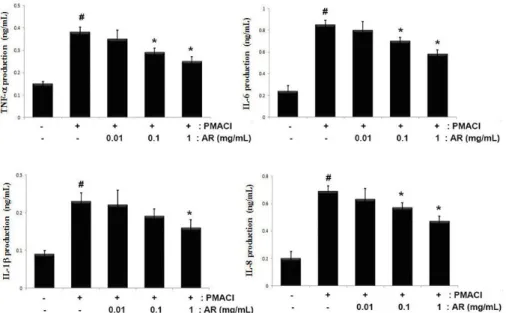
The suppression of inflammatory cytokine levels is one of the widely accepted therapeutic strategies for allergic inflam- mation (Furue and Kadono, 2017). Therefore, we evaluated the regulatory effect of AR on TNF-α, IL-6, IL-1β and IL-8 production in PMACI-stimulated HMC-1 cells. The cells were pretreated with or without AR (0.01, 0.1 and 1 ㎎/mL) for 1 h prior to stimulation with PMACI for 8 h. The results showed that PMACI alone markedly induced the secretion of TNF-α, IL-6, IL-1β and IL-8 by PMACI-stimulated HMC-1 cells. However, AR suppressed the PMACI-induced TNF-α, IL-6, IL-1β and IL-8 production in a dose-dependent manner (Fig. 2). The maximal inhibition of TNF-α, IL-6, IL-1β and IL-8 secretion by AR (1 ㎎/mL) was approximately 35.2% (p

< 0.05), 31.7% (p < 0.05), 30.4% (p < 0.05), and 34.7% (p <

0.05), respectively.

Effect of AR on NF-κB activation in PMACI-stimulated HMC-1 cells

As the suppression of NF-kB activation has been linked to anti-allergic inflammation, we theorized that the molecular mechanism of AR might be mediated via the suppression of NF-kB activation. Generally, because NF-kB activation Fig. 1. Effect of AR on cell viability in PMACI-stimulated HMC-1 cells. (A) Cells (1 × 10

5

cells/well) were treated with AR (0.01, 0.1 and 1 ㎎/mL) for 12 h and cell viability was analyzed by the MTT assay. The values are presented as the mean ± SD of independent experiments (

#

P < 0.05 vs. control,

*P < 0.05 vs. PMACI alone).

(4)

Fig. 2. Effects of AR on TNF-α, IL-6, IL-1β and IL-8 production in PMACI-stimulated HMC-1 cells. Cells (5 × 10

5

cells/well) were pretreated with or without AR (0.01, 0.1 and 1 ㎎/mL) for 1 h prior to stimulation with PMACI (50 mM PMA + 1 ㎎/mL A23187) for 8 h. The levels of TNF-α, IL-6, IL-1β and IL-8 in the indicated groups were measured by ELISA. The values are presented as the mean ± SD of independent experiments (

#

P < 0.05 vs. control, *P < 0.05 vs. PMACI alone).

Fig. 3. Effect of AR on the NF-κB activation in PMACI-stimulated HMC-1 cells. Cells (6 × 10

6

cells/well) were pre-treated with AR (0.1 and 1 ㎎/mL) for 1 h and then stimulated with PMACI (50 mM PMA + 1 ㎎/mL A23187) for 2 h. (A) Cytosolic and nuclear extracts were prepared and evaluated for IκB-α in cytosol and NF-κB (RelA/p65) in nucelar by Western blot analysis. (B) The relative levels of IκB-α and NF-κB (RelA/p65) are presented. (C) Luciferase activity was determined using a luciferase assay system kit following the manufacturer’s instructions. The values are presented as the mean ± SD of independent experiments (#P < 0.05 vs.

control, *P < 0.05 vs. PMACI alone).

(5)

requires the IκB-α degradation in cytosol and nuclear trans- location of the RelA/p65 subunit of NF-kB, we evaluated the effects of AR on the IκB-α degradation and NF-κB (RelA/

p65) translocation in nuclear by Western blot analysis. As shown in Fig. 3A, PMACI induced the IκB-α degradation compared with the untreated control. However, AR (0.1 and 1

㎎/mL) suppressed the PMACI-induced IκB-α degradation in cytosol. The levels of Rel/p65 in the nuclear fraction were increased in PMACI-stimulated cells, but AR reduced the enhanced nuclear levels of Rel/p65. The relative levels of Iκ B-α (in the cytosol) and NF-kB (in the nucleus) are shown in Fig. 3B. Moreover, to evaluate the effect of AR on the promoter activity of NF-kB, a luciferase reporter assay was conducted. As illustrated in Fig. 3C, AR attenuated the NF- kB-driven luciferase activity in PMACI-stimulated HMC-1 cells.

Effect of AR on caspase-1 activation in PMACI -stimulated HMC-1 cells

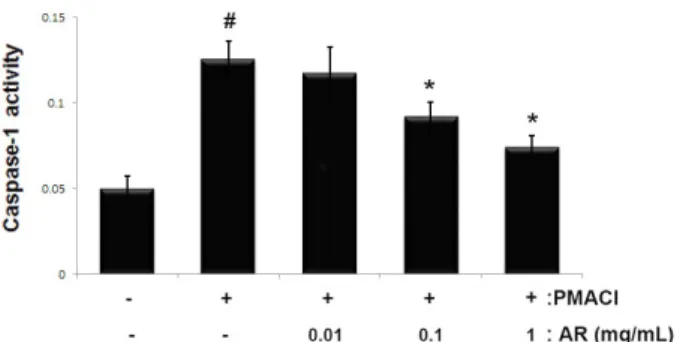
The activation of caspase-1 induces an inflammatory response via the stimulation of inflammatory cytokines (Han et al., 2017). To determine the molecular mechanism of AR involved in allergic inflammation, we investigated the effects of AR on PMACI-induced caspase-1 activity using a caspase-1 assay kit. The results showed that the enhanced caspase-1 activity

induced by PMACI was significantly reduced by AR in a dose-dependent manner (Fig. 4). The maximal inhibition of caspase-1 activity by AR (1 ㎎/mL) was approximately 40.8% (p < 0.05).

Discussion

Traditional medicines have received revived interest as alternative treatment for variety of diseases. Although traditional medicines have long been effectively employed, their precise mechanisms are not completely understood. In this study, we demonstrated the beneficial effects and molecular mechanisms of AR in mast cell-mediated allergic inflammation in vitro model. The findings of this study showed that AR effectively attenuated the PMACI-induced production of TNF-α, IL-6, IL-1β and IL-8 in stimulated HMC-1cells. Additionally, we showed that the inhibitory mechanisms of AR on allergic inflammation arose from suppressing the activation of NF-kB/caspase-1 in PMACI- stimulated HMC-1cells.

Allergic inflammation plays a central role in allergic diseases and involves the action of multiple factors within a complex network (Edwards et al., 2017). Mast cells are crucial effector cells and are associated with allergic disorders (Caughey, 2016). specifically, activated mast cells release preformed and synthesized inflammatory cytokines which contribute to the development of allergic inflammation.

Emerging evidence has shown that mast cells are present in larger numbers in patients with allergic inflammatory diseases and plays an integral role in allergic inflammation pathogenesis (Theoharides et al., 2019). Thus, these findings suggest that preventing mast cell activation and cytokine production may be a potent treatment strategy for allergic inflammation-related diseases. In this study, we demonstrated that AR attenuated the release of TNF-α, IL-6, IL-1β and IL-8 in PMACI-simulated HMC-1 cells. The inhibition of TNF-α, IL-6, IL-1β and IL-8 by AR (1 ㎎/mL) was approximately 35.2% (p < 0.05), 31.7% (p < 0.05), 30.4% (p

< 0.05), and 34.7% (p < 0.05), respectively. These results collectively demonstrate that AR exerted an anti-allergic inflammatory effect by suppressing inflammatory cytokine release from mast cells.

Fig. 4. Effect of AR on caspase-1 activation in PMACI- stimulated HMC-1. Cells (5 × 10

5

cells/well) were pretreated with or without AR (0.01, 0.1 and 1 ㎎/mL) for 1 h prior to stimulation with PMACI (50 mM PMA + 1 ㎎/mL A23187) for 4 h. The enzymatic activity of caspase-1 was measured using a caspase-1 colorimetric assay. The values are presented as the mean ± SD of independent experiments (

#

P< 0.05 vs.

control, *P< 0.05 vs. PMACI alone).

(6)

NF-κB regulates the transcription of numerous genes involved in allergic inflammation (Lee et al., 2020). In the inactive state (under normal condition), NF-κB/ IκB complexes are sequestered in the cytoplasm. During the inflammatory process, the IκB kinase (IKK) complex phosphorylate and degrades IκB protein (DiDonato et al., 2012). As a result, free NF-κB is translocated into the nucleus where it can combine with the target genes and activate various inflammatory factors (Mitchell and Carmody, 2018). Several studies have shown that increases of inflammatory mediators were associated with increased caspase-1 activation (Han et al., 2017). The activation of caspsase-1 was shown to induce an allergic inflammatory response by causing an increase in inflammatory cytokines and the recruitment of inflammatory cells (Bouchier-Hayes and Martin, 2004). It has been reported that caspase-1 deficiency reduced inflammation in an allergic rhinitis mice model (Kuida et al., 1995). Additionally, it was revealed that activation of caspasse-1 induced NF-kB and MAPK-signaling pathways (Lamkanfi et al., 2004; Siegmund et al., 2001). Based on these results, the suppression of NF-kB/caspase-1 activation was identified as an anti- inflammatory strategy. Therefore, to identify the regulatory mechanism of AR on allergic inflammation, we assessed whether AR could suppress the activation of NF-kB/

caspase-1 in PMACI-simulated HMC-1 cells. The results demonstrated that AR inhibited PMACI-induced the IκB-α degradation in cytosol and NF-kB translocation into the

nucleus. Additionally, we observed that AR attenuated the PMACI-induced caspase-1 activation in a dose-dependent manner. From this, we hypothesized that AR exerted mast cell-mediated anti-inflammatory mechanisms via the inhi- bition of NF-κB/caspase-1 activation. A model of the anti- allergic inflammatory mechanism of AR has been provided in Fig. 5. Although AR attenuated NF-kB/caspase-1 activation, the effect of AR on another pathway including MAPK or PI3K/Akt-signaling was not elucidated. Therefore, further study is necessary to clarify the role of AR in other pathways in mast cell-mediated allergic inflammation.

In conclusion, AR was shown to regulate mast cell-mediated allergic inflammation by suppressing inflammatory cytokines levels. We demonstrated that the anti-allergic inflammatory mechanism of AR could be attributed to the inhibition of the activation of NF-kB/caspase-1 in PMCI-stimulated mast cells. Our study provides experimental evidence that AR may be a useful candidate for treating allergic inflammatory-related diseases.

Acknowledgements

This research was supported by Wonkwang Digital University in 2020.

Conflicts of Interest

The authors declare that they have no conflict of interest.

References

Birrell, M.A., E. Hardaker, S. Wong, K. McCluskie, M. Catley, J. De Alba, R. Newton, S. Haj-Yahia, K.T. Pun, C.J. Watts, R.J. Shaw, T.J. Savage and M.G. Belvisi. 2005. Ikappa-B kinase-2 inhibitor blocks inflammation in human airway smooth muscle and a rat model of asthma. Am. J. Respir.

Crit. Care Med. 172:962-971.

Bouchier-Hayes, L. and S.J. Martin. 2004. CARDINAL roles in apoptosis and NFkappaB activation. Vitam. Horm. 67:

133-147.

Caughey, G.H. 2016. Mast cell proteases as pharmacological targets. Eur. J. Pharmacol. 778:44-55.

Fig 5. Proposed anti-allergic inflammatory mechanism of AR

in PMACI-stimulated HMC-1 cells.

(7)

DiDonato, J.A., F. Mercurio and M. Karin. 2012. NF-κB and the link between inflammation and cancer. Immunol. Rev.

246:379-400.

Edwards, M.R., K. Strong, A. Cameron, R.P. Walton, D.J.

Jackson and S.L. Johnston. 2017. Viral infections in allergy and immunology: How allergic inflammation influences viral infections and illness. J. Allergy Clin. Immunol.

140:909-920.

Furue, M. and T. Kadono. 2017. “Inflammatory skin march” in atopic dermatitis and psoriasis. Inflamm. Res. 66:833-842.

Gilmore, T.D. and M.R. Garbati. 2011. Inhibition of NF-κB signaling as a strategy in disease therapy. Curr. Top. Micro- biol. Immunol. 349: 245-263.

Han, N.R., P.D. Moon, N.R. Kim, H.Y. Kim, H.J. Jeong and H.M. Kim. 2017. Schisandra chinensis and its main cons- tituent schizandrin attenuate allergic reactions by down- regulating caspase-1 in ovalbumin-sensitized mice. Am. J.

Chin. Med. 45:159-172.

Hawiger, J. 2001. Innate immunity and inflammation: A trans- criptional paradigm. Immunol. Res. 23:99-109.

Kim, H.J. and S.H. Kang. 2017. Ethnobotany, phytochemistry, pharmacology of the Korean Campanulaceae: A comprehen- sive review. Korean J. Plant Res. 30:240-264.

Kim, H.Y., S.Y. Nam, S.Y. Hwang, H.M. Kim and H.J. Jeong.

2016. Atractylone, an active constituent of KMP6, attenuates allergic inflammation on allergic rhinitis in vitro and in vivo models. Mol. Immunol. 78:121-132.

Kim, J.Y., K.W. Park, K.D. Moon, M.K. Lee, J. Choi, S.T. Yee, K.H. Shim and K.I. Seo. 2008. Induction of apoptosis in HT-29 colon cancer cells by crude saponin from Platycodi Radix. Food Chem. Toxicol. 46:3753-3758.

Kim, S. J. , M. C. Kim, J. Y. Um and S. H. Hong. 2010. The beneficial effect of vanillic acid on ulcerative colitis.

Molecules 15:7208-7217.

Kuida, K., J.A. Lippke and G. Ku. 1995. Altered cytokine export and apoptosis in mice deficient in interleukin‐1B converting enzyme. Science 267:2000-2002.

Lamkanfi, M., M. Kalai, X. Saelens, W. Declercq and P.

Vandenabeele. 2004. Caspase-1 activates nuclear factor of the kappa-enhancer in B cells independently of its enzymatic activity. J. Biol. Chem. 279:24785-24793.

Lee, Y.S., S.B. Han, H.J. Ham, J.H. Park, J.S. Lee, D.Y. Hwang,

Y.S. Jung, D.Y. Yoon and J.T. Hong. 2020. IL-32γ suppressed atopic dermatitis through inhibition of miR-205 expression via inactivation of nuclear factor-kappa B. J. Allergy Clin.

Immunol. 146:156-168.

Li, J.W., Y. Liu, B.H. Li, Y.Y. Wang, H. Wang and C.L. Zhou.

2016. A polysaccharide purified from Radix Adenophorae promotes cell activation and pro-inflammatory cytokine production in murine RAW264.7 macrophages. Chin. J. Nat.

Med. 14:370-376.

Lim, J.M., B. Lee, J.H. Min, E.Y. Kim, J.H. Kim, S. Hong, J.J.

Kim, Y. Sohn and H.S. Jung. 2018. Effect of peiminine on DNCB-induced atopic dermatitis by inhibiting inflammatory cytokine expression in vivo and in vitro. Int. Immunophar- macol. 56:135-142.

Martin, R.A., J.L. Ather, L.K. Lundblad, B.T. Suratt, J.E.

Boyson, R.C. Budd, J.F. Alcorn, R.A. Flavell, S.C. Eisen- barth and M.E. Poynter. 2013. Interleukin-1 receptor and caspase-1 are required for the Th17 response in nitrogen dioxide-promoted allergic airway disease. Am. J. Respir.

Cell Mol. Biol. 48:655-664.

Mitchell, J.P. and R.J. Carmody. 2018. NF-κB and the trans- criptional control of inflammation. Int. Rev. Cell Mol. Biol.

335:41-84.

Modena, B.D., K. Dazy and A.A. White. 2016. Emerging concepts: mast cell involvement in allergic diseases. Transl.

Res.174: 98-121.

Sakamoto, T., W. Ohashi, K. Tomita , K. Hattori , N. Matsuda and Y. Hattori. 2018. Anti-inflammatory properties of cilo- stazol: Its interruption of DNA binding activity of NF-kappaB from the Toll-like receptor signaling pathways. Int Immun- opharmacol. 62:120-131.

Siegmund, B. , H. A. Lehr, G. Fantuzzi and C. A. Dinarello.

2001. IL-1 betaconverting enzyme (caspase-1) in intestinal inflammation. PNASU. 98:13249-13254.

Song, P., J. Xia, C. Rezeng, L. Tong and W. Tang. 2016. Tradi- tional, complementary, and alternative medicine: Focusing on research into traditional Tibetan medicine in China.

Biosci. Trends 10:163-170.

Theoharides, T.C., I. Tsilioni and H. Ren. 2019. Recent advances in our understanding of mast cell activation - or should it be mast cell mediator disorders? Expert Rev. Clin. Immunol.

15:639-656.

(Received 16 September 2020 ; Revised 20 November 2020 ; Accepted 25 November 2020)

수치

Fig. 2. Effects of AR on TNF-α, IL-6, IL-1β and IL-8 production in PMACI-stimulated HMC-1 cells
Fig.  4.  Effect  of  AR  on  caspase-1  activation  in  PMACI-  stimulated HMC-1. Cells (5 × 10 5  cells/well) were pretreated  with or without AR (0.01, 0.1 and 1 ㎎/mL) for 1 h prior to  stimulation with PMACI (50 mM PMA + 1 ㎎/mL A23187)  for 4 h
Fig 5. Proposed anti-allergic inflammatory mechanism of AR  in PMACI-stimulated HMC-1 cells.

참조

관련 문서

• 이명의 치료에 대한 매커니즘과 디지털 음향 기술에 대한 상업적으로의 급속한 발전으로 인해 치료 옵션은 증가했 지만, 선택 가이드 라인은 거의 없음.. •

The proposal of the cell theory as the birth of contemporary cell biology Microscopic studies of plant tissues by Schleiden and of animal tissues by Microscopic studies of

2재화 2요소 헥셔-올린 모형에서는 어느 한 경제에서 어느 한 요소의 양이 증가하면, 그 요소를 집약적으로 사용하는 산업의 생산량은 증가하고 다른

웹 표준을 지원하는 플랫폼에서 큰 수정없이 실행 가능함 패키징을 통해 다양한 기기를 위한 앱을 작성할 수 있음 네이티브 앱과

_____ culture appears to be attractive (도시의) to the

“ Sheikh Nasser has a written message from HH the Amir, Sheikh Sabah Al-Ahmad Al-Jaber Al-Sabah to the Chinese President, Chi Gen Beng related to enhancing mutual

On his part, CEO of Express Roads Authority, Saud Al-Naqqi said that the heavy rains of the previous day led to clogging parts of the express

Kuwait will celebrate on Sunday the fourth anniversary of the UN honoring and proclamation of His Highness the Amir, Sheikh Sabah Al-Ahmad Al-Jaber Al-Sabah as