Microalbuminuria in Normal Korean Children
Byung Ok Kwak,
1Sang Taek Lee,
2Sochung Chung,
1and Kyo Sun Kim
11Department of Pediatrics, School of Medicine, Konkuk University, Seoul;
2Division of National Immunization Program and Vaccine Preventable Disease, Korea Centers for Control and Prevention, Seoul, Korea.
Received: November 17, 2010 Revised: December 21, 2010 Accepted: December 23, 2010 Corresponding author: Dr. Kyo Sun Kim, Department of Pediatrics, School of Medicine, Konkuk University, 4-12 Hwayang-dong, Gwangjin-gu, Seoul 143-729, Korea.
Tel: 82-2-2030-7370, Fax: 82-2-2030-5009 E-mail: [email protected]
∙ The authors have no financial conflicts of interest.
© Copyright:
Yonsei University College of Medicine 2011 This is an Open Access article distributed under the terms of the Creative Commons Attribution Non- Commercial License (http://creativecommons.org/
licenses/by-nc/3.0) which permits unrestricted non- commercial use, distribution, and reproduction in any medium, provided the original work is properly cited.
Purpose: Although microalbuminuria is known as a predictor of clinical nephrop- athy and cardiomyopathy, few studies have investigated the incidence and refer- ence range of microalbuminuria in healthy children. This study aimed to establish a reference range and to study the age-related trend for spot urine microalbumin/
creatinine ratio in a Korean pediatric population. Materials and Methods: 352 healthy children were studied from July 2007 through March 2010. Height, weight, serum creatinine, spot urine microalbumin/creatinine ratio, and glomerular filtra- tion rate (GFR) were obtained for each subject. We divided the study population into 5 groups according to age, and compared the spot urine microalbumin/creati- nine ratio with other variables using one-way analysis of variance (ANOVA), re- gression analysis and Pearson’s correlation analysis. Results: In this study, the data showed that the spot urine microalbumin/creatinine ratio decreased with age: 1-12 months, 22.72±13.80 mg/mmol (2SD: 3.33-54.40 mg/mmol); 13-28 months, 16.34±9.58 mg/mmol (2SD: 3.16-35.19 mg/mmol); 29-48 months, 13.12±9.74 mg/mmol (2SD: 3.01-41.57 mg/mmol); 4-6 years, 10.58±8.13 mg/mmol (2SD:
0.00-30.19 mg/mmol); and 7-19 years, 5.13±5.44 mg/mmol (2SD: 0.45-14.45 mg/
mmol). The spot urine microalbumin/creatinine ratio showed correlation with age, height, height z-score, weight, weight z-score, GFR, body mass index (BMI) and body surface area (BSA). Conclusion: The spot urine microalbumin/creatinine ra- tio in normal Korean children decreased with age. This ratio could potentially be used to establish reference ranges and cutoff values for Korean children and to predict nephropathy and cardiomyopathy.
Key Words: Microalbuminuria, children
INTRODUCTION
Microalbuminuria refers to cases where urine albumin has increased to more than the normal value, and is defined when urine albumin is 30-300 mg/day in adults or 30-300 µg/mg (2-20 mg/mmol) microalbumin/creatinine ratio in random urine.1-3 It is known to be an early predicative factor for renal and cardiovascular diseases not only in diabetes mellitus and hypertension patient but also in normal persons.4-6 Recently, as concern over microalbuminuria has been increasing, studies have been conducted regarding the prevalence of microalbuminuria and its clinical
ratios were obtained by multiplying the urine microalbumin (mg/L) by 1,000, dividing the results by values resulting from multiplying urine creatinine (mg/dL) by 88.4 and then con- verting the resultant values into SI units of mg/mmol. Micro- albumin/creatinine ratio (mg/mmol)=urine microalbumin (mg/L)×1,000/urine creatinine (mg/dL)×88.4.12,13 The sub- jects were divided into five groups based on their ages to compare and analyze spot urine microalbumin/creatinine ra- tios and assess for any correlations with each variable: from one to 12 months (Group 1, n=61), 12 to 28 months (Group 2, n=60), 29 to 48 months (Group 3, n=89), 4 to 6 years (Group 4, n=71), 7 to 19 years (Group 5, n=71).
Ethics and confidential data approvals
The study was approved by the Institutional Review Board for Human Research, Konkuk University Hospital. Written informed consent was obtained from each child’s parents after sufficient explanation.
Data analysis
The spot urine microalbumin/creatinine ratios were log transformed and analyzed. All values were presented as mean± standard deviation. Differences in variables between the groups were compared using one-way analysis of vari- ance (ANOVA) and the correlations between spot urine mi- croalbumin/creatinine ratios and other variables were ob- tained using regression analysis and Pearson’s correlation analysis. Values with p<0.05 were considered statistically significant.
RESULTS
A total of 352 subjects (male children 185, female children 167) were included in this study and their mean age was 54.8±47.6 months with a range from 1 month and 19 years.
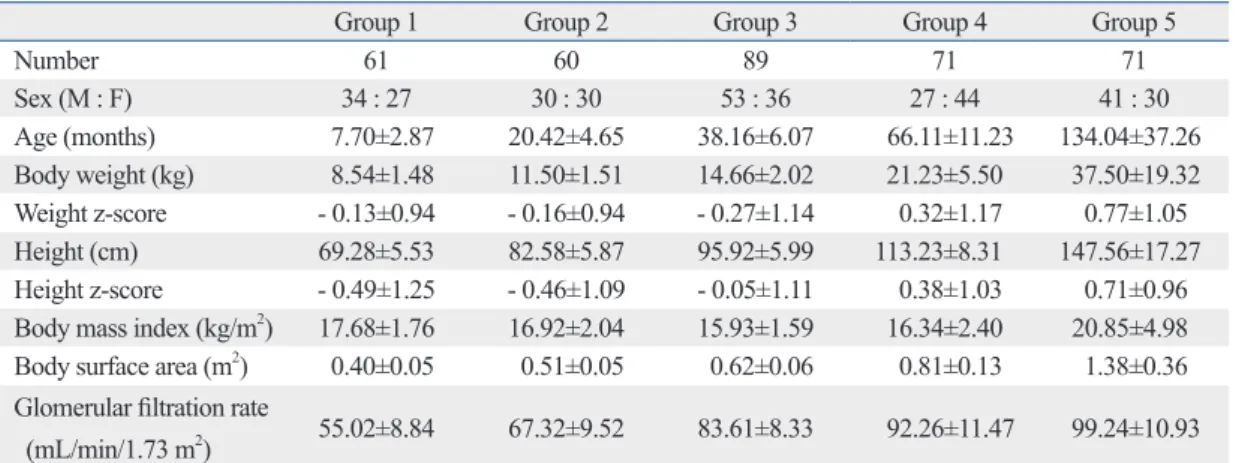
They were divided into five groups based on age. Among the groups, there were significant differences in height, weight, height z-scores, weight z-scores, body mass index (BMI), body surface areas (BSA), and GFR. All values showed a tendency to increase with age (Table 1). The spot urine mi- croalbumin/creatinine ratios were mean 13.21±11.08 mg/
mmol and differences were found between the groups (Ta- ble 2, Fig. 1). The values in Group 1 were statistically higher than in the other age groups and it was observed that the val- ues decreased thereafter as the age increased: Group 1 was 22.72±13.80 mg/mmol (2SD range: 3.33-54.40 mg/mmol);
characteristics.7,8 As methods to measure microalbuminuria, 24-hour urine collection and spot urine are frequently used clinical tests. However, since 24-hour urine collection tests have limitations to accurately collecting urine from chil- dren, their reliability may be compromised, and the test method is also inconvenient. Thus a method to measure the microalbumin/creatinine ratio in spot urine is presented as a screening test.4,9,10 To secure appropriate sensitivity and specificity of screening tests in pediatric patients, cutoff lev- els should be determined based on reference values for the relevant age group instead of the reference value for adults.9
Although studies of microalbuminuria in pediatric pa- tients with diabetes mellitus, chronic renal diseases, urinary tract infection or vesicoureteral reflux have been conducted, there have been no reports on studies conducted in normal Korean children using spot urine microalbumin/creatinine ratios. In particular, few studies have been conducted on the reference values and prevalence rates of microalbuminuria in normal Korean children. This study aimed to examine the reference values and related factors of microalbumin- uria in normal children in Korea by measuring spot urine microalbumin/creatinine ratios.
MATERIALS AND METHODS
This study was conducted on 352 healthy Korean children (185 males and 167 females) who visited the pediatrics de- partment at Konkuk University Hospital between July 2007 and March 2010. Pediatric patients with underlying diseas- es such as renal diseases or diabetes mellitus and those with suspected acute infectious diseases were excluded, as were patients with proteinuria based on urinalysis.
In this study, the subjects’ heights, weights, blood pres- sures, serum creatinine, and spot urine microalbumin/creat- inine ratio were measured. The z-scores of the heights and weights were obtained using the LMS method. Glomerular filtration rates (GFR) were obtained by multiplying κ by the height and dividing the result by the serum creatinine value using the Schwartz formula: GFR (mL/min/1.73 m2)=κ×
height (cm)/serum creatinine (mg/dL). κ was determined to be 0.33 for low birth weight infants, 0.45 for infants aged less than two years, 0.55 for children aged between two and 13 years and adolescent girls, and 0.70 for adolescent boys.11 Urine microalbumin and creatinine were examined by Toshi- ba 200 FR Neo (Toshiba Medical System Co., Tokyo, Japan) using random morning urine, and microalbumin/creatinine
min/creatinine ratios showed a tendency to decrease with age, while GFR tended to increase (Fig. 2).
DISCUSSION
Microalbuminuria refers to cases where the amount of al- bumin filtered is in excess of the re-absorption capacity of the tubules and albumin is elevated in urinalysis, with no proteinuria.14,15 The epithelial cells of the proximal tubules re-absorb filtered albumin by receptor mediated introjecting actions, and microalbuminuria occurs when the filtered al- bumin in excess of the re-absorption capacity of the tubules Group 2 was 16.34±9.58 mg/mmol (2SD range: 3.16-35.19
mg/mmol); Group 3 was 13.12±9.74 mg/mmol (2SD range:
3.01-41.57 mg/mmol); Group 4 was 10.58±8.13 mg/mmol (2SD range: 0.00-30.19 mg/mmol); Group 5 was 5.13±5.44 mg/mmol (2SD range: 0.45-14.45 mg/mmol) (p<0.001). The spot urine microalbumin/creatinine ratios were statistically significantly correlated with age (r=-0.58, p<0.001), heights (r=-0.59, p<0.001), height z-scores (r=-0.28, p<0.001), weights (r=-0.57, p<0.001), weight z-scores (r=-0.29, p<0.001), GFR (r=-0.49, p<0.001), BMI (r =-0.35, p<0.001), and BSA (r=-0.59, p<0.001). However, the spot urine micro- albumin/creatinine ratios did not show any significant corre- lations with the sex of the subjects. The spot urine microalbu-
Table 1. Characteristics of the Study Group
Group 1 Group 2 Group 3 Group 4 Group 5
Number 61 60 89 71 71
Sex (M : F) 34 : 27 30 : 30 53 : 36 27 : 44 41 : 30
Age (months) 7.70±2.87 20.42±4.65 38.16±6.07 66.11±11.23 134.04±37.26 Body weight (kg) 8.54±1.48 11.50±1.51 14.66±2.02 21.23±5.50 37.50±19.32 Weight z-score - 0.13±0.94 - 0.16±0.94 - 0.27±1.14 0.32±1.17 0.77±1.05
Height (cm) 69.28±5.53 82.58±5.87 95.92±5.99 113.23±8.31 147.56±17.27
Height z-score - 0.49±1.25 - 0.46±1.09 - 0.05±1.11 0.38±1.03 0.71±0.96 Body mass index (kg/m2) 17.68±1.76 16.92±2.04 15.93±1.59 16.34±2.40 20.85±4.98 Body surface area (m2) 0.40±0.05 0.51±0.05 0.62±0.06 0.81±0.13 1.38±0.36 Glomerular filtration rate
(mL/min/1.73 m2) 55.02±8.84 67.32±9.52 83.61±8.33 92.26±11.47 99.24±10.93 Data are expressed as mean±SD.
Table 2. Mean and Upper Limit of Spot Urine Microalbumin/Creatinine Ratios in the Study Group Age range No Mean microalbumin/creatinine ratio
(mg/mmol)
2SD of microalbumin/creatinine ratio (mg/mmol)
1-12 months 61 22.72±13.80 3.33-54.40
13-28 months 60 16.34±9.58 3.16-35.19
29-48 months 89 13.12±9.74 3.01-41.57
4-6 yrs 71 10.58±8.13 0.00-30.19
7-19 yrs 71 5.13±5.44 0.45-14.45
Data are expressed as mean±SD.
0.00 10.00 20.00 30.00 04.00 50.00 60.00
Microalbumin/creatinine ratio (mg/mmol)
1-12 months 13-28 months 29-48 months 4-6 yrs 7-19 yrs
Age Fig. 1. Spot urine microalbumin/creatinine ratios of healthy children (mean+2SD).
and older children. Furthermore, in a study conducted in Ja- pan, 6,197 school health examinations showed a prevalence rate of 2.5% and many of those with microalbuminuria had urinary system disorders.12 In Korea, a study of 72 children and juvenile patients with type 1 diabetes mellitus showed a prevalence rate of temporary microalbuminuria of 15.3%
and sustained microalbuminuria of 26.4%. In particular, it was proposed that screening tests should be conducted on patients with more than 5 years’ duration of illness and those aged more than 11 years.9
As the prevalence rates of obesity and diabetes mellitus increase even in children, microalbuminuria has been used as an early predicative factor of renal disease transition. In addition, since children have high prevalence rates of uri- nary tract infection, unlike adults, many studies of microal- buminuria have been conducted on pediatric patients with renal scars or vesicoureteral reflux that might develop into chronic renal failure.15 Since the prevalence rate of microal- buminuria in normal persons is low, there are objections to using microalbuminuria as a screening test. However, mi- croalbuminuria has recently been reported by many studies to predict cardiovascular diseases, metabolic syndrome, and renal diseases even in normal persons and since it can be easily measured at low cost, methods to utilize it have been designed.14,21 In some recent studies, it has been shown that microalbuminuria per se causes damage to the tubules, accompanying inflammation in the interstitial tissues, and may eventually bring about fibrosis due to renal failure.
This highlights that early identification and treatment of mi- croalbuminuria are important.22
The National Kidney Foundation recommends that to test for microalbuminuria, the microalbumin/creatinine ra- tio in random urine should be obtained using midstream urine from the first urination in the morning.2 This is be- cause the microalbumin/creatinine ratio in spot urine is rel- atively proportionate to the amount of microalbumin ex- creted in a 24-hour collection of urine, is relatively less affected by the dehydration state and physical activity of the subject, and can reduce deviations resulting from these fac- tors.4,9,10 Despite the fact that this method is preferred in chil- dren because of its convenience and the reduced cost, the normal reference value of spot urine microalbumin/creati- nine ratio in children has received little attention in the liter- ature.5 In general, microalbuminuria is defined by the mi- croalbumin/creatinine ratio in spot urine in the range of 30- 300 µg/mg (2-20 mg/mmol).1,2,11 However there have been many different studies defining microalbuminuria.3-5,23-26 increases.15,16 If the number of nephrons is decreased com-
pared to the normal number due to renal disease etc., the fil- tration area may be reduced and thus damage the glomeruli.
Moreover, glomerular and systemic hypertension and glo- merulosclerosis may occur, and renal functions may be re- duced.17 Basic, et al.15 stated that, in the case of patients with vesicoureteral reflux, microalbuminuria might occur in pro- portion to the severity of the reflux due to glomerulosclero- sis and excessive permeability resulting from the reflux.
In the past, microalbuminuria was known as an early predicative factor of renal and cardiovascular diseases in di- abetes mellitus and hypertension patients. However, recent- ly, as concern over microalbuminuria has been increasing in response to published reports on the associations be- tween microalbuminuria and metabolic syndrome, insulin resistance, etc., studies have focused on microalbumin- uria.4-8 Kim, et al.18 reported that when random urine sam- ples from 5,915 Korean adult males and females were test- ed, the prevalence rate of microalbuminuria was 7.7%
(male 9.5%, female 5.7%); it dropped to 5.7% (male 6.9%, female 4.7%) when diabetes mellitus and cardiovascular disease patients were excluded from the data. In a survey conducted on Americans, when random urine samples from 221,244 normal persons aged at least 6 years were tested, the prevalence rates of microalbuminuria were shown to be 6.1% in males and 9.7% in females. In this study, higher prevalence rates were found in females, children, African- Americans, and Mexican-Americans.19 In a study conduct- ed on 41,000 Europeans, a prevalence rate of 7% was re- ported.4 In random urine tests conducted on 217 (10-16 year old) children with type 1 diabetes mellitus of more than 10 years’ duration, Cizmecioğlu, et al.20 reported a prevalence rate of microalbuminuria of 1%. They also highlighted that cases of microalbuminuria were more common in females
Fig. 2. Correlation of age with spot urine microalbumin/creatinine ratio and glomerular filtration rate (GFR).
0.00 5.00 10.00 15.00 20.00
0 50 100 150 200 250
Age (months) In [Uma/Ucr (mg/g)]
GFR2/1,000
fat than the other age groups, as urine creatinine excretion was low. In a study by Yap, et al.29 conducted on 139 Singa- porean children, higher spot urine microalbumin/creatinine ratios were measured in the new born-6 months age group than in the other age groups, and as with the present study, there was a tendency for the ratios to decrease with age.
The authors explained that this phenomenon occurred be- cause the amount of filtered albumin decreased, tubule re- absorption occurred, and the tubules matured with age. It is thought that since this study and the study by Yap, et al.29 included many children of a relatively young age, less than 2, the results were different from those of previous studies due to immature renal function and differences in muscle mass. Therefore, further studies of spot urine microalbu- min/creatinine ratios are considered considered necesary in subjects aged less than 2 years. As of yet, no conclusion has been reached regarding whether adolescence affects the level of microalbuminuria. In a study conducted on pediat- ric juvenile patients with type 1 diabetes mellitus, Jung, et al.9 reported that prevalence rates were higher in subjects aged over 12 years of age, and presented a hypothesis that changes in endocrine environments including decreases in sensitivity to insulin and excessive secretion of growth hor- mone in adolescence might contribute to initial renal dam- age. Cizmecioğlu, et al.20 reported that the prevalence rate of microalbuminuria was higher in adolescent girls with type 1 diabetes mellitus, and Amin, et al.30 reported that the increase of microalbuminuria in adolescence could be related not only to poor blood sugar control but also to changes in the growth hormone-insulin-like growth factor 1 (IGF1) axis and ovarian function. In this study, spot urine microalbu- min/creatinine ratios did not increase in adolescent sub- jects; thus it is thought that the ratio may vary among sub- jects, as there was a tendency to decrease in the study by Yap, et al.,29 which was conducted on normal children. Re- garding this issue, further studies should be conducted to compare and analyze both normal children and children with underlying diseases such as diabetes mellitus.
de Jong, et al.4 stated that if microalbuminuria is found once in random urine tests, it should be checked through two or more retests to see if it is sustained microalbuminuria. Mi- croalbuminuria might be diagnosed if two or more positive reactions are shown in three tests, and Gibb, et al.27 suggested that at least five tests should be done in order to reduce varia- tions due to false positive diagnoses of microalbuminuria, which may result in patients and their families experiencing unnecessary mental stress and inconvenience.9,20 In this study Marshall23 defined <3.5 mg/mmol as normoalbuminuria,
3.5-10 mg/mmol as equivocal 10-47 mg/mmol as microal- buminuria and >47 mg/mmol as macroalbuminuria. Smul- ders, et al.3 defined <2.2 mg/mmol as normal, 2.2-22.6 mg/
mmol as microalbuminuria and >22.6 mg/mmol as macro- albuminuria. MacIsaac, et al.24 defined 2.5-25 mg/mmol (male), 3.5-35 mg/mmol (female) as microalbuminuria, and Warram, et al.25 defined >17 µg/mg (male), >25 µg/mg (fe- male) as microalbuminuria. de Jong, et al.4 defined de <1.25 mg/mmol (male), <1.75 mg/mmol (female) as normal, 1.25-2.5 mg/mmol (male), 1.75-3.5 mg/mmol (female) as high normal, 2.5-25 mg/mmol (male), 3.5-35 mg/mmol (fe- male) as microalbuminuria and >25 mg/mmol (male), >35 mg/mmol (female) as macroalbuminuria separately for each gender. In a study conducted on 377 healthy children aged 3-19, Elises, et al.26 reported a microalbumin/creatinine ra- tio of 3 mg/mmol as the upper normal reference value and in a study conducted on children aged at least 6 years, Rademacher and Sinaiko5 reported a normal reference value of 8-10 mg/g on average. Given that different researchers apply different criteria, establishing cutoff levels based on age, sex, and ethnic groups is clearly important for securing the reliability of tests.9,27
Many factors can affect microalbuminuria measurements.
When spot urine microalbumin/creatinine ratios are mea- sured, urine microalbumin can vary with blood pressure, the time of taking the sample, the degree of dehydration, and whether or not the subject has an infection. Other factors that affect urine creatinine excretion may include birth weight, age, sex, ethnic group and muscle mass.4,5,7,14,20,28 A study of 217 children diagnosed with type 1 diabetes melli- tus20 reported that spot urine microalbumin/creatinine ratios were higher in females, and that reference values were high- er for females with less muscle mass. A study conducted on young adults born as low birth weight babies28 suggested a correlation between increased microalbuminuria and birth weight, but this suggestion could not be assessed in the pres- ent study as the data on birth weight were not complete.
The prevalence rates of microalbuminuria by age show dif- ferent results in studies such as that by Cizmecioğlu, et al.20 who reported that spot urine microalbumin/creatinine ratios would increase with age, while in a study conducted on sub- jects aged 3-19 years, Elises, et al.26 reported that there was no change in relation to age. In the present study, although differences between the sexes were not observed, spot urine microalbumin/creatinine ratios were found to be higher in Group 1, which had smaller muscle mass and lower body
children, and adolescents. Pediatr Clin North Am 1987;34:571-90.
12. Pugia MJ, Lott JA, Kajima J, Saambe T, Sasaki M, Kuromoto K, et al. Screening school children for albuminuria, proteinuria and occult blood with dipsticks. Clin Chem Lab Med 1999;37:149-57.
13. Burgert TS, Dziura J, Yeckel C, Taksali SE, Weiss R, Tamborlane W, et al. Microalbuminuria in pediatric obesity: Prevalence and relation to other cardiovascular risk factors. Int J Obes (Lond) 2006;30:273-80.
14. Namgoong MK. Microalbuminuria. J Korean Soc Pediatr Nephrol 2007;11:1-8.
15. Basic J, Golubovic E, Miljkovic P, Bjelakovic G, Cvetkovic T, Milosevic V. Microalbuminuria in children with vesicoureteral re- flux. Ren Fail 2008;30:639-43.
16. Gekle M. Renal proximal tubular albumin reabsorption: daily Pre- vention of albuminuria. News Physiol Sci 1998;13:5-11.
17. Brenner BM, Anderson S. The interrelationships among filtration surface area, blood pressure, and chronic renal disease. J Cardio- vasc Pharmacol 1992;19 Suppl 6:S1-7.
18. Kim ER, Sung KC, Chon CU, Kwon CH, Koh YL, Lee HJ, et al.
Prevalence and clinical characteristics of microalbuminuria in Ko- reans: a population-based cross-sectional study. Korean J Med 2006;70:617-26.
19. Jones CA, Francis ME, Eberhardt MS, Chavers B, Coresh J, En- gelgau M, et al. Microalbuminuria in the US population: third Na- tional Health and Nutrition Examination Survey. Am J Kidney Dis 2002;39:445-59.
20. Cizmecioğlu FM, Noyes K, Bath L, Kelnar C. Audit of microal- bumin excretion in children with type I diabetes. J Clin Res Pedi- atr Endocrinol 2009;1:136-43.
21. Mattix HJ, Hsu CY, Shaykevich S, Curhan G. Use of the albumin/
creatinine ratio to detect microalbuminuria: implications of sex and race. J Am Soc Nephrol 2002;13:1034-9.
22. Iglesias J, Levine JS. Albuminuria and renal injury--beware of proteins bearing gifts. Nephrol Dial Transplant 2001;16:215-8.
23. Marshall SM. Screening for microalbuminuria: which measure- ment? Diabet Med 1991;8:706-11.
24. MacIsaac RJ, Jerums G, Cooper ME. New insights into the signif- icance of microalbuminuria. Curr Opin Nephrol Hypertens 2004;
13:83-91.
25. Warram JH, Gearin G, Laffel L, Krolewski AS. Effect of duration of type I diabetes on the prevalence of stages of diabetic nephrop- athy defined by urinary albumin/creatinine ratio. J Am Soc Nephrol 1996;7:930-7.
26. Elises JS, Griffiths PD, Hocking MD, Taylor CM, White RH.
Simplified quantification of urinary protein excretion in children.
Clin Nephrol 1988;30:225-9.
27. Gibb DM, Shah V, Preece M, Barratt TM. Variability of urine al- bumin excretion in normal and diabetic children. Pediatr Nephrol 1989;3:414-9.
28. Keijzer-Veen MG, Schrevel M, Finken MJ, Dekker FW, Nauta J, Hille ET, et al. Microalbuminuria and lower glomerular filtration rate at young adult age in subjects born very premature and after in- trauterine growth retardation. J Am Soc Nephrol 2005;16:2762-8.
29. Yap C, Yap HK, Chio LF. Urine microalbumin/creatinine ratios in Singapore children. J Singapore Paediatr Soc 1991;33:101-6.
30. Amin R, Schultz C, Ong K, Frystyk J, Dalton RN, Perry L, et al.
Low IGF-I and elevated testosterone during puberty in subjects with type 1 diabetes developing microalbuminuria in comparison to normoalbuminuric control subjects: the Oxford Regional Pro- spective Study. Diabetes Care 2003;26:1456-61.
too, children with no evidence of infection and normal renal function but showing an increased microalbumin/creatinine ratio should be followed up and re-examined.
In conclusion, spot urine microalbumin/creatinine ratios decreased with age and were correlated with height, weight, GFR, BMI, and BSA. If further large studies by age are conducted later, the results could help in determining the reference values for spot urine microalbumin/creatinine ra- tios by age in normal children. This would reduce the in- convenience and errors involved in urine collection tests and the values could be used as a predicative factor of renal and cardiovascular diseases.
ACKNOWLEDGEMENTS
This work was supported by Konkuk University 2007.
REFERENCES
1. Bennett PH, Haffner S, Kasiske BL, Keane WF, Mogensen CE, Parving HH, et al. Screening and management of microalbumin- uria in patients with diabetes mellitus: recommendations to the Sci- entific Advisory Board of the National Kidney Foundation from an ad hoc committee of the Council on Diabetes Mellitus of the Na- tional Kidney Foundation. Am J Kidney Dis 1995;25:107-12.
2. Keane WF, Eknoyan G. Proteinuria, albuminuria, risk, assessment, detection, elimination (PARADE): a position paper of the National Kidney Foundation. Am J Kidney Dis 1999;33:1004-10.
3. Smulders YM, Slaats EH, Rakic M, Smulders FT, Stehouwer CD, Silberbusch J. Short-term variability and sampling distribution of various parameters of urinary albumin excretion in patients with non-insulin-dependent diabetes mellitus. J Lab Clin Med 1998;
132:39-46.
4. de Jong PE, Curhan GC. Screening, monitoring, and treatment of albuminuria: Public health perspectives. J Am Soc Nephrol 2006;
17:2120-6.
5. Rademacher ER, Sinaiko AR. Albuminuria in children. Curr Opin Nephrol Hypertens 2009;18:246-51.
6. Lewis JB. Microalbuminuria: accuracy or economics. Am J Kid- ney Dis 1998;32:524-8.
7. Locatelli F, Pozzoni P, Del Vecchio L. Renal manifestations in the metabolic syndrome. J Am Soc Nephrol 2006;17:S81-5.
8. Srivastava T. Nondiabetic consequences of obesity on kidney. Pe- diatr Nephrol 2006;21:463-70.
9. Jung MH, Wang PT, Shin CH, Yang SW. Factors related to the de- velopment of microalbuminuria in children and adolescents with type 1 diabetes mellitus. J Korean Pediatr Soc 2001;44:577-86.
10. Chugh A, Bakris GL. Microalbuminuria: what is it? Why is it im- portant? What should be done about it? An update. J Clin Hyper- tens (Greenwich) 2007;9:196-200.
11. Schwartz GJ, Brion LP, Spitzer A. The use of plasma creatinine concentration for estimating glomerular filtration rate in infants,