• 검색 결과가 없습니다.

Water Extract of Samultang Reduces Apoptotic Cell Death by H2

N/A
N/A
Protected

Academic year: 2022

Share "Water Extract of Samultang Reduces Apoptotic Cell Death by H2"

Copied!
7
0
0

로드 중.... (전체 텍스트 보기)

전체 글

(1)

139

ABBREVIATIONS: ROS, reactive oxygen species; SMT, samultang;

DMEM, Dulbecco's modified eagle's medium; PARP, Poly (ADP-ribose) Polymerase; PBS, phosphate buffered saline; MTT, 3-(4,5-dimethyl- thiazol-2-yl)-2 ,5-diphenyl-2H-tetrazoliumbromide; RT, reverse tran- scription; GAPDH, glyceraldehyde-3-phosphate dehydrogenase.

Received March 15, 2009, Revised June 16, 2009, Accepted June 19, 2009

Corresponding to: Min Sun Kim, Department of Physiology, Wonkwang University School of Medicine, 344-2, Shinyong-dong, Iksan 570-749, Korea. (Tel) 82-63-850-6779, (Fax) 82-63-852-6108, (E-mail) [email protected]

Water Extract of Samultang Reduces Apoptotic Cell Death by H 2 O 2 -Induced Oxidative Injury in SK-N-MC Cells

Gyoung Wan Lee, and Min Sun Kim

Department of Physiology, Wonkwang University School of Medicine, Iksan 570-749, Korea

The purpose of this study was to evaluate the effects of the water extract of Samultang (SMT), a Chinese herb, on apoptotic cell death by H

2

O

2

-induced oxidative stress in SK-N-MC cells. A nuclear fragmentation was observed via fluorescence imaging 12 h after exposure to 30 μM H

2

O

2

and DNA laddering was detected via agarose electrophoresis gel. In addition, increases in sub-G1 phase and cleavage of the PARP protein were observed. However, treatment with SMT for 2 h prior to H

2

O

2

exposure significantly reduced apoptotic cell death induced by incubation with 30 μM H

2

O

2

in SK-N-MC cells. Pre-incubation with water extract of SMT for 2 h prevented the H

2

O

2

-induced decrease in mitochondrial transmembrane potential. SMT also attenuated the increase in caspase-3 activity and the breakdown of PARP protein caused by H

2

O

2

-induced oxidative stress. These results suggest that the water extract of SMT provides inhibition of apoptotic cell death against oxidative injury in SK-N-MC cells.

Key Words: Samultang, Apoptosis, Oxidative injury, SK-N-MC

INTRODUCTION

Oxidative stress is believed to be a mechanism involved in neuronal damage after cerebral ischemia (Sugawara and Chan, 2003). Namely, reactive oxygen species (ROS) can cause oxidative damage to proteins, lipids, and DNA. ROS are also mediators in signaling involving mitochondria, DNA repair enzymes, and transcription factors that may lead to apoptosis after cerebral ischemia (Chan, 2001;

Sugawara and Chan, 2003). For these reasons, oxidative stress could be considered as an important target for drug development (Fujimura et al., 2005).

A composite traditional oriental medicine, Samultang (SMT) (Korean name), Si-Wu decoction (Chinese name), or Shimotsu-to (Japanese name), is a basic prescription con- sisting of four herbs: Radix Paeoniae Alba, Radix Angelicae Sinensis, Rhizoma Chuanxiong, and Radix Rehmanniae.

For hundreds of years in Eastern Asia, SMT has been used for the treatment of gynecological diseases, chronic in- flammation, and pain relief (Xie, 1997). It has also been used to treat ischemic brain and heart diseases (Kang, 1993;

Shin, 1996). The main constituents of SMT are known as phenolic compounds, phthalides, alkaloids, terpene glyco- sides, and iridoid glycosides (Sheng et al., 2005), and some of these are known to have antioxidant or antiischemic ef- fects (Graf, 1992; Scott et al., 1993; Yan et al., 2004).

According to a recent study, SMT improved scopol- amine-impaired working memory performance in the eight-arm radial maze task (Watanabe et al., 1991).

Furthermore, pretreatment with SMT prevented apoptotic cell death by oxidative stress or irradiation in C6 neuroglial cells, jejunal epithelial cells, and hematopoietic cells (Hsu et al., 1996; Lee et al., 1999; So et al., 2000).

We therefore predicted that the water extract of SMT would aid survival of neuronal cells from oxidative injury.

The purpose of this study was to evaluate the neuro- protective effects of the water extract of SMT against oxida- tive injury in the SK-N-MC neuroblastoma cell line.

METHODS Cell cultures

Human neuroblastoma cell line SK-N-MC was obtained from the Korean Cell Line Bank (KCLB, Korea). The cells were cultured in Dulbecco's modified eagle's medium (DMEM) supplemented with 10% (v/v) heat-inactivated fe- tal bovine serum (Gibco/BRL, Canada) and maintained at 37

o

C in a humidified atmosphere with 5% CO

2

.

Cells were seeded at a density of 5×10

5

cells/well in

six-well plates, 2×10

4

cells/well in 96-well plates, or 2×10

6

cells/plate in 10-cm dishes for 24 h prior to treatment.

(2)

Drug exposure

The water extract of Samultang (SMT) was prepared by the College of Oriental Medicine, Wonkwang University, and dissolved with phosphate buffered saline (PBS).

Various concentrations of SMT (100, 200, 300, 500 μg/ml) were added to the cultures 2 h before hydrogen peroxide (H

2

O

2

) treatment. H

2

O

2

-induced oxidative stress to cells was given under SMT treatment. Control cultures were maintained in the incubator under normal conditions.

Induction of oxidative injury

Oxidative injury was induced with H

2

O

2

in SK-N-MC cells. Cells were treated with serial concentrations of H

2

O

2

prepared in DMEM containing 10% FBS for up to 12 h.

MTT assay

Cell viability was determined with a modified MTT assay. This test is based on a reduction of tetrazolium salts into red formazan derivatives in intact mitochondria of via- ble cells. After 12 h exposure to H

2

O

2

, cells were washed with PBS. Tetrazolium salt solution was pipetted into each well as per the manufacturer’s instructions. After a 3 h in- cubation period, plates were analyzed in an ELISA reader (Molecular Devices, USA) at 570 nm. MTT assay was un- dertaken three times in each experimental condition.

DAPI staining

Cells were washed with DAPI-methanol (1 μg/ml; Roche, USA), and then stained with DAPI-methanol for 15 min at 37

o

C. Stained cells were then washed once with methanol and observed under a fluorescence microscope (Olympus, Japan). Apoptotic cells were identified by features charac- teristic of apoptosis. Morphological analysis by DAPI stain- ing was done three times in each experimental state.

Cell cycle study

Cells were harvested and washed once with cold PBS.

Cell pellets were then suspended in 500 μl of PI solution containing 50 μg/ml PI, 0.1% (w/v) sodium citrate, and 0.1% RNase. Cell samples were incubated at 4

o

C in the dark for at least 30 min, and analyzed using a flow cy- tometer (FACS Calibur, USA) and Cell Quest software.

This flow cytometric analysis for cell cycle was performed three times in each experimental condition.

DNA fragmentation

DNA laddering in apoptotic cells was detected using an ApopLadder Ex kit (Takara Bio, Japan). Briefly, cells were suspended in lysis buffer and centrifuged. Supernatants were mixed with 10% Sodium dodecylsulfate (SDS) and Enzyme A, and then incubated at 56

o

C for 1 h. Enzyme B was then added, and the mixture was incubated for an additional 1 h at 37

o

C. To precipitate DNA fragments, the preparation was mixed with precipitant and ethanol and then stored for 15 min at −20

o

C. DNA pellets were washed with 80% ethanol and suspended in Tris-borate-EDTA (TBE) buffer. DNA fragmentation was visualized by electro-

phoresis on a 2% agarose gel containing ethidium bromide.

DNA laddering was performed three times in each ex- perimental condition. Three times assay for DNA laddering was achieved in each experiment.

Mitochondrial membrane potentials analysis

Treated cells were stained with 25 nmol/L MitoTracker Red CMXRos, a mitochondrial selective dye (Molecular Probes, USA) at 37

o

C for 15 min, and washed with PBS.

The mitochondrial membrane potential was measured by a flow cytometer. Assay for mitochondrial membrane poten- tials was undertaken three times in each experimental condition.

Reverse transcription-PCR for caspase-3

For reverse transcription (RT)-PCR experiments, total RNA was extracted using Trizol reagent (Life Technologies, USA) following the manufacturer's protocol. RT-PCR was performed according to standard protocols. For cDNA syn- thesis, 2.5 μg of total RNA was reversely transcribed with Superscript II (Life Technologies, USA) in a volume of 50 μl according to the manufacturer's instructions. The reaction was primed using random primers (300 ng). For the sub- sequent PCR reaction, 100 ng of ethanol-precipitated cDNA was used as the template. The primer sequences and cy- cling conditions for semiquantitative PCR were as follows:

94

o

C for 3 min, annealing for 30 sec, and extension for 30 sec at 72

o

C; caspase-3 primers, 5'-ATTCATAGTGGCACC- AAATC-3' (forward) and 5'-TAAATCAAATCCGATGTTCC-3' (reverse), annealing temperature of 64

o

C, 30 cycles; glycer- aldehyde-3-phosphate dehydrogenase (GAPDH) primers, GTGATGCTGGTGCTGA (forward) and 5'-TCCACCACCC- TGTTGCTGTA-3' (reverse), annealing temperature of 64

o

C, 23 cycles. The expressional change in mRNA for caspase-3 was observed three times in each experimental condition.

Caspase-3 activity assay

The catalytic activity of caspase-3 was measured using a colorimetric assay according to the manufacturer’s in- structions (Calbiochem, USA), which was based on the spec- trophotometric detection of the chromophore p-nitroanilide after cleavage from the labeled substrate of the enzyme DEVD-p-nitroanilide. The enzymatic activity for caspase-3 was analyzed three times in each experiment.

Western blotting for PARP

Cells were washed with ice-cold PBS and gently re- suspended in ice-cold lysis buffer (50 mM Tris-HCl [pH 7.5], 150 mM NaCl, 1% Triton X-100) with freshly added 1% pro- tease inhibitor cocktail and incubated on ice for 30 min.

Cell lysates were centrifuged at 14,000 rpm for 10 min at

4

o

C. Following SDS-PAGE, proteins were transferred to

PVDF. The membrane was blocked with 5% skim milk for

1 h at room temperature and then incubated with an-

ti-PARP (Santa Cruz Laboratory, USA) antibody. Immuno-

reactivity was detected using anti-rabbit peroxidase con-

jugated secondary immunoglobulin G antibody followed by

chemiluminescence detection (Amersham Pharmacia Biotech,

USA). The expressional change in PARP protein was ob-

served three times in each experiment.

(3)

Fig. 1. Effects of H

2

O

2

or SMT on cell viability in SK-N-MC cells. (A) Dose-response relationship of H

2

O

2

on cell viability, (B) time-dependent relationship of H

2

O

2

(30 μM) on cell viability, (C) dose-response relationship of SMT, (D) effect of SMT pretreatment on H

2

O

2

-induced cytotoxicity in SK-N-MC cells. The various concentrations of SMT were given 2 h before 30 μM H

2

O

2

treatment. Cell viability was determined by MTT assay after 12 h H

2

O

2

treatment. Values are mean±S.D. of each triplet (n=3). *Denotes a significant difference between H

2

O

2

and H

2

O

2

+ SMT (*p<0.05, **p<0.01).

Statistical analysis

Data are expressed as means±S.D. for the repeated experiments. Statistical analyses were performed using the Kruskal-Wallis test followed by the Mann-Whitney U-test.

Probability values of p less than 0.05 were considered significant.

RESULTS

Effects of SM T on H

2

O

2

-Induced cytotoxicity in SK- N-MC cells

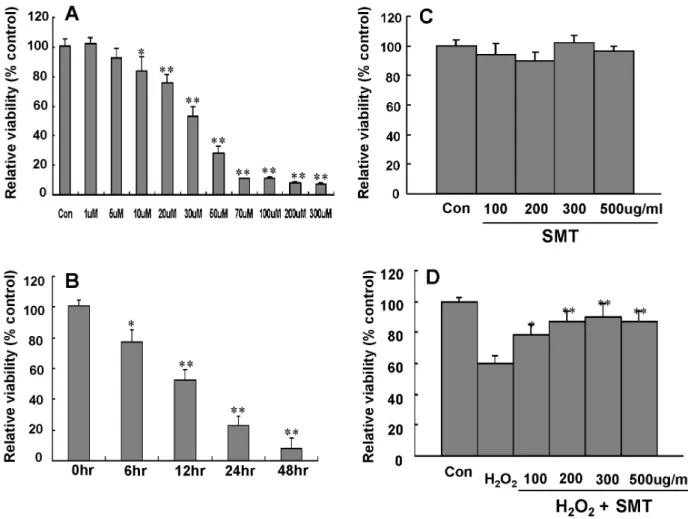
We examined the concentration-dependent effect of H

2

O

2

on cell death and determined cell viability using a MTT assay following 12 h H

2

O

2

challenge. When SK-N-MC cells were treated with various concentrations of H

2

O

2

(1∼300 μM) for 12 h, a significant cell death in a dose-dependent man- ner was observed (Fig. 1A). Cell viability in SK-N-MC cells after exposure to 30 μM H

2

O

2

was about 55% that of control viability. Additionally SK-N-MC cells showed time-depend-

ent cytotoxicity for 48 hours after exposure to 30 μM H

2

O

2

(Fig. 1B).

At concentrations less than 500 μg/ml, cells treated with various concentrations of standardized extract alone for 24 h showed no obvious changes in viability (Fig. 1C). However, SK-N-MC cells pretreated with SMT at 100, 200, 300, and 500 μg/ml 2 h before exposure to H

2

O

2

(30 μM) had statisti- cally significant increases in viability, up to 78.5±6.7 (p<

0.05), 87.2±6.8 (p<0.05), 90.1±8.7 (p<0.05), and 86.3±7.2%

(p<0.05) (n=3), respectively. SMT therefore protected SK- N-MC cells from oxidative injury (Fig. 1D).

Effects of SMT on nuclear morphologic changes

SK-N-MC cells were stained with DAPI dye to investigate

the nature of H

2

O

2

-induced cell death. Typical morphologic

changes indicating apoptotic cell death, such as shrunken

nuclei, chromatin condensation and appearance of apoptotic

bodies, were observed in SK-N-MC cells after exposure to

30 μM H

2

O

2

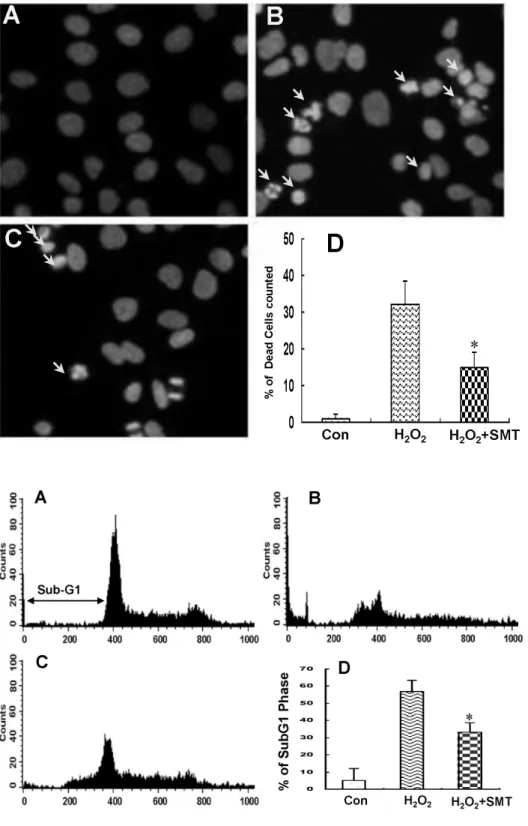
for 12 h (Fig 2B, D). However, pretreatment

with 300 μg/ml SMT for 2 h markedly reduced the level

of H

2

O

2

-induced apoptotic cells (n=3; p<0.05) (Fig. 2C, D).

(4)

Fig. 2. Photographs of DAPI staining showing changes in DNA morphology of SK-N-MC cells. (A) Control cells not treated with H

2

O

2

, (B) cells treated with 30 μM H

2

O

2

for 12 h, (C) cells treated with SMT (300 μg/

ml) 2 h prior to 30 μM H

2

O

2

, (D) bar histogram showing percent of cells showing abnormal nuclear morphology counted in 3 randomly selected fields.

A large amount of DNA was condensed or fragmented in cells treated only with H

2

O

2

(arrows), but pretreatment with SMT significantly reduced DNA abnormalities. Values are mean±S.D.

of each triplet (n=3). *Denotes a sig- nificant difference between H

2

O

2

and H

2

O

2

+ SMT (*p<0.05).

Fig. 3. Flow cytometric analysis showing changes in cell cycle of SK- N-MC cells. (A) Control, (B) treatment with 30 μM H

2

O

2

, (C) SMT (300 μg/

ml) treatment 2 h prior to exposure to H

2

O

2

for 12 h, (D) bar histogram showing percent changes of sub-G1 phase in cell cycle. Values are mean±

S.D. of each triplet (n=3). *Denotes a significant difference between H

2

O

2

and H

2

O

2

+SMT (*p<0.05).

Effects of SMT on cell cycle

To test whether treatment with H

2

O

2

induced cell death via apoptosis, the percentage of apoptotic cells was meas- ured by flow cytometry. Fig. 3B indicates that treatment with 30 μM H

2

O

2

for 12 h significantly induced the sub-G1 phase, an indicator of cell apoptosis, in SK-N-MC cells com-

pared with control (Fig. 3A). Pre-incubation with 300 μg/ml SMT for 2 h significantly attenuated the accumulation of H

2

O

2

-induced apoptotic cells in the sub-G1 peak (n=3; p<

0.05) (Fig. 3C, D).

Effects of SMT on DNA fragmentation

Untreated SK-N-MC cells displayed no detectable DNA

(5)

Fig. 5. Flow cytometric analysis sho- wing changes in the mitochondrial membrane potential of SK-N-MC cells. (A) Control, (B) treatment with 30 μM H

2

O

2,

(C) SMT (300 μg/ml) treatment 2 h prior to exposure to H

2

O

2

for 12 h, (D) bar histogram sho- wing the percent changes of relative fluorescence intensity (RFI) of mito- chondrial membrane potential in con- trol, H

2

O

2

-only treated, and SMT plus H

2

O

2

treated SK-N-MC cells. Values are means±S.D. of each triplet (n=3).

*Denotes a significant difference be- tween H

2

O

2

and H

2

O

2

+ SMT (*p<

0.05).

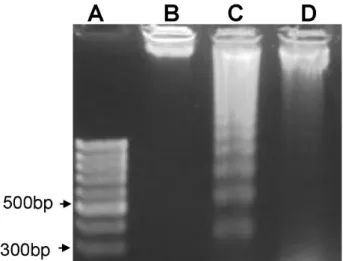
Fig. 4. Agarose gel electrophoresis of DNA extracted from SK-N-MC cells. Lane A, DNA marker (100 bp); Lane B, control; Lane C, treatment with 30 μM H

2

O

2

for 12 h; Lane D, SMT (300 μg/ml) treatment 2 h prior to exposure to H

2

O

2

for 12 h.

Fig. 6. RT-PCR analysis of caspase-3 mRNA expression from the cDNA of SK-N-MC cells 3 h after H

2

O

2

treatment. Control, cells not treated with H

2

O

2

; H

2

O

2

, cells treated with 30 μM H

2

O

2

for 3 h; SMT-H

2

O

2

, cells treated with 300 μg/ml SMT 2 h prior to 30 μM H

2

O

2

. Values are means±S.D. of each triplet (n=3). *Denotes a significant difference between H

2

O

2

and H

2

O

2

+ SMT (*p<0.05).

fragmentation in the agarose gel electrophoresis (Fig. 4B).

In contrast, SK-N-MC cells treated with 30 μM H

2

O

2

dis- played a marked increase in DNA laddering (Fig. 4C).

Pre-incubation with 300 μg/ml SMT for 2 h, however, led to a reduction in DNA laddering caused by H

2

O

2

-induced apoptosis (Fig. 4D).

Effects of SMT on mitochondrial transmembrane potential

Changes in the mitochondrial transmembrane potential in SK-N-MC cells treated with H

2

O

2

were quantified by flow cytometry with a dye mitotracker. Treatment of SK-N-MC

cells with 30 μM H

2

O

2

for 12 h produced a significant re- duction in mitochondrial membrane potential (Fig. 5B, D).

In contrast, pretreatment with 300 μg/ml SMT for 2 h pre- vented the H

2

O

2

-induced decrease of mitochondrial trans- membrane potential (n=3; p<0.05) (Fig. 5C, D).

Effects of SMT on expression of caspase-3 mrna and caspase-3 enzyme activity

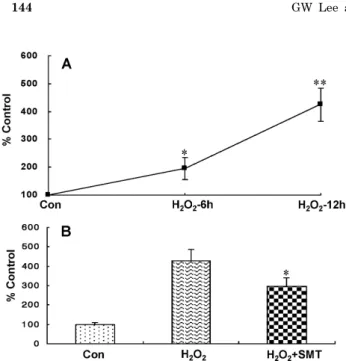
The expression of caspase-3 mRNA in SK-N-MC cells was

significantly upregulated by about 450% that of the control

level 3 h after H

2

O

2

exposure. In contrast, a significant re-

duction occurred in H

2

O

2

-induced expression of caspase-3

mRNA by pretreatment with 300 μg/ml SMT 2 h prior to

(6)

Fig. 7. Changes in caspase-3 enzyme activity from whole cell lysate of SK-N-MC cells. (A) Caspase-3 enzyme activity at 6 and 12 h after 30 μM H

2

O

2

treatment, (B) effect of SMT (300 μg/ml) pretreatment on caspase-3 enzyme activity 12 h after H

2

O

2

treatment. Values are means±S.D. of each triplet (n=3). *Denotes a significant difference between H

2

O

2

and H

2

O

2

+ SMT (*p<0.05, **p<0.01).

Fig. 8. Western blot analysis for expression of the PARP protein from whole cell lysates of SK-N-MC cells 12 h after H

2

O

2

treatment.

Control, cells not treated with H

2

O

2

; H

2

O

2

, cells treated with 30 μM H

2

O

2

for 12 h; SMT-H

2

O

2

, cells treated with 300 μg/ml SMT 2 h prior to 30 μM H

2

O

2

. Values are means±S.D. of each triplet (n=3).

*Denotes a significant difference between H

2

O

2

and SMT-H

2

O

2

(*p<0.05, **p<0.01).

H

2

O

2

exposure (n=3; p<0.01) (Fig. 6).

The caspase-3 enzyme activity was determined by meas- uring relative levels of activated caspase-3 using the colori- metric caspase-3 substrate. Caspase-3 enzyme activity was significantly upregulated after 6 h of 30 μM H

2

O

2

treat- ment, and it further increased to about four times that of the control level after 12 h of H

2

O

2

treatment (n=3; p<0.01) (Fig. 7A). Enzyme activity was significantly reduced when SK-N-MC cells were treated with 300 μg/ml SMT for 2 h prior to exposure to 30 μM H

2

O

2

(n=3; p<0.05) (Fig. 7B).

Effects of SMT on the expression of PARP protein Since it is known that proteolysis of poly (ADP ribose) polymerase (PARP) by caspase-3 is an important marker for apoptosis, Western blot analysis was used to determine whether the PARP cleavage product was expressed upon H

2

O

2

-induced cell death in SK-N-MC cells. A marked in- crease in 85-kDa cleaved forms of PARP from the 116-kDa origin protein was observed after 12 h exposure to 30 μM H

2

O

2

(Fig. 8A). Pre-incubation with 300 μg/ml SMT, how- ever, significantly attenuated the breakdown of PARP protein caused by H

2

O

2

-induced apoptotic cell death (n=3; p<0.01) (Fig. 8B).

DISCUSSION

Oxidative stress with H

2

O

2

has been widely used to as- sess cytoprotection, mainly in various cultured cell lines.

While a high degree of oxidative stress causes necrosis, low- er degrees trigger apoptosis (Dypbukt et al., 1994). A mod- erate concentration of H

2

O

2

activates the caspase, but high- er concentrations do not (Hampton and Orrenius, 1997).

When SK-N-MC cell cultures were incubated with 30 μM

H

2

O

2

for 12 h, shrunken or fragmented nuclei were ob- served via fluorescence imaging, as was DNA laddering via electrophoretic gel and increases in sub-G1 phase and in cleavage of the PARP protein. Additionally, a significant reduction of mitochondrial membrane potentials was ob- served after 6 h exposure to 30 μM H

2

O

2

. The expression of caspase-3 mRNA and caspase-3 enzyme activity were up- regulated after 3-h and 12-h treatments of 30 μM H

2

O

2

, respectively. The dose (30 μM) of H

2

O

2

used in this study was therefore sufficient to induce apoptotic cell death in SK-N-MC cells.

In this study, the water extract of SMT at concentrations less than 500 μg/ml yielded a minimal change in cell via- bility, suggesting that the concentration of SMT used for the cytoprotective tests was a sublethal dose in SK-N-MC cells. This study demonstrated that pretreatment with SMT for 2 h significantly attenuated H

2

O

2

-induced ctyotoxicity in a concentration-dependent manner. Moreover, when the SK-N-MC cells were treated with SMT (300 μg/ml) for 2 h prior to exposure to H

2

O

2

, apoptotic phenomena as de- scribed above were significantly reduced. In an earlier in vitro study (So et al., 2000), pretreatment with water ex- tract of SMT (25∼300 μg/ml) significantly prevented LPS/PMA-induced cell death and suppressed apoptotic mor- phologic changes in C6 glioma cells. Pretreatment with Radix Paeoniae Alba extract, a crude herb contained in SMT, for 3 h significantly increased cell viability in a con- centration-dependent manner, demonstrating protection from oxidative damage in the HT22 hippocampal cell line (Kang et al., 2005). Accordingly, SMT or individual crude components of SMT are likely to also inhibit apoptotic cell death in glial and neuronal cell lines in the same way.

Hydrogen peroxide can induce mitochondrial permeability

transition through an increase in intracellular calcium con-

centration, and can cause a loss in mitochondrial mem-

brane potential in a process believed to be involved in the

activation of apoptosis (Polla et al., 1996). The mitochon-

drial permeability transition causes the cytosolic release of

(7)

cytochrome c and apoptosis-inducing factor, which activate caspases-3 (Bouchier-Hayes et al., 2005). In this study, pre-incubation with the water extract of SMT (300 μg/ml) for 2 h prevented the H

2

O

2

-induced decrease in mitochon- drial transmembrane potential of SK-N-MC cells. SMT also attenuated an increase in caspase-3 activity and in the breakdown of PARP protein caused by H

2

O

2

-induced oxida- tive stress.

Water extract of SMT significantly inhibited NO generation and iNOS protein expression from the LPS/PMA-treated C6 glial cells (So et al., 2000). Additionally, pretreatment with SMT completely blocked NK-κB activation induced by LPS/PMA. Radix Paeoniae Alba, a crude herb contained in SMT, exhibited potent scavenging activity in both the 1,1-diphenyl-2-picrylhydrazyl radical and the superoxide anion assays (Kang et al., 2005). Paeoniflorin, the principal bioactive component of Radix Paeoniae Alba, was also able to prevent injury from calcium overloading in cultured pri- mary cortex neurons (Yang et al., 2001). It has been sug- gested that the water extract of SMT protected SK-N-MC cells from H

2

O

2

-induced toxicity by scavenging free radicals and preventing mitochondrial injury. However, further in vitro experiments are needed to elucidate the exact cellular mechanisms responsible for the neuroprotective effects of SMT.

In previous in vivo experiments, 7-day pretreatment with SMT extract prevented apoptosis in jejunal crypt cells and blood cells in irradiated mice with high and low doses of gamma-irradiation (Hsu et al., 1996; Lee et al., 1999). This radioprotection in jejunal crypt cells was also observed when treated only with Rhizoma Chuanxiong or Radix Paeoniae Alba. No studies have yet been undertaken, how- ever, to observe the neuroprotective effects of SMT in brain ischemia in vivo. Further research is therefore needed to evaluate whether SMT suppresses neuronal death or im- proves behavioral deficits in an in vivo brain ischemic model.

ACKNOWLEDGEMENT

This study was supported by a grant from the Oriental Medicine R&D Project (No. 03-PJ9-PG6-SO02-0001), Ministry of Health & Welfare, South Korea.

REFERENCES

Bouchier-Hayes L, Lartigue L, Newmeyer DD. Mitochondria:

pharmacological manipulation of cell death. J Clin Invest 115:

2640−2647, 2005.

Chan PH. Reactive oxygen radicals in signaling and damage in the ischemic brain. J Cereb Blood Flow Metab 21: 2−14, 2001.

Dypbukt JM, Ankarcrona M, Burkitt M, Sjoholm A, Strom K, Orrenius S, Nicotera P. Different prooxidant levels stimulate growth, trigger apoptosis, or produce necrosis of insulin-secreting

RINm5F cells. The role of intracellular polyamines. J Biol Chem 269: 30553−30560, 1994.

Fujimura M, Tominaga T, Chan PH. Neuroprotective effect of an antioxidant in ischemic brain injury: involvement of neuronal apoptosis. Neurocrit Care 2: 59−66, 2005.

Graf E. Antioxidant potential of ferulic acid. Free Radic Biol Med 13: 435−448, 1992.

Hampton MB, Orrenius S. Dual regulation of caspase activity by hydrogen peroxide: implications for apoptosis. FEBS Lett 414:

552−556, 1997.

Hsu HY, Ho YH, Lin CC. Protection of mouse bone marrow by Si-WU-Tang against whole body irradiation. J Ethnopharmacol 52: 113−117, 1996.

Kang SS. Recommended Prescription of Herbs. Daesung Culture Press, Seoul, 1993.

Kang TH, Baek HY, Kim YC. Protective effect of jakyak-gamcho- tang extract and its constituents against t-BHP-induced oxida- tive damage in HT22 cells. Am J Chin Med 33: 181−189, 2005.

Lee SE, Oh H, Yang JA, Jo SK, Byun MW, Yee ST, Kim SH.

Radioprotective effects of two traditional Chinese medicine prescriptions: si-wu-tang and si-jun-zi-tang. Am J Chin Med 27:

387−396, 1999.

Polla BS, Kantengwa S, Francois D, Salvioli S, Franceschi C, Marsac C, Cossarizza A. Mitochondria are selective targets for the protective effects of heat shock against oxidative injury. Proc Natl Acad Sci U S A 93: 6458−6463, 1996.

Scott BC, Butler J, Halliwell B, Aruoma OI. Evaluation of the antioxidant actions of ferulic acid and catechins. Free Radic Res Commun 19: 241−253, 1993.

Sheng YX, Li L, Wang Q, Guo HZ, Guo DA. Simultaneous determination of gallic acid, albiflorin, paeoniflorin, ferulic acid and benzoic acid in Si-Wu decoction by high-performance liquid chromatography DAD method. J Pharm Biomed Anal 37: 805−

810, 2005.

Shin MK. Selective oriental therapy for various diseases. New Clinical Therapies of Oriental Traditional Medicine. Seoul, Younglim Press, p 389−390, 1996.

So HS, Oh J, Chung YT, Moon YJ, Kim DH, Moon BS, Lee HS, Baek SW, Park C, Lim YS, Kim MS, Park R. The water extract of Samultang protects the lipopolysaccharide (LPS)/phorbol 12-myristate 13-acetate (PMA)-induced damage and nitric oxide production of C6 glial cells via down-regulation of NF-kappaB.

Gen Pharmacol 34: 303−310, 2000.

Sugawara T, Chan PH. Reactive oxygen radicals and pathogenesis of neuronal death after cerebral ischemia. Antioxid Redox Signal 5: 597−607, 2003.

Watanabe H, Ni JW, Ohta H, Ni XH, Matsumoto K. A kampo prescription, shimotsu-to, improves scopolamine-induced spatial cognitive deficits in rats. Yakubutsu Seishin Kodo 11: 215−222, 1991.

Xie M. Modern Study of the Medical Formulae in Traditional Chinese Medicine. Beijing: Xue Yue Press, 1997.

Yan JJ, Kim DH, Moon YS, Jung JS, Ahn EM, Baek NI, Song DK.

Protection against beta-amyloid peptide-induced memory impairment with long-term administration of extract of Angelica gigas or decursinol in mice. Prog Neuropsychopharmacol Biol Psychiatry 28: 25−30, 2004.

Yang J, He LN, He SB, Li GR. Protective effect of paeoniflorin on calcium overloading injury in cultured primary cortex neurons.

Chinese Journal of Pharmacology and Toxicology 15: 164−168,

2001.

수치

Fig. 1. Effects of H 2 O 2  or SMT on cell viability in SK-N-MC cells. (A) Dose-response relationship of H 2 O 2  on cell viability, (B) time-dependent  relationship of H 2 O 2  (30 μM) on cell viability, (C) dose-response relationship of SMT, (D) effect o
Fig. 2. Photographs of DAPI staining  showing changes in DNA morphology of SK-N-MC cells
Fig. 5. Flow cytometric analysis sho- sho-wing changes in the mitochondrial  membrane potential of SK-N-MC  cells
Fig. 7. Changes in caspase-3 enzyme activity from whole cell lysate  of SK-N-MC cells

참조

관련 문서

The purpose of this research was to suggest the water quality improvement in streams by evaluating the distribution characteristics of organics and ammonia nitrogen

The purpose of this study was to evaluate the effect of these substances on bone regeneration by applying these materials to bone defects after cyst

The purpose of this study was to investigate the effects of a disability awareness program on improving the attitudes of regular elementary school

interaction with anti-apoptotic Bcl-2 family members, we investigated whether Mcl-1 can inhibit the Noxa-induced cell death.. As expected, Mcl-1 significantly inhibits

A Study on the Development of Ship’s Ballast Water A Study on the Development of Ship’s Ballast Water A Study on the Development of Ship’s Ballast Water A Study on the

Objective: The purpose of this study was to investigate the relationship between the awareness of death and the ethical attitude to Do-Not-Resuscitate (DNR) among some

The purpose of this study is to analyze the effects of service quality on customer satisfaction and revisit intention perceived by Chinese golf range

The purpose of this study is to evaluate the marginal and internal fit of coping made by CAD/CAM using different scanning methods.. Zirconia coping was made