https://doi.org/10.6111/JKCGCT.2017.27.2.080
A time dependent thermal and solutal convection problem in physical vapor transport of Hg 2 Cl 2 -I 2 system
Geug Tae Kim
†Department of Advanced Materials and Chemical Engineering, Hannam University, Daejeon 34054, Korea (Received February 23, 2017)
(Revised March 17, 2017) (Accepted March 24, 2017)
Abstract In this research a time dependent thermal and solutal convection was computationally investigated for the physical vapor transport of the mixture of Hg
2Cl
2-I
2system with for the convective regime from thermal Rayleigh number of 2.16 × 10
6up to 1.7 × 10
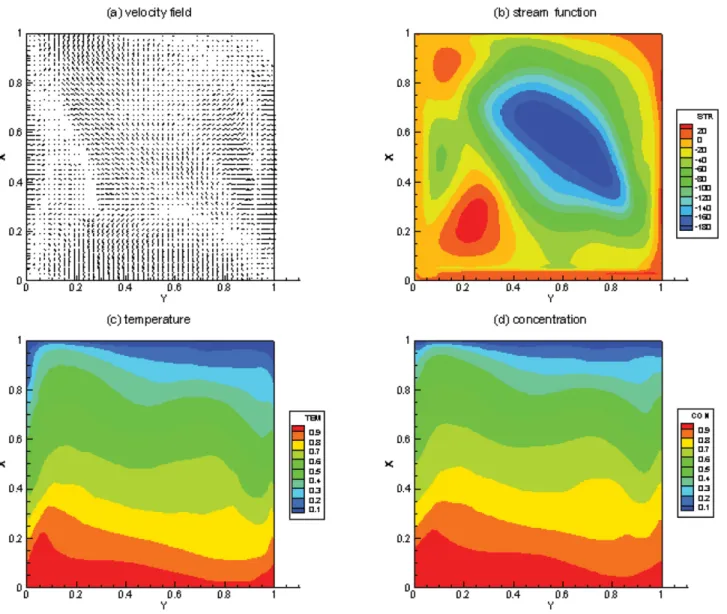
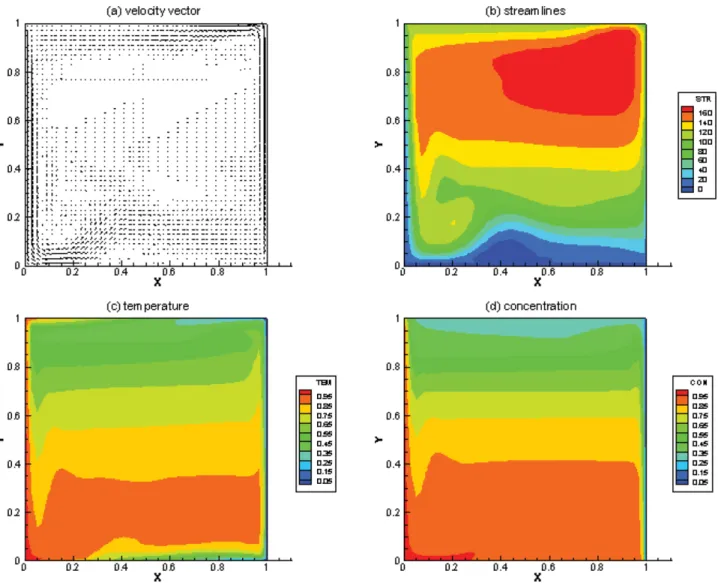
7with marching time to a steady state problem. With time marching, the convective cells are decreased for the thermal Rayleigh number of 2.16 × 10
6, and increased for the thermal Rayleigh number of 1.7 × 10
7. The convective flow structures are found to be essentially time independent on the horizontal orientation of the enclosure with respect to the gravity vector, and on the other hand, time dependent on the vertical orientation of the enclosure with respect to the gravity vector.
Key words Time dependent, Convection
1. Introduction
This paper concerns the time dependent thermal and solutal convection problems, which arise from the physical vapor transport processes of the mixture of Hg
2Cl
2-I
2system to predict the transition from unsteady to steady state flows. These problems are primarily of two configurations of enclosures. Firstly, there is the configuration of the horizontal position, i.e., hori- zontal temperature and solutal gradients present in the system of horizontal rectangular geometry with differ- entially heated end walls. Secondly, with respect to a vertical position, when the source material of mercu- rous chloride (Hg
2Cl
2) is placed with a furnace imposed with a linear temperature profile, the source of mer- curous chloride sublimes and is transported as a mix- ture of Hg
2Cl
2vapor and impurity of I
2and is recry- stallized into the crystal region. In this study, the lat- ter problem is focused because it has essentially the time dependent thermal and solutal problem under con- vective parameter ranges. In a view of point of stabi- lizing temperature profiles, the former problem is also covered in a case chosen for the study of the con- vective flow structure.
Duval investigated systematically for a wide range of convective parameters of thermal Rayleigh num- ber from 1.80 × 10
1to 5.03 × 10
7[1-4]. In particular,
Duval investigate computationally the time dependent problems in refs [1-4]. Until now, much research are focused into the problems at the steady state during the physical vapor transport (PVT) processes [5-10].
With regard to studies on the PVT in the vapor phase, in a more recent year Tebbe et al. [12] extended for transition to chaos flow fields in specialty materials of mercurous chloride in applications of microgravity experiments. In this study, one uses a material of Hg
2Cl
2as a model sample and investigate numeri- cally the influence of gravitational accelerations on diffusive convection during the PVT of a mixture of Hg
2Cl
2vapor and impurity of I
2. The distinction of this study in a comparison with our previous study [13] is centered into the unsteady state problem with thermal and solutal convection problems in both a vertical and a horizontal position with respect to the gravity. Therefore, in this study, the detailed convec- tive flow structures are discussed in the transition from unsteady state to steady state.
2. Numerical Analysis
A detailed understanding of the convective structures as well as the transition from the time dependent state to steady state is required since crystal quality is sig- nificantly affected by convection, and particularly for the growth of high quality crystals, the flow oscilla- tions due to the time dependent convective flow should
†
Corresponding author
†