Biodiesel Production From Fat of Tra Catfish and Basa Catfish (Viet Nam) Using Alkaline Catalysts
Le Thi Thanh Huong*․Phan Minh Tan**․Tran Thi Viet Hoa***․Soo Lee
*Center of Chemical Industry, Ho Chi Minh City University of Industry, 12 Nguyen Van Bao Street, GoVap District, Ho Chi Minh City, Viet Nam
**Department of Science and Technology, 244 Đien Bien Phu, 3 District, Ho Chi Minh City, Viet Nam
***Faculty of Chemical Engineering, Ho Chi Minh City University of Technique, 268 Ly Thuong Kiet, 10 District, Ho Chi Minh City National University, Viet Nam Department of Chemical Engineering, Changwon National University, 9 Sarim-dong,
Changwon, Gyeongnam, 641-773, Korea.
(Received April 28, 2008 ; Accepted August 22, 2008)
Abstract : The fat of Tra and Basa catfish (Mekong Delta, Viet Nam) was evaluated for the first time as the potential feedstock for biodiesel production, due to its abundance, availability and cheap cost. The unsaturated fatty acid contents of Tra and Basa fat were 57.97% and 64.17%, respectively. Biodiesel was prepared from Tra and Basa fat by methanolysis reaction using alkali catalysts like sodium hydroxide and potassium hydroxide. Effects of various process parameters on biodiesel production, such as molar ratio of methanol to fat, catalyst concentration, temperature and time were investigated. As those results, the transesterification can be performed under moderate conditions, and the biodiesel yields were shown more than 90%. KOH catalyst was the best catalyst for biodiesel production from both Basa and Tra fat.
As the feedstock aspect, Basa fat was indicated more efficiency than that of Tra fat. The maximum yield could be achieved by the transesterification from Basa fat with 5:1 molar ratio of methanol to fat, 0.8% KOH catalyst, 50oC, and 50 min. For Tra fat, the optimal condition were at 6:1 molar ratio of methanol to fat, 0.8% KOH catalyst, 50oC, and 45 min. Nowadays, due to cheaper cost and abundance, Tra fat is a promised resource for cheap biodiesel production in Viet Nam.
Key Words : Transesterification, Biodiesel, Catfish, Tra fat, Basa fat, KOH catalyst, NaOH catalyst.
✝Corresponding author
(e-mail ; [email protected])
1. Introduction
1.1. Transesterification reaction
Recently, because of increases in crude oil prices, limited resources of fossil oil and environmental concerns, it is important to look for an alternative energy resource that is renewable and environmental benign.
Biodiesel is a promising source of energy.
This alternative diesel fuel is made from renewable biological sources such as vegetable oil and animal fat. It is biodegradable and non-toxic, has low emission profiles, and so is environmentally beneficial. It can be used as pure form or blended with fossil diesel fuel.
Biodiesel is mono-alkyl ester of long chain fatty acid derived from renewable feedstock like vegetable oil, animal fat, and waste cooking oil. It can be produced by the transesterification method, also called alcoholysis, in which oil or fat is reacted with alcohol. Various kinds of oil are researched to use as feedstock for biodiesel production like soybean oil [1], rape-seed oil [2], sunflower oil [3], palm and coconut oil [4] and ect. Soybean oil is commonly used in United States and rape-seed oil is used in many European countries for biodiesel production, whereas, coconut oil and palm oils are used in Malaysia. Nowadays, due to the security energy problem, some researchers focus on non-edible materials like animal fat or oil extracted from wild tree like Jatropha seed [5,6], Pongamia pinnata [7], karanja [8], and castor [9] or waste frying oil [10] and ect. To produce biodiesel on the large scale, feedstock must be abundant, available, and cheap. A catalyst like alkali, acid, and enzyme is usually used to promote reaction rate and yield. The alkalis include NaOH, KOH, carbonates, bicarbonate, sodium and potassium alkoxides such as sodium methoxide, sodium ethoxide, sodium propoxide, and sodium butoxide. Sulfuric acid, sulfonic acid, and hydrochloric acid are
usually used as acid catalysts. Lipases can also be used as biocatalysts. Alkali catalyzed transesterification is much faster, less corrosive than acid catalyzed transesterification and it is most often used commercially, moreover, the reaction conditions are moderate. Hydroxides such as NaOH and KOH are more applicable to industrial uses because of their cheap cost, availability, and efficiency. However, they produce soaps by neutralizing the free fatty acids in the fat and triglyceride saponification. This process will consume catalysts, decrease biodiesel yield, complicated the separation and purification steps [11].
Alcohol was used for the transesterification process include methanol, ethanol, propanol, and butanol [12]. However, methanol has given the best results, as it has the most suitable chemical and physical properties such as polar and shortest chain alcohol. The transesterification reaction was affected by molar ratio of triglycerides to alcohol, catalyst, reaction time and temperature, water and free fatty acid content of oils or fats [13].
1.2. Tra and Basa Catfish in Mekong Delta of Viet Nam
"Tra" and "Basa" are classified as catfish, the order Siluriformes, family Pangasidae, genus Pangasius which are shown in Fig. 1.
The scientific name of Tra and Basa are Pangasius hypophthalmus and Pangasius bocourti, respectively. Basa is native in Mekong River basin and Chao Phraya River flowing onto Viet Nam, Laos, Thailand, and Cambodia. Previously, Tra was raised in ponds in the Southern Delta, Viet Nam.
Basically, they live in freshwater, and are bearable in lightly brackish water (salnidity of less than 10%) and alum water (pH > 4).
Tra has a lateral respiratory organ, breathes with bladder and skin, and hence, is bearable in environtment lacking of dissolved oxygen. Tra can be farmed in crowded space
a b Fig. 1. The Tra Catfish (Pangasius hypophthalmus) (a) and Basa Catfish (Pangasius bocourti) (b).
of high density (50 heads/m2) like floating cages, ponds, and recently "dang quan"
(immersing fences). In contrast, Basa is also known as "belly fish"due to its large fat belly flap; it has no lateral respiratory organ and its ability to live in dissolved oxygen lacking environment is low. In addition, Tra can eat various food organic wastes, bran, vegetable, bottom microorganism and synthetic food. Food for Basa is usually a mix of broken rice, bran, vegetable and broken fish (cooked), which are appropriately used in floating cages in strongly flowing water.
There are two sources of fish farming:
natural and artificial breeding. Catfish can not be spawned in pond. Natural fry swims to Viet Nam from Cambodia breeding ground.
Every year in the flooding season, fishers use "day", a kind of net, to skim fry and nurse it in ponds. Fry is grown into fingerlings, which are supplied to floating cages. The fry output is decreasing due to changes in environmental conditions and overexploitation. Recently, Viet Nam has been successful in launching artificial breeding of Basa and actively supplied brood stock to the catfish farming.
In recent years, Tra and Basa catfish have been emerged as the new "tigers" amongst fishes due to gaining fast popularity, and widespread acceptance in the export market of Viet Nam. Tra and Basa catfish or so-called Vietnamese catfish have now
become often-used new terms in the global seafood trade vocabulary. Tra and Basa production has sharply developed in Mekong Delta provinces of Viet Nam, because of the high value of catfish fillet to export. The most important regions for catfish farming produce the greatest amount of Tra and Basa catfish such as An Giang and Can Tho province (Viet Nam). Tra is more easily raised and has higher export value, which takes a high proportion (95%) in catfish exports (according to Vietnamese Association of Seafood Exporters and Produters-VASEP) in spite of low price. The total output of Tra and Basa in Mekong Delta provinces was 264,436 tons in 2004, 825,000 tons in 2006, and 1.5 million tons in 2007 (in a farming area of 5,600 hectares). In addition to the traditional southern provinces of Viet Nam, Tra and Basa are also now being bred in the centre and north. In the northern of Ha Tay province (Viet Nam), the farmer can achieve 80 tons per hectare, also, in Nghe An province (one province of Viet Nam north’s) could be obtained 150 tons per hectare.
Accordingly, it is predicted that Viet Nam can produce 2 million tons per year during next few years.
1.3. Production fat of Tra and Basa catfish
The catfish is usually subdivided into fillet, head, backbone, crush meat, skin, storage fat from anterior part of the belly area, swim
Wet fish meal Second frying
First frying
Third frying
Second s eparated fat
Third separated fat
Cooking and mixing with powed
Settling tank
Waste water
Fat of Tra and Basa catfish
Dryer Dried fish meal
By-products of Tra and Basa fillet
First separated fat
Fig. 2. The schematic of Tra and Basa fat production bladder, stomach, viscera, kidney and blood.
The fillet for exporting takes 34% on average of catfish [14]. Thus, there would be around 66% by-products after export processing, which should be opportunities for futher processing into more added value catfish like gelatin from skin, purely refined fat, mineral rich bone meal, and ect. In the processing plants, the offal (head, bone, belly flap, fat, and fins) are fried to produce raw fish fat.
Then, fat is collected and filtered to remove water for high quality. Fat of catfish can be further refined by physical or chemical methods for using as food. Other by-products such as skin, head and fins can be processed into fish meal to be used as feedstock for animal [15].
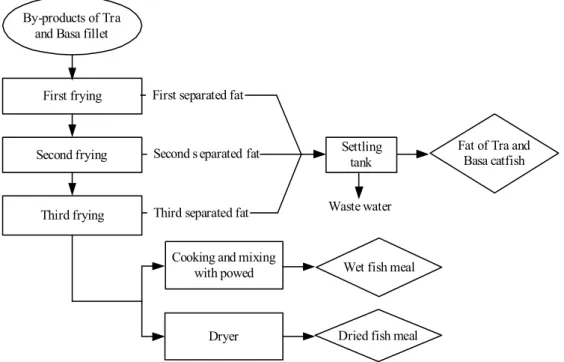
At the present of Mekong Delta, fish fat resulting from fillet exports is processed in traditional manual method in Fig. 2, it is shown the schematic diagram of processing involved in Tra and Basa fat production. The production fish fat and fish meal from Tra
and Basa wastes are taken place on the spontaneous small-scaled basis in manual method, the yield was only 10%-16%, whereas, 20%-22% for the industrial method.
Fat collected manually often contains water, free-fatty acid and residual, and has fishy odor and non-uniform colour. The low yield will increase the cost of production, and the method will seriously deteriorate the environment. However, the high cost of equipment prevents processing companies from updating their technology to increase value and decrease cost of by-products.
1.4. Prospect of producing biodiesel from fat of Tra and Basa Catfish in Viet Nam
Nowadays, during the process plants, a small part of fish skin is exported (Italy, UK, India and ect.) for gelatin production. The large quantities of available by-products like fat and meal of catfish are used as animal feed. Biodiesel production from fish fat is a
new promising industry that can make use of the huge fish wastes, create jobs for Mekong Delta people and contribute to salvaging the downgrading environment. In Viet Nam, the exploitation of this potential on a large scale is most likely thanks to increasing fillet export, labor and material abundance with cheap prices.
In the present work, the fatty acid compositions and chemical properties of Tra and Basa fat (An Giang and Can Tho provinces, Viet Nam) were analyzed. The effect of NaOH and KOH catalysts on the biodiesel production from Tra and Basa fat by transesterification reaction were investigated. Influence of the parameters such as; methanol to fat molar ratio, catalyst amount, reaction time, and temperature on the transesterification reaction were demonstrated.
2. Experimental
2.1. Materials
Tra and Basa fat (An Giang Agriculture and Food Export Company, Afiex) were used in this study. Tra and Basa fat from An Giang and Can Tho provinces were selected randomly on the processing line from January 2006 to July 2007 and November 2007, respectively. The chemical and physical properties of these two feedstocks were analyzed (Table 1). The commercial methanol (90%) was obtained commercially. The sodium hydroxide (82%) and potassium hydroxide catalyst (86%) were used in this research (China). The gas chromatograph standards for methyl esters were used for analysis (Fulka, United Kingdom and Sigma, Spain). Chemicals were used for analysis (Merck, Germany).
2.2. Transesterification of Tra and Basa fat
The catalyst content (wt%) was calculated from the total weight of fat plus methanol prior to reaction. The appropriate catalyst and methanol were placed in 250 cm3 two-necked glass flask, which was equipped with a reflux condenser. The mixture was stirred (600 rpm) by a combination hot plate and magnetic stirrer for 20 min. Then the
flask was immersed in a
constant-temperature bath and heated up to required temperature. After that, 0.05 mol of fat was added into flask. The mixture was stirred with the same rate for all conditions.
After tranesterification was completed, the excess of methanol was removed by vacuum at 50oC with rotational evaporator. The mixture was divided into two phases by separator funnel after 4h, and the separated upper layer was biodiesel. After separation, biodiesel was washed by hot distillated water (60-70oC), and this process continued until the washing was neutral. Finally, biodiesel was dried by the microwave.
2.3. Analytical methods
Important fuel properties of methyl esters of Tra and Basa fat were prepared in accordance with ASTM D6751 (biodiesel standard).The fatty acid compositions of Tra and Basa fat were determined by AOAC method. The qualitative and quantitative analyses of biodiesel production were carried out by GC method using the HP 6890 Series Gas Chromatograph System, and were analyzed with the MSD 5973 and FID detector using the EN 14103:2003 method.
The column HP INNOWAX (polyethylene glycol capillary column) was a 30m x 530μm x 1μm. The biodiesel production was tested with ASTM D 6751. The production yield was defined as the weight percentage of the final products relative to the weight of catfish fat.
The purity of biodiesel production was calculated from the area of catfish methyl ester over the reference area analyzed by gas
Fatty acid
Tra fat
Basa fat (Floating cages) An Giang province Can Tho province
Average Floating (%)
cages Ponds Immersing
fences Floating
cages Ponds Immersing fences
C12:0 0.13 0.11 0.12 0.16 0.14 0.14 0.13 0.04
C14:0 3.99 3.51 4.04 4.09 4.33 4.19 4.03 1.42
C15:0 0.20 0.18 0.20 0.23 0.25 0.23 0.22 0.14
C16:0 29.83 28.21 30.61 26.90 29.00 28.66 28.87 25.30
C16:1 0.82 0.73 0.80 0.86 0.81 0.83 0.81 0.74
C17:0 0.23 0.20 0.21 0.21 0.23 0.22 0.22 0.25
C18:0 7.75 7.44 8.14 7.00 7.68 7.74 7.63 8.24
C18:1 38.25 39.39 37.47 41.48 39.48 39.96 39.34 46.62
C18:2 14.01 15.24 13.49 14.34 13.47 13.41 13.99 14.04
C18:3 0.91 0.97 0.91 1.07 1.01 1.01 0.98 0.51
C20:0 0.32 0.35 0.37 0.30 0.35 0.31 0.33 0.25
C20:1 1.08 1.21 1.18 1.10 1.06 1.11 1.12 0.67
C20:4 0.52 0.54 0.50 0.49 0.47 0.48 0.50 0.54
C20:5 0.59 0.6 0.60 0.76 0.72 0.72 0.68 0.32
C22:0 0.29 0.27 0.28 0.26 0.29 0.26 0.28 0.11
C22:1 0.00 0.00 0.00 0.00 0.00 0.00 0.00 0.05
C22:5 0.00 0.00 0.00 0.00 0.00 0.00 0.00 0.09
C22:6 0.77 0.64 0.74 0.45 0.42 0.28 0.55 0.59
C24:0 0.31 0.35 0.34 0.30 0.29 0.45 0.34 0.08
Table 1. The fatty acid composition (% w/w) of Tra and Basa fat with different cultivated methodology and location
chromatograph method. The free glycerin was determined by spectrophotometric method [16]. The total glycerin determined by A.O.C.S Official Method Ca 14-56 [17].
m 100%
(%) m yield Production
fat Basa or fat Tra
production
biodiesel ×
=
m 100%
V C A
A A) (%) (
Purity EI EI
EI
EI × × ×
= ∑ −
A : Sum area of methyl ester peaks from C14:0 to C24:0.
AEI : Peak area of methyl heptadecanoate.
CEI (mg/ml): Concentration of methyl heptadecanoate.
VEI (ml) : Volume of methyl heptadecanoate.
m (mg) : Sample amount.
3. Results and Discussion
3.1. Characterizations of Tra and Basa fat
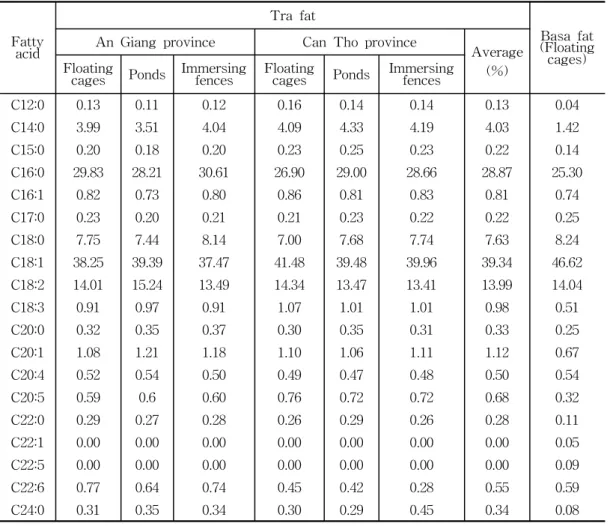
The fatty acid compositions of Tra and Basa fat determined by the gas chromatograph are shown in Table 1.
Properties Tra fat
Basa fat An Giang province Can Tho province
Specific gravity, 30oC (g/ml) 0.9081 0.9095 0.9052
Water content (%) 0.3 0.3 0.06
Acid value (mg KOH/g) 4.4 4.4 1.32
Iodine value (g I2/100g) 63.4 63.6 75.70
Peroxide value (meq/kg) 1.8 1.0 2.99
Saponification value (mg KOH/g) 207 200 198
Table 2. Physicochemical properties of Tra and Basa fat As those results, the total saturated and
unsaturated fatty acid contents of Tra fat were 43.03% and 57.97%, respectively. The unsaturated fatty acid contents of Tra and Basa fat were 57.97% and 64.17%, respectively. Oleic acid (C18:1) was the major fatty acid in both fats (39.34% and 46.62% in Tra and Basa fat, respectively). For palmitic acid (16:0), the values were 28.87% and 25.30% in Tra and Basa fat, respectively. We found that the unsaturated contents of Tra fat were as same as those of palm oil (56.6%) and edible beer tallow (52.0%), but lower than those of vegetable oils such as sunflower, rapeseed, soybean [18, 19].
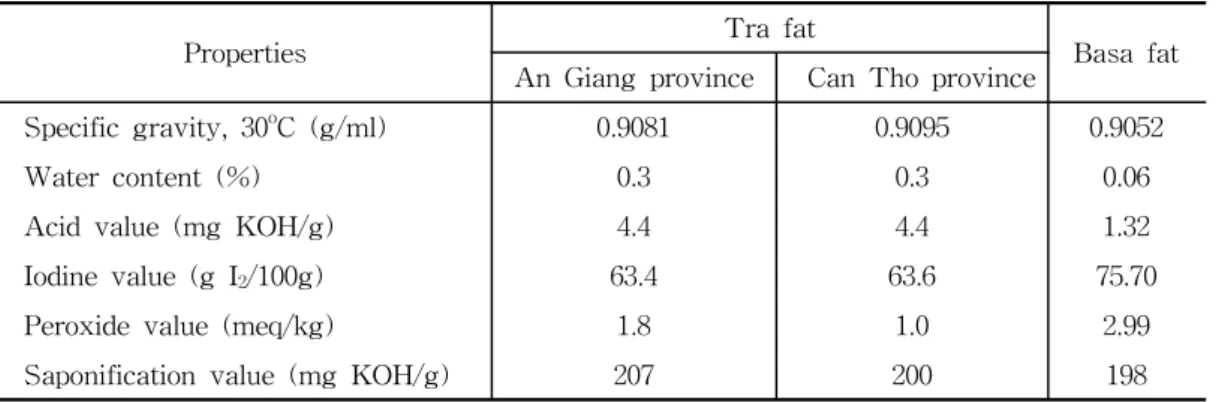
In a previous study, T. Nguyen et al. have proclaimed that fatty acid contents was 46.4%, but the authors haven’t analyzed the contents of some fatty acids (C20:4, C20:5, C22:5, C22:6, C24:0), and differentiate Tra and Basa fat sources [20]. Lower unsaturated contents from Tra and Basa fat can let biodiesel have better properties of cetane number, and oxidative stability; contrary to raising cloud point and viscosity, compared with that of vegetable oil biodiesel. There are no significant differences in fatty acid contents of Tra fat cultivated in floating cages, pond and immersing fences in An Giang and Can Tho provinces. The physicochemical properties of Tra and Basa fat are presented in Table 2. The results show that the acid
value and water contents of Basa fat are lower than those of Tra fat.
Hence, the transesterification reaction with alkaline hydroxide catalyst can be conducted more easily for Basa fat. The iodine value of Basa fat was higher than that of Tra fat, and it is appropriate for the higher unsaturated contents of Basa fat. The color of Basa fat was lighter than the color of Tra fat.
3.2. Preparation biodiesel from fat of Tra and Basa
3.2.1 Effect of molar ratio of methanol to fat
The methanol/fat molar ratio is one of the most important variables affecting the yield of transesterification conversion. Theoretically, the required methanol/triglyceride molar ratio is 3:1. However, because of a reversible reaction, excess of alcohol is required in order to shift the equilibrium of reaction to the product side [21]. The molar ratio is also depended to the type of catalyst used. An acid-catalyzed reaction, it is needed 30:1 ratio of BuOH to soybean oil, while an alkali-catalyzed reaction require only 6:1 ratio to achieve the same yield for a given reaction time [22]. Freedman et al. have reported the effect of molar ratio (from 1:1 to 6:1) on ester conversion with refined
Fig. 3. Effect of methanol/fat molar ratio on the conversion yield of Tra and Basa fat.
vegetable oils. Soybean, sunflower, peanut and cotton seed oil behaved similar and achieved the highest conversion (93-98%) at 6:1 molar ratio [23]. Also, Leung et al. have proclaimed that the maximum ester yield (90%) was obtained at molar ratio of 6:1 for methanolysis of Canola oil with 1.0% NaOH catalyst, reaction temperature of 70oC for 30 min, whereas in the case of frying oil and 1.1% NaOH catalyst, the corresponding yield obtained at 7.5:1 molar ratio of methanol to oil was 87.5% [24]. In this study, methanolysis of Tra and Basa fat was carried out with catalyst amount of 1%
(calculated from the weight total of fish fat and methanol) at 60oC for 60 min.
Methanol/fat molar ratio was changed from 4:1 to 7:1 during investigations.
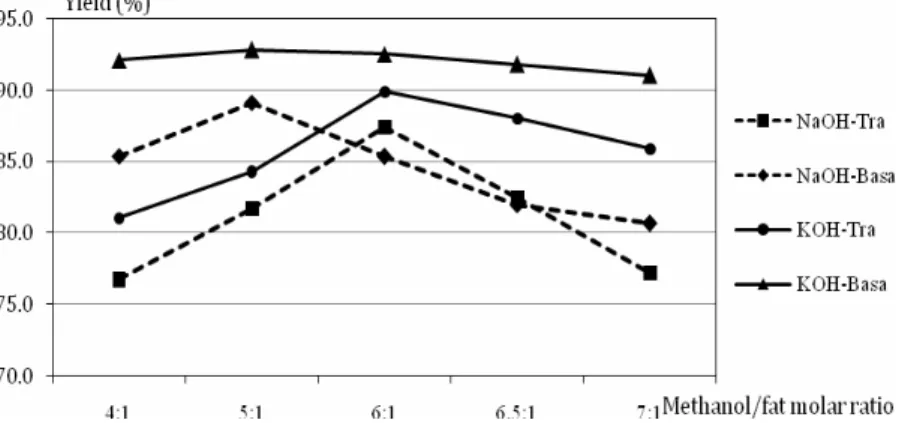
The effect of molar ratio on the yield of conversion of Tra and Basa fat is shown in Fig. 3. It found that the yield of process was increased with increasing molar ratio. For Basa fat, the maximum ester yield with KOH and NaOH as catalyst were 92.8% and 89.1%, respectively, with 5:1 molar ratio.
Correspondingly, with Tra fat, the maximum ester yields were 89.9% and 87.4% at 6:1 ratio, which was larger than that of the 5:1 molar ratio of Basa fat. As the same catalyst used, the ester yield for Basa fat was higher
than that of Tra fat. Tra fat had higher viscosity than that of Basa fat (Table 2), using more methanol for the added solvent for the solubility of catalyst in methanol, to improve dispersion of components in the reaction mixture. Thus, the reasons were different. Increase in methanol/fat molar ratio (higher than 6:1) did not increase the yield of conversion, but the separation and washing step of biodiesel from glycerin phase were difficult due to the formation of emulsion of excessive methanol with glycerin phase. It was observed that at higher molar ratio, a longer time was required for the subsequent separation stage. The results were similar to those of the above mentioned results [21,22,23].
Hence, 5:1 and 6:1 molar ratios of methanol to fat were optimal for the transesterification of Basa and Tra fat, respectively.
3.2.2 Effect of catalyst concentration The acid value of feedstock should be lower than 1 mg KOH/g (0.5%) [23,25]. If the acid value is greater than 1, more alkali hydroxide will be required to neutralize the free acid, and more soap will be produced. In fact, the alkali-catalyzed transesterification of catfish fat could work even if the free fatty
Fig. 4. Effect of amount of catalyst on the conversion yield of Tra and Basa fat
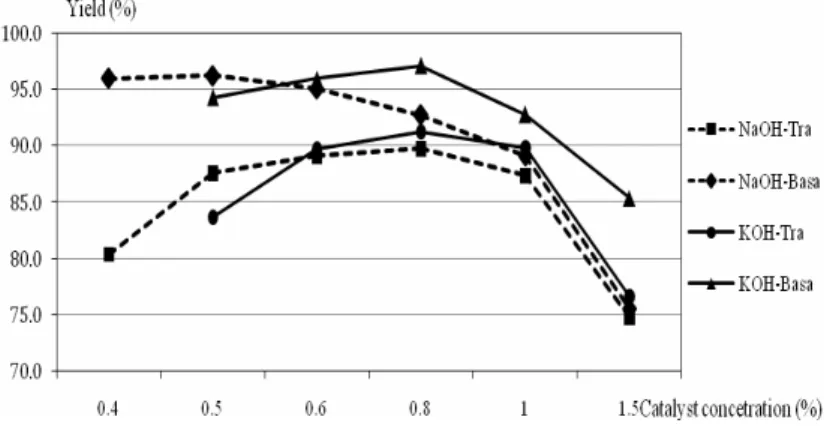
content was over 1%. In our studies, methanolysis of Tra and Basa fat were carried out at 60oC for 60 min with the above-mentioned optimized molar ratios of methanol to Tra and Basa fat. Catalyst concentrations were 0.4%, 0.5%, 0.6%, 0.8%, 1.0%, 1.5 % for NaOH, and 0.5%, 0.6%, 0.8%, 1.0%, 1.5% for KOH. The effect of catalyst concentrations on the yield of conversion of Tra and Basa fat is shown in Fig. 4.
The maximum yields of Tra fat (89.8%) and Basa fat (96.3%) were achieved with NaOH catalyst at concentration of 0.8% and 0.5%, respectively. The maximum transesterification yields of Tra fat (91.3%) and Basa fat (97.1%) were achieved with 0.8% KOH catalyst concentration. It was observed that, the catalyst concentration higher with 0.8% KOH reduced the biodiesel yield due to soap formation. The KOH catalyst for transesterification of Basa fat and Tra fat was more efficient than that of NaOH catalyst. In the feedstock aspect, Basa fat was better than that of Tra fat due to higher transesterification yield with the same value of catalyst. This was explained by the following reasons. Firstly, Basa fat has lower acid value than that of Tra fat. As a result, more soap is produced by the saponification
of the NaOH catalyst with free fatty acid contents in fish fat, which reduce the methyl ester yield. On the other hand, the molecular weight of NaOH catalyst was lower than that of KOH catalyst. It was observed that the separation and washing stage of NaOH catalyzed transesterification required more time due to the lower molecular weight of the catalyst. The best methyl ester yield was obtained at 0.8% KOH catalyst and the Basa fat feedstock.
G. Vicente et al. have studied the transesterifiaction of sunflower oil with methanol using KOH and NaOH catalysts, more soaps were produced by the saponification of free fatty acid contained sunflower oil with catalysts after completing transesterifiaction and formed soap using KOH catalyst (3.46 molar %) was lower than that of NaOH catalyst (5.65 molar %). Also, the author have noted that the yields of methanolysis processing of sunflower oil with NaOH and KOH catalysts under the same reaction condition (65oC, 4 h, 6:1 molar ratio of methanol to oil, 1% of catalyst based on weight of oil) were 86.71% and 91.67%, respectively. Furthermore, yield loss was still related to methyl ester dissolution in the glycerin phase According to this research,
Fig. 5. The effect of reaction time on the conversion yield of Tra and Basa fat
when NaOH was used as the catalyst, an increase in the methyl ester proportion in the glycerin phase was at 6.04 molar %. In comparison with KOH catalyst, the corresponding value was at 3 molar % [26,27]
D.Y.C. Leung et al. (for Canola oil production, at condition 70oC, 30 min, 7.5:1 molar ratio of methanol to oil) have demonstrated that the optimal of the NaOH catalyst concentration was 1.0% and the maximum yield was 94.6%. Thus, compared to used-frying oil with 1.1% NaOH catalyst, the yield was similar value [24]. Also, Nye and Tomasevic et al. have concluded that KOH was the best catalyst for the process of transesterification of used frying oils with different alcohols [28,29]. Since then, the best of NaOH catalyst concentrations for the transesterification used for Tra fat and Basa fat were 0.5% and 0.8%, respectively, and KOH catalyst, concentration was 0.8% for both Tra and Basa fat.
3.2.3 Effect of reaction time
The conversion rate was increased with the reaction time. Ma et al. have noted the effect of reaction time on transesterification of beef tallow with methanol. The reaction
was very slow during the first minute due to the mixing and dispersion of methanol into beef tallow. The reaction proceeded very fast for 1-5 min. The apparent yield of beer tallow methyl esters surged from 1 to 38.
The beef tallow transesterification process was reached the maximum yield for about 15 min [13]. U. Rashid et al. have noted that the yield of rapeseed oil methyl esters (molar ratio of methanol to oil 6:1, 1% KOH, temperature reaction 65oC) was 96% for 120 min reaction time [30].
In the present work, methanolysis of Tra and Basa fat were carried out during different periods of time (30, 40, 45, 50, 60 and 90 min). Other parameters of all experiments, such as molar ratio of methanol to fat, and catalyst concentration, were achieved by the optimal results in the previous sections. The effect of reaction time on the yield is shown in Fig. 5. As a result, the reactions were fast, and the methyl esters yield reached more than 85% with 30 min reaction time. The maximum achieved yield of transesterification of Tra and Basa fat with NaOH catalyst were 91.3% and 91.5% for 45 min, respectively. For the KOH catalyst, the best yields were achieved 96.3%
(Tra fat) and 97.9% (Basa fat) for 50 min.
Fig. 6. Effect of reaction temperature on the conversion yield of Tra and Basa fat
Obviously, for two styles of the feedstock, the KOH catalyzed transesterification was more efficient than that of NaOH catalyzed.
Moreover, the Basa fat feedstock was better than that of Tra fat due to the higher conversion yield, although the reaction time was slightly longer. Generally, the effect of reaction time on the conversion yields of Tra and Basa fat with the catalyst such as NaOH and KOH, have the similar trend. The conversion reaction resulted in the maximum yield if the reaction time was increased continuously but the methyl ester yield would be decreased due to long reaction time at the high temperature (60oC), thus it was accorded soap producing conditions.
As a result, the best reaction time for transesterification from Tra fat with NaOH and KOH catalysts was 45 min. For the Basa fat feedstock, the best reaction time was 50 min for both catalysts.
3.2.4 Effect of reaction temperature Various studies have reported that transesterification could occur with different temperatures. The reaction temperature clearly influenced the reaction rate and yield of esters. The results have revealed that the esters yield was slightly decreased when the reaction temperature was higher than 50oC.
However, other researchers achieved better results by using temperature above 50oC, up to 70-80oC. The reaction temperatures above boiling point of alcohol should be avoided, because at high temperatures (> 60oC) the reactions tend to accelerate the saponification of triglycerides with alkali catalysts [31]. L.C Meher et al. have investigated the transesterification reaction for Karanja oil feedstock with different temperatures such as 37, 50 and 65°C with 1% KOH catalyst contains and methanol/oil molar ratio of 6:1 [32]. The reaction temperature had a positive impact on the production yield. The best yield (97-97%) was achieved at 65°C and reaction time of 2 h. In this research, methanolysis of Tra and Basa fat was carried out with different reaction temperatures such as 30, 40, 45, 50, and 60oC.
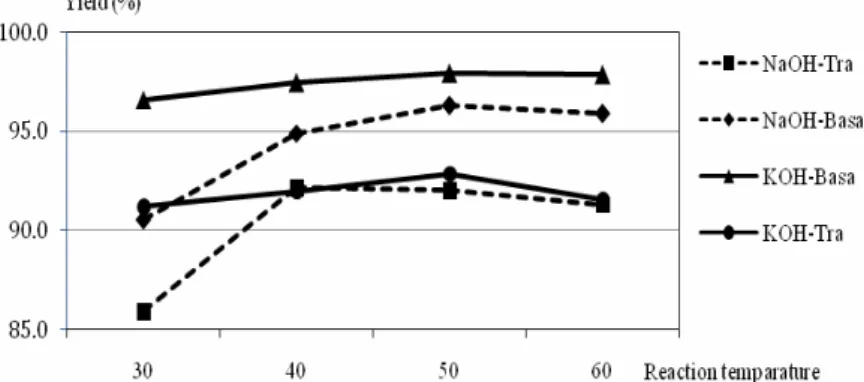
In all experiments, for the optimal results, other parameters like molar ratio of methanol to fat, the catalyst concentration, and the reaction time were achieved in the previous sections. The effect of reaction temperature on the yield is shown in Fig 6. It was found that the transesterification of Tra and Basa fat using the NaOH and KOH catalysts were obtained with the high production yields (>
85%) at the room temperature. The maximum yields of transesterification process from Tra
Properties of biodiesel Unit Tra fat methyl
esters Basa fat methyl esters
Kinematic viscosity, 40oC mm2/s 4.26 4.30
Density g/ml 0.8647 0.8643
Flash point oC 175 178
Copper strip corrosion 1a 1a
Water content % mass trace trace
Acid value mg KOH/g 0.22 0.20
Free glycerin % mass 0.0014 0.0012
Total glycerin % mass 0.22 0.11
Saponification value mg KOH/g 57.00 66.91
Iodine value g I2/100g 57.00 66.91
Table 3. The properties of biodiesel derived from Tra and Basa fat fat (92.1%) and Basa fat (96.3%) using
NaOH catalyst were obtained at 40oC and 50oC, respectively. For KOH catalyst, the maximum yields of transesterification process from Tra fat (92.9%) and Basa fat (97.9%) were obtained at 50oC.
The effect of reaction temperature on the production yield was depended on the kinds of feedstock. There was little difference about the yield of transesterification of the same feedstock with different catalysts. The obtained methyl ester yield of Tra fat using the NaOH or KOH catalyst was about 92%, for Basa fat, however our results demonstrated about 97%. After the best reaction temperature, the obtained production yields were almost constant, and equilibrium was achieved due to the transesterification reaction.
Hence, the best reaction temperature for transesterification of Tra fat and Basa fat using the NaOH catalyst were 40oC and 50oC, respectively, whereas for KOH was 50oC
3.3. The properties of Tra fat and Basa fat methyl esters
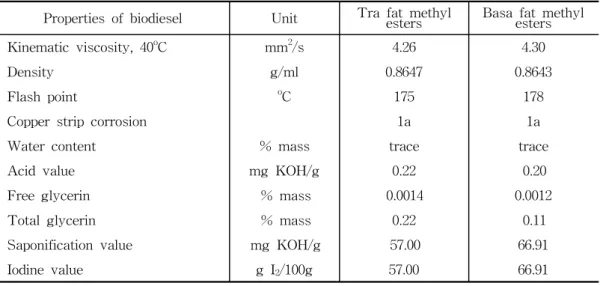
The properties of biodiesel are demonstrated in Table 3. As a result, the
physical and fuel properties of biodiesel derived from Tra and Basa fat had similar values. Important properties of biodiesel from both Catfish fats of Viet Nam were equal with those of recommended properties.
4. Conclusions
In the present work, the transesterification conditions of two feedstock fats (Tra and Basa catfish, Mekong Delta, Viet Nam) indicated that the type and quantity of catalyst, molar ratio of methanol to fat, the reaction temperature and reaction time were the main factors affecting the reaction.
The optimal values of all parameters for achieving maximum conversion of triglycerides to esters depended on the chemical and physical properties of the feedstock oils were investigated. The following conclusions can be summarized for this study;
- Tra and Basa fat could be used as feedstock for the biodiesel production with the alkali catalysts such as NaOH and KOH.
The trasesterification reactions were
conducted under moderate conditions with high biodiesel yield.
- Basa fat as feedstock for the methanolysis reaction with NaOH and KOH was better than that of Tra fat. For feedstock of both fats, the KOH catalyzed methanolysis was more efficient than that of NaOH.
- The maximum yield could be achieved by the transesterification from Basa fat at 5:1 molar ratio of methanol to fat using 0.8%
KOH catalyst at 50oC for 50 min. For Tra fat, the optimal condition were at 6:1 molar ratio of methanol to fat, 0.8% KOH catalyst, 50oC, and 45 min.
- In spite of lower the conversion yield, Tra fat is cheaper, abundant, available, and hence it is a potential feedstock for the biodiesel production on large scale in Viet Nam.
Derived biodiesel from Tra and Basa fat is an acceptable substitute for petrodiesel, and biodiesel fuels derived from other vegetable oils.
References
1. W. Xie, W, X. Huang, and H. Li, Soybean oil methyl esters preparation using NaX zeolites loaded with KOH as a heterogeneous catalyst, Bioresource Technology, 98, 936-939 (2007).
2. S. Saka and D. Kusdiana, Biodiesel fuel from rapeseed oil as prepared in supercritical methanol, Fuel, 80, 225-231 (2001).
3. K. Tiwari, A. Kumar and H. Rahema, Optimisation of biodiesel production by sunflower oil transesterification, Bioresource Technology, 83, 111-114 (2002).
4. J. Jitputti, B. Kitiyanan, P. Rangsunvigit, K. Bunyakiat, L. Attanatho, and P.
Jenvanitpanjakul, Transesterification of
crude palm kernel oil and crude coconut, Chemical Engineering Journal, 116, 61-66 (2006).
5. K. Tiwari, A. Kumar, and H. Raheman, Biodiesel production from Jatropha oil (Jatropha curcas) with high free fatty acids: An optimized process, Biomass and Bioenergy, 31, 569-575 (2007).
6. H. J. Berchmans and S. Hirata, Biodiesel production from crude Jatropha curcas L.
seed oil with a high content of free fatty acids, Bioresource Technology, 99, 1716-1721 (2008).
7. S. K. Karmee and A. Chadha, Preparation of biodiesel from crude oil of Pongamia pinnata, Bioresource Technology, 96, 1425-1429 (2005).
8. P. K. Srivastava and M. Verma, Methyl ester of karanja oil as an alternative renewable source energy, Fuel, 87, 1673-1677 (2008).
9. V. Scholza and J. N. Silva, Prospects and risks of the use of castor oil as a fuel, Biomass and Bioenergy, 32, 95-100 (2008).
10. Canakci and Mustafa, The potential of restaurant waste lipids as biodiesel feedstocks, Bioresource Technology, 98, 183-190 (2007).
11. X. Lang, A. K. Dalai, N. N. Bakhshi, M.
J. Reaney and P. B. Hertz, Preparation and characterization of bio-diesel from various oils, Bioresource Technology, 80, 53-62 (2001).
12. E. Lotero, J. R. J. Goodwin, Bruce. D. K.
Suwannakarn, Y. Liu, and D. Lopez, The Catalysis of Biodiesel Synthesis, Catalysis, 19, 58 (2006).
13. F. Ma, L. D. Clements and M. A. Hanna.
"Biodiesel fuel: The transesterification of beef tallow." PhD dissertation. (Biological System Engineering, University of Nebraska-Lincoln), (1998).
14. Nortvedt and Ragnar, Report: The opportunities in the catfish surplus market in Vietnam, Norway, Bergen:
Fiskeriforskning (Norwegian Institute of Fisheries and Aquaculture Research, (2007).
15. P. Edwards, L. A. Tuan, and G. L. Allan, A survey of marine trash fish and fish meal as aquaculture feed ingredients in Vietnam, ACIAR Working Paper (Australian Centre for International Agricultural Research), 57, 39-45 (2004).
16. P. Bondioli, L. D. Bella, An alternative spectrophotometric method for the determination of free glycerol in biodiesel, Eur. J. Lipid Sci. Technol, 107, 153-157 (2005).
17. M. Canakci and J. V. Gerpen, Biodiesel production via acid catalysis, Transactions of the ASAE, 42, 1203-1210 (1999).
18. R. Sarin, M. Sharma, S. Sinharay, and R.K. Malhotra, Jatropha Palm biodiesel blends: An optimum mix for Asia, Fuel, 86, 1365 1371 (2007).
19. D. Zheng and M. A. Hanna,Preparation and properties of methyl esters of beef tallow, Bioresource Technology, 57, 139-142 (1996).
20. N. T. Thuy, N. T. Loc, J. E. Lindberg and B. Ogle, Survey of the production, processing and nutritive value of catfish by-product meals in the Mekong Delta of Vietnam, Livestock Research for Rural Development, 19, 9 (2007).
21. F. Ma and M. A. Hann, Biodiesel production: a review, Bioresource Technology, 70, 1-15 (1999).
22. B. Freedman, R. O. Butterfield and E. H.
Pryde, Transesterification kinetics ofsoybean oil, Journal of the American Oil Chemists’Society, 63, 1357-1380 (1986).
23. B. Freedman, E.H. Pryde and T.L.
Mounts, Variables affecting the yields of fatty esters, Journal of the American Oil Chemists’Society, 61, 1638-1643 (1984).
24. D.Y.C. Leung and Y. Guo, Transesterification of neat and used frying oil: Optimization for biodiesel
production, Fuel Processing Technology, 87, 883-890 (2006).
25. M. Canakci and J. Van Gerpen, Biodiesel production from oils and fats with high free fatty acids, Transactions of the ASAE, 44, 1429-1436 (2001).
26. G. Vicente, M. Martínez and J. Aracil, Optimisation of integrated biodiesel production. Part I. A study of the biodiesel purity and yield, Bioresource Technology, 98, 1724-1733 (2007).
27. G. Vicente, M. Martínez and J. Aracil, Optimisation of integrated biodiesel production. Part II: A study of the material balance, Bioresource Technology, 98, 1754-1761 (2007).
28. M. J. Nye, T. W. Williamson, S.
Deshpande, J. H. Schrader, W. H. Snively and T. P. Yurkewich, Conversion of used frying oil to diesel by transesterification:
preliminary tests, Journal of the American Oil Chemists’Society, 71, 1323 (1992).
29. V. Tomasevic and S. S. Siler-Marinkovic, Methanolysis of used frying oil, Fuel Process Technology, 81, 1 (2003).
30. U. Rashid and Farooq Anwar. "Production of biodiesel through optimized alkaline-catalyzed transesterification of rapeseed oil." Fuel, 87, 265-273 (2008).
31. M. P. Dorado, E. Ballesteros, F. J. Lopez and M. Mittelbach, Optimization of alkali-catalyzed transesterification of Brassica Carinata oil for biodiesel production, Energy & Fuel, 18, 77-83 (2004).
32. L. C. Meher, V. S. S. Dharmagadda, and S. N. Naik, Optimization of alkali-catalyzed transesterification of Pongamia pinnata oil for production of biodiesel, Bioresource Technology, 97, 1392-1397 (2006).