510
단 보
JOURNALOF KOREAN FOREST SOCIETY ISSN 0445-4650(Print), ISSN 2289-0904(Online) http://e-journal.kfs21.or.kr
실외 실험적 온난화 처리에 따른 활엽수 4개 수종 묘목의 생리적 반응
안지애1,2ㆍ한승현1ㆍ장한나1ㆍ박민지1ㆍ손요환1*
1고려대학교 환경생태공학과, 2국립산림과학원 기후변화연구센터
Effects of Experimental Warming on Physiological Responses of Four Deciduous Tree Species Seedlings
Jiae An
1,2, Seung Hyun Han
1, Hanna Chang
1, Min Ji Park
1and Yowhan Son
1*1Department of Environmental Science and Ecological Engineering, Korea University, Seoul 02841, Korea
2Center for Forest and Climate Change, National Institute of Forest Science, Seoul 02455, Korea
요 약: 본 연구는 실외 실험적 온난화 시스템 내에서 적외선등을 이용하여 온난화 처리를 한 다음 발아 당년의 활엽수 4개 수종(물푸레나무, 느티나무, 거제수나무, 굴참나무) 묘목의 생리적 반응을 알아보고자 수행되었다. 적 외선등은 2015년 4월부터 가동되었으며, 온난화 처리구 내의 묘목들은 대조구에 비해 2.7°C 높은 대기온도 하에 서 생육되었다. 기공전도도, 증산속도 및 순광합성률은 동년 7월과 9월에, 엽록소 함량은 7월과 10월에 각각 측 정하였다. 온도 증가에 대한 묘목의 생리적 반응은 수종과 측정 시기에 따라 다른 결과를 나타내었다. 즉 기공 전도도(mmol·m−2·s−1)는 물푸레나무(대조구:158.97±42.76; 온난화 처리구:42.07±8.24), 느티나무(대조구:170.53±27.22;
온난화 처리구: 101.17±42.27), 거제수나무(대조구:249.93±47.39; 온난화 처리구:150.73±26.52)에서 온난화 처리에 의해 감소하였다. 그리고 증산속도(mmol·m−2·s−1)도 물푸레나무(대조구:4.08±0.62; 온난화 처리구:1.74±0.39), 느티나 무(대조구:4.32±0.44; 온난화 처리구:3.24±1.14), 거제수나무(대조구:6.21±0.38; 온난화 처리구:4.66±0.28)에서 대조구 에 비해 온난화 처리구에서 낮은 값을 나타내었다. 한편, 굴참나무의 경우 기공전도도와 증산속도의 처리 간 차 이가 유의하지 않았다. 엽록소 함량은 대부분의 수종에서 온난화 처리에 의해 증가하였으나, 순광합성률은 모든 수종에서 처리 간의 차이가 통계적으로 유의하지 않았다. 이는 온난화 처리의 영향이 미미하여 순광합성률의 변 화에까지 영향을 미치지 못하였기 때문인 것으로 판단된다.
Abstract: This study was conducted to investigate the physiological responses of newly-germinated seedlings of Fraxinus rhynchophylla Hance, Zelkova serrata (Thunb.) Makino, Betula costata Trautv. and Quercus variabilis Blume to open-field experimental warming. The seedlings in the warmed plots were warmed with 2.7°C higher air temperature than those in the control plots using infrared heaters since April, 2015. Physiological responses (stomatal conductance, transpiration rate, chlorophyll content and net photosynthetic rate) to experimental warming varied with the species and the time of the measurement. Stomatal conductance (mmol·m−2·s−1) tended to decrease for F.
rhynchophylla (Control: 158.97±42.76; Warmed: 42.07±8.24), Z. serrata (Control: 170.53±27.22; Warmed: 101.17±42.27) and B. costata (Control: 249.93±47.39; Warmed: 150.73±26.52). Transpiration rate (mmol·m−2·s−1) also decreased for F.
rhynchophylla (Control: 4.08±0.62; Warmed: 1.74±0.39), Z. serrata (Control: 4.32±0.44; Warmed: 3.24±1.14) and B.
costata (Control: 6.21±0.38; Warmed: 4.66±0.28). However, warming exhibited only minimal effects on stomatal conductance and transpiration rate of Q. variabilis seedlings. Chlorophyll content increased by the warming treatment while the effect of warming was not significant on net photosynthetic rate, since the warming treatment had a weak influence for changing net photosynthetic rate.
Key words: climate change, elevated temperature, experimental warming, physiological response, seedling growth
서 론
IPCC (2014)에 따르면 21세기 말(2081-2100년) 지구 표
면 온도는 1986-2005년에 비해 1.1-2.6°C 가량 상승할 것 으로 예상되며, Special Report on Emissions Scenarios에 의하면 우리나라의 연평균 대기온도는 2001-2010년에 비 해 2061-2070년에 약 3.3°C 상승할 것으로 예측되고 있다.
대기온도는 산림생태계의 기능과 구조에 영향을 주는 주
*Corresponding author E-mail: [email protected]
요 인자이며, 특히 기후변화에 따른 대기온도의 상승은 수 목의 생리적 특성 및 생장의 변화를 가져올 것으로 예상 된다(Niu et al., 2008).
온도 변화는 기공전도도, 엽록소 함량 등의 생리적 특 성에 직접적으로 영향을 주며(Saxe et al., 2001), 식물의 증산속도에도 영향을 주어 광합성 작용에 변화를 가져와 생장 특성을 변화시키는 것으로 알려져 있다(Lewis et al., 2001). 특히 대기온도의 상승은 묘목의 생장 기간이나 광 합성 활성을 변화시켜 생장 및 광합성률을 증가 혹은 감 소시키는 것으로 보고되었으며(Wu et al., 2011), 이는 식 생 군집 내에서 개체의 경쟁력과 생산성에도 영향을 미칠 수 있다(Arend et al., 2011; Xu et al., 2012).
수목의 생리적 활성 및 생장은 온난화에 따라 증가 또 는 감소하는 등 다양한 반응을 나타내는 것으로 알려져 있다(Chung et al., 2013). 또한 수목의 분포 지역에 따라 온도 변화에 대한 영향이 다르며(Fisichelli et al., 2012), 특히 한대와 아한대에 위치한 산림은 온도 변화에 매우 민감하게 반응하여 수목의 생장과 생존이 기후변화에 직 접적인 영향을 받는 것으로 알려져 있다(Matala et al., 2006; Scholze et al., 2006).
물푸레나무(Fraxinus rhynchophylla Hance), 거제수나무 (Betula costata Trautv.), 굴참나무(Quercus variabilis Blume) 는 우리나라의 주요 조림 활엽수종으로서, 각각 한반도 중 북부, 중부 이북 및 한반도 전역에 주로 분포하고 있다 (Han et al., 2012; Kim et al., 2003). 느티나무(Zelkova serrata (Thunb.) Makino)는 우리나라와 중국 및 일본 등 지에 분포하는 낙엽성 활엽수종이다(Fukatsu et al., 2005).
이러한 수종은 1-1, 1-1-1묘 등을 노지묘를 중심으로 생산 하여 조림하며, 최근에는 기후변화에 따른 기상재해로 노 지묘 현장에서 피해가 발생하고 있는 것으로 보고되고 있 다(Song et al., 2012).
묘목 단계는 대기온도, 토양 수분, 양분 등의 환경 조건 에 민감하기 때문에 수목 생장에서 중요한 시기이다(Danby and Hik, 2007). 특히 온도는 종자 발아 및 발아 후 묘목의 초기 생존에 영향을 미치며(Walck et al., 2011), 묘목 단계 에서는 뿌리와 줄기가 완전히 발달되지 않아 온도 상승에 의한 변화가 민감하게 나타나 지구 온난화에 따른 온도 상승의 영향을 용이하게 파악할 수 있다(Fisichelli et al., 2014b). 아울러 발아 또는 식재 후 묘목의 단기 생리적 특 성은 묘목의 생존율과 이후 묘목의 생장에도 영향을 주기 때문에(Sung et al., 2011) 묘목을 대상으로 한 기초 연구 가 필요하다.
한편 기후변화에 대한 수목의 수종별 생리적 특성 변화 에 관한 연구는 주로 침엽수에 대해 수행되어 왔으며, 온 대 활엽수에 대한 연구는 많지 않다(Chung et al., 2013).
따라서 온난화에 따른 산림생태계의 변화에 대응하기 위
해서는 다양한 수종을 대상으로 한 연구가 요구되며, 특 히 묘목의 온도 변화에 따른 생리적 반응을 관찰함으로써 기후변화 대응 대책 마련을 위한 기초 자료를 확보할 수 있다. 이에 본 연구는 기후변화에 따른 대기온도 상승에 대한 묘목의 반응을 알아보기 위해 발아 당년의 활엽수 4 개 수종을 대상으로 실외 실험적 온난화 처리 이후 묘목 의 생리적 반응을 조사하고 비교하였다.
재료 및 방법
1. 온난화 처리
2011년 10월에 경기도 포천시에 위치한 국립산림과학 원 산림생산기술연구소 내 묘포장(37o 75' 87'' N, 127o 17' 09'' E, 해발 98 m)에 실외 실험적 온난화 시스템을 설치 하였다. 본 시스템은 생태계 교란이 적고 식물과 토양을 모두 가열할 수 있는 적외선등(FTE-1000, Mor Electric Heating Instrument Inc., USA)을 이용한 온난화 방법을 적용한 것이다(Han et al., 2015; Zhao and Liu, 2009).
2015년 4월에 수종별로 대조구와 온난화 처리구를 각각 3개씩(n=3) 총 6개의 실험구(1 m × 1 m)를 조성하고 4개 활엽수종(F. rhynchophylla, Z. serrata, B. costata, Q.
variabilis)의 종자를 종묘사업실시요령에 따라(Korea Forest Service, 2012) 파종하여 전체 24개 실험구를 조성하였다.
적외선 온도계(SI-111, Campbell Scientific Inc., USA) 를 설치하여 대조구와 온난화 처리구 간의 온도차를 데이 터 로거(CR1000, Campbell Scientific Inc., USA)에 기록 하고, 릴레이를 이용해 적외선등의 전원을 조절함으로써 온난화 처리구 내의 묘목이 대조구 내의 묘목보다 3°C 높 은 대기온도 하에서 생육되도록 하였다. 묘목의 생장에 따 라 적외선등이 묘고로부터 80 cm 위에 위치할 수 있도록 적외선등의 높이를 조절하였으며, 대조구 내에는 적외선 등 없이 하우징만을 설치하여 처리 이외의 기타 구조물이 실험에 미치는 영향을 최소화하였다.
2015년 5월 18일부터 동년 10월 30일까지 적외선 온도 계를 이용해 측정한 대조구와 온난화 처리구 사이의 평균 온도차는 약 2.7°C로 나타났다. 이는 적외선등의 가열 범 위가 실험구의 중앙에 집중되어 있고 여름철 복사 에너지 의 증가로 적외선등의 가열 효과가 감소했기 때문인 것으 로 판단된다.
2. 묘목의 생리적 반응 조사
기공전도도, 증산속도 및 순광합성률을 측정하기 위해 각 실험구에서 임의로 선정한 2본의 묘목을 대상으로 생 육상태가 건전한 잎을 채취하였다. 2015년 7월과 9월 말 에 휴대용 광합성 측정 장비(CIRAS-2, PP-Systems, USA) 를 이용하여 기공전도도, 증산속도 및 순광합성률을 3번
반복하여 측정하고 평균값을 산출하였다. 측정 시에는 LED 광 모듈(CI-301LA, CID Bio-Science, USA)을 이용 하여 1000-1100 µmol·m−2·s−1의 광조건을 조성하였으며, 챔 버 내 이산화탄소 농도는 400±2 ppm으로 제어하였다. 그 후 스캐너(Perfection V700, Epson, Japan)와 엽면적 분석 프로그램(WinSEEDLE, Regent, Canada)을 이용하여 측정 에 사용된 잎의 엽면적을 측정한 뒤, 단위 엽면적 당 기공 전도도, 증산속도 및 순광합성률을 산출하였다.
한편 동년 7월과 10월 말에는 임의로 선정한 2본의 묘 목을 대상으로 묘목마다 유사한 양의 잎을 채취하여 2 mm 이내로 잘게 자르고 20±3 mg을 정량하여 Dimethyl sulfoxide (DMSO) 5 mL에 침전시켰다. 이후 65°C에서 1 시간 중탕하여 엽록소를 추출한 뒤, 분광광도계(UH5300, Hitachi, Japan)를 이용해 648 nm와 665 nm의 파장으로 흡광도를 측정하여 엽록소 a, b의 함량 및 총 엽록소 함량 을 산출하였다(Barnes et al., 1992; Hiscox and Israelstam, 1979).
3. 통계 분석
대조구와 온난화 처리구 간 기공전도도, 증산속도, 순광 합성률, 총 엽록소 함량 등의 생리적 특성 차이는 일원분 산분석(One-way ANOVA)을 이용하여 검정하였다. 특히 총 엽록소 함량의 경우 일원분산분석을 이용하여 월별로 차이가 있는지 검정하였다. 한편, 이원분산분석(Two-way ANOVA)을 이용하여 온난화 처리가 생리적 반응에 미치 는 영향에서 수종 간의 차이가 있는지 분석하고, 수종과 처리 간에 교호작용이 있는 경우에는 대조구의 값에 대한 온난화 처리구 값의 증가율로서 반응지수를 계산하였다 (Noh et al., 2016). 또한 사후검정에는 Tukey 검정을 이용 하였다. 모든 통계분석에는 SAS 9.3 software (SAS Institute Inc., USA)를 사용하였다.
결과 및 고찰
기공전도도와 증산속도는 수종 및 측정 시기에 따라 다 른 결과를 나타내었다(Figure 1). 7월에는 거제수나무를 제 외하고는 통계적 유의성은 없었으나, 모든 수종에서 대조 구에 비해 온난화 처리구에서 기공전도도와 증산속도가 낮 은 것으로 나타났다. 9월에는 수종에 따라 온난화 처리에 의해 기공전도도 및 증산속도가 높거나 낮게 나타났다. 기 공전도도(mmol·m−2·s−1)는 물푸레나무(대조구:158.97±42.76;
온난화 처리구:42.07±8.24), 느티나무(대조구:170.53±27.22;
온난화 처리구:101.17±42.27), 거제수나무(대조구:249.93±
47.39; 온난화 처리구:150.73±26.52)에서 온난화 처리에 의 해 감소하는 경향을 나타내었다. 증산속도(mmol·m−2·s−1) 역시 물푸레나무(대조구:4.08±0.62; 온난화 처리구:1.74±0.39),
느티나무(대조구: 4.32±0.44; 온난화 처리구: 3.24±1.14), 거제수나무(대조구: 6.21±0.38; 온난화 처리구: 4.66±0.28) 에서 온난화 처리에 의해 감소하였으며, 물푸레나무와 거 제수나무의 경우 처리 간의 차이가 통계적으로 유의하였 다. 굴참나무의 경우 기공전도도와 증산속도 모두 온난화 처리에 의한 변화가 통계적으로 유의하지 않았다.
온난화 처리에 의해 묘목의 기공전도도 및 증산속도가 감소하는 경향을 보인 것은 온난화에 의한 건조 스트레스 때문인 것으로 판단된다. Kolb and Robberecht(1996)는 1 년생 Pinus속의 묘목을 대상으로 한 온난화 실험에서 건 조 스트레스에 의해 일평균 기공전도도가 유의하게 감소 하였음을 보고한 바 있다. 온난화 처리에 의해 잎의 온도 가 광합성 적정 온도보다 높아짐에 따라 잎의 표면이 건 조해질 수 있으며, 다양한 수종을 대상으로 한 선행 모의 실험에서도 온도의 상승에 따른 잎의 건조 현상으로 기공 이 닫히고 기공전도도가 낮아지는 것을 확인하였다(Collatz et al., 1991). 또한 기공전도도의 감소는 증산속도의 감소 를 초래하는 것으로 알려져 있다(Farquhar and Sharkey, Figure 1. Stomatal conductance and transpiration rate of seedlings in the control and warmed plots in July and September, 2015 (Fraxinus rhynchophylla (a), Zelkova serrata (b), Betula costata (c), Quercus variabilis (d)). Error bars denote one standard error of the mean (n=3). Asterisks indicate statistical significance between the control and warmed plots (P<0.05).
1982).
한편, 엽록소 함량은 온난화 처리에 의한 영향이 수종 및 월별로 다르게 나타났다(Table 1). 7월에는 물푸레나무 의 총 엽록소 함량이 온난화 처리구에서 대조구에 비해 41.1% 높게 나타났으나 통계적 유의성은 없었다. 10월에 는 온난화 처리구에서 거제수나무의 엽록소 a, b 및 총 엽 록소 함량이 대조구에 비해 유의하게 높게 나타났다. 총 엽록소 함량은 처리에 따른 차이가 거제수나무에서만 통 계적으로 유의하였으나, 모든 수종이 온난화 처리구에서 대조구에 비해 총 엽록소 함량이 26.4-137.6%까지 높은 값을 보였다.
월별 비교 결과 느티나무와 거제수나무의 총 엽록소 함 량이 대조구에서 7월에 비해 10월에 유의하게 감소한 것 과 달리 온난화 처리구에서는 7월과 10월의 총 엽록소 함 량이 통계적으로 유의한 차이를 보이지 않았다. 굴참나무 는 대조구에서 총 엽록소 함량이 계절에 따라 감소한 것 과는 달리 온난화 처리구에서는 7월에 비해 10월에 오히 려 더 높은 수치를 나타내었다.
일반적으로 엽록소 함량은 대기온도가 상승함에 따라 증가하는 것으로 알려져 있고(Saxe et al., 2001), 선행연구 에서도 적외선등을 이용한 온난화 처리에 의해 대기온도 가 광합성 색소 합성의 최적 온도에 도달함에 따라 묘목 의 엽록소 함량이 증가한 것으로 나타났다(Zhao and Liu, 2009). 특히 온난화 처리구 내에서는 느티나무, 거제수나 무 및 굴참나무의 총 엽록소 함량이 대조구에서와 달리 여름철과 가을철에 통계적으로 유의한 차이를 보이지 않 았다. 이는 온난화 처리에 의해 엽록소의 퇴화가 지연되
었기 때문인 것으로 판단되며(Fracheboud et al., 2009), 동 일한 실험지 내의 1년생과 2년생 낙엽송 묘목 역시 온난 화 처리에 의해 계절에 따른 엽록소의 퇴화가 지연되는 결과를 보였다(An et al., 2016).
순광합성률은 수종에 관계없이 처리 간에 통계적으로 유의한 차이나 일정한 경향을 나타내지 않았다(Figure 2).
광합성은 기공 개폐, 증산, 엽록소 함량 등 다양한 요인이 복합적으로 작용하여 일어나게 되는데, 본 연구에서는 온 난화 처리의 효과가 미미하여 순광합성률의 변화에까지 영향을 미치지 못한 것으로 판단된다.
Table 1. Chlorophyll content (mg·g−1) of newly-germinated Fraxinus rhynchophylla, Zelkova serrata, Betula costata and Quercus variabilis seedlings in July and October, 2015. Asterisks indicate a statistical significance between the control (C) and warmed (W) plots (n=3, P<0.05).
Jul. Oct.
Species Chl a Chl b Total Chl a Chl b Total
F. rhynchophylla
C 0.99
(0.06)
0.17 (0.03)
1.17 (0.09)
0.64 (0.26)
0.39 (0.00)
1.03 (0.25)
W 1.36
(0.13)
0.28 (0.08)
1.65 (0.21)
1.00 (0.15)
0.30 (0.04)
1.31 (0.15)
Z. serrata
C 2.63
(0.03)
0.48 (0.07)
3.11 (0.06)
0.76 (0.06)
0.14 (0.03)
0.91 (0.06)
W 2.59
(0.13)
0.27 (0.04)
2.86 (0.09)
1.38 (0.51)
0.13 (0.03)
1.50 (0.54)
B. costata
C 2.11
(0.02)
0.37 (0.03)
2.48 (0.03)
1.10 (0.19)
0.09 (0.00)
1.19 (0.19)
W 2.45
(0.14)
0.40 (0.07)
2.85 (0.21)
2.60* (0.27)
0.23* (0.02)
2.83* (0.28)
Q. variabilis
C 2.03
(0.26)
0.57 (0.04)
2.60 (0.26)
1.42 (0.23)
0.45 (0.07)
1.87 (0.30)
W 1.98
(0.03)
0.60 (0.10)
2.58 (0.07)
2.16 (0.29)
0.71 (0.10)
2.87 (0.35) chlorophyll a (Chl a), chlorophyll b (Chl b) and total chlorophyll (Total)
Figure 2. Net photosynthetic rate of seedlings in the control and warmed plots in July and September, 2015 (Fraxinus rhynchophylla (a), Zelkova serrata (b), Betula costata (c), Quercus variabilis (d)). Error bars denote one standard error of the mean (n=3).
한편 2015년 5월부터 동년 12월까지 측정한 평균 토양 수분 함량은 온난화 처리구에서 대조구에 비해 118.8% 낮 게 나타났다. Novick et al. (2016)은 온난화 처리에 의한 토양 수분 및 대기 중 수분 함량의 감소가 수목의 생리적 활성에 영향을 줄 수 있다고 보고하였으며, 온난화에 대 한 묘목의 반응을 보다 정확히 분석하기 위해서는 향후 토양 및 대기 중 수분 함량 변화를 고려한 연구가 필요할 것으로 사료된다.
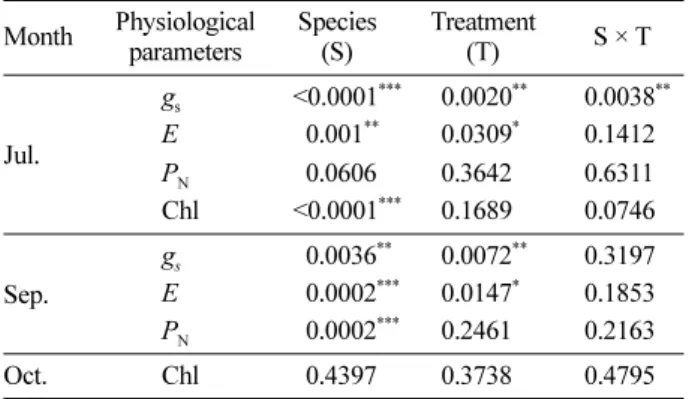
온난화에 의한 생리적 반응의 변화는 측정 항목에 따라 수종별로 처리에 대한 영향의 정도가 다르게 나타났다 (Table 2). 이러한 수종 간의 차이는 각 수종이 갖는 고유 의 특성에서 기인한 것으로 판단된다. 기공전도도와 증산 속도는 7월과 9월 모두 처리 간에 통계적으로 유의한 차 이를 보였으며, 특히 7월에는 기공전도도에서 처리에 의 한 영향력의 정도가 수종별로 다르게 나타났다. 이에 대 한 반응지수는 거제수나무가 -55%로 온난화 처리에 의한 영향을 가장 크게 받아 기공전도도의 변화폭이 크게 나타 났으며, 물푸레나무가 -10.6%로 처리에 의한 영향을 가장 적게 받은 것으로 나타났다.
수종에 따라 온난화 처리에 대한 영향의 정도가 다르게 나타난 것은 수종별 생육 지역의 차이에서 기인한 것으로 생각된다. 상대적으로 북부에 분포하고 있는 거제수나무 는 우리나라 중북부 및 전역에 분포하는 물푸레나무와 굴 참나무에 비해 온도 증가에 대한 영향을 크게 받을 것으 로 예상된다. 선행연구에서는 온도 상승에 따라 온대수종 의 생장이 촉진되고 한대수종의 생장이 저하될 수 있다고 보고된 바 있다(Fisichelli et al., 2014a, 2012). 또한 생육 지역에 따라 수종별로 광합성 최적 온도가 다르게 나타나 기도 하며(Cunningham and Read, 2002), 대기온도 변화 에 따라 광합성 최적 온도를 조절하는 능력에 차이를 보 이는 것으로 알려져 있다(Sendall et al., 2014). 한편 Han et al. (2012)은 거제수나무가 우리나라의 대표적인 아고산 수종의 하나로 우리나라 평균 기온 상승 시 영향을 받을 수 있다고 보고하였으며, 본 연구와 동일한 시스템 내에
서 수행된 선행연구에서도 거제수나무가 상대적으로 온 도 증가에 취약한 것으로 나타났다(Han et al., 2014).
결 론
본 연구는 실외 인위적 온난화 처리에 대한 활엽수 4개 수종의 생리적 반응을 알아보기 위하여 수행되었다. 발아 당년의 물푸레나무, 느티나무, 거제수나무, 굴참나무 묘목 은 수종별로 온난화 처리에 대해 각각 다른 반응을 나타 내었다. 기공전도도와 증산속도는 수종에 따라 온난화 처 리에 의해 대체로 감소하였으며, 일부 수종에서 처리 간 차이가 통계적으로 유의하였다. 엽록소 함량은 대체로 대 조구에 비해 온난화 처리구에서 높았으며, 이는 온난화 처 리에 의해 엽록소 합성은 촉진되고, 오히려 엽록소의 퇴 화는 지연되었기 때문인 것으로 생각된다. 또한 기공전도 도, 증산속도, 엽록소 함량 등 다양한 생리적 특성에 의해 결정되는 순광합성률의 경우 온난화의 효과가 미미하였 던 것으로 보인다. 본 연구결과를 바탕으로 온난화 처리 에 따른 묘목의 생장 반응 등을 추가적으로 연구함으로써 기후변화에 대응한 양묘 시업 체계를 보완할 수 있는 자 료가 확보될 수 있을 것으로 기대된다.
감사의 글
본 연구는 산림청 임업기술연구개발사업(S111110L030100) 및 환경부 기후변화대응 환경기술개발사업(201400131008) 의 지원으로 수행되었습니다.
References
An, J., Chang, H., Park, M.J., Han, S.H., Hwang, J., Cho, M.S., and Son, Y. 2016. Effect of experimental warming on physiological and growth responses of Larix kaempferi seedlings. Journal of Climate Change Research 7(1): 77- 84. (In Korean)
Arend, M., Kuster, T., Gunthardt-Goerg, M.S., and Dobbertin, M.
2011. Provenance-specific growth responses to drought and air warming in three European oak species (Quercus robur, Q.
petraea and Q. pubescens). Tree Physiology 31(3): 287-297.
Barnes, J.D., Balaguer, L., Manrique, E., Elvira, S., and Davison, A.W. 1992. A reappraisal of the use of DMSO for the extraction and determination of chlorophylls a and b in lichens and higher plants. Environmental and Experimen- tal Botany 32(2): 85-100.
Chung, H., Muraoka, H., Nakamura, M., Han, S., Muller, O., and Son, Y. 2013. Experimental warming studies on tree species and forest ecosystems: a literature review. Jour- nal of Plant Research 126(4): 447-460.
Table 2. Two-way analysis of variance on the effect of warming and species of seedlings on the physiological responses.
Month Physiological parameters
Species (S)
Treatment
(T) S × T
Jul.
gs <0.0001*** 0.0020** 0.0038**
E 00.001** 0.0309* 0.1412 PN 00.0606 0.3642 0.6311 Chl <0.0001*** 0.1689 0.0746
Sep.
gs 00.0036** 0.0072** 0.3197 E 00.0002*** 0.0147* 0.1853 PN 00.0002*** 0.2461 0.2163 Oct. Chl 00.4397 0.3738 0.4795
Collatz, G.J., Ball, J.T., Grivet, C., and Berry, J.A. 1991.
Physiological and environmental regulation of stomatal conductance, photosynthesis and transpiration: a model that includes a laminar boundary layer. Agricultural and Forest Meteorology 54(2): 107-136.
Cunningham, S.C. and Read, J. 2002. Comparison of temper- ate and tropical rainforest tree species: photosynthetic responses to growth temperature. Oecologia 133(2): 112-119.
Danby, R.K. and Hik, D.S. 2007. Responses of white spruce (Picea glauca) to experimental warming at a subarctic alpine treeline. Global Change Biology 13(2): 437-451.
Farquhar, G.D. and Sharkey, T.D. 1982. Stomatal conduc- tance and photosynthesis. Annual Review of Plant Physi- ology 33(1): 317-345.
Fisichelli, N.A., Frelich, L.E., and Reich, P.B. 2012. Sapling growth responses to warmer temperatures ‘cooled’ by browse pressure. Global Change Biology 18(11): 3455-3463.
Fisichelli, N.A., Frelich, L.E., and Reich, P.B. 2014a. Temper- ate tree expansion into adjacent boreal forest patches facili- tated by warmer temperatures. Ecography 37(2): 152-161.
Fisichelli, N.A., Wright, A., Rice, K., Mau, A., Buschena, C., and Reich, P.B. 2014b. First-year seedlings and climate change: species-specific responses of 15 North American tree species. Oikos 123(11): 1331-1340.
Fracheboud, Y., Luquez, V., Björkén, L., Sjödin, A., Tuominen, H., and Jansson, S. 2009. The control of autumn senescence in European aspen. Plant Physiology 149(4): 1982-1991.
Fukatsu, E., Isoda, K., Hirao, T., Takahashi, M., and Watanabe, A.
2005. Development and characterization of simple sequence repeat DNA markers for Zelkova serrata. Molecular Ecol- ogy Notes 5(2): 378-380.
Han, S.H., Kim, D.H., Kim, G.N., Lee, J.C., and Yun, C.W.
2012. Changes on initial growth and physiological charac- teristics of Larix kaempferi and Betula costata seedlings under elevated temperature. Korean Journal of Agricultural and For- est Meteorology 14(2): 63-70. (In Korean)
Han, S., An, J., Yoon, T.K., Yun, S.J., Hwang, J., Cho, M.S., and Son, Y. 2014. Species-specific growth responses of Betula costata, Fraxinus rhynchophylla, and Quercus variabi- lis seedlings to open-field artificial warming. Korean Jour- nal of Agricultural and Forest Meteorology 16(3): 217- 224. (In Korean)
Han, S., Lee, S.J., Yoon, T.K., Han, S.H., Lee, J., Kim, S., Hwang, J., Cho, M.S., and Son, Y. 2015. Species-specific growth and photosynthetic responses of first-year seedlings of four coniferous species to open-field experimental warm- ing. Turkish Journal of Agriculture and Forestry 39(2):
342-349.
Hiscox, J.T. and Israelstam, G.F. 1979. A method for the extraction of chlorophyll from leaf tissue without macera- tion. Canadian Journal of Botany 57(12): 1332-1334.
Intergovernmental Panel on Climate Change (IPCC). 2014.
Climate Change 2014: Synthesis Report. Intergovernmen-
tal Panel on Climate Change. UK.
Kim, G.T. 2003. Ecological forest management and reforesta- tion problem - Comparison of diameter increment of Fraxi- nus rhynchophylla between artificial, natural and coppice forest. Korean Journal of Environment and Ecology 17(2):
105-111. (In Korean)
Kolb, P.F. and Robberecht, R. 1996. High temperature and drought stress effects on survival of Pinus ponderosa seed- lings. Tree Physiology 16(8): 665-672.
Korea Forest Service. 2012. Guidelines for seed and seedling management. Korea Forest Service, Korea. (In Korean) Lewis, J.D., Lucash, M., Olszyk, D., and Tingey, D.T. 2001.
Seasonal patterns of photosynthesis in Douglas fir seed- lings during the third and fourth year of exposure to ele- vated CO2 and temperature. Plant, Cell and Environment 24(5): 539-548.
Matala, J., Ojansuu, R., Peltola, H., Raitio, H., and Kellomaki, S.
2006. Modelling the response of tree growth to tempera- ture and CO2 elevation as related to the fertility and cur- rent temperature sum of a site. Ecological Modelling 199(1):
39-52.
Niu, S., Li, Z., Xia, J., Han, Y., Wu, M., and Wan, S. 2008. Cli- matic warming changes plant photosynthesis and its tem- perature dependence in a temperate steppe of northern China.
Environmental and Experimental Botany 63(1): 91-101.
Noh, N.J., Lee, S.J., Jo, W., Han, S., Yoon, T.K., Chung, H., Muraoka, H., and Son, Y. 2016. Effects of experimental warming on soil respiration and biomass in Quercus vari- abilis Blume and Pinus densiflora Sieb. et Zucc. Seed- lings. Annals of Forest Science 73(2): 533-545.
Novick, K.A., Ficklin, D.L., Stoy, P.C., Williams, C.A., Bohrer, G., Oishi, A.C., Papuga, S.A., Blanken, P.D., Noormets, A., Sulman, B.N., Scott, R.L., Wang, L., and Phillips, R.P. 2016.
The increasing importance of atmospheric demand for ecosystem water and carbon fluxes. Nature Climate Change 6(11): 1023-1027.
Saxe, H., Cannell, M.G., Johnsen, Ø., Ryan, M.G., and Vour- litis, G. 2001. Tree and forest functioning in response to global warming. New Phytologist 149(3): 369-399.
Sendall, K.M., Reich, P.B., Zhao, C., Jihua, H., and Wei, X.O.
2004. Acclimation of photosynthetic temperature optima of temperate and boreal tree species in response to exper- imental forest warming. Global Change Biology 21(3):
1342-1357.
Scholze, M., Knorr, W., Arnell, N.W., and Prentice, I.C. 2006. A climate-change risk analysis for world ecosystems. Pro- ceedings of the National Academy of Sciences 103(35):
13116-13120.
Song, K.S., Cha, Y.G., Choi, J.Y. and Kim, J.J. 2012. Com- parison of growth characteristics of 1- and 2-year-old bare root and container seedling of Chamaecyparis obtusa. Journal of Korean Forest Society 101(2): 317-323. (In Korean) Sung, H.I., Song, K.S., Cha, Y.G., and Kim, J.J. 2011. Char-
acteristics of growth and seedling quality of 1-year-old container seedlings of Quercus myrsinaefolia by shading and fertilizing treatment. Journal of Korean Forest Soci- ety 100(4): 598-608. (In Korean)
Walck, J.L., Hidayati, S.N., Dixon, K.W., Thompson, K., and Poschilod, P. 2011. Climate change and plant regenera- tion from seed. Global Change Biology 17(6): 2145-2161.
Wu, Z., Dijkstra, P., Koch, G.W., Penuelas, J., and Hungate, B.A.
2011. Responses of terrestrial ecosystems to temperature and precipitation change: a meta-analysis of experimental manipulation. Global Change Biology 17(2): 927-942.
Xu, Z., Hu, T., and Zhang, Y. 2012. Effects of experimental warm- ing on phenology, growth and gas exchange of treeline birch (Betula utilis) saplings, Eastern Tibetan Plateau, China.
European Journal of Forest Research 131(3): 811-819.
Zhao, C. and Liu, Q. 2009. Growth and photosynthetic responses of two coniferous species to experimental warming and nitrogen fertilization. Canadian Journal of Forest Research 39(1): 1-11.
(Received: October 10, 2016; Accepted: November 8, 2016)