• 검색 결과가 없습니다.

A Study on Education Platform for Automobile Students Using AR System

N/A
N/A
Protected

Academic year: 2021

Share "A Study on Education Platform for Automobile Students Using AR System"

Copied!
8
0
0

로드 중.... (전체 텍스트 보기)

전체 글

(1)

*Project 51605352 supported by National Natural Science Foundation of China

*Corresponding Author : Young-Hwan Pan([email protected],kr) Received September 30, 2019

Accepted December 20, 2019 Revised November 13, 2019 Published December 28, 2019

A Study on Education Platform for Automobile Students Using AR System

YIng Luo

1

, Wan-Sok Jang

2

, Young-Hwan Pan

3*

1

Ph.D.Course, Dept. of Experience Design, TED, Kookmin University

2

Professor, S. of Art & Design, Wuhan University of Technology

3

Professor, Dept. of Experience Design, TED, Kookmin University

AR 시스템 기반 자동차 교육 플랫폼 연구

루오잉

1

, 장완석

2

, 반영환

3*

1

국민대학교 테크노디자인전문대학원 경험디자인학과 박사과정,

2

우한이공대학교 예술디자인대학 교수,

3

국민대학교 테크노디자인전문대학원 경험디자인학과 교수

Abstract With the popularization of online learning, mobile learning and blended learning model, augmented reality technology is increasingly widely applied in the field of education today. This article stresses the necessity of applying augmented reality to education by summarizing the current situation and advantages of augmented reality technology in education. Next, the author proposes a new education system—“AR+E education cloud platform system”. Last, the author proposes several inspirations for the design of AR-based education software according to the observation and interview of the behaviors and preferences of the respondents.

Key Words : Design, Augmented Reality, Convergence Education, User Experience, “AR + E” System 요 약 디자인 분야에서 온라인, 모바일을 통한 융합교육의 보급이 빠르게 확장되고 있다. 특히 증강현실 기술을 응용 한 교육 프로그램 개발이 점차 널리 사용되고 있다. 이 글은 우선, 증강현실 기술의 현재 상태와 장점을 검토함으로써 교육 응용 분야에서 증강현실의 필요성을 강조한다. 둘째, 필자는 새로운 유형의 교육 시스템인 “AR + E” 교육 클라우 드 플랫폼 시스템을 제안한다. 이 시스템은 일반 종이 교과서, 범용 휴대용 이동 단말기와 APP 등 3가지로 구성된다.

본 연구는 자동차 정비 전공 학생들을 대상으로 하여 “AR + E” 교육 시스템의 유용성 및 성능 실험을 통해 “AR + E” 시스템이 학습 효과에 미치는 영향 연구 조사하였다. “AR + E”시스템은 전통적인 학습 그룹과의 비교 실험을 통해 AR 대화식 미디어를 사용하여 학습자의 학업 성과를 향상시킬 뿐만 아니라, 재미와 참여도 및 연속성을 향상시키는 결과를 얻게 되었다. 끝으로, 사용자 경험, 행위와 기호에 대한 관찰과 인터뷰를 통해 AR 기반 교육 프로그램 소프트웨 어를 디자인하고 개발하여 제안하고 있다.

주제어 : 디자인, 증강현실, 융합교육, 사용자 경험, “AR + E”시스템

(2)

1. Introduction

The Chinese education market has been maintaining a momentum of rapid growth, and the size of the Chinese online education market reached 250.2 billion yuan in 2017, with increasingly fierce industrial competition[1]. With the development of the online education industry and technology, it is estimated by Goldman Sachs that around 700 million US dollars will be used for the development of the AR/VR applications designed for education by2025[2]. Currently, educational software has utilized a variety of intelligent tools as interactive media to support learning, enhance students’ concent ration and increase their learning efficiency[3].

Cool and novel technologies can boost students’ interest and bring the education industry a new opportunity and a newindustrial ecology. AR technology can help students acquire multi-sensory experience, help them develop an interest in learning and improve their learning ability by simulating real teaching scenarios[4].

Although AR technology is not brand new, the application of AR to education just started. AR technology enables learners to explore various kinds of interesting knowledge and will not cause any harm even in the case of an operating error.

Learners enter a highly simulated environment and conduct interactive learning dynamically with AR technology.

 “AR+Education” education cloud platform system is an actual project conducted by the author that is about the application of “AR+Internet” to vocational education[5]. This system consists of a normal paper textbook, a universal and portable mobile terminal and application software. The proposal of this concept is a product of education supported by technology in the context of the era of information technology, and the concept of “AR+E system” is the actual application of AR technology to education with a cloud platform as the carrier by using internet

thinking.

2. Literature review 2.1 Research trends of the educational

application of AR

AR technology visualizes abstract learning contents, enhances learners’ visual perception of a realistic situation, and improves their five senses and concentration. Hence, this technology is frequently used for simulating learning objects, as it enables learners to see a manipulable and rotatable virtual object that can be generated fast in a realistic situation and it can set up a space for independent exploration where learners can interact in a way that is the closest to nature and inspire learners to comprehend abstract contents and enhances their interest. For example, ahead-mounted device-based VR educational game developed by Chan and Leung etal. can help learners exercise dancing skills by emulating the motions of a virtual teacher, who provides learners with timely feedbacks and corrections by virtue of motion capture technology[6]. Modes of interactive experience are different for different age groups and disciplines, so AR technology is widely applied in teaching, which is of some research value.

A study conducted by Kaufmann, Steinberg,

Dunser and Gluck (2017) developed a 3D dynamic

geometric system (Construct3D) aiming at enhancing

mathematics and geometry education[7]. As an

AR system, Construct 3D not only provides

students with a real environment for teamwork,

but also presents virtual 3D objects for students

to measure and operate to help them understand

spatial relationships. The abovementioned study

offers the feasibility and short comings of AR

technology feasibility in an educational

environment. However, most AR platforms do not

have the evaluation conducted students, teachers

(3)

and teaching management including companies for improving the quality of learning.

American company Mitchlehan Media LLC successfully developed an AR application designed for assisting children in learning English letters in 2013: AR Card[8]. When children scan a card with mobile phone camera, pretty and cool 3D animal will pop up on the screen, click the animal and then they can hear the sound of the letters and the name of this animal. This AR application integrates 3D animation, sound and image, successfully attracts children’s attention and arouses their interest in learning English letters. Besides, China also introduced similar AR card and textbook, for example, New Oriental launched a set of AR-based pinyin learning materials in2016. There is a gamed called

“alphabet peekaboo” in the teaching material, where children can find the correct a letter in a picture with a magic stick, and the pinyin they write can be displayed on a tablet immediately and be judged whether it is correct or not automatically. Moreover, the system will hint when children spell right with letter cards. This interesting way of learning can boost children’s initiative.

AR application Anatomy 4D allows students to make a study of human skeleton and choose to observe muscular system, nervous system or circulatory system. In an 8 x 11 inch paper, AR technology displays lifelike 3D bones. Students may use an iPad as display device to observe the bones from different angles, thus being able to study some specific bones at length. A research team at the University of Otago, New Zealand, developed an AR application, which allows students to see the main ingredients of a non-prescription drug by scanning the drug with their mobile phone and rotate the 3D model to better observe drugs and check the chemical structure of these drugs[9].

2.2 Competitive advantages of AR education

The existing AR stereoscopic teaching materials are generally based on a smart phone or a tablet computer, and the image content on the teaching material is scanned by the camera to extract the image features, and the corresponding three-dimensional model is searched, and the real image and the three-dimensional model are superimposed and rendered and output. A stronger sense of experience, enhanced sensory stimulation and improved learning efficiency.

a. Lower cost: AR technology can save course-related consumable materials. For example, in anthropotomy class, students watch 3D images as AR displays a 3D virtual human body, while teachers no longer need to use an anthropometric dummy[9]. In biology class, lecturing with the AR Card allows students to learn about organic texture more visually, which substantially reduces the cost of purchasing biological samples.

b. More interesting: AR displays in the 3D form, vivid, visual and graphic, which helps students understand and memorize. With AR technology, classroom experience of students rises from 2D to 3D, and there is no more plane content presented by a book or on a blackboard, but lifelike 3D contents[10].AR can vividly visualize abstract or invisible contents, such as radio wave, magnetic field, atom and geometry, as boring theorizing are replaced by visual teaching. In addition, the visualization and interactivity of AR can naturally design intriguing gamified contents of teaching, substantially increase students’ willingness to learn, arouse their interest in learning and boost learning outcome.

c. Time-saving: In traditional teaching,

teachers lecture by using power point, video and

other means, then take out material objects for

observation. With AR technology, lots of digital

teaching contents can be directly integrated with

physical teaching tools to the convenience of

(4)

teachers, which improves teaching efficiency.

Taking technological AR tellurion an example, students can see corresponding animals, buildings, profiles of countries, climate and other geographical encyclopedic knowledge on the maps of various countries in the world after scanning the physical tellurion[11].

3. Research methods 3.1 Profile of participants

"AR+E" system Education Platform is a platform based on the “AR+Internet” education cloud model.

The rich media teaching resources are content, hardware and technology construction are applied, and the mobile client is the terminal. A system focusing on a certain differentiated group is established. The ecological strategy is based on a sufficient amount of cloud data to establish a vertical integration closed-loop ecological chain of

“platform + content + application + terminal".

The participants of this educational experiment are 40 students majoring in automobile maintenance who have attended training about the practical operation of automobile engine and received a test about the “AR+E” system. 40 students were divided into two groups, namely control group and experimental group. 20 students in the control group received traditional way of teaching by teacher, while 20 students in the experimental group used the "AR+E” system for learning, and the same test method was used for paired sample analysis.

3.2 Object of evaluation: introduction to the AR platform

The purpose of the experimental study of this project is to study whether the use of "AR+E learning system ”(hereinafter referred to as "AR+E system”) helps learners learn and operate automobile engine and helps them improve their

ability to learn, ability to acquire knowledge and practical operating skills, thus reinforcing their professional confidence and sense of achievement. The “AR+E system” is an actual application of AR technology to education with a cloud platform as the carrier by using internet thinking. Fig. 1

learning automobile maintenance and the way of learning it with the “AR+E” system,see Fig1.

Fig. 1. Experimental environment and experimental process

3.3 Research rationale

3.3.1 Subjective evaluation experiment The subjective part mainly refers to human feelings, emotions and everything imperceptible by people. This experimental study adopted a qualitative analysis to ascertain students’ satisfaction with AR+E system. A questionnaire was conducted among these students, and a paired sample test was carried out to compare the influence of the two teaching mode on learners[12]. By observing the interaction between students and AR learning environment and interviewing them after they experienced it and filled in the SUS, we collected qualitative data as data for the subjective diagnosis experiment.

3.3.2 Objective evaluation experiment

The objective part mainly refers to some

measurable and trackable indicators. After

students finish studying the installation of

automobile engine, they received a simulation

operation test, and test results of the students or

scores given by their teachers were used for

evaluating the learning effectiveness of the two

methods (AR+E system-based teaching model and

traditional teaching model) as data for the

objective evaluation experiment.

(5)

3.4 Research questions and preparation 3.4.1 Research questions

First, an experimental goal should be set in the early stage of the experiment. Specific surveyed questions are as follows:

1. Please evaluate the usability of this “AR+E learning system".

2. Please evaluate the level of usability of this

“AR+E learning system".

3. Are you more willing to use “AR+E learning system”rather than a traditional model to learn about the structure and principle of engine? (Involvement and interesting) 4. “AR+E learning system” allows learners to

acquire knowledge and skills more comfortably (sustain ability).

3.4.2 Preparation and instruments

In the experiment, researchers installed AR software in every mobile terminal in the classroom. The experiment consists of five parts, as shown in Table 1. The author also prepared some tools to guide users to test and measure other variables in the experiment, including user test guide, test consent, pre-test questionnaire about personal information, and SUS questionnaire.

With the usability-related questionnaire, we can know the level of usability of a product, and we can know user preferences and their other needs through interview.

3.5 Experiment process

Experiment content Operation methods Pre-test Before the experiment, respondents fill

in personal information part in the questionnaire.

Grouping and learning Divide 40 students into two groups at random, namely control group and experimental group.

Post-test After the test ends, respondents fill in the questionnaire.

Interview Randomly choose five students to interview about their experience of the

“AR+E” system separately.

Table 1. Experiment design

3.6 Data analysis method 3.6.1 Independent sample t-test

To compare two sets of data about scores, independent sample t-test was used for data analysis. The author compared the traditional study group a (μ1) and AR study group B (μ2) and checked whether the p-value of the t-test reaches the significance Level in light of the outcome.

H0 :( μ1-μ2) = 0, there is no evidence supporting the viewpoint there is a significant difference between the traditional group and the AR group in academic records.

H1 :( μ1-μ2)> 0, AR group is obviously better than that of the traditional study group in terms of academic records.

3.6.2 System usability scale (SUS)

The SUS was first formed and proposed by Brooke (1986). The scale is composed of 10 questions, including the positive statements of odd items and the negative statements of even items, and the participants were asked to score each question from 1 to 5 points after using the system or product[13]. When the number of samples is limited, the SUS can achieve the desired effect the fastest. The reliability coefficient of the SUS acquired by study based on a large sample (Bangor, 2008) is 0.91.

The respondents of this test were asked to fill

in the SUS after the experiment ended and rank

it from “1 to 5”, then it is necessary to convert

the score of every item. The score of odd items

used “original score –1”, while the score of even

items used “5-original score". Since it is a5-point

scale, the score of every question ranges from 0

to 4(maximum is 40),while the range of the SUS

is 0 to 100. Thus, it is necessary to add the

converted scores of all the items together and

multiply the sum and 2.5 to acquire the score of

the SUS.

(6)

3.6.3 Questionnaire

The questionnaire learned about the students’

attitude towards interestingness, involvement and sustain ability in the form ofan evaluation scale.

The respondents of this test were asked to rank from “1 to5” (1 is strongly disagree, 5 is strongly agree) to evaluate the interestingness, involvement and sustain ability of the “AR system”. We believe that if the mean of the test results >3, we can prove this view is established[14].

4. Data analysis and experiment results 4.1 Evaluation of the overall system (SUS)

The four weeks of course learning contains144 class hours. Compared with idle theorizing of traditional education, AR technology can be more practical and attractive in the field of education. It can help students acquire related knowledge in different environments through virtual experience more directly and relevantly.

By testing and interviewing 20students in the experimental group, it is found that the score of this system usability is 76.4. According to the extent table of the score of the SUS, this system is rated as B, and its percentage is around 72, which means it is more usable than70% of the products[15].

4.2 Comparision of learning effectiveness (comparison of objective grades)

After 40 students finished four weeks of course learning, a knowledge test and a simulated operation test were adopted to test their skills.

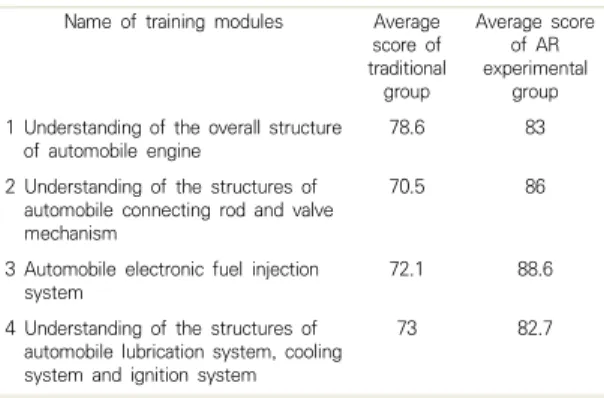
Their learning quality was evaluated by testing their knowledge about the following five training modules. We collected the tests cores of 20 students in the traditional group and 20 students in the AR experimental group, see Table 2.

Name of training modules Average score of traditional

group

Average score of AR experimental

group 1 Understanding of the overall structure

of automobile engine 78.6 83

2 Understanding of the structures of automobile connecting rod and valve mechanism

70.5 86

3 Automobile electronic fuel injection

system 72.1 88.6

4 Understanding of the structures of automobile lubrication system, cooling system and ignition system

73 82.7

Table 2. Average scores of the experimental group and control group

For the results of the independent sample t-test after the two sets of score-related data were collected. Result shows that the p-value of the mean is close to 0.06(t=-1.92, p=0.062). When the level of significance is bigger than 0.05, we cannot refuse null hypothesis, which shows that the module 1 scores of students majoring in automobile maintenance acquired through AR-based learning model were not significantly higher than that acquired through traditional learning model with paper textbooks. Thus, we drew the conclusion that the EAR system did not significantly improve learners’ abilities to study and manipulate automobile engine module 1.

This result shows that the p-value of the mean is close to 0(t=-8.364, p=0.000). When the level of significance is smaller than 0.05, we should refuse null hypothesis. The results show that the module 2 scores of students majoring in automobile maintenance acquired through AR-based learning model were not significantly higher than that acquired through traditional learning model with paper textbooks. Thus, we came to the conclusion that the module 2 scores acquired through the EAR system are higher than that acquired through traditional paper textbooks by15.5(subtract the lower average score from the higher one) points.

Both result these results show that the

academic records of the AR group is obviously

better than that of the traditional study group.

(7)

4.3 Learn about students’ attitude towards the AR+E system (interesting,

sustainability and involvement) through questionnaire and interview

Most of the students stated in the questionnaire that learning with the “AR+E system” is more interesting than traditional book learning, see Tab. 9 for detailed data. The“AR+E” system enhances students’ sense of involvement with immersive experience and it is entertaining to some extent, thus arousing their interest in learning. Over half of the students stated that they prefer learning with the“AR+E” system in future school life and they hope this system could continue to introduce other courses. Other students also stated that their ability to concentrate enhanced significantly and their self-study efficiency also improved in the learning process with the “AR+E system”.

4.4 Find students’ user experience in the learning process through observation and interview

It is found through observation and interview that the experience offered by the“AR+E system”

is more visual than traditional classroom that students can manipulate an engine and disassemble an engine pan with their hands, which is impossible for traditional teaching means. Students obviously became more interested in learning in class after AR technology was used. Although it is easy for the AR system to attract students’ attention, but they will lose interest soon after freshness wears off.

So, how to make students conduct deep learning again in immersive experience is a great challenge to an AR+E learning system. Meanwhile, in a traditional learning environment, students’

problems are concentrated on their uncertainty about knowledge, their misunderstandings about actual operation and inability to get timely feedback and solution, which lead to lower learning efficiency. 

   5. Discussion and conclusion

As AR technology is increasingly widely used in the field of education at present, this article focuses on discussing the advantages of AR technology in the context of education, and it is found by developing, demonstrating and test actual cases that AR technology can influence students’ learning outcome and make learning more interesting, participatory and sustainable.

The first application of the “AR+E system” was well-received, but it is found through investigation and interview that AR is unable to replace traditional teaching methods for the time being, though it isa trend for future education[12]. The author believes that future iterative design of the

“AR+E system” will continue to use AR technology to present future educational method, valuably combine with individualized teaching, and create a learner-centered learning environment.

Next, some pertinent literature argue that different types of students may respond differently to their interaction with technology in terms of gender, age or experience, but this study has not taken these effects into consideration. Future experimental measurement should quantify their learning ability to some extent in the early stage to make sure the experimental results more real.

REFERENCES

[1] Express Wire. (2019). Online Education Industry 2018 Global Market Research report, 360 Market Updates [Online].

https://www.360marketupdates.com/enquiry/request- sample/12847307

[2] U. Yang& G. I. Kim. (1999). Implementation and Evaluation of Just Follow Me: An Immersive, VR-Based, Motion-Training System. Presence:

Teleoperators & Virtual Environments, 11, 304-323.

DOI:10.1162/105474602317473240

[3] K. E. Raheb, M. M. Stergiou, A. Katifori & Y. E.

Ioannidis. (2019). Dance Interactive Learning Systems:

A Study on Interaction Workflow and Teaching

Approaches. ACM Comput. Surv., 52(3), 50.

(8)

DOI:10.1145/3323335

[4] C. Pribeanu, A. Balog & D. D. Iordache. (2017).

Measuring theperceived quality of an AR-based learning application: a multidimensionalmodel, Interactive Learning Environments, 25(4), 482-495, DOI:10.1080/10494820.2016.1143375

[5] E. Mangina. (2017). 3D learning objects for augmented/virtual reality educational ecosystems.

2017 23rd International Conference on Virtual System

& Multimedia (VSMM), 1-6.

DOI:10.1109/vsmm.2017.8346266

[6] S. C. Y. Yuen, G. Yaoyuneyong & E. Johnson. (2011).

Augmented Reality: An Overview and Five Directions for AR in Education,  Journal of Educational Technology Development and Exchange (JETDE). 4(1), 11.

DOI: 10.18785/jetde.0401.10

[7] J. Martín-Gutiérrez et al.(2017). Virtual technologies trendsin education. EURASIA Journal of Mathematics Science and TechnologyEducation, 13(2), 469-486.

DOI:10.12973/eurasia.2017.00626a

[8] R. Zhou, Y. Song, T. He & F. Asmi. (2016). Applying Augmented Reality Technology to E-Learning: Science Educational AR Products as an Example. 2016 IEEE 13th International Conference on e-Business Engineering (ICEBE), 129-133.

DOI: 10.1109/ICEBE.2016.030

[9] S. Dow, B. MacIntyre & M. Mateas. (2008). Styles of play in immersive and interactive story: case studies from a gallery installation of AR Façade. Advances in Computer Entertainment Technology.

DOI: 10.1145/1501750.1501838

[10] R. S. Sutton & A. G. Barto. (1988). Reinforcement Learning: An Introduction. IEEE Transactions on Neural Networks, 16, 285-286.

DOI:10.1037/a0019441

[11] J. M. Lim. (2016). The Relationship between Successful Completion and Sequential Movement in Self-Paced Distance Courses, The International Review of Research in Open and Distributed Learning, 17(1).

DOI:10.19173/irrodl.v17i1.2167

[12] M. B. González & P. A. Rodríguez. (2003). Un instrumento para evaluar el uso y las actitudes hacia los videojuegos. Pixel-Bit. Revista de Medios y Educación, 20, 17-32.

DOI:10.12795/pixelbit

[13] M. Dunleavy, C. Dede & R. Mitchell. (2009). Affordances and Limitations of Immersive Participatory Augmented Reality Simulations for Teaching and Learning. Journal of Science Education and Technology, 18, 7-22.

DOI:10.1007/s10956-008-9119-1

[14] H. B. Santoso, M. Schrepp, R. Y. Isal, A. Y. Utomo &

B. Priyogi. (2016). Measuring User Experience of the Student-Centered e-Learning Environment. Journal of Educators Online, 13(1), 58-79.

Web site: http://www.thejeo.com

[15] J. Zhang, Y. Sung, H. Hou & K. Chang. (2014). The development and evaluation of an augmented reality-based armillary sphere for astronomical observation instruction. Computers & Education, 73, 178-188.

DOI:10.1016/j.compedu.2014.01.003

루 오 잉(Ying Luo) [정회원]

․ 2000년 7월 : Hubei University of Technology 환경디자인학과(학사)

․ 2003년 7월 : Wuhan University of Technology 공업디자인학과(석사)

․ 2017년 9월 ~ 현재 : 국민대학교 테 크노디자인전문대학원 경험디자인학 과 박사과정

․ 관심분야 : 사용자경험, 인터랙션 디자인

․ E-Mail : [email protected]

장 완 석(Wan-Sok Jang) [정회원]

․ 1997년 2월 : 성균관대학교 한국철학 과(학사)

․ 2000년 6월 : Wuhan University 미 학과(석사)

․ 2004년 12월 : Wuhan University 미학과(박사)

․ 2005년 7월 ~ 현재 : Wuhan University of Technology 예술디자인대학 교수

․ 관심분야 : 사용자 경험, 서비스 디자인

․ E-Mail : [email protected]

반 영 환(Young-Hwan Pan) [정회원]

․ 1991년 2월 : 한국과학기술원 산업공 학과(공학사)

․ 1993년 2월 : 한국과학기술원 인간공 학(공학석사)

․ 1999년 8월 : 한국과학기술원 인간공 학(공학박사)

․ 2006년 9월 ~ 현재 : 국민대학교 테 크노디자인전문대학원 교수

․ 관심분야 : 인터랙션 디자인, 사용자 경험(UX)

․ E-Mail : [email protected]

수치

Fig. 1. Experimental environment and experimental process
Table 2. Average scores of the experimental group and  control  group

참조

관련 문서

The present researcher conducted a self-esteem test on 30 second-year students in J Girls' Commercial High School in Cheju City, and selected 20 of them

present everything to the students, but they should instead let students find a problem and solve it through various methods on their own to suit the STEAM class structure..

In conclusion, this research suggests that the presence of a helper is essential for effective English education for elementary school students in rural areas,

The students of Gwangju Secondary School had to compete with the students of Gwangju Intermediate School, who were Japanese nationals for access to a

First, SW-related career orientation of middle school students who received SW education improved SW education preference and SW career information depending

First, as a result of analyzing the vocabulary learning strategy that students used, students showed that they mainly used strategy when they found meaning

(Note that when the number of scored questions for a given test is greater than the range of possible scaled scores, it is likely that two or more raw scores will convert to

In this study, through carrying out a whole class, small-group and an individual web-based English blogging project, students' scores on English writing