• 검색 결과가 없습니다.

Improvement of Temporal Resolution for Land Surface Monitoring by the Geostationary Ocean Color Imager Data

N/A
N/A
Protected

Academic year: 2021

Share "Improvement of Temporal Resolution for Land Surface Monitoring by the Geostationary Ocean Color Imager Data"

Copied!
14
0
0

로드 중.... (전체 텍스트 보기)

전체 글

(1)

1. Introduction

In land remote sensing, the use of image data obtained from geosynchronous orbit satellites has been relatively rare despite their great advantages over polar orbit satellites with very high temporal resolution (Fensholt et al., 2011; Nigam et al., 2012). Global and continental scale daily observations of land surfaces

began with the Advanced Very High Resolution Radiometer (AVHRR) data, which were acquired by the National Oceanic and Atmospheric Administration (NOAA) polar orbit satellites since late 1970’s.

Although the AVHRR sensor was originally designed for meteorological and oceanographic purposes, the high temporal resolution of AVHRR imagery soon became popular for the observation of global- and

Improvement of Temporal Resolution for Land Surface Monitoring

by the Geostationary Ocean Color Imager Data

Hwa-Seon Lee and Kyu-Sung Lee

Department of Geoinformatic Engineering, Inha University

Abstract : With the increasing need for high temporal resolution satellite imagery for monitoring land surfaces, this study evaluated the temporal resolution of the NDVI composites from Geostationary Ocean Color Imager (GOCI) data. The GOCI is the first geostationary satellite sensor designed to provide continuous images over a 2,500×2,500 km

2

area of the northeast Asian region with relatively high spatial resolution of 500 m.

We used total 2,944 hourly images of the GOCI level 1B radiance data obtained during the one-year period from April 2011 to March 2012. A daily NDVI composite was produced by maximum value compositing of eight hourly images captured during day-time. Further NDVI composites were created with different compositing periods ranging from two to five days. The cloud coverage of each composite was estimated by the cloud detection method developed in study and then compared with the Moderate Resolution Imaging Spectroradiometer (MODIS) Aqua cloud product and 16-day NDVI composite. The GOCI NDVI composites showed much higher temporal resolution with less cloud coverage than the MODIS NDVI products. The average of cloud coverage for the five-day GOCI composites during the one year was only 2.5%, which is a significant improvement compared to the 8.9%~19.3% cloud coverage in the MODIS 16-day NDVI composites.

Key Words : GOCI, geostationary satellite, temporal resolution, cloud-free composite, NDVI, COMS

Received January 19, 2016; Revised February 18, 2016, Accepted February 23, 2016.

† Corresponding Author: Kyu-Sung Lee ([email protected])

This is an Open-Access article distributed under the terms of the Creative Commons Attribution Non-Commercial License (http://creativecommons. org/licenses/by-nc/3.0) which permits unrestricted non-commercial use, distribution, and reproduction in any medium, provided the original work is properly cited

Article

(2)

continental-scale land surfaces, in particular for vegetation monitoring (Justice et al., 1985). The subsequent AVHRR sensors, carried on a series of NOAA satellites, have provided continuous observations for land surface dynamics in various spatial scales (Gutman and Ignatov, 1995; Stöckli and Vidale, 2004; Pu et al., 2007). Due to the wide swath, high temporal resolution, free data distribution, and relatively inexpensive data receiving system, the AVHRR data have become one of the most widely used satellite remote sensor data over the world (Cracknell, 200l). From the success of NOAA AVHRR data for global monitoring of land surfaces, other polar orbit satellite sensors, such as MODIS and Satellite Pour l’Observation de la Terre (SPOT) VEGETATION, were added to observe and monitor various land surface features over large geographical areas (Huete et al., 2002; Maisongrade et al., 2004).

However, these polar orbit satellite images have certain limitations of persistent cloud covers obscuring the continuous land monitoring (Julien and Sobrino, 2010). To make cloud-free observations over land surface, several image composite methods have been developed (Holben, 1986; Chen et al., 2003). Cloud- free image composites are mostly based on the selection of the highest-quality cloud-free pixel among consecutive multiple observations within a predefined time period. The image composite has provided not only less cloud-covered image but also better radiometric quality images by reducing the atmospheric influences (Holben, 1986; El Saleous et al., 2000). In land surface observation and monitoring, the Normalized Difference Vegetation Index (NDVI) has been the most common form of data derived from visible and Near Infrared (NIR) spectral bands. There have been several types of global-scale NDVI composites from AVHRR and MODIS, which were produced from various compositing periods (8-day, 10- day, two-week, 16-day, a month). Although these NDVI composites have been useful for time series

analysis over land surface, they still contain cloud problem (Townshend, 1994).

Another problem of image composite with polar orbit satellite data is related to the degradation of temporal resolution (Thayn and Price, 2008). For instance, the 16-day NDVI composite may not be effective for observing and detecting the rapid changes that occur in less than a 16-day period. The phenological development of vegetation canopy can change very quickly during transition periods of green-up and senescence, which requires more frequent observations (Ahl et al., 2006; Muraoka and Koizumi, 2009). The low temporal resolution problem becomes more obvious for detecting abrupt changes, such as forest fires, flood, and heavy snow. To accurately and timely detect and monitor such rapid changes, the compositing period should be short (Remmel and Perera, 2001;

Chuvieco et al. , 2005; Jin and Sader, 2005).

Geostationary satellite images can be an effective

alternative to increase the temporal resolution if they

have suitable spectral and spatial resolution to observe

land surface features. Up to now, data from two

geostationary satellites of the European meteorological

satellite (MSG) and the Indian geostationary satellite

(INSAT 3A) have been used to derive time series

observations on land surfaces. The MSG Spinning

Enhanced Visible and InfraRed Imager (SEVIRI) data

have shown the potential to be used for detecting and

monitoring of drought (Rulinda et al., 2011), flooding

(Proud et al., 2011), and wild fires (Amraoui et al.,

2010). The geostationary data were very effective in

producing cloud-free NDVI data with much shorter

compositing period compared to polar orbit satellite

data (Fensholt et al., 2007). Another case of using

geostationary satellite data for land observation was

found using the INSAT 3A CCD data, although their

study mainly focused on the derivation of NDVI itself

(Nigam et al., 2012). These geostationary satellite

images cover a continental area with a spatial resolution

of 1~3 km in every 15~30 minutes. Although these

(3)

geostationary satellite data have rather coarse spatial resolution and are still new to land remote sensing, these two cases have shown the potential of geostationary satellite images for land monitoring with high temporal resolution.

This paper presents the advantage of high temporal resolution of a new geostationary satellite image for land observations at regional scale. Unlike the previous two geostationary satellites that were mainly developed for meteorological purposes covering continental area, the Geostationary Ocean Color Imager (GOCI) data are capturing only a particular region in northeast Asia.

Considering the high temporal resolution and, in this context, relatively high spatial resolution of 500 m, the GOCI data have the potential for detecting and monitoring short-term changes over land. The objective of this study is to evaluate the temporal resolution of the GOCI NDVI composites by comparing the cloud coverages with other polar orbit satellite data over the entire land area of the GOCI image. It may be obvious for a geostationary satellite to have higher temporal resolution than polar orbit satellite. However, the GOCI is the first regional-scale geostationary satellite sensor that is capable of capturing images with different spatial resolution and temporal resolution from previous geostationary satellite sensors.

2. Data and Methods

To evaluate the temporal resolution of the geostationary satellite image composites, the complete coverage of GOCI images obtained for one year were processed to create NDVI composites. Several sets of GOCI NDVI composite were produced with different compositing periods. Cloud coverage of each set of the NDVI composites was estimated by the cloud detection method developed in this study and then compared with the MODIS products.

1) GOCI Data

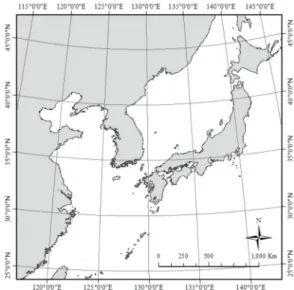
The GOCI is a suite of major imaging sensors onboard the Communication Ocean and Meteorological Satellite (COMS), which was successfully launched on 27 June 2010 to a geostationary orbit of 36,000 km altitude. The GOCI is indeed unique and the first geostationary ocean color sensor to provide continuous images at regional scale, which covers an area of about 2,500 × 2,500 km

2

centered at 130˚E × 36˚N (Fig. 1) (Ryu et al., 2012). The GOCI image has a 500m spatial resolution and is providing eight hourly observations (usually from 9:00 AM to 4:00 PM in local time) per day. The GOCI takes 16 step-by-step slot images through a scan of the pointing mirror. Each slot image of 1,432 × 1,415 pixels is sequentially transmitted to the receiving station for automatic mosaic for the entire target area. It takes less than 30 minutes to take and to transmit the whole 16 slots over the entire area (Kang et al., 2010). As the name implies, the GOCI has been mainly designed for ocean color monitoring with eight spectral bands (Table 1), which are very similar to the Sea-viewing Wide Field-of-view Sensor (SeaWiFS)

Fig. 1. Geographical coverage of the Geostationary Ocean

Color Imager (GOCI) target area, which covers an area

of about 2,500 × 2,500 km

2

in northeast Asia including

all of the Korean peninsula, Japan and part of China,

Mongolia, and Russia.

(4)

system. Although the main function of the GOCI is ocean color observation, its coverage still contains a large land area in the northeast Asian region including all of the Korean peninsula, Japan and part of China, Mongolia, and Russia. The total land area within the predetermined GOCI coverage is about 2.4 million km

2

, which occupies about 38% of the scene.

After the initial calibration and testing period, the Korea Institute of Ocean Science and Technology (KIOST) has provided GOCI images since 1 April 2011. From early calibration works, it was found that the radiometric quality of GOCI radiance values is comparable with other polar orbit satellite data for ocean and land observations (Lamquin et al., 2012; Lee et al., 2012). The KIOST supplies GOCI data in several processing levels, in which level 1B is radiometrically calibrated and geometrically corrected at-sensor radiance. GOCI level 2 products are mostly related to ocean information, such as atmospherically corrected water-leaving radiance, chlorophyll content, and total suspended sediment. Currently, there is no GOCI product that is particularly designed for land applications.

2) Cloud-free NDVI Compositing

For this study, we used one-year GOCI level 1B radiance data obtained from 30 March 2011 to 31 March 2012, which consist of 2,944 hourly images for 368 days. The GOCI NDVI composites were produced with different compositing periods ranging from one to

five days. Fig. 2 shows the whole GOCI data processing steps to produce NDVI composites to reduce cloudy pixels. The standard atmospheric correction algorithm for GOCI data is basically the same as the SeaWiFS algorithms (Ahn et al., 2012).

The atmospheric correction method, which is currently applied to produce the level 2 ocean products at the KIOST, includes corrections for solar angle variation, Rayleigh and aerosol scattering, and gas absorption.

For this study of obtaining NDVI over land area only, the GOCI at-sensor radiance was converted to reflectance after normalization of downward solar irradiance variation and correction of Rayleigh scattering. Atmospheric correction for aerosol scattering was not performed at this time because of the limited availability of spatially and temporally suitable aerosol data over the whole land area.

After masking out the ocean area using the vector file of coastal line provided by the KIOST, the GOCI reflectance in two spectral bands of 5 (red) and 8 (NIR) were used to calculate NDVI for every hourly GOCI image. The two GOCI bands were selected so as to closely match with the MODIS bands 1 (645 nm) and 2 (859 nm), which are being used to produce the MODIS NDVI product. Daily NDVI composites were produced by selecting the maximum NDVI value among eight hourly NDVI values per day. NDVI of cloud contaminated pixel is generally lower than cloud- free pixel in most land covers. The Maximum Value Composite (MVC) technique reduces sun angle effects and atmospheric influences by aerosol and water vapor (Holben, 1986). Selection of the highest NDVI among eight hourly pixels from 9:00 AM to 4:00 PM would increase the chance of choosing cloud-free pixels.

Cloud coverage was then estimated for each daily NDVI composite by a simple cloud detection method developed for this study. Further NDVI composites were produced by expanding the compositing period length up to five days and cloud coverage was estimated for each composite.

Table 1. Eight spectral bands of the Geostationary Ocean Color Imager (GOCI) onboard COMS

band Center wavelength Band width

1 412 nm 20 nm

2 443 nm 20 nm

3 490 nm 20 nm

4 555 nm 20 nm

5 660 nm 20 nm

6 680 nm 10 nm

7 745 nm 20 nm

8 865 nm 40 nm

(5)

3) Estimation of Cloud Coverage in GOCI NDVI Composites

Cloud detection and removal are important step to create cloud-free NDVI composites using multi- temporal images. However, the cloud detection method presented here was only used to estimate cloud coverage after each NDVI composite was created.

Cloud coverage is referred to the percentage of cloud pixels over entire pixels in the GOCI land area. In this study, cloud removal was carried out during the maximum value composite process by selecting the maximum NDVI value that is assumed clear-sky pixels.

Cloud detection over land surfaces has been more difficult than over ocean because of the heterogeneity of land covers. Land surfaces have variable spectral responses according to different cover types while ocean water has relatively homogeneous spectral characteristics. The traditional cloud detection methods rely on a series of threshold tests on the spectral values

of clouds from visible to thermal infrared wavelengths (Saunders and Kriebel, 1988). Spectral characteristics of clouds vary by height and thickness, which makes it difficult to discriminate from complex land surface features. In addition to visible and NIR bands, Shortwave Infrared (SWIR) and Thermal Infrared (TIR) signals are very beneficial to accurately detect clouds (Ackerman et al., 1998). Cloud detection is not easy for GOCI data or other satellite images that do not have SWIR and TIR bands. Although the threshold method is simple and easy to apply, it is often difficult to decide the exact threshold boundary between cloud and non-cloud (Ackerman et al., 1998; Lee et al., 2001). Another cloud detection method over land area is based on multi-temporal reflectance or NDVI values (Hagolle et al., 2010). The multi-temporal cloud detection method could be effective over land area when the cloud-free signals are available over the entire land area.

In this study, we developed a simple cloud detection

method over land area for the estimation of cloud

Fig. 2. GOCI data processing steps to obtain NDVI composites having different compositing period lengths.

(6)

coverage after the daily NDVI composite was produced. This method uses GOCI multi-temporal NDVI values, but it does not require any predefined threshold or cloud-free values. It reflects the seasonal change of land cover types and is completely based on consecutive NDVI value without any fixed thresholds.

In this method, a pixel was determined as a cloud if the NDVI value is lower than the average NDVI of 10 days (before and after five days from the present day), as follows:

If NDVI i < NDVI 10day (1) then a cloud, else clear

where NDVI i = NDVI of present day i

NDVI 10day = average NDVI of 5 days before and 5 days after the date i

In most land surfaces, the cloud pixel’s NDVI is lower than that of a clear land pixel. This method assumes that at least one observation was achieved in clear condition among the 10-days frame and that the average of a 10-day NDVI would be higher than the NDVI of a cloud pixel in date i. The 10-days frame is set to be short enough not to show any phenological change in land cover and long enough to expect at least one clear observation during the 10 days.

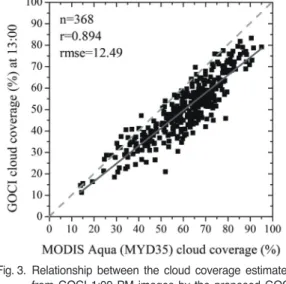
To test the proposed cloud detection method, we used only GOCI images captured at about 1:00PM local time during the 368 days, which is close to the time when the MODIS Aqua is acquired at about 1:30PM everyday to avoid any inconsistency in comparing the cloud coverage. Cloud pixels were detected by the proposed multi-temporal method and the cloud coverage of each GOCI image was then directly compared with the daily MODIS Aqua cloud products.

4) Comparison Analysis with MODIS Products To thoroughly investigate the difference between GOCI and MODIS cloud-free composites availability, we compared the relative portions of cloud coverage

obtained over the study area and the effect of compositing period on each dataset. We used both MODIS Aqua cloud mask product (MYD35) and 16- day NDVI product (MYD13) acquired at the same period (April 2011 ~ March 2012). The MODIS cloud mask product (MYD35L2) is a daily basis level 2 product generated in 1 km spatial resolution. The MODIS 16-day NDVI product (MYD13A1) is level 3 product having spatial resolution of 500m. Once these data were downloaded, they were mosaicked and geometrically registered to the GOCI image and were resampled to 500 m spatial resolution to compare with GOCI data. From both MYD35 and MYD13 products, the Quality Assurance (QA) information was used to extract cloudy pixels to compare with the cloud coverage detected in GOCI NDVI composites. From the MYD35 product, only ‘cloudy’ pixels listed in the QA (2 bit layer, 4 classes) were used to separate clear and cloudy pixels (Ackerman et al., 1998). The 368 daily cloud maps produced from the MYD35 product were overlaid to generate cloud coverage maps of different compositing period of two, three, four, and five days by a simple Boolean operation. From the MYD13 product of total 23 16-day NDVI composites during the one year period, per-pixel cloudy condition was determined by the Vegetation Index (VI) QA information.

3. Results and Discussions

1) GOCI Cloud Detection Method

In evaluating the temporal resolution of GOCI

NDVI composites, the cloud detection method is a

critical element. Before attempting to analyze the cloud

coverage between GOCI and MODIS NDVI

composites, we tested the proposed GOCI cloud

detection method by comparing the actual daily cloud

coverage detected from the GOCI and MODIS images

(7)

acquired at the same time. Fig. 3 compares the cloud coverages estimated by the proposed method with GOCI data and the MODIS cloud product. Cloud estimates between GOCI and MODIS show relatively good agreement with the correlation coefficient (r) of 0.84 and root mean square error (rmse) of 12.49%, despite the different cloud detection methods. The estimate of cloud coverage by the GOCI multi- temporal method was slightly lower than the MODIS cloud estimate. Considering that the MODIS cloud detection algorithm is known to be the most comprehensive and perhaps accurate (Platnick et al., 2003), the proposed GOCI cloud detection method may provide slightly underestimates. The GOCI cloud detection method is completely based on temporal profile of NDVI values without using SWIR and TIR reflectance. Since cloud has about the same high reflectance in red and NIR wavelengths, it could be mistakenly detected as snow and desert. Snow and desert have also about the same reflectance in red and NIR bands and their NDVI would be similar to cloud.

The estimates of cloud coverage might have changed if we used a cloud detection method other than the one proposed in this study. In a recent study by Lee and Lee

(2015), the GOCI cloud detection could be improved by applying multiple threshold criteria including the multi-temporal method used in this study. The proposed GOCI multi-temporal method showed relatively accurate cloud detection in particular over the vegetative areas that is the main area of interest and covers most of the GOCI land area. Although cloud detection is important step for producing cloud-free composite with multi-temporal images, it is often very difficult task due to the spectral complexity of clouds.

That is why several studies are continuously developing to produce cloud-free composite data and to reduce cloud for processing multi-temporal images (Ali et al., 2013; Wang et al., 2014).

2) Comparison with MODIS Cloud Mask Product

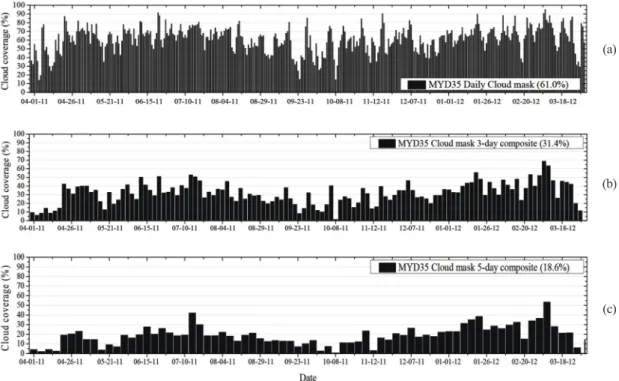
The cloud coverage in GOCI NDVI composites was directly compared with the MODIS MYD35 cloud mask product. As seen in Fig. 4-a, the daily cloud coverage obtained from the MODIS Aqua cloud mask product averages 61.0% and ranges from 10.0% to 94.0% during the one year period. Since the GOCI target area in northeast Asia includes a wide range of climate zones, ranging from subtropical in southern part of China to arid in northern Mongolia, daily cloud coverage over the land area varies by the climate zone and season. Although daily cloud coverage varies greatly throughout the year, it is slightly high in monsoon season (June to August) and winter (January to February). When daily MODIS observations were combined into 3-day and 5-day composites, the average cloud coverage decreased to 31.4% (Fig. 4-b) and 18.6% (Fig. 4-c), respectively. It is obvious that the cloud coverage can be further reduced by extending the compositing period to 16-days. However, even if the longer compositing period provides a better chance to obtain less-cloudy image, it hampers the observation of short-term changes by reducing the temporal resolution.

Fig. 3. Relationship between the cloud coverage estimated

from GOCI 1:00 PM images by the proposed GOCI

multi-temporal method and the ones obtained from the

daily MODIS Aqua Cloud Mask (MYD35) product for

during the 368-day period.

(8)

Cloud coverages decrease in the GOCI NDVI composites. The average of cloud coverage for the GOCI daily NDVI composites reduced to 46.0% (Fig.

5-a). Considering the slight underestimates of GOCI cloud detection, as seen in Fig. 3, the GOCI daily composites may not be notable improvement in Fig. 4. Cloud coverage over the GOCI land area in northeast Asia observed by daily MODIS Aqua MYD35 cloud mask (a) with 3-day

(b) and 5-day (c) compositing periods during the 368-day period.

(c) (a)

(b)

Fig. 5. Cloud coverage over the GOCI land area in northeast Asia observed by GOCI NDVI composite of 1-day (a), 3-day (b), and 5- day (c) compositing periods during the 368-day period.

(c) (a)

(b)

(9)

reducing cloud coverage by comparing with the MODIS daily cloud product. In addition, if MODIS Terra data were combined with Aqua data to make the cloud mask product, the daily cloud coverage would be further reduced. However, the cloud coverage in the GOCI composites was drastically reduced by increasing the compositing periods. The two-day GOCI composite had only 25.4% cloud coverage while the MODIS 2-day cloud map had 42.9%. The average of cloud coverage for the 3-day and 4-day GOCI composites was 12.7% (Fig. 5-b) and 7.0%, respectively.

The 5-day GOCI composites were almost cloud-free, in which the average of cloud coverage was only 2.5%

(Fig. 5-c). On the other hand, the 5-day MODIS cloud map still showed 18.6% cloud coverage. From the analysis, we can see that the GOCI data can produce cloud-free composites with much higher temporal resolution than polar orbit MODIS data.

3) Comparison with MODIS NDVI Product The high temporal resolution to produce NDVI composites with the GOCI data was more evident when we analyzed the cloud information in the MODIS NDVI product. Although the MODIS NDVI product was generated by compositing 16 daily observations,

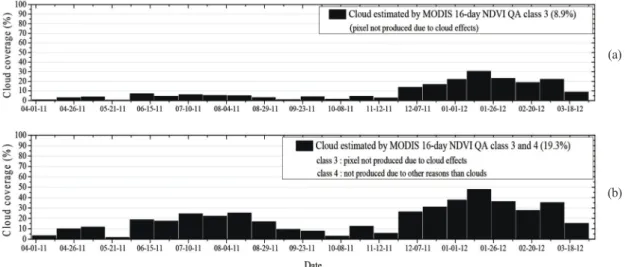
the average of cloud coverage during the same one year period was 8.9% or 19.3%, depending on the cloud information (Fig. 6) within it. The estimates of cloud coverage within the MODIS NDVI product varied by the QA information of VI quality (2 bit layer, 4 classes) (Huete et al., 1999; Roy et al., 2002). The average cloud coverage was 8.9% when we used only the QA class 3 (pixel not produced due to cloud effects), but it increased up to 19.3% when we used both classes 3 and 4 (pixel not produced due to other reasons than clouds).

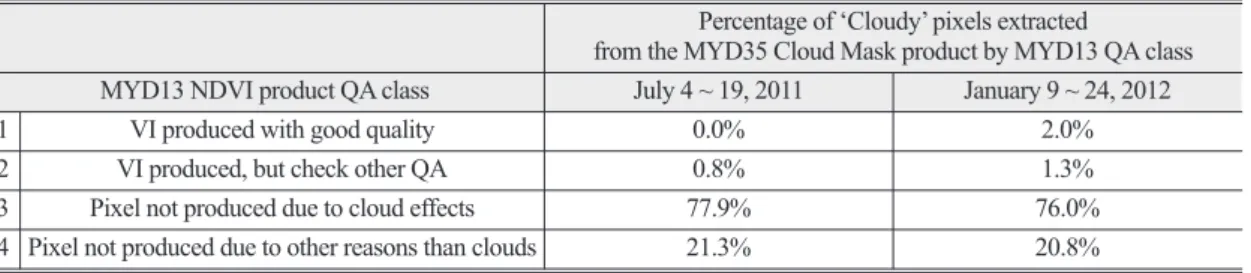
Cloud pixels in the MODIS NDVI product (MYD13) did not exactly match up with the MODIS cloud mask product (MYD35). We compared the cloud coverage between the MYD13 and MYD35 for the selected 16-day periods of high cloud seasons in the GOCI land area (Table 2). Daily MYD35 cloud maps were overlaid to extract cloudy pixels during the same 16-days of a MODIS NDVI composite. As seen in Table 2, the cloudy pixels extracted from the MYD35 product were mostly classes 3 and 4 in the MYD13 VI QA information. If the cloud detection method did not differ greatly between MYD13 and MYD35 products, the ‘cloudy’ pixel in MYD35 should have been assigned to class 3 in the MYD13 QA information. The

Fig. 6. Cloud coverage over the GOCI land area in northeast Asia estimated by the quality assurance (QA) information in the MYD13 16-day NDVI product during the 368-day period. Cloud coverage was estimated by the QA class 3 only (a) and the QA classes 3 and 4 (b).

(a)

(b)

(10)

MYD13 VI QA class 4 was also more likely to be cloudy pixels since they were mostly ‘cloudy’ pixel in the MYD35 cloud product.

The discrepancy between MYD13 and MYD35 cloud estimates might be caused by the different algorithms and purposes to produce QA information.

The MYD13 VI QA information considers other radiometric characteristics (atmospheric conditions, viewing and sun angles, and use of the backup algorithm) beside cloudy pixels to provide usability and usefulness of NDVI value (Roy et al., 2002). On the other hands, MYD35 cloud mask QA information represents purely cloudy condition (Ackerman et al., 1998; Frey et al., 2008). Although the MODIS cloud

information is known to be the most comprehensive one, cloud detection is still very difficult and contains some errors in the MYD 35 product over the GOCI land area (Lee and Lee, 2015). In either case, the average cloud coverage of the 16-day MODIS NDVI product during the 368 days can be achieved by about three-day composite of the GOCI data. Such improved high temporal resolution to obtain less-cloud NDVI composite with the GOCI images would be very beneficial to observe any short-term changes over the land.

4) Comparison in High Cloudy Season The chances of cloud-free observation with the Table 2. Distribution of ‘cloudy’ pixels extracted from the MODIS cloud mask product (MYD35) by the MODIS 16-day NDVI product

(MYD13) quality assurance (QA) class for the two cloudy seasons over the GOCI land area

Percentage of ‘Cloudy’ pixels extracted from the MYD35 Cloud Mask product by MYD13 QA class MYD13 NDVI product QA class July 4 ~ 19, 2011 January 9 ~ 24, 2012

1 VI produced with good quality 0.0% 2.0%

2 VI produced, but check other QA 0.8% 1.3%

3 Pixel not produced due to cloud effects 77.9% 76.0%

4 Pixel not produced due to other reasons than clouds 21.3% 20.8%

Table 3. Comparison of cloud coverage over the GOCI land area between the GOCI 5-day composites and the MODIS 16-day composites during the high cloudy seasons in summer and winter. The cloud coverage in MODIS was estimated by the VI QA class 3 and 4

GOCI 5-day composite MODIS 16-day composite

compositing period cloud coverage (%) compositing period cloud coverage (%)

8~12 July 2011 1.6

4~19 July 2011 24.3

13~17 July 2011 9.7

18~22 July 2011 6.1

23~27 July 2011 3.4

20 July~4 Aug. 2011 22.1

28 July~1 Aug. 2011 3.9

2~6 Aug. 2011 0.6

7~11 Aug. 2011 0.2

5~20 Aug. 2011 25.3

12~16 Aug. 2011 1.4

17~21 Aug. 2011 2.9

22~26 Aug. 2011 3.9

21 Aug.~5 Sep. 2011 16.8

27~31 Aug. 2011 3.6

1~5 Sep. 2011 4

28 Feb.~3 Mar. 2012 2.6

26 Feb.~12 Mar. 2012 35.16

4~8 Mar. 2012 20.1

9~13 Mar. 2012 2.1

(11)

GOCI data can be further analyzed by comparing the GOCI composite during the high cloudy seasons in summer Asian monsoon and winter. Table 3 compares the 5-day GOCI composites and the 16-day MODIS composite in two highly cloudy seasons. In the MODIS 16-day NDVI composites, cloud coverage was more than 20% in these seasons. However, the cloud coverage was much lower with the 5-day GOCI NDVI composites within the same period. Some of the 5-day GOCI composites provided almost cloud-free NDVI images, even in these highly cloudy seasons.

Considering that the 5-day GOCI NDVI was actually produced from 40 hourly images of GOCI data, the moving characteristics of cloud within that time period would help to extract more cloud-free pixels than the 16 daily observations of the MODIS Aqua images.

4. Conclusions

High frequency cloud-free observation is becoming important to monitor various land surface features.

Geostationary satellites can be an effective alternative to increase the temporal resolution over polar orbit satellites. The GOCI is a very unique geostationary sensor system capable of providing very high temporal observations in region-scale. Although it was mainly developed for ocean color monitoring, it has great potential to be used for land applications. In this study, we have shown that the GOCI NDVI data can be generated with much shorter compositing period compared to the MODIS NDVI. We were able to obtain almost cloud-free GOCI composites (2.5%

average cloud coverage) with a 5-day compositing period during the 368-day period from April 2011 to March 2012. This is a significant improvement in temporal resolution as compared with the MODIS NDVI products.

The GOCI images and other geostationary satellite images need steadfast processing steps for radiometric

and atmospheric corrections to obtain high quality signal for quantitative applications. The NDVI data derived from the GOCI images for selected sites of vegetation cover have already shown relatively good agreement with MODIS NDVI (Yeom and Kim, 2013), which indicates that the GOCI data have comparable radiometric quality to derive reliable NDVI value. In this study, the GOCI NDVI was calculated using the reflectance value that was corrected for solar illumination angles and Rayleigh scattering only.

Further works to refine atmospheric correction and to normalize daytime variation on directional reflectance should be performed to obtain reliable reflectance value and other spectral indices. Although geostationary satellite images are still new to land remote sensing fields, the results obtained from this study clearly show the potential of geostationary satellite images for land surface monitoring with much higher temporal resolution. The high temporal resolution, capable of producing cloud-free NDVI composite, that was obtained from the GOCI data can be effectively used to monitor short-term changes over terrestrial ecosystems.

Acknowledgement

This research was a part of the project titled

“Research for Applications of Geostationary Ocean Color Imager”, funded by the Ministry of Oceans and Fisheries, Korea.

References

Ackerman, S.A., K.I. Strabala, W.P. Menzel, R.A. Frey, C.C. Moeller, and L.E. Gumley, 1998.

Discriminating clear sky from clouds with MODIS, Journal of Geophysical Research:

Atmospheres (1984-2012), 103(D24): 32141-

(12)

32157.

Ahl, D.E., S.T. Gower, S.N. Burrows, N.V. Shabanov, R.B. Myneni, and Y. Knyazikhin, 2006.

Monitoring spring canopy phenology of a deciduous broadleaf forest using MODIS, Remote Sensing of Environment, 104(1): 88-95.

Ahn, J., Y. Park, J. Ryu, and B. Lee, 2012. Development of atmospheric correction algorithm for Geostationary Ocean Color Imager (GOCI), Ocean Science Journal, 47(3): 247-259.

Ali, A., C. de Bie, and A.K. Skidmore, 2013. Detecting long-duration cloud contamination in hyper- temporal NDVI imagery, International Journal of Applied Earth Observation and Geoinformation, 24: 22-31.

Amraoui, M., C. DaCamara, and J. Pereira, 2010.

Detection and monitoring of African vegetation fires using MSG-SEVIRI imagery, Remote Sensing of Environment, 114(5): 1038-1052.

Chen, P., R. Srinivasan, G. Fedosejevs, and J. Kiniry, 2003. Evaluating different NDVI composite techniques using NOAA-14 AVHRR data, International Journal of Remote Sensing, 24(17): 3403-3412.

Chuvieco, E., G. Ventura, M.P. Martín, and I. Gómez, 2005. Assessment of multitemporal compositing techniques of MODIS and AVHRR images for burned land mapping, Remote Sensing of Environment, 94(4): 450-462.

Cracknell, A.P., 2001. The exciting and totally unanticipated success of the AVHRR in applications for which it was never intended, Advances in Space Research, 28(1): 233-240.

El Saleous, N., E. Vermote, C. Justice, J. Townshend, C. Tucker, and S. Goward, 2000. Improvements in the global biospheric record from the Advanced Very High Resolution Radiometer (AVHRR), International Journal of Remote Sensing, 21(6-7): 1251-1277.

Fensholt, R., A. Anyamba, S. Huber, S.R. Proud, C.J.

Tucker, J. Small, E. Pak, M.O. Rasmussen, I.

Sandholt, and C. Shisanya, 2011. Analysing the advantages of high temporal resolution geostationary MSG SEVIRI data compared to Polar Operational Environmental Satellite data for land surface monitoring in Africa, International Journal of Applied Earth Observation and Geoinformation, 13(5): 721- 729.

Fensholt, R., A. Anyamba, S. Stisen, I. Sandholt, E.

Pak, and J. Small, 2007. Comparisons of compositing period length for vegetation index data from polar-orbiting and geostationary satellites for the cloud-prone region of West Africa, Photogrammetric Engineering &

Remote Sensing, 73(3): 297-309.

Frey, R.A., S.A. Ackerman, Y. Liu, K.I. Strabala, H.

Zhang, J.R. Key, and X. Wang, 2008. Cloud detection with MODIS. Part I: Improvements in the MODIS cloud mask for collection 5, Journal of Atmospheric and Oceanic Technology, 25(7): 1057-1072.

Gutman, G., and A. Ignatov, 1995. Global land monitoring from AVHRR: potential and limitations, International Journal of Remote Sensing, 16(13): 2301-2309.

Hagolle, O., M. Huc, D.V. Pascual, and G. Dedieu, 2010. A multi-temporal method for cloud detection, applied to FORMOSAT-2, VENµS, LANDSAT and SENTINEL-2 images, Remote Sensing of Environment, 114(8): 1747-1755.

Holben, B.N., 1986. Characteristics of maximum-value composite images from temporal AVHRR data, International Journal of Remote Sensing, 7(11):

1417-1434.

Huete, A., K. Didan, T. Miura, E.P. Rodriguez, X. Gao,

and L.G. Ferreira, 2002. Overview of the

radiometric and biophysical performance of the

MODIS vegetation indices, Remote Sensing of

Environment, 83(1): 195-213.

(13)

Huete, A., C. Justice, and W. Van Leeuwen, 1999.

MODIS vegetation index (MOD13), Algorithm theoretical basis document, 3: 213.

Jin, S., and S.A. Sader, 2005. MODIS time-series imagery for forest disturbance detection and quantification of patch size effects, Remote Sensing of Environment, 99(4): 462-470.

Julien, Y., and J.A. Sobrino, 2010. Comparison of cloud-reconstruction methods for time series of composite NDVI data, Remote Sensing of Environment, 114(3): 618-625.

Justice, C.O., J. Townshend, B. Holben, and e.C.

Tucker, 1985. Analysis of the phenology of global vegetation using meteorological satellite data, International Journal of Remote Sensing, 6(8): 1271-1318.

Kang, G., P. Coste, H. Youn, F. Faure, and S. Choi, 2010. An in-orbit radiometric calibration method of the geostationary ocean color imager, Geoscience and Remote Sensing, IEEE Transactions on, 48(12): 4322-4328.

Lamquin, N., C. Mazeran, D. Doxaran, J. Ryu, and Y.

Park, 2012. Assessment of GOCI radiometric products using MERIS, MODIS and field measurements, Ocean Science Journal, 47(3):

287-311.

Lee, K., S. Park, S. Kim, H. Lee, and J. Shin, 2012.

Radiometric characteristics of Geostationary Ocean Color Imager (GOCI) for land applications, Korean Journal of Remote Sensing, 28(3): 277-285.

Lee, H. and K. Lee, 2015. Development of cloud detection method with Geostationary Ocean Color Imagery for land applications, Korean Journal of Remote Sensing, 31(5): 371-384 (In Korean with English abstact).

Lee, W., J. Kudoh, and S. Makino, 2001. Cloud detection for the Far East region using NOAA AVHRR images, International Journal of Remote Sensing, 22(7): 1349-1360.

Maisongrande, P., B. Duchemin, and G. Dedieu, 2004.

VEGETATION/SPOT: an operational mission for the Earth monitoring; presentation of new standard products, International Journal of Remote Sensing, 25(1): 9-14.

Muraoka, H., and H. Koizumi, 2009. Satellite Ecology (SATECO) linking ecology, remote sensing and micrometeorology, from plot to regional scale, for the study of ecosystem structure and function, Journal of Plant Research, 122(1):

3-20.

Nigam, R., B.K. Bhattacharya, K.R. Gunjal, N.

Padmanabhan, and N. Patel, 2012. Formulation of time series vegetation index from Indian geostationary satellite and comparison with global product, Journal of the Indian Society of Remote Sensing, 40(1): 1-9.

Platnick, S., M.D. King, S. Ackerman, W.P. Menzel, B.

Baum, J.C. Riédi, and R. Frey, 2003. The MODIS cloud products: Algorithms and examples from Terra, Geoscience and Remote Sensing, IEEE Transactions on, 41(2): 459- 473.

Proud, S.R., R. Fensholt, L.V. Rasmussen, and I.

Sandholt, 2011. Rapid response flood detection using the MSG geostationary satellite, International Journal of Applied Earth Observation and Geoinformation, 13(4): 536- 544.

Pu, R., Z. Li, P. Gong, I. Csiszar, R. Fraser, W. Hao, S.

Kondragunta, and F. Weng, 2007. Development and analysis of a 12-year daily 1-km forest fire dataset across North America from NOAA/

AVHRR data, Remote Sensing of Environment, 108(2): 198-208.

Remmel, T.K., and A.H. Perera, 2001. Fire mapping in a northern boreal forest: assessing AVHRR/

NDVI methods of change detection, Forest Ecology and Management, 152(1): 119-129.

Roy, D.P., J.S. Borak, S. Devadiga, R.E. Wolfe, M.

(14)

Zheng, and J. Descloitres, 2002. The MODIS land product quality assessment approach, Remote Sensing of Environment, 83(1): 62-76.

Rulinda, C.M., W. Bijker, and A. Stein, 2011. The chlorophyll variability in Meteosat derived NDVI in a context of drought monitoring, Procedia Environmental Sciences, 3: 32-37.

Ryu, J., H. Han, S. Cho, Y. Park, and Y. Ahn, 2012.

Overview of geostationary ocean color imager (GOCI) and GOCI data processing system (GDPS), Ocean Science Journal, 47(3): 223- 233.

Saunders, R.W., and K.T. Kriebel, 1988. An improved method for detecting clear sky and cloudy radiances from AVHRR data, International Journal of Remote Sensing, 9(1): 123-150.

Stöckli, R., and P.L. Vidale, 2004. European plant phenology and climate as seen in a 20-year AVHRR land-surface parameter dataset, International Journal of Remote Sensing,

25(17): 3303-3330.

Thayn, J., and K. Price, 2008. Julian dates and introduced temporal error in remote sensing vegetation phenology studies, International Journal of Remote Sensing, 29(20): 6045-6049.

Townshend, J.R., 1994. Global data sets for land applications from the Advanced Very High Resolution Radiometer: an introduction, International Journal of Remote Sensing, 15(17): 3319-3332.

Wang, L., P. Xiao, X. Feng, H. Li, W. Zhang, and J. Lin, 2014. Effective Compositing Method to Produce Cloud-Free AVHRR Image, IEEE Geoscience and Remote Sensing Letters, 11(1):

328-332.

Yeom, J., and H. Kim, 2013. Feasibility of using

Geostationary Ocean Colour Imager (GOCI)

data for land applications after atmospheric

correction and bidirectional reflectance

distribution function modelling, International

Journal of Remote Sensing, 34(20): 7329-7339.

수치

Fig. 1.  Geographical  coverage  of  the  Geostationary  Ocean Color Imager (GOCI) target area, which covers an area of about 2,500 × 2,500 km 2 in northeast Asia including all of the Korean peninsula, Japan and part of China, Mongolia, and Russia.
Table 1.  Eight  spectral  bands  of  the  Geostationary  Ocean Color Imager (GOCI) onboard COMS
Fig. 3.  Relationship between the cloud coverage estimated from GOCI 1:00 PM images by the proposed GOCI multi-temporal method and the ones obtained from the daily MODIS Aqua Cloud Mask (MYD35) product for during the 368-day period.
Fig. 5.  Cloud coverage over the GOCI land area in northeast Asia observed by GOCI NDVI composite of 1-day (a), 3-day (b), and 5- 5-day (c) compositing periods during the 368-5-day period.
+3

참조

관련 문서

• The PDEase2D evolution solver automatically and continuously adjusts its time step interval to reduce the time interval when PDEase2D encounters a region of rapid change

14 For individuals with a triglyceride concentration of 200–499 mg/dL, pharmacological therapy should be considered to lower triglyceride concentration after

SEOUL: South Korea for the first time voted in favour of a UN resolution calling for the suspension of the death penalty, the justice ministry said yesterday.. The resolution at

그것은 이미지를 문자적 으로 서술하는 문제이며 옐름슬레브Hjelmslev[4]의 용어를 쓰자면 (코노테 이션과 반대되는 의미로서) 공정작용operation의

웹 표준을 지원하는 플랫폼에서 큰 수정없이 실행 가능함 패키징을 통해 다양한 기기를 위한 앱을 작성할 수 있음 네이티브 앱과

_____ culture appears to be attractive (도시의) to the

The “Asset Allocation” portfolio assumes the following weights: 25% in the S&amp;P 500, 10% in the Russell 2000, 15% in the MSCI EAFE, 5% in the MSCI EME, 25% in the

1 John Owen, Justification by Faith Alone, in The Works of John Owen, ed. John Bolt, trans. Scott Clark, &#34;Do This and Live: Christ's Active Obedience as the