A Study on the Korean EFL Learners’ Grammatical Knowledge Development under Input-enhanced FFI and Output-enhanced FFI
Conditions
Hee-Jeong Hwang
Liberal Arts School, Jungwon University
입력강화와 출력강화 형태초점교수 상황에서의 한국 EFL 학습자들의 언어형태 지식개발에 관한 연구
황희정
중원대학교 교양학부
Abstract This study explores the effects of different Focus-on-Form Instruction (FFI) on improving learners’
grammatical knowledge development and observes how the learners apply the knowledge to their output. A total of 112 college students were placed into three groups: 35 input-enhanced group students, who received visually enhanced input reading materials, 41 output-enhanced group students, performing dictogloss tasks, and 46 control group students given traditional grammar instruction. All the participant students took pre/post grammatical tests and completed pre/post writing tasks, which aimed to look into how the target grammatical structures were used in writing. The research findings indicated that both input-enhanced and output-enhanced FFI were effective on learners’
language form learning and made contribution to their writing. Based on the findings, this study suggests that the elaborate design of combination of both FFI can maximize learners’ language form learning.
Key Words : Focus-on-Form Instruction (FFI), Input-enhanced FFI, Output-enhanced FFI, Visually Enhanced Input, Dictogloss
요 약 본 연구의 목적은 형태초점교수법이 학습자의 언어형태에 관한 지식 향상에 미치는 영향을 조사하고, 학습자들이 그 형태에 관한 지식을 출력활동인 글쓰기에 어떻게 활용하는지를 살펴보는 것이다. 연구참여자들은 122명의 대학생들로 3개의 집단 즉 입력강화집단 35명, 출력강화집단 41명, 대조집단 46명으로 나누어 평가시험과 글쓰기 과제를 사전·사후로 실시하였다. 연구결과를 살펴보면, 입력강화 형태초점교수법과 출력강화 형태초점교수법 모두 학습자의 언어형태 학습에 영향을 미치는 것으로 드러났고, 학습자들이 이러한 형태초점교수법으로 습득한 지식을 영어글쓰기에 활용하는데 기여한 것으로 나타났다. 본 연구결과에 의거하여, 학습자의 언어형태 학습의 효과를 극대화할 수 있는 방법으로 입력강화와 출력 강화기법을 적절하게 결합한 형태초점교수법을 적용할 것을 제안한다.
주제어 : 형태초점교수법, 입력강화 형태초점교수법, 출력강화 형태초점교수법, 시각적 입력강화, 딕토글로스
*This work is a modified and developed version of part of Hee-Jeong Hwang’s doctoral dissertation.
*Corresponding Author : Hee-Jeong Hwang ([email protected]) Received March 28, 2018
Accepted May 20, 2018
Revised April 30, 2018 Published May 28, 2018
1. Introduction
Debates on how languages are learned have been spotlighted in L2 acquisition. On the theoretical front of Krashen's [1] claim that linguistic competence cannot be taught, the ‘zero option’ insisted that formal grammar instruction should be prohibited in favor of a natural way of development in language use.
The zero position, as supported by Krashen [1], rejected not only planned intervention by practice of different grammatical items and rules in second language learning but also unplanned intervention as a form of incidental error correction. Krashen [2]
considered error correction as a 'serious mistake' since it is likely to disturb the important focus on communication. L2 learning cannot be achieved without the concern of meaningful communicative contexts according to Krashen.
However, pinpointing instruction as facilitation of second language acquisition in order to present the rationale for formal instruction of L2 grammar structures, Ellis [3] explained several facilitative positions such as variability, teachability, and weak interface. The first model of the facilitative position, variability, emphasizes that teaching new grammar features are effective in planned language use but not useful in unplanned language use. The second, teachability, highlights that instruction can contribute to L2 acquisition if the grammar structures to be taught through instruction correspond to the learner's next stage of development. The third, weak interface, posits that formal instruction performs as an aid to internalize the grammatical rules by helping learners to draw selective attention to forms.
Therefore, a strong assertion was made that full target-language competence is not accomplished only through the exposure of the target language since there are certain language forms that cannot be acquired without any instructional intervention.
Due to the demand for instructional intervention, Focus-on-Form Instruction (FFI) strategies have
emerged as a new trend of grammar instruction [4-8].
The Korean EFL classrooms need FFI since there exists a lack of natural communicative language input as well as there still remains much emphasis on separate language forms without meaningful communicative contexts. Many studies suggested different results according to different kinds of FFI and different L2 learning contexts, which indicated considering factors in the research design. This calls for the present study that selected the Korean EFL context. The present study aims to examine the effects of different FFI on the grammatical knowledge development of Korean learners and its contribution to the learners’ output. Research questions generated in the study are as follows:
1. How do different FFI strategies affect learners’
language form comprehension?
2. How do different FFI strategies affect learners’
language form production?
3. How do different FFI strategies contribute to learners’ sentence composition and how do the errors occur in the composition?
2. Methodology
2.1 Participants
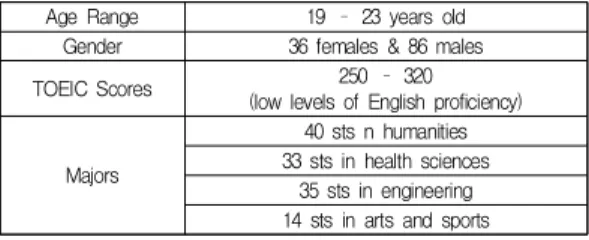
In the present study participants included 122 university students in the first year registered in a required English conversation course. Within eight intact classrooms at random, three groups were formed:
the input-enhanced (IE) group, the output-enhanced
(OE) group, and the control (CG) group. The IE group
contained 35 students receiving Visually Enhanced
Input (VEI) reading materials. The OE group consisted
of 41 students assigned to perform a dictogloss task,
which aimed at writing a story while listening. The
(CG) group with 46 students was given traditional
grammar instruction by the time to learn language
forms. More details about the participants are presented
in Table 1.
Table 1. General Characteristics of Participants
Age Range 19 – 23 years old
Gender 36 females & 86 males
TOEIC Scores 250 – 320
(low levels of English proficiency)
Majors
40 sts n humanities 33 sts in health sciences
35 sts in engineering 14 sts in arts and sports
2.2 Instruments
2.2.1 Pre-test and Post-test
Both pre- and post-test included three sets of tests designed for the target grammatical structures in the study: English verb tenses (hereafter, Form 1), relative clauses (hereafter, Form 2) and comparative adjectives (hereafter, Form 3). Examples of each target structure are as follows (Target structures were highlighted with underlining and boldness):
[Form 1: Verb Tenses]
⟶ Tom was sleeping in the room when I arrived.
[Form 2: Relative Clauses]
⟶ I met a boy whose mother works for the bank.
[Form 3: Comparative Adjectives]
⟶ Robert made more money than I did.
Selection of the first two target structures was made with pedagogical concerns that lower English proficient learners could have problems understanding appropriate verb tenses and relative clauses because there exist a variety of concepts and functions in the structures, which can challenge the learners to acquire correct forms.
On the other hand, comparative adjectives were selected as the target structure from the perspective that some grammatical structures do not necessarily require prior knowledge but timely instructional treatment given to any levels of the English language proficiency because the structures like comparative adjectives are teachable to any levels of English learners.
The grammaticality judgement and fill-in-the blank formats were prepared to verify the comprehension of the target structures and controlled writing and open-ended formats were for the production (refer to
Appendix). Tests contained 30 questions in each target structure: 20 questions for the comprehension test and 10 questions for the production test. All questions scored one point each. There were the same number of question items in both pre- and post-test; however, only different words were used in the sentence of each question items.
2.2.2 Pre-writing Task and Post-Writing Task Both pre-writing and post-writing tasks were assigned to identify how the target language structures were used in writing as follows:
[Pre-writing Task] Write about your family members. Describe ① their appearance such as height and the length of their hair with comparison of them (by looking at a picture of them, or by thinking of them). You should include ② what they plan to do in the future and ③ the most regretful or amusing things that happened to them. (* You should include yourself in your writing when describing your family.)
[Post-writing Task] Choose three friends of yours throughout your entire life. (They could be your friends since you were a child. - i.e., kindergarten, elementary school, junior high school, or high school, or even your college.) Describe ① their appearance such as height and the length of their hair with comparison of them (by looking at a picture of them, or by thinking of them). You should include ② what they plan to do in the future and ③ how you became friends together and the most regretful or amusing things that happened to them.
2.3 Research Procedures
Before the experiment, all the participants were given pre-tests and a pre-writing task to complete.
Two different formats of tasks were assigned to the
two experimental groups: three narratives in a reading
format for the input-enhanced (IE) group and the same
narratives in a listening format for the output-enhanced
(OE) group. The three narratives were adopted from
two storytelling books, Reading Plus (2) and Reading
Plus (3), graded for the low level of English, and from
a website.
1)The narratives contained three target grammar structures: one narrative for each structure.
In the three narratives for the IE group, target grammar structures were highlighted with bold-faced letters, which aims for visually enhanced input. These highlighted narratives were adapted as a written version for reading comprehension. The same narratives were audio-recorded by a native English speaker with a normal speed rate of speaking, which aimed to perform dictogloss tasks for the OE group. Error correction exercise tasks were provided for the control group (CG). Soon after the experiment, the participants were post-tested and completed a post-writing task.
3. Results and Discussion
3.1 Language Form Comprehension
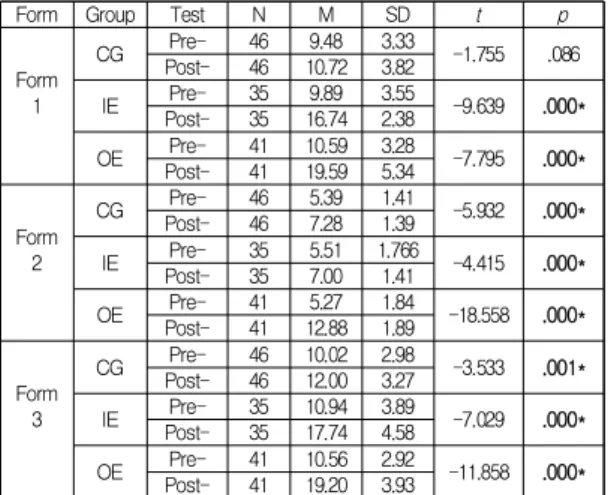
For the first research question involving language form comprehension under the different FFI, the findings revealed some increase from the pre-test to the post-test for all three groups in the three Forms.
There were statistically significant mean differences at the .05 level of alpha except for the CG group in Form 1 (p=.086) as indicated in Table 2.
1)http://www.learnenglish-online.com/grammar/comparative adjectivesreading.html#sthash.KpiTmRqE.dpuf
Looking into the difference among the groups in Table 3, there existed a statistical significance between the means in all three Forms. In terms of Form 1, the mean score of the OE group was the highest with 19.59 and the CG group scored the lowest with 10.72. Form 3 showed the same pattern. In Form 2, however, the IE group gained the lowest score with 7.00, and the OE group recorded the highest score with 12.88.
Table 3. One-way ANOVA Results for Post-Comprehension Test Scores
Form Group N M SD F p
Form 1
CG 46 10.72 3.82
53.464 .000*
IE 35 16.74 2.39
OE 41 19.59 5.34
Form 2
CG 46 7.28 1.39
178.163 .000*
IE 35 7.00 1.41
OE 41 12.88 1.89
Form 3
CG 46 12.00 3.27
41.406 .000*
IE 35 17.74 4.58
OE 41 19.20 3.93
* p<.05
Scheffe’s post hoc pairwise comparisons were drawn among individual groups in the post-test results for an insight into where the exactly significant difference lay.
As presented in Table 4, the Form 1 results showed a significant statistical difference between the CG and IE group (p=.000) as well as the CG and OE group (p=.000). There was also a difference between the IE and OE group (p=.012). In terms of Form 2, a significant difference was found between the CG and OE group (p=.000) as well as the IE and OE group (p=.000), whereas there was no statistical significance between the CE and IE group (p=.729). For the results of Form 3, there was a significant difference between the CG and IE group (p=.000) as well as the CG and OE group (p=.000). However, no statistical significance was found between the IE and OE group (p=.274).
Table 2. Paired Samples t-Test for Comprehension Test Scores
Form Group Test N M SD t p
Form 1
CG Pre- 46 9.48 3.33 -1.755 .086
Post- 46 10.72 3.82
IE Pre- 35 9.89 3.55 -9.639 .000*
Post- 35 16.74 2.38
OE Pre- 41 10.59 3.28
-7.795 .000*
Post- 41 19.59 5.34
Form 2
CG Pre- 46 5.39 1.41 -5.932 .000*
Post- 46 7.28 1.39
IE Pre- 35 5.51 1.766
-4.415 .000*
Post- 35 7.00 1.41
OE Pre- 41 5.27 1.84
-18.558 .000*
Post- 41 12.88 1.89
Form 3
CG Pre- 46 10.02 2.98
-3.533 .001*
Post- 46 12.00 3.27
IE Pre- 35 10.94 3.89
-7.029 .000*
Post- 35 17.74 4.58
OE Pre- 41 10.56 2.92 -11.858 .000*
Post- 41 19.20 3.93
* p<.05 [Form1: Verb tenses, Form2: Relative clauses, Form3: Comparative adjectives]
Table 4. Pairwise Comparison of Post-Comprehension Test Mean Scores
Form Group MD
(I-J) SEM p 95% CI
I J Lower Upper
Form 1
CG IE -6.03* .92 .000* -8.30 -3.75
OE -8.87* .88 .000* -11.05 -6.69
IE OE -2.84* .94 .012* -5.18 -.51
Form 2
CG IE .28 .36 .729 -.60 1.16
OE -5.60* .34 .000* -6.44 -4.75
IE OE -5.88 .36 .000* -6.78 -4.98
Form 3
CG IE -5.74* .88 .000* -7.91 -3.57
OE -7.20 .84 .000* -9.27 -5.12
IE OE -1.45 .90 .274 -3.68 .77
* p<.05
The overall results showed that both experimental groups, IE and OE group students, did better than those in the CG group on the language form comprehension test despite the smaller effectiveness of input-enhanced FFI, which is assumed that different effects on different kinds of the target structures might be ascribed to the different linguistic aspects that each target structure possesses. One possible explanation for the interpretation of the results was that the visually enhanced input (VEI) task did not afford enough opportunities to internalize the target forms for comprehensible input owing to a lack of exposure to the target features.
Nevertheless, the results indicated that both FFI strategies were effective in learners’ language form comprehension. More strictly, output-enhanced FFI contributed to learners’ superior performance in comparison with input-enhanced FFI. This high performance can be supported by the previous findings that proved better effects of output-enhanced FFI [9-11].
3.2 Language Form Production
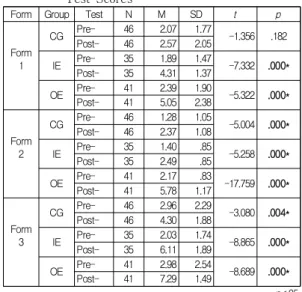
For the second research question related to language form production, the results showed the same pattern as in language form comprehension, which refers to Table 5.
Table 5. Paired Samples t-Test for Production Test Scores
Form Group Test N M SD t p
Form 1
CG Pre- 46 2.07 1.77
-1.356 .182
Post- 46 2.57 2.05
IE Pre- 35 1.89 1.47
-7.332 .000*
Post- 35 4.31 1.37
OE Pre- 41 2.39 1.90
-5.322 .000*
Post- 41 5.05 2.38
Form 2
CG Pre- 46 1.28 1.05
-5.004 .000*
Post- 46 2.37 1.08
IE Pre- 35 1.40 .85
-5.258 .000*
Post- 35 2.49 .85
OE Pre- 41 2.17 .83
-17.759 .000*
Post- 41 5.78 1.17
Form 3
CG Pre- 46 2.96 2.29
-3.080 .004*
Post- 46 4.30 1.88
IE Pre- 35 2.03 1.74
-8.865 .000*
Post- 35 6.11 1.89
OE Pre- 41 2.98 2.54
-8.689 .000*
Post- 41 7.29 1.49
* p<.05
Viewed from the differences among the groups in Table 6, a statistical significance between the means was found in all three Forms. All Forms showed the same pattern. The Form 1 results revealed that the OE group’s mean score was the highest with 5.05 and the CG recorded the lowest score with 2.57. In Form 2, the OE group gained the highest with 5.78 and the CG group scored the lowest with 2.37. It was found in Form 3 that the CG group recorded the lowest score with 4.30 and the OE group scored the highest with 7.29.
Table 6. One-way ANOVA Results for Post-Production Test Scores
Form Group N M SD F p
Form 1
CG 46 2.57 2.05
17.657 .000*
IE 35 4.31 1.37
OE 41 5.05 2.38
Form 2
CG 46 2.37 1.08
138.200 .000*
IE 35 2.49 .85
OE 41 5.78 1.17
Form 3
CG 46 4.30 1.88
31.798 .000*
IE 35 6.11 1.89
OE 41 7.29 1.49
* p<.05
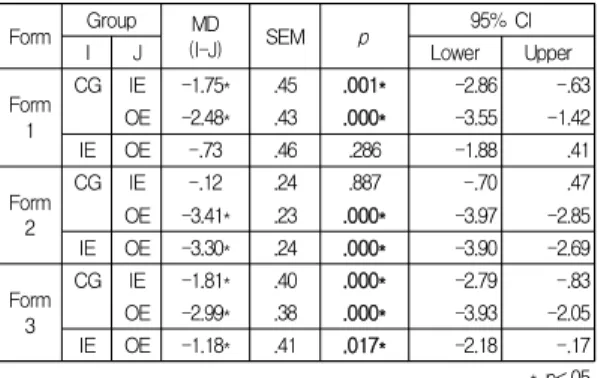
As seen in Table 7, the post hoc test results
suggested that a statistically significant difference lay
between CG and IE group (p=.001) as well as the CG and OE group (p=.000) in Form 1. However, there was no statistical significance between IE and OE group (p=.286). As to Form 2, no significant difference was found between CG and IE group (p=.887), whereas statistical significance appeared between the CG and OE group (p=.000) as well as the IE and OE group (p=.000). The Form 3 results revealed a significant difference between the CG and IE group (p=.000) as well as the CG and OE group (p=.000). There was also a difference between the IE and OE group (p=.017).
Table 7. Pairwise Comparison of Post-Production Test Mean Scores
Form Group MD
(I-J) SEM p 95% CI
I J Lower Upper
Form 1
CG IE -1.75* .45 .001* -2.86 -.63
OE -2.48* .43 .000* -3.55 -1.42
IE OE -.73 .46 .286 -1.88 .41
Form 2
CG IE -.12 .24 .887 -.70 .47
OE -3.41* .23 .000* -3.97 -2.85
IE OE -3.30* .24 .000* -3.90 -2.69
Form 3
CG IE -1.81* .40 .000* -2.79 -.83
OE -2.99* .38 .000* -3.93 -2.05
IE OE -1.18* .41 .017* -2.18 -.17
* p<.05
Like the overall results of the comprehension test, both IE and OE group students outperformed the CG students in the language form production test, indicating both FFI made a difference in producing language forms. When comparing both FFI, further, there existed more effectiveness of output-enhanced FFI on learners’ productive knowledge of the grammatical structures, which can also be found in the other previous studies reporting the effects of output-enhanced FFI [12-14]. One linked explication for the results was that output-enhanced FFI facilitated learners to be appropriately exposed to the target forms and afford enough opportunities to acquire the forms while reconstructing the narratives.
3.3 Sentence Composition
To answer the third research question related to FFI
effects on learners’ sentence composition, the frequent errors and the most noticeable patterns in both pre- and post-writing task were analyzed according to the three target Forms. The results are as follows:
First, in English verb tenses, learners made errors in choosing correct verb tenses and verb forms as well as correct subject-verb agreement. The examples are as follows (Only the parts in which there existed an error were highlighted with underlining and boldness):
He studyed Math when he was a university student.
After I eated dinner last night...
She eat dinner everyday.
..., so he don't want to go to Army.
... her friends talking to her.
My family member are three people....
Second, in the relative clauses, learners used relative clauses more often in post-writing than pre-writing, and they were most likely to be confused with the relative clause pronoun used as the object of a verb and made errors in using 'whose.' The examples are as follows:
I have a friend whom is Young Hwan's girl friend.
I know exactly the man whose will be a good man.
Lastly, in the comparative adjectives, learners produced inappropriate forms and overgeneralized comparative adjectives like the following examples:
My brother is more stronger than my father.
She runs more faster.
My dog is biger than my cat.
The overall patterns shown from the analysis of
comparison of both pre- and post-writing tasks are as
follows: (1) learners made errors in using correct verb
tenses and correct verb forms such as 'studyed' and
'eated'; (2) learners rarely used relative clauses in the
pre-writing task but the frequency of relative clauses used in the post-writing task was higher.
The most frequent errors occurred in the writing tasks are as follows: (1) learners made the most errors in ‘simple present’ tenses with ‘subject-verb agreement’ such as ‘She eat’ and ‘He don't want to go,’
and the second most errors in ‘present continuous’
tenses such as ‘Her friends talking’ and ‘I am go’; (2) learners made a wrong choice of ‘relative clauses’ such as ‘whose’ referring to ‘possessive’; (3) learners overgeneralized comparative adjectives such as ‘more stronger’ and ‘more faster,’ and made errors in spelling such as ‘biger,’ ‘wideer’ or ‘expensiver’.
Considering which of the specific language features instructional intervention should be applied to, White [15] showed one occasion when a kind of ‘problematic over-generalization’ occurs and asserted that this kind of error cannot be eliminated just by natural language input for communication. It was also considered that even ‘benign over-generalization’ could require intervention [3]. As suggested in White’s [15] study, instructional intervention should be needed to correct the kinds of errors that appeared in the present study.
4. Conclusion
The present study demonstrates how different types of FFI affect learners’ English grammatical knowledge development and their output. It was found that both input-enhanced and output-enhanced FFI groups outperformed the control group on the form comprehension and production tests, indicating both FFI strategies affect grammatical knowledge development of learners. To compare both FFI, the output-enhanced FFI group performed better than the input-enhanced group in language form comprehension and language form production. In the sentence composition task implemented to observe whether or not learners used their grammatical knowledge gained through FFI in writing, the overall patterns revealed
that the use of the target structure increased in post-writing and there existed ‘problematic over-generalization in errors made in their writing, on which the treatment as instructional intervention should be suggested.
Current attention to FFI proves that perspectives on teaching grammar have been changed into the spotlight under the umbrella of Communicative Language Teaching, which stresses language use in meaningful contexts [16-19]. This study showed insights into the effects of FFI on grammatical knowledge development of L2 learners.
From the perspective on the output-enhanced FFI effects, this study reflected the role of output in L2 learning, and the findings of the study supported the output hypothesis [20], claiming that output ‘pushes’
learners to learn linguistic forms. ‘Pushed output’
facilitates noticing the gaps in their knowledge through producing the target language, which prompts them to recognize linguistic problems and to elicit correct forms.
This study also proved that input-enhanced FFI was effective, even though it seems relatively less in comparison with that of output-enhanced FFI. The visually enhanced materials were expected to bring learners’ attention to the target grammatical forms, and to help them to use correct forms. As the previous research reported that the small effectiveness of the VEI task was still significantly meaningful [21], the findings of the study that reported the relatively small effectiveness of the VEI task can contribute to future studies on FFI.
The main findings of the study suggest one possible ideal method in FFI that can extract an impact on L2 acquisition: combination of input-enhanced FFI and output-enhanced FFI. To achieve meaningful engagements both in-class and out-of-class, moreover, the present study encourages Korean EFL learners to use digitally converged teaching methods such as blended learning through online digital media [22,23].
For instance, teachers upload reading materials for VEI
tasks and audio-recorded files for dictogloss tasks, which can make available resources for learners. Thus, if the elaborate design of the combined FFI strategies with blended learning is made, the effects of FFI will be maximized and consequently successful L2 acquisition will be achieved.
Nonetheless, the present study has limitations.
There was no delayed post-test implemented due to the time limit within the scheduled curriculum for the course. Lack of a delayed test can be a weakness of the study since the delayed test results can play a role as an evidence proving that any instructional intervention can have an impact on learning and its impact can remain long-lasting. Further studies can fill the gap and confirm its effects by including a delayed post-test.
REFERENCES
[1] S. Krashen. (1981). Second Language Acquisition and Second Language Learning. Oxford: Pergamon Press.
[2] S. Krashen. (1982). Principles and Practice in Second Language Acquisition. Oxford: Pergamon Press.
[3] R. Ellis. (2008). The Study of Second Language Acquisition. Oxford: Oxford University Press.
[4] M. Long. (1991). Focus on form: A design feature in language teaching methodology. In K. de Bot, R.
Ginsberg & C. Kramsc (Eds.), Foreign Language Research in Cross-cultural Perspective. Amsterdam:
John Benjamins.
[5] R. Dekeyser. (1998). Beyond focus on form: Cognitive perspectives on learning and practicing second language grammar. In C. Doughty & J. Williams (Eds.), Focus on Form in Classroom Second Language Acquisition.
Cambridge: Cambridge University Press.
[6] C. Doughty & J. Williams. (1998). Focus on Form in Classroom Second Language acquisition. Cambridge:
Cambridge University Press.
[7] J. Norris & L. Ortega. (2000). Effectiveness of L2 instruction: A Research Synthesis and Quantitative Meta-analysis. Language Learning, 50, 417-528.
[8] J. Williams & J. Evans. (1998). What kind of focus and on which forms? In C. Doughty & J. Williams (Eds.), Focus on Form in Classroom Second Language Acquisition. Cambridge: Cambridge University Press.
[9] S. Izumi, M. Bigelow, M. Fujiwara & S. Fearnow. (1999).
Testing on the Hypothesis: Effects of Output on Noticing and Second Language Acquisition. Studies in Second Language Acquisition, 21, 421-452.
[10] D. H. Kang. (2003). Focus on Form Instructions and L2 Learners' Instructional Preferences. Foreign Language Education, 10(1), 57-82.
[11] J. Hong. (2006). The Effects of Two Focus-on-form Techniques on the Acquisition of the Tense-aspect System. Foreign Language Education, 13(3), 161-186.
[12] S. H. Jin. (2003). A study on the Effects of Dictogloss on English Writing in Korean Middle School. Studies in English Education, 18(2), 115-134.
[13] J. J. Park, & H. K. Lee. (2009). A Study of the Effect of Dictogloss in Middle School English Classes. Foreign Languages Education, 16(1), 147-171.
[14] Y. H. Song & M. R. Park. (2012). The Effects of Focus on Form Instruction on the Learning of English Verb Tenses. English Language & Literature Teaching, 18(4), 361-384.
[15] L. White. (1989). The adjacency condition on case assignment: Do learners observe the subset principle? In S. Gass & J. Schachter (Eds.), Linguistic Perspectives on Second Language Acquisition. Cambridge:
Cambridge University Press.
[16] N. Spada. (1994). International Handbook of English Language Teaching. New York: Springer US.
[17] S. Fotos. (1994). Integrating Grammar Instruction and Communicative Language Use through Grammar Consciousness-raising Tasks. TESOL Quarterly, 28, 323-351.
[18] J. C. Richards & T. S. Rogers. (1986). Approaches and Methods in Language Teaching: A Description and Analysis. Cambridge, UK: Cambridge University Press.
[19] M. Swain. (1995). Three functions of output in second language learning. In G. Cook & B. Seidlhofer (Eds.), Principle and Practice in Applied Linguistics. Oxford:
Oxford University Press.
[20] M. Swain. (1985). Communicative Competence: Some Roles of Comprehensible Input and Comprehensible Output in Its Development. In S. Gass & C. Madden (Eds.), Input in Second Language Acquisition. Rowley, MA: Newbury House.
[21] S. K. Lee & H. T. Huang. (2008). Visual Input Enhancement and Grammar Learning: A Meta-analytic Review. Studies in Second Language Acquisition, 30, 307-331.
[22] M. Choi & T. Han. (2015). A Comparison of Learning
Effectiveness in Face-to-face versus Blended Learning of TOEIC. Journal of Digital Convergence, 13(10), 571-525.
[23] H. Cho. (2016). Relationship between College Students’
English Learning Beliefs and Their English Achievement in E-learning, Journal of Digital Convergence, 14(11), 53-61.
APPENDIX
[1] Samples of Pre/Post Form Comprehension Tests
* Check the correct answer.
1. The student (don’t spent, doesn’t spend, didn’t spend, spends) money on his boots yesterday.
2. My mother (cooked, is cooking, was cooking, cooks) right now. It smells good.
... 중략
* Put the word into the correct form.
11. The train (arrive) ________ at the platform 10 minutes ago.
12. He (drive) ________ his car to school tomorrow.
... 중략
[2] Samples of Pre/Post Form Production Tests
* Complete the following sentence.
21. 나는 어렸을 때 미국에 살았다.
⟶
I ( ) in America when I was young.
...중략
* Write the answer about you. Use a full sentence.
26. What did you do over the weekend?
⟶