Impact of delayed graft function on clinical outcomes in highly sensitized patients after deceased-donor kidney transplantation
Seong Gyu Kim
1, Suyeon Hong
2,3, Hanbi Lee
2,3, Sang Hun Eum
2,3, Young Soo Kim
4, Kyubok Jin
5, Seungyeop Han
5, Chul Woo Yang
2,3, Woo Yeong Park
5,
Byung Ha Chung
2,31 Division of Nephrology, Department of Internal Medicine, Daegu Catholic University School of Medicine, Daegu, Korea
2 Transplantation Research Center, Division of Nephrology, Department of Internal Medicine, Seoul St. Mary’s Hospital, College of Medicine, The Catholic University of Korea, Seoul, Korea
3 Division of Nephrology, Department of Internal Medicine, Seoul St. Mary’s Hospital, College of Medicine, The Catholic University of Korea, Seoul, Korea
4 Division of Nephrology, Department of Internal Medicine, Uijeongbu St. Mary’s Hospital, College of Medicine, The Catholic University of Korea, Uijeongbu, Korea
5 Division of Nephrology, Department of Internal Medicine, Keimyung University School of Medicine, Daegu, Korea
Background: We investigated whether the development of delayed graft function (DGF) in pre-sensitized patients affects the clinical outcomes after deceased-donor kidney transplantation (DDKT).
Methods: The study included 709 kidney transplant recipients (KTRs) from three trans- plant centers. We divided KTRs into four subgroups (highly sensitized DGF, highly sensi- tized non-DGF, low-sensitized DGF, and low-sensitized non-DGF) according to panel re- active antibody level of 50%, or DGF development. We compared post-transplant clinical outcomes among the four subgroups.
Results: Incidence of biopsy-proven acute rejection (BPAR) was higher in two highly sensitized subgroups than in low-sensitized subgroups. It tended to be higher in highly sensitized DGF subgroups than in the highly sensitized non-DGF subgroups. In addition, the highly sensitized DGF subgroup showed the highest risk for BPAR (hazard ratio, 3.051;
P=0.005) and independently predicted BPAR. Allograft function was lower in the two DGF subgroups than in the non-DGF subgroup until one month after transplantation, but thereafter it was similar. Death-censored graft loss rates and patient mortality tended to be low when DGF developed, but it did not reach statistical significance.
Conclusions: DGF development in highly sensitized patients increases the risk for BPAR in DDKT compared with patients without DGF, suggesting the need for strict monitoring and management of such cases.
Keywords: Kidney transplantation; Delayed graft function; Sensitization; Graft loss; Acute rejection
Received July 22, 2021 Revised September 18, 2021 Accepted September 18, 2021 Corresponding author: Byung Ha Chung Department of Internal Medicine, Seoul St. Mary’s Hospital, 222 Banpo-daero, Seocho-gu, Seoul 06591, Korea Tel: +82-2-2258-6066 Fax: +82-2-536-0323
E-mail: [email protected] Co-Corresponding author:
Woo Yeong Park
Department of Internal Medicine, Keimyung University Kidney Institute, Keimyung University School of Medicine, 56 Dalseong-ro, Jung-gu, Daegu 41931, Korea
Tel: +82-53-250-7399 Fax: +82-53-253-7976
E-mail: [email protected]
© The Korean Society for Transplantation This is an Open Access article distributed under the terms of the Creative Commons Attribution Non-Commercial License (http://creativecommons.org/licenses/
by-nc/4.0/) which permits unrestricted non-commercial use, distribution, and reproduction in any medium, provided the original work is properly cited.
pISSN 2671-8790
eISSN 2671-8804
INTRODUCTION
The term “delayed graft function” (DGF) is defined as the need for dialysis immediately after deceased-donor kidney transplantation (DDKT) mainly due to ischemic-reperfu- sion injury [1]. In previous studies, the development of DGF in DDKT was reported to be approximately 10%–50%
[2,3] and entailed ischemic damage occurring during brain death, organ harvest and transplantation as is a major mechanism [3,4]. DGF is clinically important as it may worsen the clinical course after transplantation [5,6].
Various mechanisms have been proposed to explain the role of DGF in deteriorating clinical prognosis after DDKT, resulting in progressive chronic tissue damage of allograft kidney [7,8]. Further, the activation of innate immune re- sponse by ischemic damage in DGF eventually leads to the activation of adaptive immune system directly related to allograft rejection, resulting in the deterioration of allograft function [3,4].
Sensitization refers to the presence of alloantibody targeting human leukocyte antigen (HLA). Risk factors for HLA sensitization include prior transplantation, transfu- sion, and pregnancy [9,10]. In a previous study, pre-trans- plant sensitization in kidney transplantation (KT) was reported in up to 30% [9,11]. Pre-transplant sensitization to HLA is a key risk factor for the development acute al- lograft rejection and also for adverse long-term allograft outcomes [9,12]. In living-donor KT (LDKT), desensitiza- tion therapy has been shown to improve short-term and long-term prognosis after KT in highly sensitized patients because LDKT ensures sufficient time for desensitization [13,14]. However, in DDKT, procedures that require a lot of time and preparation, such as plasmapheresis, are difficult to perform before transplantation, and only rituximab (RTX), a B-cell depleting agent can be used for desensitization in
DDKT [15,16]. Therefore, it is possible that many cases of DDKT may progress without enough removal of anti-HLA antibody.
In this regard, it is possible that the likelihood of acti- vating an allogeneic immune response increases under DGF after DDKT in highly sensitized patients, and leads to a higher incidence of allograft rejection and worsening allograft survival. However, this additive effect of DGF on high sensitization in allograft outcomes has yet to be fully investigated. Therefore, the purpose of this study was to investigate whether the development of DGF in highly sen- sitized patients may synergistically affect the short- and long-term allograft outcomes in DDKT.
METHODS
This study was approved by the Institutional Review Boards of Seoul St. Mary’s Hospital (IRB. No. XC15RIM- I0061K), Keimyung University School of Medicine, Dong- san Medical Center (IRB. No.2017–08-019), and Uijeongbu St. Mary’s Hospital (IRB. No. XC15RIMI0061U). The three transplant centers were exempted from informed consent, with the approval of institutional review boards, because the study was explained to all KTRs before KT. Personal data related to the patient's clinical course post-KT was used and personally identifiable information was protect- ed. This study was a retrospective medical record study, and this manuscript did not contain personally identifiable information. In addition, all study methods were performed in compliance with relevant guidelines and regulations.
Study Population
In this study, we included 709 cases of DDKT who received kidneys from 614 deceased donors (DDs) at three trans- plant centers (Seoul St. Mary’s Hospital, Keimyung Uni- versity Dongsan Medical Center, and Uijeongbu St. Mary’s Hospital) between October 2005 and December 2018. In all kidney transplant recipients (KTRs), the panel reactive antibody (PRA) level was measured via enzyme-linked im- munosorbent assay (ELISA, LAT-M; One-Lambda Inc., Los Angeles, CA, USA) or the Luminex method (LIFECODES Life Screen Deluxe; Gen-Probe Inc., San Diego, CA, USA) as described previously before KT [15].
The distribution of patients in various groups is pre- sented in Fig. 1. Highly sensitized KTRs were defined by a PRA level that was equal to or greater than 50% [17]. DGF HIGHLIGHTS
• The combination of high sensitization and delayed graft function (DGF) could increase the risk of biopsy-prov- en acute rejection, as the most important factor in al- lograft outcome, comparing with high sensitization or DGF alone.
• In highly sensitized patients before kidney transplant
(KT), enhanced desensitization and strict monitoring
after KT may be necessary to prevent DGF.
was defined by the need for dialysis in the first week after KT [1]. Therefore, a total of 709 KTRs were classified into low-sensitized and highly sensitized groups based on a PRA level of 50%. The low-sensitized group included 579 (81.7%) patients and 130 (18.3%) were categorized under the highly sensitized group. Depending on the development of DGF, each group was classified into non-DGF and DGF subgroups. The low-sensitized group included 470 (81.2%) patients as a low-sensitized non-DGF subgroup and an- other 109 (18.8%) patients classified as the low-sensitized DGF subgroup. The highly sensitized group included 103 (79.2%) patients without DGF (highly sensitized non-DGF subgroup) and 27 (20.8%) with DGF (highly sensitized DGF subgroup). The median follow-up period in this study was 55.7 months (interquartile range, 32.2–85.4 months) and there was no difference among the four subgroups.
Clinical Parameters and Outcomes
We retrospectively reviewed the medical records of KTRs and DDs. We collected data for KTRs, including age, sex, body mass index (BMI), history of diabetes mellitus (DM) and hypertension (HTN), number of previous KTs, cause of end-stage renal disease, number of HLA mismatches, per- centage of PRAs, type of induction therapy, maintenance immunosuppressants, and cold ischemic time. Addition- ally, we collected DD data including age, sex, BMI, history of DM and HTN, cause of death, last-day urine volume, central venous pressure and mean arterial pressure from hospitalization date until KT.
The primary outcome of this study was the incidence
of biopsy-proven acute rejection (BPAR). Secondary outcomes included the change of allograft function, death-censored graft survival, and patient mortality among the four subgroups. The change in allograft function was measured by the estimated glomerular filtration rate (eGFR) using the Chronic Kidney Disease Epidemiology Col- laboration equation [18]. The eGFR data were collected up to 3 years (1 week, 2 weeks, 1 month, 3 months, 6 months, 12 months, 2 years, and 3 years) after KT. Interpretation of protocol or indicated biopsy findings was based on the Banff classification 2013 [19]. The allograft biopsy includ- ed the period immediately after KT and could also include the DGF period. BPAR was defined as acute T-cell-mediat- ed rejection (TCMR) or acute antibody-mediated rejection (ABMR) confirmed by allograft biopsy according to Banff classification. Death-censored allograft survival was de- fined as the period until dialysis was restarted or preemp- tive KT was performed, except for death of patient with a functioning allograft after KT. Patient death was defined as the period from KT until death for any cause.
We compared the clinical outcomes among low-sen- sitized non-DGF, low-sensitized DGF, highly sensitized non-DGF, and highly sensitized DGF subgroups. We also investigated whether high sensitization and DGF had a synergistic effect on the clinical outcomes.
Statistical Analysis
Continuous variables with normal distribution were ex- pressed as mean±standard deviation. Student t-test was used for the analysis. Continuous variables with non-nor-
Low-sensitized non-DGF
Low-sensitized DGF
Highly sensitized non-DGF
Highly sensitized DGF 470 DGF
negative
109 DGF positive
103 DGF negative
27 DGF positive Low-sensitized group Highly sensitized group
579 PRA <50% 130 PRA >50%
709 Total deceased donor KT
Fig. 1. Patient distribution. Of the 709 de-
ceased donor kidney transplantation (KT)
recipients included in this study, 579 had
panel-reactive antibody (PRA) less than
50%, and 130 had PRA 50% or more. Of
the deceased-donor kidney transplantation
(DDKT) recipients with a PRA of less than
50%, 470 did not develop delayed graft func-
tion (DGF), and 109 developed DGF. Among
DDKT recipients with a PRA of 50% or more,
103 did not develop DGF and 27 developed
DGF.
mal distribution were expressed as medians and inter- quartile ranges and analyzed using the one-way analysis of variance (one-way ANOVA) test. Categorical variables were expressed as counts and percentages and analyzed using chi-square or Fisher's exact test. The risk of BPAR in- cidence among the four subgroups was analyzed by binary logistic regression analysis. Comparison of death-cen- sored allograft survival, and patient mortality among the four subgroups was investigated via Cox regression anal- ysis. As confounding variables for multivariate analysis of these clinical outcomes, sex, age, history of DM, previous KT history, and numbers of HLA mismatch were consid- ered in KTRs. Sex, age, and DM history were considered in DDs. The P-values less than 0.05 were considered statis- tically significant. All statistical analyses were performed using IBM SPSS ver. 21.0 (IBM Corp., Armonk, NY, USA)
and the MedCalc statistical software ver. 15.5 (MedCalc Software, Ostend, Belgium).
RESULTS
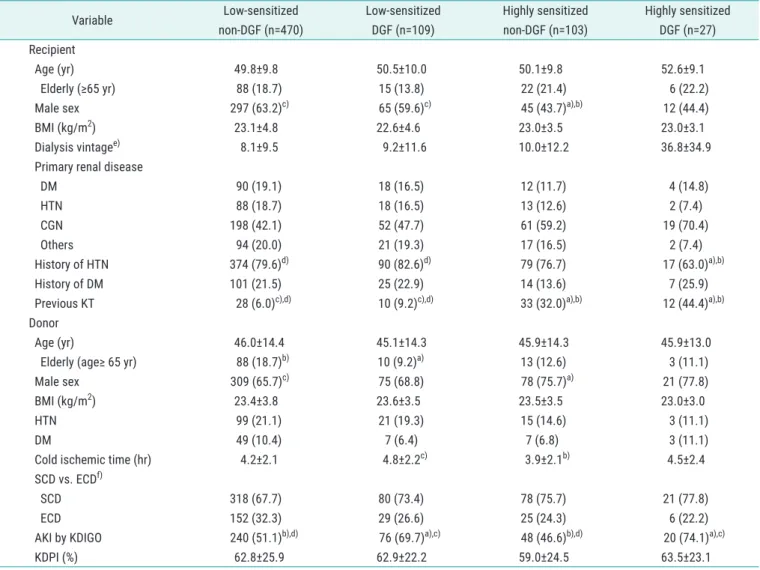
Comparison of Clinical and Laboratory Parameters According to Pre-sensitization and Development of DGF We described baseline characteristics of the patients in the four subgroups as shown in Table 1 [20]. The develop- ment of DGF in the low-sensitized and highly sensitized groups was 109 (18.8%) and 27 (20.8%), respectively, and there was no significant difference. Age, height, weight, and BMI were not different among the four groups both in KTRs and DDs. The proportion of male KTRs was lower or
Table 1. Baseline demographic and immunologic characteristics of study population
Variable Low-sensitized
non-DGF (n=470)
Low-sensitized DGF (n=109)
Highly sensitized non-DGF (n=103)
Highly sensitized DGF (n=27) Recipient
Age (yr) 49.8±9.8 50.5±10.0 50.1±9.8 52.6±9.1
Elderly (≥65 yr) 88 (18.7) 15 (13.8) 22 (21.4) 6 (22.2)
Male sex 297 (63.2)
c)65 (59.6)
c)45 (43.7)
a),b)12 (44.4)
BMI (kg/m
2) 23.1±4.8 22.6±4.6 23.0±3.5 23.0±3.1
Dialysis vintage
e)8.1±9.5 9.2±11.6 10.0±12.2 36.8±34.9
Primary renal disease
DM 90 (19.1) 18 (16.5) 12 (11.7) 4 (14.8)
HTN 88 (18.7) 18 (16.5) 13 (12.6) 2 (7.4)
CGN 198 (42.1) 52 (47.7) 61 (59.2) 19 (70.4)
Others 94 (20.0) 21 (19.3) 17 (16.5) 2 (7.4)
History of HTN 374 (79.6)
d)90 (82.6)
d)79 (76.7) 17 (63.0)
a),b)History of DM 101 (21.5) 25 (22.9) 14 (13.6) 7 (25.9)
Previous KT 28 (6.0)
c),d)10 (9.2)
c),d)33 (32.0)
a),b)12 (44.4)
a),b)Donor
Age (yr) 46.0±14.4 45.1±14.3 45.9±14.3 45.9±13.0
Elderly (age≥ 65 yr) 88 (18.7)
b)10 (9.2)
a)13 (12.6) 3 (11.1)
Male sex 309 (65.7)
c)75 (68.8) 78 (75.7)
a)21 (77.8)
BMI (kg/m
2) 23.4±3.8 23.6±3.5 23.5±3.5 23.0±3.0
HTN 99 (21.1) 21 (19.3) 15 (14.6) 3 (11.1)
DM 49 (10.4) 7 (6.4) 7 (6.8) 3 (11.1)
Cold ischemic time (hr) 4.2±2.1 4.8±2.2
c)3.9±2.1
b)4.5±2.4
SCD vs. ECD
f)SCD 318 (67.7) 80 (73.4) 78 (75.7) 21 (77.8)
ECD 152 (32.3) 29 (26.6) 25 (24.3) 6 (22.2)
AKI by KDIGO 240 (51.1)
b),d)76 (69.7)
a),c)48 (46.6)
b),d)20 (74.1)
a),c)KDPI (%) 62.8±25.9 62.9±22.2 59.0±24.5 63.5±23.1
tended to be lower in highly sensitized groups regardless of DGF than in low-sensitized groups. The proportion of re-transplant KT history was significantly higher in two highly sensitized subgroups than in low-sensitized group.
Anti-thymocyte globulin (ATG) was more frequently used than anti-IL-2 receptor antibody as induction agent in two highly sensitized subgroups. The combined use of RTX was more frequent in the two highly sensitized subgroups.
Almost all patients received a triple-drug maintenance immunosuppressive regimen with tacrolimus, mycopheno- late mofetil (or mycophenolic acid), and steroids.
Comparison of BPAR According to Pre-sensitization and Development of DGF
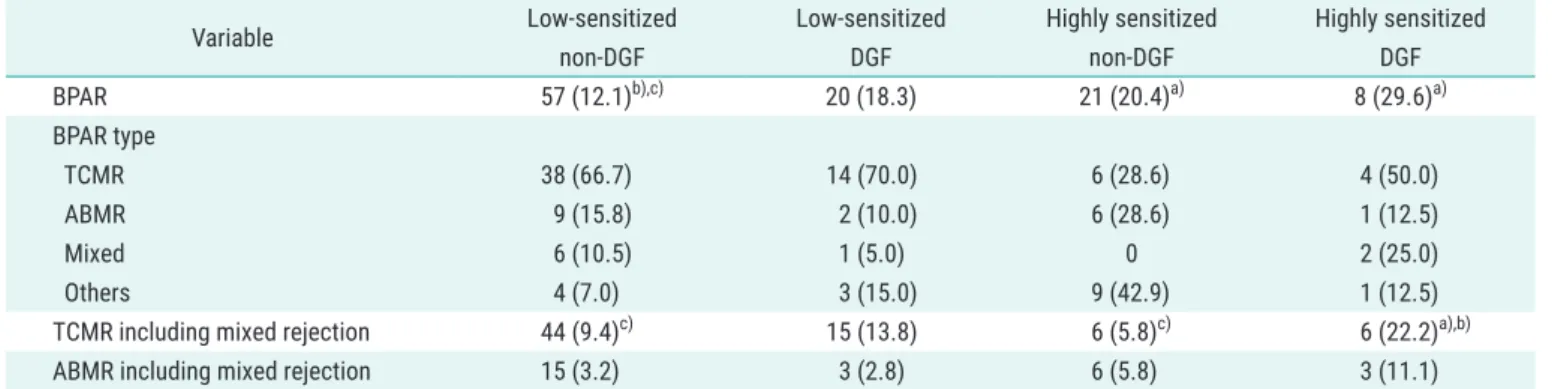
Three cases of allograft biopsy were performed during the DGF period. Two of the three allograft biopsies performed during the DGF period had BPAR. BPAR was detected in 57 cases (12.1%) in the low-sensitized non-DGF subgroup, 20 cases (18.3%) in the low-sensitized DGF subgroup, 21 cases (20.4%) in the highly sensitized non-DGF subgroup, and eight cases (29.6%) in the highly sensitized DGF sub- group. TCMR including mixed rejection occurred statisti- cally significantly more frequently in the highly sensitized DGF subgroup than in the other two non-DGF subgroups (P=0.039, vs. low-sensitized non-DGF; P=0.018 vs. highly
Table 1. ContinuedVariable Low-sensitized
non-DGF (n=470)
Low-sensitized DGF (n=109)
Highly sensitized non-DGF (n=103)
Highly sensitized DGF (n=27) Immunologic parameter
Mismatch number
<3 99 (21.1) 17 (15.6)
d)18 (17.5) 9 (33.3)
b)≥3 371 (78.9) 92 (84.4)
d)85 (82.5) 18 (66.7)
b)HLA-DSA 7/434 (1.6)
c),d)4/88 (4.5)
c),d)24/100 (24.0)
a),b)5/24 (20.8)
a),b)class I 2/434 (0.5)
c),d)0/88 (0.0)
c),d)9/100 (9.0)
a),b)3/24 (12.5)
a),b)class II 5/434 (1.2)
b),c),d)4/88 (4.5)
a),c)18/100 (18.0)
a),b)4/24 (16.7)
a)HLA-DSA, MFI
1,000 to <3,000 2/434 (0.5) 4/88 (4.5) 5/100 (5.0) 2/24 (8.3)
3,000 to <5,000 1/434 (0.2) 0/88 (0.0) 10/100 (10.0) 0/24 (0.0)
5,000 to <10,000 3/434 (0.7) 0/88 (0.0) 4/100 (4.0) 1/24 (4.2)
≥10,000 1/434 (0.2) 0/88 (0.0) 5/100 (5.0) 2/24 (8.3)
Mean MFI 3244.5
c),d)2401.7
c),d)7199.7
a),b)7391.4
a),b)Induction therapy
Basiliximab 336 (71.5)
b),c),d)67 (61.5)
a),c)35 (34.0)
a),b)12 (44.4)
a)ATG 134 (28.5)
b),c),d)42 (38.5)
a),c)68 (66.0)
a),b)15 (55.6)
a)Combined rituximab 2 (0.4)
c),d)1 (0.9)
c),d)41 (39.8)
a),b)7 (25.9)
a),b)Maintenance immunosuppression
Tac-MMF/Myf-steroid 468 (99.6) 107 (98.2) 103 (100.0) 27 (100.0)
CSA-MMF/Myf-steroid 2 (0.4) 1 (0.9) 0 0
SRL-MMF/Myf-steroid 0 1 (0.9) 0 0
Values are presented as mean±standard deviation or number (%). The values for HLA-DSA were only for patients who had undergone HLA-DSA testing.
In addition, the number of patients undergoing HLA-DSA test in each group was expressed in denominator.
DGF, delayed graft function; BMI, body mass index; DM, diabetes mellitus; HTN, hypertension; CGN, chronic glomerulonephritis; KT, kidney transplantation; SCD, standard criteria donors; ECD, expanded criteria donors; AKI, acute kidney injury; KDIGO, kidney disease improving global outcomes; KDPI, kidney donor profile index; HLA, human leukocyte antigen; DSA, donor-specific antibody; MFI, mean fluorescence intensity; ATG, antithymocyte globulin; Tac, tacrolimus; MMF, mycophenolate mofetil; Myf, mycophenolic acid; CSA, cyclosporine A; SRL, sirolimus.
a)
P<0.05 vs. low-sensitized non-DGF;
b)P<0.05 vs. low-sensitized DGF;
c)P<0.05 vs. highly sensitized non-DGF;
d)P<0.05 vs. highly sensitized DGF;
e)
For patients with a previous kidney transplant history, the years from the restart of dialysis to the date of kidney transplant was defined as the dialysis
vintage;
f)ECD was defined as all donors older than 60 years and donors older than 50 years with any two of the following criteria: (1) hypertension, (2)
cerebrovascular cause of brain death, or (3) pre-retrieval serum creatinine level >1.5 mg/dL [20].
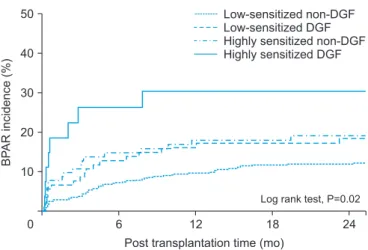
sensitized non-DGF). However, in ABMR including mixed rejection, none of the subgroups showed statistically sig- nificant differences (Table 2). In the crude model of BPAR incidence, the hazard ratio of two highly sensitized sub- groups was significantly higher than in the low-sensitized non-DGF subgroup (reference subgroup) (P=0.029; hazard ratio [HR], 1.856; 95% confidence interval [CI], 1.067–3.228 vs. highly sensitized non-DGF and P=0.012; HR, 3.051; 95%
CI, 1.277–7.291 vs. highly sensitized DGF). The low-sen- sitized DGF subgroup tended to manifest a higher BPAR incidence than the reference subgroup, but it was not sig- nificant (P=0.087; HR, 1.628; 95% CI, 0.931–2.846). Simi- larly, in the adjusted model, BPAR incidence of two highly sensitized subgroups compared with the reference sub- group was statistically significantly higher (P=0.029; HR, 1.866; 95% CI, 1.065–3.269 vs. highly sensitized-non-DGF
and P=0.005; HR, 3.631; 95% CI, 1.481–8.904 vs. highly sensitized-DGF). Within two highly sensitized subgroups, the BPAR risk tended to be higher in the highly sensitized DGF subgroup than in the highly sensitized non-DGF group (P=0.235; HR, 1.638; 95% CI, 0.725–3.700). In addition, in the adjusted model, BPAR incidence was independently influenced by elderly recipients above 65 years of age and with greater than three HLA mismatches (P=0.019; HR, 0.451; 95% CI, 0.232–0.877 and P=0.006; HR, 2.521; 95%
CI, 1.295–4.904) (Table 3, Fig. 2).
Comparison of Allograft Function According to Pre- sensitization and Development of DGF
The allograft function was significantly lower by one month after KT in two DGF subgroups compared with the other two non-DGF subgroups. However, in two DGF sub-
Table 2. Comparison of BPAR across the four subgroupsVariable Low-sensitized
non-DGF
Low-sensitized DGF
Highly sensitized non-DGF
Highly sensitized DGF
BPAR 57 (12.1)
b),c)20 (18.3) 21 (20.4)
a)8 (29.6)
a)BPAR type
TCMR 38 (66.7) 14 (70.0) 6 (28.6) 4 (50.0)
ABMR 9 (15.8) 2 (10.0) 6 (28.6) 1 (12.5)
Mixed 6 (10.5) 1 (5.0) 0 2 (25.0)
Others 4 (7.0) 3 (15.0) 9 (42.9) 1 (12.5)
TCMR including mixed rejection 44 (9.4)
c)15 (13.8) 6 (5.8)
c)6 (22.2)
a),b)ABMR including mixed rejection 15 (3.2) 3 (2.8) 6 (5.8) 3 (11.1)
Values are presented as number (%); the percentage in the BPAR type is for the total number of BPARs. A total of 303 KTRs underwent allograft biopsy, of which BPAR was identified in 106 KTRs (35.0%). This is the result of BPAR which was confirmed at least once in KTRs who underwent repeated biopsy.
BPAR, biopsy proven acute rejection; DGF, delayed graft function; TCMR, T-cell-mediated rejection; ABMR, antibody-mediated rejection; KTR, kidney transplantation recipient.
a)
P<0.05 vs. low-sensitized non-DGF;
b)P<0.05 vs. highly sensitized non-DGF,
c)P<0.05 vs. highly sensitized DGF.
Table 3. Univariate and multivariate binary logistic regression analysis for BPAR incidence
Variable Crude model Adjusted model
a)HR 95% CI P-value HR 95% CI P-value
Low-sensitized non-DGF Reference Reference
Low-sensitized DGF 1.628 0.931–2.846 0.087 1.532 0.871–2.692 0.138
Highly sensitized non-DGF 1.856 1.067–3.228 0.029 1.866 1.065–3.269 0.029
Highly sensitized DGF 3.051 1.277–7.291 0.012 3.631 1.481–8.904 0.005
Elderly recipient - - - 0.451 0.232–0.877 0.019
MN (≥3) - - - 2.521 1.295–4.904 0.006
BPAR, biopsy proven acute rejection; HR, hazard ratio; CI, confidence interval; DGF, delayed graft function; MN, mismatch number.
a)
Adjusted by several recipient and donor factors. Recipient factors included sex, age, history of diabetes mellitus, previous kidney transplant history, and
human leukocyte antigen mismatch number. And donor factors included sex, age, and history of diabetes mellitus. Elderly was defined as 65 years or
older.
groups, allograft function was improved gradually after KT, and there was no statistically significant difference among the four subgroups from 3 months to 1 year after KT (Fig.
3). No statistically significant differences were found in al- lograft function after KT between two non-DGF subgroups or between two DGF subgroups.
Comparison of Death-Censored Allograft Survival According to Pre-sensitization and Development of DGF Death-censored allograft loss up to 10 years after KT oc- curred in 26 cases (5.5%) in the low-sensitized non-DGF subgroup, 14 cases (12.8%) in the low-sensitized DGF sub- group, five cases (4.9%) in the highly sensitized non-DGF subgroup, and four cases (14.8%) in the highly sensitized DGF subgroup. Acute or chronic rejection was the most
50
40
30
20
10
24
BPARincidence(%)
Post transplantation time (mo)
0 6 12 18
Low-sensitized non-DGF Low-sensitized DGF Highly sensitized non-DGF Highly sensitized DGF
Log rank test, P=0.02
Fig. 2. Comparison of biopsy-proven acute rejection (BPAR) incidence in
the four subgroups by Kaplan-Meier analysis. DGF, delayed graft function.
Table 4. Univariate and multivariate Cox proportional hazards analysis for death-censored allograft survival and patient mortality
Crude model Adjusted model
a)HR 95% CI P-value HR 95% CI P-value
Death-censored allograft survival - - - - - -
Low-sensitized non-DGF Reference Reference
Low-sensitized DGF 2.352 1.226–4.510 0.010 2.523 1.307–4.872 0.006
Highly sensitized non-DGF 0.776 0.270–2.227 0.637 0.805 0.280–2.312 0.686
Highly sensitized DGF 2.281 0.689–7.545 0.177 2.366 0.714–7.835 0.159
Patient mortality - - - - - -
Low-sensitized non-DGF - Reference - - - -
Low-sensitized DGF 2.173 0.974–4.848 0.058 - - -
Highly sensitized non-DGF 1.363 0.505–3.676 0.541 - - -
Highly sensitized DGF 2.977 0.877–10.107 0.080 - - -
HR, hazard ratio; CI, confidence interval; DGF, delayed graft function.
a)
Adjusted by several recipient and donor factors. Recipient factors included sex, age, history of diabetes mellitus, previous kidney transplant history, and human leukocyte antigen mismatch number. And donor factors included sex, age, and history of diabetes mellitus.
1 wk 160
140 120 100 80 60 40 20 eGFRbyCKD-EPI (mL/min/1.73m)2
Posttransplantation time 0
Low-sensitized-non-DGF Low-sensitized-DGF Highly sensitized-non-DGF Highly sensitized-DGF
2 wk 1 mo 3 mo 6 mo 12 mo
b),d)
a),c) b),d)
a),c) b),d)
a),c) b),d)
a),c) b)
a),c) b),d) c)
b) a)
Fig. 3. Comparison of changes in allograft
function after kidney transplantation among patients in the four subgroups classified according to human leukocyte antigen pre-sensitization and delayed graft function (DGF) development. eGFR, estimated glo- merular filtration rate; CKD, chronic kidney disease; EPI, epidemiology collaboration.
a)
P<0.05 vs. low-sensitized non-DGF;
b)
P<0.05 vs. low-sensitized DGF;
c)P<0.05 vs.
highly sensitized-non-DGF;
d)P<0.05 vs. high-
ly sensitized DGF.
common cause of death-censored allograft loss in all four subgroups (Supplementary Table 1). In the crude model, death-censored allograft survival rate was significantly lower only in the low-sensitized DGF subgroup than in the reference subgroup (P=0.010; HR, 2.352; 95% CI, 1.226–
4.510). In the adjusted model, death-censored allograft survival rate was significantly lower only in the low-sen- sitized-DGF subgroup than in the reference subgroup (P=0.006; HR, 2.523; 95% CI, 1.307–4.872) (Table 4, Fig. 4).
Comparison of Patient Mortality According to Pre- sensitization and Development of DGF
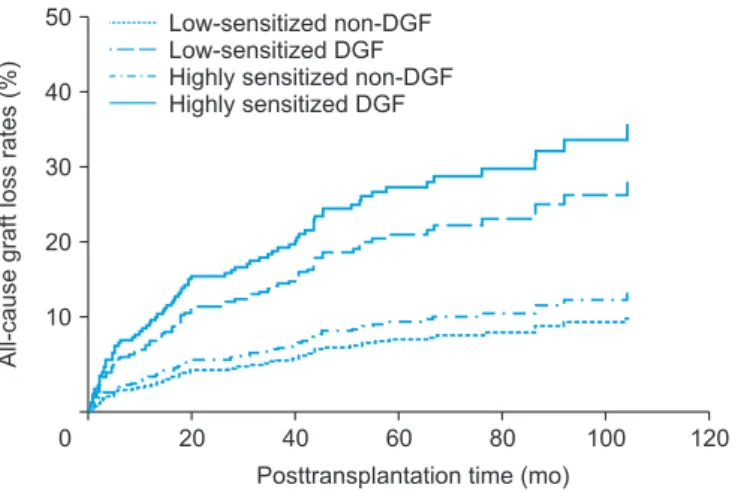
Patient death up to 10 years after KT occurred in 18 cases (3.8%) in the low-sensitized non-DGF subgroup, nine cas- es (8.3%) in the low-sensitized DGF subgroup, five cases (4.9%) in the highly sensitized non-DGF subgroup, and three cases (11.1%) in the highly sensitized DGF subgroup.
Among the causes of patient death, infection was the most common in all four subgroups during the observation period. We observed infection-related death in 10 cases (55.6%) in the low-sensitized non-DGF subgroup, five cases (55.6%) in the low-sensitized DGF subgroup, three cases (60.0%) in the highly sensitized non-DGF subgroup, and three cases (100.0%) in the highly sensitized DGF subgroup (Supplementary Table 1). In the univariate Cox regression model, patient mortality tended to be higher in the two DGF groups, but was not statistically significant (P=0.058 vs.
low-sensitized-DGF; P=0.541 vs. highly sensitized non-DGF;
P=0.080 vs. highly sensitized DGF) (Table 4, Fig. 5).
DISCUSSION
In this study, we found that DGF in highly sensitized patients after DDKT increased BPAR compared with pre-sensitization or DGF alone. The results suggest that in pre-sensitized patients, the development of DGF can result in adverse synergistic effect for allograft outcomes, espe- cially higher incidence of allograft rejection.
The proportion of study population using ATG as induc- tion therapy in the pre-sensitized group was 63.8%, which was higher than that of the low-sensitized group (30.4%).
In addition, in the pre-sensitized group, the proportion of patients exposed to combined RTX as induction therapy was 36.9%. The risk factors for development of DGF have been associated with various immunological and non-im- munological factors in KT donors and recipients [3]. In our study, the DGF group manifested significantly higher acute kidney injury in DDs than the non-DGF group, but there was no significant difference in other risk factors for DGF, such as recipients who were obese or diabetic, with prolonged cold ischemic time, and expanded criteria donor. A higher proportion of patients using ATG or combined RTX in the pre-sensitized group might have reduced the risk of devel- oping DGF associated with pre-sensitization. Until recently, the effect of ATG compared with other induction therapies or the effect of combined RTX as an induction therapy in the development of DGF has been debated; however, some studies have reported promising results [21,22].
In this study, our main objective was to investigate
50
40
30
20
10
0 120
All-causegraftlossrates(%)
Posttransplantation time (mo) 100 40
20
Low-sensitized non-DGF Low-sensitized DGF Highly sensitized non-DGF Highly sensitized DGF
60 80
Fig. 5. Comparison of patient mortality in the four subgroups. Compared
with low-sensitized non-delayed graft function (non-DGF) subgroup, patient mortality tended to be higher in the two DGF subgroups, but was not statistically significant (P=0.058 vs. low-sensitized DGF, P=0.080 vs.
highly sensitized DGF). P>0.05 for each comparison.
0 100
95
90
85
80
75
120
Deathcensoredallograftsurvival(%)
Posttransplantation time (mo) 70
100 40
20
Low-sensitized non-DGF Low-sensitized DGF Highly sensitized non-DGF Highly sensitized DGF
a)
60 80
a)
Fig. 4. Comparison of death-censored allograft survival in the four sub-