효소제 및 유화제의 첨가가 쌀빵의 부피와 경도에 미치는 영향
이명희․장학길․이영택† 경원대학교 식품생물공학과
Effects of Enzymes and Emulsifiers on the Loaf Volume and Crumb Hardness of Rice Breads
Myung-Hee Lee, Hak-Gil Chang, and Young-Tack Lee†
Dept. of Food Science and Biotechnology, Kyungwon University, Seongnam 461-701, Korea
Abstract
The effects of various enzymes and emulsifiers on the loaf volume and crumb hardness of rice breads were studied. Four different enzymes [fungal α-amylase (AMYL), maltogenic bacterial α-amylase (NMYL), glucose oxidases (GO), and xylanase+hemicellulases (PTP)] and four emulsifiers [sorbitan monostearate (SMS), glyc- erol monostearate (GMS), sodium stearoyl lactylate (SSL), and glycerol ester+propylene glycol ester+sucrose ester+sorbitan ester (SP)] were supplemented to rice dough. The addition of AMYL, GO, and GO+AMYL increased loaf volume of rice breads. The highest loaf volume was observed in rice bread supplemented with AMYL. Rice breads supplemented with enzymes firmed at lower rates during storage, and AMYL, NMYL, and GO considerably decreased crumb hardness of rice breads, exhibiting a significant antistaling effect. The addition of emulsifiers produced rice breads with better specific loaf volume and crumb texture, and con- tinuously retarded crumb hardness of rice breads during storage. Especially, rice bread supplemented with SSL demonstrated the highest loaf volume and the lowest crumb hardness during storage.
Key words: rice bread, enzymes, emulsifiers, baking properties
†Corresponding author. E-mail: [email protected]
†Phone: 82-31-750-5565, Fax: 82-31-750-5273
서 론
우리나라 농업의 기간작물인 쌀은 주로 밥의 형태로 소비 되며, 일부가 떡류, 과자류, 국수류, 장류 등 가공식품에 이용 되고 있다. 식품에 대한 소비자의 기호성이 다양해지고 고급 화됨에 따라 그에 맞는 가공식품을 개발하는데 빵류는 밥에 버금갈 정도의 소비가 이루어지고 있는 가장 보편적인 식품 이다. 빵류는 주로 밀가루를 사용하여 제조하고 있지만 일부 식빵, 케이크, 쿠키 등 베이커리제품에 쌀가루가 혼합되어 사용되고 있으며, 한편으로 밀빵에 알레르기가 있는 사람들 을 위한 대체 수단으로서 쌀빵의 연구가 진행되어 왔다 (1-3). 밀가루와 달리 쌀가루에는 빵의 구조를 형성하는 글 루텐이 없기 때문에 쌀빵의 제조에는 어려움이 따르며, 이를 보완하기 위해서 활성 글루텐, 검류, 계면활성제 등 첨가 재 료의 사용이 연구되어 왔다(4-7).
밀가루에는 amylase, protease 등 다양한 효소들이 존재 하지만 그 활성이 미약하여 보통 추가적으로 효소제를 첨가 함으로써 반죽의 가공성과 최종 빵 제품의 품질을 향상시킨 다. 전통적으로 전분을 가수분해하는 효소뿐만 아니라 비전 분성 다당류를 분해하는 효소, 그리고 지질과 글루텐을 변형
시키는 효소 등이 사용되고 있다. 이들은 반죽의 개량제나 강화제, 빵속 연화제, 효모 또는 잔존효소 강화제, 빵의 풍미 증진, 그리고 노화방지에 의한 유통기한 연장의 효과가 있는 것으로 알려져 있다(8). 또한 α-amylase, xylanase, hemi- cellulase, glucose oxidase, lipase 등 효소를 혼합적으로 사 용함으로써 빵의 품질에 상승적인 효과를 줄 수 있다고 하였 다(9). 특히 α-amylase의 첨가는 전분을 분해하여 효모가 발효할 수 있는 발효전당을 증가시켜줌으로써, 반죽의 물성 을 개량시키고 빵의 체적을 증가시키며 crumb grain, 빵 껍 질의 색과 풍미를 증진시켜 주는 효과가 있다(10). 쌀빵의 제조 시에는 glucose oxidase의 첨가가 쌀가루의 단백질을 변형시킴에 따라 쌀빵의 제조적성을 향상시킬 수 있다고 보 고된 바 있다(11).
계면활성제에 속하는 유화제는 친수성과 소수성 특성을 동시에 가지고 있는 지방산 물질로서 제빵 시에 보통 반죽강 화제(dough strengthener)와 반죽연화제(crumb softener) 로 구분되는데 일부 유화제는 두 가지의 성질을 함께 가지고 있다. 일반적으로 반죽 강화제로 불리는 유화제를 첨가하였 을 때 반죽의 내구성 개선, 주저앉음에 대한 저항성, 가스보 유력 강화를 통해서 궁극적으로 빵의 부피증가, 조직감 개선
및 균일하고 미세한 기공을 보유하도록 하며, 연화제의 경우 전분의 결정화 속도를 지연시켜 빵 속이 단단해지는 것을 방지하도록 한다(12). 유화제는 종류에 따라 그 기능을 달리 할 수 있기 때문에(13) 제품에 따라 적절한 유화제를 선택해 서 사용해야 할 필요성이 있다.
본 실험에서는 효소제 및 유화제를 첨가하여 쌀빵을 제조 하였을 때 쌀빵의 중요한 품질 요소로서 빵의 부피와 경도에 미치는 특성을 조사하고자 하였다.
재료 및 방법
재료
쌀빵의 제조에 사용된 쌀가루로 태평양 물산(경기, 안산) 에서 생산된 습식제분 쌀가루(수분함량; 12.1%)를 제공받았 으며, 활성 글루텐, 설탕, 소금, 탈지분유, 쇼트닝, 효모는 시 중에서 구입하여 실험하였다. 실험에 사용한 효소제로 4가 지를 사용하였으며 fungal α-amylase[Fungamyl(AMYL)], maltogenic bacterial α-amylase[Novamyl(NMYL)], glu- cose oxidases[Gluzyme BG(GO)], xylanase+hemicellulases [Pentopan (PTP)]를 Enzyme Tech.(Bagsvaerd, Denmark) 으로부터 구입하였다. 유화제로는 4가지를 사용하였으며 sorbitan monostearate(SMS), glycerol monostearate (GMS), sodium stearoyl lactylate(SSL)은 일신유화(서울, 합정)에서, 혼합 유화제인 glycerol ester+propylene glycol ester+sucrose ester+sorbitan ester(SP)는 삼립식품(경기, 시흥)으로부터 제공받아 사용하였다.
쌀빵의 제조방법
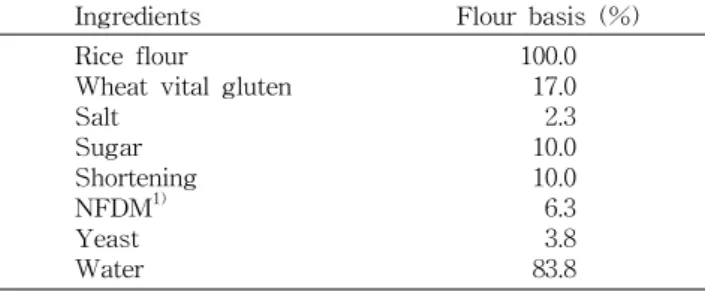
쌀가루에 활성 글루텐 17%를 첨가하여 쌀빵을 제조하였 으며, 쌀빵의 제조에 사용된 원료의 배합비율은 Table 1과 같다. 효소제의 첨가량은 공급업체의 권장첨가량에 준하여 두 가지 수준으로 실험하였으며 100 g의 쌀가루를 기준으로 AMYL(6, 12 mg/100 g flour), NMYL(5, 10 mg/100 g flour), GO(2.5, 5 mg/100 g flour), 그리고 PTP(9, 18 mg/100 g flour)를 첨가하였다. 또한 유화제인 SMS, GMS, SLS, SP를 쌀가루 100 g을 기준으로 각각 0.5%와 1.0% 첨가하여 쌀빵 을 제조하였다. 원료를 mixer(SM200, SINMAG., Taiwan)
Table 1. Baking formula for rice bread prepared from rice flour supplemented with enzymes and emulsifiers
Ingredients Flour basis (%)
Rice flour
Wheat vital gluten Salt
Sugar Shortening NFDM1) Yeast Water
100.0 17.0 2.3 10.0 10.0 6.3 3.8 83.8
1)Non-fat dry milk.
를 사용하여 10분간 반죽하였으며 반죽을 분할하고 round- ing하여 실온에서 13분간 방치하였다. 그 후 moulder &
sheeting roll(National Mfg. Co., Lincoln, USA)을 사용하여 11/32와 7/32 inch에서 두 번 sheeting하고 성형한 후 패닝하 였다. 패닝한 후 온도 38oC, 상대습도 85%에서 65분간 proofing하고 윗불 200oC, 아랫불 215oC로 예열한 오븐에서 17분간 굽기를 하였다.
쌀빵의 부피 및 비용적
쌀빵의 무게(g)는 굽기 후 1시간 동안 방냉시킨 후 측정하 였고 부피(cc)는 종자치환법으로 측정하였으며, 이로부터 비용적(cc/g)을 구하였다.
쌀빵의 저장중 경도 측정
쌀빵의 경도는 Texture Analyzer(TA-XT 2, Stable Micro Systems Co., England)를 사용하여 측정하였다. 쌀빵 을 20 mm 두께로 절단한 후 지퍼백에 넣어 밀봉한 다음 25oC에서 3일간 저장하면서 저장중 경도의 변화를 측정하였 다. 이때 지름 40 mm의 알루미늄 probe를 사용하여 0.5 mm/sec의 속도로 10 mm까지 압축하여 측정하였다.
통계분석
본 실험은 3회 반복 수행하였으며, 통계분석은 SAS 통계 프로그램을 사용하여 Duncan's multiple range test를 실시 하여 유의성을 검정하였다.
결과 및 고찰
효소제를 첨가하여 제조한 쌀빵의 부피
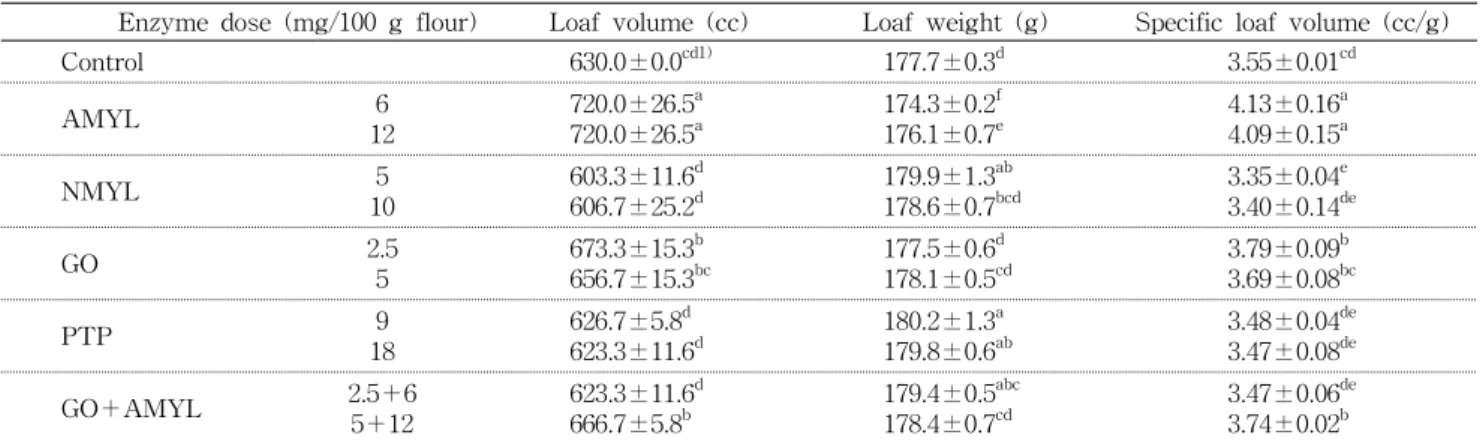
쌀가루에 곰팡이 α-amylase(AMYL), 세균 α-amylase (NMYL), glucose oxidase(GO), xylanase+hemicellulase (PTP), 그리고 GO+AMYL의 효소제를 첨가하여 쌀빵을 제조한 후 쌀빵의 부피, 무게 및 비용적을 측정한 결과는 Table 2와 같다. 효소제는 100 g의 쌀가루을 기준으로 효소 공급원의 권장 첨가량에 준하여 각각의 효소제에 대하여 2 가지 수준으로 첨가하였다. 효소제를 첨가하지 않은 대조구 쌀빵의 부피와 비용적은 각각 630 cc와 3.55 cc/g으로 나타 났으며 이에 비해 곰팡이 α-amylase, glucose oxidase, glu- cose oxidase+곰팡이 α-amylase 를 첨가한 쌀빵의 비용적 은 보다 높게 나타났다. 특히 곰팡이 α-amylase를 6 mg%, 12 mg% 첨가한 처리구에서 비용적이 각각 4.13 cc/g, 4.09 cc/g으로 가장 높은 결과를 보여주었다. 제빵시 α-amylase 의 첨가는 효모의 활성 및 CO2 가스의 생성에 필요한 발효성 당을 생산하며, 반죽의 성질에 영향을 주고 빵의 체적을 향 상시키는데 도움을 주는 것으로 알려져 있다(14). 곰팡이 α- amylase를 첨가한 쌀빵과는 달리 세균 α-amylase를 첨가한 쌀빵의 부피는 약간 감소하는 경향을 보여주었다. 이는 세균 α-amylase가 내열성이 강해 효소의 작용시간이 길어짐에
Table 2. Baking properties of rice breads supplemented with different enzymes
Enzyme dose (mg/100 g flour) Loaf volume (cc) Loaf weight (g) Specific loaf volume (cc/g)
Control 630.0±0.0cd1) 177.7±0.3d 3.55±0.01cd
AMYL 6
12
720.0±26.5a 720.0±26.5a
174.3±0.2f 176.1±0.7e
4.13±0.16a 4.09±0.15a
NMYL 5
10
603.3±11.6d 606.7±25.2d
179.9±1.3ab 178.6±0.7bcd
3.35±0.04e 3.40±0.14de
GO 2.5
5
673.3±15.3b 656.7±15.3bc
177.5±0.6d 178.1±0.5cd
3.79±0.09b 3.69±0.08bc
PTP 9
18
626.7±5.8d 623.3±11.6d
180.2±1.3a 179.8±0.6ab
3.48±0.04de 3.47±0.08de
GO+AMYL 2.5+6
5+12
623.3±11.6d 666.7±5.8b
179.4±0.5abc 178.4±0.7cd
3.47±0.06de 3.74±0.02b
1)Values are means of three replications±standard deviation. Means with the same superscript in each column are not significantly different at p<0.05 using Duncan's multiple range test.
Table 3. Changes in crumb hardness of rice breads supplemented with different enzymes during storage Enzyme dose
(mg/100 g flour)
Storage (day)
0 1 2 3
Control 193.05±6.36a1) 321.35±5.02a 602.05±14.28a 768.35±77.07a
AMYL 6
12
131.05±9.97e 134.35±10.68e
227.40±35.21cd 234.90±0.71cd
355.85±23.55cd 363.85±28.21cd
492.80±35.92cd 481.50±189.36abc
NMYL 5
10
169.60±11.31cd 167.95±8.98cd
241.20±5.66bcd 211.45±6.65d
354.25±6.01cd 314.75±10.68d
491.20±0.99cd 431.25±15.91d
GO 2.5
5
152.95±6.29d 160.45±6.29cd
244.55±5.02bcd 248.05±25.95bcd
373.00±17.96cd 355.40±52.18cd
536.50±33.94bcd 593.30±70.43abcd
PTP 9
18
194.75±1.63ab 194.50±7.92ab
289.85±27.22ab 271.55±11.24abc
487.15±11.95ab 462.05±72.76ab
665.45±57.49abc 698.10±31.25ab
GO+AMYL 2.5+6
5+12
177.30±7.64bc 155.55±2.33cd
267.75±38.54bc 232.75±19.59cd
423.05±27.51abc 416.00±8.34bc
691.30±12.30ab 671.60±60.10ab
1)Values are means of replications±standard deviation. Means with the same superscript in each column are not significantly different at p<0.05 using Duncan's multiple range test.
따라 반죽의 물리적 특성에 영향을 주었기 때문으로 생각되 었다.
Glucose oxidase(GO)를 2.5 mg%, 5 mg% 첨가한 처리구 의 비용적은 각각 3.79 cc/g, 3.69 cc/g으로 곰팡이 α-amy- lase 다음으로 높은 결과를 보여주었다. Glucose oxidase는 빵의 품질향상을 위한 화학적 산화제를 대체할 수 있는 효소 제로서 관심을 받고 있다. 효소 반응중 생성된 과산화수소가 단백질의 disulfide 결합 또는 티로신(tyrosine)의 crosslinks 형성을 야기시켜 반죽이 CO2 가스를 포집하는데 도움을 주 는 것으로 보고된 바 있으며(11) 이에 따라 쌀빵의 부피를 증가시키는 것으로 판단되었다. GO 5 mg%와 AMYL 12 mg%를 혼합하여 첨가한 처리구에서도 비용적이 3.74 cc/g 으로 높아 쌀빵의 부피에 긍정적인 영향을 주었다. 이는 glucose oxidase를 단독으로 첨가하여 쌀빵을 제조하였을 때 비용적과 crumb grain이 향상되었을 뿐만 아니라, glu- cose oxidase를 다른 효소제와 혼합하여 사용하였을 때에도 효과가 있었다는 결과(11)와 유사함을 확인할 수 있었다. 한 편 PTP의 첨가는 쌀빵의 부피와 비용적에 별 영향을 주지
못하는 것으로 나타났다. 밀빵에서는 pentosanase의 첨가가 빵의 반죽특성을 향상시키는 효과를 보여준 바 있지만(15) 이는 밀가루가 쌀가루에 비해 pentosan의 함량이 높기 때문 인 것으로 생각되었다.
효소제를 첨가한 쌀빵의 저장 중 경도 변화
빵의 경도 측정은 빵 속살의 품질을 평가하거나 저장 중 빵의 품질 변화를 조사하기 위해 자주 사용되는 평가 방법이 다. 빵의 저장 중 품질의 저하(staling)는 주로 빵 속살의 전 분-단백질 matrix에 발생하는 물리적 변화의 결과로 일어나 며 전분의 노화가 빵이 단단해지는 것을 야기시키는 가장 주요한 원인으로 작용한다. 또한 단백질, 펜토산(pentosans), 지질, 유화제, 당, 효소와 같은 반죽에 포함된 다양한 요소들 이 빵의 경도에 영향을 미칠 수 있다. 쌀가루에 효소제를 첨가하여 제조한 쌀빵의 저장 중 경도의 변화를 측정한 결과 는 Table 3에 나타나 있다. 제빵 후 쌀빵의 초기경도는 효소 제를 첨가하지 않은 대조구 쌀빵이 193 g이었는데 xylanase
+hemicellulase(PTP)를 첨가한 쌀빵만이 대조구 쌀빵과 유
Table 4. Baking properties of rice breads supplemented with different emulsifiers
Emulsifier conc. (%) Loaf volume (cc) Loaf weight (g) Specific loaf volume (cc/g)
Control 633.3±5.8e1) 177.6±0.4a 3.57±0.04d
SMS2) 0.5
1.0
668.3±2.9cd 636.7±15.3de
177.3±1.0ab 178.1±0.4a
3.77±0.04cd 3.57±0.08d
GMS3) 0.5
1.0
703.3±11.6b 680.0±10.0bc
175.2±0.7c 175.3±0.7c
4.01±0.05b 3.88±0.06bc
SSL4) 0.5
1.0
783.3±40.4a 786.7±5.8a
175.4±0.3c 175.4±0.8c
4.47±0.23a 4.49±0.05a
SP5) 0.5
1.0
706.7±28.9b 763.3±15.3a
176.0±1.1bc 175.6±1.5c
4.02±0.19b 4.35±0.12a
1)Values are means of replications±standard deviation. Means with the same superscript in each column are not significantly different at p<0.05 using Duncan's multiple range test.
2)Sorbitan monostearate. 3)Glycerol monostearate. 4)Sodium stearoyl lactylate.
5)Glycerine fatty acids+propylene glycol+sucrose fatty acid+sorbitan fatty acid.
사한 경도를 보여준 반면에 다른 효소제 처리구에서는 대조 구 쌀빵보다 낮은 수치를 나타내었다. 특히 곰팡이 α-amyl- ase(AMYL)를 첨가한 쌀빵의 초기경도가 가장 낮았으며 glucose oxidase(GO)가 그 다음으로 낮게 나타났다. 이는 쌀빵의 제조 시 산화효소인 glucose oxidase의 첨가가 crumb 의 경도를 낮추는 것으로 보고한 결과(11)와 유사하였다.
효소제를 첨가하지 않은 쌀빵은 저장 중에 경도가 현저하 게 증가하여 저장 3일 후에 768 g으로 상승하였다. 그러나 효소를 첨가한 쌀빵은 대조구 쌀빵에 비해 저장중 경도가 지속적으로 낮아 효소제의 첨가가 경도의 증가율을 감소시 키는 효과가 있음을 알 수 있었다(Fig. 1). 곰팡이와 세균 α-amylase를 첨가한 처리구에서 현저하게 낮은 증가폭을 보여주었으며, 특히 세균 α-amylase(NMYL)을 첨가한 처 리구는 3일 경과 후의 경도가 431 g으로 가장 낮게 나타나 다른 효소제보다 쌀빵의 노화지연에 보다 큰 효과가 있을 것으로 생각되었다. 밀빵에서 세균 또는 곰팡이 α-amylase 를 첨가한 빵이 효소제를 첨가하지 않은 빵에 비해 빵의 경 도 증가가 완화된다고 하였으며(16), 쌀빵의 제조시에도 α- amylase의 첨가가 비용적의 향상뿐만 아니라 전분의 재결
0 100 200 300 400 500 600 700 800 900
0 1 2 3
Storage period (day)
H a rdnes s ( g ,f or c e ) .
Control AMYL NMYL GO PTP GO+AMYL
Fig. 1. Changes in crumb hardness of rice breads supple- mented with different enzymes at supplyer's recommended dose during storage.
정화를 늦춰주어 빵의 노화속도를 감소시켜주는 효과가 있 다는 결과(17,18)와 유사한 것으로 판단되었다. α-Amylase 와 더불어 pentosanase의 첨가는 밀빵의 저장중 현저한 노 화억제 효과가 있는 것으로 보고된 바 있으나(9), 본 실험의 쌀빵에서는 xylanase+hemicellulase(PTP)의 첨가는 다른 효소제에 비해 상대적으로 큰 효과를 보이지 않았다.
유화제를 첨가하여 제조한 쌀빵의 부피
쌀가루에 4가지 종류의 유화제, 즉 sorbitan monostearate (SMS), glycerol monostearate(GMS), sodium stearoyl lactylate(SSL) glycerol ester+propylene glycol ester+
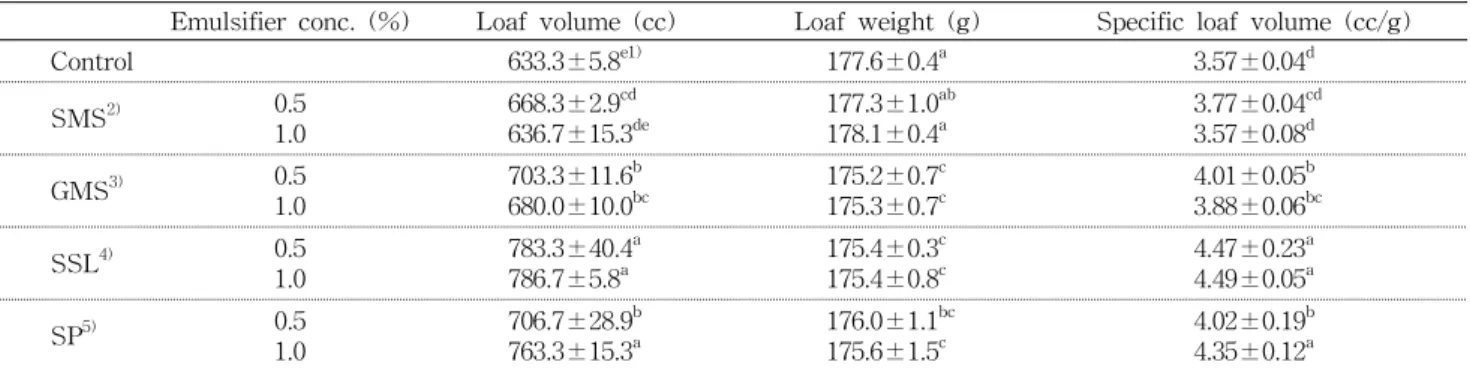
sucrose ester+sorbitan ester(SP)를 각각 0.5%와 1.0% 수 준으로 첨가하여 제조한 쌀빵의 부피를 측정한 결과는 Table 4에 나타나있다. 쌀빵의 부피는 유화제의 첨가량에 따라 다소 차이가 있었으나 대조구 쌀빵보다 모든 유화제 처리구에서 높게 나타났다. 이에 따라 유화제를 첨가하여 제조한 쌀빵의 비용적이 3.57~4.49 cc/g으로 대조구 빵 3.57 cc/g보다 높은 것으로 나타났다. 유화제의 첨가량별로는 SMS와 GMS는 0.5% 첨가한 처리구에서 각각 3.77 cc/g, 4.01 cc/g으로 높았으며 SSL과 SP는 1% 첨가하였을 때 각 각 4.49 cc/g, 4.35 cc/g으로 유화제의 첨가 효과가 높음을 알 수 있었다. 유화제의 첨가는 반죽의 글루텐 단백질에 작 용한 결과로 빵의 텍스처 특성을 좋게 할 뿐만 아니라 빵의 부피를 증가시켜주는 특징이 있다(18). 한편 Nishita 등(1)에 의하면 밀빵의 품질개선에 효과적이라고 알려진 합성유지 나 계면활성제는 쌀빵에서는 반대효과를 나타낸다고 하였 으며, 이는 본 실험에서 유화제의 첨가가 쌀빵의 부피를 증 가시키는 등 품질개선에 긍정적인 영향을 준다는 결과와 상 반된 것으로 나타났다. 이러한 차이는 본 실험에서 쌀가루에 활성 글루텐을 첨가하여 쌀빵을 제조한데 비해 쌀가루에 글 루텐 대체재로 hydroxypropyl methylcellulose(HPMC) 등 gum물질을 사용하여 제조한 gluten-free 쌀빵과의 formula 차이 때문으로(4,19) 생각되었다.
Table 5. Changes in crumb hardness of rice breads supplemented with different emulsifiers during storage Emulsifier
conc. (%)
Storage (day)
0 1 2 3
Control 196.85±6.01a1) 342.25±23.55a 599.20±108.61a 835.50±278.03a
SMS2) 0.5
1.0
127.55±0.35c 165.10±44.83abc
198.70±3.96c 275.05±55.51b
391.55±32.88bcd 510.74±99.98ab
560.95±159.45ab 629.30±46.81ab
GMS3) 0.5
1.0
139.55±3.32bc 170.93±1.73abc
250.60±12.30bc 253.45±48.86bc
365.50±73.11bcde 494.95±20.29abc
692.65±3.75ab 810.20±98.00a
SSL4) 0.5
1.0
189.80±34.51ab 192.85±32.88ab
210.00±17.25bc 211.90±19.23bc
302.10±102.95de 221.75±1.34e
517.70±145.52ab 377.95±33.59b
SP5) 0.5
1.0
159.05±1.63abc 167.45±4.31abc
226.65±22.27bc 198.25±7.28c
415.75±2.62bcd 342.00±19.94cde
702.10±210.29ab 693.20±255.14ab
1)Values are means of replications±standard deviation. Means with the same superscript in each column are not significantly different at p<0.05 using Duncan's multiple range test.
2)Sorbitan monostearate. 3)Glycerol monostearate. 4)Sodium stearoyl lactylate.
5)Glycerine fatty acids+propylene glycol+sucrose fatty acid+sorbitan fatty acid.
유화제를 첨가한 쌀빵의 저장 중 경도 변화
쌀가루에 유화제를 첨가하여 제조한 쌀빵의 저장 중 경도 의 변화를 측정한 결과는 Table 5에 나타나있다. 쌀빵의 초 기 경도는 유화제를 첨가한 쌀빵에서 모두 낮게 나타났으며 유화제의 첨가량에 따라서도 차이를 보여주었는데 SMS 0.5% 첨가한 쌀빵과 GMS 0.5% 첨가한 쌀빵의 경도가 현저 히 낮게 나타났다. 저장 중 유화제를 첨가하지 않은 쌀빵은 3일간의 저장중 경도가 급격히 증가하였다. 그러나 유화제 를 첨가한 쌀빵에서 경도가 지속적으로 낮은 것으로 나타났 으며(Fig. 2) 첨가량에 따라서 다소 변화를 보여주었다. 유화 제는 수분의 손실, 전분의 재결정화, 전분과 단백질의 상호 작용에 의해 빵의 저장 중 경도의 증가를 지연시키는 효과가 있는 것으로 알려져 있다. 즉 유화제가 아밀로오스 복합물을 형성하여 아밀로오스의 겔화를 억제하여 빵을 부드럽게 하 며, 저장 중 아밀로펙틱의 재결정화를 억제하고 전분입자에 수화된 수분을 보호하기 때문에 빵의 연화작용과 노화지연 에 효과를 갖는 것으로 설명한 바 있다(20). 특히, SSL을 첨가한 쌀빵이 다른 유화제와 비교하여 보았을 때 저장 중
0 100 200 300 400 500 600 700 800 900
0 1 2 3
Storage period (day)
Hardness (g,force) .
Control SMS GMS SSL SP
Fig. 2. Changes in crumb hardness of rice breads supple- mented with different emulsifiers at the level of 0.5% during storage.
경도의 증가율이 가장 낮게 나타났다. SSL은 밀빵에서도 가장 보편적으로 사용되는 반죽강화제중 하나이며 빵의 체 적과 부드러움을 유지시켜 주는 계면활성제로 보고된 바 있다(12). 유화제는 종류에 따라 서로 다른 화학적 특성으 로 인해 그 작용에 차이가 있다. 결과적으로 본 실험에 사 용한 유화제 중 SSL을 쌀빵에 첨가 시에 부피를 개선시킬 뿐만 아니라 노화지연에도 효과가 큰 것으로 판단되어 쌀 빵 제조 시에 적용하기에 적합한 유화제로서 긍정적인 평가 를 받았다.
요 약
효소제와 유화제의 첨가가 쌀빵의 품질특성중 빵의 부피 와 저장중 경도 변화에 미치는 영향을 조사하였다. 효소제로 는 곰팡이 α-amylase(AMYL), 세균 α-amylase(NMYL), glucose oxidase(GO), 그리고 xylanase+hemicellulase (PTP)를 사용하였으며, 유화제로 sorbitan monostearate (SMS), glycerol monostearate(GMS), sodium stearoyl lactylate(SSL), glycerol ester+propylene glycol ester+
sucrose ester+sorbitan ester(SP)를 첨가하여 그 효과를 비 교하였다. 쌀가루에 AMYL, GO, 그리고 AMYL+GO 효소 를 처리한 쌀빵의 비용적이 대조구 쌀빵에 비해 높게 나타났 는데, 특히 AMYL을 첨가한 처리구에서 가장 높은 수치를 보여주었다. 쌀빵의 저장 중 경도 변화를 측정하였을 때 AMYL, NMYL, 그리고 GO를 첨가한 처리구에서 3일 경과 후에도 낮은 증가율을 나타내 쌀빵의 노화지연에 긍정적인 효과를 제시해 주었다. 쌀가루에 유화제를 첨가한 쌀빵의 부피는 모든 유화제 처리구가 대조구 쌀빵보다 높게 나타났 으며 저장중 경도가 지속적으로 낮았다. 특히 SSL은 쌀빵의 부피 개선과 함께 노화지연의 효과가 가장 높아 쌀빵의 품질 개량을 위해 적용할 수 있는 매우 긍정적인 유화제로 평가되 었다.
감사의 글
본 연구는 농림부에서 시행한 농림기술개발사업의 연구 비 지원으로 수행된 연구결과의 일부로 이에 감사드립니다.
문 헌
1. Nishita KD, Roberts RL, Bean MM. 1976. Development of yeast-leavened rice-bread formula. Cereal Chem 53: 626- 635.
2. Bean MM, Nishita K. 1985. Rice flour for baking. In Rice
Chemistry and Technology. Juliano BO, ed. AACC, St. Paul,
MN, USA. p 539.3. Kang MY, Choi YH, Choi HC. 1997. Effects of gums, fats and glutens adding on processing and quality of milled rice bread. Korean J Food Sci Technol 29: 700-704.
4. McCarthy DF, Gallagher E, Gormley TR, Schober TJ, Arendt EK. 2005. Application of response surface method- ology in the development of gluten-free bread. Cereal
Chem 82: 609-615.
5. Sivaramakrishnan HP, Senge B, Chattopadhyay PK. 2004.
Rheological properties of rice dough for making rice bread.
J Food Eng 62: 37-45.
6. Lazaridou A, Duta D, Papageorgiou M, Belc N, Biliaderis CG. 2007. Effects of hydrocolloids on dough rheology and bread quality parameters in gluten-free formulations. J
Food Eng 79: 1033-1047.
7. Pyler EJ. 1988. Enzymes in baking. In Baking Science and
Technology. Sosland Publishing Co., Merriam, USA.
8. Collar C, Bollain C, Angioloni A. 2005. Significance of mi- crobial transglutaminase on the sensory, mechanical and crumb grain pattern of enzyme supplemented fresh pan breads. J Food Eng 70: 479-488.
9. Caballero PA, Gomez M, Rosell CM. 2007. Improvement of dough rheology, bread quality and bread shelf-life by en-
zymes combination. J Food Eng 81: 42-53.
10. Kulp K. 1993. Enzymes as dough improvers. In Advances
in Baking Technology. Camel BS, Stauffer CE, eds. Blackie
Academic and Professional, London. p 152-178.11. Gujral HS, Rosell CM. 2004. Improvement of the breadmak- ing quality of rice flour by glucose oxidase. Food Res Int 37: 75-81.
12. Stampfli L, Nersten B. 1995. Emulsifiers in bread making.
Food Chem 52: 353-360.
13. Kamel BS, Hoover R. 1992. Production of bread using so- dium stearoyl lactylate as a replacement for shortening.
Food Res Int 25: 285-288.
14. Kim JH, Maeda T, Morita N. 2006. Effect of fungal α-amy- lase on the dough properties and bread quality of wheat flour substituted with polished flours. Food Res Int 39:
117-126.
15. Rouau X, El-Hayek M, Moreau D. 1994. Effect of an en- zyme preparation containing pentosanases on the bread- making quality of flours in relation to changes in pentosan properties. J Cereal Sci 19: 259-272.
16. Sahlstrom S, Brathen E. 1997. Effects of enzyme prepara- tions for baking, mixing time and resting time on bread quality and bread staling. Food Chem 58: 75-80.
17. Gujral HS, Haros M, Rosell CM. 2004. Improving the tex- ture and delaying staling in rice flour chapati with hydro- colloids and α-amylase. J Food Eng 65: 89-94.
18. Billain C, Collar C. 2004. Dough viscoelastic response of hydrocolloid/enzyme/surfactant blends assessed by uni- and bi-axial extension measurements. Food Hydrocoll 18:
499-507.
19. Yllmaki G, Hawrysh ZJ, Hardin RT, Thomson ABR. 1991.
Response surface methodology in the development of rice flour yeast breads: sensory evaluation. J Food Sci 56:
751-755.
20. Ribotta PD, Perez GT, Leon AE, Anon MC. 2004. Effect of emulsifier and guar gum on micro structural, rheological and baking performance of frozen bread dough. Food
Hydrocoll 18: 305-313.
(2008년 2월 12일 접수; 2008년 5월 26일 채택)