학교급식에서 제공되는 숙주나물의 Staphylococcus aureus 성장예측모델 개발 및 섭취유효기간 설정
박형수1․김민영1․정현숙2․박기환1․류 경2†
1중앙대학교 식품공학과
2영남대학교 식품영양학과
Development of a Predictive Growth Model of Staphylococcus aureus and Shelf-life Estimation of Cooked Mung Bean Sprouts
Served in School Foodservice Operations
Hyoung-Su Park1, Min-Young Kim1, Hyun-Suk Jeong2, Ki-Hwan Park1, and Kyung Ryu2†
1Dept. of Food Science & Technology, Chung-Ang University, Gyeonggi 456-756, Korea
2Dept. of Food & Nutrition, Yeungnam University, Gyeongbuk 712-749, Korea
Abstract
This study was conducted to estimate the shelf-life of cooked mung bean sprouts contaminated with Staphylococcus aureus according to storage temperatures after cooking in school foodservice operations. A predictive growth model of S. aureus in cooked mung bean sprouts prepared using a standard recipe was developed at 4 storage temperatures (5, 15, 25, and 35oC). To determine the effect of vinegar on the shelf-life of cooked mung bean sprouts, the growth of S. aureus in sprouts prepared using vinegar and the standard recipe were compared. The R2 values of the specific growth rate (SGR) and lag time (LT) determined using the Gompertz model were greater than 0.90 at all temperatures except 5oC, which confirmed that it would be appropriate to use these parameters for a secondary model. The secondary model, which indicates changes in LT and SGR values according to storage temperatures, was calculated using response surface models. The compatibility of the developed model was confirmed by calculating R2, Bf, Af and MSE values as statistic parameters. The R2 values of LT and SGR were 0.94 or higher, and the MSE, Bf and Af values were 0.02 and 0.002, 0.97 and 1.03, and 1.31 and 1.10, respectively, with high statistical compatibility. The growth rate of S. aureus was higher when the standard recipe was used than when vinegar was used at all temperatures. Indeed, no growth of S.
aureus was observed in mung bean sprouts prepared using vinegar. Based on the model developed, cooked mung bean sprouts prepared using the standard recipe for school foodservice should be stored at 10oC or less.
Additionally, sprouts stored at 25 or 35oC should be consumed within 6 or 12 hours after cooking. Finally, the addition of vinegar will prevent the growth of S. aureus in cooked mung bean sprouts.
Key words: cooked mung bean sprout, Staphylococcus aureus, predictive model, shelf-life, school foodservice
†Corresponding author. E-mail: [email protected]
†Phone: 82-53-810-2876, Fax: 82-53-810-4768
서 론
우리나라는 학교급식 운영의 한 방법으로 공동조리방식 을 도입하여 시행하고 있다. 공동조리 급식체계란 둘 이상의 학교가 인접하여 있을 경우 한 단위로 묶어 중앙의 시설·설 비를 갖춘 조리교에서 조리한 후 비조리교(satellite)로 운반 하여 급식하는 방식으로 시설비, 인건비, 식재료비 등이 절 감된다(1). 이러한 이점으로 학교급식의 빠른 확대에 일조하 여 2006년 말 직영급식 학교 중 공동조리교가 24.3%의 높은 비율을 차지하였다(2). 그러나 공동조리교는 운반과정에서 적정온도 유지, 운반차량의 청결상태, 식품용기의 밀폐로 인
한 교차오염방지, 2시간 이내 배식완료 등의 적절한 관리가 이루어지지 못할 경우 식중독 발생률이 단독 조리교에 비해 가중된다. 일반적으로 학교급식의 식중독 발생건수는 높지 않지만, 일시에 다수에게 급식하므로 환자수는 높은 비율을 차지하고 있다(3). 학교급식의 조리공정별 미생물 오염도 조 사 결과 생채류 및 숙채류의 일반세균 및 대장균군은 기준치 보다 높게 나타났다. 특히 숙채류는 뜨거운 물에 데치거나 삶는 조리공정을 거치지만 원부재료의 미생물이 조리된 음 식에 상당수 전이되었다(4). 이는 조리 시 사용되는 양념, 용기, 조리원의 손 등으로부터 재 오염될 수 있는 확률이 높음을 보여주는 것이다. 사람과 동물의 피부, 점막 등에 존
재하는 S. aureus는 육류, 육제품, 우유, 유제품, 닭고기, 채소 등에서 식중독을 유발시킬 수 있다(5). 더욱이 조리원이 피 부 감염 질환으로 enterotoxin을 대량으로 보유하게 되면, 손을 많이 사용하는 숙채류 및 생채류는 쉽게 오염될 수 있 다(6). Staphylococcus aureus 식중독 발병률은 우리나라에 서 Salmonella spp., Vibrio parahaemolyticus와 더불어 빈 도가 높고, 2008년도 학교급식 식중독 발생 환자수도 E. coli O157:H7, Bacillus cereus에 이어 3위를 차지하였다(7). 따 라서 식품취급 시 조리종사자의 비위생적 행동과 조리 후 부적절한 보관온도가 원인이 되어 S. aureus 식중독이 발생 할 가능성이 높다고 할 수 있다. 이러한 식중독 발생을 유발 할 수 있는 미생물을 안전하게 관리할 수 있는 방법에는 수 분활성도 관리, 고염, 고당, 발효, 가열, 보존료 사용 등이 있다. 또한 부패균의 생육을 억제하는 초산을 함유하고 있는 식초를 식품의 부패방지에 이용하기도 한다(8).
최근 식품 안전성을 보장하기 위한 위해분석 방법으로 예 측 식품미생물학이 이용되고 있다. 이는 특정 환경조건하에 서, 식품 중 병원성 미생물의 성장과 사멸을 통계적으로 기 술하고 예측할 수 있는 기법이다(9). 식품의 안전성에 관여 하는 위해 미생물을 대상으로 하므로 기존의 미생물 검사에 비해 신속한 예측이 가능하고, 식중독 예방에 높은 효과를 가져 온다(10). 이러한 예측미생물학을 이용하여 많은 식품 에 대하여 병원성 미생물의 성장예측모델 개발에 관한 연구 가 수행되었다. 그 중 채소류에서는 상추에서 산소에 의한 Pseudomonas fluorescens 및 Listeria innocua 성장예측모 델 확인(11), 양상추에서 Listeria monocytogenes(9,12)의 성장예측모델개발, 시금치에서 L. monocytogenes의 성장예 측모델개발(10) 등의 연구가 이루어졌다. 또한 유통기한 및 보관기간 설정에 관한 연구로는 Bahk 등(13)의 김밥에서의 S. aureus에 대한 정량적 미생물 위해평가, Heo 등(14,15)의 시중에서 유통되고 있는 미강 식이섬유 함유 떡갈비와 프랑 크푸르터 소시지의 유통기한 설정, Food MicroModel을 이 용하여 김밥 중 황색포도상구균에 의한 식중독이 발생하지 않도록 유효 기간을 산정한 연구(16) 등이 있다. 그러나 학교 급식에 제공되는 조리식품에 대한 연구는 Kim(17)의 연구 를 제외하고 전무한 실정이다.
따라서 본 연구에서는 학교급식에서 제공되는 숙주나물 의 안전성을 확보하기 위하여 표준레시피를 이용하여 조리 한 숙주나물에서 보관온도에 따른 성장예측 모델을 개발하 였다. 또한 섭취유효기간을 연장하기 위하여 식초를 첨가하 여 조리한 숙주나물과 S. aureus 성장 특성을 비교하였다.
재료 및 방법
숙주나물 조리 및 시료 채취
본 실험에 사용된 숙주, 실파, 다진 마늘, 소금, 참깨, 참기 름, 식초는 서울에 위치한 H 마트에서 구입하였고, 학교급식
에서 일반적으로 사용되는 표준레시피를 이용하여 조리하 였다. 숙주는 흐르는 수돗물로 깨끗이 씻어 끓는 물에 약 1분 데친 후 찬물에 헹궈 물기를 짜고 다진 파(1.62%), 다진 마늘(1.35%), 참깨(1.35%), 참기름(1.88%), 소금(1.35%)을 넣어 잘 버무렸다. 준비된 시료는 2차 오염을 방지하기 위해 실험실에서 조리한 직후 무균적으로 멸균된 Petri dish에 25 g씩 채취하여 실험에 이용하였다.
pH 측정
S. aureus 성장 조건을 알아보기 위하여 조리 직후 숙주나 물의 pH를 측정하였다. pH 측정은 숙주나물 10 g에 증류수 90 mL를 멸균팩에 넣어 1분간 stomacher(Elmex SH-II, Tokyo, Japan)로 균질화한 후 pH meter(PB-11, Sartorius, Goettingen, Germany)를 이용하였다(18).
미생물 분석
숙주나물의 미생물 수준을 평가하기 위하여 일반세균, 대 장균군 및 대장균은 식품공전(19)의 방법을 이용하여 분석 하였다. 25 g씩 채취한 시료는 0.1% peptone water 225 mL 를 부어 stomacher로 1분간 균질화한 후, 0.1% peptone wa- ter를 이용하여 단계 희석하여 사용하였다. 일반세균수의 측 정을 위해서는 Plate Count Agar(PCA, Difco, USA)에 각 단계 희석액 1 mL를 도말하여 35oC의 incubator(BI-600M, GiEO Tech, Kimpo, Korea)에서 24~48시간 배양하여 생성 된 집락을 계수하였다. 대장균군 및 대장균은 PetrifilmTM coli/coliform count plate(PCC, 3M, USA)의 두 장 필름 사 이에 각 단계 희석액 1 mL를 접종하고 35oC로 설정한 in- cubator에서 24시간 동안 배양하였다. 대장균군은 생성된 붉 은 colony 중 주위에 기포를 형성하고 있는 colony, 대장균은 청색 colony 중 주위에 기포를 형성하고 있는 colony를 계수 하였다.
균액 제조
표준균주인 S. aureus ATCC 6538은 본 실험을 위하여 5oC 이하에서 냉장 보관하였다. 보관된 균을 백금이로 1~2 colony를 따서 0.1% peptone water에 희석시킨 후 5.0 log CFU/g로 조절하여 시험균액으로 사용하였다.
접종 및 실험 계획
균은 조리 후의 오염 수준을 고려하여 숙주나물 무게의 1/10인 2.5 mL씩 숙주나물 표면에 골고루 뿌려 초기균의 농 도가 3.0 log CFU/g가 되도록 하였다(20). 학교급식에서 음 식을 섭취하기 전까지 S. aureus 균의 성장과 관련한 중요한 환경인자 중 하나는 보관온도이므로 이를 주요 변수로 설정 하였다. 배양온도는 숙주나물을 조리한 후 배식하기 전까지 보관하는 온도를 고려하여 5, 15, 25, 35oC로 정하였다. 각 실험은 3회 반복 실시하였다.
균수 측정
각 조건별로 배양한 숙주나물을 멸균백에 넣고 10배의
0.1% peptone water로 희석한 후 stomacher로 1분간 균질화 하였다. 각각의 균질화된 시료를 Baird Parker RPF agar (Biomerieux, France) 표면에 100 μL씩 분주하고 spread한 후 37oC에서 24~48시간 배양하였다. 배양 후 회색빛을 띠는 검은색 colony를 계수하였다.
Gompertz model 적용
실험을 통해 얻어진 데이터는 modified Gompertz equa- tion을 적용할 수 있는 GraphPad Prism 4.0 Software(San Diego, USA)를 사용하여 각 배양 온도의 유도기(lag time;
LT)와 증식속도(specific growth rate log CFU/g/hr; SGR) 를 결정하였다(21).
log (N)=N0+C(exp(exp((2.718×mue/C)×(lag-X)+1) log (N, logCFU/g): log count of bacteria at time (in hours) N0 (log CFU/g): log count of bacteria at initial count C (log CFU/g): difference between intial and final cell
numbers
mue (log CFU/h): maximum specific growth rate lag (h): lag time (LT)
X (h): time
Response surface model 적용
온도의 영향에 따른 LT, SGR값을 예측하기 위하여 Minitab program Ver. 15의 response surface model을 적용 하였다. Response surface model식은 다변수함수분석인 partial least squares regression을 통해 유도되며, 그 방정식 은 다음과 같다(22).
LTprd or SGRprd=A0+A1(No)+A2(T)+A3(St)+A4(T)²
+A5(St)²+A6(No×T)+A7(No×St)
+A8(T×St)
A0~A8: different constant coefficients of the model No: initial inoculum (log CFU/g)
T: temp. (oC)
St: storage time (hr) 성장예측곡선의 적합성 평가
실험을 통해 얻은 관측값과 2차모델식에 적용하여 얻은 예측값의 적합성을 확인하기 위하여 coefficient of determi- nation(R²), mean square error(MSE), bias factor(Bf), ac- curacy factor(Af)값을 사용하였다. GraphPad(GraphPad Software)에 의해 제공되는 R2는 전체적으로 예측값을 측정 하는데 자주 사용되고(10), 0에서 1사이의 값을 나타낸다 (23,24).
R2=1-∑ei2
/∑(yi-ŷ))2
ei: the error of predictive data yi: the predictive data
ŷ: the average of predictive data
MSE는 자유도의 수에 의해 유도된 잔차 제곱합을 나타내 는데, 관측값과 예측값의 차이를 이용하여 얻어지는 수치이 다(24).
MSE=[∑log(LTpredicted/LTobserved)2]/n
=[∑log(SGRpredicted/SGRobserved)2]/n n: number of observation
Bf는 관측값과 예측값과의 상대적 편차를 측정하는 것으 로 0.7보다 작거나 1.5보다 큰 값을 나타내면 모델이 적합하 지 않아 사용이 불가능하다(25).
Bf=10(∑log(LTpredicted/LTobserved)/n}
=10(∑log(SGRpredicted/SGRobserved)/n}
n: number of observation
Af는 예측값이 얼마나 관측값에 가까운가를 측정한 것으 로 1.3~1.5일 때가 가장 적합성이 높다(26).
Af=10(∑│logLTpredicted/LTobserved│/n}
=10(∑│logSGRpredicted/SGRobserved│/n}
n: number of observation 숙주나물의 섭취유효기간 설정
숙주나물의 섭취유효기간은 S. aureus의 성장조건과 Lindqvist 등(27)이 제시한 독소가 생성되는 6.0 log CFU/g 이상 되는 시점에 근거하여 설정하였다. S. aureus의 생육온 도 범위는 7~48oC로 비교적 넓지만 식중독의 원인이 되는 enterotoxin은 생육최적온도인 35~38oC에서 가장 잘 생산 된다. pH 범위는 4.2~9.3이고, 최적 pH는 6.8~7.2로 이보다 산성측이나 알칼리성측으로 이행됨에 따라 독소 생산능력 은 나빠지며, pH 5 이하 또는 9 이상이 되면 enterotoxin 합성 이 저지된다(28,29).
식초 첨가 숙주나물의 S. aureus 성장 특성
학교급식 표준레시피를 이용하여 조리한 숙주나물을 대 조군으로 하고, 미생물학적 안전성을 높이기 위해 식초를 첨가하여 조리한 숙주나물을 실험군으로 하여 pH 및 S.
aureus 성장 특성을 비교하였다. 실험군은 대조군에서 참기 름을 넣지 않고, 식초를 첨가하였다. 식초농도는 학교급식소 에서 실제 사용하고 있는 레시피를 토대로 적정 농도를 산정 하기 위해 식초 첨가량을 3회의 예비 조리를 거쳐 가장 적정 농도인 4.0%v/w로 결정하였다. 예비조리는 숙주나물에 식 초를 각각 1.3(0.5 g), 2.6(1.0 g), 4.0(1.5 g), 5.0(2.0 g)%v/w 농도로 첨가하여 이중 맛이 가장 적절하면서 S. aureus 성장 에 영향을 줄 수 있는 pH 농도를 찾기 위해 이루어졌다. pH 측정, 미생물 분석 및 S. aureus 균수 측정은 대조군과 동일 한 방법으로 수행되었다.
통계처리
표준레시피를 이용한 숙주나물과 식초 첨가 숙주나물의
Fig. 1. Values of lag time and specific growth rate of S. aureus obtained from predicted equation in cooked mung bean sprout.
균수 차이에 대한 유의성 검증은 SPSS Win(ver. 12.0)의 General Linear Models(GLM)를 이용하여 분석하였다.
결과 및 고찰
pH 측정 및 미생물 분석
숙주나물의 pH 측정 결과 6.32로 나타나 S. aureus가 성장 하기에 적합한 조건이었다. 미생물 분석 결과 일반세균과 대장균군은 각각 3.00, 1.63 logCFU/g로 검출되었고, 대장 균은 검출되지 않았다. 이러한 결과는 보육시설급식소에서 숙주나물에 대한 미생물 오염도 조사결과 중 Min과 Lee(30) 의 연구와 Seol 등(31)의 연구에서 조리직후 일반세균수가 각각 4.28, 2.8 log CFU/g로, 대장균군이 각각 2.78, 2.4 log CFU/g로 나타났다는 결과와 비슷한 수준이었다.
보관기간 중 S. aureus의 증식
5, 15, 25, 35oC의 보관온도에서 72시간 동안 S. aureus의 증식을 관찰하였다. 그 결과 5, 15oC에서는 72시간 동안 모두 3.0 log CFU/g의 초기균수 수준으로 거의 일정하게 유지되 었으나, 25oC에서는 12시간 이후 5.0 log CFU/g 수준으로 증가하였고, 72시간까지 거의 일정하게 유지되었다. 35oC에 서는 3시간 이후부터 12시간까지 균수가 급격히 증가하여 약 7.0 log CFU/g 수준으로 유지되었다. 이러한 결과는 멸균 한 콩나물무침에 초기균수 2.0 log CFU/g의 S. aureus를 접 종했을 때 10oC 이하에서는 초기균수 수준을 유지하거나 감 소되었고, 25oC에서는 12시간 이상 경과 시 약 5.0 log CFU/g 수준으로 증가하였으며, 35oC에서는 3시간을 기준으 로 균 증식이 빠르게 나타났다는 결과(17)와 유사하였다.
Gompertz model 적용과 생육 지표 측정
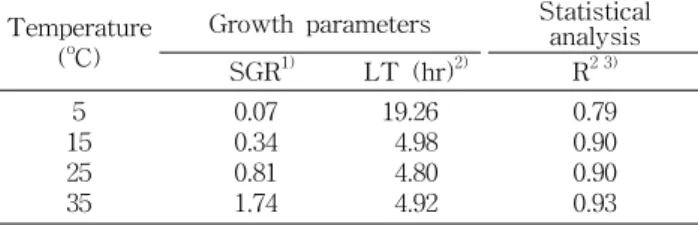
각 온도조건(5, 15, 25, 35oC)에서 S. aureus 증식을 예측하 기 위한 생육 지표인 LT와 SGR은 modified Gompertz equation을 적용하여 구하였다. 예측된 생육지표의 통계적 적합성을 나타내는 R2값들은 Table 1과 같이 5, 15, 25, 35oC 에서 각각 0.79, 0.90, 0.90, 0.93으로 나타나 대부분 1에 근접 하였다(23,24). 이러한 결과는 TSB medium을 이용하여 S.
Table 1. For the primary modeling, best-fit lag time (LT), and specific growth rate (SGR) of S. aureus in cooked mung bean sprout obtained from the modified Gompertz equation
Temperature (oC)
Growth parameters Statistical analysis SGR1) LT (hr)2) R2 3) 5
15 25 35
0.07 0.34 0.81 1.74
19.26 4.98 4.80 4.92
0.79 0.90 0.90 0.93
1)SGR: specific growth rate.
2)LT: lag time.
3)R2: coefficient of determination.
aureus의 성장예측모델을 개발하는데 사용된 LT, SGR의 R2값(0.90~0.99)(32)과 깻잎에서 L. monocytogenes 예측모 델의 R2값이 대부분 0.93 이상 나타났다는 결과(10)와 유사 하였다. 따라서 본 연구 결과의 LT와 SGR값은 숙주나물에 서의 S. aureus 생육예측을 위한 이차모델의 변수 값으로 사용하기에 적합한 것으로 확인되었다.
Response surface model
Response surface model식에 의해 개발된 예측모델을 이 용하여 온도변화에 따른 LT와 SGR의 예측값을 구하고 관 측값과 비교한 그래프를 Fig. 1에 나타내었다. LT값은 관측 값, 예측값 모두 5oC에서만 약 19시간으로 나타났고, 15, 25, 35oC에서는 약 5시간으로 나타나 LT값은 온도 증가에 반비 례하여 감소하는 경향을 나타내었다. SGR의 관측값과 예측 값은 5oC에서 각각 0.07, 0.08 log CFU/g로 매우 작았고 15oC 에서 급격히 증가하여 35oC에서 모두 1.73 log CFU/g로 나 타났다. 이러한 결과로 생육최적 온도에 가까워질수록 SGR 값은 기하급수적으로 증가하고, 낮은 온도일수록 SGR값이 거의 0에 가깝게 나타나 증식에 불리하다는 것을 확인할 수 있었다. 김밥과 샌드위치의 S. aureus 성장예측모델을 square root model에 적용한 연구(33)에서도 SGR값은 온도 가 높아질수록 기하급수적으로 증가하였고, LT값은 온도가 높아질수록 낮아져 본 연구의 결과와 일치하였다. 따라서 온도는 S. aureus의 생육변화에 주된 환경요인으로 작용한 다는 것을 알 수 있었다.
R2 = 0.94
R2 = 0.94 RR2 2 = 0.99= 0.99
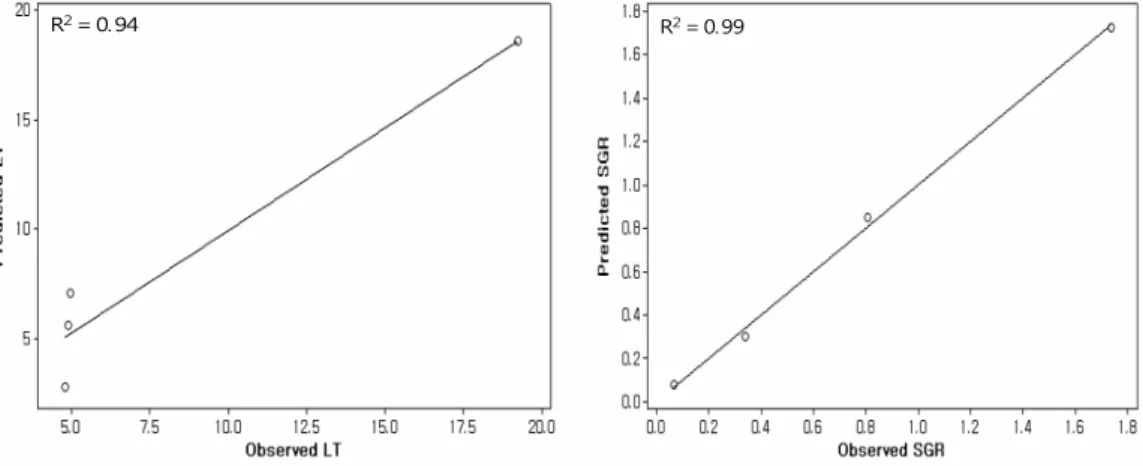
Fig. 2. Observed vs. predicted specific growth rates (SGR) and lag times (LT) of S. aureus in cooked mung bean sprout.
모델 적합성 평가
실험에 의해 관측된 값과 response surface model에 의해 얻어진 예측값의 상관관계를 살펴본 결과 R2값이 각각 0.94, 0.99로 밀접하게 나타났고(Fig. 2), 1에 가까운 값으로 나타 나 적합도가 높았다(23,24).
예측모델의 수행을 평가하기 위하여 통계적 지표가 되는 MSE, Bf, Af값은 Table 2에 나타내었다. LT, SRG의 MSE값 은 각각 0.020, 0.002로 0에 근접하여 높은 적합성을 보였다 (24). Bf값과 Af값은 이상적인 값이 1이고, 두 값 모두 1에 가까울수록 관측값과 예측값의 차이가 적다는 것을 나타낸 다(25,34). 본 연구에서 Bf값은 각각 0.97, 1.03으로 나타나 적합성이 높았고, Af값도 각각 1.31, 1.10을 나타내어 높은 정확도를 보였다. Seo 등(32)이 TSB medium에서 response surface model에 적용하여 개발한 S. aureus의 예측모델에 서도 R2값이 0.94, MSE이 0.02, Af, Bf값이 각각 1.26, 1.02로 나타나 본 연구의 결과와 유사하였다. 이러한 결과를 근거로 숙주나물에 대한 S. aureus의 성장예측모델은 통계적으로 적합성이 높다고 할 수 있으며, 사용 가능한 모델로 판단된 다. 따라서 숙주나물의 안전성 평가에 있어서 미생물의 정량 적 위험성을 판단하는 기초 자료로 활용될 수 있을 것이다.
숙주나물의 섭취유효기간 설정
5oC는 S. aureus가 성장하기에 적합하지 않은 온도로 균
Table 2. Statistical indices of the secondary modeling step for lag time (LT) and specific growth rate (SGR) of S. aureus in cooked mung bean sprout
Growth parameters R2 3) MSE4) Bf5) Af6)
LT1) SGR2)
0.94 0.99
0.020 0.002
0.97 1.03
1.31 1.10
1)LT: lag time.
2)SGR: specific growth rate.
3)R²: coefficient of determination.
4)MSE: mean square error.
5)Bf: bias factor.
6)Af: accuracy factor.
의 증식이 거의 나타나지 않았다. 15oC의 온도는 S. aureus 의 발육온도 범위(7~48oC)에는 포함되나, 표준레시피 이용 및 식초 첨가 나물에서 72시간까지 약간의 S. aureus 증식만 나타나 5oC와 마찬가지로 성장하는데 어려움이 있다는 것을 알 수 있었다. 표준레시피 이용 나물은 S. aureus의 발육온 도에 근접한 25oC에서 3시간부터 빠르게 성장하여 12시간에 는 약 5.0 log CFU/g로 나타나 식중독의 위험성을 나타내었 다. 35oC에서는 3시간부터 빠르게 성장하여 약 8시간에는 6.0 log CFU/g를 초과하여 독소생성 가능성을 보였다. 조리 된 계란의 경우 18oC에서는 S. aureus가 6.0 log CFU/g 이상 증식하여도 독소가 생성되지 않았지만 22, 30oC에서는 8.0 log CFU/g 이상으로 증식하여야 독소가 생성되었다(20). 우 유에서는 25, 32oC에서만 7.0 log CFU/g 이상으로 증식하였 을 때 독소가 생성된다고 보고하였다(35). 따라서 숙주나물 은 조리 후 약 10oC 이하의 낮은 온도에서 보관해야 하고, 25oC 이상에서 보관할 경우에는 12시간 이전, 35oC 이상에서 는 6시간 이전에 섭취하여야 할 것이다.
식초 첨가 숙주나물의 S. aureus 성장 특성
식초를 첨가한 숙주나물(실험군)은 pH 측정 결과 4.78로 나타나 S. aureus의 성장에 부적절한 조건이었다(29). 일반 세균과 대장균군은 각각 1.36, 0.62 log CFU/g로 검출되었 고, 대장균은 검출되지 않았다. Table 3과 같이 표준레시피 이용 숙주나물(대조군)과 비교해 본 결과 pH(p<0.001)와 일 반세균(p<0.01)에서 유의적인 차이를 보였다. S. aureus의
Table 3. pH measurement and microbiological contamination level in cooked mung bean sprout
Type
F-value Control Experimental pH 6.32±0.171) 4.78±0.99 192.95***
Microbial count Mean±SD (log CFU/g)
Aerobic
plate count 3.00±0.17 1.36±1.06 14.04**
Coliforms 1.63±1.27 0.62±0.96 2.42
1)Three times trail. **p<0.01, ***p<0.001.
Table 4. Growth of S. aureus in cooked mung bean sprout at different temperatures
Temperature
(oC) Type
Microbial count
Mean±SD (log CFU/g) F-value y01)
ymax2)
5 Control
Experimental
3.12±0.683) 3.02±0.00
3.34±0.55 2.00±0.00 17.65**
15 Control
Experimental
3.20±0.54 3.02±0.73
3.58±0.10
2.54±0.42 36.12***
25 Control
Experimental
3.20±0.38 3.02±0.00
5.00±0.43 2.54±0.00 16.44**
35 Control
Experimental
3.21±0.39 3.31±0.26
7.01±0.80 2.00±0.00 18.55**
1)y0: initial cell count.
2)ymax: finial cell count.
3)Three times trail.
**p<0.01 ***p<0.001
증식은 온도 변화에 상관없이 3.0 log CFU/g 수준으로 일정 하게 유지되었고, 약간 감소하는 경향도 보여 5oC(p<0.01), 15oC(p<0.001), 25oC(p<0.01), 35oC(p<0.01)에서 대조군과 유의적인 차이를 나타내었다(Table 4). 이러한 결과는 김밥 과 김초밥을 대상으로 한 연구에서 식초가 첨가된 김초밥에 서는 일반세균, 대장균군이 10, 20oC에서 보관할 경우 48시 간까지 거의 증식하지 않았고, 30oC에서는 약간의 증식만 보인 것(36)과 유사하였다. 식초는 숙주나물의 pH를 낮춰 S. aureus 성장조건에 불리한 조건으로 작용할 뿐만 아니라 다른 미생물의 생육도 억제하는 효과가 있었다. 따라서 기온 이 높은 하절기에 숙주나물을 조리할 경우 섭취 기간을 연장 하기 위하여 식초를 이용한 조리방법을 사용하는 것을 권장 한다. 그러나 본 연구는 S. aureus의 성장을 기초로 섭취유 효기간을 설정하였기 때문에, 정확한 섭취유효기간 설정을 위해서는 독소생성 및 일반세균, 대장균군, 대장균 등의 오 염 지표균에 대한 추가 검증 연구가 수행되어야 할 것이다.
요 약
본 연구는 학교급식에서 제공되는 숙주나물의 안전성을 확보하기 위하여 수행되었다. 표준레시피를 이용하여 조리 한 숙주나물에 대하여 예측 미생물학을 이용하여 숙주나물 의 성장예측 모델을 개발한 후 보관기간을 설정하였고, 식초 를 첨가하여 조리한 숙주나물의 S. aureus 성장과 비교하였 다. 표준레시피를 이용하여 조리한 S. aureus는 성장하기에 적절한 pH(6.32)로 측정되었고, 온도 변화(5, 15, 25, 35oC)에 따라 빠르게 증식하였다. 성장예측모델을 개발하기 위하여 Gompertz model을 적용하여 생육 지표(LT, SGR)를 구한 결과 5oC를 제외하고 0.90 이상의 높은 R2값을 나타내어 이차 모델의 변수 값으로 사용하기에 적합성이 높았다. Response surface model을 이용한 2차 모델에서는 LT, SGR의 R²값이 모두 0.94 이상으로 나타나 관측값과 예측값의 상관관계가
밀접하였다. MSE는 각각 0.020, 0.002로 나타났고, Bf와 Af
의 경우에도 이상적인 값인 1에 가까운 값으로 나타나 관측 값과 예측값 간의 높은 정확성을 나타내었다. 따라서 본 연 구의 S. aureus 성장예측모델은 통계적으로 적합성이 높다 고 할 수 있으며, 사용 가능한 모델로 판단된다. 숙주나물의 보관기간은 S. aureus의 성장조건과 독소가 생성되는 6.0 log CFU/g을 근거로 설정하였다. 그 결과 10oC 이하의 낮은 온도에서 보관할 것을 권장한다. 25oC 이상에서 보관할 경우 에는 12시간 이전, 35oC 이상에서는 6시간 이전에 섭취하여 야 할 것이다. 숙주나물에 식초를 첨가한 결과 pH는 4.78로 나타나 S. aureus의 증식에 불리한 조건이었고, 균의 증식도 온도 변화와 상관없이 일정한 수준을 유지하거나 감소하였 다. 따라서 기온이 높은 계절에는 식초를 이용하면 S. aur- eus에 대한 증식억제 효과를 나타내 숙주나물의 안전성을 높일 수 있을 것이다.
감사의 글
이 논문은 2008년도 정부재원(교육인적자원부 학술연구 조성사업비)으로 한국학술진흥재단의 지원을 받아 연구되 었음((KRF-2008-531-F00017)
문 헌
1. Park JK. 1990. The status of school food service program and its improvement proposal in Korea. Korean J Nutr 23:
213-218.
2. Ministry of Education Science & Technology. 2009. 2008 School Foodservices Statistics. Available at www.mest.go.kr.
Accessed Aug 1, 2009.
3. Kim YH, Ryu K, Lee YK. 2009. Microbiological safety dur- ing delivering of food ingredients supplied to elementary school food services in Daegu and Gyeongbuk provinces-
seafood, meat and frozen processing food-. Korean J Food Preserv 16: 276-285.
4. Yoo WC, Park HK, Kim KL. 2000. Microbiological hazard analysis for prepared foods and raw materials of foodser- vice operation. Korean J Dietary Culture 15: 123-137.
5. Tamarapu S, Mckillip JL, Drake M. 2001. Development of a multiplex polymerase chain reaction assay for detection and differentiation of Staphylococcus aureus in dairy products. J Food Prot 64: 664-668.
6. Pereira ML, Carmo do LS, Santos dos EJ, Bergdoll MS.
1994. Staphylococcus food poisoning from cream-filled cake in metropolitan area of south-eastern Brazil. Rev Saude Publica 28: 406-409.
7. Korea Food & Drug Administration. 2009. 2008 Foodborne Illness Statistics. Available at http://www.kfda.go.kr.
Accessed August 1, 2009.
8. Woo SM, Jang SY, Kim OM, Youn KS, Jeong YJ. 2004.
Antimicrobial effects of vinegar on the harmful food-borne organisms. Korean J Food Preserv 11: 117-121.
9. Koseki S, Isobe S. 2005. Prediction of pathogen growth on iceberg lettuce under real temperature history during dis- tribution from farm to table. Int J Food Microbiol 104:
239-248.
10. Park SY, Choi JW, Chung DH, Kim MG, Lee KH, Kim KS, Bahk GJ, Bae DH, Park SK, Kim KY, Kim CH, Ha SD.
2007. Development of a predictive mathematical model for the growth kinetics of Listeria monocytogenes in sesame leaves. Food Sci Biotechnol 16: 238-242.
11. Geysen S, Escalona VH, Verlinden BE, Aertsen A, Geeraerd AH, Michiels CW, Van Impe JF, Nicolai BM. 2006.
Validation of predictive growth models describing super- atmospheric oxygen effects on Pseudomonas fluorenscens and Listeria innocua on fresh-cut lettuce. Int J Food Microbiol 111: 48-58.
12. Carrasco E, Perez-Rodriguez F, Valero A, Garcia-Gimeno RM, Zurera G. 2008. Growth of Listeria monocytogenes on shredded, ready-to-eat iceberg lettuce. Food Control 19:
487-494.
13. Bahk GJ, Oh DH, Ha SD, Park KH, Joung MS, Chun SJ, Park JS, Woo GJ, Hong CH. 2005. Quantitative microbial risk assessment model for Staphylococcus aureus in Kimbab. Korean J Food Sci Technol 37: 484-491.
14. Heo C, Kim WK, Choi YS, Kim CJ, Paik HD. 2008.
Application of predictive microbiology for shelf-life esti- mation of Tteokgalbi containing dietary fiber from rice bran. Korean J Food Sci Ani Resour 28: 232-239.
15. Heo C, Kim WK, Choi YS, Kim CJ, Paik HD. 2009.
Shelf-life estimation of frankfurter sausage containing di- etary fiber from rice bran using predictive modeling.
Korean J Food Sci Ani Resour 29: 47-54.
16. Lee HM, Lee GY, Yoon EK, Kim HJ, Kang YS, Lee DH, Park JS, Lee SH, Woo GJ, Kang SH, Yang JS, Yang KH.
2004. Computation of maximum edible time using monitor- ing data of Staphylococcus aureus in Kimbap and Food Micro Model. J Fd Hyg Safety 19: 49-51.
17. Kim EJ. 2004. Analysis of microbiological hazards and quantitative microbial risk assessment of Staphylococcus aureus inoculated onto potentially hazardous foods in school foodservice operations. MS Thesis. Yonsei University, Seoul, Korea.
18. Dahl CA, Matthews ME, Marth EH. 1981. Survival of Streptococcus faecium in beef loaf and potatoes of after mi- crowave-heating in a simulated cook/chill foodservice system. J Food Prot 44: 128-132.
19. KFDA. 2007. Food Code. Korea Food and Drug Administration.
20. Yang SE, Yu RC, Chou CC. 2001. Influence of holding tem- perature on the growth and survival of Salmonella spp. and Staphylococcus aureus and the production of Staphylococcus enterotoxin in egg products. Int J Food Microbiol 63:
99-107.
21. Gibson AM, Bratchell N, Roberts TA. 1988. Predicting mi- crobial growth: growth response of Salmonella in a labo- ratory medium as affected by pH, sodium chloride and stor- age temperature. Int J Food Microbiol 6: 155-178.
22. Bechmann IE, Jensen HS, Bøknase N, Warm K, Nielsen J. 1998. Prediction of chemical, physical and sensory data from process parameters for frozen cod using multivariate analysis. J Sci Food Agric 78: 329-336.
23. Duffy LL, Vanderline PB, Grau FH. 1994. Growth of
Listeria monocytogenes on vaccum-packed cooked meats:
effects of pH, Aw, nitrite and sodium ascorbate. Int J Food Microbiol 23: 377-390.
24. Sutherland JP, Bayliss AJ, Robert TA. 1994. Predictive modelling of growth Staphlycoccus aureus: the effects of temperature, pH and sodium chloride. Int J Food Microbiol 21: 217-236.
25. Ross T. 1996. Indices for performance evaluation of pre- dictive model in food microbiology. J Appl Bacteriol 81:
201-508.
26. Ross T. 1999. Predictive food microbiology models in the meat industry. Meat and Livestock Australia, Sydney, Australia. p 196.
27. Lindqvist R, Sylven S, Vagsholm I. 2002. Quantitative mi- crobial risk assessment exemplified by Staphylococcus aureus in unripened cheese made from raw milk. Int J Food Microbiol 78: 144-170.
28. Atanassova V, Meindl A, Ring C. 2001. Prevalence of Staphylococcus aureus and Staphylococcal enterotoxin in raw pork and uncooked smoked ham-a comparison of classical culturing detection and RFLP-PCR. Int J Food Microbiol 68: 105-113.
29. Normanno G, Firinu A, Virgilio S, Mula G, Dambrosio A, Poggiu A, Decastelli L, Mioni R, Scuota S, Bolzoni G, Di Giannatale E, Salinetti AP, La Salandra G, Bartoli M, Zuccon F, Pirino T, Sias S, Parisi A, Quaglia NC, Celano GV. 2005. Coagulase-positive Staphylococci and Staphyl- ococcus aureus in food products marketed in Italy. Int J Food Microbiol 98: 73-79.
30. Min JH, Lee YK. 2004. Microbiological quality evaluation for implementation of a HACCP system in day-care center foodservice operations. Ⅰ. Focus on heating process and after-heating process. Korean J Nutr 37: 712-721.
31. Seol HR, Park HS, Park KH, Park AK, Ryu K. 2009.
Microbiological evaluation of foods and kitchen environ- ments in childcare center and kindergarten foodservice operations. J Korean Soc Food Sci Nutr 38: 252-260.
32. Seo KY, Heo SK, Lee C, Chung DH, Kim MG, Lee KH, Kim KS, Bahk GJ, Bae DH, Kim KY, Kim CH, Ha SD. 2007.
Development predictive mathematical model for the growth kinetics of Staphylococcus aureus by response surface model. J Microbiol Biotechnol 17: 1437-1444.
33. Chung MS. 2007. Study on the risk management for risk reduction of Staphylococcus aureus in ready-to-eat foods (II). The final report of Korea Food and Drug Administra- tion research project. Korea Health Industry Development Institute. Seoul, Korea.
34. Skandamis PN, Nychas GE. 2000. Development and evalua- tion of a model predicting the survival of Escherichia coli O157:H7 NCTT 12900 in homemade eggplant salad at vari- ous temperatures, pH and oregano essential oil concen- trations. Appl Environ Microbiol 66: 1646-1653.
35. Fujikawa H, Morozumi S. 2006. Modeling Staphylococcus aureus growth and enterotoxin production in milk. Food Microbiol 23: 260-267.
36. Kim EJ, Kang SJ, Hahn YS. 2008. Storage characteristic comparison of laver-wrapped rice and laver-wrapped rice with vinegar. Korean J Food Cookery Sci 24: 99-105.
(2009년 9월 18일 접수; 2009년 11월 18일 채택)