Archives of Craniofacial Surgery
www.e-acfs.org pISSN 2287-1152 eISSN 2287-5603
50
Copyright © 2013 The Korean Cleft Palate-Craniofacial AssociationThis is an Open Access article distributed under the terms of the Creative Commons Attribution Non-Commercial License (http://creativecommons.org/
licenses/by-nc/3.0/) which permits unrestricted non-commercial use, distribution, and reproduction in any medium, provided the original work is properly cited.
Archives of Craniofacial Surgery
구개열 환자에서 포비돈 아이오다인에 의한 흡인성 폐렴
김석화1·석효현1·정의철2·박지웅2·최태현1
1서울대학교 의과대학 성형외과학교실, 2서울대학교병원운영 서울특별시 보라매병원 성형외과
Povidone-iodine (PVP-I, Betadine) has many advantages as a disinfectant solution for preoperative preparations, especially for oral surgery. It is widely used because of its low toxicity and excellent bactericidal effect. The authors report a case of pneumonia secondary due to the aspiration of PVP-I, which was used as an oral disinfectant. We present a case of aspiration pneumonia that resulted from the careless use of PVP-I during preoperative preparation. The patient was a 10-month-old female scheduled for elective surgery to correct a complete cleft of secondary palate. During the preparation of the oral cavity for that cleft palate patient, PVP-I was incidentally aspirated to the airway. The lung resistance was noted with positive pressure and pneumonic in- filtration on chest radiograph was seen. The operation was postponed and the patient underwent respiratory care. Three months later, elective palatoplasty under general anesthesia was performed without complication. Based on the experiences of this case, the authors advise that throat-packing should be placed before oral preparation to prevent serious pulmonary complications.
Keywords: Aspiration pneumonia / Povidone-iodine / Cleft palate
Aspiration Pneumonia caused by Povidone-iodine (Betadine) in Cleft Palate Patient
Sukwha Kim1, Hyo Hyun Seok1, Eui Cheol Jeong2, Ji Ung Park2, Tae Hyun Choi1
1Department of Plastic and Reconstructive Surgery, Seoul National University College of Medicine, Seoul;
2Department of Plastic Surgery, SMG-SNU Boramae Medical Center, Seoul, Korea
Introduction
The use of topical disinfectant solution is common during the preoperative preparation of general surgical fields, in addition to preoperative antibiotic prophylaxis. In particular, intraoral proce- dures are performed after decontaminating the oral cavity of nor- mal microbial flora [1,2]. Various agents are available for oral disin- fectant, such as, saline irrigation, iodine, and other antimicrobials, the usages of which are based on surgeons’ preferences. Neverthe-
less, Povidone-iodine (PVP-I, Betadine, Korea Pharma Co., Seoul, Korea) is commonly chosen because of its safety and effectiveness.
Here, we present a case of aspiration pneumonia that resulted from the careless use of PVP-I during preoperative preparation.
Case Report
The patient was a 10-month-old female patient scheduled for elective surgery to correct a complete cleft of secondary palate. Her medical history was unremarkable and she had no history of allergy.
On admission, she weighed 9 kg and was well-developed, and well- nourished. In addition, her vital signs and routine admission labo- ratory and chest radiograph findings were all within normal limits.
The patient was placed under general anesthesia. A 4.0 Ring- Adair-Elwyn endotracheal tube without a cuff was inserted, and
Arch Craniofac Surg Vol.14 No.1, 50-52 http://dx.doi.org/10.7181/acfs.2013.14.1.50
Correspondence: Eui Cheol Jeong
Department of Plastic Surgery, SMG-SNU Boramae Medical Center, 20 Boramae- ro 5-gil, Dongjak-gu, Seoul 156-707, Korea
Tel: +82-2-870-2331 / Fax: +82-2-831-2826 / E-mail: [email protected]
* This article was presented at the 65th congress Annual Meeting of the Korean Society of Plastic and Reconstructive Surgeons on November 8-10, 2009, in Seoul, Korea.
Received March 5, 2013 / Revised March 27, 2013 / Accepted April 1, 2013
Case Report
51
www.e-acfs.org
ICU and included frequent suctioning and O2 inhalation. Subse- quently, her condition became more stable and serial blood gas val- ues improved. The use of the endotracheal tube was terminated about 2 hours after emergence. However, rale sounds persisted and intermittent fever was noted. At this time, a pediatric pulmonolo- gist was collaborating with us on the case. Additional antibiotic therapy and intermittent nebulization were administered, and a sputum culture disclosed no significant pathogens.
A week after the aborted surgery, radiographic improvements were evident and she was subsequently discharged (Fig. 2). Follow up examinations were uneventful and no further sequelae devel- oped. Three months later, elective palatoplasty under general anes- thesia was performed without complication.
Discussion
PVP-I is formed by adding free iodine to polyvinyl-pyrollidone (PVP), a solubilizing agent, to reduce the toxicity of iodine. When io- dine is liberated from PVP after application, it reacts with the mem- branous proteins of microorganisms. However, although PVP-I was developed with safety in mind and has proven wide-spectrum anti- this was followed by a routine disinfectant preparation of head and
neck skin and of the oral cavity with diluted PVP-I solution.
After positioning and draping, an attempt was made to insert a Dingman mouth gag, but during this attempt, the previously ap- plied endotracheal tube slipped out. After applying suction in the oral cavity, the anesthesiologist promptly re-intubated the patient.
However, SaO2 dropped to 72% and pulmonary rales and increased lung resistance were noted with positive pressure. These events were presumed to be due to increased secretion in the (lung), and thus, the endotracheal tube was suctioned. The fluid suctioned was tinged brown and consistent with PVP-I. Aspiration was then sus- pected, and trachea and bronchi were lavaged with sterile saline through the endotracheal tube and suctioning was reapplied.
At this time, arterial blood gas values were; pH 7.28, PaO2 65 mm Hg, PaCO2 43 mm Hg, SaO2 89%, BE-6.2 mmol/L, and FiO2 100% and the chest radiograph revealed ill-defined increased opacities in the right upper lobe–suggestive of aspiration pneumo- nia (Fig. 1). Adequate O2 supply and positive pressure mechanical ventilation were instituted and gradually her vital signs stabilized.
Surgery was postponed due to intense concerns of possible postoperative respiratory complications. On emergence from an- esthesia, the patient was transferred while intubated to our inten- sive care unit (ICU). Pulmonary cleansing was undertaken in the
Fig. 1. Suggestive radiologic finding of aspiration pneumonia.
Intraoperative chest posteroanterior view showing ill-defined infil- tration in the right upper lung lobe.
Sukwha Kim, et al. Aspiration and povidone-iodine
Fig. 2. Follow-up chest radiograph obtained before discharge, show- ing the absence of abnormal opacities.
Archives of Craniofacial Surgery Vol. 14, No. 1, 2013
www.e-acfs.org
52
bactericidal effects, its aspiration can lead to serious complications [1,2]. Furthermore, PVP-I is contraindicated in pregnant patients and in patients with thyroid dysfunction, because of the systemic effects of iodine. Moreover, prolonged use of PVP-I may induce bradycardia, hypertension, and detrimentally affect liver and renal function [1].
We explored the world literature on this topic through PUBMED (National Library of Medicine, revised 1st April 2001) using appropriate keywords and Boolean operators. The cases of aspiration pneumonia resulting from PVP-I aspiration periopera- tively are very rare, and their reported clinical manifestations and courses were similar to those observed in this presented case [2-4].
Intuitively, PVP-I impinges on the cell membrane of organisms to cause dermatitis by the same action on skin tissue [1]. Therefore, it would also have an adverse effect on respiratory mucosa and tissue more fragile than skin. Chemical pneumonia by aspiration during the general anesthesia, well known as Mendelson’s syndrome, is characterized by a bronchopulmonary reaction following aspira- tion of gastric contents. The main features are hypoxia, wheezing, low blood pressure, and decreased arterial oxygen tension. In seri- ous cases, it causes acute pulmonary edema leading to sudden death. Treatments are mainly focused on the prevention, that is ad- ministering an antacid or H2-antagonist in high risk patients [2].
On the other hand, in the previous reported cases of PVP-I, symp- toms improved under respiratory supportive care and manage- ment without no sequelae. The authors believe that the reason is the lower pH of gastric contents than that of PVP-I and the tendency of
larger amount of the aspirated contents in gastric aspiration cases.
But, most importantly, reported cases demonstrate that proper precautions must be taken to prevent PVP-I aspiration. In particu- lar, young children have a short, small airway, and thus, a small diam- eter endotracheal tube without a cuff is often used for palatoplasty.
Furthermore, it is somewhat difficult to insert a Dingman mouth gag into the oral cavity because it has several hooks and notches, if a gag is handled carelessly, tubes easily slipped out. Therefore, aspira- tion may occur more frequently in children during disinfectant pro- cedures. Howe recommended that a throat-pack (Fig. 3) should be placed and that the cuff of the nasotracheal tube be adequately inflat- ed before introducing an antiseptic solution [3]. The remaining secre- tion or fluid in the oral cavity should be sucked and cleaned as closely as possible before application of Dingman mouth gag. Furthermore, in a survey of oral decontamination methods among maxillofacial surgeons in the US, a throat-pack was also placed before general an- esthesia to prevent antiseptic solution aspiration, and positive in- trathoracic pressure was applied by the anesthesiologist during oral preparation [5]. The lesson to be learnt from experiences to date, is that every precaution, such as, throat-pack placement and application of the surgical devices, should be taken during the preparation of the oral cavity.
Conflict of Interest
No potential conflict of interest relevant to this article was reported.
References
1. Ahn MJ, Jeon Y, Chung DS. Primary irritant dermatitis to Povidone- iodine after caudal anesthesia: a case report. Korean J Anesthesiol 2004;46:114-8.
2. An TH, Ahn BR. Pneumonia due to aspiration of povidine iodine after induction of general anesthesia: a case report. Korean J Anesthesiol 2011;61:251-6.
3. Howe DJ. Aspiration pneumonia from povidone-iodine (Betadine):
report of case. J Oral Surg 1981;39:224-5.
4. Numazawa R, Morimoto Y, Yokota S, Yamamura T, Kemmotsu O.
Pneumonia due to aspiration of povidone-iodine during anesthesia: a case report. Masui 1992;41:846-9.
5. Summers AN, Larson DL, Edmiston CE, Gosain AK, Denny AD, Radke L. Efficacy of preoperative decontamination of the oral cavity.
Plast Reconstr Surg 2000;106:895-900.
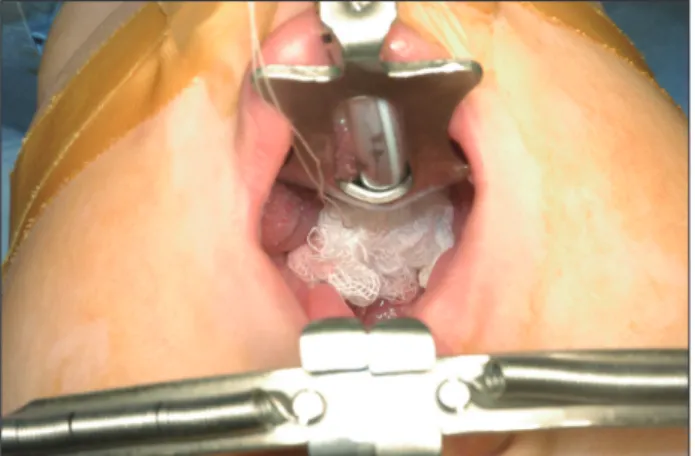
Fig. 3. A throat-pack applied before intraoral preparation. A throat- pack was placed before introducing antiseptic solution to prevent serious pulmonary complications.
Archives of Craniofacial Surgery Vol. 14, No. 1, 2013
www.e-acfs.org
52
bactericidal effects, its aspiration can lead to serious complications [1,2]. Furthermore, PVP-I is contraindicated in pregnant patients and in patients with thyroid dysfunction, because of the systemic effects of iodine. Moreover, prolonged use of PVP-I may induce bradycardia, hypertension, and detrimentally affect liver and renal function [1].
We explored the world literature on this topic through PUBMED (National Library of Medicine, revised 1st April 2001) using appropriate keywords and Boolean operators. The cases of aspiration pneumonia resulting from PVP-I aspiration periopera- tively are very rare, and their reported clinical manifestations and courses were similar to those observed in this presented case [2-4].
Intuitively, PVP-I impinges on the cell membrane of organisms to cause dermatitis by the same action on skin tissue [1]. Therefore, it would also have an adverse effect on respiratory mucosa and tissue more fragile than skin. Chemical pneumonia by aspiration during the general anesthesia, well known as Mendelson’s syndrome, is characterized by a bronchopulmonary reaction following aspira- tion of gastric contents. The main features are hypoxia, wheezing, low blood pressure, and decreased arterial oxygen tension. In seri- ous cases, it causes acute pulmonary edema leading to sudden death. Treatments are mainly focused on the prevention, that is ad- ministering an antacid or H2-antagonist in high risk patients [2].
On the other hand, in the previous reported cases of PVP-I, symp- toms improved under respiratory supportive care and manage- ment without no sequelae. The authors believe that the reason is the lower pH of gastric contents than that of PVP-I and the tendency of
larger amount of the aspirated contents in gastric aspiration cases.
But, most importantly, reported cases demonstrate that proper precautions must be taken to prevent PVP-I aspiration. In particular, young children have a short, small airway, and thus, a small diameter endotracheal tube without a cuff is often used for palatoplasty. Fur- thermore, it is somewhat difficult to insert a Dingman mouth gag into the oral cavity because it has several hooks and notches, if a gag is handled carelessly, tubes easily slipped out. Therefore, aspiration may occur more frequently in children during disinfectant procedures.
Howe recommended that a throat-pack (Fig. 3) should be placed and that the cuff of the nasotracheal tube be adequately inflated before in- troducing an antiseptic solution [3]. The remaining secretion or fluid in the oral cavity should be sucked and cleaned as closely as possible before application of Dingman mouth gag. Furthermore, in a survey of oral decontamination methods among maxillofacial surgeons in the US, a throat-pack was also placed before general anesthesia to prevent antiseptic solution aspiration, and positive intrathoracic pres- sure was applied by the anesthesiologist during oral preparation [5].
The lesson to be learnt from experiences to date, is that every precau- tion, such as, throat-pack placement and application of the surgical devices, should be taken during the preparation of the oral cavity.
No potential conflict of interest relevant to this article was reported.
1. Ahn MJ, Jeon Y, Chung DS. Primary irritant dermatitis to Povidone- iodine after caudal anesthesia: a case report. Korean J Anesthesiol 2004;46:114-8.
2. An TH, Ahn BR. Pneumonia due to aspiration of povidine iodine after induction of general anesthesia: a case report. Korean J Anesthesiol 2011;61:251-6.
3. Howe DJ. Aspiration pneumonia from povidone-iodine (Betadine):
report of case. J Oral Surg 1981;39:224-5.
4. Numazawa R, Morimoto Y, Yokota S, Yamamura T, Kemmotsu O.
Pneumonia due to aspiration of povidone-iodine during anesthesia: a case report. Masui 1992;41:846-9.
5. Summers AN, Larson DL, Edmiston CE, Gosain AK, Denny AD, Radke L. Efficacy of preoperative decontamination of the oral cavity.
Plast Reconstr Surg 2000;106:895-900.
Fig. 3. A throat-pack applied before intraoral preparation. A throat- pack was placed before introducing antiseptic solution to prevent serious pulmonary complications.