ORIGINAL ARTICLE
총담관 각도가 총담관결석 재발에 미치는 임상적 영향: 메타분석 및 고찰
유성열, 조익현, 김선후, 김연지, 정우철
가톨릭대학교 의과대학 성빈센트병원 소화기내과
Clinical Impact of Common Bile Duct Angulation on the Recurrence of Common Bile Duct Stone: A Meta-analysis and Review
Seongyul Ryu, Ik Hyun Jo, Seonhoo Kim, Yeon-Ji Kim and Woo Chul Chung
Division of Gastroenterology, Department of Internal Medicine, St. Vincent’s Hospital, College of Medicine, The Catholic University of Korea, Suwon, Korea
Background/Aims: Local and systemic factors, such as diabetes, obesity, and hyperlipidemia, are considered risk factors for the recurrence of choledocholithiasis after successful endoscopic clearance. Local factors include the presence of bile sludge, com- mon bile duct (CBD) diameter, and CBD angulation. Among them, it is unclear if acute CBD angulation is preferable to the re- currence of a CBD stone.
Methods: PubMed, EMBASE, CINAHL, the Cochrane Library databases, and google website were searched for randomized con- trolled trials reported in English and undertaken until August 2019. Meta‐analysis was performed on all randomized controlled tri- als for the recurrence of CBD stones between the patients with acute CBD angulation.
Results: Eight randomized trials (1,776 patients) were identified, and the total recurrent rate of CBD stones was 18.8%
(334/1,776). A CBD angle ≤145° was significantly associated with an increased risk of recurrent CBD stone (OR=2.65, p<0.01).
In two prospective studies, acute CBD angulation was not proven to be associated with a recurrence (p=0.39).
Conclusions: Approximately 20% of patients with a CBD stone showed recurrence after the complete clearance of the CBD stone, and a CBD angle ≤145° could increase the risk of recurrence. Overall, a large-scale prospective study should be necessary.
(Korean J Gastroenterol 2020;76:199-205)
Key Words: Common bile duct; Choledocholithiasis; Recurrence
Received June 13, 2020. Revised July 24, 2020. Accepted July 26, 2020.
CC This is an open access article distributed under the terms of the Creative Commons Attribution Non-Commercial License (http://creativecommons.org/licenses/
by-nc/4.0) which permits unrestricted non-commercial use, distribution, and reproduction in any medium, provided the original work is properly cited.
Copyright © 2020. Korean Society of Gastroenterology.
교신저자: 조익현, 16247, 수원시 팔달구 중부대로 93, 가톨릭대학교 의과대학 성빈센트병원 소화기내과
Correspondence to: Ik Hyun Jo, Division of Gastroenterology, Department of Internal Medicine, St. Vincent’s Hospital, College of Medicine, The Catholic University of Korea, 93 Jungbu-daero, Paldal-gu, Suwon 16247, Korea. Tel: +82-31-249-7138, Fax: +82-31-253-8898, E-mail: [email protected], ORCID: https://orcid.org/
0000-0002-3433-8662
Financial support: None. Conflict of interest: None.
INTRODUCTION
Protective cholecystectomy is recommended to prevent bili- ary colic, cholecystitis, or common bile duct (CBD) stone re- currence in patients with gallbladder stones after endoscopic extraction of CBD stones.1 On the other hand, a considerable
number of CBD stone recurrences often occur, even after a cholecystectomy. The recurrence of CBD stones after ERCP, which is the treatment of choice for CBD stones, has been reported to be 4-24%.2,3
Disease recurrence is defined when a bile duct stone re- appears within 6 months of ERCP.4 Many studies have exam-
Fig. 1. Images of a patient diagnosed with acute cholangitis and common bile duct (CBD) stones show sharp CBD angulation (119.6°, from magnetic resonance cholangiopancreatography).
Table 1. Main Characteristics
Study Country Study type Low CBD an- gle criteria
Cholangiop ancreatog-
raphy
Non-re- currence/
recurrence
Age Sex (female) Prior chol-
ecystectomy Non-re-
currence Recurrence Non-re-
currence Recurrence Non-re-
currence Recurrence Zhou et al.
(2019)5
China Retrospective Distal CBD angle ≤145°
MRCP 241/61 57.2±14.3 57.3±14.1 131 (54.4)
33 (54.1) Yoo et al.
(2018)10
Korea Retrospective Distal CBD angle
<145°
ERCP 504/115 221
(43.85) 61 (53.04)
504 (100.0)
115 (100.0)
Jeon et al.
(2018)12
Korea Retrospective Distal CBD angle
≤135°
ERCP 131/42 73.9±6.3 75.5±7.2 58 (44.27)
17 (40.48)
17 (13.0)
16 (38.1)
Zhang et al.
(2015)9
China Prospective Distal CBD angle
≤135°
MRCP 32/32 56.6±14.4 56.6±14.4 23 (71.9)
23 (71.9)
21 (64.3)
24 (75.0)
Kim et al.
(2013)6
Korea Retrospective Distal CBD angle
<135°
ERCP 208/14 71 (37-92) 77 (46-87) 103 (49.52)
7 (50.0)
37 (17.8)
12 (85.7)
Baek et al.
(2009)13
Korea Prospective Distal CBD angle
≤135°
ERCP 92/22 62.4±14.8 66.1±12.6 44 (47.83)
9 (40.91)
16 (17.4)
7 (31.8)
Keizman et al. (2006)7
Israel Retrospective Distal CBD angle ≤145°
ERCP 196/36 62.5±19 71.7±12 128
(65.31) 18 (50.0) Kim et al.
(2011)11
Korea Retrospective Distal CBD angle ≤145°
ERCP 38/12 22
(57.89) 6 (50.00)
12 (31.6)
5 (41.7)
ined the prevalence and risk factors for CBD stone recurrence after endoscopic extraction, even after a cholecystectomy. The
risk factors for CBD stone recurrence are as follows: CBD di- ameter >15 mm, periampullary diverticulum, endoscopic sphincterotomy, sharp angulation of the CBD, history of a pre- vious cholecystectomy, and gallbladder stone.5-8 Several stud- ies on CBD angulation and CBD recurrence have been pub- lished since Keizman et al.7,8 reported a link between sharp angulation (smaller than 145 on cholangiography) (Fig. 1) and CBD stone recurrence, which would affect bile stasis.
Among the risk factors of CBD stone recurrence, it is un- clear if acute CBD angulation is preferable to the recurrence of a CBD stone. This systematic review and meta-analysis ex- amined whether acute CBD angulation could be used as a predictive tool of CBD stone recurrence in patients undergoing ERCP due to gallstone diseases.
SUBJECTS AND METHODS
1. Search strategy
This systematic review and meta-analysis followed the Preferred Reporting Items for Systematic Reviews and Meta-analyses (PRISMA) guidelines. A systematic literature search of PubMed, EMBASE, CINAHL, and the Cochrane Library
Table 2. Results of Meta-analysis for the Effects of CBD Angle on Stone Recurrence Study
Non-Recurrence Recurrence
OR 95%
lower CI 95%
upper CI Weights p-value Low CBD
angle N Total N Proportion Low CBD
angle N Total N Proportion
Zhou et al. (2019)5 78 241 0.324 37 61 0.607 3.222 1.803 5.756 17.2
Yoo et al. (2018)10 216 507 0.426 71 115 0.617 2.174 1.435 3.293 20.2
Jeon et al. (2018)12 61 131 0.466 22 42 0.524 1.262 0.629 2.532 15.2
Zhang et al. (2015)9 6 32 0.188 20 32 0.625 7.222 2.309 22.588 9.1
Kim et al. (2013)6 66 208 0.317 8 14 0.571 2.869 0.957 8.601 9.6
Baek et al. (2009)13 19 92 0.207 4 22 0.182 0.854 0.258 2.821 8.6
Keizman et al. (2006)7 71 196 0.362 28 36 0.778 6.162 2.666 14.245 12.9
Kim et al. (2011)11 15 38 0.395 8 12 0.667 3.067 0.783 12.010 7.2
Total (random effect model)
2.656 1.721 4.099 100.0 <0.0001 p-value of test of heterogeneity among studies=0.0261; Higgins’ I2=56.0% (2.9%, 80.0%).
Fig. 2. Flow-chart of study selection.
database up to May 2019 was performed. In addition to the electronic search, a manual search for additional relevant pub- lications was also performed. The following keywords were used: (CBD angle OR CBD angulation) AND (stone recurrence).
Two reviewers (YJ Kim and SH Kim) independently reviewed all potentially relevant materials to determine if they met the inclusion criteria. Ethical approval was not necessary because this article is a review.
2. Inclusion and exclusion criteria
To be included in the meta-analysis, the studies had to
meet the following criteria: 1) studies conducted on human beings; 2) study population of patients with endoscopic ex- traction of CBD stones; and 3) the value of the RR, hazard ratio (HR), or OR with the corresponding 95% CIs, or the origi- nal data to calculate them were reported.
Studies were excluded if they were available only as ab- stracts, review studies, case reports with fewer than 10 sub- jects, duplicate publications, studies written in a non-English language, or if predefined outcome data required for analyses were lacking.
3. Study outcomes and data extraction
The recurrence of CBD stone was defined as the outcome, regardless of whether the measure was the primary or secon- dary outcome in each study. The primary outcome was the weighted summary OR of a CBD stone recurrence, according to CBD angulation with 95% CI. The secondary outcomes were to analyze and compare the odds ratios for the amount of CBD angulation, type of studies, and diagnostic methods.
Two investigators (YJ Kim and SH Kim) independently as- sessed the titles and abstracts of all studies retrieved and assessed their eligibility for inclusion in this meta-analysis.
The reviewers used a standardized approach to conduct the literature search, data extraction, and quality assessment.
The Newcastle-Ottawa scale was used to evaluate the quality of each study included. When the results were combined, dis- crepancies were resolved through discussion (Supplementary Table 1).
Fig. 3. Meta-analysis: odds ratios of common bile duct (CBD) angulation for CBD stone recurrence.
Table 3. Results of Meta-analysis for the Effects CBD Angle on Stone Recurrence (Subgroup: Low CBD Angle Criteria) Study
Non-Recurrence Recurrence
OR 95%
lower CI 95%
upper CI Weights p-value Low CBD
angle N Total N Proportion Low CBD
angle N Total N Proportion 135°
Jeon et al. (2018)12 61 131 0.466 22 42 0.524 1.262 0.629 2.532 30.8
Zhang et al. (2015)9 6 32 0.188 20 32 0.625 7.222 2.309 22.588 23.1
Kim et al. (2013)6 66 208 0.317 8 14 0.571 2.869 0.957 8.601 23.8
Baek et al. (2009)13 19 92 0.207 4 22 0.182 0.854 0.258 2.821 22.2
Total (random effect model) 2.106 0.883 5.020 100.0 0.0929
p-value of test of heterogeneity among studies=0.0313; Higgins’ I2=66.1 % (0.7%, 88.4%) 145°
Zhou et al. (2019)5 78 241 0.324 37 61 0.607 3.222 1.803 5.756 27.7
Yoo et al. (2018)10 216 507 0.426 71 115 0.617 2.174 1.435 3.293 54.1
Keizman et al. (2006)7 71 196 0.362 28 36 0.778 6.162 2.666 14.245 13.3
Kim et al. (2011)11 15 38 0.395 8 12 0.667 3.067 0.783 12.010 5.0
Total (fixed effect model) 2.832 2.087 3.843 100.0 <0.0001
p-value of test of heterogeneity among studies=0.1669; Higgins’ I2=40.8% (0.0%, 80.0%) p-value of the test for subgroup differences (fixed effect model)=0.1600; p-value of the test for subgroup differences (random effect model)=0.4373.
4. Statistical analysis
The pooled odds ratio with 95% CI was evaluated for quan- titative analyses. The Cochran’s Q statistics and Higgin’s I2 statistics were used to evaluate the heterogeneity of the literature. Heterogeneity was defined as follows: 1) the p-value of the Q statistics under 0.1, and 2) Higgin’s I2 of 50% or more. A random-effects model was used if heterogeneity oc- curred; otherwise, the fixed-effect model (inverse variance method) was used. A test for asymmetry of the funnel plot was performed to evaluate for publication bias. Meta-analysis of variance (ANOVA) was used to test for subgroup analysis
of the type of antibiotics and the duration of the regimen.
The meta-package of R language ver. 3.5.1 (R Foundation for Statistical Computing, Vienna, Austria) was performed for meta-analysis.
RESULTS
1. Identification of studies and Study characteristics Fig. 2 shows the process of a literature search and study selection. Among the initial search strategy, 1,599 published studies were identified; eight studies are considered eligible
Table 4. Results of Meta-analysis for the Effects CBD Angle on Stone Recurrence (Subgroup: Study Type) Study
Non-Recurrence Recurrence
OR 95%
lower CI 95%
upper CI Weights p-value Low CBD
angle N Total N Proportion Low CBD
angle N Total N Proportion Prospective Study
Zhang et al. (2015)9 6 32 0.188 20 32 0.625 7.222 2.309 22.588 50.4
Baek et al. (2009)13 19 92 0.207 4 22 0.182 0.854 0.258 2.821 49.6
Total (random effect model) 2.503 0.309 20.283 100.0 0.3902
p-value of test of heterogeneity among studies=0.0113; Higgins’ I2=84.4% (36.1%, 96.2%) Retrospective Study
Zhou et al. (2019)5 78 241 0.324 37 61 0.607 3.222 1.803 5.756 21.8
Yoo et al. (2018)10 216 507 0.426 71 115 0.617 2.174 1.435 3.293 42.6
Jeon et al. (2018)12 61 131 0.466 22 42 0.524 1.262 0.629 2.532 15.1
Kim et al. (2013)6 66 208 0.317 8 14 0.571 2.869 0.957 8.601 6.1
Keizman et al. (2006)7 71 196 0.362 28 36 0.778 6.162 2.666 14.245 10.5
Kim et al. (2011)11 15 38 0.395 8 12 0.667 3.067 0.783 12.010 3.9
Total (fixed effect model) 2.508 1.912 3.288 100.0 < 0.0001
p-value of test of heterogeneity among studies=0.0918; Higgins’ I2=47.2% (0.0%, 79.1%) p-value of the test for subgroup differences (fixed effect model)=0.9271; p-value of the test for subgroup differences (random effect model)=0.9607.
Table 5. Results of Meta-analysis for the Effects CBD Angle on Stone Recurrence (Subgroup: Cholangiopancreatography) Study
Non-Recurrence Recurrence
OR 95%
lower CI 95%
upper CI Weights p-value Low CBD
angle N Total N Proporti on
Low CBD
angle N Total N Proporti on ERCP
Yoo et al. (2018)10 216 507 0.426 71 115 0.617 2.174 1.435 3.293 27.2
Jeon et al. (2018)12 61 131 0.466 22 42 0.524 1.262 0.629 2.532 20.5
Kim et al. (2013)6 66 208 0.317 8 14 0.571 2.869 0.957 8.601 13.1
Baek et al. (2009)13 19 92 0.207 4 22 0.182 0.854 0.258 2.821 11.8
Keizman et al. (2006)7 71 196 0.362 28 36 0.778 6.162 2.666 14.245 17.5
Kim et al. (2011)11 15 38 0.395 8 12 0.667 3.067 0.783 12.010 9.9
Total (random effect model) 2.243 1.344 3.743 100.0 0.0020
p-value of test of heterogeneity among studies=0.0492; Higgins’ I2=55.0% (0.0%, 81.9%) MRCP
Zhou et al. (2019)5 78 241 0.324 37 61 0.607 3.222 1.803 5.756 79.4
Zhang et al. (2015)9 6 32 0.188 20 32 0.625 7.222 2.309 22.588 20.6
Total (fixed effect model) 3.804 2.268 6.380 100.0 < 0.0001
p-value of test of heterogeneity among studies=0.2162; Higgins’ I2=34.6% (-, -) p-value of the test for subgroup differences (fixed effect model)=0.0713; p-value of the test for subgroup differences (random effect model)=0.1797.
for this meta-analysis.5-7,9-13
Table 1 lists the main characteristics of the included studies. The eight studies enrolled 1,776 patients with a CBD stone. Seven of these studies were conducted on Asians. The
CBD angle measurements were based on 135° and 145°, respectively. The degree was divided into those measured by fluoroscopy at ERCP and those measured at MRCP.
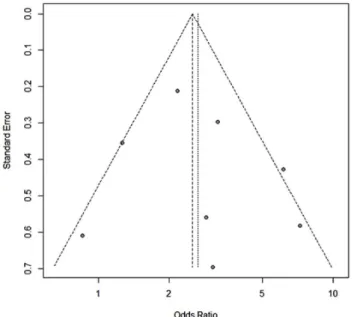
Fig. 4. Funnel plot of the study did not show publication bias.
2. CBD stone recurrence according to the CBD angula- tion
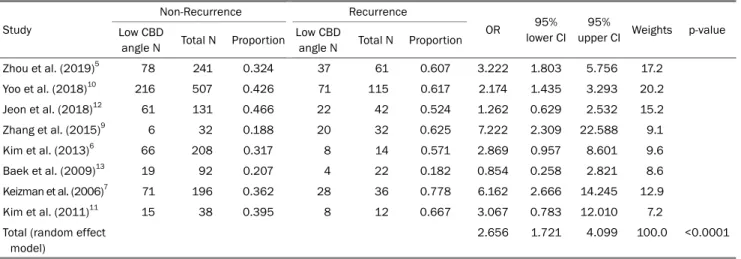
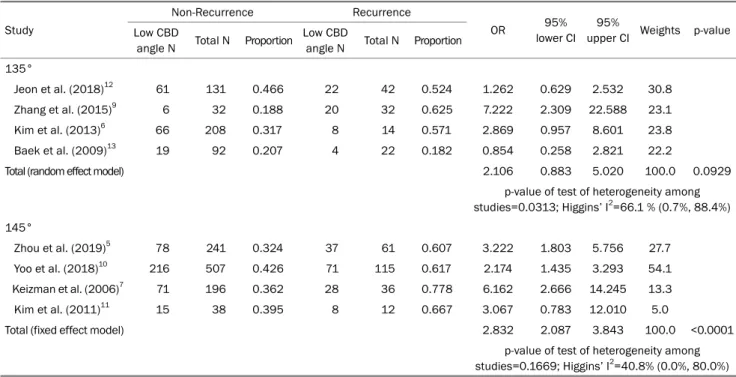
The pooled OR was 2.656 (95% CI 1.721-4.099, p<0.01), suggesting that patients with acute CBD angulation had a more than 2.6 times higher risk of disease recurrence than those without acute angulation (Table 2, Fig 3). Subgroup analysis for the studies that selected the criteria as 135°
also demonstrated a tendency for increased risk of a re- current CBD stone, but they failed to show statistical sig- nificance (OR 2.106, 95% CI 0.883-5.020, p=0.09) (Table 3).
3. CBD stone recurrence according to the type of stud- ies and measurements
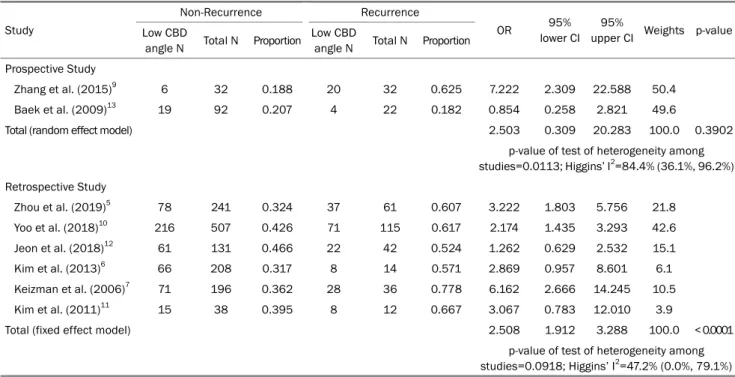
Among the eight studies, only two studies were prospective.
The prospective study and the retrospective study were div- ided and analyzed considering the potential bias of the re- search observer, but there was no significant difference in the prospective study (OR 2.503, 95% CI 0.309-20.283, p=0.39) (Table 4). The analysis was divided into ERCP and MRCP cases to determine if there was a difference according to the imaging test that measured the CBD angulation. Both sub-analyses were statistically significant (Table 5).
4. Publication bias
The funnel plot analysis (Fig. 4) was symmetrical overall, demonstrating no significant publication bias (p=0.9765).
DISCUSSION
This systematic review and meta-analysis of the clinical im- pact of CBD angulation in the recurrence of CBD stone in- cluded eight studies with 1,776 patients. The study results showed that the CBD angle ≤ 145˚ was significantly associated with an increased risk of recurrent CBD stone (OR=2.656, p< 0.01), even though it appeared to be irrelevant in cases of CBD angle ≤ 135˚ (OR=2.106, p=0.0929)
The biological mechanism for the recurrence of CBD stone on acute CBD angulation is not completely understood.
Although the precise mechanism is not known, Keizman et al.7,8 suggested that angulation along the course of the CBD promotes bile stasis, making it a risk factor for stone for- mation, and recurrent cholangitis after successful endoscopic therapy. Moreover, Charing et al. described the relationship between sharp RHD angulation (≤ 125˚) and acute CBD angu- lation (≤ 130˚) with recurrent cholangitis through unidentified mechanisms.14 Therefore, further studies will be needed to clarify the mechanism that may explain the increased risk of CBD stone recurrence among acute CBD angulation.
The present systematic review and meta-analysis had some limitations. First, the outcomes of the analysis can be con- troversial because there were only eight articles on the associa- tion of CBD stone recurrence and acute CBD angulation.
Second, except for Keizman’s study, seven observational stud- ies were conducted in South Korea and China. Unlike western countries, the incidence of primary biliary stones in Asian coun- tries can be relatively high compared to the number of secon- dary CBD stones derived from the gallbladder.15 Therefore, it is difficult to exclude a high proportion of CBD stone recur- rences in the Asian population regardless of smaller CBD angu- lation (≤ 145˚). Relevant studies of the western population will be needed to increase the reliability of the conclusion. Third, the cutoff values for the acute CBD angle and detailed proto- cols of each included study are not the same, making it difficult to generalize the result due to the increased heterogeneity of the meta-analysis. On the other hand, subgroup analysis was conducted for studies using the respective standards (135° or 145°) to reduce the unexpected effects on the results. Similar patterns were observed for the increased risk of CBD recurrence in both groups. Lastly, publication bias is likely, because all six studies were retrospective. Although no evidence of this bias was found by examining the statistical
tests or funnel plots used, residual confounding factors may influence the results. The study results can be verified through further large-scale, well-organized randomized controlled trials, accompanying regional and racial diversity. Despite the above limitations, this study is meaningful in that it is the first meta-analysis of observational studies to analyze the impact of acute CBD angulation on CBD stone recurrence.
In conclusion, approximately 20% of patients with CBD stones had a recurrence after the complete clearing of the CBD stone, and a CBD angle ≤ 145˚ could increase the risk of recurrence. Therefore, MRCP surveillance of this group of patients can reduce the morbidity and mortality associated with CBD recurrence and cholangitis.
REFERENCES
1. Boerma D, Rauws EA, Keulemans YC, et al. Wait-and-see policy or laparoscopic cholecystectomy after endoscopic sphincter- otomy for bile-duct stones: a randomised trial. Lancet 2002;
360:761-765.
2. Song ME, Chung MJ, Lee DJ, et al. Cholecystectomy for pre- vention of recurrence after endoscopic clearance of bile duct stones in Korea. Yonsei Med J 2016;57:132-137.
3. Prat F, Malak NA, Pelletier G, et al. Biliary symptoms and compli- cations more than 8 years after endoscopic sphincterotomy for choledocholithiasis. Gastroenterology 1996;110:894-899.
4. Oak JH, Paik CN, Chung WC, Lee KM, Yang JM. Risk factors for recurrence of symptomatic common bile duct stones after cholecystectomy. Gastroenterol Res Pract 2012;2012:417821.
5. Zhou XD, Chen QF, Zhang YY, et al. Outcomes of endoscopic sphincterotomy vs open choledochotomy for common bile duct stones. World J Gastroenterol 2019;25:485-497.
6. Kim KY, Han J, Kim HG, et al. Late complications and stone re- currence rates after bile duct stone removal by endoscopic sphincterotomy and large balloon dilation are similar to those after endoscopic sphincterotomy alone. Clin Endosc 2013;46:
637-642.
7. Keizman D, Shalom MI, Konikoff FM. An angulated common bile duct predisposes to recurrent symptomatic bile duct stones after endoscopic stone extraction. Surg Endosc 2006;
20:1594-1599.
8. Keizman D, Ish Shalom M, Konikoff FM. Recurrent symptomatic common bile duct stones after endoscopic stone extraction in elderly patients. Gastrointest Endosc 2006;64:60-65.
9. Zhang R, Luo H, Pan Y, et al. Rate of duodenal-biliary reflux increases in patients with recurrent common bile duct stones:
evidence from barium meal examination. Gastrointest Endosc 2015;82:660-665.
10. Yoo ES, Yoo BM, Kim JH, et al. Evaluation of risk factors for re- current primary common bile duct stone in patients with cholecystectomy. Scand J Gastroenterol 2018;53:466-470.
11. Kim JH, Kim YS, Kim DK, et al. Short-term clinical outcomes based on risk factors of recurrence after removing common bile duct stones with endoscopic papillary large balloon dilatation.
Clin Endosc 2011;44:123-128.
12. Jeon J, Lim SU, Park CH, Jun CH, Park SY, Rew JS. Restoration of common bile duct diameter within 2 weeks after endoscopic stone retraction is a preventive factor for stone recurrence.
Hepatobiliary Pancreat Dis Int 2018;17:251-256.
13. Baek YH, Kim HJ, Park JH, et al. Risk factors for recurrent bile duct stones after endoscopic clearance of common bile duct stones.
Korean J Gastroenterol 2009;54:36-41.
14. Chong CC, Chiu PW, Tan T, et al. Correlation of CBD/CHD angula- tion with recurrent cholangitis in patients treated with ERCP.
Endosc Int Open 2016;4:E62-E67.
15. Ando T, Tsuyuguchi T, Okugawa T, et al. Risk factors for recurrent bile duct stones after endoscopic papillotomy. Gut 2003;52:
116-121.