Fexofenadine-Induced Urticaria
Vol. 23, Suppl. 3, 2011 S329
Received February 14, 2011, Revised March 29, 2011, Accepted for publication April 6, 2011
Corresponding author: Hae Young Choi, M.D., Department of Dermatology, Ewha Womens University Mokdong Hospital, 911-1 Mok-dong, Yangcheon-gu, Seoul 158-710, Korea. Tel: 82-2-2650- 5259, Fax: 82-2-2652-6925, E-mail: [email protected]
This is an Open Access article distributed under the terms of the Creative Commons Attribution Non-Commercial License (http://
creativecommons.org/licenses/by-nc/3.0) which permits unrestricted non-commercial use, distribution, and reproduction in any medium, provided the original work is properly cited.
Ann Dermatol Vol. 23, Suppl. 3, 2011 http://dx.doi.org/10.5021/ad.2011.23.S3.S329
CASE REPORT
Fexofenadine-Induced Urticaria
Sang Woo Lee, M.D., Ji Yeon Byun, M.D., You Won Choi, M.D., Ki Bum Myung, M.D., Hae Young Choi, M.D.
Department of Dermatology, School of Medicine, Ewha Womans University, Seoul, Korea
Fexofenadine (AllegraⓇ 180) is a second-generation anti- histamine. It is widely used as anti-allergic drug, which suppresses various allergic reactions mediated by hista- mines. A few cases of H1-antihistamine-induced urticaria have been reported. Herein, we report a rare case of fexofenadine-induced urticaria which was confirmed by a prick test, oral provocation test, and flow cytometry assisted-basophil activation test. (Ann Dermatol 23(S3) S329
∼S332, 2011)
-Keywords-
Basophil degranulation test, Drug eruotion/etiology, Fexo- fenadine, Histamine H1 antagonist/adverse effects
INTRODUCTION
H1 antihistamines are widely used and probably most frequently used in allergic diseases. Topical application of antihistamines commonly leads to sensitization for patients;
however, skin reactions provoked by systemic admini- stration of antihistamines have been very rare1,2. Although the rate of urticaria induced by antihistamines has been rare, its relevance should not be ignored. To our know- ledge, only 16 cases of H1 antihistamine-induced urticaria have been reported in the literature2-13, and it has never been reported in Korea. Herein, we report a rare case of
fexofenadine-induced urticaria.
CASE REPORT
A 69-year-old man first visited at our dermatology depart- ment with a 10 month history of pruritic papules on his face and scalp in January 2009. With the diagnosis of allergic contact dermatitis, he had been receiving treat- ment with levocetirizine (XyzalⓇ) the previous week with no improvement. During the first three days of fexo- fenadine (Allegra 180Ⓡ) supplementation, he experienced episodes of itchy hives over his body about two hours after receiving 180 mg of fexofenadine in addition to 5 mg of levocetirizine. After ceasing the fexofenadine for two days, the symptoms disappeared; however, it recurred after rechallenging with the same drugs the next day.
Personal and family histories were not remarkable.
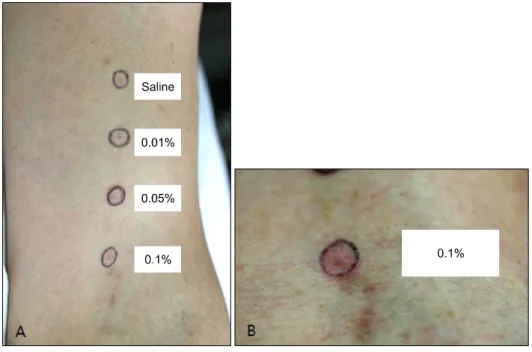
Dermatological examination revealed pruritic wheals over his body. He was treated with oral corticosteroids for three days and subsequently, levocetirizine was continued to control allergic contact dermatitis. No further wheals were observed. Three months later, prick tests with fexofenadine dilutions of 0.01%, 0.05% and 0.1%
(powder dissolved in 0.9% NaCl) were performed. After ten minutes, a wheal developed at the 0.1% fexofe- nadine site (Fig. 1). Patch tests with various classes of antihistamines including fexofenadine, terfenadine, and levocetirizine were carried out; however, but the results were all negative (powdered in petrolatum with concen- trations of 1%, 5%, and 10%, data are not shown).
To confirm the diagnosis, oral provocation tests were performed. Increasing doses were administered at 1-hour intervals starting with the half-dose. Urticarial eruptions developed over the body one hour after taking the total dose (180 mg) of fexofenadine (Fig. 2). Flow cytometry- assisted basophil activation test with the patient’s blood showed positive results (Fig. 3).
SW Lee, et al
S330 Ann Dermatol
Fig. 1. (A) A prick test was done on the forearm with saline as a negative control, and 0.01%, 0.05%, 0.1%
fexofenadine. (B) Fifteen minutes later, a wheal developed at the 0.1%
fexofenadine-provoked area.
Fig. 2. (A) Urticarial eruptions with itching sensation developed about 1 hour after provocation with a 180 mg dose of fexofenadine.
(B) Close-up view.
DISCUSSION
Fexofenadine is an active metabolite of terfenadine, and is a second generation antihistamine derived from piperi- dines. Adverse reactions to antihistamines have been rare, and second generation antihistamines are also more selective and less sedative. The most common adverse reactions related to fexofenadine have been headache, dizziness, daytime drowsiness, nausea, among others at a rate of more than 1%, and it has been very rarely reported to cause hypersensitivity14. Cutaneous lesions have been demonstrated to appear as urticaria; maculo-papular, morbilliform, and scarlatiniform eruptions; erythema multi- forme; photosensitivity; fixed eruptions; and anaphylactic shock1.
Sixteen cases of antihistamine-induced skin reaction in the form of urticaria have been reported in the literature (Table 1), with cetirizine being the most common causal drug, and diphenhydramine, prophenpyridamine, lora- tadine, mequitazine, levocetirizine, ebastine, bepotastine, hydroxyzine, olopatazine and dexchlorpheniramine also have been reported to cause urticarial reactions. Fexo- fenadine has been identified as the eliciting drug in three previous cases6,11,12.
In most cases of antihistamine-induced urticaria, oral pro- vocation test and prick tests were performed. Oral pro- vocation test results were positive in all cases; however, prick test results were positive in only five cases including our own2,4,9,13.
The mechanism of antihistamine-induced urticaria has
Fexofenadine-Induced Urticaria
Vol. 23, Suppl. 3, 2011 S331 Fig. 3. In the flow cytometry-assisted basophil activation test, 4.57% and 22.77% of basophils were activated in negative and positive controls, respectively (A, B). When a challenge with fexofenadine at 2.5 mg and 1.25 mg was done, 44.73% and 10.58% of basophils were activated, respectively (C, D). UL: upper left, UR: upper right, LL: lower left, LR: lower right.
Table 1. Reported cases of urticaria induced by antihistamines in English literature
References Age/Sex Clinical findings Causative drug Provocation
test Patch test Prick/intradermal/scratch test
Epstein (1949)3 36/F Urticaria, MP Diphenhydramine, ND + −
Prophenpyridamine
Stingeni et al. (1997)2 70/F Urticaria, MP Cetirizine ND + +
Barranco et al. (1998)4 42/F Urticaria, Diphenhydramine + − +
Anaphylaxis
Karamfilov et al. (1999)5 29/F Urticaria Cetirizine + − −
Demoly et al. (2000)6 57/F Urticaria Fexofenadine, Loratazine, + − −
Mequitazine Cetirizine
Calista et al. (2001)7 42/F Urticaria Cetirizine + ND −
Tella et al. (2002)8 32/F Urticaria Cetirizine + ND −
Schröter et al. (2002)9 36/F Urticaria Cetirizine + + +
Kränke and 33/F Urticaria Levocetirizine + ND −
Mayr-Kanhäuser (2005)10
Gonzälez de 30/F Urticaria Ebastine, + − −*
Olano et al. (2006)11 Loratadine Cetirizine,
Fexofenadine
Inomata et al. (2009)12 34/F Urticaria, Fexofenadine, + ND −
Anaphylaxis Bepotastine Loratadine, Ebastine Hydroxyzine, Cetirizine Olopatazine
Rodríquez del Río 36/M Urticaria Hydroxyzine + − ND
et al. (2009)13 20/F Urticaria Loratadine, Cetirizine + ND −
30/F Urticaria Dexchlorpheniramine, + ND −
Hydroxizine
57/M Urticaria Angioedem Mequitazine, + ND −
Ebastine
36/F Urticaria Hydroxyzine, +† − +
Levocetirizine Ebastine
Our case 69/M Urticaria Fexofenadine + − +
F: female, M: male, MP: maculo-papular eruption, ND: not done. *Positive reactions to several other antihistamines were observed on prick tests, but the results were negative to ebastine, loratadine, cetirizine and fexofenadine. †Positive reactions to dexchlo- rpheniramine, mizolastine, desloratadine, rupatadine and azelastine were observed in the provocation tests, but these drugs were negative on prick tests.
SW Lee, et al
S332 Ann Dermatol
remained controversial. In some reported cases, it has been noted as a type I IgE-mediated hypersensitivity reac- tion because of a suggestive clinical history and positive reaction on prick and intradermal tests4,12,13. In contrast, other reports have shown negative results to prick tests with the causative drugs, suggesting a non-immunologic reaction. Possible mechanisms include a Type IV hyper- sensitivity reaction, non-specific mast cell degranulation or activation of the alternative pathway of the complement system7, or an intolerance reaction9,10.
The basophil activation test is a functional in vitro test that has been used to investigate the cause of allergic reac- tions. Basophils are now considered equivalent to tissue mast cells since they play, by themselves, a pivotal role in the immediate allergic reaction. Specific population of cells can be identified by flow cytometry, which is a reliable tool for monitoring basophil activation upon allergen challenge by detecting surface expression of degranulation/
activation markers, most commonly CD63 and CD203c.
The flow cytometry-assisted basophil activation test has become a standard tool for in vitro diagnosis of immediate allergy15.
In our patient, a commercialized Flow-CAST kitⓇ (Buehlmann laboratories AG, Schoenenbuch, Switzerland) was used with fexofenadine at 1.25 mg, 2.5 mg and with stimula- tion buffer and anti-IgE receptor antibody acting as negative and positive controls, respectively. Peripheral blood leukocytes were isolated from patient’s whole blood samples and primed with stimulation buffer con- taining interleukin 3. Fexofenadine 1.25 mg and 2.5 mg were added and the cells were incubated to mimic the in vivo situation where specific IgE bind to the cellular surface, are bridged by the allergen, and activate intra- cellular enzymatic cascades leading to the activation of basophils. During the activation, intracellular compounds containing the transmembrane protein CD63 fuse to the cellular membrane and are expressed to the extracellular matrix. Activated basophil levels of fexofenadine-stimulated samples were 44.73% and 10.58% (fexofenadine 2.5 mg and 1.25 mg respectively) in our patient, which was higher than the negative control (4.57) and therefore, the test was positive to fexofenadine (Fig. 3).
Herein, we report an interesting case of urticarial reaction due to fexofenadine. The precise mechanism of urticaria induced by antihistamines has not yet been elucidated. In our case, urticarial eruptions developed one hour after taking fexofenadine prick test, oral provocation test with fexofenadine, and the basophil activation test showed
positive results and thus, an underlying immune mecha- nism cannot be ruled out. Although the allergy tests could not distinguish the precise mechanism of the reactions, they did demonstrate the causal drugs and allowed for the discovery of a well-tolerated drug of the same class.
Physicians must be aware that, occasionally, drugs used in treatment act as the causal agent themselves.
REFERENCES
1. Lew BL, Haw CR, Lee MH. Cutaneous drug eruption from cetirizine and hydroxyzine. J Am Acad Dermatol 2004;50:
953-956.
2. Stingeni L, Caraffini S, Agostinelli D, Ricci F, Lisi P. Maculo- papular and urticarial eruption from cetirizine. Contact Dermatitis 1997;37:249-250.
3. Epstein E. Dermatitis due to antihistaminic agents. J Invest Dermatol 1949;12:151.
4. Barranco P, López-Serrano MC, Moreno-Ancillo A. Anaphy- lactic reaction due to diphenhydramine. Allergy 1998;53:
814.
5. Karamfilov T, Wilmer A, Hipler UC, Wollina U. Cetirizine- induced urticarial reaction. Br J Dermatol 1999;140:979- 980.
6. Demoly P, Messaad D, Benahmed S, Sahla H, Bousquet J.
Hypersensitivity to H1-antihistamines. Allergy 2000;55:679- 680.
7. Calista D, Schianchi S, Morri M. Urticaria induced by cetirizine. Br J Dermatol 2001;144:196.
8. Tella R, Gaig P, Bartra J, Garcia-Ortega P. Urticaria to cetirizine. J Investig Allergol Clin Immunol 2002;12:136- 137.
9. Schröter S, Damveld B, Marsch WC. Urticarial intolerance reaction to cetirizine. Clin Exp Dermatol 2002;27:185-187.
10. Kränke B, Mayr-Kanhäuser S. Urticarial reaction to the antihistamine levocetirizine dihydrochloride. Dermatology 2005;210:246-247.
11. González de Olano D, Roán Roán J, de la Hoz Caballer B, Cuevas Agustín M, Hinojosa Macías M. Urticaria induced by antihistamines. J Investig Allergol Clin Immunol 2006;16:
144-146.
12. Inomata N, Tatewaki S, Ikezawa Z. Multiple H1-antihistamine- induced urticaria. J Dermatol 2009;36:224-227.
13. Rodríguez del Río P, González-Gutiérrez ML, Sánchez- López J, Nuñez-Acevedo B, Bartolomé Alvarez JM, Martínez- Cócera C. Urticaria caused by antihistamines: report of 5 cases. J Investig Allergol Clin Immunol 2009;19:317-320.
14. Markham A, Wagstaff AJ. Fexofenadine. Drugs 1998;55:269- 274.
15. Boumiza R, Debard AL, Monneret G. The basophil activa- tion test by flow cytometry: recent developments in clinical studies, standardization and emerging perspectives. Clin Mol Allergy 2005;3:9.