ICT-Based Comprehensive Health and Social-Needs Assessment System for
Supporting Person-Centered Community Care
Myonghwa Park1, Eun Jeong Choi1, Miri Jeong1, Nayoung Lee1, Minjung Kwak2, Mihyun Lee3, Eun-Chung Lim4, Haesung Nam5, Dongil Kim6, Hanwool Ku6, Bong Seok Yang2, Junsik Na7, Joong Shik Jang7, Ji Young Kim7, Wonpyo Lee8
1College of Nursing, Chungnam National University, Daejeon, Korea
2Research Institute of Nursing Science, Chungnam National University, Daejeon, Korea
3College of Nursing, Daejeon Health Institute of Technology, Daejeon, Korea
4Graduate School of Public Health, Seoul National University, Seoul, Korea
5Department of Preventive Medicine, School of Medicine, Chungnam National University, Daejeon, Korea
6Department of Computer Science and Engineering, Chungnam National University, Daejeon, Korea
7Mindlle Health Welfare Social Cooperation, Daejeon, Korea
8Social Economy Institute, Daejeon, Korea
Objectives: This study developed an information and communication technology (ICT)-based comprehensive health and so- cial-needs assessment (CHSNA) system based on the International Classification of Functioning, Disability, and Health (ICF) with the aim of enhancing person-centered community care for community residents and supporting healthcare profession- als and social workers who provide healthcare and social services in the community. Methods: Items related to a CHSNA tool were developed and mapped with ICF codes. Experts validated the CHSNA system design and process using the Delphi method, and a pilot test of the initial version of the system was conducted. Results: The following three steps of CHSNA were embedded in the system, which had a user-friendly screen and images: basic health assessment, life and activity assessment, and in-depth health assessment. The assessment results for the community residents were presented with visualized health profiles, including images, graphs, and an ICF model. Conclusions: The developed CHSNA system can be used by healthcare professionals, social workers, and community residents to evaluate the reasoning underlying health and social needs, to facil- itate the identification of more appropriate healthcare plans, and to guide community residents to receive the best healthcare services. A CHSNA system can improve the implementation of standardized terminology utilizing the ICF and the accuracy of needs assessments of community residents.
Keywords: Community Health Services, Needs Assessment, Information Technology, Patient-Centered Care, Decision Support Techniques
Healthc Inform Res. 2019 October;25(4):338-343.
https://doi.org/10.4258/hir.2019.25.4.338 pISSN 2093-3681 • eISSN 2093-369X
Submitted: June 20, 2019
Revised: 1st, September 6, 2019; 2nd, October 19, 2019 Accepted: October 19, 2019
Corresponding Author Eun Jeong Choi
College of Nursing, Chungnam National University, 266 Munhwa-ro, Jung-gu, Daejeon 35015, Korea. Tel: +82-42-580-8407, E-mail: non5427@naver.
com (https://orcid.org/0000-0001-9570-8340)
This is an Open Access article distributed under the terms of the Creative Commons Attribution Non-Commercial License (http://creativecommons.org/licenses/by-nc/4.0/) which permits unrestricted non-commercial use, distribution, and reproduction in any medium, provided the original work is properly cited.
ⓒ 2019 The Korean Society of Medical Informatics
I. Introduction
The duties associated with elderly care are changing from be- ing performed by the healthcare system to the elderly them- selves interacting with social networks [1,2]. Increasingly, the location of care provision is moving from the hospital to the community [3]. The government of Korea has addressed this situation at the national level by establishing a new para- digm for the healthcare delivery system, called ‘community care’. The community-care system provides community resi- dents with care services in the place where they have been living for their lifetime and provides them with appropriate residences, convalescence, care, and independent life so that they can still socialize with the members of their community [4].
The disabled and the elderly have unmet needs for health and social services [5], and allowing them to live in the com- munity means that their needs have to be met based on ap- propriate assessments. However, this is hindered by health- care professionals tending to focus on their medical needs, and social workers assessing mainly their social needs. This segmented approach results in community residents receiv- ing provider-centered care services weighted toward either healthcare or social services [6]. The use of a comprehensive health and social-needs assessment (CHSNA) system based on information and communication technology (ICT) and designed to help service providers and community residents can improve the efficiency of the care process by enabling more accurate determination of needs, the identification of more suitable care plans, and the implementation of the best health and social services.
A comprehensive assessment tool is required for the assess- ment of specific health and social needs. The comprehensive International Classification of Functioning, Disability, and Health (ICF) is not associated with particular health prob- lems or diseases, and it explains the related functioning per- spectives from multiple viewpoints at the body, individual,
and social levels [7]. Using this framework to design a CHS- NA tool represents an affordable way to evaluate the diverse needs of community residents. We therefore developed a CHSNA system based on ICT using the ICF framework with the aim of improving health and social-care services.
II. Case Descriptions
1. Process of CHSNA System Development
The available literature and guidelines were analyzed and used to identify the components of the CHSNA system de- veloped in this study. We only included articles published in peer-reviewed journals, guidelines, and government re- port written in English and Korean; therefore, conference proceedings, trial registries, theses, and dissertations were not involved. The publication date was limited to identify the recent relevant studies published since 2010. The initial search terms were ‘community care’, ‘integrated care’, and
‘aging in place’. The related terms were ‘visiting healthcare services’, ‘care management’, and ‘community health needs’.
The electronic databases used were PubMed/MEDLINE, CI- NAHL, Cochrane Library, Google Scholar, and the National Assembly Library of Korea. The studies included the general process of community care services, care management and visiting healthcare services, and the instruments used in as- sessing the needs of community residents. In addition, we conducted a needs analysis for the target users—community residents, healthcare professionals, and social workers—us- ing self-reported questionnaires and interview questions to determine the elements required in a comprehensive assess- ment system.
The CHSNA system aimed to utilize ICT to facilitate evalu- ations of the various needs of community residents and to improve the connection between healthcare and social ser- vices. The specific objectives were (1) to effectively enhance the assessment process with a user-friendly ICT design and (2) to allow community residents and healthcare profession-
Body function
and structures Activities Participation
Health condition (disorder or disease)
Environmental factors
Personal factors
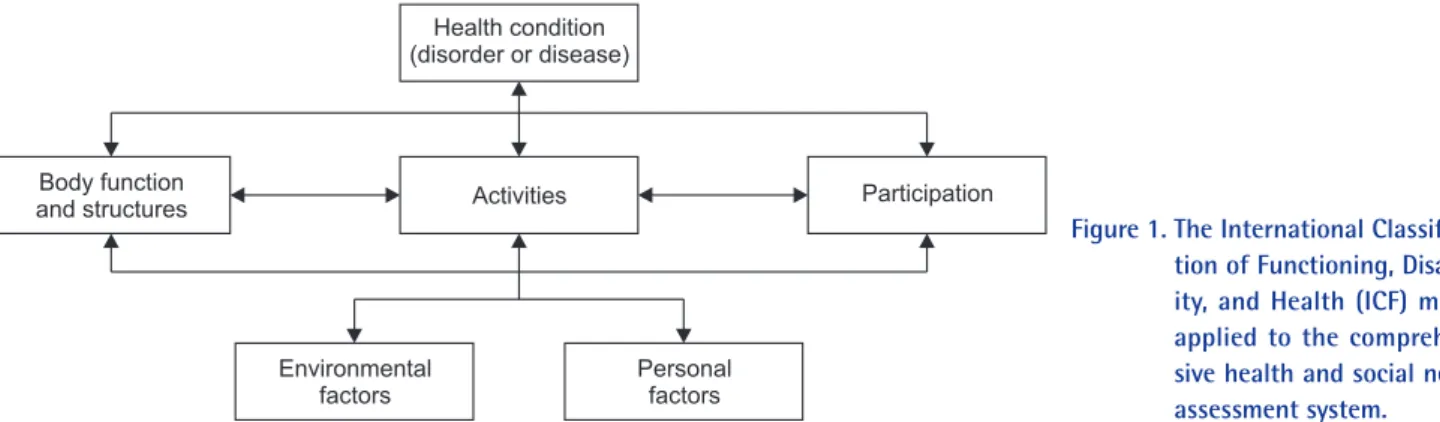
Figure 1. The International Classifica- tion of Functioning, Disabil- ity, and Health (ICF) model applied to the comprehen- sive health and social needs assessment system.
als or social workers to share decision-making when assess- ing various needs and selecting the appropriate services.
The CHSNA system was developed mainly based on the ICF, which has complex interactions among its components (Figure 1). The items of the CHSNA system include various officially used instruments: (1) the World Health Organiza- tion (WHO) Disability Assessment Schedule II [8] and its Korean version [9], which are useful assessment instruments developed by the WHO to assess health and disability lev- els across cultures; (2) impairment questions based on the Multi-Country Survey Study [10] and WHO world health surveys [11], which aimed to obtain a better understanding of various dimensions of health and health systems and ac- quire comparable data among countries [12]; (3) a care man- agement manual for Koreans; and (4) a community residents needs assessment for Koreans.
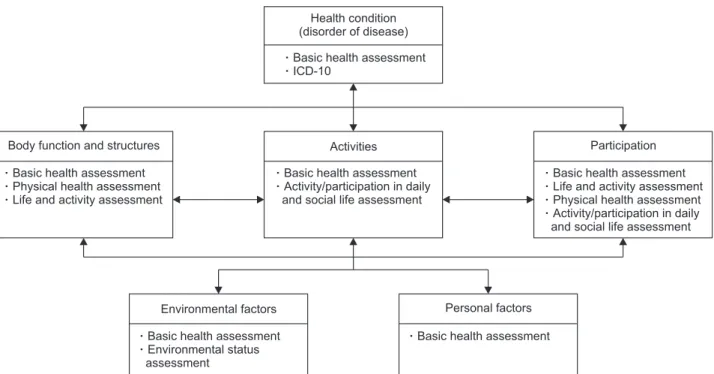
All items of the CHSNA system were mapped onto ICF components based on the available literature [13] and an expert consensus (Figure 2). Thirteen experts on medicine, nursing, public health, social welfare, and occupational therapy participated as the expert group. The algorithm of the CHSNA system was designed based on the care manage- ment of social workers and visiting healthcare services of the Ministry of Health and Welfare in Korea.
2. Implementation of CHSNA System
The initial version and final version of the system were test-
ed by experts from nursing, social work, public health, medi- cal engineering, computer science, and community residents in a city. They applied the system with PCs (laptop and desktops) and mobile devices (tablets and mobile phones).
Their opinions formed the basis for several improvements to the system. They evaluated the system usability and design, and offered their opinions. The Institutional Review Board of Chungnam National University approved this study (IRB No. 201809-SB-128-01). All participants provided written consent before the tests were initiated.
3. Features and Advantages of CHSNA System 1) CHSNA system based on the ICF framework
The interface of the developed CHSNA system included the following three assessment steps (Table 1). All items of CHSNA were mapped to ICF codes, and the assessment results were expressed as ICF codes and the ICF framework automatically.
All of the developed items were validated by experts us- ing the content validity index (CVI). The CVI values for the items ranged from 0.77 to 0.94. All items were mapped onto ICF codes, and the validity of the mapping was evaluated by experts.
2) Designing a user-centered CHSNA system
The CHSNA system presents user-friendly icons and images on the screen to help the users comprehend the meaning
Figure 2. The International Classification of Functioning, Disability, and Health (ICF) model application of the comprehensive health and social needs assessment system in this study.
Participation Basic health assessment Life and activity assessment Physical health assessment Activity/participation in daily and social life assessment Activities
Basic health assessment Activity/participation in daily and social life assessment Body function and structures
Basic health assessment Physical health assessment Life and activity assessment
Health condition (disorder of disease) Basic health assessment ICD-10
Personal factors Basic health assessment Environmental factors
Basic health assessment Environmental status assessment
of the items. For example, a life and activity assessment is performed while showing various images that indicate each activity. The scores on Likert scales are indicated with com- mon explanatory facial-expression icons. The health profiles are generated using text and also images, graphs, and an ICF model. This facilitates healthcare professionals, social work- ers, and community residents to share the assessment items and health profiles together through PC or mobile device screens.
3) Evaluation and improvement of the system
During a pretest of the first version of the system, the re- searchers noticed that the elderly participants experienced difficulties reading items on the screen, so this was ad- dressed by making the text and images larger. The research- ers also found that some words used in the system were difficult to understand for the general community residents, so this was addressed by inserting more rubrics to facilitate their understanding.
When the researchers implemented the pilot test of the fi-
nal version, the healthcare professionals and social workers stated that the new assessment system simplified the assess- ment process in comparison to previous paper-based assess- ment processes. The community residents reported that they found it very convenient to be able to check their health and social needs comprehensively using a mobile phone, tablet, or laptop. One of the best aspects of the system was that they could see the assessment results on the screen immediately after completing the assessment process. The three experts from medical engineering and computer science who evalu- ated the appropriateness of the algorithms used to imple- ment the CHSNA system considered the user interface, user experience, and system realization to be good.
III. Discussion
The CHSNA system was designed to evaluate the health- care and social needs of community residents based on us- ing an ICT-based system to help provide effective person- centered community care. We focused on making the system Table 1. Contents of the three assessment steps
Assessment step Contents
Basic health assessment Demographic information
Household information
Healthcare and social-welfare services
Health behavior information, such as smoking, drinking, exercise, and nutritive conditions
Basic health status, such as height, weight, blood pressure, blood sugar, and chronic illness
Disability and brace usage Care needs
Subjective health status Self-control in decision-making Life and activity assessment Activities of daily living
Instrumental activities of daily living Leisure activities and social activities In-depth health assessment
Physical health Impairment of physical health status, such as pain, discomfort, eyesight, hearing, and skin condition
Activity/participation in daily and social life Cognition Mobility Self-care
Getting along with people Life activities
Participation
Environmental status Housing and living environment
evidence-based, person-centered, and user-friendly during every step of its development and performed continuous evaluation to achieve this.
The researchers applied evidence-based knowledge by us- ing the official ICF classification of the WHO [14] and reli- able instruments. The assessment process using the CHSNA system and the obtained assessment results should enable healthcare professionals and social workers to implement evidence-based practice for community residents.
The researchers also included person-centered care (PCC) in the CHSNA system. The healthcare professionals, social workers, and community residents collaborated while as- sessing the needs of the community residents and planning care management by sharing the PC or mobile device screen.
This will help to improve the quality of decision-making based on the preferences and values of community residents.
The CHSNA system has a user-friendly design. Based on self-reported questionnaires and focus-group interviews, the demands of the target users could be applied to the overall system design. The evidence for the successful design came from the target users providing positive feedback after they experienced using the system.
In conclusion, the CHSNA system is the first system devel- oped using the ICF framework and based on ICT in Korea to help community residents, healthcare professionals, and social workers become involved in person-centered commu- nity care. This will help community residents comprehend their own unmet needs and participate in designing their own care plans with support from healthcare professionals and social workers.
Conflict of Interest
No potential conflict of interest relevant to this article was reported.
Acknowledgments
This work was supported by Community Business Develop- ment Program through the Korea Institute for Advanced of Technology (KIAT) funded by the Ministry of Trade, Indus- try, and Energy (No. P0004335).
ORCID
Myonghwa Park (http://orcid.org/0000-0002-0329-0010) Eun Jeong Choi (http://orcid.org/0000-0001-9570-8340) Miri Jeong (http://orcid.org/0000-0002-3334-4200)
Nayoung Lee (http://orcid.org/0000-0003-2577-0004) Minjung Kwak (http://orcid.org/0000-0002-3853-4716) Mihyun Lee (http://orcid.org/0000-0001-5700-3534) Eun-Chung Lim (http://orcid.org/0000-0002-1352-5434) Haesung Nam (http://orcid.org/0000-0003-0911-4576) Dongil Kim (http://orcid.org/0000-0001-7425-7579) Hanwool Ku (http://orcid.org/0000-0002-2668-7758) Bong Seok Yang (http://orcid.org/0000-0003-4739-6738) Junsik Na (http://orcid.org/0000-0002-3505-5779) Joong Shik Jang (http://orcid.org/0000-0003-2791-880X) Ji Young Kim (http://orcid.org/0000-0002-7104-0355) Wonpyo Lee (http://orcid.org/0000-0003-3525-4011)
References
1. Organisation for Economic Cooperation and Develop- ment. Health at a glance 2011: OECD indicators. Paris, France: OECD Publishing; 2011.
2. Willard S, Cremers G, Man YP, van Rossum E, Spreeu- wenberg M, de Witte L. Development and testing of an online community care platform for frail older adults in the Netherlands: a user-centred design. BMC Geriatr 2018;18(1):87.
3. De Vliegher K, Aertgeerts B, Declercq A, Milisen K, Ser- meus W, Moons P. Shifting care from hospital to home:
a qualitative study. Primary Health Care, 2015;25(9):26- 33.
4. Ministry of Health and Welfare. Implementation of social services (community care) based on the com- munity [Internet]. Sejong, Korea: Ministry of Health and Welfare; 2018 [cited at 2019 Oct 15]. Available from: http://www.mohw.go.kr/react/al/sal0301vw.jsp?
PAR_MENU_ID=04&MENU_ID=0403&CONT_
SEQ=344177&page=1.
5. Vlachantoni A, Shaw R, Willis R, Evandrou M, Falk- ingham J, Luff R. Measuring unmet need for social care amongst older people. Popul Trends 2011;(145):56-72.
6. Jung Y, Ko S, Kim EJ. A study on the effective chronic disease management. Seoul: Korea Institute for Health and Social Affairs; 2013.
7. World Health Organization. How to use the ICF: a prac- tical manual for using the International Classification of Functioning, Disability and Health (ICF): exposure draft for comment. Geneva, Switzerland: World Health Organization; 2013.
8. Smith M, Epping-Jordan J. WHODAS II training man- ual: a guide to administration. Geneva, Switzerland:
World Health Organization; 2000.
9. Yun JS, Kim JM, Sin IS, Yang SJ, Jeong TG, Lee HY. De- velopment of Korean version of World Health Organiza- tion Disability Assessment Schedule II (WHODAS II-K) in community dwelling elders. J Korean Neuropsychiatr Assoc 2004;43(1):86-92.
10. Bedirhan Ustun T, Chatterji S, Villanueva M, Bendib L, Celik C, Sadana R, et al. WHO multi-country survey study on health and responsiveness. Geneva, Switzer- land: World Health Organization; 2001.
11. Ustun TB, Rehm J, Chatterji S, Saxena S, Trotter R, Room R, et al. Multiple-informant ranking of the dis- abling effects of different health conditions in 14 coun- tries. Lancet 1999;354(9173):111-5.
12. Bedirhan Ustun T, Chatterji S, Mechbal A, Murrey CJ;
WHS Collaborating Groups. The world health surveys.
In: Murrey CJ, Evans DB, editors. Health systems per- formance assessment: debates, methods and empiricism.
Geneva, Switzerland: World Health Organization; 2003.
p. 797-808.
13. Dernek B, Esmaeilzadeh S, Oral A. The utility of the In- ternational Classification of Functioning, Disability and Health checklist for evaluating disability in a commu- nity-dwelling geriatric population sample. Int J Rehabil Res 2015;38(2):144-55.
14. World Health Organization. International classification of functioning, disability and health: ICF. Geneva, Swit- zerland: World Health Organization; 2001.