• 검색 결과가 없습니다.

인두위턱 양성신경종양에 의한 반복실신

N/A
N/A
Protected

Academic year: 2021

Share "인두위턱 양성신경종양에 의한 반복실신"

Copied!
4
0
0

로드 중.... (전체 텍스트 보기)

전체 글

(1)

J Pain Auton Disord Vol. 4, No. 1 2015 20

Journal of Pain and Autonomic Disorders Vol. 4, No. 1, 2015

Received: April 22, 2015 / Revised: May 24, 2015 / Accepted: May 24, 2015 Address for correspondence: Suk Yun Kang, MD, PhD

Department of Neurology, Hallym University Dongtan Sacred Heart Hospital, Hallym University College of Medicine, 7 Keunjaebong-gil, Hwaseong 445-907, Korea

Tel: +82-31-8086-2310, Fax: +82-31-8086-2317, E-mail: [email protected] ISSN 2287-6170

Journal of Pain and Autonomic Disorders

CASE REPORT Vol. 4, No. 1, June 2015

인두위턱 양성신경종양에 의한 반복실신

한림대학교 의과대학 강동성심병원 신경과,

a

한림대학교 의과대학 동탄성심병원 신경과

안소현·최미송a·조수진a·김주용a·권기한a·강석윤a

Recurrent Syncope Due to a Benign Neurogenic Tumor in the Parapharyngeal Space

So Hyun Ahn, MD, Mi-Song Choi, MD

a

, Soo-Jin Cho, MD, PhD

a

, Joo Yong Kim, MD, PhD

a

, Ki-Han Kwon, MD

a

, Suk Yun Kang, MD, PhD

a

Department of Neurology, Hallym University Kangdong Sacred Heart Hospital, Hallym University College of Medicine, Seoul;

a

Department of Neurology, Hallym University Dongtan Sacred Heart Hospital, Hallym University College of Medicine, Hwaseong, Korea

ABSTRACT The syncope is a transient loss of consciousness due to global cerebral hypo-perfusion. There are a wide variety of etiologies, but syncope as a result of parapharyrngeal space tumor is rare. A 30-year-old woman is presenting recurrent syncope associated with black out of vision, nausea and headache. Brain magnetic resonance imaging revealed a neurogenic tumor in left parapharyngeal space with gadolinium enhancement.

This is a case report of parapharyngeal space tumor as a rare cause of recurrent syncope.

(J Pain Auton Disord 2015;4:20-23) KEYWORDS Syncope, Parapharyngeal space, Tumors

The syncope is a transient loss of consciousness with rapid onset, short duration and spontaneous recovery. The mechanism is global cerebral hypoperfusion, but the etiologies of syncope are very diverse.

1,2

The most common cause is vasovagal, and the second is cardiac syncope. Carotid sinus syncope and or- thostatic hypotension is rare cause of syncope in those under the age of 40 years.

2

Especially, recurrent syncope as a result of paraphayrngeal space tumor is very rare.

3

Here, we report a woman who presented with recurrent syncope as a result of

parapharyngeal space tumor.

Case Report

A 30-year-old woman visited our clinic with a complaint of recurrent syncope 3 months ago. Symptoms were black out of vision, nausea accompanied by headache, dyspnea and chest tightness. It happened suddenly while she was getting up. It was second attack, and first attack was 3 months ago. Her med-

J Pain Auton Disord

(2)

대한통증 ‧ 자율신경학회지 2015년 제4권 제1호 21 안소현 외 5인 ❙ 인두위턱 종양에 의한 반복실신

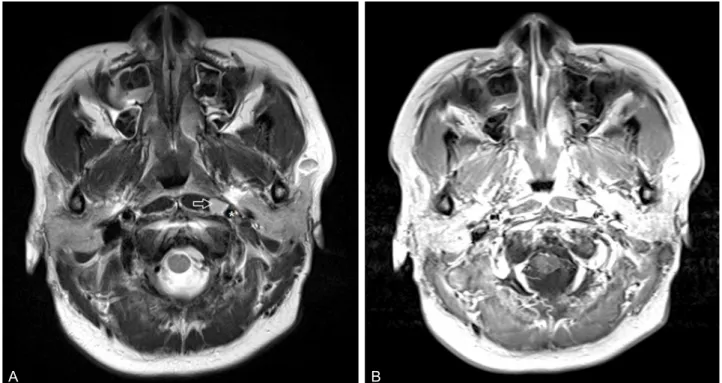
Figure 1. Her axial T2-weighted magnetic resonance (MR) image shows a well-marginated solid, cystic mass (open white arrow) in the left parapharyngeal space, about 1.3 cm sized, mildly compressed the left internal carotid artery (*) (A). Contrast-enhanced magnetic resonance imaging (MRI) was additionally performed two weeks later. Axial T1-weighted contrast-enhanced MRI shows ovoid homogenous enhancement noted in the left parapharyngeal space (B). These findings suggest benign neurogenic tumor.

ical history was unremarkable. She reported that she did not have syncope or dizziness before. She also denied previous palpitation. Her physical and neurological examinations in- cluding vital signs were normal. Her chest X-ray and labo- ratory test were unremarkable. Electrocardiography showed normal sinus rhythm without tachycardia.

Brain magnetic resonance imaging (MRI) revealed a well marginated round, solid, cystic mass in the left parapharyngeal space with gadolinium enhancement (Fig. 1). It was just close to the left internal carotid artery at the cervical portion. The ra- diologic diagnosis was a neurogenic tumor (i.e., schwanno- ma). The possibility of lymphadenitis was also suggested. On otolaryngology and neurosurgery consultation, observation was recommended and the surgical treatment was not consid- ered because of its benign nature and the difficulty in approach of the mass.

After four months, the follow-up Brain MRI showed the slightly decreased size of the cystic mass (Fig. 2). During the

4-month follow-up period, there was no recurrent attack. We recommended follow-up brain MRI after 6 to 8 months, but she did not visit our clinic thereafter.

Discussion

We describe a case with recurrent syncope possibly due to a neurogenic tumor in the parapharyngeal space. The brain MRI findings showed mild compression of the tumor to the left in- ternal carotid artery at the cervical portion. This compression might increase the abnormal sensitivity of the carotid sinus re- sponsible for recurrent syncope.

4

The reflex arc of the carotid sinus is consisted of an afferent pathway from baroreceptors located in the bifurcation of the carotid artery. When arterial wall is stretched, the information is transmitted by the carotid sinus nerve, a branch of the glossopharyngeal nerve, to the caudal nucleus of the solitary tract, and then, interneurons ac- tivate the efferent pathways to activate the parasympathetic

A B

(3)

J Pain Auton Disord Vol. 4, No. 1 2015 22

Journal of Pain and Autonomic Disorders Vol. 4, No. 1, 2015

Figure 2. Follow-up magnetic resonance (MR) images, axial T2-weighted (A) and T1-weighted contrastenhanced (B), after 4 months show slightly reduced tumor size of 1.1 cm (open white arrow) and less compressing effect on left internal carotid artery (*) in the left parapharyngeal space.

and to inhibit the sympathetic systems. This causes lower blood pressure and heart rate. Overstimulation of this reflex caused by mechanical traction or invasion of the carotid sinus by a tumor, or caused by irritation of the glossopharyngeal nerve may produce symptoms.

5

There are some reports about recurrent syncope with head and neck cancer tumors.

3-7

The symptoms and signs of the syncope were severe and the prognosis was poor, but our case was benign. We assume that it may be related to the nature of the tumor. Most previous cases were malignant tumor, where- as, in our case, it was benign neurogenic tumor.

There are some limitations in our case. The trigger of re- current syncope was not verified, because we did not carry out carotid massage or autonomic function test to check her car- diovagal function, i.e. head-up tilt study.

8

However, the tem- poral relationship between her syncope and the change of tu- mor size suggests that this neurogenic tumor may be respon- sible for her recurrent syncope. The pathology of the tumor was not identified, because of difficulty of surgical approach

and its benign course.

Recurrent syncope as an initial symptom of the para- pharyngeal space tumor is very rare, and may be difficult to diagnosis. High suspicion and close observation is important in case of recurrent syncope in young patients without past medical history. Comprehensive work-up may be helpful for etiological diagnosis.

REFERENCES

1. Lim YM, Lee SA, Kim DK, Kim GE. Aneurysm of the extracranial internal carotid artery presenting as the syndrome of glossophar- yngeal pain and syncope. J Neurol Neurosurg Psychiatry 2002;73:

87-88.

2. Saklani P, Krahn A, Klein G. Syncope. Circulation 2013;127:

1330-1339.

3. Nakahira M, Nakatani H, Takeda T. Syncope as a sign of occult ma- lignant recurrence in the retropharyngeal and parapharyngeal space: CT and MR imaging findings in four cases. AJNR Am J Neuroradiol 2002;23:1257-1260.

4. Cicogna R, Bonomi FG, Curnis A, Mascioli G, Bollati A, Visioli O, et al. Parapharyngeal space lesions syncope-syndrome. A newly pro- posed reflexogenic cardiovascular syndrome. Eur Heart J 1993;14:

A B

(4)

대한통증 ‧ 자율신경학회지 2015년 제4권 제1호 23 안소현 외 5인 ❙ 인두위턱 종양에 의한 반복실신

1476-1483.

5. Casini A, Tschanz E, Dietrich PY, Nendaz M. Recurrent syncope due to esophageal squamous cell carcinoma. Case Rep Oncol 2011;

4:433-438.

6. Sharma J, Dougherty AH. Recurrent syncope in a cancer patient: a case report and review of the literature. Cardiol Res Pract 2011;

2011:678237.

7. Wang H, Wang Y, Liu H, Cai L. Syncope associated with carotid si- nus syndrome in an occult nasopharyngeal carcinoma. Int J Cardiol 2015;186:236-238.

8. Low PA, Tomalia VA, Park KJ. Autonomic function tests: some

clinical applications. J Clin Neurol 2013;9:1-8.

수치

Figure 1. Her axial T2-weighted magnetic resonance (MR) image shows a well-marginated solid, cystic mass (open white arrow) in the left  parapharyngeal space, about 1.3 cm sized, mildly compressed the left internal carotid artery (*) (A)
Figure 2. Follow-up magnetic resonance (MR) images, axial T2-weighted (A) and T1-weighted contrastenhanced (B), after 4 months show  slightly reduced tumor size of 1.1 cm (open white arrow) and less compressing effect on left internal carotid artery (*) in

참조

관련 문서

Consequently, Zr-Cu binary alloys have the potential to be used as biomaterials with nullifying magnetic properties for magnetic resonance imaging diagnosis and

In this architectural design field, the space with new concept and organic space come into sight, escaping from the space concept in the geometric and

• Robert Krier, Stadtsraum in Theories und Praxis (Theory and Practice of Urban Space), 1975. • Urban space is defined as 'covering all types of space between buildings and

* When a symmetry operation has a locus, that is a point, or a line, or a plane that is left unchanged by the operation, this locus is referred to as the symmetry element..

~ a volume which is fixed in space and through whose boundary matter, mass, momentum, energy can flow. ~ The boundary of control volume is

A Study on the Evaluation of Space Recognition Space Recognition Space Recognition in the Space Recognition in the in the in the Concourse of Hospital using the

A retrospective analysis of invasive tumor percentages of GSS tumor samples showed that samples with high tumor content correlated well with FNAB samples

 Assuming the materials exist as a continuum, meaning the matter in the body is continuously distributed and fills the entire region of space it occupies..  A continuum is