https://doi.org/10.18325/jkmr.2017.27.2.39 Review Article
요추 추간판 탈출증에 대한 중국 내 도침 임상 연구의 현황 분석
전푸르메⋅류 연*⋅박지은†⋅정소영⋅한창현
한국한의학연구원 임상연구부, 정원당중의클리닉*, 한국한의학연구원 미병연구단†
The State of Clinical Trials on Acupotomy for Lumbar Disc Herniation in China
Purumea Jun, Master, Yan Liu, Ph.D.*, Ji-Eun Park, Ph.D.
†, So-Young Jung, B.Sc., Chang-Hyun Han, Ph.D.
Clinical Research Division, Korea Institute of Oriental Medicine, Beijing Zhengyuantang Chienese Medicine Clinic*, Mibyeong Research Center, Korea Institute of Oriental Medicine
†This study was supported by the project (K17780) of Korea Institute of Oriental Medicine.
RECEIVED March 22, 2017 REVISED April 5, 2017 ACCEPTED April 12, 2017
CORRESPONDING TO
Chang-Hyun Han, Clinical Research Division, Korea Institute of Oriental Medicine, 1672 Yuseongdae-ro, Yuseong-gu, Daejeon 34054, Korea
TEL (042) 868-9498 FAX (042) 863-9463 E-mail [email protected]
Copyright © 2017 The Society of Korean Medicine Rehabilitation
Objectives This study aimed to search the Chinese literature on acupotomy for lumbar disc herniation and to analyze their methodologies.
Methods Using 4 Chinese databases (CBM [www.sinomed.ac.cn], CNKI [www.cnki.net], WANFANG [www.wanfangdata.com], and WEIPU [www.cqvip.com]), we searched for clin- ical trials conducted in China over the past 10 years on acupotomy for lumbar disc herniation. The search terms used were “(腰椎椎間板脫出症 or 椎間板脫出症 or 椎間板脫出) and (针刀or 针刀松解术)” and we selected only meta-analyses that were published before December 2016. From among these meta-analyses, we excluded duplicates and selected the remaining 36 randomized controlled trials (RCTs) for our final analysis.
Results The largest numbers of acupotomy papers were published in 2008 and 2013 (8 papers each). The average number of subjects was 120; the most common treatment method used for the control group was standard acupuncture (in 11 papers), and the most common concurrent treatment in the treatment group was massage (in 10 papers). The most common site of needle insertion was between the spinous processes, or at less than 0.5 cm on either side of the spinous processes (in 24 papers). The most common site of adhesion lysis was at the transverse process (in 24 papers). Two studies were blinded, and the mean Jadad score was 1.17.
Conclusions A large number of RCTs on the use of acupotomy for lumbar disc hernia- tion are conducted every year in China, and the procedure has been shown to be very ef- fective, with few adverse effects. However, the average quality of the studies was not very high. Based on our study, we expect several high-quality clinical trials on acupotomy to be conducted in Korea in the future. (J Korean Med Rehabil 2017;27(2):39-54)
Key words Acupotomy, Herniation of lumbar disk, Clinical trial, Traditional Chinese medicine
서론»»»
요추 추간판 탈출증은 임상에서 흔히 볼 수 있는 요통
의 주요한 질병 중 하나이며 추간판의 퇴행성 변화에 의 한 약해진 섬유륜의 파열로 수핵의 일부 혹은 전체가 탈 출을 일으켜 척수의 경막이나 신경근을 압박하여 신경 증
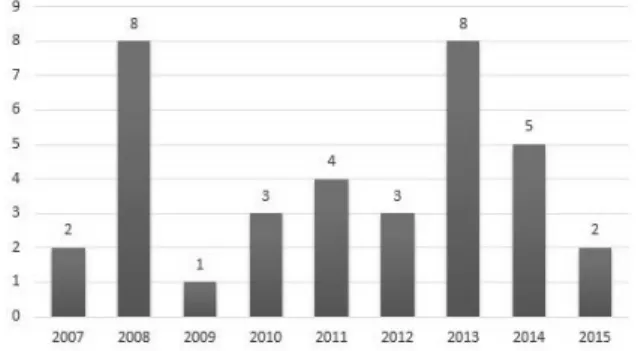
Fig. 1. Number of papers published for RCTs of acupotomy.
상을 유발하는 질환을 말한다1). 추간판의 탈출 정도에 따 라 4가지 형태로 나뉘는데, 섬유륜이 밀려나 수핵이 정상 범위에서 3 mm 이상 밖으로 벗어난 팽륜형(bulging disc)과 수핵이 외부로 탈출되려 하나 외측 섬유륜이 완 전히 파열되지 않은 돌출형(protruded disc), 수핵이 섬유 륜 밖으로 탈출하였으나 아직 수핵과 연결되어 있는 탈출 형(extruded disc), 완전히 벗어나 분리된 부골화형 (sequestrated disc)이 있다2).
일반적인 치료법에는 보전적 요법과 수술적 치료법 두 가지로 나눌 수 있는데, 보존적 치료요법으로 전체 환자 의 치료율이 80∼90%에 달한다고 보고되어 있으며3) 물 리치료, 견인치료, 근력운동, 침상안정 등과 같은 보존적 치료를 보편적으로 임상에 활용하고 있다.
한의학에서의 치료법에는 침구치료, 약물치료, 뜸치료, 추나요법과 같은 다양한 보존적 방법이 주를 이루며, 1976년 중국에서 처음 고안된 도침 시술요법4) 또한 요추 추간판 탈출증에 치료 조직의 유착을 박리하고 결절과 반 흔을 제거하여 막힌 기혈을 회복시켜 통증을 경감시키는 등의 기존의 보존적 요법에 수술요법을 병합한 치료법으 로 많은 관심을 받고 있다5).
국내에서도 도침 시술요법으로 요추 추간판 탈출증에 관한 연구가 보고되어 있으나 아직 그 수가 적고 추적 관 찰이 이루어지지 않아 임상에서의 추가적인 연구가 필요 한 실정이다.
이에 본 연구에서는 최근 중국에서 이루어지고 있는 연구들을 고찰하여 요추 추간판 탈출증에 대한 도침 치료 임상 연구에 대한 정보를 제공하며, 도침 치료의 실질적 으로 적용 가능한 임상적 근거를 제시하고자 한다.
대상 및 방법 »»»
본 연구는 중국의 데이터베이스 4건 CBM (www.
sinomed. ac.cn), CNKI (www.cnki.net), WANFANG (www.wanfangdata.com), WEIPU (www.cqvip.com)을 이용하여 최근 중국에서 진행된 요추 추간판 탈출증에 대 한 도침 치료 임상 연구 자료를 검색하였다.
논문 검색어는 주제어를 “(腰椎椎間板脫出症 or 椎間 板脫出症 or 椎間板脫出) and (针刀 or 针刀松解术)”으 로 하였으며 2016년 12월까지 발간된 최근 10년의 중국
어로 쓰인 메타분석 논문만을 선택하였다.
선택된 5편의 메타분석 논문6-10)은 무작위 대조군 연구 (Randomized Controlled Trial, RCT)만을 포함하여 분석 하였으며 비무작위 대조군 연구(non-randomized con- trolled trial) 및 사례연구(Case study)는 포함하지 않았 다. 59편의 RCT 논문 중 중복을 제외한 36편의 논문들을 본 연구 대상으로 선정하였다.
자료 추출 및 분석은 2명의 저자(전·류)에 의해 수행 되었으며, 추출된 논문의 전문을 읽고 자료를 분석하였다.
선정된 논문을 대상으로 발간 연도, 대상자 및 질환, 대조군 설정, 도침 치료 방법, 도침 시술 횟수, 병행 시술, 치료 및 관찰 기간, 평가도구, 치료 결과, 윤리적 승인 및 이상 반응 보고 등을 분석하고 평가하였다.
결과»»»
1. 일반적 연구 현황
1) 연도별 분석
중국 내 최근 10년간 저널에 등록된 요통 관련 도침 임상 연구 논문 중에서 메타분석 논문을 선별해 대상 연 구 중 중복을 제외한 36건의 RCT 논문이 최종 선정되었 다. 선정된 논문의 범위는 2007년도부터 2015년도까지였 으며 이중 2008년과 2013년에 각각 8편씩 가장 많은 논 문이 게재되었다(Fig. 1).
Treatment in control group Number of RCTs Concurrent treatment in treatment group Number of RCTs
Acupuncture 11 Massage therapy 10
Traction therapy 10 Injection therapy 3
Electro acupuncture 9 Traction therapy 3
Massage therapy 7 Electro acupuncture 3
Radio frequency therapy 3 Acupuncture 2
Chiropractic adjustments 2 Chiropractic adjustments 2
Injection therapy 2 Fire cupping therapy 2
Nerve block in intervertebral foramen 1 Nerve block in intervertebral foramen 1
Disc operative treatment 1 Chinese traditional medicine 1
Acupotomy 1 Hot compress therapy 1
Pseudo direct neurolysis 1 Radio frequency therapy 1
Chinese traditional medicine 1 Ozone therapy 1
Hot compress therapy 1
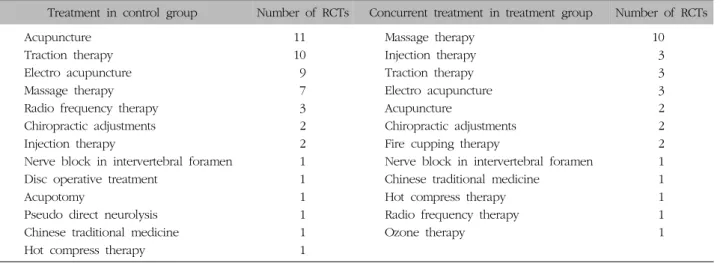
Table I. Treatment in Control Group and Concurrent Treatment in Treatment Group
2. 임상 연구 방법
1) 대상자
(1) 총 참여 환자 수
가장 많이 참여된 환자의 수는 312명이었고 가장 적은 참여 환자의 수는 50명이었다. 36편의 논문에서 대상자 수는 평균 120명으로 집계되었다.
(2) 연령 분포
대상 환자의 연령은 최소 18세, 최대 81세였다. 80세 이상의 고령층을 포함시키는 논문이 1편32)이었고 70세 이 상 80세 미만을 포함하는 논문이 14편이었으며 20세 미 만의 청소년층을 포함하는 논문이 4편20,26,27,53)
있었다. 나 이를 평균으로만 밝힌 논문은 3편35,37,47)이었고, 2편24,40)의 논문은 환자의 나이를 언급하지 않았다.
(3) 유병 기간
대상자의 유병 기간은 최단 하루에서 최장 24년의 기 간을 가졌다. 한 달 미만의 급성 요추 추간판 탈출증을 대상으로 한 논문은 1편36)이 있었고 6편24,30,40,46,49,51)
의 논 문은 유병 기간을 기술하지 않았다.
(4) 성별 분포
남녀의 성비는 남성의 수가 더 많은 논문이 27편, 여성 의 수가 더 많은 논문이 7편, 성별을 기술하지 않은 논문 이 2편24,40) 있었다. 34편의 논문 가운데 남성 평균은 약 70명이었고 여성 평균은 약 52명이었다.
2) 연구 설정 (1) 무작위 배정 방법
단순 무작위 배정 31편, 블록 무작위 배정 5편20,21,31,43,49,51)
으 로 대부분 배정 방법에 대한 자세한 설명은 기술하지 않았다.
(2) 대조군 설정
대조군에는 총 13가지의 다양한 치료 방법이 사용되었 다. 일반 침구 치료 11건, 전기침 치료 9건, 견인 치료 10 건, 마사지 7건, 고주파 치료 3건, 척추 지압술 2건, 약물 주사 2건, 온열 치료 1건, 도침 치료 1건, 가짜 도침 치료 1건, 중약 복용 1건, 추간공 신경차단술 1건, 추간판 절제 술 1건으로, 한 가지 치료법만 사용한 논문은 25편이고 두 가지 이상의 치료법을 병행한 논문이 11편이었다. 총 5가지의 치료법을 병행해 사용한 논문도 1건 있었다 (Table I).
(3) 병행 시술
20편의 논문에서 치료군에 도침 외의 병행 시술을 사 용하였다. 사용된 치료법에는 마사지가 10건으로 가장 많 았고 견인 치료 3건, 전기침 3건, 약물 주사 3건이 그 뒤 를 이었다. 그 밖에도 불부항 치료 2건, 침구 치료 2건, 척추 지압술 2건, 고주파 치료 1건, 중약 복용 1건, 추간 공 신경차단술 1건 및 오존 치료 1건이 있었다. 오존 치 료를 병행한 연구는 대조군을 도침 치료 하나로 설정하였 다(Table I).
(4) 맹검
맹검을 사용한 논문은 2편21,45)이 있었다. Mu JP는 임
Adhesion lysis sites Number of RCTs Needle insertion sites Number of RCTs Transverse process 24 Spinous process on both sides within 0.5 cm 24
Spinous process 17 Spinous process on both sides 1∼3 cm 14
Inferior articular process 9 Spinous process on both sides 3∼5 cm 10 Intervertebral foramen 7 Spinous process on both sides more than 5 cm 1
Lumbar articular capsule 6 Hip and lower limbs 11
Etc. 6 Transverse process 7
Etc. 4
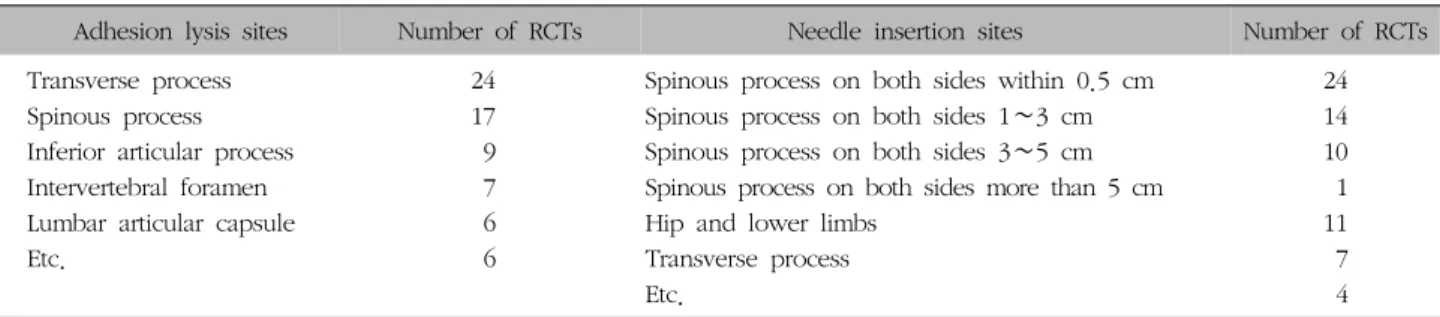
Table II. Adhesion Lysis Sites and Needle Insertion Sites
상 결과를 관찰, 기록하는 평가자를 눈가림 하였고 Tian HB는 연구대상 환자와 참여 의사의 눈가림이 이루어지는 양측 눈가림을 적용하였다.(5) 시술자
시술자에 대한 소개나 언급을 한 논문은 4편23,45,53,54)
이 었다. 소개된 내용은 시술자의 이름, 직종, 직위 및 전공 분야 등이 있었다.
(6) 임상시험심사위원회(institutional Review Board, IRB) 승인 및 환자 동의서 작성
전체 36건의 임상 연구 중에서 IRB의 승인 하에 임상 치료를 진행한 연구는 2건45,54)이었으며, 34건은 IRB 승인 여부에 대해서 기술하지 않아 확인할 수 없었다. 대상 환 자로부터 동의서를 받았다고 기술한 연구는 14건이었다.
3. 도침치료 방법
1) 사용 도구
가장 보편적으로 임상에 사용된 도구는 漢章 상표의 도침으로 11편 이었다. 그 밖에 華夏도침 2편40,42), SJ-L형 레이저 도침 1편21)이 있었고 상표를 언급하지 않고 호수 만 기재한 논문은 8편, 사용 도구를 기재하지 않은 논문 이 15편 있었다.
1∼2호 도침은 1건 사용되었고 2∼3호 도침 사용은 2 건, 3호 도침 사용은 6건, 3∼4호 도침 사용은 8건, 4호 도침 사용은 1건이며, 이 외에 사용 도침의 규격을 호수가 아닌 1.0 mm×50 mm라고 기재한 논문도 1건 있었다.
2) 마취
마취를 언급한 논문은 21편으로 시술 부위에 소독 후 국소마취를 시행하였다. 사용된 국소마취제는 리도카인 (lidocaine)으로 15편의 논문이 언급하였고 나머지는 기
술하지 않았다.
3) 치료 부위 (1) 자입 부위
도침 자입 부위는 극돌기 사이 혹은 극돌기 양측 0.5 cm 이하 24건, 1∼3 cm 14건, 3∼5 cm 10건, 5 cm 이상 1 건이 있으며, 둔부 및 하지 11건, 횡돌 부위 7건 이었다.
그 외에도 극돌기 옆 소관절 돌기 부근, 척추관 외부 입 구 부근, 천골 능선 정중앙 및 천골후면 부근 등의 부위 에 자입하기도 하였으며 혈자리에 자입하는 경우도 1건 있었다(Table II).
(2) 유착 제거 부위
가장 많이 선택된 곳은 횡돌기 부위로 총 24편의 논문 에서 기술하였고, 다음으로 많은 부위는 극돌기로 17편의 논문에서 유착 제거 시술 부위로 선택되었다. 하관절 부 위는 9편, 추간공 부위는 7편, 관절낭 십자형 절개는 6편 의 논문에서 기술하였으며 그 외에 좌골신경 출구, 종아 리 외측 또는 후측 근육 조직, 관절인대, 황인대, 골섬유 관, 천골 능선 정중앙 등의 부위에서 유착 제거를 시술하 였다. 또한 4편의 논문에서 유착 제거 부위에 대한 기술 을 하지 않았다(Table II).
4) 도침 사용 개수
한번 치료할 때 사용된 도침의 양은 6개 이하가 10편 이었고, 7개 이상은 1편23)이 있었으며 그 외에도 3∼8개 를 사용하거나 5∼15개를 사용하기도 하였다. 가장 적은 수의 사용된 도침은 1개였으며, 가장 많이 사용된 개수는 15개였다. 사용한 도침의 개수를 서술하지 않은 논문이 23편이었다.
First author (Year)
Randomization Blinding Description of
dropouts or withdrawals
Total Described as
randomized
Appropriate method
Inappropriate method
Described as double blind
Appropriate method
Inappropriate method
2007 Qu QW
20)1 1 0 0 0 0 0 2
2007 Mu JP
21)1 1 0 1 0 0 1 4
2008 Li M
22)1 0 −1 0 0 0 0 0
2008 Yang C
23)1 0 −1 0 0 0 0 0
2008 Wang XM
24)1 0 0 0 0 0 0 1
2008 Yao J
25)1 0 0 0 0 0 0 1
2008 Yin JQ
26)1 0 −1 0 0 0 0 0
2008 Wang QG
27)1 0 0 0 0 0 0 1
2008 Shi j
28)1 0 −1 0 0 0 0 0
2008 Li TF
29)1 0 0 0 0 0 0 1
2009 Li DP
30)1 0 0 0 0 0 0 1
2010 Qiu CM
31)1 1 0 0 0 0 1 3
2010 Dong H
32)1 0 0 0 0 0 0 1
2010 Wang JM
33)1 0 −1 0 0 0 0 0
2011 Wu CJ
34)1 0 0 0 0 0 0 1
2011 Tian ZQ
35)1 0 0 0 0 0 0 1
2011 Zhao GY
36)1 0 0 0 0 0 0 1
2011 Zhou JH
37)1 0 −1 0 0 0 0 0
2012 Meng GC
38)1 0 0 0 0 0 0 1
2012 Yang SB
39)1 0 0 0 0 0 0 1
2012 Quan K
40)1 1 0 0 0 0 0 2
2013 Xu YJ
41)1 0 0 0 0 0 0 1
2013 Zhang LY
42)1 0 0 0 0 0 0 1
2013 Du BF
43)1 1 0 0 0 0 0 2
2013 Song HW
44)0 0 0 0 0 0 0 0
2013 Tian HB
45)1 0 0 1 1 0 1 4
2013 Chen GY
46)1 0 0 0 0 0 0 1
2013 He WX
47)1 0 0 0 0 0 0 1
2013 Qiu ZA
48)1 0 0 0 0 0 0 1
2014 Ren KJ
49)1 1 0 0 0 0 1 3
2014 Dong DH
50)1 0 0 0 0 0 0 1
2014 Zhang XW
51)1 1 0 0 0 0 0 2
2014 Xia RF
52)1 0 0 0 0 0 0 1
2014 Zhang YM
53)1 0 0 0 0 0 0 1
2015 Chen GQ
54)1 0 0 0 0 0 0 1
2015 Liu LY
55)1 0 0 0 0 0 0 1
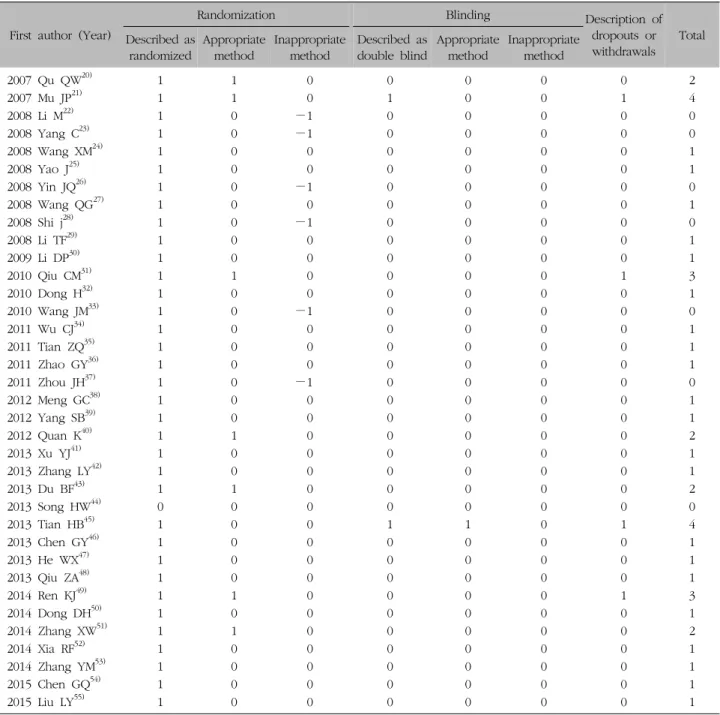
Table III. Quality Assessment for RCTs Using Jadad Scale
5) 도침 총 시술 횟수도침 시술 횟수는 최단 1회, 최다 10회로 평균적으로 4 회를 시술하는 것으로 나타났다. 3회 이하의 시술을 한 논문은 14편이었고, 4회 이상 7회 미만은 15편, 8회 이상 은 2편22,29)이었으며 시술 횟수를 기술하지 않은 논문은 5 편25,32,37,51,55)
이 있었다.
6) 치료 기간
치료 기간은 최단 열흘, 최장 3개월이었으며 평균 약 1 개월의 치료 기간을 가졌다. 2주 이하의 치료 기간을 가 지는 논문이 4편30,35,43,45)
, 2주 초과 1개월 이하의 치료 기 간을 가지는 논문이 22편, 1개월을 초과하는 논문이 6편 있었으며 치료 기간을 기술하지 않은 논문은 4편25,32,37,51)
이 있었다.
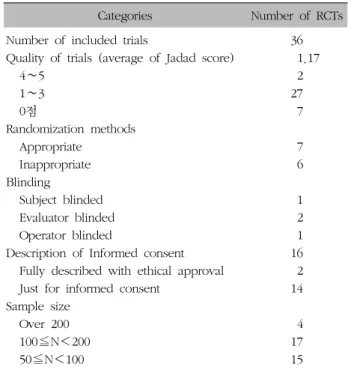
Categories Number of RCTs
Number of included trials 36
Quality of trials (average of Jadad score) 1.17
4∼5 2
1∼3 27
0점 7
Randomization methods
Appropriate 7
Inappropriate 6
Blinding
Subject blinded 1
Evaluator blinded 2
Operator blinded 1
Description of Informed consent 16 Fully described with ethical approval 2
Just for informed consent 14
Sample size
Over 200 4
100≦N<200 17
50≦N<100 15
Table IV. Summary of Methods in Included RCTs
4. 임상 연구 결과
1) 평가 도구
전체 36편의 논문 중 총 16종류의 평가 도구를 사용하 였는데, 가장 많이 쓰인 평가도구는 중의 병증 진단 치료 효과 표준 측정이 24편, VAS (Visual Analogue Scale) 측 정 6편, JOA (Japanese Orthopedic Association) 측정 3 편, PRI (Pain Rating Index) 측정 2편, PPI (Present Pain Intensit) 측정 2편, MUP (Motor Unit Potential), MacNab, RIS (The Rate of the Improved JOA Score), FRS (Faces Rating Scale), Oswestry, MPQ (McGill Pain Questionnaire), Qu LIDP 측정이 각각 1편씩 사용되었 다. 두 가지 이상 평가 도구를 사용한 논문은 9편이고, 사용된 평가 도구를 밝히지 않은 논문은 5편이었다.
2) 치료 결과
치료 결과로 35편의 논문이 치료군에서의 결과가 대조 군보다 높게 나왔으며, 단 1편27)의 논문에서 치료군의 도 침 치료 효과가 수술 치료와 같은 유효 효과를 보인다고 기술하였다.
3) 이상 반응
7편의 논문에서 이상 반응에 대한 보고를 하였는데, 그 중 3편의 논문이 몇 명의 이상 반응이 일어났다고 보고를 하였으며 나머지 4편의 논문은 이상 반응 환자는 없었다 고 기술하였다.
5. 연구 질 평가(Jadad Scale)
Jadad scale는 0점에서 4점까지의 분포를 가졌고 전체 36건 논문의 평균은 1.17점이었다(Table III, IV).
1) 무작위 배정
RCT 연구를 대상으로 하는 논문이기 때문에 기본적으 로 무작위 배정이 이루어졌지만 언급을 하지 않은 논문도 1편 있었다. 적절한 무작위 배정 사용이 언급된 논문은 7 편이며, 부적절한 방법을 사용한 논문은 6편이었다.
2) 맹검
맹검을 사용한 논문은 2편이었고, 평가자가 눈가림을
사용한 1편과 환자 및 시술자의 이중 눈가림을 사용한 1 편이 있었다.
3) 중도 탈락
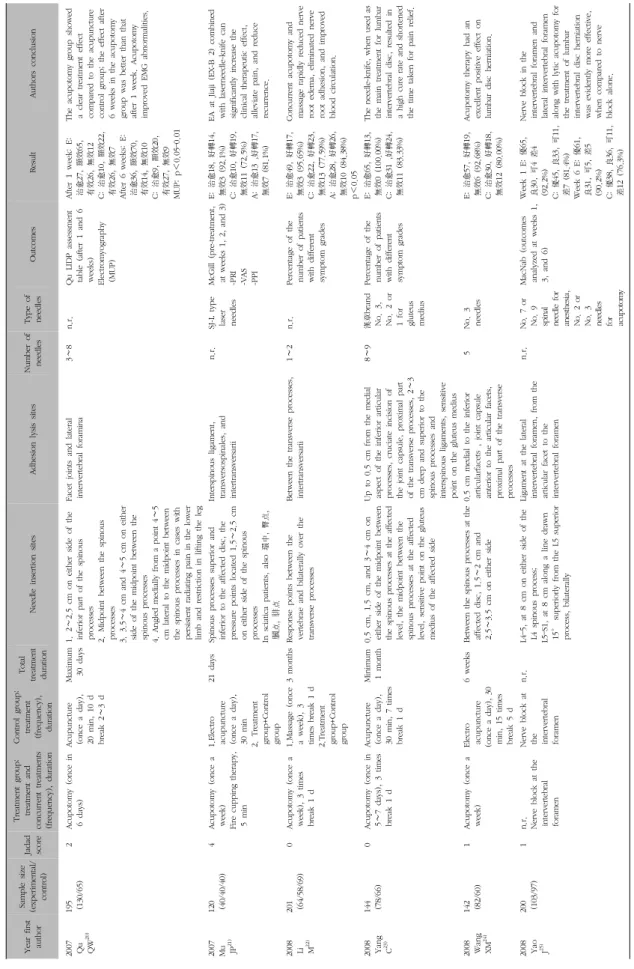
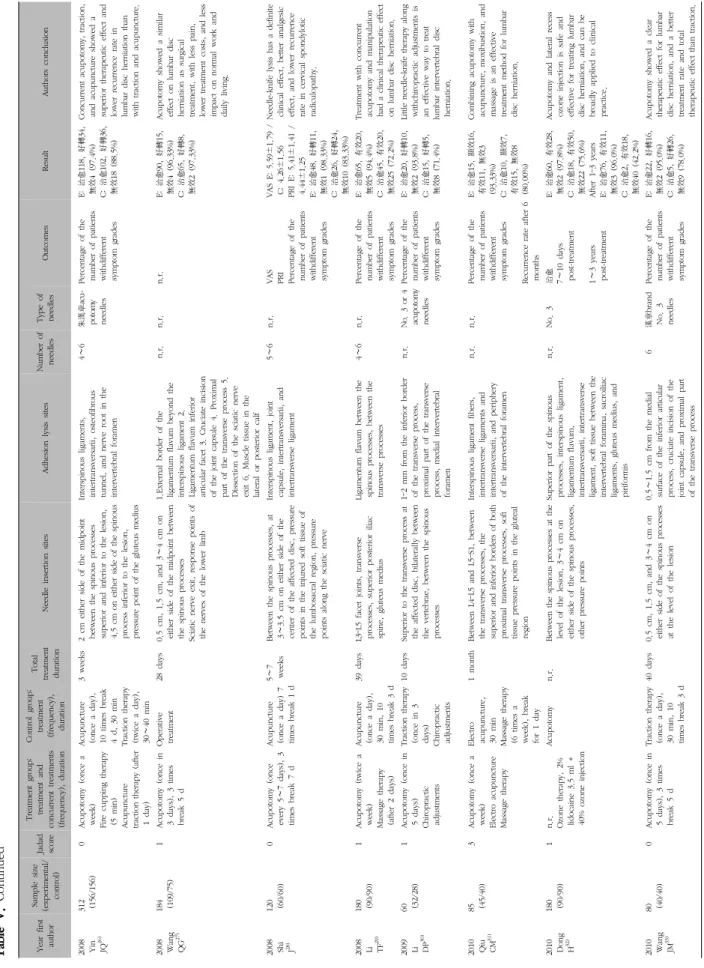
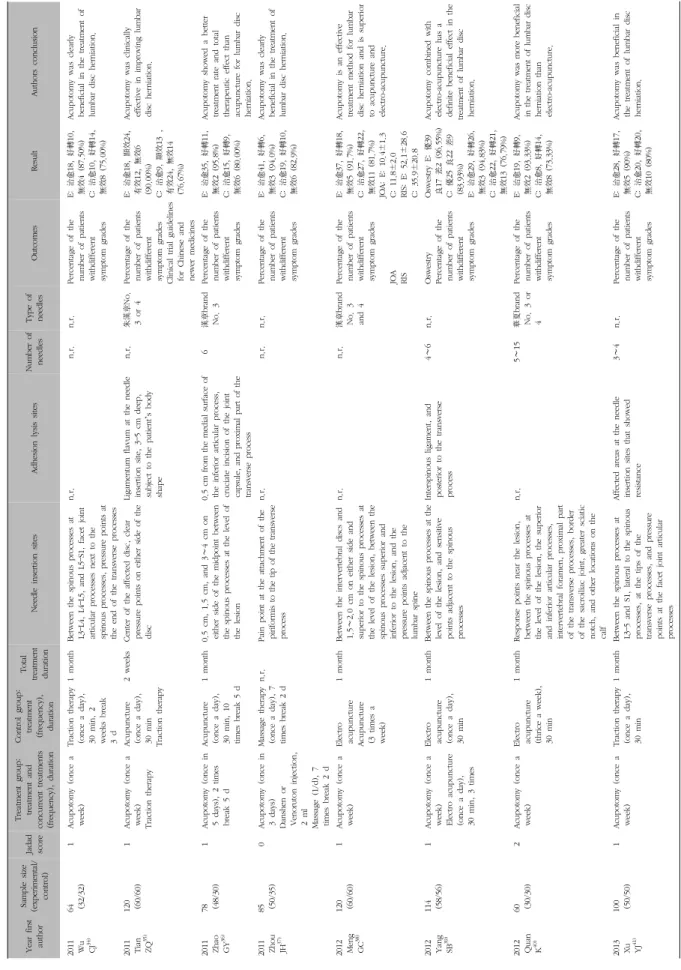
중도 탈락의 기술은 3편의 연구에서 되었고, 2편의 연 구는 추적 관찰 결과에서 전체 대상자의 n 수가 줄어들었 으나 그 이유에 대한 기술은 보이지 않았다. 탈락의 이유 에는 치료를 준수하지 않은 경우, 다른 치료를 병행한 경 우, 치료 효과를 판단할 수 없는 경우, 이상 반응이 나타 난 경우가 있었다(Table V).
고찰 »»»
요추 추간판 탈출증은 한의학의 腰痛에 해당되는데, 이 는 질환의 특징적인 용어가 아닌 허리에 나타나는 동통증 후군의 광범위한 표현으로 요추신경이 끝나는 제2요추 이하에서 천장골관절까지 기인하는 동통의 총칭이다1). 요 추는 운동범위가 넓고 근육이 특히 발달되어 있으며 다른 척추에 비해 체중을 지지할 때 보다 많은 긴장과 압박이 수반되어 동통 질환 가운데에서도 그 발생 빈도수가 매우 높다. 또한 그 원인과 증상이 복잡하고 다양하여 아직까
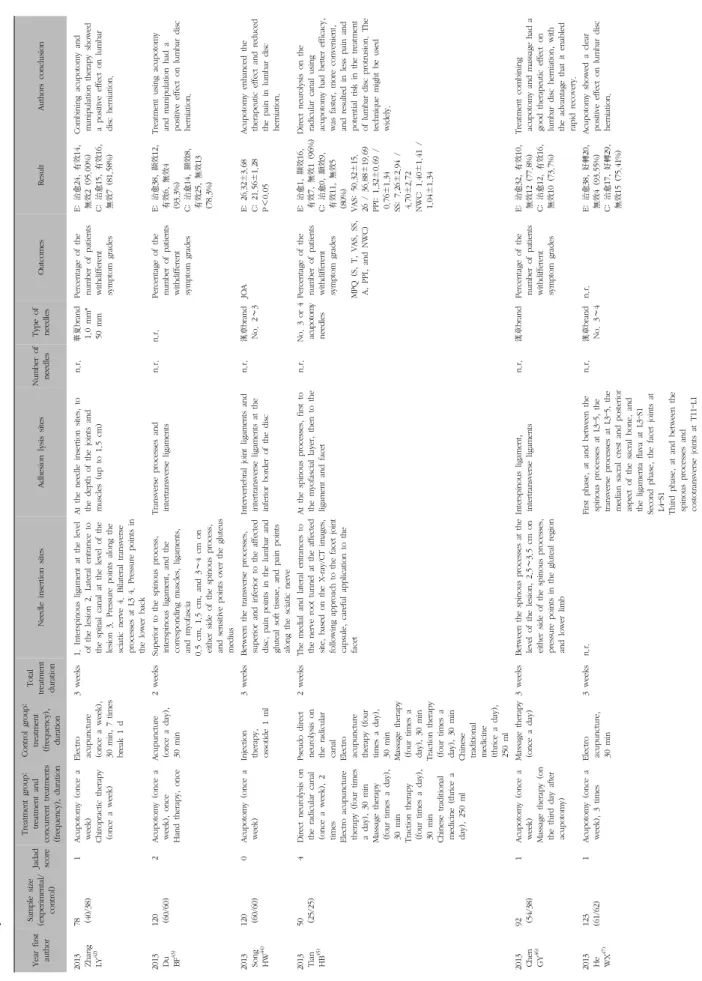
Year first author Sample size (experimental/ control)
Jadad score Treatment group: treatment and concurrent treatments (frequency), duration Control group: treatment (frequency), duration
Total treatment durationNeedle insertion sitesAdhesion lysis sitesNumber of needlesType of needlesOutcomesResultAuthors conclusion 2007 Qu QW20)
195 (130/65)2Acupotomy (once in 6 days)Acupuncture (once a day), 20 min, 10 d break 2∼3 d
Maximum 30 days1. 2∼2.5 cm on either side of the inferior part of the spinous processes 2. Midpoint between the spinous processes 3. 3.5∼4 cm and 4∼5 cm on either side of the midpoint between the spinous processes 4. Angled medially from a point 4∼5 cm lateral to the midpoint between the spinous processes in cases with persistent radiating pain in the lower limb and restriction in lifting the leg Facet joints and lateral intervertebral foramina3∼8n.r. Qu LIDP assessment table (after 1 and 6 weeks) Electromyography (MUP)
After 1 week: E: 治愈27, 顯效65, 有效26, 無效12 C: 治愈10, 顯效22, 有效26, 無效7 After 6 weeks: E: 治愈36, 顯效70, 有效14, 無效10 C: 治愈9, 顯效20, 有效27, 無效9 MUP: p<0.05–0.01
The acupotomy group showed a clear treatment effect compared to the acupuncture control group; the effect after 6 weeks in the acupotomy group was better than that after 1 week. Acupotomy improved EMG abnormalities. 2007 Mu JP21)
120 (40/40/40)4Acupotomy (once a week) Fire cupping therapy, 5 min 1.Electro acupuncture (once a day), 30 min 2. Treatment group+Control group 21 daysSpinous processes superior and inferior to the affected disc, the pressure points located 1.5∼2.5 cm on either side of the spinous processes In sciatica patients, also 環中, 臀点, 膕点,腓点 Interspinous ligament, transversospinales, and intertransversarii n.r.SJ-L type laser needles McGill (pre-treatment, at weeks 1, 2, and 3) -PRI -VAS -PPI E: 治愈18, 好轉14, 無效3 (92.1%) C: 治愈10, 好轉19, 無效11 (72.5%) A: 治愈13 ,好轉17, 無效7 (81.1%) EA at Jiaji (EX-B 2) combined with laserneedle-knife can significantly increase the clinical therapeutic effect, alleviate pain, and reduce recurrence. 2008 Li M22)
201 (64/58/69)0Acupotomy (once a week), 3 times break 1 d 1.Massage (once a week), 3 times break 1 d 2.Treatment group+Control group 3 monthsResponse points between the vertebrae and bilaterally over the transverse processes Between the transverse processes, intertransversarii1∼2n.r.Percentage of the number of patients with different symptom grades E: 治愈49, 好轉17, 無效3 (95.65%) C: 治愈22, 好轉23, 無效13 (77.59%) A: 治愈28, 好轉26, 無效10 (84.38%) p<0.05 Concurrent acupotomy and massage rapidly reduced nerve root edema, eliminated nerve root adhesion, and improved blood circulation. 2008 Yang C23)
144 (78/66)0Acupotomy (once in 5∼7 days), 3 times break 1 d Acupuncture (once a day), 30 min, 7 times break 1 d Minimum 1 month0.5 cm, 1.5 cm, and 3∼4 cm on either side of the midpoint between the spinous processes at the affected level, the midpoint between the spinous processes at the affected level, sensitive point on the gluteus medius of the affected side Up to 0.5 cm from the medial aspect of the inferior articular processes, cruciate incision of the joint capsule, proximal part of the transverse processes, 2∼3 cm deep and superior to the spinous processes and interspinous ligaments, sensitive point on the gluteus medius 8∼9漢章brand No. 3, No. 2 or 1 for gluteus medius Percentage of the number of patients with different symptom grades E: 治愈65, 好轉13, 無效0 (100.00%) C: 治愈31 ,好轉24, 無效11 (83.33%)
The needle-knife, when used as the main treatment for lumbar intervertebral disc, resulted in a high cure rate and shortened the time taken for pain relief. 2008 Wang XM24)
142 (82/60)1Acupotomy (once a week)Electro acupuncture (once a day), 30 min, 15 times break 5 d 6 weeksBetween the spinous processes at the affected disc, 1.5∼2 cm and 2.5∼3.5 cm on either side 0.5 cm medial to the inferior articularfacets , joint capsule anterior to the articular facets, proximal part of the transverse processes 5No. 3 needlesE: 治愈57, 好轉19, 無效6 (92.68%) C: 治愈30, 好轉18, 無效12 (80.00%) Acupotomy therapy had an excellent positive effect on lumbar disc herniation. 2008 Yao J25)
200 (103/97)1n.r. Nerve block at the intervertebral foramen Nerve block at the intervertebral foramen n.r.L4–5, at 8 cm on either side of the L4 spinous process; L5–S1, at 8 cm along a line drawn 15° superiorly from the L5 superior process, bilaterally Ligament at the lateral intervertebral foramen, from the articular facet to the intervertebral foramen
n.r.No. 7 or No. 9 spinal needle for anesthesia, No. 2 or No. 3 needles for acupotomy MacNab (outcomes analyzed at weeks 1, 3, and 6)
Week 1 E: 優65, 良30, 可4 差4 (92.2%) C: 優45, 良33, 可11, 差7 (81.4%) Week 6 E: 優61, 良31, 可5, 差5 (90.2%) C: 優38, 良36, 可11, 差12 (76.3%) Nerve block in the intervertebral foramen and lateral intervertebral foramen along with lytic acupotomy for the treatment of lumbar intervertebral disc herniation was evidently more effective, when compared to nerve block alone.
Ta bl e V. K ey D at a of RC Ts of L um ba r H er ni at ed Int er ver te br al D is c
Year first author Sample size (experimental/ control)
Jadad score Treatment group: treatment and concurrent treatments (frequency), duration Control group: treatment (frequency), duration
Total treatment durationNeedle insertion sitesAdhesion lysis sitesNumber of needlesType of needlesOutcomesResultAuthors conclusion 2008 Yin JQ26)
312 (156/156)0Acupotomy (once a week) Fire cupping therapy (5 min) Acupuncture traction therapy (after 1 day) Acupuncture (once a day), 10 times break 4 d, 30 min Traction therapy (twice a day), 30∼40 min 3 weeks2 cm either side of the midpoint between the spinous processes superior and inferior to the lesion, 4.5 cm on either side of the spinous process inferior to the lesion, pressure point of the gluteus medius Interspinous ligaments, intertransversarii, osteofibrous tunnel, and nerve root in the intervertebral foramen 4∼6朱漢章acu- potomy needles Percentage of the number of patients withdifferent symptom grades E: 治愈118, 好轉34, 無效4 (97.4%) C: 治愈102, 好轉36, 無效18 (88.5%)
Concurrent acupotomy, traction, and acupuncture showed a superior therapeutic effect and lower recurrence rate in lumbar disc herniation than with traction and acupuncture. 2008 Wang QG27)
184 (109/75)1Acupotomy (once in 3 days), 3 times break 5 d Operative treatment28 days0.5 cm, 1.5 cm, and 3∼4 cm on either side of the midpoint between the spinous processes Sciatic nerve exit, response points of the nerves of the lower limb
1.External border of the ligamentum flavum beyond the interspinous ligament 2. Ligamentum flavum inferior articular facet 3. Cruciate incision of the joint capsule 4. Proximal part of the transverse process 5. Dissection of the sciatic nerve exit 6. Muscle tissue in the lateral or posterior calf n.r.n.r.n.r.E: 治愈90, 好轉15, 無效4 (96.33%) C: 治愈65, 好轉8, 無效2 (97.33%)
Acupotomy showed a similar effect on lumbar disc herniation as surgical treatment, with less pain, lower treatment costs, and less impact on normal work and daily living. 2008 Shi J28)
120 (60/60)0Acupotomy (once every 5∼7 days), 3 times break 7 d Acupuncture (once a day) 7 times break 1 d 5∼7 weeksBetween the spinous processes, at 3∼3.5 cm on either side of the center of the affected disc, pressure points in the injured soft tissue of the lumbosacral region, pressure points along the sciatic nerve Interspinous ligament, joint capsule, intertransversarii, and intertransverse ligament 5∼6n.r.VAS PRI Percentage of the number of patients withdifferent symptom grades VAS E: 5.59±1.79 / C: 4.26±1.56 PRI E: 5.41±1.41 / 4.44±1.25 E: 治愈48, 好轉11, 無效1 (98.33%) C: 治愈26, 好轉24, 無效10 (83.33%) Needle-knife lysis has a definite clinical effect, better analgesic effect, and lower recurrence rate in cervical spondylotic radiculopathy. 2008 Li TF29)
180 (90/90)1Acupotomy (twice a week) Massage therapy (after 2 days) Acupuncture (once a day), 30 min, 10 times break 3 d 39 daysL3–L5 facet joints, transverse processes, superior posterior iliac spine, gluteus medius Ligamentum flavum between the spinous processes, between the transverse processes 4∼6n.r.Percentage of the number of patients withdifferent symptom grades E: 治愈65, 有效20, 無效5 (94.4%) C: 治愈45, 有效20, 無效25 (72.2%) Treatment with concurrent acupotomy and manipulation had a clinical therapeutic effect on lumbar disc herniation. 2009 Li DP30)
60 (32/28)1Acupotomy (once in 5 days) Chiropractic adjustments Traction therapy (once in 3 days) Chiropractic adjustments 10 daysSuperior to the transverse process at the affected disc, bilaterally between the vertebrae, between the spinous processes 1–2 mm from the inferior border of the transverse process, proximal part of the transverse process, medial intervertebral foramen n.r.No. 3 or 4 acupotomy needles Percentage of the number of patients withdifferent symptom grades E: 治愈20, 好轉10, 無效2 (93.8%) C: 治愈15, 好轉5, 無效8 (71.4%)
Little needle-knife therapy along withchiropractic adjustments is an effective way to treat lumbar intervertebral disc herniation. 2010 Qiu CM31)
85 (45/40)3Acupotomy (once a week) Electro acupuncture Massage therapy Electro acupuncture, 30 min Massage therapy (6 times a week), break for 1 day 1 monthBetween L4–L5 and L5–S1, between the transverse processes, the superior and inferior borders of both proximal transverse processes, soft tissue pressure points in the gluteal region Interspinous ligament fibers, intertransverse ligaments and intertransversarii, and periphery of the intervertebral foramen n.r.n.r.Percentage of the number of patients withdifferent symptom grades Recurrence rate after 6 months E: 治愈15, 顯效16, 有效11, 無效3 (93.33%) C: 治愈10, 顯效7, 有效15, 無效8 (80.00%) Combining acupotomy with acupuncture, moxibustion, and massage is an effective treatment method for lumbar disc herniation. 2010 Dong H32)
180 (90/90)1n.r. Ozone therapy, 2% lidocaine 3.5 ml + 40% ozone injection Acupotomyn.r.Between the spinous processes at the level of the lesion, 3∼4 cm on either side of the spinous processes, other pressure points Superior part of the spinous processes, interspinous ligament, ligamentum flavum, intertransversarii, intertransverse ligament, soft tissue between the intervertebral foramina, sacroiliac ligaments, gluteus medius, and piriformis n.r.No. 3治愈 7∼10 days post-treatment 1∼3 years post-treatment E: 治愈60, 有效28, 無效2 (97.8%) C: 治愈18, 有效50, 無效22 (75.6%) After 1–3 years E: 治愈76, 有效11, 無效3 (96.0%) C: 治愈2, 有效18, 無效40 (42.2%) Acupotomy and lateral recess ozone injection is safe and effective for treating lumbar disc herniation, and can be broadly applied to clinical practice. 2010 Wang JM33)
80 (40/40)0Acupotomy (once in 5 days), 3 times break 5 d Traction therapy (once a day), 30 min, 10 times break 3 d 40 days0.5 cm, 1.5 cm, and 3∼4 cm on either side of the spinous processes at the level of the lesion 0.5∼1.5 cm from the medial surface of the inferior articular process, cruciate incision of the joint capsule, and proximal part of the transverse process 6漢章brand No. 3 needles Percentage of the number of patients withdifferent symptom grades E: 治愈22, 好轉16, 無效2 (95.0%) C: 治愈5, 好轉26, 無效9 (78.0%) Acupotomy showed a clear therapeutic effect for lumbar disc herniation, and a better treatment rate and total therapeutic effect than traction.
Ta bl e V. C ont inued
Year first author Sample size (experimental/ control)
Jadad score Treatment group: treatment and concurrent treatments (frequency), duration Control group: treatment (frequency), duration
Total treatment durationNeedle insertion sitesAdhesion lysis sitesNumber of needlesType of needlesOutcomesResultAuthors conclusion 2011 Wu CJ34)
64 (32/32)1Acupotomy (once a week)Traction therapy (once a day), 30 min, 2 weeks break 3 d 1 monthBetween the spinous processes at L3–L4, L4–L5, and L5–S1, facet joint articular processes next to the spinous processes, pressure points at the end of the transverse processes n.r.n.r.n.r.Percentage of the number of patients withdifferent symptom grades E: 治愈18, 好轉10, 無效4 (87.50%) C: 治愈10, 好轉14, 無效8 (75.00%) Acupotomy was clearly beneficial in the treatment of lumbar disc herniation. 2011 Tian ZQ35)
120 (60/60)1Acupotomy (once a week) Traction therapy Acupuncture (once a day), 30 min Traction therapy 2 weeksCenter of the affected disc, clear pressure points on either side of the disc Ligamentum flavum at the needle insertion site, 3–5 cm deep, subject to the patient’s body shape n.r.朱漢章No. 3 or 4Percentage of the number of patients withdifferent symptom grades Clinical trial guidelines for Chinese and newer medicines E: 治愈18, 顯效24, 有效12, 無效6 (90.00%) C: 治愈9, 顯效13 , 有效24, 無效14 (76.67%) Acupotomy was clinically effective in improving lumbar disc herniation. 2011 Zhao GY36)
78 (48/30)1Acupotomy (once in 5 days), 2 times break 5 d Acupuncture (once a day), 30 min, 10 times break 5 d 1 month0.5 cm, 1.5 cm, and 3∼4 cm on either side of the midpoint between the spinous processes at the level of the lesion 0.5 cm from the medial surface of the inferior articular process, cruciate incision of the joint capsule, and proximal part of the transverse process 6漢章brand No. 3Percentage of the number of patients withdifferent symptom grades E: 治愈35, 好轉11, 無效2 (95.8%) C: 治愈15, 好轉9, 無效6 (80.00%) Acupotomy showed a better treatment rate and total therapeutic effect than acupuncture for lumbar disc herniation. 2011 Zhou JH37)
85 (50/35)0Acupotomy (once in 3 days) Danshen or Venoruton injection, 2 ml Massage (1/d), 7 times break 2 d Massage therapy (once a day), 7 times break 2 d n.r.Pain point at the attachment of the piriformis to the tip of the transverse process n.r.n.r.n.r.Percentage of the number of patients withdifferent symptom grades E: 治愈41, 好轉6, 無效3 (94.0%) C: 治愈19, 好轉10, 無效6 (82.9%)
Acupotomy was clearly beneficial in the treatment of lumbar disc herniation. 2012 Meng GC38)
120 (60/60)1Acupotomy (once a week)Electro acupuncture Acupuncture (3 times a week) 1 monthBetween the intervertebral discs and 1.5∼2.0 cm on either side and superior to the spinous processes at the level of the lesion, between the spinous processes superior and inferior to the lesion, and the pressure points adjacent to the lumbar spine n.r.n.r.漢章brand No. 3 and 4
Percentage of the number of patients withdifferent symptom grades JOA RIS E: 治愈37, 好轉18, 無效5 (91.7%) C: 治愈27, 好轉22, 無效11 (81.7%) JOA: E: 10.4±1.3 C: 11.8±2.0 RIS: E: 52.1±28.6 C: 35.9±20.8 Acupotomy is an effective treatment method for lumbar disc herniation and is superior to acupuncture and electro-acupuncture. 2012 Yang SB39)
114 (58/56)1Acupotomy (once a week) Electro acupuncture (once a day), 30 min, 3 times Electro acupuncture (once a day), 30 min 1 monthBetween the spinous processes at the level of the lesion, and sensitive points adjacent to the spinous processes Interspinous ligament, and posterior to the transverse process 4∼6n.r.Oswestry Percentage of the number of patients withdifferent symptom grades Oswestry E: 優39 良17 差2 (96.55%) C: 優25 良22 差9 (83.93%) E: 治愈29, 好轉26, 無效3 (94.83%) C: 治愈22, 好轉21, 無效13 (76.79%) Acupotomy combined with electro-acupuncture has a definite beneficial effect in the treatment of lumbar disc herniation. 2012 Quan K40)
60 (30/30)2Acupotomy (once a week)Electro acupuncture (thrice a week), 30 min
1 monthResponse points near the lesion, between the spinous processes at the level of the lesion, the superior and inferior articular processes, intervertebral foramen, proximal part of the transverse processes, border of the sacroiliac joint, greater sciatic notch, and other locations on the calf n.r.5∼15華夏brand No. 3 or 4
Percentage of the number of patients withdifferent symptom grades E: 治愈19, 好轉9, 無效2 (93.33%) C: 治愈8, 好轉14, 無效8 (73.33%)
Acupotomy was more beneficial in the treatment of lumbar disc herniation than electro-acupuncture. 2013 Xu YJ41)
100 (50/50)1Acupotomy (once a week)Traction therapy (once a day), 30 min 1 monthBetween the spinous processes at L3–5 and S1, lateral to the spinous processes, at the tips of the transverse processes, and pressure points at the facet joint articular processes Affected areas at the needle insertion sites that showed resistance 3∼4n.r.Percentage of the number of patients withdifferent symptom grades E: 治愈28, 好轉17, 無效5 (90%) C: 治愈20, 好轉20, 無效10 (80%) Acupotomy was beneficial in the treatment of lumbar disc herniation.
Ta bl e V. C ont inued
Year first author Sample size (experimental/ control)
Jadad score Treatment group: treatment and concurrent treatments (frequency), duration Control group: treatment (frequency), duration
Total treatment durationNeedle insertion sitesAdhesion lysis sitesNumber of needlesType of needlesOutcomesResultAuthors conclusion 2013 Zhang LY42)
78 (40/38)1Acupotomy (once a week) Chiropractic therapy (once a week) Electro acupuncture (once a week), 30 min, 7 times break 1 d 3 weeks1. Interspinous ligament at the level of the lesion 2. Lateral entrance to the spinal canal at the level of the lesion 3. Pressure points along the sciatic nerve 4. Bilateral transverse processes at L3 4. Pressure points in the lower back At the needle insertion sites, to the depth of the joints and muscles (up to 1.5 cm) n.r.華夏brand 1.0 mm* 50 mm Percentage of the number of patients withdifferent symptom grades E: 治愈24, 有效14, 無效2 (95.00%) C: 治愈15, 有效16, 無效7 (81.58%)
Combining acupotomy and manipulation therapy showed a positive effect on lumbar disc herniation. 2013 Du BF43)
120 (60/60)2Acupotomy (once a week), once Hand therapy, once Acupuncture (once a day), 30 min
2 weeksSuperior to the spinous process, interspinous ligament, and the corresponding muscles, ligaments, and myofascia 0.5 cm, 1.5 cm, and 3∼4 cm on either side of the spinous process, and sensitive points over the gluteus medius Transverse processes and intertransverse ligamentsn.r.n.r.Percentage of the number of patients withdifferent symptom grades E: 治愈38, 顯效12, 有效6, 無效4 (93.3%) C: 治愈14, 顯效8, 有效25, 無效13 (78.3%)
Treatment using acupotomy and manipulation had a positive effect on lumbar disc herniation. 2013 Song HW44)
120 (60/60)0Acupotomy (once a week)Injection therapy, ossotide 1 ml 3 weeksBetween the transverse processes, superior and inferior to the affected disc, pain points in the lumbar and gluteal soft tissue, and pain points along the sciatic nerve Intervertebral joint ligaments and intertransverse ligaments at the inferior border of the disc n.r.漢章brand No. 2∼3JOAE: 26.32±3.68 C: 21.56±1.28 P<0.05
Acupotomy enhanced the therapeutic effect and reduced the pain in lumbar disc herniation. 2013 Tian HB45)
50 (25/25)4Direct neurolysis on the radicular canal (once a week), 2 times Electro acupuncture therapy (four times a day), 30 min Massage therapy (four times a day), 30 min Traction therapy (four times a day), 30 min Chinese traditional medicine (thrice a day), 250 ml Pseudo direct neurolysis on the radicular canal Electro acupuncture therapy (four times a day), 30 min Massage therapy (four times a day), 30 min Traction therapy (four times a day), 30 min Chinese traditional medicine (thrice a day), 250 ml 2 weeksThe medial and lateral entrances to the nerve root tunnel at the affected site, based on the X-ray/CT images, following approach to the facet joint capsule, careful application to the facet
At the spinous processes, first to the myofascial layer, then to the ligament and facet n.r.No. 3 or 4 acupotomy needles Percentage of the number of patients withdifferent symptom grades MPQ (S, T, VAS, SS, A, PPI, and NWC)
E: 治愈1, 顯效16, 有效7, 無效1 (96%) C: 治愈0, 顯效9, 有效11, 無效5 (80%) VAS: 50.32±15. 26 / 36.88±19.69 PPI: 1.32±0.69 / 0.76±1.34 SS: 7.26±2.94 / 4.70±2.72 NWC: 1.40±1.41 / 1.04±1.34
Direct neurolysis on the radicular canal using acupotomy had better efficacy, was faster, more convenient, and resulted in less pain and potential risk in the treatment of lumbar disc protrusion. The technique might be used widely. 2013 Chen GY46)
92 (54/38)1Acupotomy (once a week) Massage therapy (on the third day after acupotomy) Massage therapy (once a day)3 weeksBetween the spinous processes at the level of the lesion, 2.5∼3.5 cm on either side of the spinous processes, pressure points in the gluteal region and lower limb Interspinous ligament, intertransverse ligamentsn.r.漢章brandPercentage of the number of patients withdifferent symptom grades E: 治愈32, 有效10, 無效12 (77.8%) C: 治愈12, 有效16, 無效10 (73.7%)
Treatment combining acupotomy and massage had a good therapeutic effect on lumbar disc herniation, with the advantage that it enabled rapid recovery. 2013 He WX47)
123 (61/62)1Acupotomy (once a week), 3 timesElectro acupuncture, 30 min
3 weeksn.r.First phase, at and between the spinous processes at L3–5, the transverse processes at L3–5, the median sacral crest and posterior aspect of the sacral bone, and the ligamenta flava at L3–S1 Second phase, the facet joints at L4–S1 Third phase, at and between the spinous processes and costotransverse joints at T11–L1 n.r.漢章brand No. 3∼4n.r.E: 治愈38, 好轉20, 無效4 (93.55%) C: 治愈17, 好轉29, 無效15 (75.41%)
Acupotomy showed a clear positive effect on lumbar disc herniation.
Ta bl e V. C ont inued
Year first author Sample size (experimental/ control)
Jadad score Treatment group: treatment and concurrent treatments (frequency), duration Control group: treatment (frequency), duration
Total treatment durationNeedle insertion sitesAdhesion lysis sitesNumber of needlesType of needlesOutcomesResultAuthors conclusion 2013 Ren KJ48)
58 (29/29)3Acupotomy (once a week)Intermediate frequency therapy (once a day), 1 hour Radiofrequency therapy (twice a day), 30 min 3 weeks華佗夹脊穴, 腰眼穴, 環跳穴, 承扶穴, 殷門穴, 阿是穴Intertransverse ligaments and intertransversariin.r.n.r.Percentage of the number of patients withdifferent symptom grades E: 顯效17, 有效9, 無效3 (89.7%) C: 顯效9, 有效12, 無效8 (72.4%)
Acupotomy is a clinically applicable treatment for lumbar disc herniation, safe, and shows a clear positive effect. 2014 Qiu ZA49)
80 (40/40)1Acupotomy (once a week) Massage therapy
Injection therapy, Danshen 200 ml + 20% Mannitol 125 ml + Dexamethasone 5 mg (once a day), 10 times n.r.n.r.Inferior border of the transverse process facetsn.r.n.r.n.r.E: 顯效24, 有效11, 無效5 (87.5%) C: 顯效12, 有效15, 無效13 (67.5%)
Combined acupotomy and massage therapy had a high total treatment rate in lumbar disc herniation. 2014 Dong DH50)
200 (100/100)1Acupotomy (once a week), 3 times Injection therapy (2% Lidocaine 2 ml, Triamcinolone acetonide 20 mg, Vitamin B6 0.1 mg, Vitamin B12 0.5 mg, and saline solution 20 ml) Acupuncture (once a day), 30 min
21 days0.5 cm on either side of the spinous processes at L4–5, or 0.3 cm on either side of the spinous processes at L5–S1 At the insertion sites, when an empty space was felt, the needle was advanced a little further and stopped when the patient could feel the needle.
2∼4n.r.n.r.E: 治愈71, 好轉27, 無效2 (98.00%) C: 治愈35, 好轉46, 無效19 (81.00%)
Acupotomy showed a clear positive effect on lumbar disc herniation. 2014 Zhang XW51)
63 (32/31)2Acupotomy (once a week) Massage therapy Massage therapy (5 times a week), 20 min 1 monthBased on CT/MRI images, pressure points near the lesionSupraspinous, interspinous, and intertransverse ligaments and corresponding muscles, the start of the lateral border of the intervertebral foramen n.r.No. 3 and 4 needlesPercentage of the number of patients withdifferent symptom grades E: 治愈17, 好轉14, 無效1 (96.9%) C: 治愈9, 好轉16, 無效6 (80.6%) Acupotomy combined with massage was beneficial in the treatment of lumbar disc herniation. 2014 Xia RF52)
100 (60/40)1Acupotomy, once Injection therapy, once (Vitamin B12 + Lidocaine + Dexamethasone) Massage therapy, once Acupuncture (once a day), 40 min Traction therapy (once a day), 30 min 1 monthInferior to the spinous process at the level of the lesion, 1.5 cm on either side of the spinous process Interspinous ligament, annulus fibrosus, and nerve rootn.r.No. 4 acupotomy needles VASE: 優28, 良22, 差9, 無效1 (83%) C: 優13, 良7, 差17, 無效3 (50%)
Small knife and manipulative treatment of lumbar disc herniation was significantly superior to other methods. 2014 Zhang YM53)
60 (30/30)1Acupotomy (once in 5 days) Acupuncture (once in 5 days) Spine manipulation (once in 5 days) Traction therapy (twice a day), Spine manipulation (twice a day) 16 days0.5 cm, 1.5 cm, and 3∼4 cm on either side of the spinous process at the level of the lesion, between the affected spinous processes, and pressure points adjacent to the anterior gluteal line 0.5 cm from the medial aspect of the facet joints, cruciate incision of the joint capsule, 2∼3 cm from the interspinous ligaments, within 0.5 cm of the start of the muscular attachments to the tips of the transverse processes
n.r.漢章brand No. 3ODIBefore treatment E:I13, II8, III5, IV4, V0 C:I12, II9, III6, IV3, V0 After treatment E:I0, II3, III5, IV10, V12 C:I8, II8, III6, IV5, V2 After 1 year E:I0, II2, III4, IV11, V13 C:I5, II7, III6, IV3, V0 The effect of combined small needle-knife, silver needle acupuncture, and spine manipulation was better than that of combined traction and spine manipulation in the treatment of intractable lumbar disc herniation.
Ta bl e V. C ont inued
지 완벽한 치료법이 나오지 않은 실정이다11).
《黃帝內經·素問·氣交變大論》에서 “歲水不足.... 民 病腹滿 身重流泄 寒傷流水 腰胯痛”이라 하여 腰痛을 처 음 언급하였으며,《黃帝內經·素問·脈要精微論》에서는
“腰者腎之府 轉搖不能 腎將憊矣 兩腎任於腰內 故腰爲腎 之外腑”라 하여 腰痛이 腎의 기능과 밀접한 관련이 있다 고 보았다12).
腰痛의 치료 방법은 크게 보존적 치료와 수술적 치료 로 구별할 수 있는데, 한의학에서는 주로 보존적 치료 방 법이 많이 쓰이고 있다. 침구치료, 약물치료, 뜸치료, 추 나요법 등이 그 대표적인 치료법이며 최근에는 도침요법 이 새로운 치료 방법으로써 주목을 받고 있다. 도침 시술 요법은 중국의 朱漢章이 고안한 연부 조직 치료법으로 침 구치료와 수술치료가 결합되어 양치료법의 장점을 극대 화했다13).
요추 추간판 탈출증에 대한 도침 치료의 효과에 대한 연구가 우리나라에서도 최근 조금씩 이루어지고 있는 추 세이다. 전통의학정보포탈 오아시스를 이용한 논문검색 결과 2008년도에 2편3,14)의 임상 증례 보고와 2010년 임 상적 고찰15), 2012년 병행치료의 효과 비교연구16) 및 2015년 도침치료를 병행한 복합치료 효과를 연구한 논문
2편17,18)이 보고되어 있으며 이를 통해 도침 치료 후 유의
한 결과가 있었다는 보고가 있었다. 그러나 증례의 수가 부족하고 추적기간 또한 비교적 짧아 아직 보완할 점이 많아 보인다. 현재 중국에서는 도침을 활용한 치료법의 연구가 활발히 진행되고 있으며 매년 수십 편의 논문이 보고되고 있다. 본 연구는 중국 내의 데이터베이스 검색 을 시행하여 나온 메타 논문을 기반으로 하여 선정하였기 때문에 중국 이외의 해외 동향을 파악하기에는 부족하였 고 RCT 논문의 누락 가능성을 배제할 수 없다는 한계를 가지고 있다. 하지만 최근 10년간 중국에서 도침을 활용 한 요추 추간판 탈출증 치료에 대하여 분석함으로써 국내 에서 부족한 도침요법 RCT 연구를 활성화하기 위한 기초 자료로 활용될 수 있을 것으로 기대하며, 연구의 설계 및 검증에 근거를 제공하고자 한다.
논문의 대상자 수를 살펴보면 국내에서의 연구는 임상 증례에 국한되거나 대상자 수가 100명 미만인데 비하여, 36편 가운데 21편의 논문이 100명 이상의 대상자를 가졌 고 전체 대상자 수 평균은 120명에 이르는 등 비교적 많 은 수의 대상자를 연구 대상으로 삼았다. Mu JP과 Li M
Year first author Sample size (experimental/ control)
Jadad score Treatment group: treatment and concurrent treatments (frequency), duration Control group: treatment (frequency), duration
Total treatment durationNeedle insertion sitesAdhesion lysis sitesNumber of needlesType of needlesOutcomesResultAuthors conclusion 2015 Chen GQ54)
172 (86/86)1Acupotomy (once a week) Hand therapy (once a day), 20 min Hot compress therapy (once a day), 20∼30 min Hand therapy (once a day), 20 min Hot compress therapy (once a day), 20∼30 min 1 monthBased on the CT/MRI images, pressure points near the lesion3–4 cm to the lumbar disc at the articular processes , the spinous processes, between the spinous processes, the intertransverse ligaments, myofascia, intertransversarii, and the lateral border of the intervertebral foramen n.r.No. 3 or 4 needlesVAS, JOA, FRS Percentage of the number of patients withdifferent symptom grades
E: 治愈60, 顯效19, 有效5, 無效2 (97.67%) C: 治愈26, 顯效28, 有效15, 無效17 (80.23%) VAS: E 3.19±1.26 C 5.48±1.31 JOA: E: 18.02±3.96 C: 22.15±3.07 Acupotomy, manipulation therapy, Chinese medicine, and heat packs alleviated the pain and symptoms in lumbar disc herniation. 2015 Liu LY55)
70 (35/35)1Acupotomy (once a week) Radiofrequency thermocoagulation therapy (150∼300 Ω, high frequency 100 Hz, 0.8∼1.0 mA, low frequency 3 Hz, 1.2∼3.0 mA, week 1 70∼80oC, week 2∼4 90oC), 60 s Intermediate frequency therapy (twice a day), 30 min, 15 days Ultra-short wave therapy (once a day), 15 min, 10 days Traction therapy (twice a day), 20 min, 15 days 1 monthSpinous process at the level of the lesion, 2 cm on either side of the spinous process, pressure points at the waist and gluteal region
Interspinous ligaments, intertransversarii, and osteofibrous tunnel n.r.n.r.VAS Straight leg raise test Touch test Evaluation of adverse effects VAS: Before treatment E 8.4±0.7 C 8.3±0.8 After treatment E: 1.7±0.6 C: 3.1±0.7
Acupotomy and radiofrequency thermocoagulation showed a clear therapeutic effect in lumbar disc herniation. n.r.: not reported, LIPD: Lumbar Intervertebral Disc Protrusion, JOA: Japanese Orthopedic Association, VAS: Visual Analogue Scale, McGill: Mcgill Pain Questionnaire, ODI: Oswestry Disability Index, PRI: Pain Rating Index, PPI: Present Pain Index, FRS: Faces Rating Scale, RIS: The Rate of the Improved JOA Score.
Ta bl e V. C ont inued
은 연구에서 조를 셋으로 나누어 치료군, 대조군, 그리고 치료군과 대조군의 치료를 함께 사용하는 종합조로 구분 하여 임상 효과를 관찰하기도 하였다.
대상자의 연령은 18세부터 81세까지 다양하게 나타났 는데 70세 이상의 고령층을 포함하는 논문이 15편이고 20세 미만의 청소년층을 포함하는 논문이 4편이 있었다.
각 논문의 치료 결과를 고려해 보면 도침 치료가 고령과 청소년 환자에게서도 높은 치료 효과를 가지는 것을 알 수 있었다.
RCT 연구 논문에서 무작위 배정 방법은 단순 무작위 배정이 31편, 블록 무작위 배정 5편으로 무작위 배정의 방법에 대해 상세히 기술하기보다는 사용한 무작위 배정 방법만을 언급하거나 ‘난수표를 사용하였다’와 같이 간단 한 설명만을 추가하였다. 무작위 배정은 피험자의 특성이 대상 그룹에 영향을 미치지 않고 연구자의 의지가 개입되 지 않도록 해주는 중요한 설계 방법이다. 연구 결과의 공 정성과 신뢰성을 높일 수 있도록 보다 자세한 배정 방법 을 기술하는 것이 필요해 보인다.
대조군의 치료법으로는 일반 침구 치료가 11건으로 가 장 많이 설정되었고 견인 치료 10건, 전기침 9건, 마사지 7건, 고주파 치료 3건, 척추 지압술 2건, 약물 주사 2건, 온열 치료 1건, 도침치료 1건, 가짜 도침치료 1건, 중약 복용 1건, 추간공 신경차단술 1건, 추간판 절제술 1건의 순으로 많았는데, 침구 치료는 중의에서 가장 보편적인 치료법 중의 하나이며 혈위나 통증 부위에 침을 사용하여 자극을 줄 수 있다는 공통점이 있어 도침과의 비교 연구 에 가장 많이 사용된 것으로 사료된다. 그리고 견인 치료, 전기침, 마사지도 요추 추간판 탈출증에 많이 활용되고 있는 것으로 보인다.
치료군에서의 병행 시술 또한 매우 다양하게 설정되었 는데, 병행 시술을 사용한 20편의 논문들 중에는 마사지, 견인 치료, 전기침 같은 한방 치료로 치료 효과를 높인 연구뿐만 아니라 약물 주사나 추간공 신경차단술 및 오존 치료와 같은 양한방 협진 연구 또한 5건이 있었다. 우리 나라와 달리 중국에서는 중서의학 결합 정책으로 중의사 들이 간단한 양방치료나 수술을 임상에서 활용하는 것이 법적으로 가능하기에 이와 같은 협진 치료가 함께 이루어 지기 용이하다. 여러 가지 비교 연구를 통해 보다 좋은 치료 방법을 찾아낼 수 있다는 것은 의학 연구에 있어 큰 장점이 될 것이다.
전체 논문에서 맹검이 이루어진 논문은 2편21,45)이 있었 는데 Mu JP는 임상 결과를 관찰 기록하는 평가자를 임상 치료와 분리시켜 눈가림하였고, Tian HB은 환자에게는 자극이 강한 일회용 가짜침을 사용하여 환자를 눈가림하 였고 병행 치료를 하는 의사들 및 평가자를 고정하고 분 리하여 이중맹검법을 실시하였다.
전체 36편의 연구 중에서 IRB 승인 후 임상 치료를 진 행하였다고 기술한 연구는 2건45,54)이었고, 환자의 동의서 를 받은 연구는 14건이며 시술자에 대해 기재한 논문은 4 편23,45,53,54)
이었다. 최근 중국에서는 국제적으로 정해진 엄 격한 임상 시험의 윤리 지침을 적용해 나가는 단계를 밟 고 있으며 IRB 승인을 받는 연구도 점점 늘어나고 있다.
하지만 전체를 보았을 때 아직까지 연구의 윤리적 측면에 서 미흡한 점이 존재하며 향후 문제를 의식하고 임상시험 에서 항상 연구 대상 집단에 대한 윤리적 고려와 보호를 유념해야 할 것이다.
도침 치료시 가장 많이 선정된 자입 부위는 극돌기 혹 은 극돌기 사이의 양측 0.5 cm 이하가 24건으로 가장 많 았고 1∼3 cm 이하 14건, 3∼5 cm 이하 10건, 5 cm 이 상이 1건 있었다. 둔부 및 하지 11건, 횡돌 부위 7건, 그 외에도 극돌기 옆 소관절 돌기 부근, 척추관 외부 입구 부근, 천골 능선 정중앙 및 천골후면 부근 등의 부위에 자입하기도 하였으며 혈자리에 자입하는 경우도 1건 있 었다. 이는 유착이 발생한 병변과 밀접한 관계가 있는데 가장 빈도가 높은 치료 부위는 횡돌기 부위로 총 24건이 었고, 극돌기 17건, 하관절 부위 9건, 추간공 부위 7건, 관절낭 십자형 절개 6건, 좌골신경 출구, 종아리 외측 또 는 후측 근육 조직, 관절 인대, 황인대, 골섬유관, 천골 능선 정중앙 등의 부위도 치료 대상 부위였다. 도침 치료 는 병변부의 유착을 박리 제거하여 막힌 기와 혈을 소통 시켜 통증을 감소시키고 관절가동범위의 제한 및 기능장 애를 직접적으로 개선하는 방식으로, 자입 부위의 선택은 유착된 병소의 범위가 주를 이루었다. 또한 탈출된 수핵 이 신경근을 압박하여 둔부 근육이 지속적인 손상을 입으 면 좌골신경을 압박하여 하지의 통증이 더욱 커지므로15) 이와 관련된 부위도 도침 치료 시술의 대상이었다. Ren KJ는 華佗夹脊穴(EX-B2), 腰眼穴(EX-B7), 環跳穴(GB30), 承扶穴(BL36), 殷門穴(BL37), 극돌기 사이 및 둔부 阿是 穴와 같은 혈자리를 자입부위로 선정하였는데 EX-B2, EX-B7, GB30은 해부학적으로 척추와 관련이 깊은 곳에