• 검색 결과가 없습니다.

Journal of Korean Society of Health-System Pharmacists

N/A
N/A
Protected

Academic year: 2021

Share "Journal of Korean Society of Health-System Pharmacists"

Copied!
16
0
0

로드 중.... (전체 텍스트 보기)

전체 글

(1)

Definition and Statistics

Acute coronary syndromes(ACS) 은 throm- bus 에 의하여 관상동맥이 완전히 폐쇄된 ST-seg- ment elevation myocardial infarction(STEMI), Thrombus에 의하여 관상동맥이 부분적으로 폐쇄 되었거나 또는 일시적인 폐쇄와 동시에 revascu- larization이 일어는 Non-ST segment elevation 과 Unstable angina(UA)로 분류된다. 그 중에서 Non-ST segment elevation myoc ardial infarction(NSTEMI)은 한 개 또는 2개 이상의 관 상동맥질환(plaque erosion, plaque rupture, fissuring, dissection)과 Thrombus에 의하여 혈 관이 부분적으로 폐쇄되고 심근에 혈액공급이 부족 하여 산소와 영양공급이 차단되므로 심근조직에 괴 사를 초래하는 질환이다. 혈액공급의 장애로 심근에 서 요구하는 산소 요구량을 충분히 공급하지 못할 때 coronary artery에 긴장도가 증가한다. Acute myocardial infarction(AMI)은 신속한 응급조치 를 필요로 하는 질환으로서 1980년까지 만해도 AMI환자들은 대증적인 치료만 받아왔었으나 현재 는 미국 심장학회인 American college of cardiol- ogy(ACC)와 American heart association(AHA) 의 evidence-based 안내지침을 근거로 신속하게 환자를 치료 관리하고 있다. 미국AHA가 발표한 통 계에 의하면 2006년에 미국의 심근경색 발생률은 8,500,000명이며 사망률은 141,462명으로 관상동 맥질환은 미국에서 사망률 1위를 차지하는 위급한 질환이지만 2004년부터 관상동맥질환으로 인한 사

망률은 급격히 감소하기 시작하여서 2004년 사망률 에 비교할 때 2008년 관상동맥질환 사망률은 25%

이상 감소한 것으로 나타났다. 감소된 주 원인은 아 직 확실히 밝혀져 있지 않으나 고혈압, 흡연, 고지혈 증의 지속적인 관리와 관상동맥질환 예방을 위한 신 속한 응급치료 일 것으로 여겨지고 있다.

2007년 미국 통계에 의하면 (AHA, ASA, Circulation) 총 1,570,000명의 ACS 환자 중에서 UA/NSTEMI 환자는 1,240,000명으로 추산되며, STEMI 환자는 330,000명으로 추산되고 있으며, 우리나라는 아직 구체적인 통계 자료가 없는 실정으 로 2009년 OECD가 발표한 자료에 의하면 우리나 라의 심근경색 사망률은 8.1%로 전체 OECD에 가입 한 국가에서 가장 높은 사망률을 나타내고 있다.

Pathology

대다수의 Acute myocardial infarction(AMI) 의 원인은 관상동맥의 부분폐쇄 또는 완전폐쇄와 함께 일어나는 Atheromatous plaque의 파열이며 이차 적으로는 thrombus 생성이 그 주요원인이다. 관상 동맥에 형성되는 thombus는 atherosclerotic plaque가 파열되어 생성된 것으로 atherosclerosis 의 초기단계는 아직 확실히 밝혀져 있지 않지만, Atherosclerosis의 초기단계는 혈관벽에 lipid accumulation (주로 Low-density lipoprotein cholesterol [LDL-C])과 그 다음단계인 LDL-C 의 산화인 것으로 알려져 있다. 그리고 활성화된

학술강좌
Non-ST segment elevation myocardial infarction의 치료

강릉아산병원 약제팀

(2)

macrophage가 산화된 LDL-C를 받아들여 foam c e lls (lipid -lad e n mac rophage )을 형성 하며 병소의 진행에 따라 Leukocyte가 생성한 Proinflammatory cytokine이 Extra cellula matrix(collagen)을 분비하여 plaque가 증가하게 된 다 . 증 가 된 plaque 는 ac tivate d foam cells(macrophage plus LDL-C)이 분비한 met- alloproteinases와 proteolytic enzyme에 의하여 fibrous plaque가 파열되어 혈액이 collagen과 fatty acid에 노출되어 platelet이 활성화 된다. 활 성화된 platelet는 thrombin에 의하여 활성화된 fibrin이나 red blood cell과 결합하여 점도가 증가 한 blood clot인 thrombus를 형성한다. 혈관에서 plaque stenosis가 70-80%까지 진행되어도 atheroclerosis 증세를 느끼지 못할 수 있지만 myocardial infarction이나 stroke의 경우는 50%

이하의 stenosis에서도 그 증세를 유발할 수 있다.

Diagnosis

임상증상를 갖고 있는 NSTEMI 환자의 진단을 위 하여 가슴통증과 함께 12-leads ECG reading은 중요한 진단요소이며 NSTEMI는 ST-segment가 0.5mm 이상 감소하였거나 증가하였어도 0.6- 1.0mm 이하로 증가하였고 T-wave inversion이 1mm 이상으로 변화하며 Q-wave를 나타내지 않는 경우이다. 또한 심장세포가 손상을 입었을 때 혈액순 환에 분비되는 cardiac biomarkers인 creatine kinase (CK)와 Troponin T & I 효소는 NSTEMI 를 진단할 수 있는 중요한 laboratory 진단 요소로 서, CK 효소는 BB, MB, MM의 3가지 isoenzymes 을 갖고 있으며 이중에서 CK-MB 효소는 AMI를 진 단하는데 가장 특이성을 갖고 있다. CK-MB는 심근 손상 이후 3-6시간 이내에 혈중에 나타나며 12-24 시간 이내에 최고농도에 달하고 (CK-MB 정상범위:

< 12IU/L) 48-72시간 이내에 정상수치로 돌아온다.

가장 민감한 cardiac marker인 Troponin I & T는 심장세포내의 actin과 myosin의 작용을 조절하고 있으며 세포가 손상을 입으면 말초혈액순환에 분산

된다. Troponin은 2개의 isoenzymes로 구성되어 있으며 증세 시작 후 6-12시간 이내에 혈중에 나타 나 며 30시 간 이 내 에 최 고 농 도 에 도 달 한 다 . Troponin-I isomer는 7-14일간 지속적으로 검출 되며 Troponin-T isomer는 10-14일간 지속적으 로 검출된다. 12-leads ECG reading에서 ST- segment elevation이 없으며 CK-MB 효소가 검 출되지 않을지라도 30%의 환자에게서 Troponin enzyme이 정상수치 이상으로 검출되어 AMI 진단 에 사용될 수 있다. 또 다른 cardiac marker로서 myoglobin enzyme이 있으나 심근세포 외에 골격 근손상이나 운동시 에도 분비되므로 비 특이적인 진 단 요 소 로 사 용 된 다 . 따 라 서 2007년 미 국 AHA/ACC의 안내지침에 의하면 새로운 biomark- er로서 B-type natriuretic peptide(BNP)를 ACS 진단에 고려할 것을 추천하였다. BNP는 심실 의 심근세포가 이완할 때 분비되는 신경호르몬으로 STEMI와 UA/NSTEMI의 환자들의 short 또는 long term mortality를 예측할 수 있는 효과가 있 다. 기타 진단검사로는 Exercise tolerance test (ETT) 와 Adenosine이 나 Dobutamin을 사 용 한 Pharmacologic stress test (PST), 관상동맥질환에서 동맥경화의 위치와 그 범위를 확인할 수 있는 Specific imaging방법인 Cardiac Angiography, 혈관의 구조적인 이상이나 혈관의 기형을 진단할 수 있는 Magnetic Resonance Image(MRI)가있으며 MRI와Computed Tomography(CT) 둘 모두 심근 경색이 발생한 위치와 그 손상부위의 크기를 진단하 는데 적합한 Non-invasive tools 이다. NSTEMI 를 진단하기 위하여 위의 진단방법 중에서 12- leads ECG와 Cardiac biomarkers및 임상증세인 가슴통증 중에서 2개를 충족하면 NSTEMI라고 진 단할 수 있다.

Clinical manifestations

NSTEMI의 임상적인 주요 증세는 30분 이상 계속

되는 가슴통증이나 흉부 압통으로 일부 환자는 소화

불량이나 gastrointestinal symptoms으로 오인될

(3)

수도 있다. 가슴통증은 그 발생부위와 특성이 비전형 적이지만 팔, 어깨, 목, 아래턱, 등 부위로 통증이 있 을 수 있으며 shortne ss of bre ath(SOB), diaphoresis, nausea, vomiting이 있을 수도 있 다. 심신의 과로나 정신적인 긴장이나 흥분에 의해 발생할 수도 있으며 안정시에도 올 수 있다. 심근경 색증 환자의 15-20%는 통증이 없을 수도 있는데 남 성의 경우는 통증이 흔히 나타나고 여성의 경우는 통 증대신 nausea나 diaphoresis를 나타내며 노인의 경우는 저혈압이나 심혈관계 증세를 나타내는 경향 이 있다. 통증이 없는 심근경색증은 주로 당뇨병 환 자나 여성, 노인환자에게 많으므로 통증이 없는 경우 라고 안심하여서는 안 된다.

Initial management

우선 환자를 침대에 안정시키고 환자의 기도와 호 흡과 혈액순환을 정상화하기 위하여 산소를 공급하 며 SaO

2

(systemic atrial oxygen saturation) 90% 이상을 유지토록 권장하고 있다. 환자의 위급한 상태를 개선하고 사망률을 감소시키기 위하여 신속 한 의료조치가 필요하다. 신속한 진단을 위하여 EKG를 측정이 필요하며 병원에 도착한 NSTEMI 환자에게 antithrombotic therapy로서 aspirin 325mg (non-enteric coated)을 씹어서 삼키도록 하 며 c lopid ogre l, GpIIbIIIa inhibitor, Unfractioned heparin(UFH)이나 low molecular weight heparin(LMWH)을 사용할 수 있으며 환자 의 병력과 혈액검사, Cardiac biomarkers인 Troponin I/T과 CK-MB수치의 분석이 필요하다.

STEMI 환자의 치료와 유사한 방법으로 약물치료를 시작하지만 약물치료중에서 Fibrino lytic 는 NSTEMI 환자에게 그 효과가 입증되지 않고 있어서 사용을 고려하지 않는다. Antiischemic agent와 가슴의 통증을 완화하기 위하여 NTG(IV/ PO), Beta-blockers(IV/PO), Morphine(IV, prn), ACEI(left ventricular systolic dysfunction 이나 congestive heart disease를 갖고 있는 환자로서 지속적으로 고혈압인 환자의 경우)를 사용하며 lipid

lowering agent로서 Statins, bile acid resins, ezetimibe, niacin, fibrate을 투여할 수 있고 관상 동맥의 폐쇄와 혈관의 손상, 그리고 고위험 환자들의 MI 위험도에 따라 필요한 reperfusion treatment 를 실시할 수 있다.

Hospital care

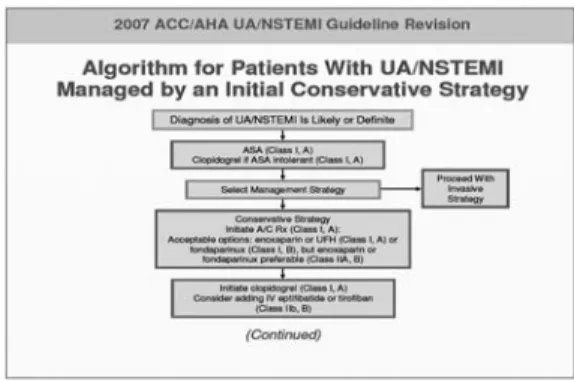
병원에서 NSTEMI 환자를 치료하기 위하여 약물 요법(conservative therapy)과 또는 수술요법 (invasive therapy)을 사용하고 있으며 약물요법으 로는 antiischemic agents, antithrombotic agent, lipid lowering agents 사용을 권장하며 수 술요법으로는 Percutaneous coronary interven- tion(PCI)과 Co ro na ry a rte ry bypa s s graft(CABG)가 권장되고 있다. TACTICS- TIMI 18 trial은 출혈위험, 병원치유를 위한 체류 기간, 치료비용에 관하여 invasive therapy와 conservative therapy를 비교하였는데 연구결과 두 치료방법의 효과에 차이가 없었으며 위험도가 높 은 환자에게는 수술요법이 약물요법 보다 더 효과가 좋았으며 위험도가 낮은 환자에게는 두 방법의 효과 에 차이가 없는 것으로 나타났다. Fig. 1, 2는 ACC/AHA (2007년) 안내지침으로 NSTEMI환자를 위한 약물치료와 수술요법(invasive therapy)에 관 한 치료 순서(algorithm)를 나타내고 있다.

Fig. 1 Algorithm for treatment of UNSTEMI

(4)

1) Invasive therapy

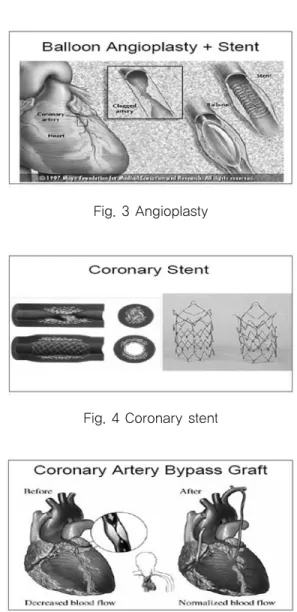
- Percutaneous coronary intervention(PCI) Balloon angioplasty는 1977년 스위스의 Andreas Gruntzig가 관상동맥에 적용한 것으로 Fig. 3, 4에서와 같이 angioplasty는 catheter상 에 있는 balloon을 plaque가 있는 곳에서 부풀리 어 plaque를 눌러준 후 동맥경화 부위를 부수어서 혈액의 흐름을 복원시킬 수 있으며 s te nt는 angioplasty 후에 혈관의 재협착을 방지하기 위하 여 동맥벽을 떠바치도록 금속 구조물을 협착부위에 삽입하여 동맥내 혈액흐름을 복원 유지할 목적으로 사용하며 drug-eluting stent와 bare-metal stent 2종류가 있다. NSTEMI 환자에게 Early angiography와 Revascularization이 필요한 경 우 는 He mod ynamic ally ins table , Cardiogenic shock, Severe left ventricular dysfunction(LVD), Heart failure(HF), New or Worsening Mitral regurgitation, New ventricular septic defect가 있는 고위험군 환자 로서 Fig. 6에서와 같이 UA/NSTEMI 환자에게 early invasive treatment를 실시하면 그렇지 않은 환자와 비교 할 때 ACS로 인한 사망률이나 심근경색 발생률, 재입원율이 감소 하였음을 나타 내고 있다.

- Coronary artery bypass graft(CABG) Fig. 5에서 CABG는 다리의 정맥을 대용혈관으로 사용하여 atherosclerotic coronary artery의 막 힌 부분을 경유하여 aorta 끝에서 coronary artery 끝을 연결하여 대용혈관으로 혈액이 우회하여 흐르 도록 복원하는 수술로서 left main c oronary artery에 협착이 있을 때, 3개 이상의 혈관에 협착 이 있을 때, 또는 1-2개의 proximal left circum- Fig. 2 Algorithm for treatment of USTEM

Fig. 3 Angioplasty

Fig. 4 Coronary stent

Fig. 5 Coronary artery bypass graft

(5)

flex arteries와 left anterior desc ending cornary artery에 70% 이상의 협착이 있을 때 CABG가 권장된다. Table 1.은 ACC/AHA안내지침 에서 CABG 수술이 권장되는 NSTEMI 환자의 상 태에 관하여 요약한 내용을 나타내고 있다.

- Management after angiography

Fig. 7에서와 같이 Angiography를 실시한 후 CABG, PCI 또는 약물치료 중에서 ACC/ AHA algorithm에 따라 NSTEMI 환자를 치료할 것을 권장하였으며. PCI를 실시할 계획이 있는 경우 NSTEMI 환자에게 aspirin을 평생 복용할 것을 권장하며 만일 Angiography전에 clopidogrel과 Glycoprotein IIb/IIIa inhibitor를 사용하지 않 았다면 clopidogrel loading dose 300mg과

Table 1. ACC/AHA Guideline: Coronary artery bypass surgery in patients with NSTEMI Fig. 6 Improved outcome in early invasive

treatment with NSTEMI

Source: :TACTICS Thrombolysis in Myocardial Infarction 18 Investigators, N Engl J Med 2001; 344:1879. cumulative incidence of the primary end point (death, nonfatal myocardial infarction, or rehospitalization for an acute coronary syndrome) during the six-month is lower in the inva- sive-strategy group than in the conservative treatment group (15.9 ver- sus 19.4 percent) in patients with unstable angina or a non-ST eleva-

tion myocardial infarction Fig. 7 Invasive treatment followed by pharmacologic treatment

(6)

Glycoprotein IIb/IIIa inhibitor 사용을 권장하 고 있다.

2) Pharmacologic management(Conservative therapy)

Acute coronary syndrome을 유발하는 혈관내 thrombus나 thrombotic occlusion을 완화시키기 위한 여러 가지 유용한 약물치료가 있다.

(1) Anti ischemic and analgesic for chest pain

심근경색에서 가슴통증을 완화하여 환자를 안정시 키고 교감신경(hyper-adrenergic response)의 이 상상태를 완화할 수 있다.

- Providing oxygen

Respiratory distress 환자의 SaO2가 90% 이하 인 경우, 고위험군 저산소혈증 환자에게 반드시 산소 를 공급하도록 권장하고 있다.

- Nitroglycerin sublingual (NTG-SL) 심근경색으로 인한 통증을 완화하기 위하여 설하정 (0.6mg) 1정을 혀 밑에 놓아서 5분 정도 기다린 후 통증이 소실되지 않으면 응급실로 신속히 연락하여 응급의료팀의 지시를 따르도록 한다. 환자의 이송은 가족이나 친구보다 응급의료팀의 ambulance를 사 용할 것을 권장하고 있다. 응급의료팀이 도착할 때까 지 NTG을 3정까지 사용할 것을 권장하고 있으며 통 증이 지속적이거나 재발한 경우는 intravenous morphine과 또는 intravenous nitroglycerine 을 사용할 것을 권장하고 intra venous NTG 10mcg/min을 매 5-10분 간격으로 5-10mcg/min 씩 증량하여 통증을 조절한다. 고용량에서 혈압이 조 절되지 않거나 저혈압, 두통, tachycardia가 오면 중단해야 한다. NTG는 심근경색에 의한 통증을 완 화하기 위하여 사용하며 평활근에서 nitrosothiol을 형성하여 cyclic guanosine monophosphate(c- GMP)을 생성하여 평활근을 이완시키고 정맥혈관을 이완하여 preload와 pulmonary capillary wedge

pressure를 감소시키므로 혈압과 pulmonary congestion을 조절할 수 있다. NTG를 사용할 때 환자의 systolic blood pressure(SBP)가 90 mmhg 이하일 경우, 또는 severe bradycardia (Heart rate < 50 bpm), tarchycardia(heart rate > 100 bpm), right ventricle infarction (우 심실경색)인 경우 또는 발기부전을 치유하기 위하여 24 시간 이내에 phosphodiesterase inhibitor인 sildenafil, 48시간 이내에 tardalafil을 복용한 환 자에게는 금기이다. 지속적인 ischemic 상태인 환자 나 24시간 후에 임상적 증상이 소실된 환자에게는 nitroglycerine topical agent 사용이 권장한다.

- Morphine sulfate

환자의 통증을 치유하기 위한 선택적인 약물로서 혈압과 심장의 대사요구량을 낮추고 hyper- adrenergic state를 감소시키는 것으로 알려져 있 다. 그러나 사망률을 감소시키는 효과는 없는 것으로 나타났으며 (Antman et al. JACC 2004).

Morphine 사용량은 정맥으로 2-4mg을 사용하고 매 5-15분 간격으로 반복하여 2-8mg씩 정맥으로 증가하여 사용할 수 있다. Morphine은 심장질환이 나 심근파열이 있는 환자의 경우 non-selective COX-2 inhibitors나 selective COX-2 inhibitors NSAIDS를 병용 사용하지 말 것을 권장 하고 있고 과민성이 있거나 systolic blood pres- sure 90mmhg 이하이거나 diastolic blood pres- sure 50mmhg 이하인 경우도 금기이다

- Beta-blockers

Beta-blockers는 심박동율, 혈압, 심장수축력을

감소하므로 심근의 산소요구량과 심근경색증의 증세

를 감소시켜 사망률을 낮추고 동맥경화의 진행을 지

연시키는 효과가 있는 것으로 나타났으며, 심근대사,

관상미세혈관, 측부혈액흐름(collateral blood

flow), 심근 혈액흐름, oxygen-hemoglobin친화성

을 개선할 수 있는 것으로 나타났다. MI, left ven-

tricular dysfunction(LVD) 환자에게 nitrate나

calcium channel blockers(CCB)를 사용하기 전에

Beta-blocker에 대한 금기가 없으면 Beta-block-

(7)

er를 투여하고 평생 사용할 것을 권장하고 있다.

Metoprolol의 경우 5mg을 천천히 1-2분에 걸쳐 정 맥으로 투여하고(max. 5mg) 다음은 경구로 25- 50mg을 매 6시간마다 48시간 동안 사용하고 그 이 후부터 경구로 metoprolol 100mg을 하루 2번 사용 한다. 경구제제는 정맥주사 제제 사용 후 15분 이내 에 투여하며 사용되는 Beta-blockers는 Beta- selectivity가 있는 약물이 선호되고 있다. Beta- blocker를 사용할 때 과거나 현재 환자의 병력 중에 서 당뇨병, 고지혈증, air-way diseaser (예:asth- ma, compulsive obstructive pulmonary dis- ease)이 있는 경우는 B-blockers의 사용이 환자에 게 유리한지 불리한지를 검토한 후 사용하도록 권장 하고 있다. 이유는 B-blockers는 고혈당, 고지혈증 을 일으키는 부작용이 있으며 asthma나 COPD치료 에 사용되고 있는 B-agonists의 작용을 감소시킬 수 있기 때문이다. B-blockers는 severe bron- chospastic disease, AV block (PR >0.24 second), second or third degree heart block, decom- pensate bradycardia (HR<60 bpm), Shock, SBP가100mmhg 이상인 경우나 active airway disease, cocaine남용으로 유발된 ischemia의 경 우는 사용금기이다.

- Calcium channel blockers:

Calcium channel blockers(CCB)중에서 non- dihydropyridine인 verapamil과 diltiazem은 말 초혈관 확장과 관상동맥확장작용이 있으며 심장 전 도를 감소시켜 심방과 심실의 불응기를 지연시킬 수 있으므로 left ventricular systolic dysfunction 이 있는 환자에게 사용하지 말아야 한다. CCB는 심 근의 산소 요구량을 감소시키며 심근에 혈액 공급량 을 증가시키고 평활근을 수축하며 혈관을 이완하여 혈액 흐름에 대한 혈관의 저항을 감소시킨다. 말초에 대한 작용은 말초혈관을 이완하여 systemic vas- cular resistan와 혈압을 감소하여 심장에 미치는 영향을 줄일 수 있다. Dihydropyridine중에서 amlodipine이나 felodipine은 다른 CCB와 다르게 LVD에 안전하게 사용할 수 있는 것으로 나타났다.

Verapamil이나 diltiazem은 nitrate나 B-block-

ers를 사용할 수 없거나 이미 사용중인 환자에게 사 용할 수 있으며, 환자가 정상적인 ejection frac- tion을 갖고 있으며 pulmonary congestion이 없 는 경우 사용할 수 있다. Diltiazem을 사용할 경우 는 0.25mg/kg (actual body weight 사용)을 약 2 분간 동안 정맥으로 투여하고 필요하면 5mg/hour 씩 계속 정맥 투여한다. 환자가 안정되면 경구제 (immediate release form)로 교체하여 투여하며 퇴원 할 때는 경구제(sustained release form)로 투여한다.

- Angiotensin converting enzyme inhibitors (ACEI):

ACEI는 heart failure(HF), acute MI, diabetes mellitus(DM)환자에게 사용할 때 사망률과 이환률 을 효과적으로 감소하는 것으로 나타났다. HOPE study에 의하면 ramipril은 만성관상동맥질환 (chronic CAD)환자의 사망, 심근경색증, 뇌졸증 발 생률을 유의성 있게 감소하는 것으로 나타났다.

ACEI의 기전은 명확히 밝혀지지 않았지만 평활근에

서 growth-mediating properties를 억제하며 동

맥 경 화 성 plaque를 파 열 되 지 않 도 록 하 고

endothelial function을 개선하는 것으로 알려져

있다. ACEI는 nitrate나 B-blockers를 사용하였음

에도 불구하고 조절되지 않는 고혈압을 조절하기 위

하여 사용하도록 권장하고 있으며 금기가 없다면 당

뇨병이나 좌심실의 ejection fraction이 40% 이하

인 경우의 LVD이나 HF를 갖고 있는 NSTEMI 환자

에게 평생 사용하도록 권장하고 있다. 그러나 ACEI

를 사용할 수 없는 경우는 대용약으로 angiotensin

receptor blockers(ARB)를 사용하도록 권장하고

있다. 이 약의 부작용으로는 가래가 없는 마른 기침

이 약을 복용한 후 수 시간 안에 발생할 수 있으며 약

을 단약 한 후 에도 3개월까지 지속될 수 있다. 한 연

구에 의하면 ACEI로 인한 부작용으로 기침 발생률

이 높아서 백인에게는 5-10%이며 중국인의 경우는

약 50%라고 발표하였다. 따라서 american college

of chest physician(ACCP)에 의하면 ACEI의 부작

용인 기침이 발생하면 중단할 것이 권유하며 안전한

대용제로 ARB나 hydralazine, isosorbide 사용이

(8)

권장 되고 있다.

(2) Antiplatelet agents

Antiplatelet treatmen은 환자가 병원에 도착할 때 가능한 신속하게 투여해야 하는 약물로써 Table 2. 는 antiplatelet treatment에 관한 ACC/AHA 안내지침이며 NSTEMI환자에게 aspirin, clopido- grel, Glycoprotein IIb/IIIa inhibitors, heparin 과 같은 antiplatelet의 치료시기와 대용에 관하여 나타내고 있다.

- Aspirin

Aspirin은 cyclooxigenase-1 enzyme과 cyclooxigenase-2 enzymes에 모두 작용하여 비 가역적으로 arachidonic acid에서 thromboxane A2합성을 차단하여 platelet aggregation 을 억제 하는 기전을 갖고 있는 antiplatelet agent로서 이 약물의 platelet inhibition 기간은 약 8~10일이다.

전체 platelet중 10% 정도가 매일 보충되며, 반감기 가 15-20분인 aspirin 75mg/daily 로는 충분히 platelet aggregation을 억제할 수 있지만, aspirin을 불규칙적으로 사용하고 있는 NSTEMI 환 자인 경우는 효과가 충분치 않아 12개월 이내에 심 근경색증재발로 입원하거나 사망하는 비율이 4배 증 가하는 것으로 보고되었다(AHA, Circulation.

2007). 그러나 외국의 Cairns, Lewis, Theroux, Pooled, Wallentin 연구에 의하면 NSTEMI 환자 에게 aspirin을 사용하여 placebo와 비교한 결과 aspirin은 사망이나 심근경색을 일으킬 수 있는 상 대적인 위험 (relative risk)을 감소하였다. 따라서 aspirin은 NSTEMI 환자에게 사용할 때 사망률을 감소(mortality benefit) 할 수 있는 유익한 효과가 있는 antiplatelet agent로서 NSTEMI 환자가 병 원에 도착 후 심근경색증으로 진단을 받으면 가능한 빠른 시간에 초기용량 aspirin 160-325mg/daily 을 사용하고 유지용량 aspirin 75-325mg/daily을 평생 사용할 것을 권장한다. (예외: aspirin 사용에 내성이 있거나 금기인 경우).

- Tienopyridines

Adenosine diphosphate inhibitors(ADP)로서 비가역적으로 Platelet aggregation을 억제한다.

∙Clopidogrel (Plavix

)

활성적인 대사체로 platelet-signal pathway를 비가역적으로 영구히 손상시키는 것과 관련이 있다.

Clopidogrel 75mg/daily은 충분히 antiplatelet 작용을 갖고 있지만 불규칙하게 복용할 경우 사망률 과 이환률(mortality and morbidity)를 증가시키 는 것과 관련이 있다(AHA, Circulation. 2007). 또 한 clopidogrel은 환자에 따라서 다양하게 반응하므 로 불완전하게 platelet aggregation을 억제할 수 도 있다. 따라서 clopidogrel은 aspirin에 내성이 있거나 금기(과민성, 위장관 내성)인 환자로서 NSTEMI 회복기에 있는 환자에게 최소 1개월 동안 clopidogrel 75mg/daily을 사용할 수 있으며(level of evidence A) 이상적으로는 1년 정도 사용할 것을 권장하고 있다(Level of evidence B). CAPRIE 연 구에서 NSTEMI 환자를 대상으로 ischemic stroke, MI, vascular death 위험률(risk ratio)에 관하여 clopidogrel과 aspirin효과를 비교 하였는데 clpidogrel의 경우 aspirin에 비하여 위험률이 8.8% 감소하였으며 CURE study에서는 aspirin과 clopidogrel의 병용투여의 효과를 비교하였는데 aspirin단독 투여에 비하여 aspirin과 clopidogrel 병용투여는 위험률을 20%나 더 감소 한 것으로 나타 났다. Clopidogrel은 ticlopidine에 비하여 작용시 간이 빠르며 부작용이 적은 장점이 있다. 그러나 aspirin과 병용하면 심혈관계 질환을 예방하는 효과 가 증가하지만 출혈이 지속하는 시간도 함께 증가하 는 부작용이 있으므로 주의 하여야 하며 특히 고용량 의 atorvastatin을 사용할 경우 atorvastatin(CYP 3A4 inhibitor)은 clopidogrel(CYP 2B6 inhibitor)의 대사를 90% 이상 억제하는 것으로 나 타났으므로 두 약물의 병용사용에 주의 하여야 한다 (Circulation,AHA 2007)

∙Ticlopidine(Ticlid

)

Clopidogrel에 내성이 있는 환자에게 clopidogrel

의 대용제로 사용할 수 있으며 초기용량은 500 mg

을 경구로 사용하고 유지용량은 250mg을 하루에 두

번 음식과 함께 복용한다. Tclopidine의 최대효과는

(9)

투여 후 3-5일 이내에 나타나며 제산제를 사용하면 그 작용 발현이 느려지는 약물상호작용이 있다.

Ticlopidine은 neutropenia, thombocytopenia purprea, aplastic anemia를 유발할 수 있으므로 복용 처음 3개월 동안 매 2주마다 complete blood count (CBC) test를 실시하여 부작용을 검토하며 만일 간기능 이상이 의심될 경우 처음 4개월 동안 간 기능 검사(LFT)를 받도록 권장하고 있으며 출혈의 증세나 징후를 검토하여야 한다.

∙Prasugrel

Platelet aggregation을 억제하는 신약으로 심혈 관계 질환으로 인한 사망이나 심근경색증, 뇌졸증을 감소하는 것으로 나타났으며(TRION TIMI-38 research, 2001) 약효는 clopidogre보다 우수하지 만 출혈위험이 clopidogrel보다 높은 것으로 나타났 다( TIMI research: prasugrel vs clopidogrel = 2.4% vs 1.8%). Prasugrel을 사용하는데 관한 FDA금기는 transient ischemic attack(TIA)이나 뇌졸증의 병력이 있는 환자이거나 병적으로 출혈이 있는 환자에게는 prasugrel을 사용할 수 없으며 (FDA contraindication) 75세 이상의 고령의 환자 에게는 치명적인 뇌경동맥 출혈위험이 증가할 수 있 으므로 주의가 필요하고(FDA warning) 당뇨병 또 는 심근경색증 병력이 있는 경우는 prasugrel의 사 용이 효과적인 것으로 나타났다(FDA indication).

- Glycoprotein IIb/IIIa inhibitors

Platelet integrin αⅡbβ3(Glycoprotein IIb/IIIa)이 soluble fibrinogen과 결합하여 platelet aggregation을 억제하는 antiplatelet agent이다. Aspirin이나 tienopyridine보다 완 전하게 platelet aggregation을 억제하지만 출혈 위험이 높다. PCI를 실시할 환자에게 보조치료제 로써 사용되며 경구용 dual antiplatelet 사용 전 에 투약하며 PCI를 실시할 계획이 없는 환자에게는 abciximab 사용은 피하여야 한다. Glycoprotein IIb/IIIa inhibitors를 사용할 수 없는 경우는 4-6 주 내에 급성출혈, 고혈압이 심한 경우 (SBP

>180-200mmhg, DBP >110mmhg), 심혈관계 출혈 (Intracranial neoplasm, AVM, Aneurysm), 4-6주

내의 주수술 또는 외상, thrombocytopenia(platelet count <100,000/mm3), bleeding diathesis, war- farin 사용으로 인하여 INR이 상승한 때이다. 사 용중인 Glycoprotein IIb/IIIa inhibitors는 아 래와 같다.

∙Abciximab (Repro

)

Murin-human chimeric antibodies로서 비가 역적으로 platelet aggregation을 억제하며 약물을 단약 할 경우 24-48시간 이내에 platelet 기능이 정 상으로 돌아온다. PCI를 시행하기 전에 0.25mg/kg 을 정맥투여하고 유지용량으로 0.125mcg/kg/min (max. 10mcg/min)을 투여하며 12시간 동안까지 투여할 수 있다. 투약 후 첫 1시간동안 매 15분 마다 PCI 적용부위의 출혈을 검토하고 다음 6시간동안은 매시간마다 출혈 여부를 확인하여야 한다. 검토해야 하는 laboratory data는 activated clotting time(ACT)로서 정상수치는 200-300 second이다.

∙Eptifibatide (Integrilin

)

Synthetic cyclic hepta peptide로서 glycoprotein receptor에서 유사 amino acid sequence로 작용 하여 platelet aggregation을 억제하며 약물을 단 약 하면 4시간 후에 platelet 기능이 정상으로 돌아 온다. PCI를 시행하기 전 180mcg/kg을 1-2분 동안 투여하고 그 다음 2mcg/kg/min을 계속 투여하여 최대 72시간까지 투여할 수 있다. 신장기능이 저하 된 환자(Scr 2-4mg/dl)에게는 용량을 감소하여 135mcg/kg을 초기용량으로 투여하고 그 다음 0.5mcg/kg/min을 계속하여 투여한다. 신장기능 (Scr >4mg/dl)이 저하된 환자에게는 투여할 수 없 다. 정상 ACT 수치는 300-350 second이다.

∙Tirofiban (Aggrastat

)

Synthetic non-peptide로서 glycoprotein receptor에서 유사 amino acid sequence로 작용 하여 platelet aggregation을 억제하며 기전은 eptifibatide와 유사하다. 초기용량은 0.4mcg/kg/min 을 정맥투여하고 그 다음 0.1mcg/kg/min을 계속 투여하며 최대 12-24시간 동안 투여할 수 있다. 만 일 신장기능이 저하된 경우라면(Clcr <30ml/min), 약용량은 50%까지 감소하여 투여하여야 한다.

Tirofiban을 levothyroxin 함께, 또는 omeprazole

(10)

과 병용 투여하면 tirofiban의 청소율(CL)을 증가시 키므로 주의하여야 한다.

(3) Anticoagulation agents

UFH이나 LMWH은 thrombus에 의하여 혈관이 다시 막히는 것을 방지하는 효과가 있는 thrombin inhibitor로서 acute coronary syndrome 환자에 게 사용하는 heparin은 low molecular weight heparin(LMWH)과 unfractioned heparin(UFH) 이 있으며 low molecular weight heparin은 unfractioned heparin(UFH) 보다 NSTEMI 환자 의 사망률이나 MI 또는 ischemia 재발을 보다 효과적으로 줄일 수 있는 것으로 나타났지만 (Braunwald, et al. 2002 p=0.032, p=0.029) 신 장기능이상이나 비만환자 또는CABG를 실시할 환자에게는 UFH을 사용할 것을 권장하고 있다.

Enoxaparin의 초기용량 30mg을 정맥투여하고 15 분 후 유지 용량으로 1mg/kg을 12시간마다 피하로 투여한다. 만일 Creatinine clearance(CrCl) 30ml/min이하인 경우는 enoxaparin 1mg/kg 을 피하로 24시간마다 투여한다. LMWH은 생체 이용 률을 예측할 수 있으며 모니터링이 적고 반감기가 길

어서 투여하기에 편리하지만 UFH과 비교할 때 가격 이 비싸고 소출혈 위험이 많다. 반면에 UFH은 작용 발현 시간이 빠른 항응고제로 glycosaminoglycans 의 heterogenous mixture이다. Heparin은 antithrombin(AT)에 결합하여 heparin-AT complex를 만들어서 비가역적으로 factor IIa (thrombin)과 factor Xa, IX, XI, XII를 불활성화 시키며, platelet기능을 억제하고 혈관의 투과성을 증가시켜 출혈위험을 증가시킬 수 있다. Dose- response가 다양하며 생체 이용률이 낮으므로 heparin의 효과를 측정하기 위하여 투여 후 3시간 후에 activated partial thromboplastin time (aPTT)를 측정하고 투여 후 6시간 이내에 aPTT를 검토하여 환자에게 투여하는 Heparin의 용량을 조 절해야 하는 단점이 있다( aPTT수치: 정상 aPTT수 치의1.5-2.5배). 그리고 드물지만 hepain의 부작용 으로 hepain-induced thrombocytopenia(HIT)와 hepain-associated-thrombocytopenia(HAT)가 있으므로 매일 platelet 수치를 검토하여 platelet 수치가 50% 이하로 감소하였거나 1,000,000/mm

3

이하로 감소하였으면 heparin투여를 중지하여야 한 다. Heparin의 초기용량으로 60-70U/kg=(max.

Table 2. Antiplatelet and anticoagulant therapy

(11)

1,000units)을 정맥투여하고 유지용량으로 12- 15U/kg을 투여하여 aspirin 또는 clopidogrel을 복 용하고 있는 모든 NSTEMI 환자에게 첨가하도록 권 장하고 있다. Acute coronary syndrome 환자에게 aspirin과 UFH의 병용요법은 aspirin 단독투여와 비교할 때 aspirin보다 사망률이나 MI의 위험을 더 줄일 수 있는 효과가 있는 것으로 나타났다 (Theroux, RISC study, p=0.06).

(4) Lipid lowering agents

NSTEMI 환자를 위하여 입원 후 24시간 이내에 환자의 lipid panel을 확인하고 입원 후 24-96시간 이내에 hydroxy methyl glutaryl-coenzyme A reductase inhibitors(statins)를 투여하기 시작하 여 퇴원 후에도 고지질을 관리하기 위하여 계속 투여 할 것을 권장하고 있다. 만일 환자의 low den- sity lipoprotein cholesterol(LDL-C) 수치 가 100mg/dl이상이면 치료를 시작할 수 있다.

ACC/AHA, NCEPIII에 안내지침에 의하면 심근경 색이나 당뇨병환자를 위한 LDL-C목표수치는 100mg/dl 이하이며 L-TAP 연구에 의하면 관상동 맥질환을 갖고 있는 환자중에서 LDL-C수치가 정상 에 도달한 환자는 20% 미만인 것으로 나타났는데 이 것은 환자가 lipid lowering agents 사용에 대하여 그 순응도(compliance)가 부족하였거나 또는 고지 혈증을 치료하기 위한 lipid lowering agents가 부 적합하였거나 운동과 식이요법에 관한 환자교육이나 환자 자신의 관리가 부족하였음을 나타낸다. 최근에 변경된 미국 AHA안내지침은 만일 High density lipoprotein cholesterol 수치가 40mg/dl 이하일 경우 niacin이나 fibrate를 첨가하여 치료할 것을 권유하고 있다.

(5) Others

- Direct thrombin inhibitors

NSTEMI 환자에게 효과와 안전성이 입증되지 않 아서 권장되지 않고 있다.

- Warfarin

NSTEMI 환자에게 효과에 관한 결정적인 자료가 없으므로 사용을 권장하지 않는다. 그러나 항응고제 를 사용하고 있는 환자중에서 고위험군 환자로 과거 나 현재 atrial fibrillation(AF), LV thrombus, cerebral, venous, pulmonary emboli 병력이 있 는 경우 warfarin을 첨가투여하고 INR수치는 2.0- 2.5를 그 목표수치로 하고 있다.

- Thrombolysis

사망률과 이환률이 증가한 연구결과(TIMI IIB study)과 있으므로 사용을 권장하지 않는다.

Secondary prevent ion

1. Aspirin, ACEI, Beta-blocker를 평생 복용하 며 aspirin으로 인한 위장관 출혈이 있는 경우 의료 진에 신속히 연락할 수 있도록 환자에게 교육을 제 공한다.

2. Nitro sublingual은 MI로 인한 가슴의 통증을 소실할 목적으로 사용하는 것이므로 일반 진통제가 아님을 반드시 환자에게 알려주어야 하며 nitro sublingual을 사용 후 5분이 지나도 통증이 소실되 지 않으면 즉시 응급의료서비스팀에 연락하도록 환 자에게 교육을 실시한다. Nitro sublingual origi- nal bottle 을 다른 병으로 바꾸지 않도록 환자에게 설명하고 유효기간을 병 위에 기입하도록 하여 유효 기간이 지난 약물을 복용하지 않도록 한다.

3. 혈압은 SBP 140mmhg 이하, DBP 90mmhg 이하로 조절하며 만성신장기능 이상이나 당뇨병이 있는 경우는 SBP 130mmhg 이하, DBP 80mmhg 이하로 혈압을 조절하도록 한다.

4. 당뇨병이 있는 경우 HbA1C 수치는 7% 이하로 혈당을 유지하여 고혈당으로 인한 관상동맥합병증 위험요소를 감소하도록 한다.

5. 흡연을 금하고 흡연 환경에 노출되지 않도록 금

연교육을 제공하며 금연의 의지를 갖고있는 환자에게

는 재활교육을 안내함과 동시에 약물치료를 제시하고

금연하고 있는 환자를 위하여 지속적인 격려와 관찰

(12)

이 필요하다(금연교육, 금연 재활교육, 약물치료).

6. LDL-C수치는 100mg/dl 이하로 감소하여 심 근경색의 위험요소를 감소하도록 한다.

7. 주 7일간 30-60분 (최소 주 5 일)정도의 규칙적 인 운동을 하여 심근경색의 위험요소를 감소하도록 권장한다.

8. 체중 조절을 한다 [Body mass index(BMI) 18.5-24.9kg/m

2

, waist circumference men:

<40 in, women: <35 in]

9. 급성심근경색이 왔을 때 약물사용 및 응급의료 지원팀과의 연락과 약물사용 순응도의 중요성에 관 하여 퇴원교육을 실시한다

10. 매년 독감예방접종을 받도록 한다.

참고문헌

1) ACC/AHA Guideline of ACS and NSTEMI.(

2009)

2) ACC/AHA Clinical performance measure for adults with ST-elvation and NON- ST-elevation myocardial infarction 3) Antman et al. JACC 44-689.(2004) 4) Stone et al. N Eng J Med. 358:2218-

30.(2008)

5) ACC/AHA Guideline for the management of UA/NSTEMI. (2007)

6) Management of acute coronary syndrome:

Larry S.Dean, FACC/FCSAI.

Classification Antiplatelet

Antiplatelet : Glycoprotein IIb/IIIa inhibitors

Medication Aspirin

Abciximab (Reopro

)

Eptifibatide (Integrilin

)

Tirofiban (Aggrast

)

Lamifiban

Comments: recommendation and contraindication Consider discontinuation 1 week prior to surgery except CABG, PCI.

CI: Allergic reaction, active bleeding, Hemophilia, acute peptic ulcer

CI: Active internal bleeding, GI/GU bleeding within 6 weks, history of cerebrovascular accident within 2 years, thrombocytopenia, major surgery or trauma within 6 weeks, uncontrolled hypertension, hypersensitivity. Eptifibatide: contraindication if Scr > 4mg/dl or dialysis.

Monitor ACT level

Drug-drug interaction(DDI):combination use with levothyroxin and/or omeprazole increases ticlopidine clearance

On clinical trials Dosage

Initiate loading dose 162~325mg/day,main- tenace dose 75~162mg/day. Take aspirin indefinitely.

0.25mg/kg IV bolus over 10~60min before PCI then, infuse IV 0.125mcg/kg/min(max.

10mcg/min) up to 12~18hr

nitial bolus of 180 mcg/kg over 1-2 minutes then,continuous infusion of 2 mcg/kg/minute (maximum: 15 mg/hour) up to 72 hr. If Scr 2-4mg/dl, reduce first dose to 135mcg/kg and reduce the infusion rate to 0.5mcg/kg/min

Initial IV infusion of 0.4mcg/kg/min for 30 min followed by continuous IV infusion of 0.1mcg/kg/min up to 12-24 hr. Decrease bolus dose and infusion rate by 50% in patient with Clcr <30ml/min.

NSTEMI에 사용되는 약물

(13)

Classification

Antiplatelet : Thienopyridines

Non- Tienopyridines

Anti-Ischemic and analgesic

Anti-ischemic and analgesic

Anticoagulant

Medication

Clopidogrel (Plavix

)

Ticlopidine (Ticlid

)

Prasugrel (Effient

)

Cangrelor Ticagrelor

Sublingual nitroglycerine

(Nitrostst

)

Nitroglycerine(IV) (Tridil

)

Nitroglycerine transdermal (Nitro-Dur

)

Morphine(IV)

Unfractioned Heparin(UFH)

Enoxaparin (Clexane

)

Comments: recommendation and contraindication Monitor CBC with platelet count Drug-drug interaction:atorvastatin increases clopidogrel clearance , may reduce the effect of clopido- grel, combination with aspirin may increase the bleeding time CI: active pathologic bleeding(peptic ulcer, ICH).

Monitor CBC with platelet count every 2 weeks for the first 3 months due to neutropenia, agranulocytopenia, and TTP, If suspect- ed liver function, monitor LFT for the first 4 months.

CI: history if TIA, Stroke, and acute pathologic bleeding.

Not recommended in patient > 75yrs(excetpt DM, prior MI)

On clinical trials

not yet available for clinical use

Call emergency medical service team if chest pain is not resolved after taking one sublingual nitroglycerine tablet. Unused tablet should be discarded 6 months after the original bottle is opened.

Store in original bottle to maintain potency/stability

CI: SBP < 90mmhg, Severe bradycardia < 50 bpm, Tarchycardia>100 bpm, suspected RV infarction If patient have received within 24 hours of sildenafil or 48 hours of tadalafil

Recommend 24 hours after clinical symptoms are resolved. Give nitrate free period of 10-14 hours each day to avoid nitrate tolerance

CI: hypersensitivity, severe respiratory depressionMonitor repiratory rate, SBP/DBP over 90/50mmhg, hypersensitivity

Adjust infusion to maintain aPTT at 1.5-2.5 times control. SE:

bleeding, thrombocytopenia, HIT, osteoporosis, hyperkalemia, eleva- tion of liver enzymes. Monitor ApTT level, signs and symptoms of bleeding, aPTT level. Do not use for >48hrs in patient without symp- toms

Do not use in CABG

SE:osteoporosis, hypersensitivity, HIT,Caution :monitor antiXa level, if use in patient with renal failure, elderly 75 years of age, and/or obese

Dosage

Initiate loading dose 300mg po > 6hours proir to procedure then, maintenance dose 75mg po daily

Initiate dose 500mg daily,Maintenance dose 250mg bid

Initiate loading dose 60mg po then, continue maintenance dose 10mg po daily. Patient should take with Aspirin (75-325mg/day).

180mg po load then 90mg po bid

Administer 0.4mg one sublingual nitroglyc- erine every 5 min under tongue for ongoing ischemic discomfort up to 3 doses

Start at IV 10 mcg/min, increase by 5 or 10 mcg/min every 5 to 10 min for the first 48 hr for persistent ischemia, heart failure, or hypertension

apply 0.2-0.8mg/hour to a hairless area and rotate the site.

Initial infusion of IV 2~4mg every 5~15min as needed. Adjust the dose in renal insuffi- ciency .

Start with IV bolus of 60~70 U/kg(max.

5,000U) then infusion of 12~15U/kg(max.

1,000U)

Start with IV bolus of 30mg then,injection

1mg/kg SC every 12 hour for 2~8 days. if

CrCl < 30ml/min, reduce dose to 1mg/kg/day

SC.

(14)

Classification

Anticoagulant

Direct thrombin inhibitor

Beta-blockers

Calcium channel blocker

Medication

Statins

Aspirin Clopidogrel

Beta-blockers

Medication

Fondaparinux (Arixtra

)

Bivalirudin (Angiomax

)

Metoprolol (Toprol XL

)

Ditiazem (Cardizem

, Cardizem LA

)

Rosuvastatin Atorvastatin Simvastatin

Lovastatin Fluvastatin

Metoprolol succinate extended release

(ToprolXL

)

Carvedilol

Bisoprolol

Comments: recommendation and contraindication Caution : If CrCl 30~50ml/min, use cautiously. Should not be used as the sole anticoagulant for PCI due to risk of catheter thrombosis CI: CrCl < 30ml/min due to increased bleeding risk Monitor renal function in all patients

If Clcr > 30 ml/min, no adjustment needed. If Clcr 10-29 ml/min, decrease infusion rate to 1mg/kg/hr. Monitor ACT level CI: active major bleeding

Efficacy and safety in UA/NSTEMI is not widely accepted CI: Sinus bradycardia, AV block (pr > 0.24 sec.), 2nd and 3rd degree heart block, SBP < 100mmhgcardiogenci shock and hypotension cocaine induced ischemia

Caution: If with air way disease like asthma, COPD or diabetes, hyperlipidemia, use cautiously and monitor lipid profile and blood glucose level during the therapy

CI: Left ventricular dysfunction/CHF, pulmonary congestion, hypotension, 2nd or 3rd degree AV block. Do not use in patient with systolic dysdunction HF ,DDI: increase digoxine level

Comments: recommendation and contraindication Doses should be individualized according to the baseline LDL-C level. Recommended goal of LDL-C: less than100mg/dlIf HDL-C is less than 40mg/dl , add niacin or fibrates.

CI: active liver disease, elevation of serum transaminase,allergic reaction

Administer indefinitely unless contraindication Alternative to Aspirin if allergic to aspirin

Administer indefinitely unless contraindication Dosage

2.5mg/day SC for up to 8 days

IV bolus 0.75mg/kg prior to intervention, followed by continuous infusion 1.75mg/kg/hr for the duration of procedure

Start with IV dose of 2.5-5mg and repeat every 5 min if needed(max. 10mg). At 15 min after last IV dose, start oral dose with 50mg every 6hrs for 48 hrs then, 100mg bid

IV bolus 0.25mg/kg over 2min,continuous infusion of IV 5mg/hr and adjust as need- ed.Then, Switch to PO(immediate release) medication then, switch to SR(sustained release) formular when discharge home

Dosage 5-80mg/day 10~80mg/day 5~40mg/day 10~80mg/day 20~40mg/day

Start 12.5-25mg once (max. 200mg/day)

Start 3.125 mg two times a day (max. 25mg two times a day. 50mg two times a day for patient >85kg)

Start 1.25mg once a day (max. 10mg/day) 75~325mg /day

75mg/day

Second prevention

(15)

Medication

ACEinhibitors

Warfarin (Coumadin

)

Enalapril

Ramipril

Lisinopril

Comments: recommendation and contraindication Dosage

Start 2,5-5mg/day (max. 20mg two times a day

Start 1.25-2.5mg/day (max.10mg two times a day

Start 2.5-5 mg/day (max. 40mg/day) Initial dose must be individualized. Consider patient's hepatic function, cardiac function, age, concurrent therapy, nutrition status and risk of bleeding. Start 5-10mg daily for 2 days and adjust dose to keep INR level between 2.0-3.0 for most indica- tions, 2.5-3.5 for mechanical heart valve but INR value depends on the site and the type of vlave . Usual maintenance dose: 2-10mg/day.

Note: Lower starting dose may be required for hepatic impairment, poor nutrition, CHF, elderly, higher risk of bleeding.

Recommended goal of blood pressure: SBP/DBP= 140/90mmhg, If patient has diabetes and/or renal insufficiency,

SBP/DBP=130/80mmhg. Take indefinitely unless contraindication

Use warfarin for long term period for the patient with specific con- dition like AFib, LV thrombosis, cerebral, venous or pulmonay emboli at discharge.

SE: hypercoagulability during first 24-36 hours of therapy, bleed-

ing, hypersensitivity, teratogenicity, skin necrosis associated with

malignancy

(16)

1. Which of the following is true regarding the use of clopidogrel in patients with an acute coronary syndrome?

A) A loading dose of at least 300mg should be used

B) Clinical outcome in clopidogrel treated patients are significantly worse in the set- ting of concomitant treatment with ator- vastatin

C) Doubling the loading dose and mainte- nance dose of clopidogrel has been shown to be more effective than standard therapy D) A loading dose of clopidogrel is effica- cious regardless of the time of dosing as long as it is prior to the percutaneous intervention

2. True statements about aspirin include all of the following, except for :

A) The antiplatelet effects of aspirin can be prevented with concomitant nonsteroidal anti-inflammatory drug use

B) Aspirin exerts its antiplatelet effects trough inhibition of the platelet thrombin- receptor for the life span of the platelet C) Aspirin is a relatively weak inhibitor of platelet aggregation in vitro

D) When chewed or solubilized the full antiplatelet effects of aspirin can be achieved in ~15minutes.

3. A patient is admitted from the emergency room for a suspected acute coronary syn- drome with EKG change( ST depression >

2mm in lateral leads) and initial cardiac enzymes within normal limits. However, a second and third set of cardiac enzymes are mildly elevated. The patient is scheduled for coronary angiography. The optimal antiplatelet regimen for this patient at this time of PCI in order to minimize PCI throm- botic events should include :

A) Aspirin

B) Aspirin + Clopidogrel 300mg at the time of PCI

C) Aspirin + Clopidogrel 600mg at the time of PCI

D) Aspirin + Clopidogrel loading dose administered prior to PCI + GPIIb/IIIa inhibitor

4. post intervention CK-MB leaks are : A) Of no concern

B) Rarely occur

C) Do not represent real myocardial injury D) Are related to late mortality and MI

5. what medications should a patient who is post MI with preserved LVEF receive as dis- charge therapy ?

A) Aspirin, plavix, cardizem, and simvas- tatin

B) Aspirin, metoprolol, enalapril, atorvas- tatin, and SL NTG

C) Plavix, metoprolol, enalapril, and sim- vastatin

D) Morphine, aspirin, SL NTG, and Lovenox E) Morphine, IV NTG, aspirin, and oxygen

1. B) 2. C) 3. E) 4. E) 5. B)

【제27권 2호 정답】

수치

Fig. 1 Algorithm for treatment of UNSTEMI
Fig. 3 Angioplasty
Table 1. ACC/AHA Guideline: Coronary artery bypass surgery in patients with NSTEMIFig
Table 2. Antiplatelet and anticoagulant therapy

참조

관련 문서

CHD: coronary heart disease, CVD: cardiovascular disease, MI: myocardial infarction, ACS: acute coronary syndrome, CKD: chronic kidney disease, HTN: hypertension. LDL-C

Long-term outcome after an early invasive versus selective invasive treatment strategy in patients with non.ST-elevation acute coronary syndrome and elevated

It considers the energy use of the different components that are involved in the distribution and viewing of video content: data centres and content delivery networks

After first field tests, we expect electric passenger drones or eVTOL aircraft (short for electric vertical take-off and landing) to start providing commercial mobility

1 John Owen, Justification by Faith Alone, in The Works of John Owen, ed. John Bolt, trans. Scott Clark, &#34;Do This and Live: Christ's Active Obedience as the

CBS73 strain isolated from domestic Korean traditional food able to produce antimicrobial peptide having high antibacterial effect, low molecular weight, stable over wide

Keywords □ acute coronary syndrome, discharge medication patterns, Korea, tertiary hospital, follow-up evaluation, troponin-T,

H, 2011, Development of Cascade Refrigeration System Using R744 and R404A : Analysis on Performance Characteristics, Journal of the Korean Society of Marine Engineering, Vol.