Vol. 37, No. 4, pp 217~223 (2002)
Effect of Acrylonitrile-Butadiene Rubber on the Properties of Silica-Filled Styrene-Butadiene Rubber Compounds: Reduction
of Silane Coupling Agent and Diphenylguanidine
Sung-Seen Choi†, Dong-Ho Chang*, Ik-Sik Kim*
Research Institute of Advanced Materials, Chungnam National University 220, Gung-dong, Yuseong-gu, Daejeon 305-764, Korea
*Kumho Research and Development Center, 555, Sochon-dong, Kwangsan-gu, Kwangju 506-711, Korea
(Received May 22, 2002, Revised July 5, 2002, Accepted July 15, 2002)
실리카로 보강된 SBR 배합물의 특성에 미치는 NBR 효과:
실란커플링제와 DPG의 사용량 감소
최 성 신†․장 동 호*․김 익 식*
충남대학교 신소재연구소, *금호산업 주식회사
(2002년 5월 22일 접수, 2002년 7월 5일 수정, 2002년 7월 15일 채택)
ABSTRACT : Silica-filled rubber compounds show poor filler dispersion and slow cure characteristics compared to carbon black-filled ones. In general, a silica-filled rubber compound contains silane coupling agent (bis-(3-(triethoxysilyl)-propyl)-tetrasulfide, TESPT) and diphenylguanidine (DPG) to improve the filler dispersion and to make fast cure characteristics. Acrylonitrile-butadiene rubber (NBR) improves the filler dispersion in silica-filled styrene-butadiene rubber (SBR) compounds. In this study, effect of NBR on the properties of silica-filled SBR compounds was investigated. Properties of the compounds which contain NBR without DPG or with small amount of TESPT (Compound A) were compared with those of the compounds which contain TESPT and DPG without NBR (Compound B). Scorch time of Compound A is faster than those of Compound B. Modulus and tensile strength of Comound A are slightly lower than those of Compound B. Traction property of the Comound A is better than that of the Compound B. Addition of NBR leads to reduction of the used amount of TESPT and DPG.
요 약 : 실리카로 보강된 고무 배합물은 카본 블랙으로 보강된 배합물에 비해 보강제의 분산이 나쁘고 느린 가황 특성을 보인다. 보강제의 분산을 향상시키고 가황 특성을 빠르게 하기 위해 일반적으로 실리카로 보강된 고무 배합물에서는 실란커플링제인 bis-(3-(triethoxysilyl)-propyl)-tetrasulfide (TESPT)와 diphenylguanidine (DPG)를 사용한다. Acrylonitrile-butadiene rubber (NBR)은 실리카로 보강된 styrene-butadiene rubber (SBR) 배합물에서 실리카의 분산을 향상시킨다. 이 연구에서는 실리카로 보강된 SBR 배합물의 특성에 NBR이 미치는 영향에 대해 조사하였다. NBR을 포함하 고 있으나 TESPT의 양이 적거나 DPG를 포함하지 않은 배합물(배합물 A)의 특성과 NBR은 포 함하지 않고 TESPT와 DPG를 포함하는 배합물(배합물 B)의 특성을 비교하였다. 배합물 A의 스
†대표저자(e-mail : [email protected])
Ⅰ. Introduction
Silica has lots of silanol groups on the surface.
The polar surface of silica makes hydrogen bonds with polar materials in a rubber compound. Since the silica surface is acidic, especially it forms a strong hydrogen bond with basic materials. N-tert- Butyl-2-benzothiazole sulfenamide (TBBS) and N-cyclohexyl benzothiazole sulfenamide (CBS), are common cure accelerators for rubbers. Since they have basic functional groups such as amide, they are adsorbed well on the silica surface. The adsorp- tion of curatives by silica results in delay of the scorch time and reduction of the crosslink density of a silica-filled rubber compound. In general, silane coupling agent such as bis-(3-(triethoxysilyl)- propyl)-tetrasulfide (TESPT) is used to improve the filler dispersion and to prevent adsorption of cura- tives on the silica surface.1-3 The silane coupling agent reacts with silanol on the surface of silica and a siloxane bond is formed and the silane molecule is bound to the silica surface. The silica surface modified by the silane coupling agent becomes less polar and the filler dispersion becomes better.
Diphenylguanidine (DPG) is used to accelerate the cure of rubber compound.
In the previous work,4 we studied improvement of the filler dispersion in a silica-filled styrene- butadiene rubber (SBR) compound using acrylonitrile- butadiene rubber (NBR) and found that properties of a silica-filled SBR compound were improved by adding NBR to the compound. Since NBR has nitrile groups (-CN), it can make a hydrogen bond with silica and the filler dispersion is improved. In the present work, properties of silica-filled SBR compounds containing NBR instead of TESPT and
DPG were studied. TESPT and DPG are expensive chemicals. Thus, usage of smaller amount of TESPT and DPG leads to the reduction of cost.
Ⅱ. Experimental
The silica-filled rubber compounds were made of SBR, NBR, silica, silane coupling agent (X50S), carbon black (N330), cure activators (stearic acid and ZnO), antidegradants (HPPD and wax), pro- cessing oil, and curatives (TBBS, DPG, and sulfur).
Two NBRs of KNB 25M and KNB 35M with acrylonitrile contents of 28.4 and 34.9%, respec- tively, of Korea Kumho Petroleum Co. were used.
Z 175 (pH = 6.9, BET = 175 m2/g) of Kofran Co.
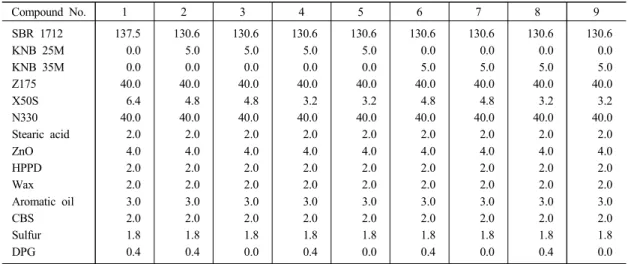
was used as silica. The formulations were given in Table 1. The compound without NBR (Compound No. 1) contains 6.4 phr of X50S and 0.4 phr of DPG.
The compounds containing NBR of 5.0 phr contain X50S of 4.8 phr (Compounds No. 2, 3, 6, and 7) or 3.2 phr (Compounds No. 4, 5, 8, and 9). The Compounds No. 3, 5, 7, and 9 do not contain DPG.
Mixing of the compounds was performed in a Ban- bury type mixer at a rotor speed of 40 and 30 rpm for the master batch (MB) and final mixing (FM) stages, respectively. The initial temperatures of the mixer were 110 and 80℃ for the MB and FM stages, respectively. The 1MB compounds were prepared as follow. (1) The rubbers were loaded into the mixer and premixed for 0.5 min. (2) The silica and silane coupling agent were compounded into the rubbers for 3.0 min and then the compound was discharged. The 2MB compounds were prepared as follows. (1) The 1MB was loaded into the mixer and premixed for 0.5 min. (2) The carbon black and ingredients (cure activators, processing oil, and anti- 코치 시간은 배합물 B의 것에 비해 빨랐고 모듈러스와 인장 강도는 배합물 B에 비해 약간 떨 어지는 경향을 보였다. 마찰 특성은 배합물 A의 것이 배합물 B의 것에 비해 우수하게 나타났 다. NBR의 사용으로 TESPT와 DPG의 사용을 줄일 수 있었다.
Keywords : silica, SBR, NBR,TESPT, DPG
degradants) were compounded into the rubbers for 2.5 min and then the compound was discharged. The FM compounds were prepared by mixing the curatives with the 2MB compounds for 1.5 min.
Cure characteristics were obtained using a Flex- sys rheometer (MDR 2000) at 160℃. Viscosities and Mooney cure times of the compounds were measured at 100 and 125℃, respectively, using a Mooney MV 2000 of Alpha Technologies. The vulcanizates were prepared by curing at 160℃ for 30 min. Physical properties of the vulcanizates were measured with the universal testing machine (Ins- tron 6021). Tan δ of the vulcanizates were measured according to ASTM D2231-87 with a Qualimeter Eplexor 150N of Gabo company.
Ⅲ. Results and Discussion
Figure 1. shows variation of the viscosity. The viscosity of the compound without NBR is lower than those of the compounds containing NBR. This may be due to the reduced contents of X50S and
Figure 1. Mooney viscosities of the compounds (ML 1+4 at 100℃).
DPG. X50S is a mixture of TESPT and carbon black. The silane coupling agent (TESPT) and DPG lower the viscosity of a filled rubber compound.5,6 For the compounds containing NBR, viscosities of Table 1. Formulations (phr)
Compound No. 1 2 3 4 5 6 7 8 9
SBR 1712 KNB 25M KNB 35M Z175 X50S N330 Stearic acid ZnO HPPD Wax Aromatic oil CBS Sulfur DPG
137.5 0.0 0.0 40.0 6.4 40.0 2.0 4.0 2.0 2.0 3.0 2.0 1.8 0.4
130.6 5.0 0.0 40.0 4.8 40.0 2.0 4.0 2.0 2.0 3.0 2.0 1.8 0.4
130.6 5.0 0.0 40.0 4.8 40.0 2.0 4.0 2.0 2.0 3.0 2.0 1.8 0.0
130.6 5.0 0.0 40.0 3.2 40.0 2.0 4.0 2.0 2.0 3.0 2.0 1.8 0.4
130.6 5.0 0.0 40.0 3.2 40.0 2.0 4.0 2.0 2.0 3.0 2.0 1.8 0.0
130.6 0.0 5.0 40.0 4.8 40.0 2.0 4.0 2.0 2.0 3.0 2.0 1.8 0.4
130.6 0.0 5.0 40.0 4.8 40.0 2.0 4.0 2.0 2.0 3.0 2.0 1.8 0.0
130.6 0.0 5.0 40.0 3.2 40.0 2.0 4.0 2.0 2.0 3.0 2.0 1.8 0.4
130.6 0.0 5.0 40.0 3.2 40.0 2.0 4.0 2.0 2.0 3.0 2.0 1.8 0.0 SBR 1712: styrene-butadiene rubber with 23.5% of styrene content (37.5 wt% oil extended)
KNB 25M and 35M: acrylonitrile-butadiene rubber with 28.4 and 34.9% of acrylonitrile content, respectively Z175 and N330: silica and carbon black, respectively
X50S: silane coupling agent, bis-(3-(triethoxysilyl)-propyl)-tetrasulfide (TESPT), mixed with the same weight of N330 HPPD: N-phenyl-N′-(1,3-dimethylbutyl)-p-phenylenediamine
CBS: N-cyclohexyl-2-benzothiazole sulfenamide DPG: diphenylguanidine
the compounds conatining 4.8 phr of X50S are lower than those of the compounds containing 3.2 phr of X50S. This is an evidence that the silane coupling agent lower the viscosity of a filled rubber compound. Viscosity of the compound containing NBR with higher acrylonitrile content (KNB 35M) is lower than that of the compound containing NBR with lower one (KNB 25M). This is due to the in- teraction of nitrile groups with silica. Since the nitrile groups are polar, they can make hydrogen bonds with silica and then filler-filler interactions will be weaken.7 The more the acrylonitrile content, the stronger the hydrogen bonds between NBR and silica.
Figure 2. shows variation of the Mooney scorch time (t5). The Mooney scorch time is used to determine the start point of crosslinking reaction.
The t5 means the time taken for the viscosity to reach from the minimum point to increase of 5 MU (Mooney unit). The t5 of the compounds containing NBR are faster than that of the compound without NBR. This is a surprising result because the com- pounds containing NBR have less amounts of the silane coupling agent and DPG. In general, a rubber compound with higher contents of TESPT and DPG
Figure 2. Mooney scorch times (t5) of the compounds at 125℃.
has a faster scorch time than a compound with lower ones. Results for the Mooney scorch time imply that NBR is effective to make the scorch time faster. This is due to the prevention of curative adsorption on silica by NBR. Since NBR is more compatible with silica than SBR, it is more abundant around the silica than SBR. The NBR molecules covered on the silica will prevent the adsorption of curatives. For the compounds containing NBR, the compounds containing DPG have faster t5 than the compounds without DPG and the compounds with higher content of X50S have faster t5 than the compounds with lower one. The t5 of the compounds containing NBR with higher acrylonitrile content are faster than those of the compounds containing NBR with lower one. This is an evidence that the acrylonitrile component of NBR makes the scorch time faster.
Figure 3. shows variation of the cure rate index (Δt). The Δt is the difference between the t35 and t5. The t35 means the time taken for the viscosity to reach from the minimum point to 35 MU. The reciprocal of the Δt is used as a cure rate. The bigger the Δt, the slower the cure rate. The compounds
Figure 3. Cure rate indices (Δt = t35 - t5) obtained from measurement of Mooney cure time at 125℃.
with NBR have faster cure rate than the compound without NBR which contains DPG, while they have slower cure rate than compound without NBR when without DPG.
Delta torque is the difference of the maximum torque (Tmax) and minimum torque (Tmin) in the rheograph. The delta torque reflects the crosslink density since the delta torque begins to increase from the minimum torque point by crosslinking reactions. Figure 4. shows variation of the delta torque. The delta torques of the compounds con- taining NBR are lower than that of the compound without NBR. This is due to the reduced amounts of the silane coupling agent and DPG. The silane coupling agent, TESPT, has a sulfidic linkage of di- to octa-sulfides and the average number x of -Sx- is about 3.8.2 The sulfur content of the silane is about 20 wt%. Elemental sulfur (S8) is formed by heating the silane coupling agent.8 The delta torque increases as the total sulfur content increases with increasing the silane content. DPG also makes the delta torque increase. For the compounds containing NBR, the delta torques of the compounds with 4.8 phr of X50S are higher than those of the compounds with 3.2 phr of X50S. The compounds containing
Figure 4. Delta torques in rheocurves of the compounds.
DPG have larger delta torques than the compounds without DPG. For the compounds containing NBR, difference in the delta torque depending on the acrylonitrile content is not big.
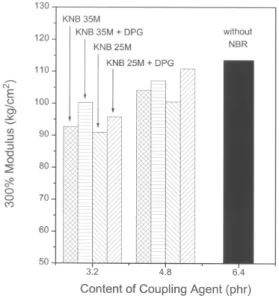
Figure 5. shows variation of the modulus at 300%
strain. The modulus of the vulcanizate without NBR is larger than those of the vulcanizates containing NBR, because the crosslink density of the former is higher than those of the latters as discussed previously. Modulus of a rubber vulcanizate is a proportional property to degree of crosslink density.9 Modulus of a rubber vulcanizate with a higher crosslink density is larger than that of a rubber vulcanizate with a lower one. For the vulcanizates containing NBR, the moduli of the vulcanizates containing DPG are larger than those of the vulca- nizate without DPG. This can be also explained with the crosslink density. The crosslink densities of the vulcanizates containing DPG are higher than those of the vulcanizate without DPG as shown in Figure 4.
The tensile strength of the vulcanizate without NBR is larger than those of the vulcanizates con- taining NBR. (Figure 6) Figure 7 shows variation of the elongation at break. The vulcanizates contai ning NBR have longer elongation at break than the
Figure 5. 300% moduli of the vulcanizates.
Figure 6. Tensile strength of the vulcanizates.
Figure 7. Elongation at break of the vulcanizates.
vulcanizate without NBR, because the former have lower crosslink density than the latter as discussed previously. In general, elongation at break of a vulcanizate with higher crosslink density is smaller than that of a vulcanizate with lower one, since elongation at break is inversely proportional to the degree of crosslink density.9
Figures 8 and 9 show variation of the tan δ at
Figure 8. Tan δ at 0℃ of the vulcanizates. Values of the tanδ at 0℃ reflect the traction property.
Figure 9. Tan δ at 60℃ of the vulcanizates. Values of the tanδ at 60℃ reflect the rolling resistance property.
0 and 60℃, respectively. The tan δ values at 0 and 60℃ reflect the wet traction and the rolling resis- tance, respectively. The larger the tan δ value at 0℃, the better the wet traction property of a vulcanizate.
The smaller the tan δ value at 60℃, the better the wear property of a vulcanizate. The tan δ values
at 0℃ of the vulcanizates containing NBR are higher than that of the vulcanizate without NBR as shown in Figure 8. This implies that NBR is good for the wet traction. The tanδ values at 60℃ of the vulcanizates containing NBR, except the vulca- nizates containing DPG and 4.8 phr of X50S, are higher than that of the vulcanizate without NBR as shown in Figure 9. This implies that the vulcanizate without NBR have better rolling resistance than those of the vulcanizates containing NBR except the two vulcanizates. This may be due to the higher modulus of the vulcanizate without NBR. Though, of the vulcanizates containing NBR, the vulcanizates containing DPG and 4.8 phr of X50S also have lower moduli than the vulcanizate without NBR, the tanδ values at 60℃ of the formers are lower than that of the latter. This may be due to the better silica dispersion of the formers.
Ⅳ. Conclusions
Filler dispersion, cure characteristics, and phy- sical properties of silica-filled rubber compounds are improved by adding NBR. The Mooney scorch times of the compounds containing NBR are faster than that of the compound without NBR. For the cure rate, the formers are faster than the latter when containing DPG, while the formers are slower than the latter without DPG. The crosslink densities of the compounds containing NBR are lower than that of the compound without NBR. The moduli and tensile strength of the vulcanizates containing NBR are lower than those of the vulcanizates without NBR. The tan δ at 0℃ of the vulcanizates contai- ning NBR are higher than that of the vulcanizate without NBR. The tan δ at 60℃ of the formers are lower than that of the latter. By adding NBR, it is
possible to reduce the used amounts of TESPT and DPG in silica-filled SBR compounds.
References
1. U. Görl and A. Hunsche, "Advanced investigations into the silica/silane reaction system", in Proceedings of the Rubber Division 150th Meeting, American Chemical Society, Paper No. 76 (1996).
2. U. Görl and A. Hunsche, "Investigation unto the chemistry of the TESPT sulfur chain", in Proceedings of the Rubber Division 151st Meeting, American Chemical Society, Paper No. 38 (1997).
3. A. S. Hashim, B. Azahari, Y. Ikeda, and S. Kohjiya,
"The effect of TESPT on silica reinforcement of styrene-butadiene rubber", Rubber Chem. Technol., 71, 289 (1998).
4. S.-S. Choi, "Improvement of properties of silica-filled styrene-butadiene rubber compounds using acrylonitrile- butadiene rubber", J. Appl. Polym. Sci., 79, 1127 (2001).
5. S.-S. Choi, "Influence of silane coupling agent on properties of filled styrene-butadiene rubber com- pounds", Kor. Polym. J., 8, 285 (2000).
6. K. Ishikawa, F. Yatsuyanagi, and H. Kaidou, "Novel processing agents for silica-filled rubber", in Pro- ceedings of the Rubber Division 151st Meeting, Ame- rican Chemical Society, Paper No. 9 (1997).
7. S.-S. Choi, "Properties of silica-filled styrene-butadiene rubber compounds containing acrylonitrile-butadiene rubber: Influence of the acrylonitrile-butadiene rubber type", J. Appl. Polym. Sci., 85, 385 (2002).
8. H.-D. Luginsland, "Reactivity of the sulfur chains of the tetrasulfane silane Si69 and the disulfane silane TESPD", Kautsch. Gummi Kunstst., 53, 10 (2000).
9. N. J. Morrison and M. Porter, "Temperature effects on the stability of intermediates and crosslinks in sulfur vulcanization", Rubber Chem. Technol., 57, 63 (1984).