INTRODUCTION
Attention-deficit/hyperactivity disorder (ADHD), a neu- ropsychiatric disorder with attentional and impulsive symp- toms, mainly presents in young adolescents and shares sim- ilar clinical features with anxiety disorder. Since 25–30% of ADHD patients have comorbid anxiety disorder [1] and the features of ADHD and anxiety are sometimes indistinguish- able, understanding the intertwined relationships between ADHD and anxiety has been a major research focus.
Numerous previous studies have suggested childhood ad- versity, which encompasses previous negative experiences during childhood, as a common risk factor for both ADHD and anxiety. A previous study by Brown and Harris [2] pro- vided evidence that childhood adverse experiences contrib- ute to the risk of anxiety in adult life. In addition, females who reported having experienced abuse had higher scores of anxiety than those who did not [3]. The relationship between childhood adversity and anxiety is also demonstrated in child- hood and adolescence; negative family environments and losses or deaths cause anxiety in children [4]. This relation- ship is further supported by the influence of childhood ad- versities on the neurobiological mechanisms of anxiety dis-
This is an Open Access article distributed under the terms of the Creative Commons Attribution Non-Commercial License (https://creativecommons.org/licenses/by-nc/4.0) which permits unrestricted non-commercial use, distribution, and reproduction in any medium, provided the original work is properly cited.
Effects of Adversities during Childhood on Anxiety Symptoms in Children and Adolescents: Comparison of Typically Developing Children and Attention-Deficit/
Hyperactivity Disorder Group
You Bin Lim
1, Kukju Kweon
2, and Bung-Nyun Kim
1,31Department of Neuropsychiatry, Seoul National University Hospital, Seoul, Korea
2Department of Psychiatry, School of Medicine and Institute of Brain Research, Chungnam National University, Daejeon, Korea
3Division of Child and Adolescent Psychiatry, Department of Neuropsychiatry, Clinical Research Institute, Seoul National University Hospital, Seoul, Korea
Objectives: Childhood adversity is a risk factor for anxiety symptoms, but it affects anxiety symptoms in attention-deficit/hyperactivity disorder (ADHD). The current study aimed to examine the association between childhood adversity and anxiety symptoms in partici- pants with and without ADHD.
Methods: Data were obtained from a school-based epidemiological study of 1017 randomly selected children and adolescents. The ADHD and non-ADHD groups were divided using the Diagnostic Interview Schedule for Children Predictive Scale (DPS). The DPS was also used to assess comorbidities such as anxiety and mood disorders. The childhood adversities were assessed using the Early Trauma Inventory Self Report-Short Form, and the anxiety symptoms were assessed using the Screen for Child Anxiety Related Disorders. Lin- ear and logistic regression models were used to investigate the association between childhood adversity and anxiety in the ADHD and non-ADHD groups with adjustments for age and sex.
Results: This study found that the ADHD group did not show any significant association between anxiety symptoms and childhood ad- versities, whereas the non-ADHD group always showed a significant association. In a subgroup analysis of the non-ADHD group, the normal group without any psychiatric disorders assessed with DPS demonstrated a statistically significant association between child- hood adversities and anxiety symptoms. These results were consistent with the association between childhood adversities and anxiety disorders assessed using DPS, as shown by logistic regression.
Conclusion: The association between anxiety symptoms and childhood adversities statistically disappears in ADHD; ADHD may mask or block the association. Further longitudinal research is necessary to investigate this relationship.
Key Words: Adverse childhood experiences; Attention deficit hyperactivity disorder; Anxiety.
Received: February 3, 2021 / Revision: April 5, 2021 / Accepted: May 7, 2021
Address for correspondence: Bung-Nyun Kim, Division of Child and Adolescent Psychiatry, Department of Neuropsychiatry, Seoul National University Hos- pital, 101 Daehak-ro, Jongno-gu, Seoul 03080, Korea
Tel: +82-2-2072-3647, Fax: +82-2-747-2471, E-mail: [email protected]
orders [5].
In addition to the relationship between anxiety and child- hood adversities, the association between anxiety and ADHD has also been emphasized. There was a higher prevalence of childhood adversities in children with than in those without [6], and childhood adversities before age 5 were associated with ADHD at 9 years of age, according to a previous study [7]. Childhood adversities aggravate the risk of behavioral disorders, including ADHD, and they are closely related to externalizing and internalizing symptoms [8]. In addition, the odds ratio (OR) of childhood sexual abuse was higher among those who reported symptoms of ADHD [9].
Despite these recent advances in clarifying the relation- ship between childhood adversities and anxiety symptoms and that between childhood adversities and ADHD, there are still few studies on the influence of childhood adversities on anxiety symptom changes in the ADHD group.
According to a retrospective study of adult ADHD patients who were not diagnosed with ADHD until after childhood, emotional trauma and neglect were more frequent in the ADHD group than in the normal group. When multiple re- gression was conducted to predict the scores for psychoso- cial functioning in this study, the presence of ADHD was more likely to account for current depression, anxiety, lower self- esteem, and uncontrollable attributional style than the his- tory of abuse [9]. Although they suggested that the associa- tion between anxiety and ADHD is stronger than that between anxiety and childhood adversity, further research involving children and adolescents, the main population of ADHD patients, will be necessary to determine the precise relation- ships between trauma, anxiety, and ADHD.
Therefore, the current study aimed to examine the associ- ation between childhood adversities and anxiety symptoms specifically in the ADHD group.
METHODS
Subjects
The data were provided by the participants from a school- based research by the Korean Ministry of Health and Welfare, entitled “Prevalence and Risk Factors of Psychiatric Disorders in Child and Adolescent Population -School Based Research-”
[10]. The study population included children and adolescents aged 8–19 years who had been attending school for the last 6 months. Between April and December 2017, one or two class- es for each grade in randomly selected schools situated in four different Korean cities (Seoul, Goyang, Daegu, and Jeju) were randomly selected, and their students were invited to partici- pate. All the participants and their parents provided written informed consent, and the study protocol, amendments, and
informed consent forms were approved by the Institutional Review Boards of the research centers in each city (0720161058).
As an epidemiological cross-sectional study, the following information was gathered simultaneously from each partic- ipant and parents through questionnaires.
Study assessments ADHD group
The Diagnostic Interview Schedule for Children Predic- tive Scale (DPS) [11], which was filled by parents of the par- ticipants, was used to predict a high-risk group of psychiatric disorders, such as ADHD, anxiety disorder, depressive dis- order, tic disorder, psychotic disorder, substance use disor- der, and oppositional defiant disorder. Since the Korean ver- sion of the DPS has not yet been standardized, it has been translated into Korean. Since the prevalence of the specific phobia, classified as anxiety disorder, has been unusually high, according to a previous analysis using the same data as this study, specific phobias were differentiated from anxiety dis- order in our study [8].
This study used DPS to categorize participants into the ADHD high-risk group (referred to as the ‘ADHD group’
from below) when they showed more than four of the main symptoms of ADHD, including hyperactivity, impulsivity, and attention problems. Using these criteria, this study as- sessed and divided the participants into ADHD and non- ADHD groups. In addition, as sub-groups of the non-ADHD group, the normal group was identified when participants did not show any psychiatric disorder. In addition, DPS was used to assess the risk of comorbidities, including anxiety disorder, mood disorder, psychotic disorder, tic disorder, and substance use disorder.
Childhood adversities
In this study, the Early Trauma Inventory Self Report-Short Form, validated in the Korean version, was used to collect data from the participants of the parents about the childhood ad- versities experienced by the participants until they were 12 years old. This inventory consisted of 27 questionnaires cov- ering four subsets of adversities: general, physical, emotion- al, and sexual adversities. A standardization study proved its validity and internal consistency [12,13]. The adversities were quantitatively assessed and analyzed.
Anxiety scale
The Screen for Child Anxiety Related Disorders (SCARED)
is a self-reporting tool developed by Birmaher et al. It has
high validity and reliability and consists of 39 questions,
which were used mainly to quantitatively measure the anxi-
ety levels of the participants [14-17].
In addition to SCARED, as the main measure of anxiety, DPS was used to categorize anxiety disorder to perform fur- ther logistic regression analysis between childhood adversi- ties and anxiety.
Psychiatric symptoms scale
To assess external/internal or behavioral/affective symp- toms of the participants, the Child Behavior Checklist (CBCL) and Youth Self Report (YSR) were used. While CBCL was conducted by parents of the participants who were ≤13 years, YSR was performed by adolescents ≥14 years of age. The Ko- rean-validated versions of the CBCL and YSR were used in this study to assess the following symptoms: internalizing symptoms, externalizing symptoms, withdrawn symptoms, somatic complaints, anxious depression, social problems, thought problems, attention problems, delinquent behaviors, and aggressive behaviors [18-21].
Statistical analysis
The collected data were filtered so that all the datasets in- cluded information about sex, age, anxiety scale, and wheth- er they were diagnosed with ADHD. The symptoms of the ADHD and non-ADHD groups were compared using t-test.
To investigate whether childhood adversity was a risk factor for anxiety symptoms in both the ADHD and non-ADHD groups, multiple linear regression was used to measure the association between anxiety symptoms and childhood ad- versities. To confirm an association, logistic regression be- tween anxiety disorders assessed with DPS and childhood
adversities was performed. Statistical significance was set at p<0.05, and all the data were analyzed using SPSS Statistics for Windows, version 23 (IBM Corp., Armonk, NY, USA).
RESULTS
Demographic data
A total of 1068 participants (974 non-ADHD and 94 ADHD participants) were included in this study. The non-ADHD group (mean age 13.61 years) was significantly older than the ADHD group (mean age 12.66 years, p=0.015). The non- ADHD group consisted of 421 children (≤13 years) and 553 adolescents (>13 years), whereas the ADHD group consisted of 52 children and 42 adolescents. In addition, the percent- age of males was significantly higher in the ADHD group (55.3%) than in the non-ADHD group (38.5%) (p=0.001). Since these demographic characteristics were significantly differ- ent between the two groups, sex and age were controlled for further analysis.
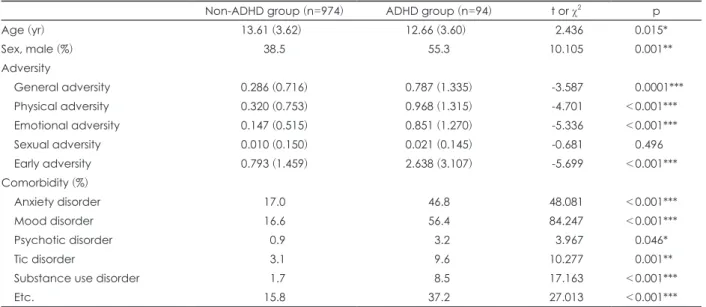
The ADHD group showed a higher prevalence of general, physical, and emotional adversities than the non-ADHD group (p<0.001). The ADHD group had a higher risk of psychiatric comorbidities than the non-ADHD group (Table 1).
Psychiatric symptoms
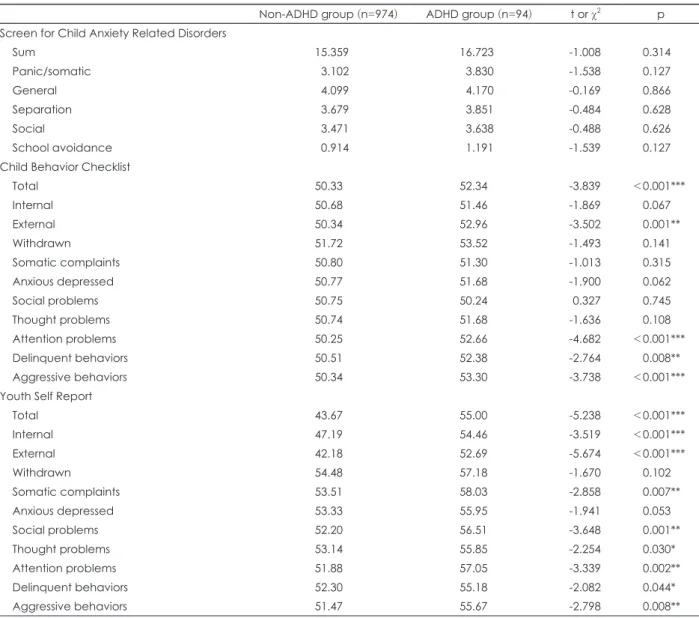
Regarding anxiety symptoms assessed with SCARED, the ADHD group did not show any significant difference from the non-ADHD group. These findings were consistent when anxiety symptoms in the two groups were compared using the anxious depressed subscores of the CBCL and YSR.
Table 1. Difference in characteristics between ADHD group (according to Diagnostic Interview Schedule for Children Predictive Scale) and non-ADHD compared with t-test
Non-ADHD group (n=974) ADHD group (n=94) t or χ2 p
Age (yr) 13.61 (3.62) 12.66 (3.60) 2.436 0.015*
Sex, male (%) 38.5 55.3 10.105 0.001**
Adversity
General adversity 0.286 (0.716) 0.787 (1.335) -3.587 0.0001***
Physical adversity 0.320 (0.753) 0.968 (1.315) -4.701 <0.001***
Emotional adversity 0.147 (0.515) 0.851 (1.270) -5.336 <0.001***
Sexual adversity 0.010 (0.150) 0.021 (0.145) -0.681 0.496
Early adversity 0.793 (1.459) 2.638 (3.107) -5.699 <0.001***
Comorbidity (%)
Anxiety disorder 17.0 46.8 48.081 <0.001***
Mood disorder 16.6 56.4 84.247 <0.001***
Psychotic disorder 0.9 3.2 3.967 0.046*
Tic disorder 3.1 9.6 10.277 0.001**
Substance use disorder 1.7 8.5 17.163 <0.001***
Etc. 15.8 37.2 27.013 <0.001***
Data are presented as mean (standard deviation) or number only. *p<0.05, **p<0.01, ***p<0.001. ADHD: attention-deficit/hyper- activity disorder
Children in the ADHD group scored significantly higher for the total symptoms, external symptoms, attention prob- lems, delinquent behaviors, and aggressive behaviors than children in the non-ADHD group.
When compared with YSR, adolescents with ADHD dem- onstrated higher scores for total symptoms, internal symp- toms, external symptoms, somatic complaints, social prob- lems, thought problems, attention problems, delinquent behaviors, and aggressive behaviors (Table 2).
Association between childhood adversities and anxiety symptoms
Multiple linear regression showed that the association be- tween childhood adversities and anxiety symptoms in the ADHD group was not statistically significant. The results were the same after adjusting for sex and age.
The association between childhood adversities and anxi- ety symptoms in the non-ADHD group was statistically sig- nificant, but general adversities (p=0.011), emotional adver- sities (p<0.001), and the total number of adversities (p=0.001) were associated with anxiety symptoms. Physical and sexual adversities did not show any significant association with anx- iety symptoms. The subgroup analysis of the non-ADHD group generated the same results; the normal group without any psychopathological risks showed a significant associa- tion between the total number of adversities and anxiety symptoms (p=0.034) (Table 3).
Logistic regression showed similar results for the differ- ences between the ADHD and non-ADHD groups regard- ing the association between childhood adversities and anxi- ety disorder assessed with DPS. In the ADHD group, none of the childhood adversities demonstrated any statistically
Table 2. Difference of psychiatric symptoms between ADHD and non-ADHD group compared with t-test
Non-ADHD group (n=974) ADHD group (n=94) t or χ2 p Screen for Child Anxiety Related Disorders
Sum 15.359 16.723 -1.008 0.314
Panic/somatic 3.102 3.830 -1.538 0.127
General 4.099 4.170 -0.169 0.866
Separation 3.679 3.851 -0.484 0.628
Social 3.471 3.638 -0.488 0.626
School avoidance 0.914 1.191 -1.539 0.127
Child Behavior Checklist
Total 50.33 52.34 -3.839 <0.001***
Internal 50.68 51.46 -1.869 0.067
External 50.34 52.96 -3.502 0.001**
Withdrawn 51.72 53.52 -1.493 0.141
Somatic complaints 50.80 51.30 -1.013 0.315
Anxious depressed 50.77 51.68 -1.900 0.062
Social problems 50.75 50.24 0.327 0.745
Thought problems 50.74 51.68 -1.636 0.108
Attention problems 50.25 52.66 -4.682 <0.001***
Delinquent behaviors 50.51 52.38 -2.764 0.008**
Aggressive behaviors 50.34 53.30 -3.738 <0.001***
Youth Self Report
Total 43.67 55.00 -5.238 <0.001***
Internal 47.19 54.46 -3.519 <0.001***
External 42.18 52.69 -5.674 <0.001***
Withdrawn 54.48 57.18 -1.670 0.102
Somatic complaints 53.51 58.03 -2.858 0.007**
Anxious depressed 53.33 55.95 -1.941 0.053
Social problems 52.20 56.51 -3.648 0.001**
Thought problems 53.14 55.85 -2.254 0.030*
Attention problems 51.88 57.05 -3.339 0.002**
Delinquent behaviors 52.30 55.18 -2.082 0.044*
Aggressive behaviors 51.47 55.67 -2.798 0.008**
*p<0.05, **p<0.01, ***p<0.001. ADHD: attention-deficit/hyperactivity disorder
significant association with anxiety disorder. However, in the non-ADHD group, there were significant associations between childhood adversity and anxiety disorder. In other words, the participants with childhood adversities were likely to have an anxiety disorder (early adversity sum: OR 1.528, 95% confidence interval 1.374–1.699, p<0.001), but this association was not demonstrated in the ADHD group (Table 4).
DISCUSSION
The purpose of the current study was to explore the asso- ciations between anxiety symptoms and childhood adversi- ties in the ADHD group; the ADHD group showed distinct associations between anxiety symptoms and childhood ad- versities.
Accumulating evidence shows that individuals with child- hood adversities are more likely to develop psychiatric symp- toms [8]. Compared with the non-ADHD group, the ADHD group showed a higher proportion of participants who re- ported childhood adversities, which was consistent with the findings of previous studies. Likewise, a previous study by Hughes et al. [22] reported a dose-response relationship be- tween childhood adversities and mental disorders, which suggests a significant association between childhood adver- sities and psychiatric symptoms, including anxiety symptoms.
Although the ADHD group was exposed to more child- hood adversities than the non-ADHD group, the severity of anxiety symptoms in the former was not significantly differ- ent from that of the latter. All the other psychiatric symptoms were more severe in the ADHD group than in the non-AD- HD group. These findings were also reflected in the SCARED and CBCL/YSR anxious depressed subscores.
The prevalence of anxiety disorder assessed with DPS, however, was significantly higher in the ADHD group, which was not consistent with the results mentioned above. Sever- al previous studies have emphasized discrepancies between internalizing symptoms, such as anxiety, reported by chil- dren and adolescents and their parents [23,24]. In addition, since DPS has a relatively low threshold for sorting out a high- risk group of anxiety disorders, it may overestimate the anx- iety symptoms compared with the self-reported symptoms.
In addition, the SCARED qualifies as a measure of anxiety symptoms in this study because it is a dimensional assess- ment, whereas the categorical classification of anxiety dis- orders by DPS limits the assessment of anxiety symptoms.
Thus, the SCARED was used for the primary assessment of anxiety symptoms in this study.
As the main finding, the non-ADHD group, including the normal group without any psychiatric disorders, demonstrat-
Table 3. Comparison of association between childhood adversities and anxiety symptom assessed with Screen for Child Anxiety Related Disorders in ADHD and non-ADHD group us- ing linear regression analysis GeneralPhysicalEmotionalSexualEarly adversity sum B (SE
)βpB
(SE
)βpB
(SE
)βpB
(SE
)βp B
(SE
)βp ADHD group
(n=94) Non-adjusted 1.197
(1.043
)0.1190.254-1.478
(1.055
)-0.1450.1640.081
(1.104
)0.0080.942-14.022
(9.551
)-0.1510.145-0.072
(0.451
)-0.0170.874 Adjusted 0.647
(1.044
)0.0640.537-2.011
(1.060
)-0.1970.061-1.026
(1.226
)-0.0970.405-14.934
(9.157
)-0.1610.106-0.485
(0.485
)-0.1120.319 Non-ADHD group
(n=)974 Non-adjusted 1.278
(0.556
)0.0740.022*-0.009
(0.530 )
-0.0010.9863.122
(0.768 )0.129<0.001***0.704 (2.660
)0.0080.7910.731
(0.273
)0.0860.007** Adjusted1.354
(0.530
)0.0780.011*0.465
(0.509
)0.0280.3622.932
(0.735 )0.121<0.001***0.296 (2.531
)0.0040.9070.851
(0.261
)0.1000.001** Subgroup of non-ADHD: normal
(n=)595 Non-adjusted 1.709
(1.009
)0.0690.0910.392
(0.896
)0.0180.662 2.112
(1.558
)0.0560.1761.429
(11.503
)0.0050.9010.902
(0.489
)0.0760.065 Adjusted 1.395
(0.972
)0.0570.1520.941
(0.863
)0.0430.2762.183
(1.496
)0.0570.145-0.547
(11.061
)-0.0020.9610.996
(0.469
)0.0830.034* *p<0.05, **p<0.01, ***p<0.001. ADHD: attention-deficit/hyperactivity disorder, SE
: standard error
ed a significant association between anxiety symptoms and childhood adversities, which was consistent with the find- ings of previous studies that reported childhood adversity as a risk factor for anxiety symptoms [4]. However, in the ADHD group, the anxiety symptoms assessed using the SCARED sum score were not significantly associated with childhood adversities. This implies that ADHD may diminish the asso- ciation, which was apparent in the non-ADHD group.
There are two possible hypotheses for this result. First, ADHD may mask the association between childhood ad- versities and anxiety symptoms since it showed a strong as- sociation with childhood adversities. This relationship may be explained by the results of previous studies that demon- strated that adverse childhood experiences may increase the risk of impulsivity and other externalizing symptoms since adverse childhood experiences influence sensation- or nov- elty-seeking and risk-taking behaviors through altered gene expression in dopamine, oxytocin, and glucocorticoid sys- tems [25]. In other words, ADHD symptoms may be affected by childhood adversities, and their association is well-estab- lished. Therefore, a strong relationship between childhood adversity and ADHD may conceal the relationship between anxiety symptoms and adversity.
Second, ADHD may block such associations and distort the way childhood adversities influence symptoms. This may be attributed to the manifestation of the influence of child- hood adversity as ADHD symptoms rather than anxiety symp- toms. The association between externalizing symptoms and childhood adversities has not yet been fully established, and it is affected by numerous other factors that are yet unknown.
Previous studies have focused on the moderators of the as- sociation between anxiety and childhood adversities, such as psychological resilience and maternal adverse childhood experiences [26,27], and identifying ADHD as another pos- sible moderator may help understand our results.
These two hypotheses could not be tested in our study be- cause the ADHD and the anxiety symptoms at the time were assessed simultaneously. Therefore, the masking of the rela- tionship between childhood adversity and anxiety symptoms
by ADHD cannot be statistically verified. These hypotheses are yet to be confirmed, and they need to be proved through longitudinal studies with considerations of the developmen- tal perspective.
Despite the main findings, our study had several limita- tions. First, as a cross-sectional epidemiological study, this study could not demonstrate any causal relationship between childhood adversities and anxiety symptoms. Therefore, this study could not fully explain whether the association between ADHD and childhood adversity masks or blocks the associ- ation between childhood adversities and anxiety symptoms, which was apparent in the ADHD group. Second, childhood adversities were reported by the parents of the participants, a factor that can affect reliability if the study is retested with the self-reported experience of childhood adversities. In ad- dition, the psychiatric symptoms of the children were collect- ed with the CBCL by the parents, and the results may differ from those based on self-reported experiences. The study also lacked the data of the adolescents who reported through YSR. Third, since a predictive and parent-reported scale, such as DPS, was used to categorize the ADHD and non-ADHD groups, the threshold of being categorized as ADHD may have been lower than the actual standard. The current study used DPS to incorporate more participants so that it would be possible to fully understand the association between child- hood adversities and anxiety symptoms with attentional problems. However, a stricter definition of ADHD may be applied in future studies to investigate whether our results remain consistent.
While this study suggested a different manifestation of anx- iety symptoms affected by childhood adversity in ADHD, the reason or mechanism underlying the concealment of the association between childhood adversity and anxiety symp- toms in ADHD should be explored. Although the ADHD group did not show a significant association between anxi- ety symptoms and childhood adversity, there is still insuffi- cient evidence to presume that such an association was ab- sent in the ADHD group. Therefore, further longitudinal studies on self-reported symptoms and childhood adversi-
Table 4. Comparison of association between childhood adversities and anxiety disorders assessed with Diagnostic Interview Sched- ule for Children Predictive Scale using logistic regression analysis
ADHD group (n=94) Non-ADHD group (n=974)
OR (95% CI) OR (95% CI)
General 1.264 (0.844-1.893) 1.912 (1.524-2.401)**
Physical 0.912 (0.644-1.291) 1.721 (1.421-2.085)**
Emotional 0.923 (0.618-1.379) 2.366 (1.792-3.125)**
Sexual 0 (0-0) 5.419 (1.119-26.338)*
Early adversity sum 1.00 (0.853-1.172) 1.528 (1.374-1.699)**
*p<0.05, **p<0.001. ADHD: attention-deficit/hyperactivity disorder, OR: odds ratio, CI: confidence interval