INTRODUCTION
In the Diagnostic and Statistical Manual of Mental Disor- ders, fifth edition, attention-deficit/hyperactivity disorder (ADHD) is classified under the “neurodevelopmental disor- der” section [1]. Persistence of the disorder up to adulthood has been reported in 40–60% of individuals [2,3]. Although a growing body of research has focused on the persistence of
childhood ADHD through adolescence to adulthood [4,5], professional and public awareness of adult ADHD requires improvement. Concerns associated with stimulant abuse are prevalent, while awareness of the negative consequences re- sulting from ADHD is highlighted. [6,7] There are no prac- tice guidelines specifically for adult ADHD in Korea, al- though major guidelines have been published worldwide and expert opinions have been suggested for appropriate treat- ment for adult ADHD [8,9]. Medical insurance coverage for adult ADHD medication since September 2016, has attrib- uted to the current state of medication, which is inaccurate
This is an Open Access article distributed under the terms of the Creative Commons Attribution Non-Commercial License (https://creativecommons.org/licenses/by-nc/4.0) which permits unrestricted non-commercial use, distribution, and reproduction in any medium, provided the original work is properly cited.
Comparison of Attention-Deficit/Hyperactivity Disorder Practice in Adults According to
a Training Background in Child Psychiatry
Minha Hong
1, Seung-Yup Lee
2, Young Sik Lee
3, Bongseog Kim
4, Yoo Sook Joung
5, Hanik K Yoo
6, Eui-Jung Kim
7, Soyoung Irene Lee
8, Su-Bin Park
9, Soo-Young Bhang
10, Doughyun Han
3, and Geon Ho Bahn
21
Department of Psychiatry, Myongji Hospital, Hanyang University College of Medicine, Seoul, Korea
2
Department of Psychiatry, Kyung Hee University School of Medicine, Seoul, Korea
3
Department of Psychiatry, Chung-Ang University College of Medicine, Seoul, Korea
4
Department of Psychiatry, Inje University College of Medicine, Seoul, Korea
5
Department of Psychiatry, Sungkyunkwan University College of Medicine, Seoul, Korea
6
Seoul Brain Research Institute, Seoul, Korea
7
Department of Psychiatry, College of Medicine, Ewha Womans University, Seoul, Korea
8
Department of Psychiatry, Soonchunhyang University College of Medicine, Buchun, Korea
9
National Center for Mental Health, Seoul, Korea
10
Department of Psychiatry, Eulji University Hospital, Eulji University School of Medicine, Seoul, Korea
Objectives: Awareness of attention-deficit/hyperactivity disorder (ADHD) in adults has significantly increased; however, clinical data specific to the Korean population are insufficient. Clinical experience of ADHD may differ based on whether psychiatrists have re- ceived pediatric psychiatry-specific training. In order to prepare a practice parameter for adult ADHD patients in Korea, we examined questionnaire data to observe how pediatric psychiatry training could affect clinical practice for adults with ADHD.
Methods: A questionnaire about the diagnosis and treatment process was distributed to both general psychiatrists (GPsy) and child and adolescent psychiatrists (CAP) at the summer and winter workshop meetings of Korean Academy of Child and Adolescent Psychiatry.
Results: In total, 142 psychiatrists participated in the survey (86 GPsy, 56 CAP). GPsy and CAP preferred pharmacotherapy (GPsy 82.40%, CAP 64.30%) as the primary treatment option and answered that the clinical psychiatric interview is the most necessary step in diagnostic assessment (GPsy 22.16%, CAP 19.00%). The GPsy responded with an optimal and average treatment duration that was shorter than that reported by CAP.
Conclusion: Identification of the initial presenting symptom as the correct diagnosis and the optimal duration of pharmacotherapy dif- fered between GPsy and CAP in practice, whereas concepts in diagnosis and treatment of ADHD in adults were similar for both groups.
These results suggest the urgent need for the Continuing Medical Education program for psychiatrists treating adults with ADHD.
Key Words: Adult; Attention deficit hyperactivity disorder; Practice pattern; Experts.
Received: June 12, 2019 / Revision: June 19, 2019 / Accepted: June 21, 2019
Address for correspondence: Geon Ho Bahn, Department of Psychiatry, Kyung Hee University College of Medicine, 23 Kyungheedae-ro, Dongdaemun-gu, Seoul 02447, Korea
Tel: +82-2-958-8556, Fax: +82-2-957-1997, E-mail: [email protected]
and with an absence of information on the patterns of treat- ment or compliance. There is a need for the Korean Practice Guideline not only because of issues caused by insurance, but also due to culture specific issues such as the stigma sur- rounding psychiatric disorders and their medication, differ- ences in drug availability for clinical use, and differences in drug efficacy, and adverse event profiles for Asians, specific for Korean patients. Nonetheless, with the consequent in- creasing interest in adult ADHD, it has progressively be- come the main subject of media reports and academic con- ferences in the field of psychiatry.
Improvement in public awareness has led to an increase in the number of adult ADHD patients seeking general psy- chiatric specialists as well as child and adolescent psychia- trists (CAP) and general psychiatrists (GPsy), actively in- volved with treating patients. However, it is our understanding that CAP are more familiar with symptoms and signs of ADHD, due to their experience with childhood and adoles- cent ADHD, and therefore may be more familiar with the symptoms or signs that change with time. For example, the
‘hyperactive’ symptom is observed in adults with ADHD as avoidance of symposiums, lectures, or church sermons, while in children, it is observed as standing up while eating or while in the classroom.
In order to establish a practice parameter for adult ADHD, the ‘Adult ADHD Study Group in the Korean Academy of Child & Adolescent Psychiatry’ surveyed the expert consen- sus of GPsy on their diagnostic and treatment methods for adults with ADHD.
METHODS
Prior to the survey, the use of the questionnaire was con- firmed through the several meetings with authors who were members of Adult ADHD Study Group. The survey was con- ducted with the voluntary participation of Korean psychiatrists.
In Korea, one can become a board-certified psychiatrist (GPsy) after passing the 4-year psychiatric resident training exam and then a qualified CAP by undergoing an addition- al 2-year training. Here, we categorized the psychiatrists without child and adolescent psychiatric training as GPsy, and with child and adolescent psychiatric training as CAP.
The survey questionnaire was distributed at the summer, August 2018, and winter, February 2019, workshops of Ko- rean Academy of child and adolescent psychiatry from Au- gust 2018 to February 2019. Among the 195 attendants, re- sponses were received from 142 members: 86 GPsy and 56 CAP. The response rate was 74.3%.
The questionnaire included the following parameters; 1) sociodemographic variables such as age, sex, and years of
clinical experience, 2) opinion and clinical practice about di- agnostic assessment of adult ADHD such as chief complaints at initial visit and steps to diagnosis and differential diagno- sis, and 3) opinion and clinical practice about adult ADHD treatment, such as preferred treatment options, preference of anti-ADHD medication, and treatment duration.
Data analysis
Descriptive statistics were calculated to analyze demo- graphic characteristics. We used Student’s t-test to compare the means and the Chi-squared (χ
2) test to compare propor- tions. We did not include missing responses in our compu- tations. The data were analyzed using SPSS for Windows (ver- sion 21.0; IBM Corp., Armonk, NY, USA).
Ethics statement
This study’s protocol was approved by the Institutional Review Board of Hospital (KMC IRB 2017-02-054).
RESULT
General
Psychiatrists in the CAP group were older and had more clinical experience than did those in the GPsy group (Table 1).
Percentage of patients showing ADHD core symptoms as the chief complaint at the first clinic visit was statistically different between groups. (GPsy 48.16%, CAP 56.48; p=0.045).
The presenting symptoms of bipolar disorder, anxiety dis- order, and substance abuse disorders (SUDs) as the chief complaints in patients with ADHD were significantly high- er in the GPsy group (p=0.016, p=0.011, p=0.004) (Table 1).
Diagnosis
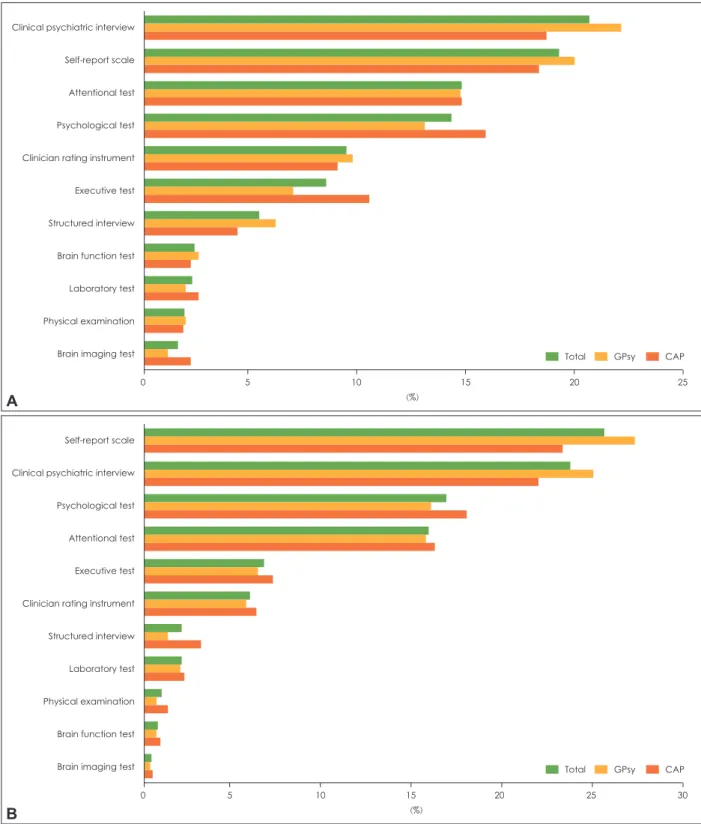
In the diagnostic process, both GPsy and CAP used a self- report scale, clinical psychiatric interview, psychological tests, and attention tests in order of descending frequencies (Fig. 1).
Treatment
GPsy and CAP equally prefer pharmacotherapy as the first option, psychoeducation as the second, and cognitive be- havioral therapy as the third. (Fig. 2) Optimal treatment du- ration according to 31.3% of GPsy and 5.7% of CAP was less than 1 year. The average duration of treatment in adult ADHD was less than 6 months for 38% of GPsy and 1.9% of CAP (Table 2).
DISCUSSION
Results of this survey suggest that there is no significant
difference between GPsy and CAP, with regards to the pref-
erence of a self-report scale and clinical psychiatric inter- view, while diagnosing adult ADHD, considering the medi- cation, psychoeducation, and cognitive behavioral treatment in adult ADHD.
However, there was a significant difference in GPsy con- sidering comorbid diseases such as bipolar disorder, anxiety disorder, and SUD at the first visit. This suggests that the GPsy interpret the patients’ symptoms as a symptom of oth- er diseases common to adults rather than as the core symp- toms of ADHD. For a symptom such as “difficulty in con- centration,” GPsy seem to first consider diagnoses of other conditions that may occur in adulthood and CAP seem to consider ADHD as the first diagnosis in a developmental perspective.
In the absence of a single diagnostic tool that can be called
‘gold standard,’ a final decision of the clinician based on clini- cal information is imperative; therefore it is reasonable to
conclude that a clinical interview is conducted after the ad- ministration of a self-report scale to identify subjective symp- toms. Additionally, psychological tests and attention tests, which are comparatively objective and capable of examin- ing attention, are the third and fourth necessary diagnostic assessments. These are performed in order to obtain an ob- jective, evidence-based diagnosis in practice.
In terms of treatment, our result of pharmacotherapy pref- erence as the first option is consistent with the existing guide- line that drug treatment should be the first line of treatment unless the person prefers a psychological approach [10].
Average treatment duration and optimal treatment peri- od is significantly shorter for GPsy than CAP, possibly due to the difference of opinion and in clinical experience on long- term course and prognosis.
To date, thorough psychiatric interview is important in di- agnosis of adult ADHD [11]. Therefore, clinical experience
Table 1. Characteristics of respondents of the survey
CAP (n=56)
GPsy
(n=86) t/z/χ
2p Total
(n=142) Age (years), n (%)
Mean 43.80 40.16 2.616* 0.010 41.57
<40 22 (39.28) 50 (58.13) 72 (50.34)
40-50 19 (33.92) 22 (25.58) 41 (28.67)
≥50 13 (23.21) 13 (15.11) 26 (18.18)
No answer 2 (3.57) 1 (1.18) 3 (2.81)
Sex (male), n (%) 24 (42.86) 38 (44.19) 62 (43.66)
Years of clinical experience, after board acquisition (mean)
13.62 9.99 2.542* 0.012 11.55
Experience of treatment of adults with ADHD, n (%) 55 (98.21) 79 (91.86) -1.322 0.188 134 (94.37) Number of patients the respondent has experience
with, n (%)
<10 10 (18.18) 41 (51.90) 51 (38.06)
10-50 31 (56.37) 35 (44.30) 66 (49.25)
≥50 14 (25.45) 3 (3.80) 17 (12.69)
Percentage of patients showing ADHD core symptoms as initial clinical presentation
at the 1st visit, %
56.48 48.16 2.024* 0.045 51.09
Other than ADHD core symptoms
Bipolar disorder 14.17 23.75 -2.465* 0.016 20.00
Depressive disorder 44.48 38.39 1.541 0.126 40.57
Anxiety disorder 23.56 32.50 -2.602* 0.011 28.37
SUD 14.04 27.17 -3.041
†0.004 21.31
Personality disorder 10.33 12.14 -0.285 0.800 12.11
Intermittent explosive disorder 25.08 24.34 0.183 0.856 24.46
Others 13.50 14.58 -0.314 0.771 14.09
Percentage of patients who were diagnosed as ADHD, when they were grown up, %
55.19 66.42 -1.995* 0.048 62.10
*p<0.05,
†p<0.01. ADHD: attention-deficit/hyperactivity disorder, CAP: child and adolescent psychiatrists, GPsy: general psychia-
trists, SUD: substance abuse disorder
of the physician is important. CAP experience the growth and development of child and adolescent patients with ADHD, while accumulating experience, considering that many par- ents of child and adolescent patients are with ADHD. With regard to adult ADHD patients, communication between
GPsy and CAP is essential.
All GPsy need a long time to build up their experience; hence, it is necessary that psychiatrists of the CAP group share their knowledge on the long-term clinical course and their clinical experience. Utilization of valid and appropriate di-
Clinical psychiatric interview Self-report scale Attentional test Psychological test Clinician rating instrument Executive test Structured interview Brain function test Laboratory test Physical examination Brain imaging test
0 5 10 15 20 25
(%)
Total GPsy CAP
A
Fig. 1. The diagnostic assessment methods. A: The diagnostic assessment methods in current practice (%), B: The diagnostic assess- ment methods in the text-book level knowledge (%). CAP: child and adolescent psychiatrists, GPsy: general psychiatrists.
Self-report scale Clinical psychiatric interview Psychological test Attentional test Executive test Clinician rating instrument Structured interview Laboratory test Physical examination Brain function test
Brain imaging test
0 5 10 15 20 25 30
(%)
Total GPsy CAP
B
agnostic tools such as Korean ADHD Rating Scale [12,13], which is a screening tool developed by WHO and standard- ized in Korea, Korean Adult ADHD Rating Scale [12], which has been developed and standardized in Korea, Diagnostic Interview for ADHD in Adults [12,14], which is a semi-struc- tured diagnostic tool for assessing the presence or absence of symptoms by obtaining detailed examples of each item of diagnostic criteria, and Comprehensive Attention Test [12], which has adulthood norms, are needed to complement shortcomings in clinical practice. Current clinical interviews are disadvantaged due to the lack of objectivity, but can be complemented by using the above-mentioned tools when assessing individuals with ADHD.
CONCLUSIONS
Regardless of whether the psychiatrists receive training for pediatric psychiatry, GPsy have a textbook-level knowl- edge about ADHD. However, GPsy may not be able to iden-
tify and interpret an adult ADHD patient’s line of thought.
CAP and GPsy may have different indices of suspicion in the initial stage of ADHD diagnosis in adults. Considering the duration of optimal pharmacotherapy, both groups agreed in theory, however, they demonstrated differences in opin- ions with regards to clinical practice.
Efforts should be made to narrow the gap between the ex- pert opinions of the two groups in order to reduce the po- tential confusion that may be experienced by patients in clinical practice. As part of this effort, we intend to provide Continuous Medical Education that includes newly devel- oped and updated diagnostic tools and current knowledge on adult ADHD, to improve the knowledge among experts and share clinical experiences to provide more advanced medical care. It is important to offer Continuing Medical Ed- ucation program to doctors to aid their examination of adult ADHD patients and to collect the data for the long-term follow-up in adults with ADHD.
Conflicts of Interest
The authors have no potential conflicts of interest to disclose.
REFERENCES
1) American Psychiatric Association. DSM-5 Task Force. Diagnostic and statistical manual of mental disorders: DSM-5
TM. 5th ed.
Washington DC: American Psychiatric Association;2013. p.947.
2) Sibley MH, Mitchell JT, Becker SP. Method of adult diagnosis in- fluences estimated persistence of childhood ADHD: a systematic review of longitudinal studies. Lancet Psychiatry 2016;3:1157-1165.
3) Sibley MH, Swanson JM, Arnold LE, Hechtman LT, Owens EB, Stehli A, et al. Defining ADHD symptom persistence in adult- hood: optimizing sensitivity and specificity. J Child Psychol Psy- chiatry 2017;58:655-662.
4) American Psychiatric Association. Diagnostic and statistical manual of mental disorders. 5th ed. Washington DC: American Psychiatric Association Publishing;2013.
5) Agnew-Blais JC, Polanczyk GV, Danese A, Wertz J, Moffitt TE, Arseneault L. Evaluation of the persistence, remission, and emer- gence of attention-deficit/hyperactivity disorder in young adult- hood. JAMA Psychiatry 2016;73:713-720.
6) Caye A, Rocha TB, Anselmi L, Murray J, Menezes AM, Barros FC, et al. Attention-deficit/hyperactivity disorder trajectories from childhood to young adulthood: evidence from a birth cohort sup- porting a late-onset syndrome. JAMA Psychiatry 2016;73:705-712.
7) Noh GM, Lee SM, Bahn GH. Social function of adult men with at- tention-deficit/hyperactivity disorder in the context of military service. Neuropsychiatr Dis Treat 2018;14:3349-3354.
8) Kooij SJ, Bejerot S, Blackwell A, Caci H, Casas-Brugué M, Car- pentier PJ, et al. European consensus statement on diagnosis and treatment of adult ADHD: The European Network Adult ADHD.
BMC Psychiatry 2010;10:67.
9) Young S, Adamou M, Asherson P, Coghill D, Colley B, Gudjons- son G, et al. Recommendations for the transition of patients with ADHD from child to adult healthcare services: a consensus state- ment from the UK adult ADHD network. BMC Psychiatry 2016;16:301.
10) Faltinsen E, Zwi M, Castells X, Gluud C, Simonsen E, Storebø OJ.
Updated 2018 NICE guideline on pharmacological treatments for people with ADHD: a critical look. BMJ Evid Based Med 2019;
Fig. 2. The preferred treatment options for attention-deficit/hy- peractivity disorder in adults. CAP: child and adolescent psy- chiatrists, GPsy: general psychiatrists.
100 80 60 40 20
0 1st
pharmacotherapy
2nd psychoeducation
3rd cognitive behavioral therapy
(%)
Total GPsy
CAP