• 검색 결과가 없습니다.

Dysfunction of Time Perception in Children and Adolescents with Attention-Deficit Hyperactivity Disorder

N/A
N/A
Protected

Academic year: 2021

Share "Dysfunction of Time Perception in Children and Adolescents with Attention-Deficit Hyperactivity Disorder"

Copied!
8
0
0

로드 중.... (전체 텍스트 보기)

전체 글

(1)

Introduction

Attention-deficit hyperactivity disorder (ADHD) is asso- ciated with specific frontal-lobe mediated executive dysfunc- tion,

1)

and most prominent deficits in ADHD can be found in the task of motor response inhibition, working memory and sustained attention.

2,3)

ADHD symptoms continue into adulthood. Nearly 65% of children with ADHD show partial remission by the age of 25.

4)

Although hyperactivity symp- toms seem to decline, inattention, impulsivity symptoms, and poor executive functions persist into the adolescent and adult years.

5)

Neuropsychological studies have shown that ADHD pa-

tients have cognitive deficits in the timing functions,

6)

de- fined as functions that are necessary for temporal informa- tion processing. These timing deficits are linked with frontal- lobe mediated executive dysfunction.

2,3)

It is widely known that frontal functions including motor response inhibition, working memory and sustained attention are often impaired in ADHD.

4,5)

Timing function refers to the ability to manage the tem- poral domain in behavior, such as the adjustment of behav- ior to timeframes, the ability to perceive and estimate time intervals, and the ability to consider future consequences of behavior. Accordingly, timing functions are subcategorized into motor timing, time perception, and temporal foresight.

7)

Particularly, time perception is the ability to measure ex- plicitly attended temporal intervals that can be considered as a complex cognitive and adaptive ability to estimate, pre- dict, and respond effectively to future events. In this sense, accurate representation of transient information is required to accomplish the ability to plan and organize adequate se- quences of behavioral actions.

8)

Time perception is often mea-

Dysfunction of Time Perception in Children and Adolescents with Attention-Deficit Hyperactivity Disorder

Dong-Won Shin, M.D., Ph.D., Se-Won Lim, M.D., Ph.D., Young-Chul Shin, M.D., Ph.D., Kang-Seob Oh, M.D., Ph.D., Eun-Jin Kim, M.D., and Yun-Young Kwon, M.D.

Department of Psychiatry, Kangbuk Samsung Hospital, Sungkyunkwan University School of Medicine, Seoul, Korea Objectives: Children with attention-deficit hyperactivity disorder (ADHD) may have deficits in time perception, as assessed by the time estimation task and the time reproduction task, however its age-related trajectory is not yet determined. Therefore we examined the correlation between accuracy of time perception tasks and age, and the association between accuracy of es- timation tasks and reproduction tasks.

Methods: Sixty-three patients with ADHD, aged 8 to 18 years tested the tasks for five time durations (2, 4, 12, 45, and 60 seconds). Accuracy of tasks was assumed differences (absolute values) between raw results of tasks and original time dura- tions. Spearman’s correlation analysis was performed to determine correlation between accuracy of time perception tasks and age. Multivariate regression was used to determine the association of accuracy of estimation tasks with accuracy of reproduc- tion tasks.

Results: Age showed correlation with accuracy of estimation tasks, but not with that of reproduction tasks. We observed that the higher the accuracy in 12, 45, and 60 seconds duration time reproduction, the higher the accuracy in longer seconds duration time estimation.

Conclusion: Age was correlated with time estimation accuracy whereas there was no impact on time reproduction accura- cy. Association of each of the two time perception tasks, particularly in longer time duration, suggested specific impairments in time perception.

KEY WORDS: Attention-Deficit Hyperactivity DisorderㆍTime PerceptionㆍChildㆍAdolescentㆍAge Factors.

Date received: November 13, 2015 Date of revision: January 4, 2016 Date accepted: January 12, 2016

Address for correspondence: Yun-Young Kwon, M.D., Department of Psy- chiatry, Kangbuk Samsung Hospital, Sungkyunkwan University School of Medicine, 29 Saemunan-ro, Jongno-gu, Seoul 03181, Korea

Tel: +82.2-2001-8532, Fax: +82.2-2001-2211

E-mail: [email protected]

(2)

sured by the verbal time estimation task and the time repro- duction task.

Numerous studies demonstrate a time perception deficit in children with ADHD.

9,10)

Both the time estimation task and the time reproduction task are needed for working mem- ory

9)

and attention.

7)

Although timing function and inhibi- tion function are not found to be intercorrelated in the normal population, timing function deficits in patients with ADHD appear to be associated with inhibitory control deficit and impulsiveness.

2,3)

During normal development, time perception improves as children get older. From the age of 4 months, training can be given to distinguish time interval,

11)

and several studies report that time perception constantly improves up to mid- dle adulthood.

12,13)

However, the age-related developmental change in time perception ability in ADHD remains un- known. To the best of our knowledge, only two cross- sec- tional studies

14,15)

have reported the developmental course of time perception in ADHD by comparing age groups.

Marx et al.

14)

compared time perception tasks in children and adults with ADHD. They found less time reproduction error in adults with ADHD than in the children group, but timing function deficits seem to persist into adulthood com- pared to age and IQ matched healthy controls. Valko et al.

15)

found that there was no interaction between ADHD and age in the time reproduction task when they analyzed the whole group including children and adults.

Up till now, no studies assessing the age effect on time perception in children and adolescents with ADHD using the verbal time estimation task have been reported. In this study, we aimed to investigate the correlation between age and time perception ability using those tasks in children and adolescents with ADHD.

Further, frontal function is a necessary basis for both time reproduction and estimation tasks; therefore, we can antici- pate that both tasks are inter-related in ADHD. After review- ing the literature, we found no studies comparing accuracy of the time estimation task and the time reproduction task in ADHD. Another aim of this study was to examine the as- sociation between accuracy of the estimation task and the reproduction task in children and adolescents with ADHD.

Methods

1. Subjects

The study was conducted between January 2010 and De- cember 2010. From among youth aged 8 to 18 years who were psychiatric outpatients in ◯◯ Samsung Hospital, patients

were enrolled if they fulfilled the following criteria: 1) they were diagnosed with ADHD by Kiddie-Schedule for Affec- tive Disorders and Schizophrenia-Present and Lifetime ver- sion-Korean version,

16)

2) their IQ scores were higher than 70 on the Korean Educational Development Institute Wechsler Intelligence Scale for Children (KEDI-WISC), Revised

17)

or Weschsler Intelligence Scale for Children, 3rd edition (WISC- III).

18)

Youth were excluded if they had a major psychiatric illness (e.g., psychosis, pervasive developmental disorder) and severe medical condition including brain injury and ep- ilepsy. Informed consent to participate in this study was pro- vided by participants/parents. The protocol of this study was approved by the Institutional Review Board at Kangbuk Sam- sung Hospital.

2. Time estimation task and time reproduction task The time estimation task and the time reproduction task conducted in the previous study

19)

were used to assess time perception. In the estimation task, several predetermined time durations were presented by using a stopwatch. The examiner told the child when to start and stop the stopwatch by using a verbal word, and the child answered the question on time duration using a verbal word. After this task, the reproduction task was performed as the child reproduced these predetermined time durations using a stopwatch. There were a total of five predetermined time durations (2, 4, 12, 45, and 60 s) and all these time durations were presented twice. All of these time durations were presented in an iden- tical order to all participating children, first, from the short- est to the longest time duration, and second, randomly. The child completed the time estimation and time reproduction tasks twice. From these two trials, mean of the time estima- tion task and time reproduction task was calculated. For ex- ample, in the 60 seconds time reproduction task, if the child achieved 58 seconds in the first trial and 60 seconds in the second trial, the result was defined as the mean value of these two numbers, i.e., 59 seconds.

The absolute value of the difference between predeter-

mined time durations (2, 4, 12, 45, and 60 s) and the child’s

actual perceived duration was calculated to confirm the ac-

curacy of the task performed. For example, if the examiner

presented 12 seconds and the child actually perceived this

time as 10 seconds, then the absolute value of the difference

was 2 seconds. As the absolute value of the difference con-

verges to zero, actual perception of time duration was con-

sidered to be more accurate. This confirmation using the

absolute value of the difference was also obtained in the time

reproduction task.

(3)

3. Measurement

The demographic variables, sex, age, parent’s education lev- el and occupation, and economic status were collected by the self-report method. Korean ADHD Rating Scale (K-ARS)

20)

and Inattention/Overactivity With Aggression Conners’

Parent Rating Scale (IOWA CPRS)

21)

were included in this report. Study participant’s intellectual ability was measured using KEDI-WISC

17)

or WISC-III,

18)

and ADHD Diagnostic System (ADS),

22)

which is a computerized continuous per- formance test that consists of visual-auditory stimulation was also performed.

4. Statistical analysis

The participating children’s sex and age, their parents’ ed- ucational, occupational, and socioeconomic status were not- ed as baseline demographic characteristics. K-ARS score,

20)

IOWA CPRS score,

21)

IQ scores, and variables measured in ADS

22)

such as omission error, commission error, response time, and standard deviation of response time were noted as baseline clinical characteristics.

Demographic and clinical variables were compared by Student’s t-test for continuous variables and chi-square test for categorical variables. Correlation between age, IQ, accu- racy of the time estimation task and accuracy of the time re- production task was assessed using Spearman’s rank corre- lation test. Pearson’s correlation analysis was performed to examine a correlation between the accuracy of time percep- tion tasks and the scores of ADHD scales. The accuracy of the time estimation task and the accuracy of the time repro- duction task were log transformed to achieve normal distri-

butions of the variables, and multivariate linear regressions were performed to evaluate the association between accura- cy of the time estimation task and accuracy of the time re- production task after adjusting for confounding factors (age, sex, IQ). Statistical analysis was performed using PASW statistics 18.0 (IBM, Armonk, NY, USA). The cut-off for sta- tistical significance was set at p<.05.

Results

In this study, 63 participants (41 boys, 22 girls) were in- cluded in the final analyses. The mean age of the participants was 12.89 years (8 years of age, N=5; 9 years of age, N=8; 10 years of age, N=4; 11 years of age, N=5; 12 years of age, N=9;

13 years of age, N=2; 14 years of age, N=8; 15 years of age, N=5; 16 years of age, N=9; 17 years of age, N=5; 18 years of age, N=3); boys and girls had mean ages of 12.3±2.9 years and 13.9±3.2 years, respectively.

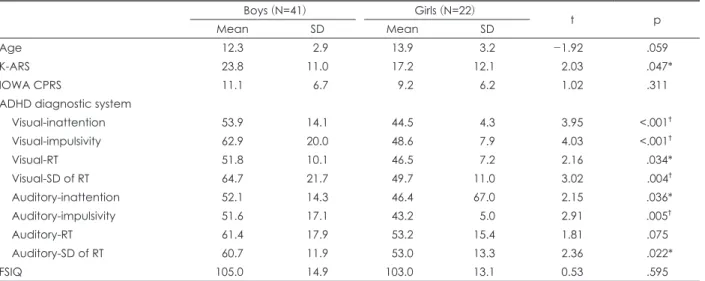
No significant intergroup differences were observed in age, IOWA CPRS, and IQ scores (Table 1). Statistically significant differences were observed in K-ARS and ADS. Boys had higher mean K-ARS scores than girls (23.8±11.0 vs. 17.2±

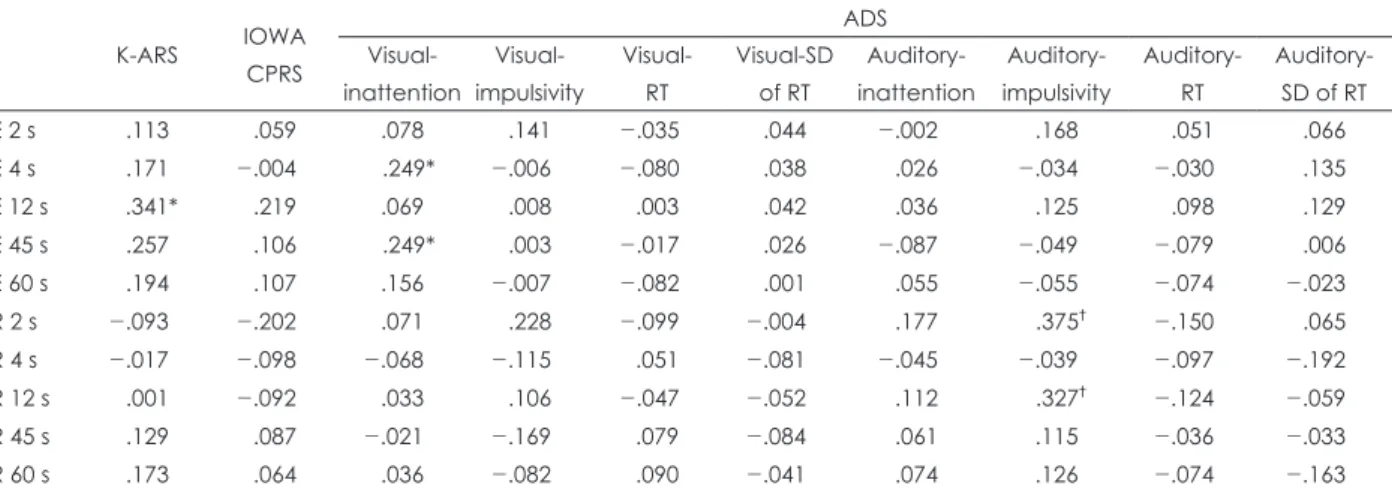
12.1, p=.047). Scores of ADS subcategories were signifi- cantly higher in boys compared to girls except for the audi- tory-reaction time score. No gender differences were found with respect to the time perception task accuracy. Certain accuracy of time perception tasks indicated a correlation be- tween the K-ARS scores and the ADS scores. However, in most second durations, correlation between accuracy of time perception tasks and those ADHD scales was not signifi-

Table 1. Baseline demographic and clinical characteristics of participants

Boys (N=41) Girls (N=22)

t p

Mean SD Mean SD

Age 12.3 2.9 13.9 3.2 -1.92 .059

K-ARS 23.8 11.0 17.2 12.1 2.03 .047*

IOWA CPRS 11.1 6.7 9.2 6.2 1.02 .311

ADHD diagnostic system

Visual-inattention 53.9 14.1 44.5 4.3 3.95 <.001

Visual-impulsivity 62.9 20.0 48.6 7.9 4.03 <.001

Visual-RT 51.8 10.1 46.5 7.2 2.16 .034*

Visual-SD of RT 64.7 21.7 49.7 11.0 3.02 .004

Auditory-inattention 52.1 14.3 46.4 67.0 2.15 .036*

Auditory-impulsivity 51.6 17.1 43.2 5.0 2.91 .005

Auditory-RT 61.4 17.9 53.2 15.4 1.81 .075

Auditory-SD of RT 60.7 11.9 53.0 13.3 2.36 .022*

FSIQ 105.0 14.9 103.0 13.1 0.53 .595

*: p<.05,

: p<.001. ADHD: attention-deficit hyperactivity disorder, FSIQ: full scale intelligence quotient, IOWA CPRS: Inattention/

Overactivity With Aggression Conners’ Parent Rating Scale, K-ARS: Korean ADHD Rating Scale, RT: reaction time, SD: standard de-

viation

(4)

cant (Table 2).

The accuracy of time reproduction tasks in most second durations showed a significant positive correlation with the accuracy of time estimation tasks (Table 3). Age had a nega- tive correlation with the accuracy of time estimation tasks (Table 4). In other words, in time estimation tasks, age and absolute value of the result of subtraction; actual time mea- sured by participants from the original time duration tended to be in inverse proportion. But no correlation was found between age and accuracy of time reproduction tasks. IQ score was not significantly correlated with the accuracy of both tasks, except only in the 2-second duration time esti- mation task (Table 4). Participants were recruited in two age groups (8–11-year-old children, 12–18-year-old adolescents).

There were no group differences in the accuracy of time per- ception tasks. Also, higher accuracy in 12, 45, and 60 sec- onds duration time reproduction was associated with higher accuracy in longer duration time estimation. But no associa- tion was observed in 2 and 4 seconds duration time repro- duction tasks (Table 5).

Discussion

The main purpose of this study was to evaluate age-relat- ed patterns of time perception in children and adolescents with ADHD. A notable point was that no significant corre- lations were observed between accuracy of time reproduc- tion tasks and age. In time estimation tasks, the absolute value of the difference between actual time measured by partici- pants and original time duration showed a negative correla- tion with age. We assumed that the absolute value of the dif- ference between actual time measured by participants and original time duration was represented as accuracy of tasks.

A lesser absolute value indicated a more accurate task per- formance. In other words, more accurate time estimation was correlated with older age, whereas time reproduction was not correlated with age.

Marx et al.

14)

found a general time reproduction deficit in 20 children, 20 adolescents, and 20 adults with ADHD.

However, time reproduction error tended to decline with in- creasing age in ADHD. They also found that adolescents and adults with ADHD significantly under-reproduced the lon- gest time durations of 36 and 48 s compared to age and IQ matched healthy controls. In the study by Valko et al.,

15)

chil- dren and adults with ADHD were compared to sex, age and IQ matched healthy controls based on the time reproduction task whose intervals of 1, 2, 3 ,4, 6, and 8 s had to be repro- duced. There was no interaction between ADHD and age effects in the whole group, and this result suggested that continuation of difficulties in time reproduction until adult- hood in ADHD. But when children and adults were analyzed

Table 2. Correlation between accuracy of time perception tasks and scores of ADHD Rating Scales and continuous performance task

K-ARS IOWA

CPRS

ADS Visual-

inattention

Visual- impulsivity

Visual- RT

Visual-SD of RT

Auditory- inattention

Auditory- impulsivity

Auditory- RT

Auditory- SD of RT

E 2 s .113 .059 .078 .141 -.035 .044 -.002 .168 .051 .066

E 4 s .171 -.004 .249* -.006 -.080 .038 .026 -.034 -.030 .135

E 12 s .341* .219 .069 .008 .003 .042 .036 .125 .098 .129

E 45 s .257 .106 .249* .003 -.017 .026 -.087 -.049 -.079 .006

E 60 s .194 .107 .156 -.007 -.082 .001 .055 -.055 -.074 -.023

R 2 s -.093 -.202 .071 .228 -.099 -.004 .177 .375

-.150 .065

R 4 s -.017 -.098 -.068 -.115 .051 -.081 -.045 -.039 -.097 -.192

R 12 s .001 -.092 .033 .106 -.047 -.052 .112 .327

-.124 -.059

R 45 s .129 .087 -.021 -.169 .079 -.084 .061 .115 -.036 -.033

R 60 s .173 .064 .036 -.082 .090 -.041 .074 .126 -.074 -.163

*: p<.05,

: p<.001. ADHD: attention-deficit hyperactivity disorder, ADS: ADHD Diagnostic System, E: accuracy of time estimation task, IOWA CPRS: Inattention/Overactivity With Aggression Conners’ Parent Rating Scale, K-ARS: Korean ADHD Rating Scale, R:

accuracy of time reproduction task, RT: reaction time, SD: standard deviation Table 3. Correlation between accuracy of time reproduction

tasks and accuracy of time estimation tasks

R 2 s R 4 s R 12 s R 45 s R 60 s

E 2 s .391

.386

.221 .124 .207

E 4 s .311* .524

.389

.402

.417

E 12 s .306* .533

.477

.505

.374

E 45 s .194 .437

.330

.501

.364

E 60 s .216 .281* .377

.465

.326

*: p<.05,

: p<.001. E: accuracy of time estimation task, R: ac-

curacy of time reproduction task

(5)

separately, only children presented the underreproduction of longer time duration compared to controls.

Contrary to previous studies,

14,15)

our results which showed no correlation between accuracy of time reproduction and aging can be explained as follows: we confined participants to children and adolescents, whereas the previous two stud-

ies

14,15)

had included adults. Because of the absence of the

adult group in our sample, our results may not reflect a more definite age effect and developmental trajectory continuing into adulthood was not observed in ADHD population. There is evidence that cortical development in patients with ADHD lagged behind that of normal developing controls by several years.

23)

The cortical maturation delay in ADHD was most prominent in the lateral prefrontal cortex,

23)

causing inabili- ty to suppress inappropriate responses

24)

and executive con- trol of attention,

25)

which may be potential causes of time reproduction deficits. Furthermore, Marx et al.

14)

included only male participants, and therefore, the results cannot be generalized to female patients with ADHD. Valko et al.

15)

used time duration shorter than 10 s in the reproduction task and the result of the whole group analysis was contrasted with a separate analysis in children and adults. The results in our study suggested no significant differences between two age groups in the time perception task ability. Compar- ing two groups with broad range of age was not sensitive enough to reflect individual developmental differences.

Although time reproduction had no correlation with age, the accuracy of time estimation task was presented as a posi- tive correlation. There are no preceding studies about the age-related time estimation task, and hence, our results are poorly understood. Findings indicate that ADHD is associ- ated with a specific impairment in the capacity to reproduce rather than estimate time durations and that this may be re- lated to the deficits in inhibition and working memory.

26)

In addition, the correlation between accuracy of time per- ception tasks and K-ARS scores and the ADS scores was not significant. In other studies,

10,26-28)

an association between dysfunction of time perception in ADHD and their clinical severity measures has not always been consistent and the interrelationship between time perception ability and those ADHD scales in ADHD needs to be further investigated.

Another aim of this study was to identify the relationship between accuracy of time estimation tasks and accuracy of time reproduction tasks. The two tasks tended to correlate positively with each other. Also, through regression analy- sis, we observed that the higher the accuracy in 12, 45, and 60 seconds duration time reproduction, the higher the accu- racy in longer seconds duration time estimation in children Table 4.

Correlation between accuracy of time perception tasks and age/IQ E 2 s E 4 s E 12 s E 45 s E 60 s R 2 s R 4 s R12 s R 45 s R 60 s r p r p r p r p r p r p r p r p r p r p Age - .286* .023 - .254* .045 - .282* .025 - .346

.005 - .300* .017 - .169 .210 - .143 .263 - .155 .225 - .161 .207 - .54 .676 IQ .276* .028 - .148 .245 .004 .972 .067 .602 .120 .349 .058 .654 - .040 .755 .028 .826 .072 .575 - .099 .441 *: p<.05,

: p<.001. E

: accuracy of time estimation task, R

: accuracy of time reproduction task

(6)

with ADHD. Accuracy of time reproduction tasks of 2 and 4 seconds duration was not associated with accuracy of all- duration time estimation tasks except for only the 2 second duration time estimation. Regarding the accuracy, we could make an inference based on the results that the longer the duration of tasks, the more intense the association.

Previous studies

29-40)

suggest that the time perception task of longer duration imposes load on different brain functions and areas compared with shorter duration task. Perbal-Ha- tif

29)

reported that episodic memory would be necessary to reproduce durations exceeding 10 to 15 seconds. The longer- duration reproduction would require a retrieval of informa- tion from long-term memory when the target durations ex- ceed the short-term memory span.

29)

Time estimation in the millisecond range is related to the sensorimotor function, whereas time estimation in the longer duration range, such as the second-to minute range is considered to be controlled by cognition

30)

mainly involving the right hemisphere.

31,32)

Patients with right temporal lobe lesions have a difficulty in the estimation of durations in the second-to-minute range, not in the millisecond range.

33,34)

Patients with right prefron- tal cortex lesions also show time estimation impairment of long durations,

35)

and neuroimaging studies confirm the ac- tivation of the right prefrontal cortex in time estimation.

30,36)

Dorsolateral prefrontal cortex (DLPFC) is the commonly reported brain region involved in perceptual timing of rela- tively longer second intervals.

37-39)

Jones et al.

40)

found that frontal region such as right DLPFC and supplementary mo- tor cortex are involved intensely when longer intervals are tested. Also, PFC plays an important role in working memo- ry,

41)

sustained attention,

42)

and endogenous shift of attention to time,

43)

but impairment of prefrontal cortex function can be found in ADHD.

2,44,45)

In patients with ADHD who have frontal dysfunction, several researches found higher reproduction errors for the relatively longer intervals.

14,19,46)

The load on working mem- ory is higher for longer intervals of a number of seconds or minutes than for shorter intervals from milliseconds to 2–3

seconds.

47)

Intervals of more than 2–3 seconds need to be remembered, therefore, there is load on working memory.

47)

In this study, time tasks were tested in children with ADHD who are thought to have deficits in frontal function. Thus, definite association was seen in longer duration task, which is considered to be related to frontal function.

There are several limitations to the current study. One limi- tation was absence of the normal control group. Consequent- ly, we may not conclude whether the impairment in the time processing is specific to those with ADHD. Also, results of this study may be insufficient to conclude that those with ADHD only have persistent problems in time perception as they age. And, research on influential administration had not been existent, and number of participants per age group was insufficient. Another limitation was that this was a cross- sectional study; it was not possible to verify longitudinal causality. Nevertheless, the strength of this study is that it is the first study to show age-related correlation with time es- timation tasks in ADHD. Also, it is the first study to identify the association in timing task accuracy using two time per- ception tasks at the same time in children and adolescents di- agnosed with ADHD using a standardized diagnostic tool.

A further study of time perception tasks in ADHD is need- ed, including adult participants, for understanding definite age-related trajectory. Also, future longitudinal studies should clarify how changing timing deficits is reflected in the brain maturation processes. Time perception tasks should be tested for a shorter duration in sub-second unit and for a longer du- ration in minute unit to obtain more clear results.

Conclusion

To conclude, we observed time perception dysfunction in childhood and adolescence with ADHD. The correlation be- tween accuracy of time perception tasks and ADHD mea- sures was not significant. More accurate time estimation was correlated with older age, whereas time reproduction was not correlated with age. Association of each of the two time per-

Table 5. Association between time reproduction tasks and time estimation tasks

R 2 s R 4 s R 12 s R 45 s R 60 s

B (SE) p B (SE) p B (SE) p B (SE) p B (SE) p

E 2 s .059 (.023) .012* .000 (.001) .936 .034 (.021) .115 .002 (.007) .710 .004 (.005) .380

E 4 s .027 (.036) .449 .002 (.002) .415 .071 (.031) .026* .025 (.009) .012* .019 (.006) .004

E 12 s .049 (.038) .200 .004 (.002) .088 .134 (.030) .000

.050 (.008) .000

.029 (.006) .000

E 45 s .013 (.054) .808 .006 (.003) .063 .102 (.047) .035* .055 (.013) .000

.033 (.009) .001

E 60 s .060 (.070) .397 .008 (.004) .064 .173 (.060) .006

.065 (.018) .000

.037 (.013) .004

Multivariate logistic regression model adjusted for sex, age, and IQ. *: p<.05,

: p<.01. E: accuracy of time estimation task, R: ac-

curacy of time reproduction task, SE: standard error

(7)

ception tasks, especially in longer time duration was found.

Conflicts of Interest

The authors have no financial conflicts of interest.

References

1) Stuss DT, Alexander MP. Executive functions and the frontal lobes:

a conceptual view. Psychol Res 2000;63:289-298.

2) Cubillo A, Halari R, Smith A, Taylor E, Rubia K. A review of fronto-striatal and fronto-cortical brain abnormalities in children and adults with attention deficit hyperactivity disorder (ADHD) and new evidence for dysfunction in adults with ADHD during motivation and attention. Cortex 2012;48:194-215.

3) Willcutt EG, Doyle AE, Nigg JT, Faraone SV, Pennington BF. Va- lidity of the executive function theory of attention-deficit/hyper- activity disorder: a meta-analytic review. Biol Psychiatry 2005;57:

1336-1346.

4) Faraone SV, Biederman J, Mick E. The age-dependent decline of attention deficit hyperactivity disorder: a meta-analysis of follow- up studies. Psychol Med 2006;36:159-165.

5) Biederman J, Mick E, Faraone SV. Age-dependent decline of symptoms of attention deficit hyperactivity disorder: impact of re- mission definition and symptom type. Am J Psychiatry 2000;157:

816-818.

6) Rubia K, Halari R, Christakou A, Taylor E. Impulsiveness as a timing disturbance: neurocognitive abnormalities in attention-defi- cit hyperactivity disorder during temporal processes and normal- ization with methylphenidate. Philos Trans R Soc Lond B Biol Sci 2009;364:1919-1931.

7) Rubia K. The neural correlates of timing functions. In: Glicksohn J, Myslobodsky M, editors. Timing the future: the case for a time- based prospective memory. London: World Scientific;2006. p.213- 8) González-Garrido AA, Gómez-Velázquez FR, Zarabozo D, López- 238.

Elizalde R, Ontiveros A, Madera-Carrillo H, et al. Time reproduc- tion disturbances in ADHD children: an ERP study. Int J Neuro- sci 2008;118:119-135.

9) Smith A, Taylor E, Rogers JW, Newman S, Rubia K. Evidence for a pure time perception deficit in children with ADHD. J Child Psy- chol Psychiatry 2002;43:529-542.

10) Toplak ME, Rucklidge JJ, Hetherington R, John SC, Tannock R.

Time perception deficits in attention-deficit/hyperactivity disorder and comorbid reading difficulties in child and adolescent samples.

J Child Psychol Psychiatry 2003;44:888-903.

11) Provasi J, Rattat AC, Droit-Volet S. Temporal bisection in 4-month- old infants. J Exp Psychol Anim Behav Process 2011;37:108-113.

12) Christakou A, Brammer M, Rubia K. Maturation of limbic corti- costriatal activation and connectivity associated with developmen- tal changes in temporal discounting. Neuroimage 2011;54:1344- 1354.

13) Allman MJ, Pelphrey KA, Meck WH. Developmental neurosci- ence of time and number: implications for autism and other neu- rodevelopmental disabilities. Front Integr Neurosci 2012;6:7.

14) Marx I, Hübner T, Herpertz SC, Berger C, Reuter E, Kircher T, et al. Cross-sectional evaluation of cognitive functioning in children, adolescents and young adults with ADHD. J Neural Transm (Vi- enna) 2010;117:403-419.

15) Valko L, Schneider G, Doehnert M, Müller U, Brandeis D, Stein- hausen HC, et al. Time processing in children and adults with ADHD. J Neural Transm (Vienna) 2010;117:1213-1228.

16) Kim YS, Cheon KA, Kim BN, Chang SA, Yoo HJ, Kim JW, et al.

The reliability and validity of kiddie-schedule for affective disor- ders and schizophrenia-present and lifetime version- Korean ver- sion (K-SADS-PL-K). Yonsei Med J 2004;45:81-89.

17) Park K, Yoon J, Park H. The manual of Korean educational devel- opment institute-Wechsler Intelligence Scale for children-revised.

Seoul: Korean Educational Development Institute;1991.

18) Wechsler D. WISC-III: Wechsler Intelligence Scale for children:

manual. 3th ed. San Antonio, TX: Psychological Corporation;1991.

19) Barkley RA, Murphy KR, Bush T. Time perception and reproduc- tion in young adults with attention deficit hyperactivity disorder.

Neuropsychology 2001;15:351-360.

20) So YK, Noh JS, Kim YS, Ko SG, Koh YJ. The reliability and valid- ity of Korean parent and teacher ADHD Rating Scale. J Korean Neuropsychiatr Assoc 2002;41:283-289.

21) Shin MS, Ryu ME, Kim BN, Hwang JW, Cho SC. Development of the Korean version of the IOWA Conners Rating Scale. J Korean Neuropsychiatr Assoc 2005;44:82-88.

22) Shin MS, Cho SC, Chun SY, Hong KE. A study of the develop- ment and standardization of ADHD diagnostic system. J Child Adolesc Psychiatry 2000;11:91-99.

23) Shaw P, Eckstrand K, Sharp W, Blumenthal J, Lerch JP, Green- stein D, et al. Attention-deficit/hyperactivity disorder is character- ized by a delay in cortical maturation. Proc Natl Acad Sci U S A 2007;104:19649-19654.

24) Tamm L, Menon V, Reiss AL. Maturation of brain function asso- ciated with response inhibition. J Am Acad Child Adolesc Psy- chiatry 2002;41:1231-1238.

25) Posner MI, DiGirolamo GJ. Executive attention: conflict, target de- tection, and cognitive control. In: Parasuraman R, editor. The atten- tive brain. Cambridge: MIT Press;1998. p.401-424.

26) Bauermeister JJ, Barkley RA, Martinez JV, Cumba E, Ramirez RR, Reina G, et al. Time estimation and performance on repro- duction tasks in subtypes of children with attention deficit hyper- activity disorder. J Clin Child Adolesc Psychol 2005;34:151-162.

27) Hurks PP, Hendriksen JG. Retrospective and prospective time def- icits in childhood ADHD: the effects of task modality, duration, and symptom dimensions. Child Neuropsychol 2011;17:34-50.

28) Gooch D, Snowling M, Hulme C. Time perception, phonological skills and executive function in children with dyslexia and/or ADHD symptoms. J Child Psychol Psychiatry 2011;52:195-203.

29) Perbal-Hatif S. A neuropsychological approach to time estima- tion. Dialogues Clin Neurosci 2012;14:425-432.

30) Lewis PA, Miall RC. A right hemispheric prefrontal system for cognitive time measurement. Behav Processes 2006;71:226-234.

31) Biermann T, Kreil S, Groemer TW, Maihöfner C, Richter-Schmie- dinger T, Kornhuber J, et al. Time perception in patients with ma- jor depressive disorder during vagus nerve stimulation. Pharmaco- psychiatry 2011;44:179-182.

32) Harrington DL, Haaland KY, Knight RT. Cortical networks un- derlying mechanisms of time perception. J Neurosci 1998;18:1085- 1095.

33) Koch G, Costa A, Brusa L, Peppe A, Gatto I, Torriero S, et al. Im- paired reproduction of second but not millisecond time intervals in Parkinson’s disease. Neuropsychologia 2008;46:1305-1313.

34) Vidalaki VN, Ho MY, Bradshaw CM, Szabadi E. Interval timing performance in temporal lobe epilepsy: differences between pa- tients with left and right hemisphere foci. Neuropsychologia 1999;

37:1061-1070.

35) Koch G, Oliveri M, Carlesimo GA, Caltagirone C. Selective deficit of time perception in a patient with right prefrontal cortex lesion.

Neurology 2002;59:1658-1659.

36) Harrington DL, Haaland KY. Neural underpinnings of temporal processing: a review of focal lesion, pharmacological, and func- tional imaging research. Rev Neurosci 1999;10:91-116.

37) Lewis PA, Miall RC. Brain activation patterns during measure- ment of sub- and supra-second intervals. Neuropsychologia 2003;

41:1583-1592.

38) Macar F, Lejeune H, Bonnet M, Ferrara A, Pouthas V, Vidal F, et al.

Activation of the supplementary motor area and of attentional net-

(8)

works during temporal processing. Exp Brain Res 2002;142:475- 39) Smith AB, Giampietro V, Brammer M, Halari R, Simmons A, Ru- 485.

bia K. Functional development of fronto-striato-parietal networks associated with time perception. Front Hum Neurosci 2011;5:136.

40) Jones CR, Rosenkranz K, Rothwell JC, Jahanshahi M. The right dorsolateral prefrontal cortex is essential in time reproduction: an investigation with repetitive transcranial magnetic stimulation. Exp Brain Res 2004;158:366-372.

41) Marklund P, Fransson P, Cabeza R, Petersson KM, Ingvar M, Ny- berg L. Sustained and transient neural modulations in prefrontal cortex related to declarative long-term memory, working memory, and attention. Cortex 2007;43:22-37.

42) Adler CM, Sax KW, Holland SK, Schmithorst V, Rosenberg L, Strakowski SM. Changes in neuronal activation with increasing attention demand in healthy volunteers: an fMRI study. Synapse 2001;42:266-272.

43) Coull JT. fMRI studies of temporal attention: allocating attention within, or towards, time. Brain Res Cogn Brain Res 2004;21:216- 44) Valera EM, Faraone SV, Murray KE, Seidman LJ. Meta-analysis of 226.

structural imaging findings in attention-deficit/hyperactivity dis- order. Biol Psychiatry 2007;61:1361-1369.

45) Arnsten AF, Rubia K. Neurobiological circuits regulating atten- tion, cognitive control, motivation, and emotion: disruptions in neurodevelopmental psychiatric disorders. J Am Acad Child Ado- lesc Psychiatry 2012;51:356-367.

46) Hwang SL, Gau SS, Hsu WY, Wu YY. Deficits in interval timing measured by the dual-task paradigm among children and adoles- cents with attention-deficit/hyperactivity disorder. J Child Psychol Psychiatry 2010;51:223-232.

47) Pöppel E. Time perception. In: Held R, Leibowitz HW, Teuber HL, editors. Handbook of sensory physiology VIII. Perception.

New York: Springer Verlag;1978. p.713-729.

수치

Table 1. Baseline demographic and clinical characteristics of participants
Table 2. Correlation between accuracy of time perception tasks and scores of ADHD Rating Scales and continuous performance  task K-ARS IOWA CPRS ADS Visual-inattention  Visual-impulsivity Visual- RT Visual-SD  of RT  Auditory-inattention  Auditory-impulsiv
Table 5. Association between time reproduction tasks and time estimation tasks

참조

관련 문서

Based on the results above, the art therapy centering on modeling contributes to increase of concentration and the concentration period of children with ADHD

The above-mentioned findings suggested that the children with normal weight fared better with others and were more confident of their own physical ability

Father shared more computing communication with children, children were inclined to be strongly resistable-distrustful, dominant-superior, rival-aggressive,

3) There was a significant difference in the strategy children had utilized to reduce parents' anger according to the gender. In anger situation with

Conclusion: The mean CGRP level in overweight and obese children with headache was not significantly higher than in overweight and obese children without headache. There

In this paper, a software policy considering testing time and the number of errors corrected is presented.. The software is tested until a specified testing

Therefore, this study would illuminate that it is a criticism for chronological time, historical and philosophical time included in nihilistic diversity,

In this study, it is shows that the stream of CO 2 is more effective in the reduction of unreacted TEGDMA and the increase of surface microhardness than that of N 2