©2019 한국전자통신연구원
* DOI: 10.22648/ETRI.2019.J.340309
* 본 연구는 과학기술정보통신부 및 정보통신기획평가원의 정보통신・방송 연구개발사업의 일환으로 수행하였음[2019-0-00102, 복합 전 파환경에서의 국민 건강 보호기반 구축].
전자파 인체 노출 표준 동향
Standard Trends of Human Exposure to Electromagnetic Waves
전상봉 (S.B. Jeon, [email protected]) 전파환경감시연구그룹 선임연구원
ABSTRACT
New products and services, such as 5G and wireless power transmission equipment, have recently brought about changes in the field of electromagnetic technology. There is a need for the evaluation and measurement of the health effects of such technology. To address this need, the development of international standards related to human exposure to electromagnetic waves of these new technologies are currently being discussed. This article briefly introduces the International Standard Organization standards for human exposure to electromagnetic waves, and focuses on the major standard trends for SAR measurement techniques that employ vector probes, wireless power transfer, and 5G base station measurement.
KEYWORDS EMF, Human exposure, SAR, WPT, Base station
Ⅰ. 서론
전기전자통신기기의 사용이 늘어날수록 전자파 에 대한 일반 대중의 우려가 증가하고 있다. 특히, 2011년 세계보건기구(WHO: World Health Orga- nization) 산하의 국제암연구소(IARC: International Agency for Research on Cancer)에서 휴대전화 전자 파를 발암 가능성 물질 2B 등급으로 분류함에 따 라 전자파에 대한 국민의 막연한 불안감이 확대되 고 있다[1].
최근 5G(5th Generation) 서비스, 무선전력전송기 기 등과 같은 새로운 서비스로 인해서 전자파 환경 에 변화를 가져오고 있고, 변화된 전자파 환경에서 의 건강 영향에 대한 평가 및 측정 방법의 필요성 이 대두되고 있다. 이러한 필요성에 따라 국제표준 기구에서도 새로운 서비스로 인한 전자파 인체 노 출과 관련된 표준을 개발하기 위해서 활발하게 논 의하고 있다.
본 고에서는 전자파 인체 노출 관련한 국제표준
기구에 대해서 간단히 소개하고 표준기구에서 현
재 진행하는 이슈 분야 중 5G 단말기 측정을 위한 고속 SAR(Specific Absorption Rate) 측정, 무선전력 전송 및 5G 무선국에 대한 주요 표준 동향을 중심 으로 기술하였다.
Ⅱ. IEC TC 106 개요
국제전기기술위원회(IEC: International Electro- technical Commission)는 1906년 설립되었으며, 모 든 전기, 전자 및 관련 기술에 대한 국제표준을 다 루는 기구이다. 현재는 전기, 전자와 관련된 105 개의 기술위원회(TC: Technical Committees)와 100 개의 소위원회(SC: Subcommittees)로 구성되어 있 다. 그중 TC 106은 전자파 인체 노출과 관련하여 저주파 및 고주파 대역의 전자파 노출 평가 방법 에 대한 표준을 다루는 위원회이다. 위원회에서 다 루는 주파수 범위는 0Hz~300GHz이며, 휴대전화, 무전기, 기지국, 무선전력전송기기, 밀리미터파기 기 등 다양한 전자파 발생원으로부터 전자파 인체 노출 평가 방법에 대한 표준을 개발하고 있다. 현 재 IEC TC 106 회원국은 표준화 작업에 참여할 수 있는 25개국의 참여 국가(Participating Countries)와 단순 참관만 가능한 13개국의 참관 국가(Observer Countries)로 구성되어 있다. 위원회의 의장은 호 주의 Michael Wood이며, 간사는 독일의 Matthias Meier가 맡고 있다. 표준화 작업을 위한 IEC TC 106 조직의 구성은 7개의 프로젝트 팀(PT: Pro- ject Teams), 6개의 유지보수 팀(MT: Maintenance Teams), 2개의 작업 그룹(WG: Working Groups), 3 개의 공동 작업 그룹(JWG: Joint Working Groups) 과 1개의 ad-Hoc 그룹으로 조직되어 있다.
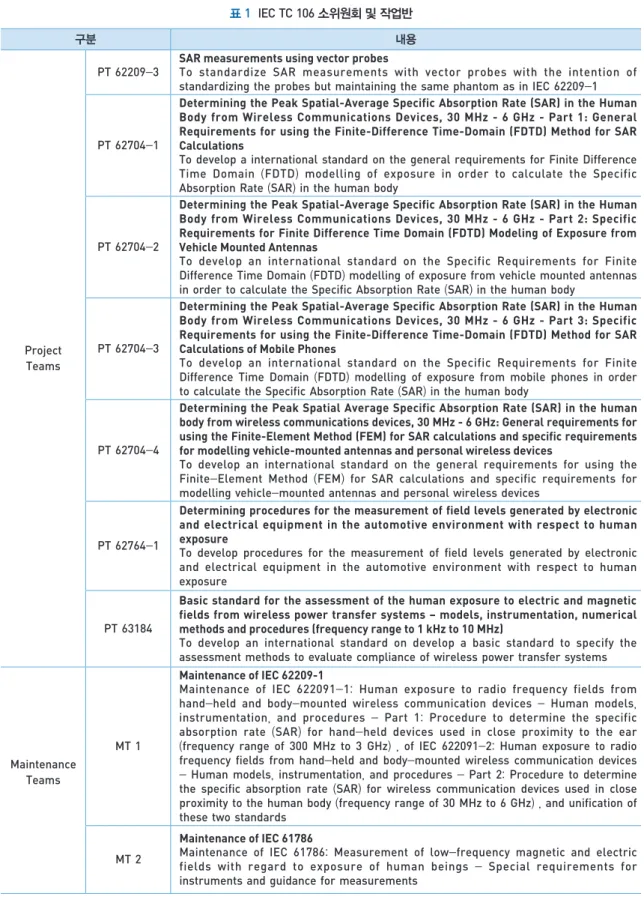
표 1은 IEC TC 106에 운영되는 소위원회 및 작 업반에서 현재 진행 중인 표준화 작업 내용을 보 여준다. PT 62209-3에서는 벡터 프로브를 이용하
여 고속으로 전자파 흡수율(SAR: Specific Absorp- tion Rate)을 측정하는 방법에 대해서 다루며, PT 62704-1~4에서는 무선 통신 기기로부터 인체에 흡수되는 SAR을 수치 해석적으로 계산하기 위한 내용을 다룬다. 또한, PT 62764-1은 자동차 내에 서 발생하는 전자파로부터 인체 노출 평가를 위한 측정 방법에 대해서 논하며, PT 63184는 새롭게 등장한 무선전력전송시스템으로부터 전자파 인체 노출 평가 방법에 대해서 다룬다. MT 1에서는 휴 대전화의 SAR 측정 방법에 관한 표준의 개정을 진 행 중이며, MT 2는 저주파 전자기장의 측정 장비 및 요구사항에 대한 표준을 유지・보수한다. MT 3 에서는 무선국에 대한 인체 노출 평가를 다루는 표 준으로 새로운 5G 무선국에 대한 평가를 포함하여 개정을 추진 중이다. JWG는 IEC와 IEEE가 공동으 로 표준화 작업을 추진하기 위해 결성된 작업 그룹 이다.
Ⅲ. 주요 표준 동향
1. 고속 SAR 측정(PT 62209-3)
근접해서 사용하는 휴대기기에 대해서는 기본
한계인 SAR 값을 기준으로 전자파 인체 노출 평가
를 수행하고 있다. 하지만 기존의 방법은 측정 시
간이 매우 많이 소요되며, 새로운 5G 서비스가 시
작하면 측정 시간은 급격히 증가한다. 따라서 이에
대해 논의하고 있는 표준이 벡터 프로브를 이용한
고속 SAR 측정 방법이다. 프로젝트 팀에서는 일정
지연의 이유로 CD(Committee Draft for comments)
단계, CDV(Committee Draft for Vote) 단계를 거
쳐 정식 표준으로 가지 않고 PAS(Publicity Available
Specification) 형태로 2018년 1월에 IEC PAS 63151
문서를 출판하였다[2]. 해당 표준은 200mm 이하
의 거리에서 인간의 머리 또는 신체 근처의 위치에
표 1 IEC TC 106 소위원회 및 작업반
구분 내용
Project Teams
PT 62209-3 SAR measurements using vector probes
To standardize SAR measurements with vector probes with the intention of standardizing the probes but maintaining the same phantom as in IEC 62209-1
PT 62704-1
Determining the Peak Spatial-Average Specific Absorption Rate (SAR) in the Human Body from Wireless Communications Devices, 30 MHz - 6 GHz - Part 1: General Requirements for using the Finite-Difference Time-Domain (FDTD) Method for SAR Calculations
To develop a international standard on the general requirements for Finite Difference Time Domain (FDTD) modelling of exposure in order to calculate the Specific Absorption Rate (SAR) in the human body
PT 62704-2
Determining the Peak Spatial-Average Specific Absorption Rate (SAR) in the Human Body from Wireless Communications Devices, 30 MHz - 6 GHz - Part 2: Specific Requirements for Finite Difference Time Domain (FDTD) Modeling of Exposure from Vehicle Mounted Antennas
To develop an international standard on the Specific Requirements for Finite Difference Time Domain (FDTD) modelling of exposure from vehicle mounted antennas in order to calculate the Specific Absorption Rate (SAR) in the human body
PT 62704-3
Determining the Peak Spatial-Average Specific Absorption Rate (SAR) in the Human Body from Wireless Communications Devices, 30 MHz - 6 GHz - Part 3: Specific Requirements for using the Finite-Difference Time-Domain (FDTD) Method for SAR Calculations of Mobile Phones
To develop an international standard on the Specific Requirements for Finite Difference Time Domain (FDTD) modelling of exposure from mobile phones in order to calculate the Specific Absorption Rate (SAR) in the human body
PT 62704-4
Determining the Peak Spatial Average Specific Absorption Rate (SAR) in the human body from wireless communications devices, 30 MHz - 6 GHz: General requirements for using the Finite-Element Method (FEM) for SAR calculations and specific requirements for modelling vehicle-mounted antennas and personal wireless devices
To develop an international standard on the general requirements for using the Finite-Element Method (FEM) for SAR calculations and specific requirements for modelling vehicle-mounted antennas and personal wireless devices
PT 62764-1
Determining procedures for the measurement of field levels generated by electronic and electrical equipment in the automotive environment with respect to human exposure
To develop procedures for the measurement of field levels generated by electronic and electrical equipment in the automotive environment with respect to human exposure
PT 63184
Basic standard for the assessment of the human exposure to electric and magnetic fields from wireless power transfer systems – models, instrumentation, numerical methods and procedures (frequency range to 1 kHz to 10 MHz)
To develop an international standard on develop a basic standard to specify the assessment methods to evaluate compliance of wireless power transfer systems
Maintenance Teams
MT 1
Maintenance of IEC 62209-1
Maintenance of IEC 622091-1: Human exposure to radio frequency fields from hand-held and body-mounted wireless communication devices - Human models, instrumentation, and procedures - Part 1: Procedure to determine the specific absorption rate (SAR) for hand-held devices used in close proximity to the ear (frequency range of 300 MHz to 3 GHz) , of IEC 622091-2: Human exposure to radio frequency fields from hand-held and body-mounted wireless communication devices - Human models, instrumentation, and procedures - Part 2: Procedure to determine the specific absorption rate (SAR) for wireless communication devices used in close proximity to the human body (frequency range of 30 MHz to 6 GHz) , and unification of these two standards
MT 2
Maintenance of IEC 61786
Maintenance of IEC 61786: Measurement of low-frequency magnetic and electric fields with regard to exposure of human beings - Special requirements for instruments and guidance for measurements
구분 내용
Maintenance Teams
MT 3 Maintenance Team for IEC 62232
Maintenance Team for IEC 62232: Methods for the assessment of electric, magnetic and electromagnetic fields associated with human exposure
MT 622236- 3-1
Maintenance of IEC 62226-3-1
To maintain IEC 62226-3-1: Exposure to electric or magnetic fields in the low and intermediate frequency range - Methods for calculating the current density and internal electric field induced in the human body - Part 3-1: Exposure to electric fields - Analytical and 2D numerical models
MT 62233
Maintenance of IEC 62233
To maintain IEC 62233: Measurement methods for electromagnetic fields of household appliances and similar apparatus with regard to human exposure
MT 62211 Maintenance of IEC 62311
To maintain IEC 62311: Assessment of electronic and electrical equipment related to human exposure restrictions for electromagnetic fields (0 Hz - 300 GHz)
Working Groups
WG 8
Addressing methods for assessment of contact current related to human exposures to electric, magnetic and electromagnetic fields
The task of the group will include the following: a) Identification of a suitable scope for exposure condition against contact currents covered by TC106 documents; b) Determinations of measuring methods for contact currents – Different methods should be provided for stimulation-based frequency ranges (< 10 MHz) and heat-based frequency ranges (>100 kHz); c) Determinations of an electrical circuit that represents the characteristics of human response; d) Preparation of a suitable document addressing this matter – Technical report or other deliverables will be prepared;
WG 9
Addressing methods for assessment of Wireless Power Transfer (WPT) related to human exposures to electric, magnetic and electromagnetic fields
The task of the group will include the following: a) Identification of current gaps for WPT (including implanted medical devices) related to human exposures to electric, magnetic and electromagnetic fields; b) Determinations of requirements for WPT related to exposures assessment. – Both stimulation-based frequency ranges (< 10 MHz) and heat-based frequency ranges (>100 kHz) should be considered; c) Summarization of possible assessment methods for WPT to be applied; d) Determinations whether new IEC standard is required or existing standard can be adapted; e) Preparation of a suitable document addressing this matter – Technical report or other deliverables will be prepared;
Joint Working Groups
JWG 11
Computational Methods to assess the power density in close proximity to the head and body
Develop a dual logo IEC/IEEE standard for a procedure to determine the assessment of power density from wireless communication devices in close proximity to the head and body from 6 GHz - 300 GHz by computational methods
JWG 12
Measurement Methods to assess the power density in close proximity to the head and body
Develop a dual logo IEC/IEEE standard for the assessment of power density of wireless communication devices in close proximity to the head and body by measurement from 6 GHz – 300 GHz
JWG 13
Measurement Procedures to Determine the Specific Absorption Rate (SAR)
Develop a dual logo IEC/IEEE standard for a procedure to determine the specific absorption rate (SAR) for wireless communication devices used in close proximity to the human body (frequency range of 4 MHz to 10 GHz) combining IEC 62209-1 and IEC 62209-2
Ad-Hoc
Groups AHG 6
Guide to the drafting of EMF assessment publications
To provides the scientific building blocks in which EMF exposure compliance standards are based
서 사용하도록 의도된 모든 무선 통신 장치에 적용 하며, 머리 또는 신체의 간소화된 모델 내에서 최 대 공간 평균 SAR(psSAR: peak spatial-average SAR) 의 재현성 있는 측정을 위한 프로토콜 및 시험 절 차를 규정하고 있다. 프로젝트 팀에서는 PAS 표준 에 반영되지 않았던 안테나 유효성 검사, 불확도 등을 반영하여 현재 정식 표준 발간을 위한 절차를 진행 중에 있다. IEC 62209-3 Ed. 1은 FDIS(Final Draft International Standard) 단계를 위한 교정 절차 중에 있다. 최종 표준은 2019년 9월에 발간 예정이 며, IEC 62209-3 표준이 발간되면 IEC PAS 63151 문서는 자동으로 폐기된다.
2. 무선전력전송 측정 방법(WG 9/PT 63184)
휴대폰, 자동차 등 새로운 무선전력전송기기 가 등장함에 따라 이러한 기기로부터의 전자파 인 체 영향 노출량 평가에 대한 필요성이 대두되었 다. 이에 IEC TC 106에서는 2015년 10월에 WG 9 를 설립하였다. 이런 목적에 따라 WG 9에서 무선 전력전송기기에 대한 전자파 인체 영향 평가 방 법에 대해서 2018년 2월에 기술보고서(TR: Tech- nical Report)로 IEC TR 62905 문서가 발간되었 다[3]. 이 문서는 열 및 자극 효과를 고려하여 최 대 10MHz 주파수의 무선전력전송(WPT: Wireless Power Transfer)에 대한 일반적인 노출 평가 방법 을 기술하고, 전기 자동차나 모바일 장치 같은 예 에 대해서 노출 평가 절차 및 실험적 결과를 보여 준다. 해당 기술보고서를 토대로 무선전력전송에 대한 기본 표준을 만들기 위한 새로운 프로젝트가 2018년 2월 회의에서 승인되어 PT 63184이 결성되 었다. 현재 프로젝트에서는 기존 10MHz까지의 범 위에서 30MHz까지의 주파수 범위로 확장되었다.
인체 모델 정보, Hybrid 방법, 기준 레벨의 평가 방
법, 전류 밀도에 대한 평가 방법 등에 대해서 수치 해석적 평가 방법이 포함되었으며, 측정과 수치 해 석 방법을 결합한 평가에 대한 내용도 포함하여 작 업 중에 있다. 국내에서는 드론 무선 충전 기기에 대한 전자파 인체 노출 평가를 기고하고, 표준에 반영하기 위한 노력을 하고 있다[4]. 향후 일정으 로는 2019년 6월까지 CD 문서를 준비하고, 최종 2021년에 표준을 발간할 예정으로 있다.
3. 무선국 전자파 노출 측정 방법(MT 3)
MT 3에서는 무선국에서의 전자파 노출 측정 방법을 다루는 IEC 62232 표준[5]과 무선국 평 가에 대한 표준의 이해를 돕기 위해 발행된 IEC TR 62669 문서[6]의 유지보수를 하는 역할을 한 다. IEC 62232 문서는 2011년 초판을 발행하였고, 2017년에 표준 문서의 구조, 다른 규격과의 조화, 5G 서비스에 대한 주파수 범위 확장, 새로운 측정 물리량 포함 등 초판에 비해 큰 변화를 가지고 개 정판이 발행되었다. 개정된 표준에서는 주파수 범 위를 6GHz에서 100GHz 범위로 확장하였으며, 이 는 5G 서비스 대역인 28GHz를 포함하여 밀리미터 파에 대한 기지국을 염두에 둔 것이다. 또한 밀리 미터파에 대한 평가를 위해서는 새로운 측정 물리 량이 필요하게 되므로 전력 밀도에 대한 측정 물리 량을 포함하였다.
하지만, IEC 62232 표준은 주파수와 측정 물리
량은 5G 서비스를 고려하여 개정하였지만, 5G 무
선국 평가를 위한 내용은 다루지 않고 있다. 따라
서 MT 3에서는 무선국에 대한 전자파 노출 평가
에 대한 사례 연구(case study) 형태의 기술보고서인
IEC TR 62669 문서에 대해 5G 무선국에 대한 평
가 사례를 포함한 개정판을 준비 중에 있다. 사례
연구는 총 10가지의 평가 사례를 포함하여 진행 중
에 있다. 현재 이 문서는 출판이 승인된 상태이며, 2019년 6월에 기술보고서가 출판될 예정이다.
MT 3에서 개정되는 IEC TR 62669 내용을 IEC 62232 표준에 반영하기 위한 새로운 개정 작업이 최근에 IEC로부터 승인되었다. 2019년 3월에 개최 되는 회의에서는 IEC 62232 개정에 포함할 아이템 에 대해서 논의하였다. 주요 내용으로는 현장 측 정에서 5G 디코더 혹은 스펙트럼 분석기를 이용한 PBCH(Physical Broadcast Channel) 측정, 테스트 모 드를 이용한 고정 빔 혹은 랜덤 빔 시험, 실제 트 래픽과 100% 트래픽일 때의 시험, 외삽을 위한 가 정 조건 등에 대한 내용이다. 5G 서비스의 특징은 빔포밍 기술, MIMO 기술, 전력제어 등 다양한 기 술들에 대한 통신 사업자의 운용 자유도가 높게 구 현됨에 따라 전자파 최대 노출 조건과 실제 노출에 는 상당한 차이가 발생할 것으로 예상된다. 따라서 5G 무선국 평가를 위한 방법은 기존 무선국 평가 방법에서 고려한 부분 외에도 고려사항들을 잘 검 토해야 할 것이다. 개정본은 2019년 12월에 CD 문 서를 준비하고, 2020년 12월에 CDV 문서 준비를 목표로 하고 있다.
Ⅳ. 결론
본 고에서는 전자파 인체 영향과 관련하여 국제 표준에서 다루고 있는 주요 이슈에 대해서 기술하 였다. 특히, 휴대 전화기와 같이 근접해서 사용하 는 단말기에 대한 SAR 측정을 위해 벡터 프로브를 이용한 고속 SAR 측정 표준, 저주파 대역에서 사 용되는 무선전력전송 기기에 대한 평가 표준, 5G 무선국에 대한 전자파 인체 영향 평가 표준에 대한 내용을 소개하였다. 새로운 서비스인 5G 휴대 단 말기, 무선국, 무선전력전송에 대한 전자파 인체 영향뿐만 아니라 현재 국제표준에서 진행 중인 표
준에 대해서도 적극적인 표준화 활동을 통해 국내 산업에 도움이 되고 국내 연구 결과를 표준에 반영 할 수 있도록 할 필요성이 있다.
약어 정리
CD Committee Draft for comments CDV Committee Draft for Vote FDIS Final Draft International Standard IARC International Agency for Research on
Cancer
IEC International Electrotechnical Com- mission
JWG Joint Working Groups MT Maintenance Teams
PBCH Physical Broadcast CHannel psSAR peak spatial average SAR PT Project Teams
PAS Publicity Available Specification SAR Specific Absorption Rate SC SubCommittes
TC Technical Committees TR Technical Report WG Working Groups
WHO World Health Organization WPT Wireless Power Transfer
참고문헌
[1] WHO Press Release no. 208, “IARC classifies radiofrequency electromagnetic fields as possibly carcinogenic to humans,”
31th, May. 2011.
[2] IEC PAS 63151:2018, “Measurement procedure for the as- sessment of specific absorption rate of human exposure to radio frequency fields from hand-held and body-mounted wireless communication devices -Vector measurement based systems (Frequency range of 30 MHz to 6 GHz),” 6th, Feb.
2018.
[3] IEC TR 62905:2018, “Exposure assessment methods for
wireless power transfer systems,” 15th, Jan. 2018.
[4] TC106/PT63184/2018_024, “Assessment of human expo- sure to EMFs for drone using wireless charging system,” 27th, Sep. 2018.
[5] IEC 62232:2017, “Determination of RF field strength, power density and SAR in the vicinity of radiocommunication base
stations for the purpose of evaluating human exposure,”
23th, Aug. 2017.
[6] IEC TR 62669:2011, “Case studies supporting IEC 62232-Determination of RF field strength and SAR in the vicinity of radiocommunication base stations for the purpose of evaluating human exposure,” 27th, May. 2011.