• 검색 결과가 없습니다.

Interventional Radiology Treatment for Postoperative Chylothorax

N/A
N/A
Protected

Academic year: 2021

Share "Interventional Radiology Treatment for Postoperative Chylothorax"

Copied!
5
0
0

로드 중.... (전체 텍스트 보기)

전체 글

(1)

KJTCVS

The Korean Journal of Thoracic and Cardiovascular Surgery

Interventional Radiology Treatment for Postoperative Chylothorax

Hoyong Jun, M.D., Saebeom Hur, M.D.

Department of Radiology, Seoul National University Hospital, Seoul, Korea

ARTICLE INFO Received May 20, 2020 Revised June 22, 2020 Accepted July 1, 2020 Corresponding author Saebeom Hur

Tel 82-2-2072-2584 Fax 82-2-743-6385

E-mail [email protected] ORCID

https://orcid.org/0000-0003-0787-5101

This article was presented at the 6th Esophageal Cancer Symposium (lecture on No vember 16th, 2019, Samsung Medical Center, Seoul, Korea).

Postoperative chylothorax is a rare occurrence after various thoracic surgical procedures, but it poses a substantial risk of morbidity and mortality. Thoracic duct embolization (TDE) is currently deemed the optimal treatment due to its safety and efficacy. This review offers an introduction to interventional options in this setting, detailing the steps of TDE for the edification of those engaged in postoperative care.

Keywords: Intervention, Chylothorax, Thoracic duct, Postoperative care

Copyright © The Korean Society for Thoracic and Cardiovascular Surgery. 2020. All right reserved.

This is an Open Access article distributed under the terms of the Creative Commons Attribution Non-Commercial License (http://creativecommons.org/licenses/

Introduction

The lymphatic system primarily serves to collect and re- turn interstitial fluid to the venous system [1]. Its bodily components (i.e., retroperitoneal, intestinal, and hepatic) ultimately fuse at the cisterna chyli, traversing the medias- tinum via the thoracic duct and eventually draining into the left internal jugular or subclavian vein [2]. The ana- tomic location of the thoracic duct leaves it vulnerable to injury during various thoracic surgical procedures, such as esophagectomy, lung resection, and mediastinal or aortic surgery, all of which typically are invasive in nature. For- tunately, the incidence of clinically significant chylothorax is relatively low, ranging from 1% to 9% [3-5]. However, chylothorax poses a considerable risk of morbidity and mortality if not appropriately managed at the onset be- cause chylous leakage contains higher nutrient concentra- tions than non-chylous lymphatic leaks, and the seepage is usually excessive.

Conservative and surgical management of postoperative chylothorax

The optimal clinical management of postoperative chy- lothorax has yet to be established. At present, therapeutic strategies generally include the following: (1) conservative management, using total parenteral nutrition or medi- um-chain triglyceride diets; (2) somatostatin and oct- reotide administration; and (3) surgical intervention in- volving talc pleurodesis, pleurectomy, or thoracic duct ligation [6]. Surgical ligation of the thoracic duct is an ef- fective means of managing high-output or recurrent chy- lothorax, with impressive success rates, but the reported rates of procedural morbidity and mortality are as high as 38.8% and 25%, respectively [7-9].

Interventional radiology treatment

In treating chylothorax, the minimal invasiveness and excellent safety profiles of interventional options have fu- eled their growing popularity [10-13].

Collective of current Review, Lecture

https://doi.org/10.5090/kjtcs.2020.53.4.200 pISSN: 2233-601X eISSN: 2093-6516

Korean J Thorac Cardiovasc Surg. 2020;53(4):200-204

(2)

Hoyong Jun and Saebeom Hur. Interventional Radiology Treatment for Postoperative Chylothorax KJTCVS

Thoracic duct embolization

First introduced in the late 1990s, thoracic duct emboli- zation (TDE) has gradually gained acceptance as first-line therapy for traumatic chylothorax [14]. Some physicians may still be averse to passing a needle through vital ab- dominal organs, but data on the safety of such procedures continue to mount. There are three major steps to this ap- proach: (1) Lipiodol lymphangiography, (2) thoracic duct access (TDA), and (3) TDE.

Lipiodol lymphangiography

For many years, lymphangiography was synonymous with X-ray imaging of lymphatics opacified by Lipiodol (ethiodized oil, Lipiodol Ultra-Fluid; Guerbet, Villepinte, France). The first use of Lipiodol for this purpose was in the 1960s. Unlike water-soluble iodinated compounds that dissipate rather quickly, Lipiodol remains in the lymphatic system. The transpedal technique was once the mainstay of lymphangiography, entailing direct cannulation of a surgically exposed, minuscule lymphatic channel in the foot. This laborious approach was limited by the sophisti- cation of the requisite operative skills and experience. It was also very time-consuming, slowed by obvious injection constraints and the protracted course of flow from the leg to the trunk.

Intranodal lymphangiography is an effective alternative method of direct lymphatic access that relies on ultrasound guidance. Its launch in 2011 essentially rendered tran- spedal injections obsolete [15]. In addition to providing very reliable and secure access to the lymphatics, only fun- damental skills and standard equipment are called upon for the puncture of centimeter-sized structures. Further- more, the time invested in lymphatic imaging is dramati-

cally reduced by the ready injectability of contrast agents and the ability to bypass the lower extremity.

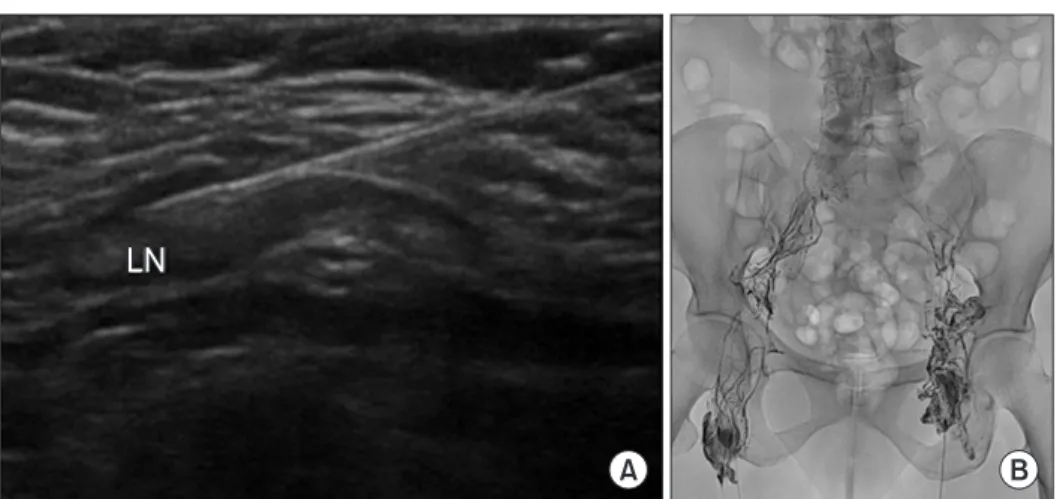
In this procedure, the lymph nodes of both inguinal ar- eas are directly pierced under ultrasound guidance by a 26G needle pre-connected to a short accessory tube and a 3-mL polycarbonate syringe. The needle tip is positioned at the transition between the nodal cortex and hilum. Lipi- odol is then manually injected at a slow rate, using inter- mittent fluoroscopy until the lymphatics along the upper lumbar region and the cisterna chyli are opacified (Fig. 1) [16,17].

Thoracic duct access

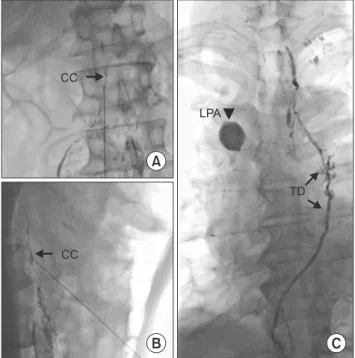
A 15-cm or 21-cm 21G Chiba needle is advanced to the target structure (cisterna chyli, its major tributary, or an even lower segment of the thoracic duct) under fluoroscop- ic guidance, and puncture is achieved. A relatively stiff guidewire (0.3556 mm or 0.4572 mm) is then passed through the needle into the cisterna chyli and, eventually, the thoracic duct. Next, a microcatheter is inserted over the guidewire into the thoracic duct. While injecting 5–10 mL of iodinated water-soluble contrast (0.3–1 mL/sec) via a microcatheter, digital subtraction lymphangiography is performed to identify the point(s) of leakage.

Embolization

Once leakage of lymphatic fluid is confirmed by lymph- angiography, the entire segment of the thoracic duct is em- bolized using a combination of microcoils and n-bu- tyl-2-cyanoacrylate (NBCA) liquid glue (Histoacryl; B.

Braun Medical Inc., Melsungen, Germany) plus Lipiodol at a ratio of 1:1.5–1:3 (usually 1:2). This is the most commonly applied technique (Fig. 2).

In a meta-analysis, the clinical success rate of TDE in

Fig. 1. Lipiodol lymphangiography.

(A) Ultrasound-guided inguinal LN puncture and (B) Lipiodol lymph- angiography of the iliolumbar re- gion. LN, lymph node.

LN LN

A B

(3)

https://doi.org/10.5090/kjtcs.2020.53.4.200

KJTCVS

treating traumatic chylothorax proved to be 92.4%, assum- ing no technical impediments. The problem is that the pooled technical success rate of TDE, on a per-protocol ba- sis, was only 63.1% [18]. Of the 3 steps involved in the pro- cess, TDA is paramount in terms of difficulty and thus dictates the technical outcomes of TDE. However, it is our contention that technical success approaches 90% at expe- rienced centers offering advanced lymphangiography and other forms of interventions.

Despite the high clinical success rate of TDE, some pa- tients do not respond well, and the chylothorax persists.

There are several explanations for this, the first being in- complete ductal occlusion due to the inappropriate usage of embolic agents. A dilute mixture of NBCA or a steeper Lipiodol ratio (beyond 1:4) might account for this [19]. An- other reason may be the existence of collateral channels that continue to leak chylous fluid. Finally, translocation of chylous ascites is quite conceivable, and can manifest as chylothorax, especially if the diaphragmatic barrier be- tween compartments is damaged during the original sur- gery. In such circumstances, occlusion of the thoracic duct by embolization or ligation may substantially aggravate symptoms. The decision to perform TDE should, therefore, proceed cautiously if evidence of leakage is not found on Lipiodol lymphangiography or digital subtraction lymph-

angiography.

Contraindications and complications of thoracic duct em­

bolization

TDE may be contemplated in any situation amenable to thoracic duct ligation. The goal of each procedure is the same. However, conditions that increase TDA risk may be relative contraindications. Pertinent examples are active abdominal infection, aortic aneurysm, and pancreatitis.

In general, needle penetration of various abdominal or- gans during TDA is considered safe. However, the gallblad- der should be avoided, because there is a potential for bile peritonitis [20]. As with surgical ligation of the thoracic duct, leg swelling (7%) or diarrhea (8%) may develop after TDE during long-term follow-up [11]. Other possible com- plications include systemic or pulmonary embolization of Lipiodol/glue, bleeding, and allergic reactions to the con- trast agent.

Therapeutic Lipiodol lymphangiography

Originally, Lipiodol lymphangiography was intended to visualize leakage points or the cisterna chyli during TDE.

Nevertheless, its therapeutic ramifications for refractory lymphatic leakage have since drawn attention [21-26]. Lipi- odol-induced selective blockade of pathologic lymph ducts and the sterile inflammatory reactions that occur are be- lieved to produce scarring, encouraging the resolution of lymphatic leakage within several days or weeks [27]. A hy- pothetical scenario is the saturation of central lymphatics with viscous Lipiodol, with the goal of redirecting flow through existing peripheral lymphovenous connections [2].

Unfortunately, a high proportion of patients fail to respond as anticipated, especially those with higher drainage vol- umes who are most in need of definitive treatment.

Thoracic duct disruption

Thoracic duct disruption (TDD) is usually performed as a bail-out procedure if TDA is prohibited by technical is- sues. The aim is to macerate the cisterna chyli or the main retroperitoneal lymphatic channels through multiple nee- dle punctures, thereby reducing downstream lymphatic flow and allowing leaks to heal spontaneously [10,14,28].

Alternatively, the mechanism of action may well be the Lipiodol effect, the inflow of venous blood through dis- rupted lymphatic vessels, or the pressure exerted upstream on thoracic duct by hematomas formed at puncture sites [28]. In a meta-analysis, the pooled TDD clinical success

Fig. 2. TD access and embolization. (A, B) Puncture of the CC, an- teroposterior and lateral views. (C) Spot image upon completion of TD embolization. TD, thoracic duct; CC, cisterna chyli; LPA, lymphopseudoaneurysm.

CC

CC

TD LPA

A

B C

(4)

Hoyong Jun and Saebeom Hur. Interventional Radiology Treatment for Postoperative Chylothorax KJTCVS

rate on a per-protocol basis was 60.8%, which is much less than that of TDE (79.4%) and only slightly better than that of lymphangiography (56.6%) [18]. This suggests that the efficacy of TDD derives fundamentally from lymphangi- ography, and that it confers no real clinical benefit by itself.

Conclusion

Among the various options for radiologic lymphatic in- tervention, TDA and TDE are optimal measures, preferable to other available methods (i.e., Lipiodol lymphangiogra- phy or TDD) when feasible, as they show superior clinical efficacy. They represent less invasive alternatives to open surgical strategies, such as pleurodesis or thoracic duct li- gation, in the treatment of high-output chylothorax.

Conflict of interest

No potential conflict of interest relevant to this article was reported.

Acknowledgments

This research was supported by the Basic Science Re- search Program of the National Research Foundation of Korea (Grant no., NRF-2018R1C1B6007875), funded by the Ministry of Science, ICT and Future Planning.

ORCID

Hoyong Jun: https://orcid.org/0000-0002-2628-3542 Saebeom Hur: https://orcid.org/0000-0003-0787-5101

References

1. Ikomi F, Kawai Y, Ohhashi T. Recent advance in lymph dynamic analysis in lymphatics and lymph nodes. Ann Vasc Dis 2012;5:258- 68.

2. Hsu MC, Itkin M. Lymphatic anatomy. Tech Vasc Interv Radiol 2016;19:247-54.

3. Dougenis D, Walker WS, Cameron EW, Walbaum PR. Management of chylothorax complicating extensive esophageal resection. Surg Gynecol Obstet 1992;174:501-6.

4. Lai FC, Chen L, Tu YR, Lin M, Li X. Prevention of chylothorax complicating extensive esophageal resection by mass ligation of tho- racic duct: a random control study. Ann Thorac Surg 2011;91:1770- 4.

5. Mishra PK, Saluja SS, Ramaswamy D, Bains SS, Haque PD. Tho- racic duct injury following esophagectomy in carcinoma of the

esophagus: ligation by the abdominal approach. World J Surg 2013;

37:141-6.

6. Seeliger B, Alesina PF, Walz MK. Posterior retroperitoneoscopic thoracic duct ligation: a novel surgical approach. Surg Endosc 2018;

32:3732-7.

7. Paul S, Altorki NK, Port JL, Stiles BM, Lee PC. Surgical manage- ment of chylothorax. Thorac Cardiovasc Surg 2009;57:226-8.

8. Schild HH, Strassburg CP, Welz A, Kalff J. Treatment options in pa- tients with chylothorax. Dtsch Arztebl Int 2013;110:819-26.

9. Cerfolio RJ, Allen MS, Deschamps C, Trastek VF, Pairolero PC.

Postoperative chylothorax. J Thorac Cardiovasc Surg 1996;112:

1361-6.

10. Itkin M, Kucharczuk JC, Kwak A, Trerotola SO, Kaiser LR. Nonop- erative thoracic duct embolization for traumatic thoracic duct leak:

experience in 109 patients. J Thorac Cardiovasc Surg 2010;139:584- 90.

11. Laslett D, Trerotola SO, Itkin M. Delayed complications following technically successful thoracic duct embolization. J Vasc Interv Ra- diol 2012;23:76-9.

12. Pamarthi V, Stecker MS, Schenker MP, et al. Thoracic duct emboli- zation and disruption for treatment of chylous effusions: experience with 105 patients. J Vasc Interv Radiol 2014;25:1398-404.

13. Yannes M, Shin D, McCluskey K, Varma R, Santos E. Comparative analysis of intranodal lymphangiography with percutaneous inter- vention for postsurgical chylous effusions. J Vasc Interv Radiol 2017;

28:704-11.

14. Cope C, Kaiser LR. Management of unremitting chylothorax by per- cutaneous embolization and blockage of retroperitoneal lymphatic vessels in 42 patients. J Vasc Interv Radiol 2002;13:1139-48.

15. Rajebi MR, Chaudry G, Padua HM, et al. Intranodal lymphangiogra- phy: feasibility and preliminary experience in children. J Vasc Interv Radiol 2011;22:1300-5.

16. Kim SW, Hur S, Kim SY, et al. The efficacy of lymph node emboli- zation using N-butyl cyanoacrylate compared to ethanol sclerothera- py in the management of symptomatic lymphorrhea after pelvic sur- gery. J Vasc Interv Radiol 2019;30:195-202.

17. Bielsa S, Pardina M. Refractory chylothorax: where do we go now?

Curr Pulmonol Rep 2019;8:60-7.

18. Kim PH, Tsauo J, Shin JH. Lymphatic interventions for chylothorax:

a systematic review and meta-analysis. J Vasc Interv Radiol 2018;29:

194-202.

19. Kuetting D, Schild HH, Pieper CC. In vitro evaluation of the polym- erization properties of N-butyl cyanoacrylate/iodized oil mixtures for lymphatic interventions. J Vasc Interv Radiol 2019;30:110-7.

20. Schild HH, Pieper CC. Where have all the punctures gone?: an anal- ysis of thoracic duct embolizations. J Vasc Interv Radiol 2020;31:74- 9.

21. Kortes N, Radeleff B, Sommer CM, et al. Therapeutic lymphangiog-

raphy and CT-guided sclerotherapy for the treatment of refractory

(5)

https://doi.org/10.5090/kjtcs.2020.53.4.200

KJTCVS

lymphatic leakage. J Vasc Interv Radiol 2014;25:127-32.

22. Matsumoto T, Yamagami T, Kato T, et al. The effectiveness of lymphangiography as a treatment method for various chyle leakages.

Br J Radiol 2009;82:286-90.

23. Kos S, Haueisen H, Lachmund U, Roeren T. Lymphangiography:

forgotten tool or rising star in the diagnosis and therapy of postoper- ative lymphatic vessel leakage. Cardiovasc Intervent Radiol 2007;30:

968-73.

24. Gruber-Rouh T, Naguib NNN, Lehnert T, et al. Direct lymphangiog- raphy as treatment option of lymphatic leakage: indications, out- comes and role in patient’s management. Eur J Radiol 2014;83:2167- 71.

25. Alejandre-Lafont E, Krompiec C, Rau WS, Krombach GA. Effec-

tiveness of therapeutic lymphography on lymphatic leakage. Acta Radiol 2011;52:305-11.

26. Kawasaki R, Sugimoto K, Fujii M, et al. Therapeutic effectiveness of diagnostic lymphangiography for refractory postoperative chylotho- rax and chylous ascites: correlation with radiologic findings and pre- ceding medical treatment. AJR Am J Roentgenol 2013;201:659-66.

27. Pieper CC, Hur S, Sommer CM, et al. Back to the future: lipiodol in lymphography: from diagnostics to theranostics. Invest Radiol 2019;

54:600-15.

28. Binkert CA, Yucel EK, Davison BD, Sugarbaker DJ, Baum RA. Per-

cutaneous treatment of high-output chylothorax with embolization or

needle disruption technique. J Vasc Interv Radiol 2005;16:1257-62.

수치

Fig. 1. Lipiodol lymphangiography.
Fig. 2. TD access and embolization. (A, B) Puncture of the CC, an- an-teroposterior and lateral views

참조

관련 문서

Conclusion : The treatment using facet joint block with lumbar surgical operation seems to have short term clinical effects, however can't prevent

Data represent the mean ±SD of Three separate experiments; the statistical significance of differences between each treatment group and the control (**P < 0.01, *P

The virtues of ordinary steel such as those listed in the below (which assure ductile behavior at member or structural level) tend to disappear in high strength

The average tensile strength value before heat treatment of PLA output was 9.67 N/㎟, and the average tensile strength value after heat treatment was 24.17 N/㎟, which

• LCC computes Present Value of alternatives over a period of time using discounting methods.. • Hence, important to consider alternatives using same period of

Schou S, Holmstrup P, Jørgensen T, Skovgaard LT, Stoltze K, Hjørting-Hansen E, Gundersen HJG: Implant surface preparation in the surgical treatment of

However, due to waste management law the sand is classified as designated waste, as defined in Table 1 of the Enforcement Rule of law matter less than or equal to

In this study, two types of treatment methods, ozone treatment and combination of alkaline and ozone treatment, was used for character's variation and