pISSN 2288-9272 eISSN 2383-8493 J Oral Med Pain 2020;45(2):23-28 https://doi.org/10.14476/jomp.2020.45.2.23
Evaluation of Sleep Quality and Psychological Profiles in Patients with Chronic Painful Temporomadibular Disorders
Hye-Mi Jeon 1 , Kyung-Hun Han 2 , Hye-Min Ju 3 , Yong-Woo Ahn 3 , Soo-Min Ok 3 , Sung-Hee Jeong 3
1 Dental Clinic Center, Pusan National University Hospital, Busan, Korea
2 Division of Sport Science, Pusan National University, Busan, Korea
3 Department of Oral Medicine, Pusan National University School of Dentistry, Yangsan, Korea
Received June 3, 2020 Revised June 14, 2020 Accepted June 14, 2020
Purpose:
Purpose: Temporomadibular disorders (TMDs) can result in chronic pain, which is often as- sociated with psychological and sleep disturbance. Increased levels of psychological and sleep impairments are often related with poor treatment outcomes. The purpose of the pres- ent study was to evaluate clinical features, psychological profiles and the prevalence of clinical insomnia in TMD patients with chronic pain and to suggest an effective treatment approach.
Methods:
Methods: A total of 200 TMD patients who had visited the Pusan National University Hospital dental clinic for treatment of their pain were recruited from June 2018 through December 2019. TMD patients were classified into an acute (n=100) and chronic (n=100) group and compared the clinical symptoms. The primary diagnosis of TMD were catego- rized as TMD with joint pain group (TMD_J), TMD with muscle pain group (TMD_M) and TMD with joint-muscle mixed pain group (TMD_JM). Self- report measures of sleep quality and psychological profiles were evaluated via the Insomnia Severity Index (ISI) and the Ko- rean Stress Response Inventory (SRI). Independent t-tests, Mann-Whitney U-tests, and chi- squared test were used for the statistical analysis.
Results:
Results: Chronic TMD patients showed higher pain intensity, as well as higher prevalence of related symptoms (headache, musculoskeletal pain) and myogenous pain. They also had sig- nificantly higher scores in all SRI parameters and a higher percentage of clinical insomnia than acute TMD patients.
Conclusions:
Conclusions: Based on the above results, psychological profiles and sleep quality assess- ments are necessary to provide essential data that will allow for improved treatment of chronic TMD patients.
Key Words:
Key Words: Chronic pain; Psychological stress; Sleep; Temporomadibular disorders
Correspondence to:
Sung-Hee Jeong
Department of Oral Medicine, Pusan National University School of Dentistry, 49 Busandaehak-ro, Mulgeum-eup, Yangsan 50612, Korea
Tel: +82-55-360-5242 Fax: +82-55-360-5238 E-mail: [email protected]
https://orcid.org/0000-0002-6296-4775 This study was supported by Clinical Research Grant from Pusan National University Hospital in 2020.
JOMP Journal of Oral Medicine and Pain
Copyright Ⓒ 2020 Korean Academy of Orofacial Pain and Oral Medicine. All rights reserved.
CC
This is an open-access article distributed under the terms of the Creative Commons Attribution Non-Commercial License (http://creativecommons.org/licenses/by-nc/4.0/),
INTRODUCTION
Temporomandibular disorders (TMDs) are embrace dis- tinguished clinical problems involving the masticatory muscles, the temporomandibular joint (TMJ), or both [1].
Although the exact causes of the most TMDs remain ei- ther largely unknown or speculative, most are assumed to be due to many factors, including trauma, anatomical,
pathophysiological, social, and psychological factors. The
chief clinical symptom of most TMDs is pain, and TMD pa-
tients often complain of increased pain sensitivity and psy-
chological dysfunction due to its chronic nature. This em-
phasizes the importance of gaining information about the
duration of the patient’s pain complaints. Patient with se-
vere psychological stress-related problems as well as pain
should have both managed simultaneously, because failure
to resolve the severe psychological stress-related reactions can interfere with the appropriate treatment of the TMD pain [2,3]. There has been continued attention to the study of the relationship between psychological stress and TMD.
In this regard, various attempts have been made to mea- sure psychological stress in a quantifiable manner. In spite of being criticized for their subjectivity, self-rating reports have been a primary modality for measuring stress in clinic settings [4].
Insomnia, defined as “a persistent difficulty with sleep initiation, duration, consolidation, or quality that occurs despite adequate opportunity and circumstances for sleep”, has long been associated with chronic pain and psychologi- cal distress [5]. Fibromyalgia, one of the notorious chronic pain, showed high rates of pain, poor sleep and depression.
Sleep difficulties were reported by 77% of patients with orofacial pain, including TMD patients. Thus, it is clini- cally important to identify chronic TMD patient with a high risk for insomnia and sleep evaluations are essentials for the proper assessment and treatment of chronic TMD [6].
However, dental clinics do not normally have the resources or expertise to provide detailed sleep assessments for TMD patients with insomnia. To evaluate insomnia, subjective assessments are considered the gold standard, and have been recommended for the evaluation of patients with TMD [7-9].
Several studies has evaluate the clinical, psychological profiles and sleep disturbance in the TMD patients have been reported [1,2,6]. Unfortunately, there are limited stud- ies regarding the chronicity of TMD pain. Therefore, this study was designed (1) to assess psychological profiles and the prevalence of clinical insomnia based on self-report questionnaires and to compare the differences in clinical characteristics in TMD patients; (2) to propose an effective management approach for chronic TMD patients.
MATERIALS AND METHODS
1. Subjects
TMD patients who had visited the Pusan National University Hospital dental clinic for treatment of their pain were recruited from June 2018 through December 2019.
Exclusion criteria were as follows (1) patients with history
of facial and jaw fracture, and orthognathic surgery, (2) pa- tients who had a history of psychiatric conditions, (3) pa- tients who had neurologic impairment or diseases (e.g., stroke, tumor, trauma, or epilepsy), (4) patients who had other systemic muscular disorders (e.g., fibromyalgia, in- flammatory joint disease), (5) patients who were pregnant.
A total of two-hundred TMD patients were classified by acute and chronic group. Chronicity was established by persistence of pain beyond 3 months of symptoms. The re- search protocol was approved by the Ethics Committee of Pusan National University Hospital (PNUH; approval no.
H-1806-007-067) and informed consent was obtained.
2. Clinical Signs and Symptoms
Each subjects examined their clinical signs and symp- toms based on the Research Diagnostic Criteria for TMD axis I guidelines including pain intensity, comfortable mouth opening (CMO), pain duration and related symp- toms (headache, comorbid musculoskeletal pain, sleep dis- turbance). Subjects were divided into the patients with joint pain group (TMD_J), patients with muscle pain group (TMD_M) and patients with joint-muscle mixed pain group (TMD_JM).
3. Questionnaires
Psychological profile and sleep quality were assessed with self-report instruments administered at the initial evalua- tion. The questionnaires were consisted of two parts;
1) Insomnia Severity Index
Insomnia Severity Index (ISI) is a self-rating scale de- signed to assess the subjective perception of the severity of insomnia. ISI has been translated into several languag- es and used to evaluate insomnia in pain research [10]. A Korean version of the ISI was validated in 2014 by Cho et al. [11]. The questionnaire contains seven items assessing:
(1) the severity of sleep-onset, (2) sleep maintenance, (3)
early morning awakening problems, (4) satisfaction with
current sleep pattern, (5) interference with daily function-
ing, (6) noticeability of impairment attributed to the sleep
problem, and (7) level of distress caused by the sleep prob-
lem. Patients rated each items on a 5-point scale (not at all,
0; Somewhat, 1; Moderately, 2; Very much, 3; Absolutely,
4), and total scores range from 0 to 28, with higher scores indicating more severe insomnia. According to the recom- mended score interpretation guideline, a total score of 0-7 indicates ‘no clinically significant insomnia’, 8-14 indicates
‘sub-threshold insomnia’, 15-21 indicates ‘moderate clinical insomnia’, and 22-28 indicates ‘severe clinical insomnia’. A cutoff score of 15 has been used as the threshold for clini- cally significant insomnia, and a score below 8 has been used to define remission after treatment.
2) Stress Response Inventory
Psychological profiles were assessed based on the Stress Response Inventory (SRI). SRI is validate assessment meth- od that has been developed by Ko et al. [4] in Korean to measure of stress levels for research in stress-related field within a short time. It includes seven symptom dimensions:
tension subscale (6 items), aggression subscale (4 items), so- matization subscale (3 items), anger subscale (6 items), de- pression subscale (8 items), fatigue subscale (5 items), and frustration subscale (7 items). In total, the questionnaire contained 39 items, each of which was arranged in a Likert- type format: not at all, 0; Somewhat, 1; Moderately, 2;
Very much, 3; Absolutely, 4. The global score ranges from 0 to 156, with higher scores indicating more severe stress responses.
4. Statistical Analysis
A normality test for the parameters was performed using
the Kolmogorov-Smirnov test. For comparison of the dif- ferences between the acute and chronic TMD groups, data were analyzed by the independent t-test or the Mann- Whitney U-test for continuous variables. Chi-square test was used for assessing differences in categorical variables between two groups. Statistical tests were done at the 5%
significance level. The data were analyzed using IBM SPSS Statistics for Windows, Version 22.0 (IBM Co., Armonk, NY, USA).
RESULTS
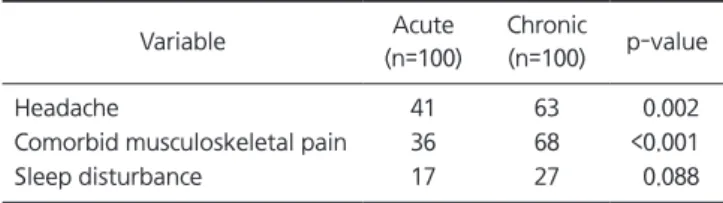
1. Comparison of Demographic and Clinical Features The clinical and descriptive data were compared be- tween acute and chronic group. As presented in Table 1, there were no significant differences between two groups for age and CMO. However chronic group showed signifi- cantly higher pain intensity and longer pain duration. The prevalence of acute TMD was about 2 times higher in wom- en (62.0%) than in men (38.0%). In chronic group, women (83.0%) showed about 5 times higher prevalence than men (17.0%). The distribution of TMD patients according to the primary diagnostic group differed significantly between acute and chronic group (p<0.001). The percentage of the TMD_M and TMD_JM were significantly higher in chronic group than acute group. Table 2 shows the differences in the prevalence of related symptoms between two groups.
Chronic group reported higher prevalence of headache and
Table 1.
Table 1. Demographics and clinical characteristics of the patients
Variable Acute (n=100) Chronic (n=100) p-value
Age (y) 41.3±17.5 36.8±17.7 0.067
aPain intensity 3.5±1.2 4.4±1.9 <0.001
aCMO (mm) 35.5±8.5 35.1±7.4 0.698
aPain duration (mo) 0.7±0.6 28.4±49.3 <0.001
aSex (%) 0.001
bMale 38.0 17.0
Female 62.0 83.0
Diagnosis (%) <0.001
bTMD_J 72.0 43.0
TMD_M 9.0 19.0
TMD_JM 19.0 38.0
CMO, comfortable mouth opening; TMD, temporomadibular disorder; TMD_J, joint pain group; TMD_M, muscle pain group, TMD_JM, joint- muscle mixed pain group.
Values are presented as mean±standard deviation.
a