pISSN 2288-9272 eISSN 2383-8493 J Oral Med Pain 2015;40(2):47-54 http://dx.doi.org/10.14476/jomp.2015.40.2.47
Pain Catastrophizing for Patients with Temporomandibular Disorders
Jin-Ho Park, Hye-Kyoung Kim, Ki-Suk Kim, Mee-Eun Kim
Department of Oral Medicine, Dankook University College of Dentistry, Cheonan, Korea
Received February 25, 2015 Revised March 6, 2015 Accepted March 10, 2015
Purpose: Besides depression and anxiety, recently pain catastrophizing has been emphasized for an important psychological factor explaining pain response in various pain conditions including temporomandibular disorders (TMDs). The aims of this study were to evaluate pain catastrophizing of TMD patients and to investigate how the level of pain catastrophizing re- lated with clinical variables and psychometric morbidity.
Methods: Inclusion criterion was all new TMD patients ≥18 years old attending the Department of Orofacial Pain and Oral Medicine of Dankook University Dental Hospital (Cheonan, Korea) over three-month period in 2014, who completed questionnaires. The questionnaires included the Brief Pain Inventory (BPI), Pain Catastrophizing Scale (PCS), and Symptom Check List- 90-Revised (SCL-90-R). All of them were examined clinically and diagnosed.
Results: One hundred fifty five patients diagnosed as TMDs were participated in this study (mean age of 38.7±15.2 years, male:female=1:2.5). Mean PCS score of the patients was 17.3 with standard deviation of 12.6. By the median of the PCS score (i.e., 15), the subjects were categorized into the high (≥15) and low catastrophizers (<15). Increased pain severity and in- terference and increased score of psychological features of SCL-90-R were found in the TMD patients with higher level of catastrophizing (p<0.001) and there was weak to moderate cor- relation between those factors (p<0.05). Difference in catastrophizing level was not found for other variables such as age, gender, duration of pain, education level and types of TMDs.
Conclusions: Conclusively, pain catastrophizing of TMD patients relates positively to pain severity and pain interference. In addition to depression and anxiety, pain catastrophizing is positively correlated with variable other psychological morbidity such as somatization, obses- sive-compulsive, interpersonal sensitivity, paranoid ideation and psychoticism. Types of TMD diagnosis do not seem to affect catastrophizing level. The results of this study suggest that pain catastrophizing should be emphasized and assessed in the TMD patients.
Key Words: Catastrophization; Pain; Temporomandibular joint disorders
Correspondence to:
Mee-Eun Kim
Department of Oral Medicine, Dankook University College of Dentistry, 119 Dandae-ro, Dongnam-gu, Cheonan 330-714, Korea
Tel: +82-41-550-1913 Fax: +82-505-434-7951 E-mail: [email protected]
JOMP
Journal of Oral Medicine and PainCopyright Ⓒ 2015 Korean Academy of Orofacial Pain and Oral Medicine. All rights reserved.
CC This is an open-access article distributed under the terms of the Creative Commons Attribution Non-Commercial License (http://creativecommons.org/licenses/by-nc/4.0/),
INTRODUCTION
It is widely accepted that psychological factors plays an important role in perpetuating and aggravating temporo- mandibular disorders (TMDs).
1)Traditionally, depression and anxiety has been considered primary psychological factors.
2)More recent studies have stressed out “catastrophizing” for one of the most important psychological factors explaining pain response.
3-5)The term, catastrophizing was adapted to describe a mal-
adaptive cognitive style employed by patients with anxiety
and depression disorders.
6)According to their definitions,
catastrophizing was the concept of an irrationally negative
fore-cast of future event. Similarly, pain catastrophizing is
defined as ‘an exaggerated negative orientation towards ac-
tual or anticipated pain experiences’ and reflects a tendency
to misinterpret or exaggerate apparently threatening situ-
ations
7)that can lead to increased sensitivity to pain, thus
enmeshing patients in a vicious circle that may also involve reduced bodily performance.
8)To assess an individual’s propensity to catastrophize, several measures have been developed: Cognitive Errors Questionnaire (CEQ), Coping Strategies Questionnaire (CSQ), Pain Cognition List (PCL), and Pain Catastrophizing Scale (PCS). Among these, the CSQ and PCS are typically used with a variety of populations.
9)The PCS assess three do- mains—rumination, magnification, helplessness—believed to comprise much of the pain catastrophizing construct, while the CSQ only evaluates the helplessness dimension. Hence, it can be said that the PCS considers a broader assessment of the catastrophizing construct than the CSQ.
6)Studies have been performed to assess the use of catastro- phizing in a clinical context. A positive correlation between catastrophizing level and pain perception has been reported in studies involving healthy adults undergoing aversive di- agnostic procedures, those with chronic pain conditions, those with whiplash injuries, and those undergoing dental procedures.
8,10-13)Catastrophizing has also been suggested a predictive factor for postoperative pain.
3,14)There also ex- isted several studies concerning pain catastrophizing in the TMD population. Turner et al.
15,16)showed that catastroph- izing has been linked to self-reported clinical pain, activity interference, negative mood, greater clinical examination findings and increased health care utilization. In a prospec- tive cohort study of TMDs by Velly et al.,
4)catastrophizing and depression contributed to the progression of chronic TMD pain and disability.
Compared to other chronic pain conditions, less atten- tion has been given to catastrophizing in TMD patients and particularly little attention has been paid to it in Korea. The aims of this study were to evaluate pain catastrophizing of TMD patients and to investigate how the level of pain cata- strophizing related with various clinical variables and psy- chometric morbidity.
MATERIALS AND METHODS
1. Subjects
Inclusion criterion was all new TMD patients attend- ing the Department of Orofacial Pain and Oral Medicine of Dankook University Dental Hospital (Cheonan, Korea) over
three-month period in 2014, who completed the follow- ing questionnaires. Prior to the first consultation, all new patients in the waiting room were asked to fill in the Brief Pain Inventory (BPI), PCS, and Symptom Check List-90- Revised (SCL-90-R). Then all of them were examined clini- cally and diagnosed.
We exclude those who did not fully complete the ques- tionnaires; <18 years old; with significant mental disorders;
who were considered to have dental or psychological pain.
Those who disagreed participating in the study were also excluded. In accordance to inclusion and exclusion criteria, total subjects were 155 with male:female ratio of 1:2.5 and their mean age of 38.7±15.2 years (range, 18 to 81 years).
2. Methods
Information collected retrospectively from clinical records of the eligible patients included scores of pain severity and interference from BPI and PCS scores, SCL-90-R, age, gen- der, education level, duration of symptoms and types of TMD diagnosis.
Pain catastrophizing level for the subjects in this study was measured by the PCS developed by Sullivan et al.
7)in 1995. It has been developed for use in both clinical and nonclinical contests. The items relate to the frequency of thoughts and feelings experienced when participants are in pain. It contains 13 items on a 5-point scale to assess three dimensions of catastrophizing—rumination, helplessness, and magnification. The PSC has been shown to have ad- equate internal consistency and construct validity.
17)Cata- strophizing is considered to have a continuous distribution in the population without a clear cut-off level to distinguish between high and low catastrophizers.
3,18)We used the me- dian PCS score to divide the subjects into a high and low catastrophizing groups as in Akhter et al.’s study
19): those who scored ≥15 were assigned to the high pain catastroph- izing group and <15 to the low group.
Pain severity and pain interference for the subjects was
evaluated by BPI, a simple, self-administered question-
naire.
20)The BPI Pain severity is determined as the mean
of the four BPI pain ratings: worst, least, average and cur-
rent pain. The BPI Pain interference includes seven items to
assess impact of pain on patient’s general activity, mood,
walking, work, relation with others, sleep, and enjoyment
of life, which were summed up and averaged. The question asking interference with walking ability was replaced by in- terference with chewing ability in this study because TMD is hardly considered to be related with walking ability. We also evaluated the subscales of pain interference, i.e., affec- tion and activity related with catastrophizing level.
Psychological morbidity was assessed by SCL-90-R, a 90- item self-report questionnaire on a 5-point rating scale.
21)SCL-90-R is widely used to screen global psychological dis- tress in research with a variety of pain conditions with good internal consistency and test-retest reliability. The items include nine dimension measuring somatization (SOM), obsessive-compulsive (O-C), interpersonal sensitivity (I-S), anxiety (ANX), depression (DEP), hostility (HOS), phobic anxiety (PHOB), paranoid ideation (PAR), and psychoticism (PSY).
Duration of TMD symptoms such as pain and/or noise was categorized into acute and chronic; duration <6 months as acute, and ≥6 months as chronic. Mean duration of symp- toms in this study was 13.2±28.9 months, ranging from 1 day to 180 months. TMD were categorized into internal de- rangement without pain (n=11), myalgia (n=69), arthralgia (n=47), and myalgia-arthralgia combined problem (n=28) as TMD is not a single entity but a heterogeneous disorder.
3. Statistical Analysis
We investigated relations of pain catastrophizing to de- mographic and clinical factors. The t-test was used to in- vestigate influence of age, pain severity and interference by BPI and psychological morbidity by SCL-90-R on level of pain catastrophizing. The chi-square test was used any difference between high and low catastrophizers with re- gards to gender, chronicity, education and types of TMD diagnosis. Difference in PCS scores among TMD diagnosis groups were analyzed by one-way ANOVA. We calculated the Pearson’s correlation coefficients for relations between pain catastrophizing and pain severity and interference and between pain catastrophizing and psychometric features.
Statistical calculations were made by the PASW Statistics version 18.0 (IBM Co., Armonk, NY, USA) with the statisti- cal significance set at the 0.05.
RESULTS
Mean PCS score of 155 TMD patients in this study was 17.3 with standard deviation of 12.6. By the median of the PSC score of this study (i.e., 15), the subjects were catego- rized into high (≥15) and low catastrophizers (<15).
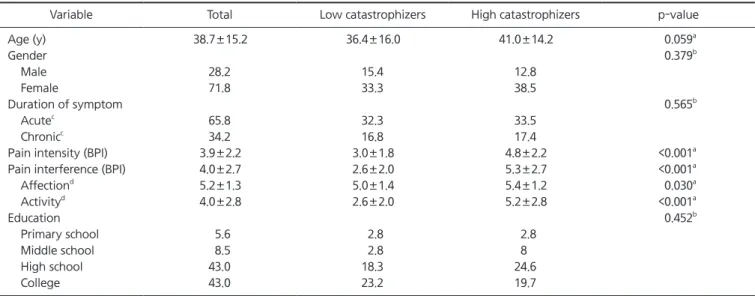
Table 1 shows the demographic and clinical variables of
Table 1. Comparison of demographic and clinical variables between high and low catastrophizers
Variable Total Low catastrophizers High catastrophizers p-value
Age (y) 38.7±15.2 36.4±16.0 41.0±14.2 0.059
aGender 0.379
bMale 28.2 15.4 12.8
Female 71.8 33.3 38.5
Duration of symptom 0.565
bAcute
c65.8 32.3 33.5
Chronic
c34.2 16.8 17.4
Pain intensity (BPI) 3.9±2.2 3.0±1.8 4.8±2.2 <0.001
aPain interference (BPI) 4.0±2.7 2.6±2.0 5.3±2.7 <0.001
aAffection
d5.2±1.3 5.0±1.4 5.4±1.2 0.030
aActivity
d4.0±2.8 2.6±2.0 5.2±2.8 <0.001
aEducation 0.452
bPrimary school 5.6 2.8 2.8
Middle school 8.5 2.8 8
High school 43.0 18.3 24.6
College 43.0 23.2 19.7
BPI, Brief Pain Inventory.
Values are presented as mean±standard deviation or %.
The catastrophizing groups were divided by the median Pain Catastrophizing Scale score, i.e., 15 (low, <15; high, ≥15).
a
By t-test;
bBy chi-square test.
c
Acute and chronic was defined based on the period of 6 months; acute (<6 months), chronic (≥6 months).
d
Subscale of pain interference of BPI.
our subjects and their relation with the level of pain cata- strophizing. There was no significant difference in age, gen- der, duration of symptoms and education between high and low pain catastrophizers. High catastrophizers were older than low catastrophizers but the difference did not reach the statistical significant level (p=0.059; by t-test). On the contrary, the level of catastrophizing was clearly influenced by pain severity and pain interference of BPI questionnaire (p<0.001; Table 1). High catastrophizers showed greater pain severity and pain interference. Interference in affection and activity of BPI was higher in high pain catastrophizers compared to low group, and the difference was greater in activity interference than in affection interference (p<0.001;
Table 1).
The level of catastrophizing was not different among dif- ferent types of TMD including internal derangement with- out pain, myalgia, arthralgia and myalgia-arthralgia com- bined groups (p=0.494; Table 2). Mean and standard devia- tion of the PCS scores for different TMD diagnosis groups were 10.8±7.1 for internal derangement, 19.1±13.6 for ar- thralgia, 17.1±12.3 for myalgia and 17.2±12.6 for com- bined group. The PCS score was the lowest in the subjects
with internal derangement compared to the other three groups but there was no significant difference among them (p=0.275; by one-way ANOVA).
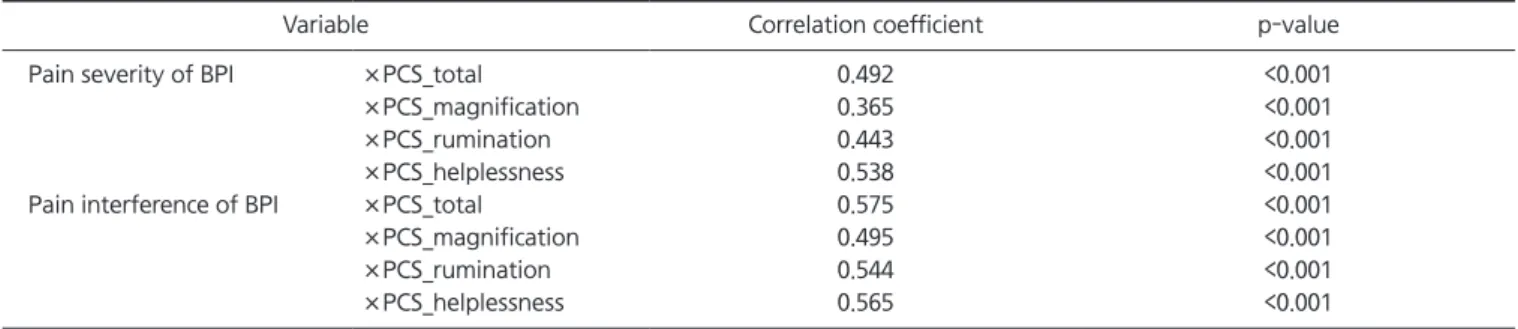
Table 3 shows the relation of pain catastrophizing scores to pain severity and interference. Moderate correlation was found between the total scores of PCS and pain severity and between the PCS scores and pain interference (p<0.001;
Table 3). The subscales such as magnification, rumination and helplessness also were moderately correlated with pain se- verity and pain interference, respectively (p<0.001; Table 3).
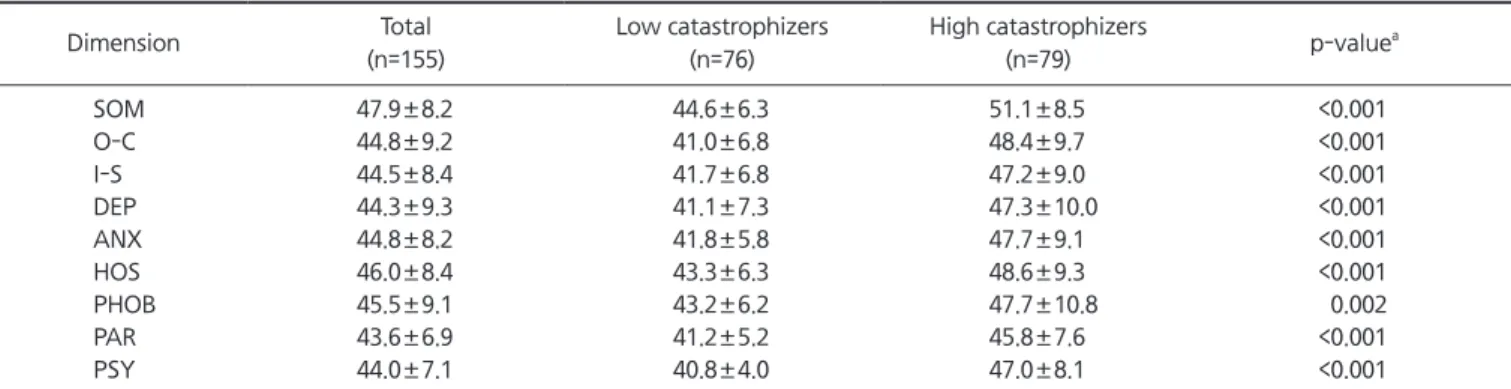
Table 4 presents with difference in psychometric morbid- ity between high and low pain catastrophizers. Although their mean scores of the nine dimensions were within nor- mal range, psychological features assessed by SCL-90-R were affected by level of pain catastrophizing (Table 4).
Compared to low catastrophizers, high pain catastrophiz- ers showed significantly higher scores in all dimensions of SCL-90-R including SOM, O-C, I-S, DEP, ANX, HOS, PHOB, PAR, and PSY (p<0.05; Table 4). Pain catastrophizing was weakly to moderately associated with all psychological di- mensions of SCL-90-R (p<0.001; Table 5).
Table 2. Distribution of types of temporomandibular disorders related to the level of pain catastrophizing (n=155)
Diagnosis Total (%) Low catastrophizers (%) High catastrophizers (%)
Internal derangement 7.1 5.2 1.9
Arthralgia 30.3 12.9 17.4
Myalgia 44.5 21.9 22.6
Combined
a18.1 9.0 9.1
Total 100 49.0 51.0
The catastrophizing groups were divided by the median Pain Catastrophizing Scale score, i.e., 15 (low, <15; high, ≥15).
a
Myalgia-arthralgia combined.
p=0.494, by chi-square test.
Table 3. Pearson’ s correlation analysis between pain intensity and interference and pain catastrophizing
Variable Correlation coefficient p-value
Pain severity of BPI ×PCS_total 0.492 <0.001
×PCS_magnification 0.365 <0.001
×PCS_rumination 0.443 <0.001
×PCS_helplessness 0.538 <0.001
Pain interference of BPI ×PCS_total 0.575 <0.001
×PCS_magnification 0.495 <0.001
×PCS_rumination 0.544 <0.001
×PCS_helplessness 0.565 <0.001
BPI, Brief Pain Inventory; PCS, Pain Catastrophizing Scale.
DISCUSSION
This study investigated relations between level of the pain catastrophizing and clinical and psychological variables for the subjects with TMDs. According to our results, increased pain severity and interference and increased psychological propensity were found in the TMD patients with the high level of catastrophizing and there were weak to moderate positive correlation between those variables. Difference in catastrophizing level was not found for other variables such as age, gender, duration of pain, education level and types of TMDs.
In this study, the catastrophizing level for 155 patients with TMDs using the PCS was the mean and standard de- viation score of 17.3±12.6 (range, 0 to 52). Possible scores
of the PCS range from 0 to 52 with higher scores indicat- ing greater catastrophizing.
22)The questionnaire have been validated in patient and nonpatient samples, and the factor structure appears to be invariant across participant sex and patient/nonpatient status.
7,17,23)In a study with sixty seven individuals with chronic back pain, the mean PCS score was 25.63±12.40, ranging from 1 to 51.
24)One hundred twenty six healthy volunteers presented with the mean PCS score of 10.48±7.83 for women and 9.10±7.64 for men in the ex- periment on induced muscle injury by Parr et al.
25)Quartana et al.
22)reported the mean PCS score of 14.05±8.81 for 39 TMD patients and 8.91±6.77 for healthy controls. Mean PCS score of one hundred ninety eight Koreans with chronic non-cancer pain was 27.68±13.54.
26)Taken these together, TMD patients appear to have relatively lower level of cata- strophizing than that of the other chronic pain conditions and relatively higher level than that of healthy controls al- though catastrophizing level cannot be simply compared across the different samples because of possibility that there are influencing factors such as age, gender, ethnicity, etc.
9)This study showed that catastrophizing was positively correlated to pain severity, consistent with previous data obtained from variable types of pain conditions including
TMD.
18,24,27)Pain catastrophizing has been associated with a
number of indices of pain sensitivity in the context of ex- perimental pain testing paradigms, both among healthy, pain-free participants and individuals with various chron- ic pain conditions.
6,18,27)Higher catastrophizing is associ- ated with more tender points, enhanced responsiveness to
Table 4. Psychometric features by Symptom Check List-90-Revised and pain catastrophizing
Dimension Total
(n=155)
Low catastrophizers (n=76)
High catastrophizers
(n=79) p-value
aSOM 47.9±8.2 44.6±6.3 51.1±8.5 <0.001
O-C 44.8±9.2 41.0±6.8 48.4±9.7 <0.001
I-S 44.5±8.4 41.7±6.8 47.2±9.0 <0.001
DEP 44.3±9.3 41.1±7.3 47.3±10.0 <0.001
ANX 44.8±8.2 41.8±5.8 47.7±9.1 <0.001
HOS 46.0±8.4 43.3±6.3 48.6±9.3 <0.001
PHOB 45.5±9.1 43.2±6.2 47.7±10.8 0.002
PAR 43.6±6.9 41.2±5.2 45.8±7.6 <0.001
PSY 44.0±7.1 40.8±4.0 47.0±8.1 <0.001
SOM, somatization; O-C, obsessive-compulsive; I-S, interpersonal sensitivity; DEP, depression; ANX, anxiety; HOS, hostility; PHOB, phobic anxiety; PAR, paranoid ideation; PSY, psychoticism.
The catastrophizing groups were divided by the median Pain Catastrophizing Scale score, i.e., 15 (low, <15; high, ≥15).
a