Comparison of Myogenous and Arthrogenous Pain Patients of Temporomandibular Disorders using Research Diagnostic
Criteria for Temporomandibular Disorders
Joo Sun Park, D.D.S.,M.S.D., Dong Hee Kim, D.D.S., Jin Woo Chung, D.D.S.,Ph.D.
Department of Oral Medicine and Oral Diagnosis
School of Dentistry and Dental Research Institute, Seoul National University
The purposes of this study were to compare psychological profiles, to investigate the differences in the clinical characteristics, and to compare treatment outcomes between myogenous pain and arthrogenous pain subgroups of temporomandibular disorder (TMD) based on Research Diagnostic Criteria for Temporomandibular disorders (RDC/TMD). Two hundred and fifty two patients diagnosed as TMD were divided into three groups based on the RDC/TMD axis I diagnostic guidelines; myogenous pain group, arthrogenous pain group, and mixed pain (both myogenous pain and arthrogenous pain) group. RDC/TMD history questionnaire was administered to each patient and depression, somatization, jaw disability, pain intensity, disability days, and graded chronic pain scale were analyzed.
Bruxism, clenching, insomnia, headache, and unilateral chewing were assessed in a standardized TMD dysfunction questionnaire and the duration of onset, chronicity of pain, treatment period, the effectiveness of the treatment, and improvement of symptoms also analyzed.
Myogenous pain group had higher depression (p=0.002), and somatization scales (p<0.001) than the arthrogenous pain group. Mixed pain group showed higher pain intensity (p=0.008), disability days (p<0.001), graded chronic pain scale (p=0.005), somatization (p<0.001), and depression scores (p=0.002) than the arthrogenous pain group. Jaw disability did not show any significant differences among the three groups (p=0.058). Arthrogenous pain group reported more limitation of mouth opening than myogenous pain group (p=0.007). Duration of onset showed that the arthrogenous pain group had lowest prevalence of chronicity among three groups (p=0.002). Mixed pain group patients showed lowest symptom improvements among three groups (p=0.007). Multiple linear regression analysis results showed that the treatment effectiveness was significantly associated with somatization score (ß=-0.251, p=0.03).
Key words: Myogenous pain, Arthrogenous pain, RDC/TMD, Pain-related disability, Psychological factors
1)
Ⅰ. INTRODUCTION
Temporomandibular disorders (TMD) refer to a
Corresponding author : Jin Woo Chung, DDS, PhD Professor
Department of Oral Medicine and Oral Diagnosis School of Dentistry and Dental Research Institute Seoul National University
Received: 2012-11-25
collection of medical and dental conditions affecting the temporomandibular joint (TMJ) and/or the muscles of mastication, as well as contiguous tissue components.
1)TMD pain has been established as a condition of substantial public health importance with a prevalence of about 10% among adults and well-documented impaired psychosocial functioning and decreased quality of life in a significant segment of the clinical population.
2-4)Multiple etiological factors such as trauma,
parafunctional habits, and psychosocial impacts have been suggested for the causes of TMD.
Female gender also has been identified as a possible risk factor for TMD. Many epidemiological studies founded that TMD pain was 1.5 to 2 times more common in women than in men, and 80% of patients treated for TMD were women.
2,5)TMD has been understood as a fluctuating, self-limiting, and recurrent chronic pain condition.
6)In chronic pain, the role of psychological distress has gained much attention, and the majority of published reports have suggested that chronic pain patients show increased levels of distress such as depression or anxiety.
7)It was reported that 28% of TMD patients met criteria for the diagnosis of depression.
8)Stress, depression, disability, and dysfunctional illness behaviors are critical aspects of TMD patient's profile. These psychological factors have been implicated in the predisposition, initiation, and perpetuation of TMD and may also affect the treatment of outcome of TMD patients.
9)Several studies that examined psychological differences between TMD subgroups have led to conflicting results. Some studies indicated that patients with myogenic diagnoses had more pain and distress than those with joint-related diagnoses,
10,11)
whereas others reported no differences between subgroups.
12,13)These contradictory results seem to be originated from lack of standardized diagnostic criteria for TMD subgroup classification, absence of age-gender matched subject selection, and incomplete comparison methods.
The conventional disease classification system would be difficult to develop, and could be misleading, given that necessary epidemiological information is lacking, and the etiologies underlying the conditions called TMD have not been adequately defined and described.
1)Dworkin and LeResche showed much attention in this issue and developed the Research Diagnostic Criteria for Temporoman- dibular Disorders (RDC/TMD) to address the above-mentioned classification problems.
14)The RDC/TMD is reliable and valid diagnostic criteria and use clinical examination and history-
gathering methods with scientifically demonstrated reliability for gathering clinical signs of TMD, and also include assessment of behavioral, psychological, and psychosocial factors.
15)This dual-axis system allows a clinical diagnosis based on pathophysiology to be placed on one axis (Axis I) and assessment of TMD pain-related disability and psychosocial status on the second axis (Axis II). Axis II assess and classify the global severity of the pain condition in terms of pain intensity, pain related disability, depression, and nonspecific physical symptoms.
The effective treatments of TMD have been suggested including physical therapy, medication, behavioral therapy, occlusal appliance therapy, and surgical intervention. Despite of successful results of these treatments on TMD, very few literatures have been reported comparing the treatment outcomes between TMD subgroups. As psychological factors have been implicated in the predisposition, initiation, and perpetuation of TMD, the patient's Axis II profile is important for the initial management of TMD.
15)The purposes of this study were to compare psychological profiles, to investigate the differences in the clinical characteristics, and to compare treatment outcomes among myogenous pain, arthrogenous pain, and mixed pain subgroups of TMD using Korean version of RDC/TMD.
Ⅱ. MATERIALS AND METHODS 1. Subjects
A total of 308 (61 male and 237 female)
consecutive patients with TMD who visited at the
Orofacial Pain Clinic of Seoul National University
Dental Hospital, were recruited. The patients were
divided into three groups based on the RDC/TMD
axis I diagnostic guidelines
14); Group A- patients
with only myogenous pain, Group B- patients with
only arthrogenous pain, and Group C- patients with
both myogenous pain and arthrogenous pain (mixed
pain). Of the 308 patients, 56 were excluded because
Group A (n= 44) Group B (n= 78) Group C (n= 130) P-value
Gender (female) (%) 35 (79.5) 60 (76.9) 113 (86.9) 0.156
aAge (years) 32.2 ± 12.8 29.8 ± 14.2 32.3 ± 13.1 0.405
ba: One-way ANOVA, b: Chi-square test
Group A= myogenous pain group, Group B= arthrogenous pain group, Group C= mixed pain group.
Table 1. Demographics of the 252 TMD patients according to the 3 diagnostic subgroups
of no symptoms of pain or not fit in the criteria described below. The demographics of the 252 subjects were shown in Table 1.
Myogenous pain patient group was defined as following criteria; 1) Location of pain differed with the muscle mainly involved: pre-auricular and cheek areas for the lateral pterygoid and masseter muscle; parietal, temporal, periorbital areas for the temporal muscle. 2) A complaint of pain and pain reported in response to palpation of 3 or more of 20 muscle sites: pain was spontaneous but could be exacerbated by muscle palpation.
Arthrogenous pain patient group was defined as one or more pain and tenderness in the region of joint; 1) pain in one or both joint sites during palpation. 2) one or more of the following self-reports of pain; pain in the region of the joint, pain in the joint during maximum unassisted opening, pain in the joint assisted opening, pain in the joint during lateral excursion. Mixed pain (both myogenous and arthrogenous pain) patient group was defined as presence of both symptoms.
Each patient was examined by two clinical examiners. The clinical examiners all had advanced training in the diagnosis of TMD and the RDC/TMD procedures. If the diagnostic results between two examiners were differed, the final diagnosis was discussed by the examiners and decided.
2. RDC/TMD axis II questionnaire
RDC/TMD axis II history questionnaire was administered to each patient before treatment. We used a systematically translated Korean version of
RDC/TMD.
The parameters of psychological profiles including depression and somatization, jaw disability, pain intensity, disability days, and graded chronic pain scale were analyzed. Method of assessing depression and somatization was derived from Symptom Checklist-90-Revision (SCL-90-R).
Participants responded to 13 items of depression parameter and 7 items of additional parameter of SCL-90-R, and then resultant raw mean score was regarded as depression scale. Somatization scale was also obtained by raw mean score from the responses to 12 items of non-specific physical symptoms of SCL-90-R.
Jaw disability scale was gained from the ratio of positively responded item number to 12 items of jaw disability checklist base on items commonly used in clinical TMD research.
The history questionnaire includes three questions to grade pain intensity: one for the actual pain, one for maximal pain in the last 6 months, and one for average pain in the last 6 months. The response options for each of three items were based on the ordinal rating of 0 to 10 scales. To obtain the final score, we multiplied average of the responses to the each item by 10. Therefore pain intensity is 0 to 100 score derived from above three questions. The score of pain days was obtained from the number of days that each subject had pain in facial area.
Graded chronic pain scale was classified to five stages (0=no TMD pain in the prior 6 months;
I=low intensity-low disability; II=high intensity-
low disability; III=high intensity-high disability-
moderately limiting; IV=high intensity-high
disability-severely limiting). According to the
severity of chronic pain symptoms derived from the pain intensity and disability paint which is summed by adding disability score point to disability days score point. Grade I and II are defined as low disability group, and grade III and IV are defined as high disability group.
3. Clinical Examination
After the RDC/TMD questionnaires were completed, clinical examination was performed according to the RDC/TMD. The clinical examination involves clinical assessment of TMD signs and symptoms including pain site, mandibular range of motion and associated pain, joint sounds, muscles and joint palpation or tenderness. For evaluation of the existence of contributing factors, the 17 parafunctional habits (sleep bruxism, daytime clenching clenching, perioral contraction, tongue thrusting, frequent hard food mastication, unilateral chewing, unilateral sleep, high pillow, biting something, irregular diet, chin buttressing, coffee, insomnia, indigestion, bad posture, much talking, cold weather) were assessed using standardized questionnaire used in our clinic.
Duration of onset and chronicity of pain were also assessed. Chronicity of pain was defined by symptom longer than 6 months.
4. Treatment outcome
Of the 252 patients, total 149 patients were received constant treatments. All of the patients received physical treatment, and behavioral management. Ninety-three of 149 patients (62.4%) received occlusal splint therapy.
Total treatment period, effectiveness of the treatment, and existence of improvement of symptoms were also assessed. The effectiveness of the treatment at the last visit was evaluated as follows; pain relief, satisfactory mandibular function, with good patient acceptance, and minimal to adverse effects (0= no pain relief or prominent adverse effects; 1= not satisfactory mandibular
function or insufficient pain relief; 2= notable pain relief or satisfactory mandibular function; 3=
absolute pain relief or great patient acceptance).
16)For the existence of improvement of symptoms, 0 and 1 were classified as no improvement, and 2 and 3 were classified as symptom improvement after treatment.
5. Statistical analyses
One-way ANOVA was used to analyze separately the differences between the three groups on pain intensity, disability days, graded chronic pain scale, depression, nonspecific physical symptoms (pain item included), nonspecific physical symptoms (pain item excluded) and jaw disability.
Chi-square tests were used for analyzing group differences on bruxism, clenching, unilateral chewing, insomnia, and headache. Multiple linear regression analysis were used to analyze association factors among psychosocial profiles could affect the treatment effectiveness.
Ⅲ. RESULTS 1. RDC/TMD axis II profiles
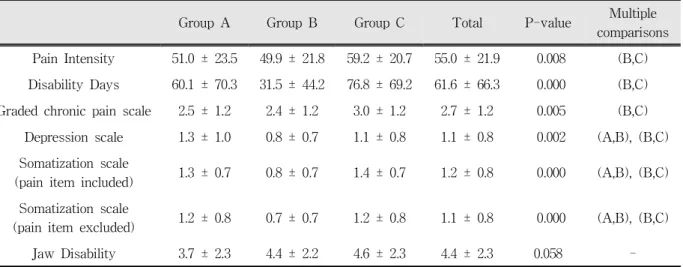
Overall 6 of the 7 parameters of the RDC/TMD axis II profiles were statistically significantly different among three groups (p<0.05). The arthrogenous pain group reported lower pain intensity, disability days, graded chronic pain scale than the mixed pain group. Depression and somatization (with or without pain items) scored lower in the arthrogenous pain group than the myogenous pain group and the mixed pain group.
However, jaw disability did not show significant differences among the three groups. (Table 2) 2. Other clinical parameters
When the clinical data obtained from the
standardized TMD dysfunction chart were compared,
mandibular range of motion and the effectiveness of
Group A Group B Group C Total P-value Multiple comparisons Pain Intensity 51.0 ± 23.5 49.9 ± 21.8 59.2 ± 20.7 55.0 ± 21.9 0.008 (B,C) Disability Days 60.1 ± 70.3 31.5 ± 44.2 76.8 ± 69.2 61.6 ± 66.3 0.000 (B,C) Graded chronic pain scale 2.5 ± 1.2 2.4 ± 1.2 3.0 ± 1.2 2.7 ± 1.2 0.005 (B,C)
Depression scale 1.3 ± 1.0 0.8 ± 0.7 1.1 ± 0.8 1.1 ± 0.8 0.002 (A,B), (B,C) Somatization scale
(pain item included) 1.3 ± 0.7 0.8 ± 0.7 1.4 ± 0.7 1.2 ± 0.8 0.000 (A,B), (B,C) Somatization scale
(pain item excluded) 1.2 ± 0.8 0.7 ± 0.7 1.2 ± 0.8 1.1 ± 0.8 0.000 (A,B), (B,C) Jaw Disability 3.7 ± 2.3 4.4 ± 2.2 4.6 ± 2.3 4.4 ± 2.3 0.058 - Group A= myogenous pain group, Group B= arthrogenous pain group, Group C= mixed pain group.
Table 2. RDC/TMD axis II parameters and analysis of variances for the 3 diagnostic subgroups.
treatment were statistically significant differences among the three groups (p<0.05). The arthrogenous pain group reported more limitation of mouth opening than the myogenous pain group. The effectiveness of treatment showed significant
Group A Group B Group C Total P-value Multiple
comparisons Maximum mouth
opening (mm) 46.0 ± 7.3 40.9 ± 8.7 43.6 ± 8.7 43.2 ± 8.6 0.007 (A,B) Duration of
symptoms (month) 39.1 ± 42.7 25.5 ± 36.5 38.0 ± 38.7 34.2 ± 39.0 0.065 - Treatment
effectiveness 2.2 ± 0.7 2.3 ± 0.8 1.9 ± 1.0 2.1 ± 0.9 0.049 - Group A= myogenous pain group, Group B= arthrogenous pain group, Group C= mixed pain group.
Table 3. Clinical parameters and analysis of variances for the 3 diagnostic subgroups.
Group A Group B Group C Total P-value
Chronicity of pain 87.5 64.5 83.5 78.2 0.002
Improvement of symptoms 82.6 87.2 63.3 73.8 0.007
Group A= myogenous pain group, Group B= arthrogenous pain group, Group C= mixed pain group.
Table 4. Prevalence (%) of chronicity of pain, and symptom improvement among 3 diagnostic subgroups.
differences among groups (p= 0.049), but mean duration of symptoms, mean treatment period did not show significant difference among the three groups. (Table 3)
The results of the chi-square analysis showed
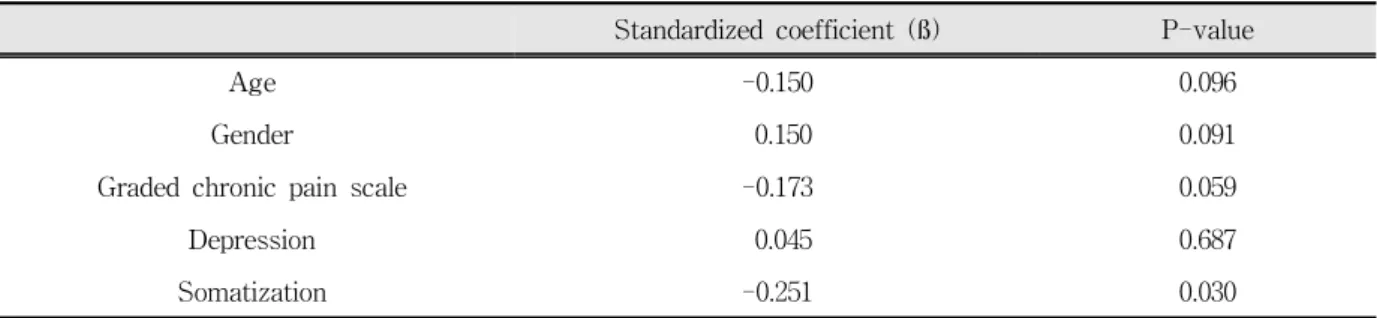
Standardized coefficient (ß) P-value
Age -0.150 0.096
Gender 0.150 0.091
Graded chronic pain scale -0.173 0.059
Depression 0.045 0.687
Somatization -0.251 0.030
Table 5. Standardized coefficients of gender, age, and RDC/TMD axis II profiles on the treatment effectiveness in the multiple linear regression model.
significant difference in chronicity of pain and improvement of symptoms after treatment among the 3 groups. The symptom was more likely to be chronic in myogenous and mixed pain groups. The lowest improvement of symptoms after treatment was observed in mixed pain group about 63.3%.
(Table 4)
Multiple linear regression analysis results showed that the effectiveness of treatment was significantly associated with somatization score ( ß =-0.251, p=0.030). (Table 5)
Ⅳ. DISCUSSION
Present study is the first study evaluating the clinical characteristics, psychological profiles, and the treatment outcomes using RDC/TMD among different subgroups of TMD patients in Korean population. Our study showed that the myogenous pain group had higher depression, somatization (with or without pain), and sleep disturbance than the arthrogenous pain group. These results are consistent with the findings of Yap et al.
10)They reported that patients with both myofascial pain and other joint conditions were significantly more depressed and had more somatization than patients with only disk displacement. On the other hand, no differences in pain intensity, disability days and GCP scale between the myogenous pain group and the arthrogenous group. The result is consistent with the findings of Lindroth et al.,
17)these 2 groups had equivalent pain intensity as well as pain
duration. However, Lundeen et al.
18)reported that the muscle pain group had more intense pain than the joint pain group. In our study, mixed pain (both myogenous and arthrogenous pain) group showed most pain intensity, disability days, graded chronic pain scale, and somatization with pain, and had higher depression and somatization without pain than the arthrogenous pain group.
In recent years, there have been several studies whether the myogenous pain patients have higher levels of psychopathology than the arthrogenous pain patients or not. Overall, many results support that the myogenous pain patients could be characterized as having more psychological distress than the arthrogenous pain patients. For example, Auerbach et al.
19)found that myofascial pain and dysfunction patients had higher depression, stress exposure, and overall pain disability scores than arthrogenous TMJ patients. Epker and Gatchel
20)reported that myogenous pain patients showed higher levels of psychological difficulties and displayed more dysfunctional behavior than did arthrogenous pain patients. Lindroth et al.
17)also reported that masticatory muscle pain patients presented more psychological distress, had poorer sleep habits, and related more symptoms due to serious life stressors than the intracapsular pain patients. But Michelotti et al.,
12)using the Minnesota Multiphasic Personality Inventory, found no significant differences in depression levels between myogenous and arthrogenous patients.
Visscher et al.
7)also reported no differences in
SCL-90 scores among the myogenous and arthrogenous craniomandibular pain patients.
The myogenous pain is most common forms of the chronic orofacial pain. There is no adequate diagnostic test for muscle pain except muscle palpation, and no proper treatment tools. Myofascial pain has been reported to be influenced by sympathetic activity and this finding means that the muscle pain could be affected by the emotional distress. Hubbard et al.
21)reported that the EMG activity at the myofascial trigger point was increased during the stressful events.
In our study, the effectiveness of the treatment was affected by somatization score. Depression is the psychological mood characterized by feelings of sadness, helplessness, hopelessness, guilt, despair, and futility. Somatization is the process whereby a mental condition is experienced as a bodily symptom.
22)These psychological factors may be a predictor of poor TMD outcome.
19,23-24)Indeed, the result of the effectiveness of the treatment was lowest in the both myogenous and arthrogenous pain group. And overall, the myogenous TMD patients responded less favorably to treatment than the arthrogenous patients.
25)Therefore, these psychological factors must be considered during treatment. As mentioned by Dworkin,
26)tailored self-care treatment programs (cognitive-behavioral therapy) can be effective with myogenous (with or without arthrogenous pain) pain patients. Turk et al.
27)have recommended the use of a cognitive- behavioral therapy which is significantly effective in reducing pain, depression, and medication use in TMD patients with high levels of psychological distress. Carlson et al.
28)reported that myogenous pain patients responded well to a self-regulation protocol that provided sustained pain reduction over a 6-month period of time. Dworkin et al.
16)also demonstrated the effectiveness of such approach.
The etiology of TMD is multifactorial and it is difficult to make explicit a cause-and-effect. Our results of associated factors for TMD did not show any significant differences in the contributing factors among the TMD subgroups except insomnia
and headache. Mixed pain patients showed significantly higher percentage of insomnia and headache. Many investigators agreed that muscle tenderness has most often been found to be connected with headache.
29-31)And as noted earlier,
17)
the myogenous pain patients showed lower sleep quality than arthrogenous pain patients and normal controls.
Many authors reported that bruxism is a possible causal factor for TMD,
11,32-34)but some authors disagreed on the role of bruxism in the etiology of
TMD.
35-36)The prevalence of bruxism with TMD
reported about 26-80%.
37-38)In our study, prevalence of bruxism was 23.6%, and clenching was 33.1% and mean. There were no significant differences among subgroups of TMD, and these results were consistent with the report by Pergamalian et al.
37)Other authors, however, reported that myofascial pain patients showed higher prevalence of bruxism and clenching than arthrogenous pain patients and supported the role of bruxism and clenching important as etiologic factors of TMD.
32-33)Tay et al.
39)suggested that severe TMD patients tend to chewing to the side of the lesion. Kino et al.
34)reported that unilateral chewing is over 56% of the TMD patients in all subgroups, and had not significant difference between groups. Our result was similar with the report by Kino et al., but the percentage of unilateral chewing in our TMD patients was about 37%.
The mandibular range of motion was significantly smaller in the arthrogenous pain group. Masumi et al.
40)reported that mandibular motion measurements are critical to the process of differential diagnosis and to measure the severity of symptoms in the acute disk displacement without reduction group only. Hesse et al.
41)presented that the closed lock patients doubtless displayed strong limitation in mandibular range of motion, and the myogenous pain patients also showed smaller mandibular range of motion, but no-closed lock arthrogenous pain patients failed to show significant differences with the control group.
In sum, myogenous pain group and mixed pain
group had higher psychological profiles than the arthrogenous pain group. Mixed pain group patients showed lowest symptom improvements among three groups. Treatment effectiveness was significantly affected by somatization score.
Ⅴ. CONCLUSIONS
TMD refer to a collection of medical and dental conditions affecting the TMJ and/or the muscles of mastication, as well as contiguous tissue components. The purposes of this study were to compare psychological profiles, to investigate the differences in the clinical characteristics, and to compare treatment outcomes between myogenous pain and arthrogenous pain groups of TMD based on RDC/TMD.
Two hundred and fifty two TMD patients were selected and divided into three groups based on the RDC/TMD axis I diagnostic guidelines; myogenous pain group, arthrogenous pain group, and mixed pain group. RDC/TMD axis II profiles, contributing factors, clinical findings, and treatment outcomes of three TMD subgroups were analyzed. Myogenous pain group had higher depression (p=0.002), and somatization scales (p<0.001) than the arthrogenous pain group. Mixed pain group showed higher pain intensity (p=0.008), disability days (p<0.001), graded chronic pain scale (p=0.005), somatization (p<0.001), and depression scores (p=0.002) than the arthrogenous pain group. Jaw disability did not show any significant differences among the three groups (p=0.058). Arthrogenous pain group reported more limitation of mouth opening than myogenous pain group (p=0.007). Duration of onset showed that the arthrogenous pain group had lowest prevalence of chronicity among three groups (p=0.002). Mixed pain group patients showed lowest symptom improvements among three groups (p=0.007).
Multiple linear regression analysis results showed that the treatment effectiveness was significantly associated with somatization score ( ß =-0.251, p=0.03).
REFERENCES
1. NIH. Management of temporomandibular disorders.
National Institute of Health Technology Assessment Statement, 1996.
2. LeResche L. Epidemiology of temporomandibular disorders: implications for the investigation of etiologic factors. Crit Rev Oral Biol Med 1997; 8:291- 305.
3. Von Korff M, Dworkin SF, LeResche L. Graded chronic pain status: an epidemiologic evaluation. Pain 1990;40:279-291.
4. Chung JW, Kim JH, Kim HD, Kho HS, Kim YK, Chung SC. Chronic orofacial pain among Korean elders: prevalences, and impact using the graded chronic pain scale. Pain 2004; 112:164-170.
5. Warren MP, Fried JL. Temporomandibular disorders and hormones in women. Cells Tissues Organs 2001;169:187-192.
6. Dworkin SF, Huggins KH, Wilson L , et al. A randomized clinical trial using research diagnostic criteria for temporomandibular disorders-axis II to target clinic cases for a tailored self-care TMD treatment program. J Orofac Pain 2002;16:48-63.
7. Visscher CM, Lobbezzo F, de Boer W, van der Meulen M, Naeije M. Psychological distress in chronic craniomandibular and cervical spinal pain patients. Eur J Oral Sci 2001;109:165-171.
8. Korszun A, Hinderstein B, Wong M. Cormodibity of depression with chronic facial pain and temporo- madibular disorders. Oral Surg Oral Med Oral Pathol Radiol Endod 1996;82:496-500.
9. Yap AUJ, Dworkin SF, Tan HH, Tan KBC. Multiple pains and psychosocial functioning/psychologic distress in TMD patients. Int J Prosthod 2002;15:
461-466.
10. Yap AUJ, Tan KBC, Chua EK, Tan HH. Depression and somatization in patients with temporomandibular disorders. J Prosthet Dent 2002;88:479-484.
11. Huang GJ, LeResche L, Critchlow CW, Martin MD, Drangsholt MT. Risk factors for diagnostic subgroups of painful temporomandibular disorders. J Dent Res 2002;81:284-288.
12. Michelotti A, martina R, Russo M, Romeo R.
Personality characteristics of temporomandibular disorder patients using MMPI. Cranio 1998;16:
119-125.
13. Marbach JJ, Lund P. Depression, anhedonia and
anxiety in temporomandibular joint and other facial
pain syndromes. Pain 1981;11:73-84.
14. Dworkin SF, LeResche L. Research diagnostic criteria for temporomandibular disorders: Review, criteria, examinations and specifications, critique. J Craniomandib Disord 1992;6:301-355.
15. Yap AUJ, Dworkin SF, Chua EK, List T, Tan KBC, Tan HH. Prevalence of temporomandibular disorder subtypes, psychologic distress, and psychosocial dysfunction in asian patients. J Orofac Pain 2003;
17:21-28.
16. Dworkin SF, Huggins KH, Wilson L, et al . A randomized clinical trial using research diagnostic criteria for temporomandibular disorders-axis II to target clinic cases for a tailored self-care TMD treatment program. J Orofac Pain 2002;16:48-63.
17. Lindroth JE, Schmidt JE, Carlson CR. A comparison between masticatory muscle pain patients and intracapsular pain patients on behavioral and psychosocial Domains. J Orofac Pain 2002; 16:277- 283.
18. Lundeen TF, Sturdevant JR, George JM. Stress as a factor in muscle and temporomadibular joint pain. J Oral Rehabil 1987;14:447-456.
19. Auerbach SM, Laskin DM, Frantsve LM, Orr T.
Depression, pain, exposure to stress life events, and long-term outcomes in temporomandibular disorder patients. J Oral Maxillofac Surg 2001; 59:628-633.
20. Epker J, Gatchel RJ. Coping profile differences in the biopsychosocial functioning of patients with temporo- mandibular disorders. Psychosom Med 2000;62:69-75.
21. Hubbard DR, Jr., Berkoff GM: Myofascial trigger points show spontaneous needle EMG activity. Spine 1993;18:1803-1807.
22. Okeson JP. Orofacial pain-guidelines for assessment, diagnosis and management. Chicago, 1996, Quin- tessence Publishing Co., pp.223-268.
23. Rudy TE, Turk DC, Kubinski JA, Zaki HS.
Differential treatment responses of TMD patients as a function of psychological characteristics. Pain 1995;61:103-112.
24. Grossi ML, Goldberg MB, Locker D, Tenenbaum HC.
Reduced neuropsychologic measures as predictors of treatment outcome in patients with temporoman- dibular disorders. J Orofac Pain 2001;15:320-339.
25. Scholte AM, Steenks MH, Bosman F. Characteristics and treatment outcome of diagnostic subgroups of CMD patients: retrospective study. Community Dent Oral Epidemiol 1993;21: 215-220.
26. Dworkin SF, Turner JA, Wilson L, et al . Brief group
cognitive-behavioral intervention for temporomandi- bular disorders. Pain 1994; 59:175-187.
27. Turk DC, Rudy TE, Kubinski JA, Hussein SZ. Greco CM. Dysfunctional patients with temporomandibular disorders: Evaluating the efficacy of a tailored treatment protocol. J Consult Clin Psychol 1996;64:
139-146.
28. Carlson CR, Bertrand PM, Ehrlich AD, Maxwell AW, Burton RG. Physical self-regulation training for the management of temporomandibular disorders. J Orofac Pain 2001;15:47-55.
29. Ingervall B, Molin B, Thilander B. Prevalence of symptoms of functional disturbances of the masticatory system in Swedish men. J Oral Rehabil 1980;7:185-197.
30. Lee FK, Tay DK, Tan WK. Orofacial pain distribution in the Singapore Armed Forces: a pilot study. Ann Acad Med Singapore 1995;24:26-32.
31. Mongini F, Ciccone G, Ceccarelli M, Baldi I, Ferrero L. Muscle tenderness in different types of facial pain and its relation to anxiety and depression: A cross-sectional study on 649 patients. Pain 2007;131:
106-111.
32. Rauhala K, Oikarinen KS, Raustia AM. Role of temporomandibular disorders in facial pain: occlusion, muscle and TMJ pain. Cranio 1999;17:254-261.
33. Manfredini D, Cantini E, Romagnoli M, Bosco M.
Prevalence of bruxism in patients with different research diagnostic criteria for temporomandibular disorders (RDC/TMD) diagnoses. Cranio 2003;21:
279-285.
34. Kino K, Sugisaki M, Haketa T, et al . The comparison between pains, difficulties in function, and associating factors of patients in subtypes of temporomandibular disprders. J Oral Rehabil 2005;32:315-325.
35. Cassanova-Rosado JF, Medina-Solis CE, Vallejos- Sanchez AA, Cassanova-Rosado AJ, Hernandez- Prado B, Avila-Burgos L. Prevalence and associated factors for temporomandibular disorders in a group of Mexican adolescents and youth adults. Clin Oral Investig 2006;10:42-49.
36. Lobbezoo F, Lavigne GJ. Do bruxism and temporo- mandibular disorders have a cause-and-effect relationship? J Orofac Pain 1997;11:15-23.
37. Pergamalian A, Rudy TE, Zaki HS, Greco CM. the association between wear facets, bruxism, and severity of facial pain in patients with temporo- mandibular disorders. J Prosthet Dent 2003; 90:
194-200.
38. Molina OF, dos Santos Jr J, Nelson SJ, Nowlin T. A clinical study of specific signs and symptoms of CMD in bruxers classified by the degree of severity.
Cranio 1999;17:268-279.
39. Tay DK, Soh G, Tan LS, Tan KL. The prevalence of unilateral mastication in a non-patient population: a pilot study. Ann Acad Med Singapore 1989;18: 556- 559.
국문요약
측두하악장애 연구진단기준(RDC/TMD)를 이용한 측두하악장애의 근육성 동통과 관절성 동통 환자군의 비교