INTRODUCTION
Human skin is constantly at risk of damage with exposure to environmental insults including microbial challenge and ultraviolet irradiation (1). So innate immune system may immediately respond to intruding microbes for prevention of further invasion, although stratum corneum is the first line of defense. Antimicrobial peptides (AMPs), which is a kind of innate immune system, can be isolated from various tissues including respiratory, urogenital, and skin epithelium (2, 3). In mammals, several AMPs such as defensins, cathe- licidins, cecropins, histatins, lactoferrins, NK-lysin, and pro- tegrins have been found (1, 4, 5). These peptides, which are produced by keratinocytes in the skin, can disrupt the mem- brane of the target microbe or penetrate the microbial mem- brane, interfering with intracellular functions (1-5). The mech- anisms that regulate expressions of AMPs are not yet under- stood. Recently, however, Toll-like receptor (TLR) 2 and TLR 4 have been suggested to be related with the expressions of these AMPs (6, 7).
Among numerous antimicrobial peptides, human -de- fensin (HBD) and cathelicidin are the major peptides in mam- malian skin and they can be induced by injury or inflamma- tion of the skin (1, 8-10). In humans, the cathelicidin family is known to contain just a single member, LL-37 (9, 10).
Precise roles of HBD and LL-37 for the protection of UV- induced damage in the skin are less well understood. Yang et al. (11) reported that HBD may recruit immature dendritic cells and memory T cells through their interaction with che- mokine receptor 6 (CCR6) and therefore play important roles in both innate and adaptive immune responses.
Atopic dermatitis and psoriasis, the common inflamma- tory skin diseases, show contrasting disease features although both diseases are characterized by defective skin barrier (12).
About 30 percent of patients with atopic dermatitis have bacterial or viral infections of the skin, as compared with only 7 percent of patients with psoriasis (13). This fact is due to distinct profile of chemokines and incoming helper T cell types, and difference of epidermal thickness (13). In psoria- sis, epidermis is thickened owing to increased and accelera- tive differentiating keratinocytes. So, quantitatively, abun- dant antimicrobial peptides are expressed in the epidermal layer of psoriasis (12, 14).
Normal human keratinocytes (NHK) which are normally differentiated cell and HaCaT cells which are immortalized, rarely differentiated keratinocyte cell lines show different differentiation feature. So, we designed this study to identify the expressions of LL-37 in NHK and HaCaT cells after expo- sure to stimulants in order to elucidate their roles for environ- mental insults and to investigate the level of LL-37 expres-
Ji Eun Kim, Beom Joon Kim, Mi Sook Jeong*, Seong Jun Seo, Myeung Nam Kim, Chang Kwun Hong, Byung In Ro
Department of Dermatology, College of Medicine, Chung Ang University; Chung Ang Medical Research Center*, Seoul, Korea
Address for correspondence Seong Jun Seo, M.D.
Department of Dermatology, College of Medicine, Chung Ang University Medical Center, 224-1 Heukseok-dong, Dongjak-gu, Seoul 156-756, Korea Tel : +82.2-6299-1525, Fax : +82.2-823-1049 E-mail : [email protected]
*This research was supported by the Chung Ang University Research Grants in 2005.
649
Expression and Modulation of LL-37 in Normal Human Keratinocytes, HaCaT cells, and Inflammatory Skin Diseases
Defensins and cathelicidins (LL-37) are major antimicrobial peptides (AMPs) of the innate immune system of the human skin. In normal non-inflamed skin these pep- tides are negligible, but their expression can be markedly increased in inflammatory skin disease such as psoriasis. We designed this study to identify the expressions of LL-37 in normal human keratinocyte (NHK) and HaCaT cells after exposure to stimulants and to investigate difference of LL-37 expression accompanied with cell differentiation status, and come to understand difference of susceptibility to infection in atopic dermatitis and psoriasis. Expressions of LL-37 in NHKs and HaCaT cells were evaluated by using RT-PCR, Western blotting, and immunohistochemical (IHC) staining at 6, 12, and 24 hr post stimulation after exposure to Ultraviolet B irradiation and lipopolysaccharide. And expression of LL-37 in skin biopsy specimens from patients with atopic dermatitis and psoriasis was determined by immunohistochemi- cal analysis. In time-sequential analyses of LL-37 expression revealed that LL-37 was expressed in NHKs, but not in HaCaT cells. IHC analysis confirmed the pres- ence of abundant LL-37 in the epidermis of psoriasis. Therefore we deduced that expression of LL-37 is affected by UV irradiation, bacterial infection, and status of cell differentiation.
Key Words : CAP18 lipopolysaccharide-binding protein; LL-37; Keratinocytes; HaCaT Cell; Psoriasis; Der- matitis, Atopic
Received : 30 November 2004 Accepted : 7 February 2005
sion accompanied with cell differentiation status and come to understand difference of susceptibility to infection in atopic dermatitis and psoriasis.
MATERIALS AND METHODS HaCaT cell culture
The HaCaT cells, human keratinocyte cell lines, were cul- tured in Isocove’s Modified Dulbecco’s Medium (IMDM) (Gibco, Carlsbad, CA, U.S.A.), supplemented with 10% fetal bovine serum (Gibco) and penicillin-streptomycin 100 IU- 100 g/mL (Gibco) grown on 75 cm2flask and incubated with 5% CO2at 37℃. Cultured HaCaT cells were divided as a number of 2×10⁵/mL and plated in a standard flat bot- tomed 10 cm2polystyrene plate. Cells were starved in IMDM supplemented with free fetal bovine serum overnight, some cells then were irradiated Ultraviolet B (UVB) 20 mJ/cm2 and treated lipopolysaccharide (LPS) 2.5 g/mL, 5.0 g/mL (Sigma, St. Louis, MO, U.S.A.) respectively and incubated for 6, 12, and 24 hr.
Normal human keratinocytes
For harvesting NHKs, neonatal foreskin was obtained from neonatal circumcision specimen and then primary culture was done. Briefly, neonatal foreskin was chopped in 1 mm size and trypsinized in room temperature overnight. After vortex vigorously and incubated for 5 min and supernatant was taken and plated on 25 cm2culture flask and then incu- bated 5% CO2at 37℃in keratinocyte growth media (Clo- netics, East Rutherford, NJ, U.S.A.). Cultured normal human keratinocytes were irradiated in UVB 20 mJ/cm2and treat- ed LPS 2.5 g/mL, 5.0 g/mL, respectively and incubated for 6, 12, and 24 hr.
Ultraviolet B irradiation
Dosage of irradiation was 20 mJ/cm2which were chosen based on preliminary data in this experiment. UVB irradia- tion was delivered with a Philips TL 20W/12 (Eindhoven, Netherlands), a fluorescent bulb emitting 280-320 nm wave with a peak at 313 nm wave. Before UVB irradiation, medi- um was removed and covered with phosphate buffered saline (PBS). Irradiation output was monitored by means of a Wald- mann UV-meter (Waldmann, Villigen-Schwenningen, Ger- many).
Lipopolysaccharide stimulation
2.5 g/mL and 5.0 g/mL of LPS (Sigma, St. Louis, MO, U.S.A.) was used.
Preparation of primer
We synthesized the PCR primer from the basis of Gen- Bank data. Primers were chemically synthesized by using DNA synthesizer (Pharmacia, Bj rkgatan, Uppsala, Sweden).
Their sequences were as follows:
LL-37 (348 bp) :
5′-TCG GAT GCT AAC CTC TAC CG-3′(sense), 5′-GGG TAC AAG ATT CCG CAA AA-3′(anti-sense) GAPDH (593 bp) :
5′-CCA CCC ATG GCA AAT TCC ATG GCA-3′(sense), 5′-GGT GCT GCT TGT TAG GAG GTC AAG TAA
AGG GC-3′(anti-sense)
Reverse transcription-polymerase chain reaction
Total RNA was isolated from NHKs and HaCaT cells using TRIZol reagent (Invitrogen, Carlsbad, CA, U.S.A.), cells were added 1 mL of TRIZol reagent in cultured dish.
After 5 min at room temperature, added 0.2 mL of chloro- form per 1 mL of TRIZol reagent, shook tubes vigorously by hands for 15 sec and incubated them at 15℃to 30℃for 3 min. The mixtures were centrifuged with 12,000 rpm at 4℃for 15 min, transferred the upper aqueous phase to a fresh tube, and the same amount of 2-propanol was added. After mixtures were incubated at 4℃for 15 min, it was centrifuged with 12,000 rpm at 4℃for 15 min. The supernatant was removed, then washed 500 L of 70% ethanol with 12,000 rpm at 4℃for 5 min, the RNA pellet was briefly dried. The purified RNA was dissolved in DEPC-DW 30 L. 3 g of total cellular RNA was reverse transcribed at 42℃for 30 min in a 20 L volume containing 1 L reverse transcriptase (TaKaRa, Shiga, Japan), 10× buffer 2 L, 10 mM dNTP 2 L (dNTP mix), oligo dT primer 1 L, RNase inhibitor 0.5 L, 25 mM MgCl24 L. 2 L of each cDNA sample from the RT-PCR was amplified by PCR in 25 L containing 10×
buffer 2.5 L, 25 mM MgCl22.5 L and 10 pmol 0.75 L primer
Reactions were cycled 35 times with denaturation at 94℃ for 1 min followed by annealing at 59℃for 1 min and finally an extension step at 72℃for 1 min.
Electrophoresis
The products were run on 1.5% agarose gel containing 1 g ethidium bromide per millimeter. 20 L of reaction mixture was mixed with loading buffer separated by electrophoresis for 15 min at 100 voltages and visualized by UV transillu- mination.
Quantitative analysis
It has been quantitatively analyzed with densitometer that
hybrids of PCR products of LL-37 and GAPDH on DIG chemiluminescent film were calculated (volume of LL-37/
volume of GAPDH ×100).
Western blotting
NHK and HaCaT cell were lysed in a buffer containing 50 mM Tris-Cl (pH 8.0), 150 mM NaCl, 0.02% sodium azide, 100 g/mL phenylmethanesulfonyl fluoride (PMSF), 1 g/
mL aprotinin, 1% Triton ×100, centrifuged with 12,000 rpm at 4℃for 30 min.
The supernatant was transferred into new tube, 30 g of soluble protein were loaded in 15% sodium dodecyl sulfate polyacrylamide gel electrophoresis (SDS-PAGE) with sam- ple buffer containing 1 M Tris, glycerol 50%, samples were heated at 95℃for 5 min prior to gel loading.
For LL-37 dectection, separated protein on gel electrophore- sis was transferred to nitrocellulose membrane (Osmonics, Minnesota, MN, U.S.A.) at 0.16A for 1 hr. The membrane were washed 3 times with Tris-buffered saline Tween 20 (TBST), and blocked with 5% skim milk for 1 hr at room temperature. Following this, the membrane were incubated overnight at 4℃with goat anti human LL-37 polyclonal antibody (1:1,500 in 5% bovine serum albumin, SantaCruz, Delaware, CA, U.S.A.) and then washed 3 times with TBST.
The secondary mouse anti-goat peroxidase conjugated anti- body (1:2,000 in blocking solution, SantaCruz) was incubat- ed for 1 hr at room temperature.
After washing the membrane with TBST, the membrane was developed with ECL solution (SantaCruz) for 3 min then exposed to radiography film (Roche, Indianapolis, IN, U.S.A.).
Immunohistochemistry (IHC) for LL-37
The HaCaT cells and NHKs were cultured on coverslip (Nunc, Rochester, NY, U.S.A.); the cells were fixed for 10
min in 4% paraformaldehyde and washed 3 times for 5 min with PBS. Endogenous peroxidase was inactivated by incu- bating 3% hydrogen peroxide at room temperature for 5 min, and blocked with 3% BSA for 20 min then washing. Cells were incubated overnight at 4℃with goat anti-LL-37 poly- clonal antibody, the primary antibody was diluted 1:50 in PBS, rinsed three times with PBS and incubated with mouse anti goat peroxidase-confugated antibody (1:200 in PBS) for 1 hr at room temperature. After washing 3 times, cells were immersed in 3,3′-diaminobenzidine (DAKO, Glostrup, Den- mark), rinsed in distilled water.
Also immunohistochemical staining was carried out using sections of paraffin-embedded tissues of psoriasis and atopic dermatitis. Briefly, sections 4 m thick were deparaffinized in xylene three times for 5 min each time, and epitopes were retrieved by autoclaving (121℃) for 10 min in citrate-buffered saline (pH 6.0). After cooling for 20 min at room tempera- ture, endogenous peroxidase activities were quenched with 3% H2O2treatment for 5 min. Sections were blocked with normal goat serum for 1 hr and incubated with goat anti- human LL-35 polyclonal antibody (1:200 dilution in PBS).
After five washes with PBS, sections were incubated with peroxidase-conjugated anti-goat secondary antibody, and color was developed with diaminobenzidine.
Statistical analysis
The amount of LL-37 expression in NHK and HaCaT cell between unstimulated control and stimulated groups were statistically compared using t-test.
RESULTS RT-PCR
Expression of LL-37 mRNA in HaCaT cells was not detect- ed in unstimulated control. Moreover, in UVB irradiation and LPS stimulated groups, expressions of LL-37 mRNA were not observed in HaCaT cells (data not shown).
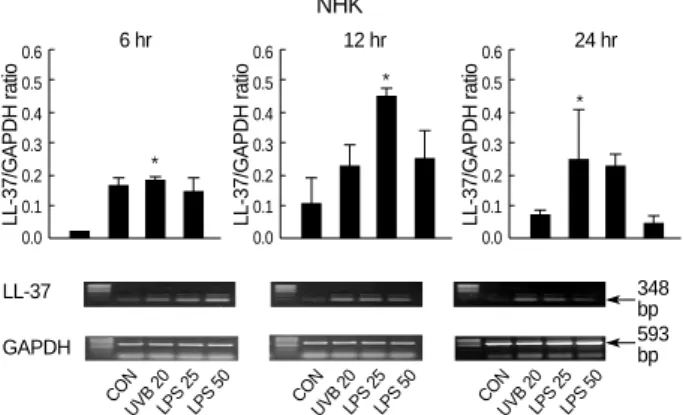
However, those in NHKs were upregulated by UVB irra- diation and LPS stimulation (Fig. 1). At 6, 12 hr post stim- ulation, LL-37 mRNA expressions were more markedly up- regulated by LPS 2.5 g/mL and at 24 hr, by UVB 20 mJ/
cm2. These results were statistically significant compared to control group (p<0.001).
Western blotting
Expression of LL-37 protein in NHKs was evaluated by Western blotting study using polyclonal antibody to LL-37 at 6, 12, and 24 hr after stimulation (Fig. 2). The expres- sion amounts of LL-37 protein in UVB irradiated and LPS treated groups were shown more intense than those of un-
LL-37/GAPDH ratio
0.6 0.5 0.4 0.3 0.2 0.1 0.0
*
LL-37/GAPDH ratio
0.6 0.5 0.4 0.3 0.2 0.1 0.0
*
LL-37/GAPDH ratio
0.6 0.5 0.4 0.3 0.2 0.1 0.0
* 6 hr
LL-37 GAPDH
CON UVB 20
LPS 25
LPS 50 CON UVB 20
LPS 25
LPS 50 CON UVB 20
LPS 25 LPS 50
348 bp 593 bp 12 hr
NHK
24 hr
Fig. 1.RT-PCR for LL-37 mRNA from normal human keratinocytes (NHK) at 6 hr, 12 hr, and 24 hr after stimulation. CON, control; UVB 20, UVB 20 mJ/cm2; LPS 25, LPS (2.5 g/mL); LPS 50, LPS (5.0 g/mL). *Statistically significant compared to control group (p<
0.001).
stimulated control group. Expression of LL-37 band were more intense in 6 hr, 12 hr after stimulation than 24 hr after stimulation. But expressions of LL-37 protein in HaCaT cells were not detected by Western blotting study (data not shown).
Immunohistochemistry
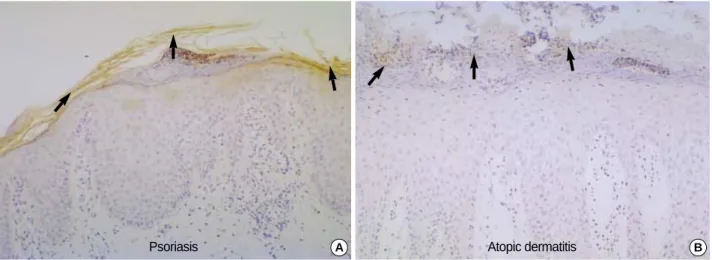
The expressions of LL-37 protein in NHKs were determined by IHC analysis. In NHKs, expressions of LL-37 protein of UVB irradiated and LPS stimulated groups were more strongly stained than those of unstimulated groups (Fig. 3). Expres- sions of LL-37 protein in HaCaT cells were not detected by IHC study using polyclonal antibody to LL-37 at 6, 12, and 24 hr after stimulation (data not shown). Also IHC confirmed the presence of abundant LL-37 in the epidermis of psoriasis.
The sample from psoriatic lesions had much more intense staining for LL-37 than sample from atopic dermatitis lesions (Fig. 4).
DISCUSSION
Naturally occurring AMPs are critical component of innate immune system which provide mammalian skin protection
against invasive bacterial infection and other environmental insults including UV irradiation, toxin, extreme temperature etc. (1, 2). In human, the two main antimicrobial peptide fam- ilies are defensins and cathelicidins. The two defensin subfam- ilies, - and -defensins, differ in the length of peptide seg- ments between the six cysteines and the pairing of the cys- teines that are connected by disulphide bonds (8). The - defensins are abundant in neutrophil granules and Paneth cells. The defensins have been classified to defensin 1, 2, 3, and 4 which can be expressed constitutively or after expo- sure to stimulants (3). Until now many studies have been reported regarding defensins and those of cathelicidins are less reported in comparison with defensins (4, 5). So, we in- tended to elucidate that inducible expression of LL-37 after exposure to different experimental conditions and their role in skin immunity against various environmental insults includ- ing bacterial infection and UV irradiation in this study.
The term ‘cathelicidin’ was introduced in 1995 to encom- pass bipartite molecules containing both cathelin domain and C-terminal antimicrobial peptide domain (6). Catheli- cidins are widely expressed family of mammalian antimicro- bial peptides and like many such molecules are synthesized as a preproprotein. This preproprotein consists of highly con- served signal sequence and cathelin domain but have substan- tial heterogeneity between species in the C-terminal domain
NHK
CON UVB 20 LPS 25 LPs 50
Fig. 3.Immunohistochemical study using polyclonal antibody to LL-37 in NHKs at 12 hr after stimulation. CON, control; UVB 20, UVB 20 mJ/cm2; LPS 25, LPS (2.5 g/mL); LPS 50, LPS (5.0 g/mL) (×200).
6 hr 12 hr
NHK
24 hr LL-37
Actin CON
UVB 20 LPS 25
LPS 50 CON UVB 20
LPS 25
LPS 50 CON UVB 20
LPS 25 LPS 50
18 kDa 43 kDa
Fig. 2.Expression of LL-37 protein in NHKs by Western blotting study using polyclonal antibody to LL-37 at 6 hr, 12 hr, and 24 hr after stimulation. CON, control; UVB 20, UVB 20 mJ/cm2; LPS 25, LPS (2.5 g/mL); LPS 50, LPS (5.0 g/mL).
Fig. 4.Immunostaining for LL-37 in frozen skin sections from patients with psoriasis and atopic dermatitis. The arrow indicate immune reac- tivity to LL-37 (×200).
A B
Psoriasis Atopic dermatitis
encoding the mature active peptide. Porcine and bovine neu- trophils contain a variety of cathelicidins, whereas there is the only one cathelicidin in human known as human cationic antimicrobial peptide 18 kDa (hCAP-18). The major effector molecule of hCAP-18 is C-terminus which begins with 2 leucines and 37 amino acid residues in length, so called LL- 37 (8). The antimicrobial activity of cathelicidins is only acti- vated following proteolytic processing from the cathelin do- main of the preproprotein by elastase or proteinase-3 (15-17).
LL-37 has broad-spectrum antimicrobial activity against Gram-positive and Gram-negative bacteria such as S. aureus, Pseudomonas aeruginosa, and E. coli, as well as against fungi and enveloped viruses and expression of it is up-regulated by inflammatory stimulants or injury such as microbial inva- sion (18-20). Because LL-37 is widely distributed within skin and mucosal epithelial tissues, as well as secretion such as saliva and sweat, it is ideally situated to serve a sentinel role as multifunctional effectors of innate immunity (4, 5, 16).
Beside this function, LL-37 can influence wound repair and has been shown to have additional effects on the host. LL-37 up-regulates epithelial expressions of chemokine and chemokine receptor genes, and itself acts as chemoattractant for neutro- phils, monocytes, T cells and mast cells (21, 22).
We could observe that LL-37 expressions were up-regu- lated by LPS stimulation and UVB irradiation in NHKs. In RT-PCR analysis, at 6 hr and 12 hr post stimulation, LL-37 is more intensely expressed in LPS 2.5 g/mL stimulated group but, at 24 hr post stimulation. LL-37 expression was also markedly up-regulated by UVB irradiation with dose of 20 mJ/cm2. However, expressions of LL-37 were not seen in HaCaT cells.
Production patterns of LL-37 proteins were also identified in Western blotting in NHKs. The maximum expressions of LL-37 protein in NHKs were obtained with LPS stimu- lation at 6 hr post stimulation. But, LL-37 expressions were not enhanced even in stimulated HaCaT cells. In immuno- histochemical staining analysis, UVB irradiated and LPS treated groups were stained stronger than those of control.
However, in HaCaT cells, the study showed no staining.
We obtained the results that expressions of LL-37 were up- regulated in NHKs by UVB irradiation and LPS stimulation.
No expressions of LL-37 in HaCaT cells even exposure to UVB irradiation and LPS could be supposed on the assump- tion of the following hypotheses. First, these results may be due to different feature of differentiation between these two groups. That is NHKs are gradually differentiating, whereas HaCaT cells are really not differentiating any more. Such dissimilar differentiation property may have exerted influence on the expression of LL-37. In the second place, we could presume that there were genetic defect encoding LL-37 or unknown interference on transcription of LL-37 in HaCaT cells. The third, we assumed that relative deficiency of immu- nity in perinatal period brought about these results. Dorschner et al. (23) reported that human cathelicidin expression is sig-
nificantly elevated in the perinatal period when compared with adult skin and expression is present in the absence of inflammation. In consideration of relative deficiency in cel- lular immune function in neonates, it is attractive to specu- late that augmented innate antimicrobial peptide defense mechanism is beneficial to the newborn and provides essen- tial level of microbial protection. In this study NHKs were prepared from neonatal foreskin, so LL-37 is more prominently expressed in NHKs independent of stimulation in compari- son with HaCaT cells.
Atopic dermatitis is very common skin disease known to be associated with a high prevalence of skin infections, how- ever, in psoriasis only small proportion of patients are suffering from infection. In atopic dermatitis, inflammation is medi- ated by type 2 helper T cells which can produce IL-4, IL-13 whereas inflammation of psoriasis is mediated by type 1 helper T cells and epidermis is thickened owing to increased differ- entiated keratinocytes (12-14). And LL-37 has potential bind- ing sites for acute phase response factor (APRF) and IL-6, in its promoter and intron regions (24). Interestingly, increased levels of IL-6 and IL-8 have been identified in psoriatic skin.
Therefore, bacterial infection is not severe problem in psori- asis although the barrier function of psoriatic skin is disrupt- ed because of increased expression of AMPs (12). However these peptides are significantly decreased in acute and chronic lesions of atopic dermatitis. Decreased expressions of AMPs may account for the susceptibility of atopic dermatitis patients to skin infection and inhibitory effects of IL-4 and IL-13 on HBD-2 expression may account for this finding (13, 14, 25).
The results of immunostaining for LL-37 in the sample of psoriatic lesions and atopic dermatitis lesions were consistent with previous study showing that psoriatic lesions have greater expression of LL-37 than atopic dermatitis. In a word, signif- icant difference of LL-37 expression between psoriasis and atopic dermatitis may be due to distinct cytokine profiles and difference of epidermal differentiation status.
With our experiments, we were able to demonstrate en- hanced expression of LL-37 after LPS stimulation and UVB irradiation in both mRNA and protein level and confirmed that LL-37 expression is induced by inflammatory stimula- tions. And LL-37 expressions were also affected by cell dif- ferentiation status. LL-37 expressions were identified only in NHKs which are gradually differentiated cells and more abundant in the epidermis of psoriasis. In summary, we could understand susceptibility difference to infection in atopic dermatitis and psoriasis that show different epidermal differ- entiation status and concluded that induced LL-37 may con- tribute to the skin immunity against various environmental insults.
REFERENCES
1. Nizet V, Ohtake T, Lauth X, Trowbridge J, Rudisill J, Dorschner
RA, Pestonjamasp V, Piraino V, Huttner K, Gallo RL. Innate antimi- crobial peptide protects the skin from invasive bacterial infection.
Nature 2001; 414: 454-7.
2. Fulton C, Anderson GM, Zasloff M, Bull R, Quinn AG. Expression of natural peptide antibiotics in human skin. Lancet 1997; 350: 1750-1.
3. Alice LY, Delphin D, Annie VW, Christina PH, Erika VV, Lide L, Tomas G. Human -defensin-2 production in keratinocytes is regu- lated by interleukin-1, bacteria, and the state of differentiation. J Invest Dermatol 2002; 118: 27.
4. Murakami M, Ohtake T, Dorschner RA, Gallo RL. Cathelicidin an- timicrobial peptides are expressed in salivary glands and saliva. J Den Res 2002; 81: 845-50.
5. Woo JS, Jeong JY, Hwang YJ, Chae SW, Hwang SJ, Lee HM. Expres- sion of cathelicidin in human salivary glands. Arch Otolaryngol Head Neck Surg 2003; 129: 211-4.
6. Park YM. Application of toll-like receptor in dermatological scope.
Korean J Invest Dermatol 2003; 10: 1-5.
7. Pivarcsi A, Koreck A, Bodai L, Szell M, Szeg C, Belso N, Kender- essy-Szabo A, Bata-Csorgo Z, Dobozy A, Kemeny L. Differentia- tion-regulated expression of Toll-like receptors 2 and 4 in HaCaT keratinocytes. Arch Dermatol Res 2004; 296: 120-4.
8. Frohm M, Agerberth B, Ahangari G, Stahle-Backdahl M, Liden S, Wigzell H, Gudmundsson GH. The expression of the gene coding for the antibacterial peptide LL-37 is induced in human keratinocytes during inflammatory disorders. J Biol Chem 1997; 272: 15258-63.
9. Seo SJ, Ahn SW, Hong CK, Ro BI. Expressions of beta-defensins in human keratinocyte cell lines. J Dermatol Sci 2001; 27: 183-91.
10. Gallo RL, Huttner KM. Antimicrobial peptides: an emerging concept in cutaneous biology. J Invest Dermatol 1998; 111: 739-43.
11. Yang D, Chertov O, Bykovskaia SN, Chen Q, Buffo MJ, Shogan J, Anderson M, Schroder JM, Wang VM, Howard OM, Oppenheim JJ.
Beta-defensins: linking innate and adaptive immunity through den- dritic and T cell CCR6. Science 1999; 286: 525-8.
12. Grossman RM, Krueger J, Yourish D, Granelli-Piperno A, Murphy DP, May LT, Kupper TS, Sehgal PB, Gottlieb AB. Interleukin 6 is ex- pressed in high levels in psoriatic skin and stimulates proliferation of cultured human keratinocytes. Proc Natl Acad Sci USA 1989; 86:
6367-71.
13. Ong PY, Ohtake T, Brandt C, Strickland I, Boguniewicz M, Ganz T, Gallo RL, Leung DY. Endogenous antimicrobial peptides and skin infections in atopic dermatitis. N Eng J Med 2002; 347: 1151-60.
14. Leung DY. Atopic dermatitis: new insights and opportunities for
therapeutic intervention. J Allergy Clin Immunol 2000; 105: 860-76.
15. Nizet V, Gallo RL. Cathelicidins and innate defense against invasive bacterial infection. Scand J Infect Dis 2003; 35: 670-6.
16. Murakami M, Ohtake T, Dorschner RA, Schittek B, Garbe C, Gallo RL. Cathelicidin anti-microbial peptide expression in sweat, an innate defense system for the skin. J Invest Dermatol 2002; 119: 1090-5.
17. Zaiou M, Nizet V, Gallo RL. Antimicrobial and protease inhibitory functions of the human cathelicidin (hCAP18/LL-37) prosequence.
J Invest Dermatol 2003; 120: 810-6.
18. Dorschner RA, Pestonjamasp VK, Tamakuwala S, Ohtake T, Rudisill J, Nizet V. Cutaneous injury induces the release of cathelicidin anti- microbial peptides active against group A Streptococcus. J Invest Dermatol 2001; 117: 91-7.
19. Larrick JW, Hirata M, Balint RF, Lee J, Zhong K, Wright SC. Human CAP18: a novel antimicrobial lipopolysacharide-binding protein.
Infect Immunol 1995; 63: 1291-7.
20. Harder J, Meyer-Hoffert U, Teran LM, Schwichtenberg L, Bartels J, Maune S, Schroder JM. Mucoid Pseudomonas aeruginosa, TNF-alpha, and IL-1beta, but not IL-6, induce human beta-defensin-2 in repira- tory epithelia. Am J Respir Cell Mol Biol 2000; 22: 714-21.
21. Koczulla R,Von Degenfeld G, Kupatt C, Krotz F, Zahler S, Gloe T, Issbrucker K, Unterberger P, Zaiou M, Lebherz C, Karl A, Raake P, Prosser A, Boekstegers P, Welsch U, Hiemstra PS, Vogelmeier C, Gallo RL, Clauss M, Bals R. An angiogenic role for the human pep- tide antibiotic LL-37/hCAP-18. J Clin Invest 2003; 111: 1643-5.
22. Yang D, Chen Q, Schmidt AP, Anderson GM, Wang JM, Wooters J, Oppenheim JJ, Chertov O. LL-37, the neutrophil granule- and epithelial cell-derived cathelicidin, utilizes formyl peptide receptor- like 1(FPRL1) as a receptor to chemoattract human peripheral blood neutrophils, monocytes, and T cells. J Exp Med 2000; 192: 1069-74.
23. Dorschner RA, Lin KH, Murakami M, Gallo RL. Neonatal skin in mice and humans expresses increased levels of antimicrobial peptides:
innate immunity during development of the adaptive response. Pediatr Res 2003; 53: 566-72.
24. Zanetti M, Gennaro R, Romeo D. Cathelicidins: a novel protein family with a common proregion and a variable antimicrobial domain. FEBS Lett 1995; 374: 1-5.
25. Harder J, Bartels J, Christophers E, Schroder JM. A peptide antibiotic from human skin. Nature 1997; 387: 861.
26. Kim ST, Chang YS, Cha HE, Kim HB, Hwang YJ, Lee HS. Antimi- crobial peptide (LL-37) expression in nasal mucosa. Korean J Oto- laryngol-Head Neck Surg 2001; 44: 1048-52.